Do you often feel uncomfortable with symptoms like nausea, dizziness, or headaches when you're traveling in your car or other moving vehicles? There are some tricks you can use to look at your phone without feeling sick.
Probably the biggest story in the world of old cars over the past couple of weeks has been the surfacing of a GM EV1 electric car for sale from an auto salvage yard. This was the famous electric car produced in small numbers by the automaker in the 1990s, then only made available for lease before being recalled. The vast majority were controversially crushed with a few units being donated to museums and universities in a non-functional state.
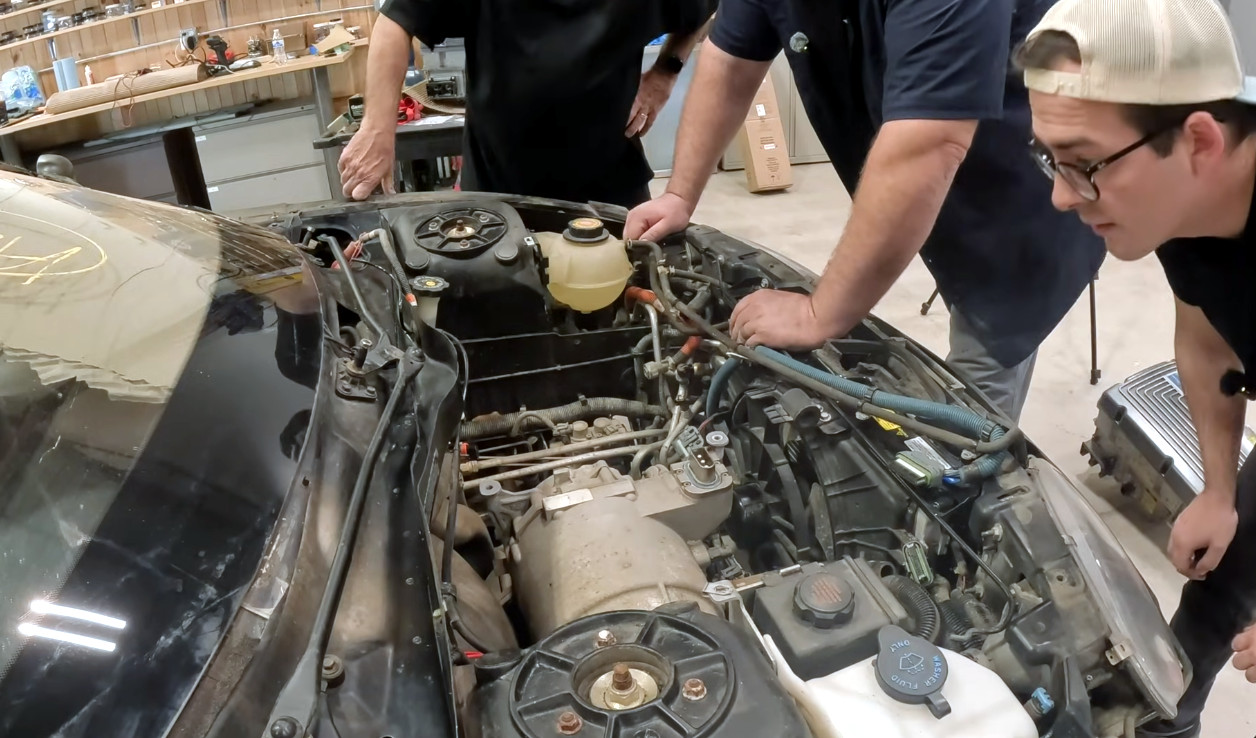
Finding an old car isn’t really a Hackaday story in itself, but now it’s landed in [The Questionable Garage]. It’s being subjected to a teardown as a prelude to its restoration, offering a unique opportunity to look at the state of the art in 1990s electric automotive technology.
The special thing about this car is that by a murky chain of events it ended up as an abandoned vehicle. GM’s legal net covers the rest of the surviving cars, but buying this car as an abandoned vehicle gives the owner legal title over it and frees him from their restrictions. The video is long, but well worth a watch as we see pieces of automotive tech never before shown in public. As we understand it the intention is to bring it to life using parts from GM’s contemporary S10 electric pickup truck — itself a rare vehicle — so we learn quite a bit about those machines too.
Along the way they find an EV1 charger hiding among a stock of pickup chargers, take us through the vehicle electronics, and find some galvanic corrosion in the car’s structure due to water ingress. The windscreen has a huge hole, which they cover with a plastic wrap in order to 3D scan so they can create a replacement.
This car will undoubtedly become a star of the automotive show circuit due to its unique status, so there will be plenty of chances to look at it from the outside in future. Seeing it this close up in parts though is as unique an opportunity as the car itself. We’ve certainly seen far more crusty conventional cars restored to the road, but without the challenge of zero parts availability and no donor cars. Keep an eye out as they bring it closer to the road.
Headlights. Indicators. Trunk releases. Seatbelts. Airbags. Just about any part of a car you can think of is governed by a long and complicated government regulation. It’s all about safety, ensuring that the car-buying public can trust that their vehicles won’t unduly injure or maim them in regular operation, or in the event of accident.
However, one part of the modern automobile has largely escaped regulation—namely, the humble door handle. Automakers have been free to innovate with new and wacky designs, with Tesla in particular making waves with its electronic door handles. However, after a series of deadly incidents where doors wouldn’t open, regulators are now examining if these door handles are suitable for road-going automobiles. As always, regulations are written in blood, but it raises the question—was not the danger of these complicated electronic door handles easy to foresee?
Trapped
A number of automakers have developed fancy retractable door handles in recent years. They are most notably seen on electric vehicles, where they are stated to have a small but measurable aerodynamic benefit. They are often paired with buttons or other similar electronic controls to open the doors from the inside. Compared to mechanical door handles, however, these door handles come with a trade-off in complexity. They require electricity, motors, and a functioning control system to work. When all is well, this isn’t a problem. However, when things go wrong, a retractable electronic door handle often proves inaccessible and useless.
It’s not hard to find case reports of fatal incidents involving vehicles with electronic door handles—both inside and out. Multiple cases have involved occupants burning alive inside Tesla vehicles, in which electronic door handles failed after a crash. Passengers inside the vehicles have failed to escape due to not finding emergency release door pulls hidden in the door panels, while bystanders have similarly been unable to use the retracted outside door handles to free those trapped inside.
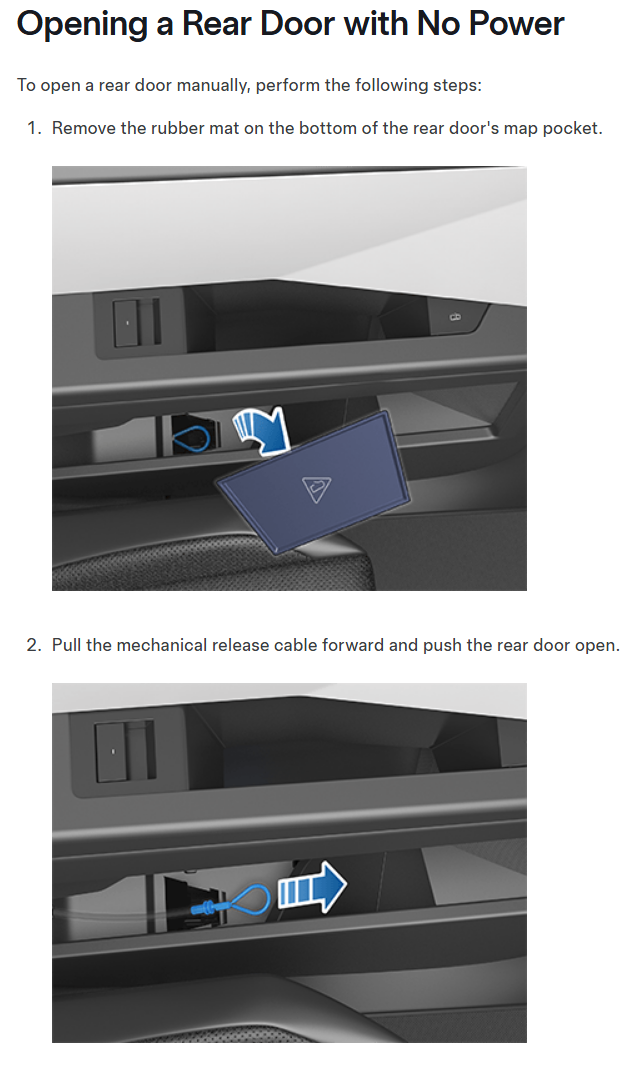
In response, some Tesla owners have gone so far as to release brightly-colored emergency escape ripcords to replace the difficult-to-spot emergency release pulls that are nearly impossible to find without prior knowledge. In the case of some older models, though, there’s less hope of escape. For example, in the Tesla Model 3 built from 2017 to 2023, only front doors have an emergency mechanical release. Rear passengers are out of luck, and must find another route of escape if their electronic door handles fail to operate. No Tesla vehicles feature an easily-accessible mechanical release that can be used from outside the vehicle.
US regulations mandate highly-visible emergency trunk release handles that are easily activated. However, obvious mechanical backups have not been required for cars fitted with electronic door handles. Credit: NHTSA
It’s worth noting that in the US market, federal regulations have mandated glow-in-the-dark trunk releases be fitted to all sedans from the 2002 model year onwards. You could theoretically escape from the trunk of certain Teslas more easily than a Cybertruck or Model 3 with a failed electrical system.
Tesla isn’t the only company out there building cars with retractable door handles. It does, however, remain the most prominent user of this technology, and its vehicles have been involved in numerous incidents that have made headlines. Other automakers, such as Audi and Fiat, have experimented with electronic door handles, both for ingress and egress, with varying degrees of mechanical backup available. In some cases, automakers have used smart two-stage latches. A small pull activates the electronic door release, while a stronger pull will engage a mechanical linkage that unlatches the door. It’s smart engineering—the door interface responds to the exact action a passenger would execute if trying to escape the vehicle in a panic. There are obviously less concerns around electronic door releases that have easily-accessed mechanical backups; it’s just that Tesla is particularly notable for not always providing them.
Over the years, national automotive bodies have thrown up their arms about all sorts of emerging automotive technologies. In the United States specifically, NHTSA has famously slow-walked the approval of things like camera-based rear-view mirror systems and replaceable-bulb headlamps, fearing the worst could occur if these technologies were freely allowed on the market.
Meanwhile, despite the obvious risks, electronic door handles have faced no major regulatory challenges. There were no obvious written rules standing in the way of Tesla making the choice to eliminate regular old door handles. Nor were there strict regulations on emergency door releases for passengers inside the vehicle. Tesla spent years building several models with no mechanical door release for the rear passengers. If your door button failed, you’d have to attempt escape by climbing out through the front doors, assuming you could figure out how to open them. Even today, the models with mechanical door releases still often hide them behind interior trim pieces or carpets, where few passengers would ever think to look in an emergency.
Try explaining this to someone in the back seat while the car is burning around you. Credit: Tesla
Obvious Mistakes
Flush door handles have become popular with Chinese automakers like BYD and Geely. However, these door handles require the vehicle’s electrical supply to be intact in order to work. Credit: BYD
Things are beginning to change, however. Chinese regulators have led the charge, with reports stating that electronic retractable door handles could be banned as soon as 2027. While some semi-retractable styles will potentially avoid an outright ban, it’s believed new regulations will require a mechanically redundant release system as standard.
As for the US, the sleeping giant of NHTSA has finally awoken in the wake of Bloomberg‘s reporting on the matter. As reported by CNBC, Tesla has been given a deadline of December 10 to deliver records to the federal regulator, regarding design, failures, and customer issues around its electronic door release systems. The Office of Defects Investigations within NHTSA has already recorded 16 reports of failed exterior door releases in the a single model year of the Tesla Model Y. It’s likely a drop in the ocean compared to the full population of Tesla vehicles currently on roads. Meanwhile, the US automaker also faces multiple lawsuits over the matter from those who have lost family members in fatal crashes and fires involving the company’s vehicles.
In due time, it’s likely that automotive regulators in most markets will come out against electronic door handles from a safety perspective alone. No matter how well designed the electrical system in a modern vehicle, it’s hard to beat a lever flipping a latch for simplicity and robustness. The benefits of these electronic door handles are spurious in the first place—a fraction of a percent reduction in drag, and perhaps a little more luxury appeal. If the trade-off is trapping passengers in the event of a fire, it’s hard to say they’re worthwhile.
The electronic door handle, then, is perhaps the ultimate triumph of form over function. They’re often slower and harder to use than a regular door handle, and particularly susceptible to becoming useless when iced over on a frosty morning. For a taste of the future, lives were put at risk. Anyone could see that, so it’s both strange and sad that automakers and regulators alike seemed not to notice until it was far too late. Any new regulations will, once again, be written in blood.
The 8845 LEGO Technic Dune Buggy original. (Credit: Matt Denton)
It’s part of the great circle of life that toys and scale models that provide a reflection of macro-sized objects like vehicles and buildings will eventually be scaled up again to life-sized proportions. Case in point the LEGO Technic dune buggy that [Matt Denton] recently printed at effectively human scale, while also making it actually drivable.
The basis for this project is the 8845 Dune Buggy which was released in 1981. Unlike the modern 42101 version, it’s more straightforward and also seems more amenable to actually sitting in despite featuring more pieces for a total of 174 pieces. Naturally, [Matt] didn’t simply go for a naïve build of the 8845 buggy, but made a few changes. First is the scale that’s 10.42 times larger than the LEGO original, based around the use of 50 mm bearings. The model was also modified to be a single-seater, with the steering wheel placed in the center.
With some structural and ergonomic tweaks in place, the resulting CAD model was printed out mostly in PLA with a 1 mm nozzle and 10% infill using a belt FDM printer to help with the sheer size of the parts. After that it was mostly a LEGO kit assembly on a ludicrous scale that resembles a cross between building a LEGO kit and assembling Ikea flatpack furniture.
At merely the cost of most of his sanity, [Matt] finally got the whole kit together, still leaving a few suspension issues to resolve, as it turns out that so much plastic actually weighs a lot, at 102 kg. With that and other issues resolved, the final touch was to add an electric motor to the whole kit using a belt-driven system on the rear axle and bringing every LEGO minifig’s dreams to life.
After a few test drives, some issues did pop up, including durability concerns and not a lot of performance, but overall it performs much better than you’d expect from a kid’s toy.
Modern vehicles are transforming into full-fledged digital devices that offer a multitude of features, from common smartphone-like conveniences to complex intelligent systems and services designed to keep everyone on the road safe. However, this digitalization, while aimed at improving comfort and safety, is simultaneously expanding the vehicle’s attack surface.
In simple terms, a modern vehicle is a collection of computers networked together. If a malicious actor gains remote control of a vehicle, they could be able not only steal user data but also create a dangerous situation on the road. While intentional attacks targeting a vehicle’s functional safety have not become a widespread reality yet, that does not mean the situation will not change in the foreseeable future.
The digital evolution of the automobile
The modern vehicle is a relatively recent invention. While digital systems like the electronic control unit and onboard computer began appearing in vehicles back in the 1970s, they did not become standard until the 1990s. This technological advancement led to a proliferation of narrowly specialized electronic devices, each with a specific task, such as measuring wheel speed, controlling headlight modes, or monitoring door status. As the number of sensors and controllers grew, local automotive networks based on LIN and CAN buses were introduced to synchronize and coordinate them. Fast forward about 35 years, and modern vehicle is a complex technical device with extensive remote communication capabilities that include support for 5G, V2I, V2V, Wi-Fi, Bluetooth, GPS, and RDS.
Components like the head unit and telecommunication unit are standard entry points into the vehicle’s internal infrastructure, which makes them frequent objects for security research.
From a functional and architectural standpoint, we can categorize vehicles into three groups. The lines between these categories are blurred, as many vehicles could fit into more than one, depending on their features.
Obsolete vehicles do not support remote interaction with external information systems (other than diagnostic tools) via digital channels and have a simple internal architecture. These vehicles are often retrofitted with modern head units, but those components are typically isolated within a closed information environment because they are integrated into an older architecture. This means that even if an attacker successfully compromises one of these components, they cannot pivot to other parts of the vehicle.
Legacy vehicles are a sort of transitional phase. Unlike simpler vehicles from the past, they are equipped with a telematics unit, which is primarily used for data collection rather than remote control – though two-way communication is not impossible. They also feature a head unit with more extensive functionality, which allows changing settings and controlling systems. The internal architecture of these vehicles is predominantly digital, with intelligent driver assistance systems. The numerous electronic control units are connected in an information network that either has flat structure or is only partially segmented into security domains. The stock head unit in these vehicles is often replaced with a modern unit from a third-party vendor. From a cybersecurity perspective, legacy vehicles represent the most complex problem. Serious physical consequences, including life-threatening situations, can easily result from cyberattacks on these vehicles. This was made clear 10 years ago when Charlie Miller and Chris Valasek conducted their famous remote Jeep Cherokee hack.
Modern vehicles have a fundamentally different architecture. The network of electronic control units is now divided into security domains with the help of a firewall, which is typically integrated within a central gateway. The advent of native two-way communication channels with the manufacturer’s cloud infrastructure and increased system connectivity has fundamentally altered the attack surface. However, many automakers learned from the Jeep Cherokee research. They have since refined their network architecture, segmenting it with the help of a central gateway, configuring traffic filtering, and thus isolating critical systems from the components most susceptible to attacks, such as the head unit and the telecommunication module. This has significantly complicated the task of compromising functional safety through a cyberattack.
Possible future threat landscape
Modern vehicle architectures make it difficult to execute the most dangerous attacks, such as remotely deploying airbags at high speeds. However, it is often easier to block the engine from starting, lock doors, or access confidential data, as these functions are frequently accessible through the vendor’s cloud infrastructure. These and other automotive cybersecurity challenges are prompting automakers to engage specialized teams for realistic penetration testing. The results of these vehicle security assessments, which are often publicly disclosed, highlight an emerging trend.
Despite this, cyberattacks on modern vehicles have not become commonplace yet. This is due to the lack of malware specifically designed for this purpose and the absence of viable monetization strategies. Consequently, the barrier to entry for potential attackers is high. The scalability of these attacks is also poor, which means the guaranteed return on investment is low, while the risks of getting caught are very high.
However, this situation is slowly but surely changing. As vehicles become more like gadgets built on common technologies – including Linux and Android operating systems, open-source code, and common third-party components – they become vulnerable to traditional attacks. The integration of wireless communication technologies increases the risk of unauthorized remote control. Specialized tools like software-defined radio (SDR), as well as instructions for exploiting wireless networks (Wi-Fi, GSM, LTE, and Bluetooth) are becoming widely available. These factors, along with the potential decline in the profitability of traditional targets (for example, if victims stop paying ransoms), could lead attackers to pivot toward vehicles.
Which vehicles are at risk
Will attacks on vehicles become the logical evolution of attacks on classic IT systems? While attacks on remotely accessible head units, telecommunication modules, cloud services or mobile apps for extortion or data theft are technically more realistic, they require significant investment, tool development, and risk management. Success is not guaranteed to result in a ransom payment, so individual cars remain an unattractive target for now.
The real risk lies with fleet vehicles, such as those used by taxi and carsharing services, logistics companies, and government organizations. These vehicles are often equipped with aftermarket telematics and other standardized third-party hardware that typically has a lower security posture than factory-installed systems. They are also often integrated into the vehicle’s infrastructure in a less-than-secure way. Attacks on these systems could be highly scalable and pose significant financial and reputational threats to large fleet owners.
Another category of potential targets is represented by trucks, specialized machinery, and public transit vehicles, which are also equipped with aftermarket telematics systems. Architecturally, they are similar to passenger cars, which means they have similar security vulnerabilities. The potential damage from an attack on these vehicles can be severe, with just one day of downtime for a haul truck potentially resulting in hundreds of thousands of dollars in losses.
Investing in a secure future
Improving the current situation requires investment in automotive cybersecurity at every level, from the individual user to the government regulator. The driving forces behind this are consumers’ concern for their own safety and the government’s concern for the security of its citizens and national infrastructure.
Automotive cybersecurity is already a focus for researchers, cybersecurity service providers, government regulators, and major car manufacturers. Many automotive manufacturing corporations have established their own product security or product CERT teams, implemented processes for responding to new vulnerability reports, and made penetration testing a mandatory part of the development cycle. They have also begun to leverage cyberthreat intelligence and are adopting secure development methodologies and security by design. This is a growing trend, and this approach is expected to become standard practice for most automakers 10 years from now.
Simultaneously, specialized security operations centers (SOCs) for vehicles are being established. The underlying approach is remote data collection from vehicles for subsequent analysis of cybersecurity events. In theory, this data can be used to identify cyberattacks on cars’ systems and build a database of threat information. The industry is actively moving toward deploying these centers.
Previously exclusive to Trend Vision One customers, select Trend Cybertron models, datasets and agents are now available via open-source. Build advanced security solutions and join us in developing the next generation of AI security technology.

 Login
Login