
Normal view

There are new articles available, click to refresh the page.
Before yesterdayMain stream

Ethereum Emerges As Likely Candidate In BlackRock Tokenization Vision – Here’s Why

23 January 2026 at 15:30

Recent remarks from BlackRock CEO Larry Fink have pointed toward the need for a single, unified blockchain for tokenized markets, and have intensified the focus on platforms capable of handling institutional-scale liquidity, compliance, and settlement. With its long track record in smart contracts, extensive developer ecosystem, and growing role in regulated financial products, Ethereum is now emerging as the most likely candidate to serve as the settlement layer for tokenized capital markets.

Why Asset Managers Prefer Familiar Infrastructure

In an X post, the Ethereum Daily shared a video in which BlackRock CEO Larry Fink made it clear that tokenization is necessary. Speaking at the World Economic Forum, Fink said the financial system must move rapidly toward digitization, adding that a single, common blockchain could reduce corruption and improve transparency across the global markets.

While Fink did not name a specific network, the most plausible candidate could be ETH, based on BlackRock’s own initiatives and public statements that emphasized the role of ETH in asset tokenization. The firm has consistently highlighted ETH as a core platform for its on-chain strategy. Meanwhile, BlackRock launched its BUIDL tokenized money market fund directly on ETH, a product that has already grown to over $2 billion in total value locked. “There’s no second best,” Ethereum Daily noted.

In the staking space, Bitmine has turned Ethereum staking into a multi-billion-dollar business. An analyst known as Milk Road has revealed that the company now has 1.83 million ETH staked, worth roughly $6 million at current prices, and plans to scale that figure toward 4.2 million ETH over time. Over the past months, Bitmine Immersion Technologies Inc. (BMNR) has accounted for nearly 50% of all new ETH entering the staking queue.

Ethereum

Staking at this scale is important because it removes ETH from the liquid supply and locks it into long-term infrastructure rather than keeping it for short-term trading. When one player is willing to commit billions of dollars worth of ETH to staking, it reflects confidence in ETH’s future economic prospects. A lower liquid supply, combined with sustained network demand, will create structural pressure over time.

How Support Built Through Multiple Market Cycles

Analyst Milk Road has also highlighted that Ethereum is holding near a critical support zone around $3,000, hovering just above the lower boundary of its long-term rising structure, an area that has acted as a stress test for ETH throughout the cycle. Historically, when ETH drifts into this area, the market will need to decide whether the weakness is temporary or structural.

The $2,750 level remains the key line because it has repeatedly stopped downside pressure after macro-driven or narrative-driven pullbacks, making it a reliable floor for the broader trend. As long as ETH holds above that level, the broader multi-year uptrend will remain intact.
Ethereum

Here’s How Ethereum Staking Transforms Into A Multi-Billion-Dollar Bet For Bitmine Immersion

23 January 2026 at 13:00

Over the years, Ethereum staking has become one of the most vital and successful aspects of the broader ETH ecosystem, with big companies steadily jumping into the field. The majority of these companies, especially Bitmine Immersion, are revolutionizing ETH staking, turning it into a massive financial sector and edge.

Bitmine Monetized Ethereum Staking At Scale

After the entry of institutional investors, Ethereum staking has been transformed into a significant business opportunity from a technical requirement. At the forefront of this evolution is Bitmine Immersion Technologies Inc. (BMNR), a leading digital asset platform dedicated to improving the ETH ecosystem.

With its remarkable involvement in ETH staking, Bitmine Immersion is proving just how large this opportunity can be. The digital asset platform has successfully transformed Ethereum staking into a multi-billion-dollar enterprise by growing its validator operations and staking infrastructure.

As outlined by Milk Road on the social media platform X, the company intends to increase its present investment of 1.83 million ETH, valued at approximately $6 billion at current rates, to 4.2 million ETH. Bitmine’s plan and robust participation in ETH staking are a clear sign of the growing institutional appetite for on-chain yield.

Ethereum

This expansion demonstrates how staking is now about creating profitable, long-lasting businesses around ETH’s proof-of-stake economy rather than just protecting the network. Over the past month, Bitmine has been responsible for almost half of all new ETH entering the staking queue. 

Milk Road stated that staking at this scale removes Ethereum from the liquid supply and locks it away in long-term infrastructure rather than short-term trading. When a single player expresses a willingness to commit billions of dollars’ worth of ETH to staking, it points to an increased confidence in ETH’s future economics.

According to the expert, structural pressure is created by a reduced liquid supply and ongoing network demand over time. Given the sustained growth in institutional staking, Milk Road is confident that ETH’s price will move higher in the foreseeable future.

ETH Powering Crypto Native Financial Rails

With crypto native financial rails expanding, Ethereum is increasingly being positioned as the core infrastructure for major financial firms. JP Morgan asset management firm has confirmed this narrative with its latest fund launched on the ETH network.

Milk Road has reported that JP Morgan has introduced a tokenized money market fund on ETH, which is now live and already holds over $100 million in US treasuries. The rails are native to cryptocurrency, and the product appears to be traditional finance.

In reality, there is no separation, and there is only a financial product operating on the trains that make the most sense. Interestingly, this is how institutions move into new systems. “Incrementally, and only after the rules are clear enough to deploy real capital. Once they are live, they don’t leave,” Milk Road stated.

Ethereum

Vitalik Buterin Proposes Fix to Ethereum Staking — No More Single-Node Risk

22 January 2026 at 05:32

Vitalik Buterin, the co-founder of Ethereum, has suggested the fundamental alteration to the staking system in the network to eliminate the dependency on one validator node.

In a detailed post published Wednesday on the Ethereum Research forum, Buterin introduced the idea of “native distributed validator technology,” or native DVT.

Source: ethresear.ch

The idea would allow stakers to split validator responsibilities across multiple nodes directly at the protocol level rather than relying on complex external setups.

Ethereum’s Staking Boom Brings New Security Questions

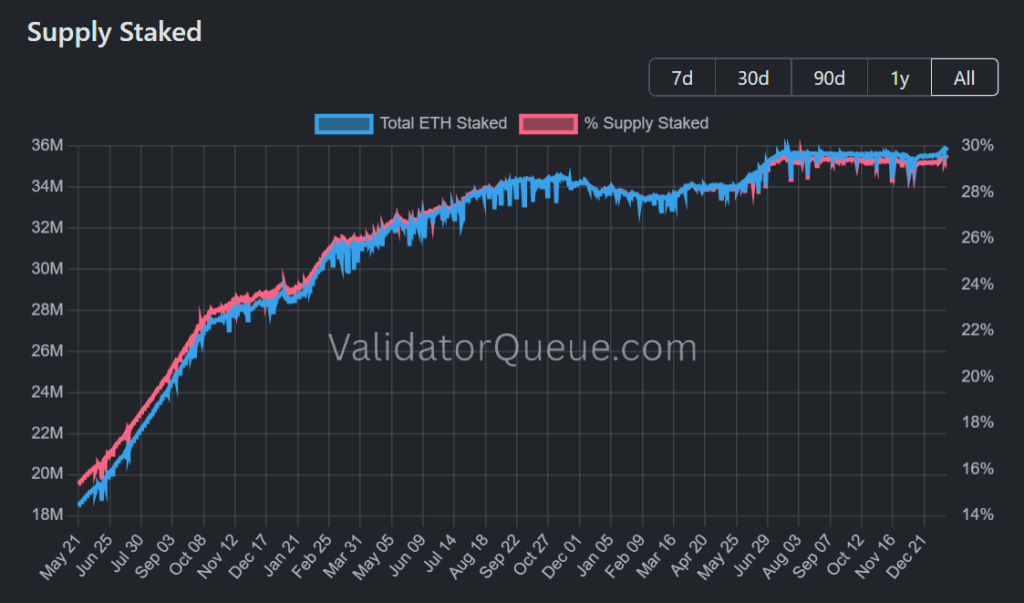
The proposal comes as Ethereum staking reaches record scale with more than 36 million ETH now staked across nearly one million validators, with the total value of staked assets exceeding $118 billion.

Source: ValidatorQueue.

While this growth has reinforced Ethereum’s security, it has also amplified long-standing concerns around centralization, operational risk, and the technical barriers faced by solo stakers.

For much of Ethereum’s proof-of-stake history, running a validator meant placing 32 ETH behind a single machine and a single private key.

Any failure, from a power outage to a software bug or security breach, could result in inactivity penalties or slashing.

These risks pushed many users toward large staking providers and liquid staking platforms, concentrating control of consensus among a relatively small group of operators and cloud providers.

Buterin’s proposal directly targets that single-node risk, as under the proposed native DVT, a validator with a larger balance would be allowed to register multiple keys, up to a maximum of 16, and define a threshold for signing duties.

Validator actions, such as block proposals or attestations, would only be considered valid if a minimum number of those keys signed off together.

As long as more than two-thirds of the nodes behave honestly, the validator would continue operating normally without penalties.

Buterin’s Native DVT Idea Targets Easier, Safer ETH Staking

Unlike existing DVT solutions such as Obol or ssv.network, which rely on external tooling, networking layers, and the linear properties of BLS signatures, Buterin’s design would be embedded directly into Ethereum’s consensus rules.

He argued this would dramatically simplify staking operations, reduce setup complexity, and remove dependencies that may not be compatible with future cryptographic upgrades.

🚀 @VitalikButerin unveils "The Splurge," a bold plan to prepare Ethereum for a quantum future!#Ethereum #QuantumComputinghttps://t.co/vvRijeahpS

— Cryptonews.com (@cryptonews) October 29, 2024

From a user perspective, Buterin described the experience as running multiple standard validator nodes with minimal configuration changes.

Most of the added complexity would be limited to block production, where one node would act as a temporary leader and others would co-sign its output.

The proposal is explicitly aimed at medium- to large-sized ETH holders, including institutions and individual “whales,” who currently face a choice between running fragile single-node setups or outsourcing control to staking providers.

By making multi-node staking simpler, Buterin said native DVT could increase client diversity, improve measurable decentralization metrics, and encourage more self-custodial staking.

Ethereum Developers Debate Practical Challenges of the DVT model

The discussion quickly drew technical feedback from the community.

Ethereum developer Alonmuroch raised questions around coordination during block production, the possibility of multiple proposers racing to collect signatures, and the need for protocol-level key rotation to handle compromised keys without forcing validators to exit and re-stake.

Buterin largely agreed, noting that instant key changes should be feasible and that reducing operational headaches is central to the proposal’s motivation.

The proposal also fits into a broader shift in Buterin’s recent public messaging.

Earlier this month, he declared 2026 the year Ethereum would reclaim lost ground on self-sovereignty and trustlessness, calling for fewer compromises in favor of convenience.

Days later, he warned that Ethereum risks becoming an “unwieldy mess” if developers continue layering complexity onto the protocol without deliberate simplification.

The post Vitalik Buterin Proposes Fix to Ethereum Staking — No More Single-Node Risk appeared first on Cryptonews.

Will Ozak AI’s launch price justify ETH holders ditching 2%–5% staking yields?

21 January 2026 at 08:40
Large ETH holders rotate staking profits into Ozak AI’s presale, betting its AI DePIN tools and $1 launch talk can outperform Ethereum’s low single-digit yields. Large Ethereum (ETH) holders are redirecting profits from staking into Ozak AI, an early-stage artificial…

Ethereum’s Supply Dynamics Shift As ETH Staking Sees Historical Growth – Here’s The Number

20 January 2026 at 14:00

In the current market structure, the Ethereum price continues to move in a separate direction from its network’s performance and fundamentals. While ETH’s price struggles to initiate a major rally, the network is performing at a remarkable pace, breaking past prior all-time highs in most aspects of the blockchain, such as staking.

More Ethereum Getting Locked Away

Even in the ongoing crypto volatile landscape, the supply dynamics of Ethereum, the second-largest cryptocurrency asset, are undergoing a quiet but meaningful shift. Currently, ETH staking is experiencing exponential growth, leading to a tightening supply as more ETH gets locked away.

Milk Road, a market expert, stated that ETH is becoming intentionally harder to access in the midst of the strong growth in its staking ecosystem. The chart shared by Milk Road shows that ETH staking has now hit a new all-time high, with millions of the altcoin presently scheduled to be locked away.

Ethereum

While more tokens are being locked into validator contracts, an increasing percentage of Ethereum’s total supply is essentially taken out of daily circulation. The supply of ETH taken by staking has never been this high, snatching over 30% of the entire supply in circulation. 

This points to growing confidence in staking as a yield strategy in the long term and a deeper commitment to the security offered by the network. Meanwhile, the Ethereum network is now secured by approximately $120 billion worth of staked ETH.

In addition to being removed from active circulation, Milk Road highlighted that this supply is also taken off crypto exchanges. When staking rises, and supply shrinks, Mlik Road stated that this trend is a positive signal for price appreciation in the long term, reinforcing the expert’s conviction in ETH to move higher. 

A Sharp Rise In ETH’s Network Activity To New Highs

On-chain activity has experienced a similar growth, rising to historical levels. Crypto Tice reported that Ethereum network activity is at an all-time high, highlighting the blockchain’s rising function as the layer of settlement for cryptocurrency and financial operations.

The network growth is observed among new wallet addresses, of which more than 393,000 new wallets were created in a single day, reaching the highest level ever recorded for the 7-day average of daily wallet creation. Such an increase in activity is noteworthy not only for its magnitude but also for its tenacity, occurring despite the continued volatility of the market.

It is worth noting that these types of growth are subtle as they do not show up at the tops, and momentum is gradually picking up again. However, when it does show up, it is accompanied by a quiet spike in adoption beneath the surface; a clear instance of how increasing demands follow an expansion in usage.

At the time of writing, the ETH price was trading at $3,119, demonstrating a nearly 3% decline in the last 24 hours. Its trading volume is also showing bearish performance, dropping by more than 16% over the past day.

Ethereum

Staking Provider Chorus One Partners with Ledger for Self-Custodial ETH, SOL Staking

20 January 2026 at 10:27

Institutional staking provider Chorus One has integrated with Ledger Enterprise to bring self-custodial, governance-ready staking for four cryptocurrencies.

According to the press release shared with Cryptonews.com, this move aims to enable institutions to earn staking rewards directly from Ledger’s custody ecosystem.

All staking operations happen within the institution’s existing governance framework. Therefore, institutions can participate in Proof-of-Stake (PoS) networks without “transferring asset custody or compromising internal governance controls.”

The collaboration enables staking for Ethereum (ETH), Solana (SOL), Polkadot (DOT), and Tezos (XTZ).

Chorus One x Ledger Enterprise 🤝

Institutions can now stake ETH, SOL, DOT & XTZ directly through their self-custody platform, using Chorus One validator infrastructure.

🔐 Hardware-backed key management
📊 Audit-ready reporting
⚙ Seamless staking & reward management pic.twitter.com/xwNMoTQ80W

— Chorus One (@ChorusOne) January 20, 2026

Per the announcement, Ledger’s hardware and governance controls protect the private keys. At the same time, Chorus One backs the institutional-grade validator performance. It says it provides institutional validator infrastructure and research-driven staking operations.

Other key points of the collaboration include multi-authorisation and configurable governance workflows, as well as reporting and auditability for compliance and treasury management.

“Institutions need staking solutions that match their security, compliance, and operational requirements,” says Damien Scanlon, Chief Product Officer at Chorus One. The integration allows the two companies “to deliver a streamlined staking experience that keeps governance firmly in the hands of the client,” he added.

Staking In The News

Sébastien Badault, Executive Vice President at Ledger Enterprise, noted that “companies are adopting digital assets at a rapid pace worldwide.” At the same time, “uncompromising security and governance remain fundamental prerequisites.”

Therefore, integrating Chorus One’s staking infrastructure into the Ledger Enterprise platform makes “it simpler for institutions to earn staking yields,” Badault says.

Speaking of which, many staking-related news stories hit the front pages in the first few days of this year.

Among these, Robinhood’s head Vlad Tenev claimed that staking remains one of the most sought-after features among Robinhood users.

Tenev urged the US to be the leader in shaping crypto policy. The staking feature is still not available to customers in four US states “due to the current gridlock,” he said. “Stock Tokens are available to our customers in the EU, but not in our home market,” Tenev wrote.

Staking is one of the most requested features on @RobinhoodApp, but it’s still unavailable to customers in four U.S. states due to the current gridlock. Stock Tokens are available to our customers in the EU, but not in our home market.

It's time for the US to lead on crypto…

— Vlad Tenev (@vladtenev) January 15, 2026

Moreover, SharpLink Gaming started seeing results of its decision to fully commit to ETH and place its entire crypto treasury into staking. The company reported more than $33 million in passive income generated from ETH staking over the past seven months.

Also, Bitmine recently added nearly 100,000 ETH, valued at about $344.4 million, lifting its holdings to 908,192 ETH, worth $2.95 billion. The additional staking came hours after the leading ETH accumulator reported staking 19,200 ETH, worth $60.85 million.

Bitmine (@BitMNR) has further staked 109,504 $ETH, worth $344.44M

In total, they have staked 908,192 $ETH, valued at $2.95Bhttps://t.co/1vbYSuGDkR https://t.co/XRS6pEPUkJ pic.twitter.com/5wLn0GrtTh

— Onchain Lens (@OnchainLens) January 8, 2026

Meanwhile, Chorus One operates infrastructure for over forty PoS networks, including Cosmos, Solana, Avalanche, and Near.

As for Ledger, it announced its Ledger Nano Gen5 last year. It is now weighing a US listing and is preparing to raise capital.

“Money is in New York today for crypto, it’s nowhere else in the world, certainly not in Europe,” said chief executive Pascal Gauthier.

Early in January, hackers exploited vulnerabilities in Ledger’s Global‑e payment processor, gaining access to customer names and contact information. Wallets and private keys were unaffected, the company said.

The post Staking Provider Chorus One Partners with Ledger for Self-Custodial ETH, SOL Staking appeared first on Cryptonews.

Ethereum Staking Hits Record Levels As Buterin Urges Builders To Deliver Real Apps

16 January 2026 at 00:00

According to ValidatorQueue data, staked Ethereum has climbed to close to 36 million, equal to nearly 30% of the circulating supply. That figure now represents more than $119 billion at current prices.

Staking rose from 35.5 million to almost 36 million since early January, even though ETH has fallen more than 30% since August.

The unstaking queue is zero, while the staking queue topped 2.5 million ETH — its highest level since August 2023. Based on reports, those moves point to strong long-term bets on the network.

Ethereum Staking Shows Strong Conviction

Institutional interest helped push the numbers higher. Publicly listed Digital Asset Treasuries and big staking services are said to be among the active participants.

Some of the latest increases came during a stretch that had been mostly flat since last August. Market watchers say that rising stakes add to the protocol’s security profile, and the large queue suggests demand for on-chain commitments remains high even with price weakness.

Buterin Says Infrastructure Is Ready

Meanwhile, reports have disclosed that Ethereum’s founder, Vitalik Buterin, has urged builders to stop experimenting only in theory and start shipping real products.

He has argued that the technical pieces are finally functional: the chain runs on proof of stake, transaction costs are lower, and scaling through ZK-EVMs and Layer 2s is working.

Messaging that began with Whisper has been adapted into Waku, and apps such as Status and Railway were cited as examples that already use these systems.

In 2014, there was a vision: you can have permissionless, decentralized applications that could support finance, social media, ride sharing, governing organizations, crowdfunding, potentially create an entire alternative web, all on the backs of a suite of technologies.… pic.twitter.com/ihU9qOrXfG

— vitalik.eth (@VitalikButerin) January 14, 2026

He used the term “walkaway test” to describe a simple check: if a decentralized app’s operator disappears, can the data and functionality remain available to users? Fileverse, a decentralized document editor, was pointed to as a case where documents would survive even if the team behind it vanished.

Builders Urged To Ship Practical Apps

Buterin also criticized the trend toward overly centralized consumer devices and services that lock users into accounts and subscriptions. He warned against appliances that require registration and that may collect data on routine tasks.

He contrasted those products with tools that a person truly owns and controls. The message was clear: now that infrastructure is in place, developers should focus on practical software people will actually use, not just experiments that live on testnets.

What This Means Going Forward

The split between the technical optimism and the market reality is visible. On one side, nearly 36 million ETH staked and a swollen staking queue show investor conviction in the protocol’s future.

On the other, price pressure since August has been real and is still being felt. Reports emphasize that the climb in staked ETH strengthens the network’s security, but the call to build usable, user-friendly apps remains loud.

If developers respond by shipping useful products that meet everyday needs, the combination of a secure chain and working applications could push broader adoption.

For now, the numbers and the rhetoric are both sending a clear signal: the ingredients exist, and attention is shifting toward turning them into tools people rely on.

Featured image from Unsplash, chart from TradingView

More Ethereum Locked: Bitmine Immersion Extends Its ETH Staking – Here’s How Much

14 January 2026 at 16:30

As the price of Ethereum slowly picks up pace following a brief rebound, a significant portion of the leading altcoin is currently being locked away in staking activity. Many institutions, such as Bitmine Immersion, have ventured into ETH staking, demonstrating the growing faith and interest in the investment method.

Bitmine’s Ethereum Staking Gets A Boost

In the burgeoning cryptocurrency market, Bitmine Immersion, a leading public company, continues to make decisive steps into the growing Ethereum ecosystem. Bitmine Immersion’s step into the ecosystem is evidenced by the company’s rising participation in ETH staking.

The public firm keeps extending its staking operations and reinforcing its commitment to on-chain yield generation following its latest move. This move was reported by Lookonchain, a popular on-chain data analytics platform, in a recent post on the X platform. Furthermore, the move coincides with staking’s continued development from a specialized tactic to a fundamental element of institutional cryptocurrency involvement, providing both recurrent benefits and a closer alignment with network security.

Ethereum

As seen in the report, the firm, led by industry leader and billionaire Tom Lee, has staked another 154,208 ETH valued at a staggering $478.77 million. Interestingly, the massive ETH staking was carried out within a 6-hour time frame, reflecting the firm’s robust conviction in the altcoin’s long-term prospects.

After the latest staking operation, the company has now staked a total of 1.344,224 ETH worth approximately $4.17 billion. By increasing its ETH stake, Bitmine Immersion is demonstrating its interest in Ethereum, from scaling upgrades to the ongoing expansion of DeFi and tokenized assets. 

SharpLink Deepens Exposure With Expanded Staking Efforts

Another company making waves in the Ethereum staking is SharpLink Gaming, a move that was initiated alongside the launch of its ETH treasury since June 2. According to a report from the firm’s official page on X, they recently generated over 500 ETH in staking rewards last week.

SharpLink ETH staking rewards underscore its expanded participation in on-chain yield and increasing interest in the altcoin and its ecosystem. This growth highlights a larger trend as more businesses are moving from passive holding to active network participation, making Ethereum staking a key component of their business strategy.

With this additional ETH, SharpLink’s total cumulative staking rewards are now sitting at 11,157 ETH since it was launched. By dedicating more of its ETH holdings to validators, the firm is indirectly contributing to Ethereum’s security and decentralization while reaping the benefits of a constant flow of rewards.

Prior to the development, SharpLink deployed $170 million in ETH with a first-of-its-kind enhanced yield on Linea. Specifically, this move integrates native ETH yield, restaking rewards from Eigencloud, and direct incentives from Linea and Etherfi within an institutional-grade qualified custodian with the help of Anchorage. SharpLink has declared this the most productive way to hold ETH with institutional-grade infrastructure.

Ethereum

❌
❌