Normal view

There are new articles available, click to refresh the page.
Before yesterdayMain stream

Why Is Crypto Down Today? – January 23, 2026

23 January 2026 at 07:22

The crypto market is down today after a brief jump. The cryptocurrency market capitalisation decreased by 2.2% over the past 24 hours, pulling back to $3.11 trillion. At the time of writing, 70 of the top 100 coins have seen their prices drop. The total crypto trading volume stands at $110 billion.

TLDR:
  • Crypto market cap is down 2.2% on Friday morning (UTC);
  • 70 of the top 100 coins and 8 of the top 10 coins are down;
  • BTC decreased by 0.4% to $89,477 and ETH fell by 2% to $2,945;
  • Geopolitical uncertainty may leave BTC oscillating between its safe-haven narrative and its high-beta risk asset role;
  • Ukraine-Russia talks may help ease markets’ tail-risk fears, but only temporarily;
  • BTC’s outlook is driven by macro conditions and actual capital flows;
  • BTC is no longer trading in a state of euphoria;
  • ‘The most plausible near-term scenario is for Bitcoin to continue consolidating in a cautious manner’;
  • US SEC and CFTC Chairmen will hold a crypto-focused joint event on 27 January;
  • Ledger is reportedly planning a US IPO that could value it over $4 billion;
  • US BTC and ETH spot ETFs saw $32.11 million and $41.98 million in outflows, respectively;
  • Crypto market sentiment remained unchanged within the fear zone.
  • Crypto Winners & Losers

    As of Friday morning (UTC), 8 of the top 10 coins per market capitalisation have seen their price drop over the past 24 hours.

    Bitcoin (BTC) fell by 0.4%, currently trading at $89,477. This is the smallest drop on the list,

    btc logo
    Bitcoin (BTC)
    24h7d30d1yAll time

    Ethereum (ETH) decreased by 2%, changing hands at $2,945. This is the second-highest drop in the category.

    The highest fall among the top 10 is XRP’s 2.2%, now standing at $1.91.

    On the other hand, two coins are currently green. Tron (TRX) appreciated by 3.3% to the price of $0.309.

    Binance Coin (BNB) is technically also green, but its increase is so low that the price is practically unchanged. It’s up 0.1% to $890.

    At the same time, of the top 100 coins per market cap, 70 have seen their price drop today.

    Pump.fun (PUMP) fell the most among these: 6.4% to $0.002481.

    It’s followed by Provenance Blockchain (HASH) with a 4.2% drop to $0.0242.

    On the green side, Rain (RAIN) appreciated the most: 8.4% to $0.00997.

    River (RIVER) is next, with a rise of 7.4% to $49.83.

    Meanwhile, in the US, SEC Chairman Paul Atkins and CFTC Chairman Michael Selig will hold a joint event on 27 January to discuss ending regulatory chaos, as well as efforts to make the United States the global crypto capital.

    “For too long, market participants have been forced to navigate regulatory boundaries that are unclear in application and misaligned in design, based solely on legacy jurisdictional silos,” the chairmen said in their statement.

    I'm looking forward to joining @ChairmanSelig next week at our @SECgov and @CFTC joint event to discuss harmonization between our two agencies.

    Together we will discuss our efforts to deliver on President Trump’s promise to make the US the crypto capital of the world.

    Join us! https://t.co/qgJwmiHYus

    — Paul Atkins (@SECPaulSAtkins) January 22, 2026

    How Will Ukraine-Russia Talks Influence Markets

    According to Bitunix analysts, the recent developments around the Russia-Ukraine war may be beneficial for the markets, but possibly only in the short term. The US will facilitate talks between Ukraine and Russia in Abu Dhabi today.

    At the macro level, analysts say, “this initiative may help ease markets’ tail-risk fears of a full-scale escalation in the near term, but it does not imply a rapid end to the conflict.” A limited ceasefire could be more realistic.

    Moreover, geopolitical risk premia could ease in the short term, supporting risk assets and dampening volatility in energy prices, they add.

    Yet, the symbolism of these talks may outweigh any immediate breakthroughs. Over the medium term, “markets will need to see tangible room for Russian concessions; absent that, sentiment is likely to swing back and forth.”

    For crypto markets, “a scenario in which geopolitical uncertainty merely ‘cools but does not thaw’ would leave Bitcoin oscillating between its safe-haven narrative and its role as a high-beta risk asset,” they conclude.

    BTC is No Longer in State of Euphoria

    Linh Tran, Senior Market Analyst at XS.com, commented that Bitcoin’s short-term outlook is centred on interest rates, liquidity, and institutional capital flows.

    “After the sharp volatility seen toward the end of 2025, BTC is no longer trading in a state of euphoria, but instead reflects the cautious sentiment of global investors amid persistently high rates and financial conditions that have yet to meaningfully ease,” Tran writes.

    One of the most important factors influencing BTC is the level of U.S. Treasury yields. “BTC struggles to attract sustained new inflows unless markets begin to believe that the monetary policy cycle is approaching a turning point.”

    Meanwhile, the US Federal Reserve will likely hold a cautious stance at the late-January meeting. Therefore, “only sufficiently strong economic data capable of shifting expectations around the rate path are likely to generate meaningful volatility in BTC; otherwise, the market is likely to remain locked in a tug-of-war,” the analysts argue.

    Still, the most decisive factor for BTC’s near-term outlook are institutional flows, they conclude. “Bitcoin only establishes a durable uptrend when ETF flows remain consistently positive, rather than through sporadic inflows that are quickly reversed.”

    Moreover, the dip-buying demand has not been strong enough to push prices through key resistance levels. Therefore, “without the support of fresh inflows, each rebound risks turning into a profit-taking opportunity, leaving the short-term trend choppy and lacking clear direction.”

    “From my perspective,” Tan writes, “the most plausible near-term scenario is for Bitcoin to continue consolidating in a cautious manner, with downside risks persisting if ETF outflows continue. For a more constructive scenario to emerge, the market would need to see improvement on two fronts simultaneously: easing financial conditions and a steady return of institutional net buying.”

    Conversely, Tan says, “if yields rebound or global markets shift decisively into a defensive, risk-off stance, Bitcoin is likely to face renewed downside pressure in the short term, given its high sensitivity to changes in risk appetite.”

    Levels & Events to Watch Next

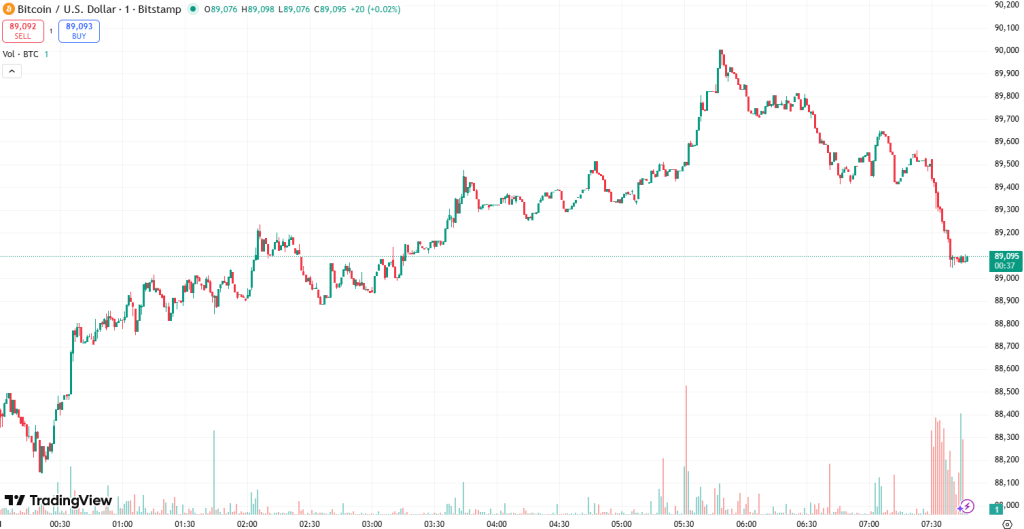
    At the time of writing on Friday morning, BTC was changing hands at $89,477. It was quite a choppy trading day for the coin. The coin initially and briefly climbed to the intraday high of $90,159 and then dropped to the day’s low of $88,557. It continued trading in this range.

    Over the past 7 days, BTC decreased by nearly 7%, trading in the $87,653–$95,649 range.

    We now found the support at $89,300, followed by the $87,400 level. The latter previously acted as demand. On the other hand, the resistance levels stand at $91,800 and $94,200.
    Bitcoin Price Chart. Source: TradingView

    At the same time, Ethereum was trading at $2,945. It saw a similarly choppy trading day. Earlier in the day, it fell from $3,012 to the intraday low of $2,909. For most of the day, it traded in the $2,944-$2,953 range.

    Moreover, ETH fell 11.3% over the past seven days, moving between $2,898 and $3,361.

    Should the downward push continue, the price may fall further below $2,900, followed by $2,830 and $2,745. If the tide turns, ETH may reclaim the $3,000 level, and if it manages to hold it firmly, the move could open doors for additional notable increases.

    Ethereum (ETH)
    24h7d30d1yAll time

    Meanwhile, the crypto market sentiment remained unchanged over the past day, firmly maintaining its position within the fear zone.

    The crypto fear and greed index currently stands at 34 today, the same level as yesterday.

    This highlights the overall uncertainty and caution in the market, with participants waiting to see in which direction the needle will move.

    ETFs See the Highest Drop in Two Months

    The US BTC spot exchange-traded funds (ETFs) posted minor outflows on 22 January, totalling $32.11 million. This is the lowest amount of flows in nearly a month. The total net inflow now stands at $56.6 billion.

    Of the twelve ETFs, only two recorded outflows, and none saw inflows.

    BlackRock let go of $22.35 million, and Fidelity followed with $9.76 million in outflows.

    Additionally, the US ETH ETFs posted minor negative flows as well, with $41.98 million. Like their BTC counterparts, this is also the lowest amount since late December. With this, the total net inflow pulled back further for a third day in a row to $12.34 billion.

    Of the nine funds, two ETH ETFs posted outflows, and two saw inflows. Grayscale took in 17.63 million in total.

    At the same time, BlackRock recorded $44.44 million in outflows, followed by Bitwise’s $15.16 million.

    Meanwhile, major French hardware wallet manufacturer Ledger is reportedly planning a US initial public offering (IPO) that could value the company over $4 billion.

    It would do so in collaboration with Wall Street banks Goldman Sachs, Jefferies, and Barclays.

    Exclusive: The French cryptocurrency group, which sells devices that allow investors to securely store tokens, is working with bankers at Goldman Sachs, Jefferies and Barclays on an initial public offering that could take place as soon as this year. https://t.co/SLDJma0xX1 pic.twitter.com/FdoOGh6B58

    — Financial Times (@FT) January 23, 2026

    Quick FAQ

    1. Did crypto move with stocks today?

    After a single day of increases, the crypto market reverted to downward action that governed this week. Meanwhile, the US stock market closed the Thursday session higher for the second consecutive day. By the closing time on 22 January, the S&P 500 was up 0.55%, the Nasdaq-100 increased by 0.76%, and the Dow Jones Industrial Average rose by 0.63%. Presumably, the TradFi markers are still digesting the US’s apparent decision not to use military force in Greenland or impose tariffs on eight NATO allies.

    1. Is this drop sustainable?

    For now, we may continue to see further decreases in the crypto market, at least in the short term. Nonetheless, the price action is not closed for a renewed upward trajectory, though how stable it would be is still unclear.

    The post Why Is Crypto Down Today? – January 23, 2026 appeared first on Cryptonews.
    Euphoria Over the US Commitment to Crypto Quickly Faded, But Which Key Factors Affect Bitcoin – Analysts Weigh In

    22 January 2026 at 14:51

    Bitcoin (BTC) has recorded a dip below the $90,000 level. But how much of the drop was the result of various macroeconomic, geopolitical, and regulatory factors? Analysts have shared their valuable insights on the matter.

    TLDR:
  • Euphoria over America’s commitment to crypto quickly faded;
  • Clarity Act is far more important to the future of digital assets than tariff news;
  • Clarity Act delay is likely just one in a series;
  • Bitcoin has remained “relatively resilient” over the past month;
  • Institutions are shifting from holding BTC to enabling it to function as productive capital;
  • Verbal intervention alone is unlikely to fully suppress volatility;
  • The sharp dislocation in sovereign bond markets once again highlights the fragility of traditional safe-haven assets.
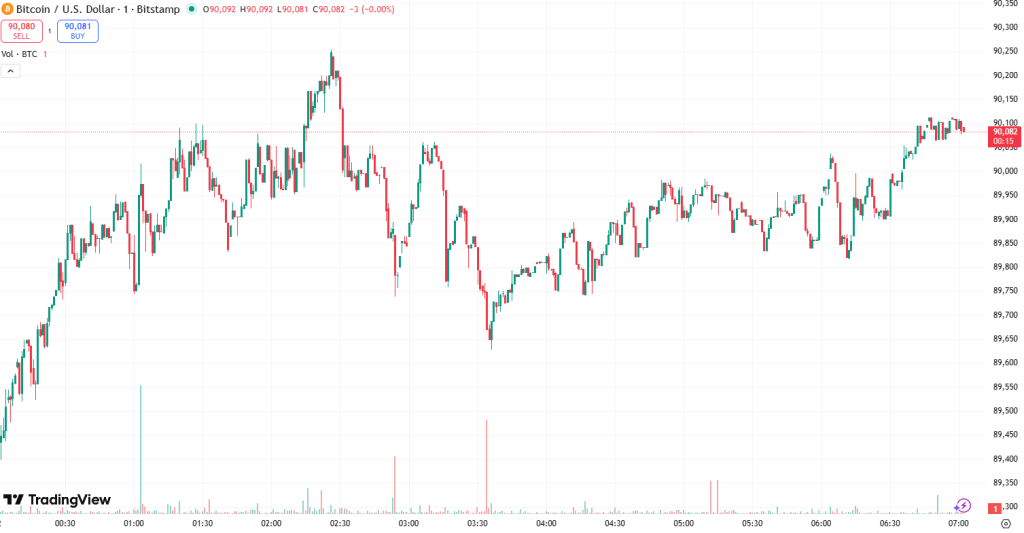
  • Over the past 24 hours, Bitcoin has remained mostly unchanged by the time of writing (Thursday afternoon, UTC). It has gone up by just 0.2%, currently trading at $89,582.

    Earlier in the day, it saw a notable drop to the $87,300 level, before climbing to the briefly held $90,295.

    Source: TradingView

    Observing its performance over the past week, we see it’s now down nearly 8%, trading between $87,653 and $96,875.

    Clarity Bill is Far More Important for Market Than Tariff Noise

    Nic Puckrin, digital asset analyst and co-founder of Coin Bureau, commented on the CLARITY Act being postponed in the US. The bill was supposed to be passed last year but is still being delayed.

    Puckrin says that, despite President Donald Trump’s statement that the bill would be signed “soon”, there’s a reason he didn’t mention it until the very end of his speech in Davos.

    “While he may say crypto is a priority, […] it’s clearly not the first item on the agenda,” Puckrin writes.

    Bitcoin grinding sideways while gold surges isn’t a sign of fading conviction.

    It’s the shift from a high-beta venture asset to a crystallised institutional balance sheet play.

    In macro stress, gold absorbs the immediate scale and urgency because it remains the world’s primary…

    — Nic (@nicrypto) January 22, 2026

    However, BTC fell below $90,000 yesterday. The most significant lesson learned from the market’s reaction is that “tariff noise” is not that relevant. Instead, the bill is “far more important to the future of digital assets.”

    Puckrin writes:

    “The momentary euphoria over America’s commitment to crypto quickly faded, and even the cancellation of tariffs on NATO countries couldn’t lift it higher.”

    Taking a long time to agree on a perfect piece of legislation is not a good idea, he argues. Instead, passing the bill quickly would bring more benefits. However, this is likely just the first of many delays to “this potentially game-changing digital asset legislation.” And yet, “the longer CLARITY is delayed, the longer uncertainty prevails.”

    “The big concern is that this could take years rather than months, leaving the crypto industry in the same limbo it has been fighting so hard to emerge from,” the analyst warns.

    Bitcoin Remains Resilient

    Dom Harz, Co-Founder of BOB, commented that many are keeping an eye on BTC’s day-to-day price movements. However, Bitcoin has remained “relatively resilient” nonetheless. It’s up 2% this month (at the writing time) despite broader market volatility.

    As Davos is wrapping up, he says, “conversations among institutional leaders and investors highlight the growing emphasis on resilience, efficiency, and the search for credible and reliable stores of value.”

    Bitcoin is the hardest collateral on earth.

    DeFi is the most transparent financial stack.

    Yet very little BTC touches DeFi.

    That gap is the opportunity. https://t.co/0At7z7izQ3

    — BOB (@build_on_bob) January 22, 2026

    Notably, “institutions are shifting from simply holding BTC to searching for opportunities that enable it to function as productive capital, while remaining anchored to Bitcoin’s base layer security,” Harz says.

    Therefore, he argues, the focus now needs to be on developing Bitcoin DeFi infrastructure to support secure participation and scale mainstream adoption.

    Structural Pressures Stay Intact

    Bitunix analysts noted a recent (what appears to be) bond market liquidity shock. It is a stress test of policy credibility within the global financial system, they write.

    “In the short term, markets trade on sentiment; in the medium term, on the boundaries of central bank action; and in the long term, on whether institutional demand for non-sovereign assets is genuinely awakened,” the analysts explain.

    So, what happened exactly?

    On 21 January, Japan’s long-dated government bond market saw a sudden wave of selling. 30-year and 40-year as Japanese Government Bond (JGB) yields jumped more than 25 basis points in a single session, Bitunix writes.

    “The magnitude of the move was described as a ‘six-standard-deviation’ event and quickly spilled over into U.S. Treasuries, pushing the U.S. 10-year yield to its highest level since last August,” they explained.

    Bitunix Analyst 📊$BTC is still moving in a range around $90K, with price reacting mainly to liquidity levels.@coinglass_com data shows a short-liquidation cluster near $91K, which could be swept if momentum builds. On the downside, $89K–$87K holds dense long-liquidation… pic.twitter.com/lefuwLuZMz

    — Bitunix (@BitunixOfficial) January 22, 2026

    Japanese Finance Minister and the U.S. Treasury Secretary both called for market calm at Davos. The goal is “to contain the spread of a ‘weaponization of bond markets’ narrative.”

    However, the analysts warn that “verbal intervention alone is unlikely to fully suppress volatility.” Structural pressures remain intact. These include Japan’s rapidly rising domestic rates, election-related uncertainty, and market expectations of unconventional Bank of Japan bond-buying measures weighing on sentiment.

    Therefore, “for the crypto market, the sharp dislocation in sovereign bond markets once again highlights the fragility of traditional safe-haven assets.”

    The analysts predict that:

    • In the short term, simultaneous pressure on bonds and risk assets may dampen risk appetite in crypto markets.
    • Over the medium term, if the politicisation of bond markets and monetary intervention become persistent features, this dynamic could reinforce the allocation case for BTC as a non-sovereign asset.
    • Over the longer term, sustained erosion in global interest rates and currency stability could result in a repricing of crypto assets’ strategic weight within portfolio allocation.

    The post Euphoria Over the US Commitment to Crypto Quickly Faded, But Which Key Factors Affect Bitcoin – Analysts Weigh In appeared first on Cryptonews.

    Why Is Crypto Up Today? – January 22, 2026

    22 January 2026 at 07:22

    The crypto market is up today after several days of a downward trajectory. The cryptocurrency market capitalisation increased by 1.5% over the past 24 hours to $3.13 trillion. At the time of writing, 87 of the top 100 coins have appreciated. The total crypto trading volume stands at $149 billion.

    TLDR:
  • Crypto market cap is up 1.5% on Thursday morning (UTC);
  • 87 of the top 100 coins and all top 10 coins are up;
  • BTC and ETH increased by 0.7% each to $89,853 and $2,986, respectively;
  • BTC’s price action remains fragile below $90,000
  • Upside progress is likely to remain constrained;
  • ‘Long-term holders remain a latent source of resistance’;
  • BTC’s price action is driven ‘more by the absence of pressure than by active conviction’;
  • Institutional and corporate demand is cautious;
  • The US crypto market structure legislation is heading to a markup on 27 January;
  • Ark Invest argues says digital assets could reach $28 trillion in market value by 2030;
  • US BTC and ETH spot ETFs saw the highest pullback since November and December, respectively;
  • Crypto market sentiment climbed very slightly up within the fear zone.
  • Crypto Winners & Losers

    As of Thursday morning (UTC), all top 10 coins per market capitalisation have seen a reversal, with their price rising over the past 24 hours.

    Bitcoin (BTC) appreciated 0.7%, currently trading at $89,853.

    btc logo
    Bitcoin (BTC)
    24h7d30d1yAll time

    Ethereum (ETH) increased by 0.7% as well, changing hands at $2,986. BTC’s and ETH’s are the lowest increases in this category.

    The highest rise among the top 10 is XRP’s 2.3%, now standing at $1.95.

    Solana (SOL)’s 1.7% is next, currently trading at $129.

    Of the top 100 coins per market cap, 87 have seen their price rise today.

    Canton (CC) is at the top, with a rise of 12.2% to $0.1492.

    It’s followed by Rain (RAIN), which appreciated 9.5%, trading at $0.009421.

    On the other side, at the top of the red coin list is Midnight (NIGHT), with a drop of 5.3% to the price of $0.05828.

    MemeCore (M) posting a decrease of 3.5%, trading at $1.6.

    Meanwhile, the US Senate Agriculture Committee released updated crypto market structure legislation and scheduled a markup for 27 January, but without Democratic support.

    “Although it’s unfortunate that we couldn’t reach an agreement, I am grateful for the collaboration that has made this legislation better,” Chairman John Boozman said.

    🚨BREAKING: Chairman @JohnBoozman releases updated market structure legislation ahead of January 27th markup. https://t.co/PB7O9FMJlZ pic.twitter.com/k7FuIBgEsk

    — Senate Ag Committee Republicans (@SenateAgGOP) January 22, 2026

    BTC’s Price Action Remains Fragile Below $90,000

    According to Glassnode’s latest report, until there is new demand with sufficient strength to absorb overhead supply, long-term holders remain a latent source of resistance.

    “As a result, upside progress is likely to remain constrained, with rallies vulnerable to renewed distribution unless this supply overhang is decisively resolved,” the analysts say.

    The market, they add, is building a base, consolidating from a pause in conviction – as investors wait for the next catalyst to unlock broader engagement – and not from excess participation.

    As for Bitcoin, it still stands in a low participation regime. Its price action is driven “more by the absence of pressure than by active conviction.” They write that,

    “[BTC’s] price action remains fragile below $90,000, while that level itself is likely to act as a friction point. Reclaiming it sustainably would require sufficient momentum and confidence to absorb dealer hedging flows and shift gamma exposure higher.”

    Moreover, institutional and corporate demand is cautious. Treasury flows are stabilising near neutral, while activity stands concentrated in isolated transactions.

    Derivatives participation is thin. Futures volume is compressed, and leverage deployment is subdued. This reinforces “a low-liquidity environment where price is increasingly sensitive to modest positioning shifts.”

    Finally, “options markets echo this restraint” as well, the report says. “Volatility repricing has been confined to the front end, hedging demand has normalised, and elevated volatility risk premium continues to anchor implied volatility.”

    Levels & Events to Watch Next

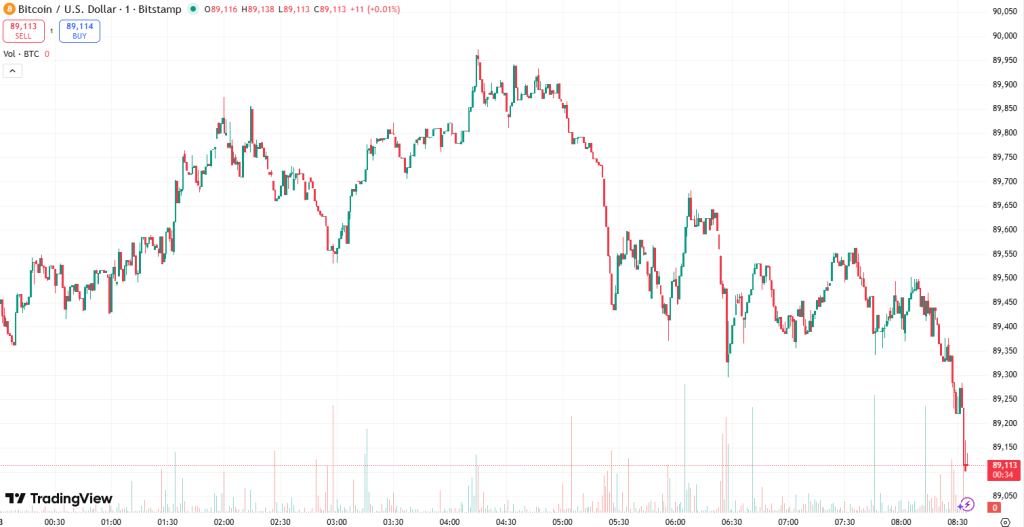
    At the time of writing on Thursday morning, BTC was changing hands at $89,853. The coin briefly dipped to $87,304 earlier in the day. However, for the most part, it traded sideways, with the highest point being $90,295.

    BTC is now down 7.3% over the past 7 days, moving in the $87,653–$96,937 range.

    Looking ahead, we find the key support levels at $87,400 and $85,900. A drop below this level could lead to a dip below $80,000. Meanwhile, resistance currently stands at $90,400 and $92,300.

    Bitcoin Price Chart. Source: TradingView

    At the same time, Ethereum was trading at $2,986. Earlier in the day, the price fell from $3,014 to the intraday low of $2,872. It then jumped to the intraday high of $3,052 but was unable to hold this level. Nonetheless, it traded mostly sideways.

    Over the past week, ETH has dropped 11.3%, moving between $2,898 and $3,374.

    For now, its price is still at risk of falling towards the $2,500 level. However, analysts argue that it could reach $3,500 by Q2 and possibly $4,500 in H2.

    Ethereum (ETH)
    24h7d30d1yAll time

    Meanwhile, the crypto market sentiment posted a minor increase over the past day, not changing its position in the fear zone.

    The crypto fear and greed index rose from 32 seen yesterday to 34 today. It would take a stronger push to lead it out of the fear and back into neutral territory.

    As noted yesterday, caution, fear, and uncertainty among market participants have been increasing, fuelled by the macroeconomic and geopolitical conditions. Constantly shifting news from the US is not helping. We may see the metric drop lower in the near-term.

    ETFs See the Highest Drop in Two Months

    On 21 January, the US BTC spot exchange-traded funds (ETFs) saw a significant amount of outflows of $708.71 million. This is the highest level since mid-November 2025. The total net inflow fell below $57 billion to $56.63 billion.

    Of the twelve ETFs, six recorded outflows, and one saw inflows. This one is VanEck, taking in $6.35 million.

    At the same time, the highest outflows were posted by BlackRock, letting go of $356.64 million. Fidelity follows with $287.67 million in outflows.

    Moreover, the US ETH ETFs posted their second day of negative flow with $286.95 million. This is their highest amount since mid-December 2025. With this, the total net inflow pulled back to $12.4 billion.

    Of the nine funds, four ETH ETFs posted outflows, and one saw inflows. Grayscale took in $10.01 million.

    BlackRock is at the top again, accounting for the main chunk of the total outflows: $250.27 million. In second place, we find Fidelity, which posted $30.89 million in negative flows.

    Meanwhile, Cathie Wood’s Ark Invest argues that digital assets could reach $28 trillion in market value by 2030. That is up from about $3.13 trillion today, a jump of roughly 9x.

    “We believe Bitcoin could account for 70% of the market,” it said, with the rest led by smart contract networks such as Ethereum and Solana.

    Quick FAQ

    1. Did crypto move with stocks today?

    The crypto market finally had a green day after days of overwhelming red. At the same time, the US stock market closed the Wednesday session sharply higher, following the biggest losses since October. By the closing time on 21 January, the S&P 500 was up 1.16%, the Nasdaq-100 increased by 1.36%, and the Dow Jones Industrial Average rose by 1.21%. This comes as the US seems to have decided against using military force in Greenland and imposing tariffs on eight NATO allies.

    1. Is this rally sustainable?

    There is still room for the crypto market to go down. It’s being squeezed by the overall geopolitical and economic uncertainty. Nonetheless, in the short-term, it may find a base for another leg up, even if it ends up being brief.

    The post Why Is Crypto Up Today? – January 22, 2026 appeared first on Cryptonews.
    Why Is Crypto Down Today? – January 21, 2026

    21 January 2026 at 06:04

    The crypto market is down today again. The cryptocurrency market capitalisation decreased by 2.4% over the past 24 hours to $3.1 trillion. At the time of writing, 92 of the top 100 coins have posted price falls. The total crypto trading volume stands at $152 billion.

    TLDR:
  • Crypto market cap is down 2.4% on Wednesday morning (UTC);
  • 92 of the top 100 coins and all top 10 coins are down;
  • BTC decreased by 2.2% to $89,104, and ETH is down 5% to $2,965;
  • ‘The outlook remains mildly bearish through mid-year’;
  • Traders are paying a premium for downside protection;
  • Macro risks are quickly building;
  • ‘Crypto markets appear more risk-averse than in previous cycles’;
  • There is now a 30% chance that BTC will fall below $80,000 by 26 June;
  • SkyBridge Capital leans harder into macro trades as the policy uncertainty under the US president increases market volatility;
  • Delaware Life added the BlackRock US Equity Bitcoin Balanced Risk 12% Index to its fixed indexed annuity portfolio;
  • US crypto spot ETFs reopened this week with significant outflows;
  • Crypto market sentiment plunged and re-entered the fear zone.
  • Crypto Winners & Losers

    As of Wednesday morning (UTC), all top 10 coins per market capitalisation have seen a price decrease over the past 24 hours.

    Bitcoin (BTC) fell by 2.2% and below $90,000. It is currently trading at $89,104.

    btc logo
    Bitcoin (BTC)
    24h7d30d1yAll time

    Ethereum (ETH) decreased by 5%, below $3,000, now changing hands at $2,965. This is the highest decrease in the category.

    Lido Staked Ether (STETH) is next, also with a 5% drop to $2,965, followed by Binance Coin (BNB)’s 4.7% to the price of $874.

    Currently, the lowest fall in this period is seen by Dogecoin (DOGE), which dropped 1.8%, currently standing at $0.1248.

    Of the top 100 coins per market cap, 92 are down today. Of the eight green coins, Provenance Blockchain (HASH) is the category’s best performer. It appreciated 4.9% to the price of $0.02724.

    Canton (CC) is next, with a rise of 4.4% to $0.1326.

    On the other hand, Monero (XMR) posted a double-digit decrease of 15.2%, trading at $492.

    It’s followed by Hyperliquid (HYPE), which fell by 8.2% to the price of $21.27.

    The rest are down 5.4% and less per coin.

    Meanwhile, alternative asset manager SkyBridge Capital is leaning harder into macro trades, given the increasing policy uncertainty under the US President Donald Trump is rising market volatility. “Because of the volatility, the macro traders have done better,” founder Anthony Scaramucci said.

    “This is more of a timing issue than a direction issue. I don’t think the fundamental story for Bitcoin has changed. If anything, you’ve seen a lot of consolidation,” he said.

    ⚡ SkyBridge is leaning into macro trades amid policy-driven volatility while staying cautious on regulation and positive on bitcoin’s long-term outlook, Anthony @Scaramucci said.#Scaramucci #SkyBridge https://t.co/rirukb9ehU

    — Cryptonews.com (@cryptonews) January 21, 2026

    Calm On Surface, But Turmoil Rising Underneath

    Sean Dawson, Head of Research at onchain options platform Derive.xyz, commented that any current market calm is unlikely to last. Even if markets appear calm on the surface, macro risks are building.

    We’re seeing rising geopolitical tensions between the U.S. and Europe, particularly around Greenland. These are raising “the risk of a regime shift back into a higher-volatility environment, a dynamic not currently reflected in spot prices,” Dawson says.

    “Against a backdrop of persistent geopolitical uncertainty, crypto markets appear more risk-averse than in previous cycles, despite historically low realised volatility.”

    Looking at options, “the outlook remains mildly bearish through mid-year.” BTC 25-delta skew has deteriorated sharply, plunging from +5% this time last year to -3%. This suggests that traders are paying a premium for downside protection.

    “This persistent skew suggests markets are increasingly positioned for weakness in the first half of the year, Dawson writes.

    Vol looking due for a breakout; 30 and 90 dte atm iv been crushed to 2 monthly lows at 38%.

    Greenland tensions, war (?) in Iran and a continuing K-shaped economy makes this look cheap pic.twitter.com/86P2ZgIUxx

    — Sean | Derive (@SeanNotShorn) January 20, 2026

    Moreover, the above view is reinforced by positioning, he argues. Observing the BTC June 26 expiry, he finds a significant concentration of put open interest across the $75,000-$85,000 strikes. This implies “expectations of a drawdown into the mid-70s to low-80s before the second half of the year.”

    Additionally, options markets show a clear downside skew. There is now a 30% chance that BTC will fall below $80,000 by 26 June, compared to a 19% chance it rallies above $120,000 in the same period.

    “These expectations are consistent with trends established since October 10’s flash crash. While markets have stabilised modestly since then, BTC’s rebound above $90,000 has been tepid, and confidence remains fragile,” Dawson concludes.

    Levels & Events to Watch Next

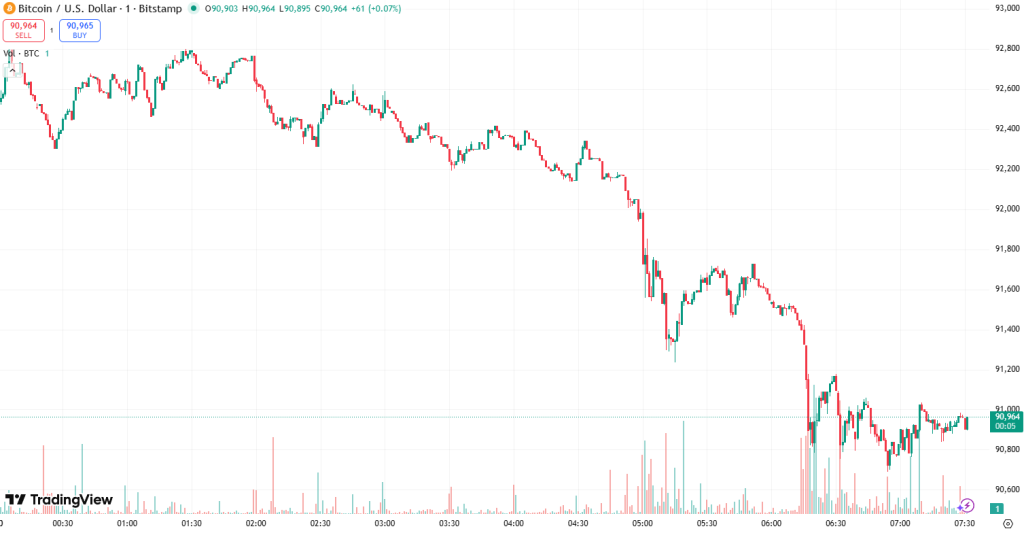
    At the time of writing on Wednesday morning, BTC was changing hands at $89,104. The coin began the day with the intraday high of $91,320, soon decreasing below the $90,000 level and hitting the intraday low of $87,901.

    Also, it has now posted a notable drop in the 1-week timeframe. It fell 6.2%, trading in the $88,312–$97,538 range.

    Given that BTC hit the $87,900 level with this latest pullback, the price may revisit the $86,200 and $85,000 zones as well. This could open doors for the $79,000 level.

    Bitcoin Price Chart. Source: TradingView

    At the same time, Ethereum was trading at $2,965. Its intraday high was $3,120, seen early in the day. It then gradually but swiftly moved to the day’s low of $2,924. It’s stayed below the $3,000 mark since.

    While usually outperforming BTC in the weekly timeframe, ETH has now posted a higher drop: 10.9%. It has moved between $2,935 and $3,379.

    Having dipped below $3,000, ETH may continue decreasing to $2,890, followed by $2,800 and $2,760. Deeper pullbacks are possible if we don’t see a shift in the market soon.

    Ethereum (ETH)
    24h7d30d1yAll time

    Meanwhile, the crypto market sentiment noted a significant fall over the past day.

    The crypto fear and greed index plunged from 45 seen yesterday to 32 today. This has pushed it out of the neutral and into the fear zone.

    The metric clearly shows a palpable rise of caution, fear, and uncertainty among market participants, fuelled by the deteriorating macroeconomic and geopolitical circumstances.

    ETFs Markets Return Red

    Traditional markets were closed in the US on Monday and reopened on Tuesday, thus providing fresh data for the US crypto spot exchange-traded funds (ETFs).

    On 20 January, the US BTC spot exchange-traded funds (ETFs) closed the first session of the week with $483.38 million in negative flows. The total net inflow pulled back to $57.34 billion.

    Of the twelve ETFs, eight recorded outflows. There were no inflows. The highest among these is Grayscale’s $160.84 million in negative flows.

    Fidelity follows with $151.13 million in outflows, with BlackRock coming in third, letting go of $56.87 million.

    Moreover, the US ETH ETFs broke their latest green streak on Tuesday, posting $229.95 million in outflows. With this, the total net inflow fell to $12.68 billion.

    Of the nine funds, six ETH ETFs posted outflows, and none saw inflows. BlackRock is at the top, having recorded $92.3 million in negative flows.

    In second place on this list, we find Fidelity, which posted $51.54 million in negative flows.

    Meanwhile, Delaware Life has added the BlackRock US Equity Bitcoin Balanced Risk 12% Index to its fixed indexed annuity portfolio, saying it’s the first time an insurance carrier has offered an index that includes crypto.

    “As the retirement-planning landscape evolves, we’re continuously and thoughtfully innovating to meet the needs of financial professionals and their clients,” said Colin Lake, president and CEO of Delaware Life Marketing. “Our fixed index annuities deliver what today’s investors want and need: opportunity for growth with protection.”

    Delaware Life Insurance Company, a Group 1001 insurance subsidiary, announced the addition of the BlackRock U.S. Equity Bitcoin Balanced Risk 12% Index to its fixed indexed annuity (FIA) product lineup, making it the first U.S. insurer to introduce bitcoin exposure within this…

    — Wu Blockchain (@WuBlockchain) January 20, 2026

    Quick FAQ

    1. Did crypto move with stocks today?

    The crypto market posted another drop over the last 24 hours. Additionally, the US stock market closed the Tuesday session sharply lower. By the closing time on 20 January, the S&P 500 was down 2.06%, the Nasdaq-100 decreased by 2.12%, and the Dow Jones Industrial Average fell by 1.76%. This followed the US president’s renewed threats to impose new tariffs on eight NATO allies for opposing his Greenland desires.

    1. Is this drop sustainable?

    For now, additional drops are likely. The markets in general are feeling pressure due to geopolitical tensions and economic stress. Longer-term, analysts argue that we may still see another leg up.

    The post Why Is Crypto Down Today? – January 21, 2026 appeared first on Cryptonews.
    DeFi Gains 24/5 Access to U.S. Equity Market Data, Chainlink Brings $80Tn Stock Market Onchain

    20 January 2026 at 11:32

    Major oracle platform Chainlink has expanded its Data Streams with the launch of the novel 24/5 U.S. Equities Streams, providing market data for U.S. equities and ETFs across trading sessions 24 hours a day, 5 days a week.

    Per the announcement, Data Streams is available on more than 40 blockchains. It allows protocols to build onchain equity markets that are not limited to standard U.S. trading hours. They can build equity perps and prediction markets, among others.

    Moreover, a number of protocols already utilise the Chainlink 24/5 U.S. Equities Streams. These include Lighter, BitMEX, ApeX, HelloTrade, Decibel, Monaco, Opinion Labs, and Orderly.

    JUST SHIPPED: Chainlink 24/5 U.S. Equities Streams brings the ~$80T U.S. equities market onchain.

    Fast, secure stock & ETF data is now live across 40+ chains—24 hours a day, 5 days a week.

    Trusted by @lighter_xyz, @BitMEX, @OfficialApeXdex, & more.

    🧵https://t.co/DMzBK5yJ71

    — Chainlink (@chainlink) January 20, 2026

    Chainlink states that they built the 24/5 Streams on their Chainlink Data Standard. The latter has so far enabled over $27 trillion in transaction value and delivered over 19 billion total verified messages onchain. It also claims to have secured some 70% of oracle-related DeFi.

    Additionally, the new offer includes bid and ask price, bid and ask volume, mid price, last traded price, staleness indicator, and market status flags.

    Per the team, “For the first time, DeFi has secure access to U.S. equity market data that also includes after-hours and overnight sessions, unlocking the ~$80T U.S. stock market onchain.”

    Moreover, 24/5 U.S. Equities Streams resolve several significant issues, its creators say.

    Primarily, reliable sub-second pricing – available 24 hours a day across regular, pre-market, post-market, and overnight sessions – removes pricing gaps, blind spots during off-hours, and the risk of stale reference prices.

    Beyond data price, 24/5 Streams offers asset data for financial applications for “a more complete picture of market conditions.” The data enables “smarter pricing logic, enhanced risk management, and faster execution for onchain protocols,” Chainlink says.

    Transforming Fragmented Equity Market Data Into Continuous Streams

    According to Chainlink, 24/5 U.S. Equities Streams come with expanded coverage and enhanced data schemas, enabling a variety of onchain use cases.

    Traders can work with stocks and ETFs onchain all day for most of the week, be it for trading, lending, or another purpose.

    Also, the product provides builders with risk controls, safer execution, and advanced logic, all via market data.

    Use cases include:

    • building perpetuals and derivatives 24 hours a day;
    • creating prediction markets for accurate resolution;
    • creating synthetic equities and ETFs;
    • operating lending markets: dynamic margining, collateral valuation, and risk management;
    • enabling structured products and vaults: new yield and exposure strategies tied to U.S. equities.

    .@lighter_xyz, the #2 perp DEX by volume and largest ZK rollup on Ethereum, leverages Chainlink as its official RWA oracle.

    By integrating Chainlink's 24/5 Equities Streams as its primary oracle, Lighter is unlocking new low-latency markets that go beyond standard trading hours. pic.twitter.com/1besjKyN8f

    — Chainlink (@chainlink) January 20, 2026

    Meanwhile, the press release went into the key issue the novel product aims to resolve. It explains that, while real-world assets (RWAs) are seeing fast onchain adoption, U.S. equities remain “significantly underrepresented.” And yet, the latter is one of the world’s largest and most liquid asset classes, the team argue.

    The reason is structural, they explain. Blockchain-enabled trading operates nonstop. However, U.S. equity markets trade across fragmented sessions during dedicated market hours.

    Also, most onchain data solutions provide only one price point for equities during standard trading hours. This creates two interrelated issues:

    • a gap where onchain markets are unable to reliably replicate market conditions all 24 hours of the day:
    • pricing blind spots, increased risk during off-hours, and difficulty building secure, scalable equity-based financial products onchain.

    Chainlink 24/5 U.S. Equities Streams solves this “by transforming fragmented U.S. equity market data into continuous, cryptographically signed Data Streams,” the announcement says. “As a result, traditional markets can properly operate onchain.”

    The post DeFi Gains 24/5 Access to U.S. Equity Market Data, Chainlink Brings $80Tn Stock Market Onchain appeared first on Cryptonews.

    Staking Provider Chorus One Partners with Ledger for Self-Custodial ETH, SOL Staking

    20 January 2026 at 10:27

    Institutional staking provider Chorus One has integrated with Ledger Enterprise to bring self-custodial, governance-ready staking for four cryptocurrencies.

    According to the press release shared with Cryptonews.com, this move aims to enable institutions to earn staking rewards directly from Ledger’s custody ecosystem.

    All staking operations happen within the institution’s existing governance framework. Therefore, institutions can participate in Proof-of-Stake (PoS) networks without “transferring asset custody or compromising internal governance controls.”

    The collaboration enables staking for Ethereum (ETH), Solana (SOL), Polkadot (DOT), and Tezos (XTZ).

    Chorus One x Ledger Enterprise 🤝

    Institutions can now stake ETH, SOL, DOT & XTZ directly through their self-custody platform, using Chorus One validator infrastructure.

    🔐 Hardware-backed key management
    📊 Audit-ready reporting
    ⚙ Seamless staking & reward management pic.twitter.com/xwNMoTQ80W

    — Chorus One (@ChorusOne) January 20, 2026

    Per the announcement, Ledger’s hardware and governance controls protect the private keys. At the same time, Chorus One backs the institutional-grade validator performance. It says it provides institutional validator infrastructure and research-driven staking operations.

    Other key points of the collaboration include multi-authorisation and configurable governance workflows, as well as reporting and auditability for compliance and treasury management.

    “Institutions need staking solutions that match their security, compliance, and operational requirements,” says Damien Scanlon, Chief Product Officer at Chorus One. The integration allows the two companies “to deliver a streamlined staking experience that keeps governance firmly in the hands of the client,” he added.

    Staking In The News

    Sébastien Badault, Executive Vice President at Ledger Enterprise, noted that “companies are adopting digital assets at a rapid pace worldwide.” At the same time, “uncompromising security and governance remain fundamental prerequisites.”

    Therefore, integrating Chorus One’s staking infrastructure into the Ledger Enterprise platform makes “it simpler for institutions to earn staking yields,” Badault says.

    Speaking of which, many staking-related news stories hit the front pages in the first few days of this year.

    Among these, Robinhood’s head Vlad Tenev claimed that staking remains one of the most sought-after features among Robinhood users.

    Tenev urged the US to be the leader in shaping crypto policy. The staking feature is still not available to customers in four US states “due to the current gridlock,” he said. “Stock Tokens are available to our customers in the EU, but not in our home market,” Tenev wrote.

    Staking is one of the most requested features on @RobinhoodApp, but it’s still unavailable to customers in four U.S. states due to the current gridlock. Stock Tokens are available to our customers in the EU, but not in our home market.

    It's time for the US to lead on crypto…

    — Vlad Tenev (@vladtenev) January 15, 2026

    Moreover, SharpLink Gaming started seeing results of its decision to fully commit to ETH and place its entire crypto treasury into staking. The company reported more than $33 million in passive income generated from ETH staking over the past seven months.

    Also, Bitmine recently added nearly 100,000 ETH, valued at about $344.4 million, lifting its holdings to 908,192 ETH, worth $2.95 billion. The additional staking came hours after the leading ETH accumulator reported staking 19,200 ETH, worth $60.85 million.

    Bitmine (@BitMNR) has further staked 109,504 $ETH, worth $344.44M

    In total, they have staked 908,192 $ETH, valued at $2.95Bhttps://t.co/1vbYSuGDkR https://t.co/XRS6pEPUkJ pic.twitter.com/5wLn0GrtTh

    — Onchain Lens (@OnchainLens) January 8, 2026

    Meanwhile, Chorus One operates infrastructure for over forty PoS networks, including Cosmos, Solana, Avalanche, and Near.

    As for Ledger, it announced its Ledger Nano Gen5 last year. It is now weighing a US listing and is preparing to raise capital.

    “Money is in New York today for crypto, it’s nowhere else in the world, certainly not in Europe,” said chief executive Pascal Gauthier.

    Early in January, hackers exploited vulnerabilities in Ledger’s Global‑e payment processor, gaining access to customer names and contact information. Wallets and private keys were unaffected, the company said.

    The post Staking Provider Chorus One Partners with Ledger for Self-Custodial ETH, SOL Staking appeared first on Cryptonews.

    Why Is Crypto Down Today? – January 20, 2026

    20 January 2026 at 06:12

    The crypto market is down today, with the cryptocurrency market capitalisation having decreased by 1.6% over the past 24 hours to $3.17 trillion. At the time of writing, 85 of the top 100 coins have posted price falls. Also, the total crypto trading volume stands at $105 billion.

    TLDR:
  • Crypto market cap is down 1.6% on Tuesday morning (UTC);
  • 85 of the top 100 coins and all top 10 coins are down;
  • BTC decreased by 1.6% to $91,020, and ETH is down 2.5% to $3,117;
  • Bitcoin fell after Donald Trump threatened EU with tariffs and NATO allies over control of Greenland;
  • For a more durable rally, maturation supply needs to outweigh LTH spending;
  • BTC is moving into a dense LTH supply zone between $93,000 and $110,000 where recovery attempts previously stalled;
  • ‘The pullback in digital assets suggests that optimism was on thin ice’;
  • ‘Crypto markets are once again spiralling into risk-off mode’;
  • A recent spike in activity on the Ethereum network may be partly driven by address poisoning attacks;
  • Brian Armstrong said he’s discuss the US crypto market structure in Davos;
  • US crypto spot ETFs were closed on Monday and will reopen today;
  • Crypto market remained unchanged over the weekend.
  • Crypto Winners & Losers

    As of Tuesday morning (UTC), all top 10 coins per market capitalisation have seen price decreases over the past 24 hours.

    Bitcoin (BTC) dropped 1.6% since this time yesterday, changing hands at $91,020.

    btc logo
    Bitcoin (BTC)
    24h7d30d1yAll time

    Ethereum (ETH) decreased by 2.5%, now trading at $3,117. This is the highest decrease in the category.

    Lido Staked Ether (STETH) is next, with a 2.4% drop, followed by Tron (TRX)’s 1.9% to the price of $0.3116.

    The lowest fall in this period is seen by Dogecoin (DOGE), given that it’s unchanged since yesterday, currently standing at $0.127.

    Of the top 100 coins per market cap, 85 are down today.

    The highest among these is Provenance Blockchain (HASH), having decreased by 8.9% to the price of $0.02567.

    Monero (XMR) is next on this list, having seen a drop of 7.2%, trading at $588.

    On the other hand, Canton (CC) is the only coin with a double-digit increase. It’s up 12.4% to $0.1251.

    It’s followed by MemeCore (M), which appreciated 5% to the price of $1.67.

    The rest are up between 4.9% and 0.2% per coin.

    Meanwhile, Coinbase chief executive Brian Armstrong said he would be discussing the US crypto market structure in Davos this week.

    “We’re going to continue to work on the market structure legislation, and meet with some of the bank CEOs to figure out how we can make this a win-win,” he said.

    Just arrived in Davos for @WEF. Three main goals this week:

    1) Talk to world leaders about economic freedom and how crypto can update their financial systems

    2) Continue the push for market structure legislation

    3) Keep pushing for tokenization to democratize access to capital… pic.twitter.com/knjuMZKRtb

    — Brian Armstrong (@brian_armstrong) January 19, 2026

    In other news, a recent spike in activity on the Ethereum network may be partly driven by address poisoning attacks, rather than organic user growth.

    “Address poisoning has become disproportionately attractive for attackers,” security researcher Andrey Sergeenkov said, adding that scaling blockchain infrastructure without prioritising user safety risks distorts headline activity metrics.

    Something extraordinary happened on @Ethereum last week.

    On Friday, January 16, #Ethereum mainnet hit 2.9M #transactions in a single day (see Chart 1) — a new all-time high per @Etherscan. That activity was accompanied by a sharp jump in daily active addresses: ~1.3M (Chart 2),… pic.twitter.com/8EvKFymfWV

    — Victor "DeFi Toronto" Li (@CryptoEcon_Li) January 19, 2026

    Market Spiralling Into Risk-Off Mode

    Commenting on the conditions needed for a sustained recovery, Bitfinex analysts argued that “for a more durable rally to take hold, market structure will need to transition into a regime where maturation supply begins to outweigh long-term holder spending.”

    Such a shift would drive long-term holder (LTH) supply higher, which would signal renewed conviction and reduced sell-side pressure. Historically, analysts add, this configuration was last observed in August 2022–September 2023 and March 2024–July 2025. Both periods “preceded stronger and more sustained trend recoveries for Bitcoin.”

    Moreover, according to the latest Bitfinex report, BTC is moving into a dense LTH supply zone between $93,000 and $110,000. Previous recovery attempts stalled there. LTHs remain net sellers, but the pace of distribution has slowed sharply, they write. Realised profits are down to around 12,800 BTC per week from cycle peaks above 100,000 BTC.

    “This moderation, combined with supportive Q1 seasonality and stronger order-flow dynamics than prior rallies, improves the probability that BTC can absorb overhead supply,” Bitfinex says. “A sustained move through this zone would require further easing in LTH sell pressure, paving the way for a more durable recovery and a potential re-test of all-time highs.”

    $BTC is improving – but the real test starts here. 👀

    Price is pushing into the $93K–$110K supply zone.

    Long-term holder selling is slowing fast, order flow is stronger, and Q1 seasonality helps – but a clean breakout needs sellers to ease, with macro risks still in play… pic.twitter.com/v83LAl88KJ

    — Bitfinex (@bitfinex) January 19, 2026

    Meanwhile, Petr Kozyakov, co-founder and CEO at payment infrastructure platform Mercuryo, commented that “Bitcoin is on the back foot, dropping 3 per cent after US President Donald Trump once again raised the stick of further tariffs, threatening NATO allies over control of Greenland.”

    Kozyakov also noted a dive in Asian trading that “evaporated” most of BTC’s year’s gains. Even though sentiment turned positive at the start of the year, “the pullback in digital assets suggests that optimism was on thin ice, underscored by multi-million-dollar liquidations across derivatives markets.”

    The CEO concludes that “cryptocurrency markets are once again spiralling into risk-off mode as global stock markets also record losses. Meanwhile, gold and silver continue to shine brightly as investors seek out safer pastures.”

    Levels & Events to Watch Next

    At the time of writing on Tuesday morning, BTC was changing hands at $91,020. The coin has traded mostly sideways over the past 24 hours, between the intraday high of $93,301 and $93,176. It has dipped to $90,765 earlier this morning.

    BTC has also turned red in the 7-day timeframe, dropping by 1%. It has traded in the $90,765–$97,538 range.

    If the price fails to maintain this level, it could move below $90,000 and towards the $87,600 zone. Breaking above this current range would allow the coin to attempt to reclaim the $95,000 level.

    Bitcoin Price Chart. Source: TradingView

    At the same time, Ethereum was trading at $3,117. Much like BTC, ETH has moved in a tight range for the majority of the past 24 hours, between $3,210 and $3,231. It has decreased to the intraday low of $3,110 prior to the time of writing.

    Over the past week, the price performance turned red, having decreased by 0.3%. It has been moving within the $3,110–$3,379 range in this timeframe.

    An additional price drop may open doors for the $3,000 territory or even lead the coin to dip below it, leading to the $2,880 level. That said, a push upwards could see the coin reclaiming the $3,400 zone.

    Ethereum (ETH)
    24h7d30d1yAll time

    Meanwhile, after remaining largely unchanged over the weekend, the crypto market sentiment dropped over the past day.

    The crypto fear and greed index fell from 49 seen over the past three days to 45 today, still staying within the neutral zone.

    Caution, exasperated by the general uncertainty and concerns over the macroeconomic and geopolitical circumstances – specifically regarding Europe, China, and the US – is rising steadily among market participants.

    ETFs Markets On Pause

    Traditional markets were closed in the US on Monday for the federal holiday, Martin Luther King Jr. Day. Therefore, we don’t have fresh data on the US crypto spot exchange-traded funds (ETFs).

    As reported yesterday, US BTC spot ETFs closed the Friday session with $394.68 million in negative flows. At the same time, the US ETH spot ETFs posted $4.64 million in inflows.

    However, this gives us a chance to look into the performance of other major ETFs. For example, US XRP spot ETFs posted $1.12 million in inflows on Friday, with the total net inflow rising to $1.28 billion.

    One of the five funds recorded positive flows, while there were no outflows on this day. Franklin took in $1.12 million.

    Moreover, US SOL spot ETFs posted negative flows of $2.22 million, with the total standing at $863.8 million. While Fidelity recorded inflows of $425,030, Grayscale and 21Shares saw outflows of $1.92 million and $725,810.

    Meanwhile, US DOGE spot ETFs didn’t see any flows since 8 January, when they collectively took in $10.32 million. As of 16 January, the total flows stand at $6.58 million.

    Quick FAQ

    1. Did crypto move with stocks today?

    The crypto market posted another drop over the last 24 hours. Meanwhile, the US stock market was closed on Monday for a federal holiday. International stock markets – including the London Stock Exchange, the Euronext Paris, the Stock Exchange of Hong Kong, the Shanghai Stock Exchange, and the Tokyo Stock Exchange – posted mixed performance on Monday.

    1. Is this drop sustainable?

    The decrease may continue in the short term. It’s neither surprising nor unhealthy for the market. Zooming out, we see that the market has recently been trading sideways for the most part. Incoming signals, such as those coming from Davos, may affect the market, though how beneficial they may be remains to be seen.

    The post Why Is Crypto Down Today? – January 20, 2026 appeared first on Cryptonews.

    Are We Entering Wave V? Further Bitcoin Downside Still Likely, Analysts Say

    19 January 2026 at 11:33

    As the crypto market continues trading sideways, analysts argue that we may soon enter the last phase of this bull run, but also that we’ll likely see further downside. However, there are significant risk-off factors preventing a Bitcoin (BTC) recovery.

    The crypto market posted a notable increase last week, but dipped over the weekend and started this week lower.

    Looking at BTC, over the past 24 hours, it dropped from the intraday high of $95,467 to the low of $92,263. At the time of writing (Monday afternoon, UTC), BTC is trading at $92,973.

    Notably, it has appreciated 2.6% in a week and 5.4% in a month.

    Bitcoin Price Chart. Source: TradingView

    Wave V Incoming?

    In a recent email, John Glover, Chief Investment Officer at digital asset financial services company Ledn, argued that we are currently in Wave IV of the major bull run. We may potentially soon enter the fifth and final section of the bull’s track.

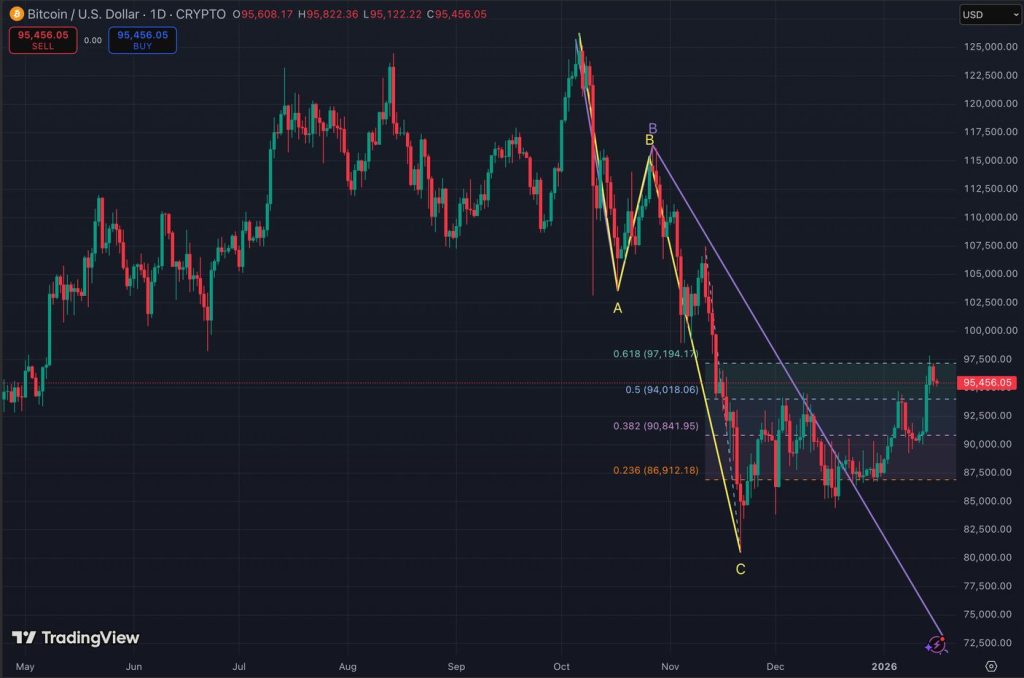
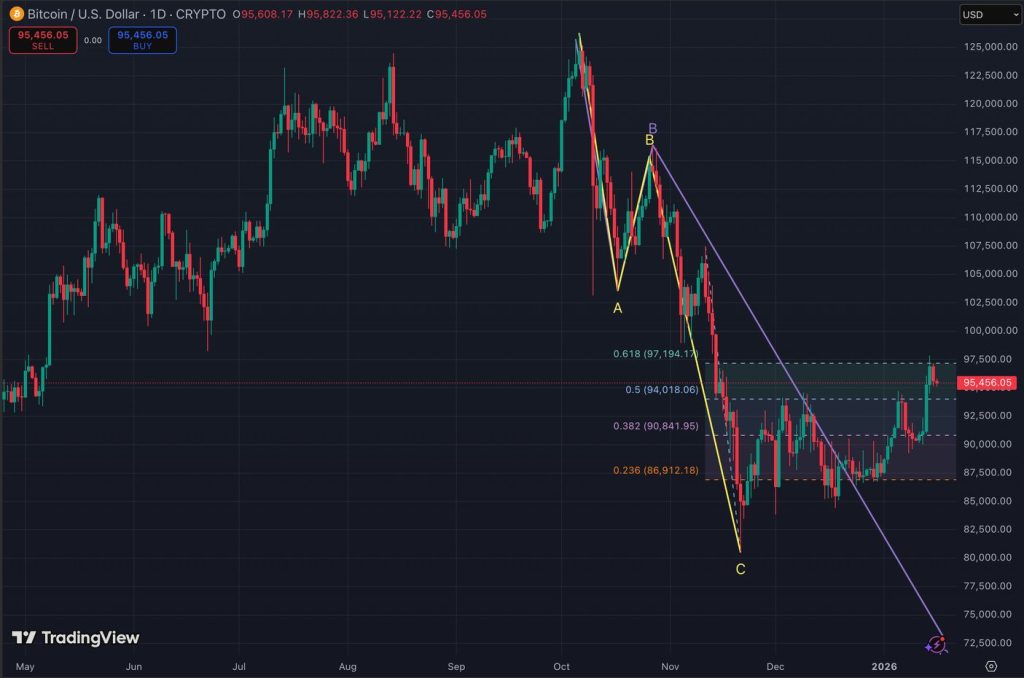
    Therefore, the current wave’s competition target for BTC is between $71,000 and $84,000, he says. The breakdown of any corrective wave is an A-B-C structure, as seen in the chart below.

    Source: John Glover, Ledn

    Now, the question is whether the yellow path is the full Wave IV or we will follow the purple path and see another move lower to $71,000, Glover writes.

    “From the breakerdown of wave C within this corrective pattern, it seems like another leg lower is likely,” he adds.

    The confirmation of the path we’re following will come from either:

    • a break and close above $104,000 (bottom of A), which would confirm that we followed the yellow path and are now starting Wave V,
    • or a break below $80,000, which means a move to the low $70,000 before we head higher.

    As a reminder, Wave IV is the fourth phase of a five-wave bullish impulse sequence. This is according to the popular price prediction model called Elliott Wave Theory.

    Per this model, during the five phases of the positive trend, wave four goes down and corrects against the trend set by wave three. Then wave five takes over, goes up and reaches a new peak. After this, the three waves of the negative trend begin.

    Another Drop Likely

    Nic Puckrin, digital asset analyst and co-founder of the Coin Bureau, highlighted that BTC has broken below a key support level of $94,000. This marked the January breakout trend line.

    He added that the sell-off rides on the back of tariff news and geopolitics. These are coming out of the US in particular.

    “From here, it’s likely we’ll see further downside unless buyers step in, with strong support around $88,000. So far, a small rebound has taken BTC back above $93,000, but it’s nothing to write home about.“

    No better way to start the week than a tariff induced crypto crash.

    US markets closed today so investors are expressing their macro positions through BTC.

    If we fall below $90k before market open tomorrow, ETF holders may also start dumping. pic.twitter.com/6I1758isOC

    — Nic (@nicrypto) January 19, 2026

    In the US, the markets closed today for a federal holiday, and volatility persists. The possibility of a deeper sell-off depends on whether BTC closes the day below $90,000, Puckrin writes. This could see exchange-traded fund (ETF) holders exiting positions when the US market opens on Tuesday.

    Finally, as altcoins bleed, the analyst says, precious metals are surging. “Unfortunately, investors holding out for a rotation from metals to altcoins will be sorely disappointed, as the uncertainty and fears around Greenland are likely to get worse before they get better,” Puckrin concludes.

    Bitcoin: Logical Hedge Against Institutional Decay

    Samer Hasn, senior market analyst at global multi-asset broker XS.com, said that Bitcoin’s latest downtrend is the result of a mix of profit-taking and a “risk-off” pivot, Hasn writes. This follows a renewed spike in US political risk, as well as geopolitical and trade tensions. These risk-off factors are preventing a notable BTC recovery.

    These factors include a criminal investigation into the US Federal Reserve Chair Jerome Powell, as well as the stalled confirmation process of the bank’s new head. These have “effectively paralyzed the central bank’s leadership transition.”

    The loss of Fed autonomy “could very well sow the seeds for the demise of dollar dominance, a scenario that would permanently redefine the global financial hierarchy,” he says, citing Ray Attrill of National Australia Bank.

    This affects the crypto market sentiment, as “uncertainty regarding the Fed’s autonomy typically triggers a flight from dollar-denominated assets,” Hasn argues.

    “For the crypto markets, this ‘politicized dollar’ narrative serves as a long-term bull case, even if current prices are dipping. If investors lose faith in U.S. government debt and the Fed’s autonomy, decentralized assets like Bitcoin and ‘hard’ assets like gold, which has already seen skyrocketing prices, become the logical hedge against institutional decay.”

    Meanwhile, there are also global geopolitical tensions to take into account. These are primarily between the US and China, as well as the US and Europe. The latter is currently focused on Donald Trump’s threats to annex Greenland.

    🇪🇺 Trump's Europe tariff threats erase $875 million in crypto positions as Bitcoin falls 3% to $92,000 amid geopolitical market shock.#Trump #Europe #Tariffs #Bitcoinhttps://t.co/heRs8hxlkV

    — Cryptonews.com (@cryptonews) January 19, 2026

    Moreover, the upcoming days are bringing fresh US PCE inflation data and the World Economic Forum in Davos. Solid inflation figures could definitively “put the lid” on hopes for a near-term rate cut, forcing a repricing of bonds and equities alike.

    Finally, the Bank of Japan’s “surprise hawkishness” or an intervention to save the yen could “trigger a massive liquidity squeeze, sending tremors through Western markets already on edge.”

    Hasn concludes that, “ultimately, we see a shift from ‘market fundamentals’ to ‘geopolitical theater’ as the primary driver of price action.”

    The post Are We Entering Wave V? Further Bitcoin Downside Still Likely, Analysts Say appeared first on Cryptonews.

    Why Is Crypto Down Today? – January 19, 2026

    19 January 2026 at 05:59

    The crypto market is down today, with the cryptocurrency market capitalisation having decreased by 3% over the past 24 hours to $3.21 trillion. At the time of writing, 95 of the top 100 coins have posted price falls. Also, the total crypto trading volume stands at $117 billion.

    TLDR:
  • Crypto market cap is down 3% on Monday morning (UTC);
  • 95 of the top 100 coins and all top 10 coins are down;
  • BTC decreased by 2.7% to $92,532, and ETH is down 3.6% to $3,192;
  • We are currently in Wave IV of the major bull run;
  • ‘It seems like another leg lower is likely’;
  • It’s likely we’ll see further downside unless buyers step in;
  • A close above $104,000 would confirm we’re starting Wave V;
  • Newrez will add specific crypto holdings to qualifying assets in its mortgage underwriting process;
  • US BTC spot ETFs posted outflows of $394.68 million, while ETH spot ETFs saw $4.64 million in inflows;
  • Anchorage Digital is reportedly seeking up to $400 million in fresh funding ahead of an IPO;
  • Steak ’n Shake, an American burger chain, bought $10 million of BTC for its treasury;
  • Crypto market sentiment remained unchanged over the weekend.
  • Crypto Winners & Losers

    As of Monday morning (UTC), all top 10 coins per market capitalisation have recorded price decreases over the past 24 hours.

    Bitcoin (BTC) dropped 2.7% since this time yesterday, changing hands at $92,532.

    btc logo
    Bitcoin (BTC)
    24h7d30d1yAll time

    Ethereum (ETH) decreased by 3.6%, now trading at $3,192.

    The highest fall in this period is Dogecoin (DOGE)’s 7.7%, currently standing at $0.1267.

    Solana (SOL) follows with a 6.7% decrease to the price of $133.

    At the same time, the smallest drop is Tron (TRX)’s 0.5%, trading at $0.3176.

    Of the top 100 coins per market cap, 95 are down today, with 10 posting double-digit decreases.

    The highest drop in this category is 12.7% by Aster (ASTER) to the price of $0.6265.

    Sui (SUI) is next, having dropped 12.5% and trading at $1.56.

    As for the five green coins in this category, Dash (DASH) was the winner with a 9.3% rise, currently standing at $83.24.

    Next up is Monero (XMR), which appreciated 6% to the price of $624.

    The rest are up between 4.5% and 2.3% per coin.

    Meanwhile, mortgage lender Newrez will add specific crypto holdings to qualifying assets in its mortgage underwriting process. Borrowers will be able to use Bitcoin, Ether and stablecoins without selling them.

    Likely to take effect in February, the system will apply across the lender’s non-agency products, including home purchases, refinancing, and investment properties.

    🏡 Newrez is set to begin counting certain cryptocurrency holdings as qualifying assets in its mortgage underwriting process.#Newrez #Bitcoinhttps://t.co/dPdwWWS0yr

    — Cryptonews.com (@cryptonews) January 17, 2026

    Further Downside Is Likely

    In a recent email, John Glover, Chief Investment Officer of Ledn, highlighted that we are currently in Wave IV of the major bull run. Its competition target is between $71,000 and $84,000. The breakdown of any corrective wave is an A-B-C structure, as seen in the chart below.

    Source: John Glover, Ledn

    “The question that has yet to be answered is whether the yellow path is the full Wave IV or we will follow the purple path and therefore have another move lower to $71,000,” Glover writes. “From the breakerdown of wave C within this corrective pattern, it seems like another leg lower is likely.”

    As to which path we’re following, the confirmation will come from either:

    • a break and close above $104,000 (bottom of A), which would confirm that we followed the yellow path and are now starting Wave V,
    • or a break below $80,000, which means a move to the low $70,000 before we head higher.

    Moreover, Nic Puckrin, digital asset analyst and co-founder of the Coin Bureau, added: “Another weekend, another sell-off in digital assets on the back of tariff news and geopolitics.” BTC has broken below a key support level of $94,000, which marked the January breakout trend line.

    “From here, it’s likely we’ll see further downside unless buyers step in, with strong support around $88,000. So far, a small rebound has taken BTC back above $93,000, but it’s nothing to write home about.”

    Moreover, today “likely still has some volatility in store, not least since the US market is closed today for Martin Luther King Day,” the analyst says. “Whether we see a deeper sell-off will depend on whether Bitcoin closes the day below $90,000, which could see ETF holders exiting positions when the US market opens tomorrow.”

    At the same time, “investors holding out for a rotation from metals to altcoins will be sorely disappointed,” Puckrin writes, “as the uncertainty and fears around Greenland are likely to get worse before they get better.”

    Levels & Events to Watch Next

    At the time of writing on Monday morning, BTC was changing hands at $92,532. The coin began the day at the $95,000 level, trading sideways for a while. After hitting the intraday high of $95,467, BTC plunged to the low of $92,263.

    Over the past week, BTC is up 1%. It’s been trading in the $90,321-$97,538 range. Notably, it’s down 26.6% from its all-time high of $126,080 seen in October 2025.

    Market participants are now looking to see if BTC will hold the $92,000 or will drop to $91,000. Should this happen, it may dip below the $90,000 zone. However, an increase could allow the coin to reclaim the $95,000 territory.

    At the same time, Ethereum was trading at $3,192. Initially trading sideways, the price reached the day’s highest point of $3,364. It then dived to the intraday low of $3,190. ETH has been trading at this level at the time of writing.

    Moreover, ETH appreciated 1.6% over the past 7 days. It moved between $3,089 and $3,379. On the other hand, it’s down 35.3% from the August 2025 ATH of $4,946.

    ETH could fall further to the $3,100 level, which may potentially lead it below $3,000. Yet, should it hold the current level, a market rise could enable it to return to the $3,300-$3,500 range.

    Ethereum (ETH)
    24h7d30d1yAll time

    Meanwhile, the crypto market sentiment has remained largely unchanged over the weekend.

    The crypto fear and greed index fell from 50 to 49 on Friday. It has stood at 49 over the past couple of days, firmly in the neutral zone.

    The metric indicates market uncertainty. Market participants await additional macroeconomic and geopolitical signals that would point to the near-term market movements.

    ETFs Paint Mixed Picture

    The US BTC spot exchange-traded funds (ETFs) closed the previous week with a break of a green streak, recording $394.68 million in negative flows. The total net inflow pulled back below $58 billion, currently standing at $57.82 billion.

    Of the twelve ETFs, only one posted positive flows, while four recorded outflows. The one green fund was BlackRock, which took in $15.09 million.

    At the same time, Grayscale let go of the highest amount among the twelve on Friday, with outflows of $205.22 million. It’s followed by Bitwise’s $90.38 million.

    On the other hand, the US ETH ETFs posted inflows, albeit a minor amount. On 16 January, these funds together took in $4.64 million. That said, this was their fifth consecutive day of positive flows. The total net inflow remained unchanged, standing at $12.91 billion.

    Of the nine funds, one ETH ETF posted inflows, and one saw outflows at the same time.

    BlackRock recorded $14.87 million in positive flows, while Grayscale recorded $10.22 million in negative flows.

    Meanwhile, Steak ’n Shake, an American burger chain, announced a $10 million purchase of BTC for its treasury. This is the company’s first disclosed direct allocation since it began accepting crypto payments in May 2025.

    The move formalises what the restaurant chain calls a “Strategic Bitcoin Reserve,” a system that channels all BTC received from customers directly into its treasury rather than converting it into cash.

    Eight months ago today, Steak n Shake launched its burger-to-Bitcoin transformation when we started accepting bitcoin payments. Our same-store sales have risen dramatically ever since.

    All Bitcoin sales go into our Strategic Bitcoin Reserve.

    Today we increased our Bitcoin…

    — Steak 'n Shake (@SteaknShake) January 17, 2026

    Additionally, Anchorage Digital is reportedly preparing a significant capital raise as it positions itself for a potential public listing.

    The company is seeking between $200 million and $400 million in fresh funding, with an initial public offering (IPO) under consideration for next year.

    ANCHORAGE DIGITAL SEEKS $200M FUNDING ROUND AS IPO PLANS TAKE SHAPE

    Crypto custodian Anchorage Digital is seeking to raise $200 million in new funding as it moves forward with plans for a potential public listing.

    The fundraising effort underscores continued institutional… pic.twitter.com/7Un0hfBw4a

    — Crypto Town Hall (@Crypto_TownHall) January 17, 2026

    Quick FAQ

    1. Did crypto move with stocks today?

    The crypto market posted another drop over the last 24 hours. Meanwhile, the US stock market closed the Friday session and the week lower. By the closing time on 16 January, the S&P 500 was down 0.064%, the Nasdaq-100 decreased by 0.07%, and the Dow Jones Industrial Average fell by 0.17%. Treasury yields jumped to a four-month high amid uncertainty about the US Federal Reserve’s next steps.

    1. Is this drop sustainable?

    The decrease may continue in the short term. It’s yet unclear how long it may last, and market participants wait for additional signals that could clarify that. That said, analysts argue that further increases are not only possible but likely to occur.

    The post Why Is Crypto Down Today? – January 19, 2026 appeared first on Cryptonews.

    ❌
    ❌