❌

Normal view

There are new articles available, click to refresh the page.
Yesterday β€” 17 December 2025Main stream

UK Crypto Ownership Takes Biggest Hit Since 2021, Regulator Says

17 December 2025 at 17:00

According to new research commissioned by the Financial Conduct Authority, the share of UK adults who hold cryptocurrencies has fallen to 8% in 2025, down from 12% a year earlier.

Survey Shows Smaller Numbers Holding Crypto

Fieldwork for the FCA study ran from 5th August to 2nd September 2025, using a YouGov online panel to collect a nationally representative sample of 2,353 interviews plus a boosted sample of people who own or previously owned crypto. Awareness of cryptocurrencies remains high at 91%, even as fewer people report owning them.

The drop marks the first fall in overall ownership in the last four years, although ownership is still about double the level recorded in 2021. That suggests some people who held small amounts have pulled back while a core of larger holders remains active.

Average Holdings Have Increased

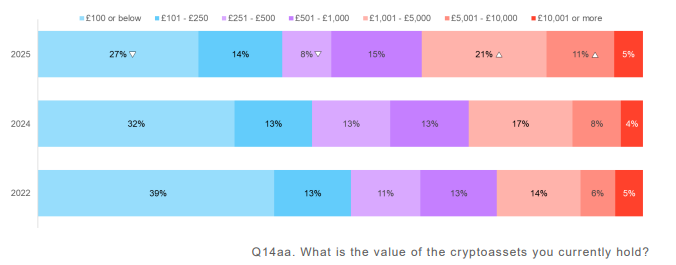
Reports have disclosed that the mix of holdings has shifted upward. The proportion of holders with crypto worth between Β£1,001 and Β£5,000 rose to over 20%, and those with holdings of Β£5,001 to Β£10,000 increased to around 10%.

At the same time, reported small holdings under Β£100 have declined. Many users also reported net gains in 2025, with a majority saying their portfolios rose in value over the year.

Among people who still hold crypto, Bitcoin is the most common asset at 57%, followed by Ether at 43%. Other tokens are far less widely held, though Solana registers with about 21% of holders. These figures point to concentration in a few large names even as overall participation shrinks.

Regulators Move To Tighten Rules

The FCA published this research as part of a broader push to bring the sector under clearer rules. The regulator has launched consultations on proposals covering trading platforms, market safeguards and rules for staking, lending and custody. Reports show the consultation process is part of a wider government plan that aims to start formal regulation of cryptoassets by October 2027.

What This Means For Markets And Consumers

Traders and platforms will likely watch these trends closely. A smaller base of retail owners can mean less retail-driven volatility, but it can also reduce everyday familiarity with crypto in the wider public.

At the same time, higher average portfolio sizes raise the stakes for consumer losses when markets wobble. The FCA’s work on clearer rules comes amid growing government attention to market integrity and consumer protection.

In short, fewer Britons now report owning crypto, yet those who remain tend to hold larger sums and favor the top coins. The figures from the FCA suggest a market that is thinning at the edges while concentration and regulatory scrutiny rise.

Featured image from Unsplash, chart from TradingView
Before yesterdayMain stream

UK Crypto Ownership Plunges to 8% β€” But High-Value Portfolios Are Soaring

16 December 2025 at 14:02

Crypto ownership in the UK dropped noticeably in 2025, even as the investors who stayed in the market continued to build larger holdings, according to new figures from the Financial Conduct Authority (FCA).

The data from FCA’s Cryptoassets Consumer Research 2025 report shows that 8% of UK adults currently own some form of cryptocurrency. That is down from 12% a year earlier, marking the first clear decline in participation since crypto use surged during the pandemic.

Source: FCA

While fewer people now hold digital assets, ownership has not fallen back to early levels. In 2021, just 4% of adults reported owning crypto, meaning today’s figure is still roughly double what it was four years ago.

The figures point to a market that is becoming smaller but more concentrated. Rather than attracting new entrants, crypto ownership appears to be shifting toward existing users who are committing more capital and holding their assets for longer periods.

Crypto Ownership in the UK Still Dominated by 18–34 Age Group

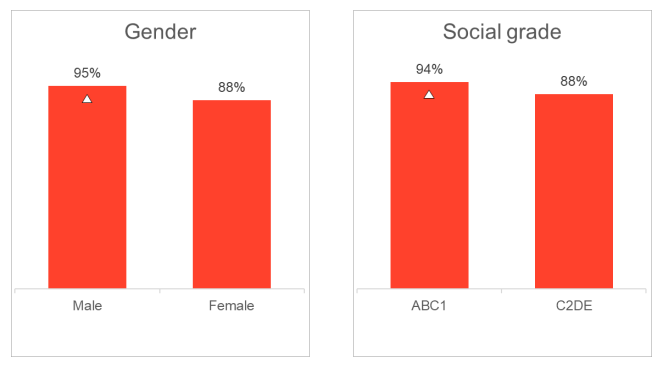
The profile of crypto holders has remained broadly consistent. Ownership is higher among men at 11%, compared with women, and is most concentrated among people aged 18 to 34, where 15% report holding crypto.

Source: FCA

Overall public awareness of crypto remains high, with 91% of respondents saying they have heard of cryptocurrencies, matching 2024 levels and continuing a multi-year trend of widespread familiarity.

Individuals from ethnic minority backgrounds and higher-income social grades are also more likely to own digital assets, according to the FCA’s nationally representative survey of more than 2,300 respondents.

Source: FCA

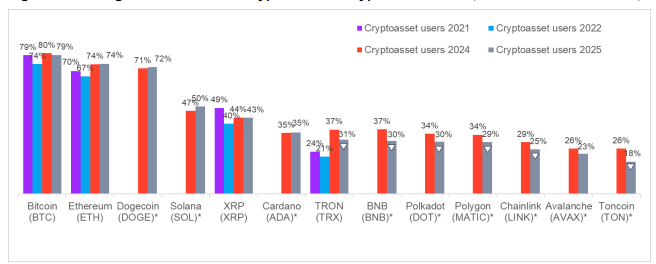
Bitcoin remains the most commonly held cryptoasset, owned by 57% of users, and recorded a five-percentage-point recovery after several years of declining ownership.

Ethereum followed at 43%, largely unchanged from 2024. Also, other assets were held at much lower levels, with Solana, Dogecoin, XRP, and Cardano the most commonly mentioned beyond the two market leaders.

Small Holders Exit as High-Value Crypto Portfolios Grow

Behind the headline decline in ownership, the report shows a steady shift toward higher-value holdings.

The share of users holding Β£1,001 to Β£5,000 in crypto rose to 21%, up four percentage points from 2024, while those holding Β£5,001 to Β£10,000 increased to 11%, up three points.

Source: FCA

At the same time, the number of people holding Β£100 or less continued to fall, extending a trend seen over several years.

The FCA noted that the difference between high- and low-value holders has widened since last year, particularly in motivations linked to long-term investing.

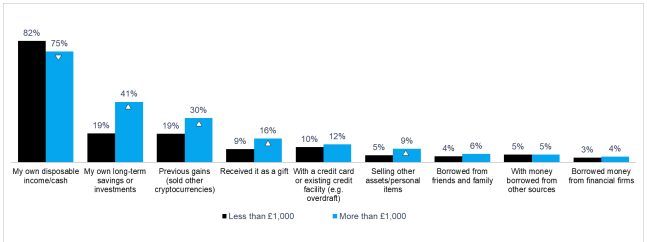
Most crypto purchases continue to be funded using personal cash.

Around 76% of users relied on disposable income, while 25% used long-term savings and 19% used previous investment gains.

Source: FCA

The use of credit cards or borrowing fell further, with just 9% reporting credit-based purchases, down five percentage points from 2024.

The data also suggests that new adoption is slowing, noting that only 5% of crypto owners first bought assets after October 2024, while most entered the market between 2019 and 2021.

Incentives such as rewards or promotions also declined, with just 17% of users reporting receiving one in the past six months.

Source: FCA

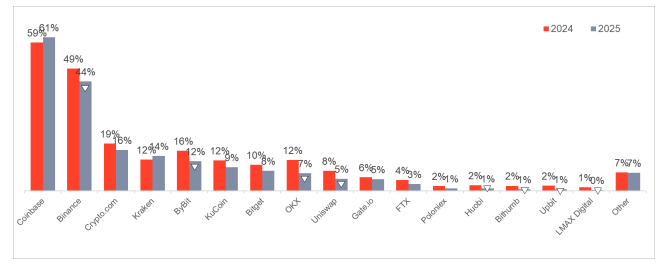
The report also noted centralized exchanges remain the dominant access point, used by 73% of UK crypto users, an increase from last year. Coinbase and Binance remained the most widely used platforms, though Binance’s share declined.

UK Ranks 11th in Global Crypto Adoption as regulation gets clearer

The findings come as the UK continues to reshape its regulatory framework. In 2025, the government introduced legislation to bring crypto activities under the FCA’s supervision while also formally recognizing digital assets as personal property under UK law.

πŸ‘¨πŸ»β€βš–οΈ The UK has formally recognized cryptocurrencies and stablecoins as legal property through a new Act of Parliament.#UK #Cryptohttps://t.co/I68t8BBZoD

β€” Cryptonews.com (@cryptonews) December 3, 2025

Full implementation of the regime is not expected until 2027, but the FCA has already accelerated approvals and launched consultations covering trading, staking, lending, and decentralized finance.

Globally, the UK ranked 11th in Chainalysis’ crypto adoption index, behind countries such as India, the United States, Brazil, and Vietnam.

The post UK Crypto Ownership Plunges to 8% β€” But High-Value Portfolios Are Soaring appeared first on Cryptonews.

UK To Bring Crypto Under Financial Services Laws By 2027

16 December 2025 at 00:00

According to reports, the UK Treasury will extend existing finance laws to cover cryptoasset firms, with the new rules set to take effect in October 2027.

This means exchanges, wallet providers and other crypto service companies will move beyond current anti-money-laundering registration and into the same regulatory space as banks and brokers.

Regulators To Apply Existing Rules

Based on statements from ministers and officials, the Financial Conduct Authority will be the main supervisor for the sector. Firms will be required to meet standards on reporting, governance and customer protections similar to those applied in traditional finance.

The shift is described as bringing clarity for businesses that want to operate long term in the UK, while giving regulators tools to act against fraud and market abuse.

UK TO REGULATE CRYPTO UNDER FINANCIAL LAW FROM 2027

– The UK will bring cryptocurrencies like Bitcoin under full financial regulation from 2027, placing crypto alongside traditional financial products, per Reuters.

– The Treasury plans to extend existing financial laws to… pic.twitter.com/RhWK96NN51

β€” BSCN (@BSCNews) December 15, 2025

Consumer Safeguards And Market Integrity

Reports have disclosed that one of the core aims is stronger consumer protection. Officials say the changes will help block bad actors and reduce scams, and that the Treasury is also considering tighter rules around political donations made with crypto. The move follows a series of high-profile fraud cases and growing public concern about safety in crypto markets.

The road to full regulation will be gradual. The Treasury has circulated draft legislation and ministers expect complementary rules from the FCA and the Bank of England to be ready by the end of 2026, ahead of the legal regime going live in 2027. Consultations and regulatory sandboxes are under way, giving firms time to adjust.

How This Compares Internationally

Based on reports, the UK’s plan is being framed more like the US approach than the EU’s Markets in Cryptoassets (MiCA), which was introduced in 2024.

Officials say closer alignment with US practice should help international firms that operate across borders, but it also raises questions about how UK rules will differ from both US and EU requirements in practice.

A draft bill has been prepared and it has had only minor edits since first being published, according to government sources.

Industry responses are mixed: some firms welcome the certainty, while lawyers and trade groups want clearer detail on how existing conduct rules will apply to crypto business models. The FCA is running targeted workstreams, including tests for stablecoin issuers and custody providers.

Featured image from Unsplash, chart from TradingView
UK to roll out cryptocurrency regulations by 2027 under FCA oversight

By: Rony Roy
15 December 2025 at 01:43
The UK’s Treasury department hopes to finalize its cryptocurrency regulations by late 2027 by bringing the sector under a regulatory framework that mirrors oversight in traditional markets. According to a report from The Guardian, the crypto sector, which has been…

Britain to Begin Crypto Regulation Under FCA Starting 2027, Treasury Says

14 December 2025 at 22:56

The UK Treasury is drafting rules to bring crypto under the FCA supervision, starting in 2027. Digital assets will be regulated similar to other financial products under the legislation, the finance ministry said in a statement.

Reuters reported Monday that Britain is moving to formally regulate crypto from October 2027.

The move would provide β€œclear rules of the road” and keep β€œdodgy actors” out of the market, said Chancellor Rachel Reeves. She added that the rules will hand β€œstrong consumer protections.”

β€œBringing crypto into the regulatory perimeter is a crucial step in securing the UK’s position as a world-leading financial centre in the digital age,” the Chancellor noted.

The European Union introduced a similar legislation (MiCA) one year ago, while the US is progressing with its own set of rules for crypto regulation.

Britain seeks to collaborate with the US to foster crypto regulation and innovation through the β€œTransatlantic Taskforce”. The UK will introduce a draft bill into Parliament later today.

Crypto Regulation Under FCA Supervision

The new set of rules would place crypto firms, including exchanges and digital wallets, under the purview of the Financial Conduct Authority (FCA).

This means the crypto services are regulated in the same way as other financial products, including by being subject to transparency standards, The Guardian reported.

Lucy Rigby, the minister for the City of London, said that these new rules β€œwill give firms the clarity and consistency they need to plan for the long term.”

Besides, recent data from the financial regulator shows around 12% of UK adults hold some form of cryptocurrency, a figure that has risen steadily in recent years.

As a result, the UK formally recognized Bitcoin and crypto assets as legal property under a new Act of Parliament. Under the law, digital assets can be owned, inherited, and recovered.

Regulator, Bank to Finalize Own Rules by End 2026

Separately, the UK FCA is planning rules for trading and market abuse, custody and issuance. Additionally, the Bank of England last month unveiled its proposals for regulating stablecoins.

Both the BoE and the FCA have promised to finalize their rules by end-2026, the Reuters report added.

The crypto regulatory rulebook plans come at a time when crypto has suffered from market turbulence and several digital asset scams recently.

The amount of money lost to investment scams by UK crypto consumers has leapt 55% in a year, per official UK banking industry data.

Separately, ministers are also drawing up plans to ban crypto political donations, raising red flags about their unverifiable origin and ownership.

The post Britain to Begin Crypto Regulation Under FCA Starting 2027, Treasury Says appeared first on Cryptonews.

UK advances crypto rules with FCA sandbox tests involving Coinbase, Crypto.com and Kraken

26 November 2025 at 08:47
  • The tests will use standardised templates with major exchanges including Coinbase, Crypto.com and Kraken.
  • The project links to the earlier Admissions and Disclosures Discussion Paper.
  • The experiments sit within the FCA’s multi-year Crypto Roadmap ending in 2026.

The United Kingdom is pushing ahead with a practical form of crypto regulation, and the latest move by the Financial Conduct Authority shows how the country plans to shape its rulebook.

The FCA has approved RegTech firm Eunice to carry out live experiments in its sandbox, creating a clearer picture of how future rules may be built through real-world testing rather than theory.

On Wednesday, the regulator confirmed that Eunice will test standardised crypto disclosure templates with major exchanges such as Coinbase, Crypto.com and Kraken.

The templates are designed to check whether transparency improves when tools are used directly in active market conditions.

Industry input

The FCA said its sandbox is still open to companies working on similar solutions, and it continues to encourage firms to apply. The regulator’s message points to a broader shift.

The UK wants to rely on practical experiments to understand how crypto behaviours unfold in real time, instead of relying only on policy consultation rounds.

This approach moves industry participants closer to the centre of rule formation. It also gives the regulator the chance to observe how products behave before final guidance is introduced.

Eunice’s work fits this model, focusing on ways to strengthen transparency in a market that is seeing increased institutional involvement.

The trial also links back to the Admissions and Disclosures Discussion Paper published last year. That paper invited the industry to share technical insight and help shape early frameworks.

The new pilot now tests those ideas under live conditions, allowing the FCA to gather evidence on how different disclosure requirements perform when applied at scale.

Broader roadmap

The Eunice experiment also aligns with the regulator’s multi-year Crypto Roadmap, which is expected to end with the publication of the UK’s final crypto rules in 2026.

Over the past year, the FCA has introduced several changes aimed at increasing clarity for crypto companies.

These include stricter financial promotion rules, warnings issued to unregistered exchanges still operating in the UK and a comprehensive paper covering admissions, disclosures and market-abuse concerns across digital assets.

Each step forms part of a longer regulatory timeline that aims to tighten standards while preserving room for innovation. The use of the sandbox allows the FCA to test what works and what does not before decisions are written into policy.

Shifting tone

More recent actions suggest the regulator is becoming more open to crypto activity under controlled conditions. On 1 August, the FCA lifted its ban on crypto exchange-traded notes for retail investors.

This allowed consumers to access crypto-based ETN products again, signalling a more flexible approach to digital assets. On 17 September, the FCA launched a consultation on whether Consumer Duty should apply to crypto.

This traditional finance requirement focuses on ensuring firms deliver good outcomes for customers. Extending it to crypto would raise expectations around product design, risk communication and market conduct.

The regulator’s move to work with Eunice fits into this shift. By focusing on trials inside the sandbox, the FCA is building a system that responds to real behaviour rather than assumptions.

The decision also supports the UK’s long-term plan to use evidence gathered from ongoing experiments to shape final rules.

The sandbox programme will continue to influence how the UK designs its next phase of crypto regulation.

As new projects enter the environment, the FCA will gather more insight into how disclosure tools perform, how markets react and how different rules might work once introduced.

The Eunice trial marks an early step in this process, and future policy decisions are expected to draw heavily on the findings produced through these real-world tests.

The post UK advances crypto rules with FCA sandbox tests involving Coinbase, Crypto.com and Kraken appeared first on CoinJournal.

❌
❌