
Normal view

There are new articles available, click to refresh the page.
Yesterday — 5 December 2025Main stream

Exposed: “Ramarxyz” Sniped 70% of $WET Presale With 1,000+ Wallets – Then Demanded Refund

5 December 2025 at 14:00

A chaotic token launch on Solana has placed decentralized finance platform HumidiFi and Jupiter Exchange under intense scrutiny after blockchain investigators linked a single actor to the mass botting of the $WET public presale, capturing the majority of the allocation within seconds.

According to a detailed on-chain investigation published by Bubblemaps, one entity operating under the alias “Ramarxyz” used more than 1,000 wallets to claim roughly 70% of the $WET public presale allocation.

BREAKING: We found the identity of the $WET sniper

"Ramarxyz" claimed 70% of the @HumidiFi presale using 1,000+ wallets

Then dared to ask for a refund

🧵pic.twitter.com/YhWnOrZRNZ

— Bubblemaps (@bubblemaps) December 5, 2025

The sale, which took place through Jupiter’s Decentralized Token Formation (DTF) launchpad, sold out in just two seconds before most retail participants could interact.

HumidiFi Confirms Bot Attack as Blockchain Data Traces Sale to One Actor

HumidiFi later confirmed that a large bot farm had overwhelmed the public sale. Bubblemaps found that at least 1,100 of the 1,530 participating addresses were controlled by the same actor.

The wallets followed a repetitive funding pattern, with each receiving exactly 1,000 USDC from centralized exchanges shortly before the sale.

Source: Bubblemaps

One wallet allegedly broke the pattern by receiving funds from a private address that could be traced to the Twitter handle @ramarxyz through previous public blockchain activity.

Rather than acknowledging the activity, the individual later publicly suggested that HumidiFi should refund the sniper’s allocation, despite being linked to the exploit.

Shortly afterward, HumidiFi confirmed that all suspected bot allocations had been canceled and that legitimate presale participants would instead receive a prorated airdrop.

A separate on-chain analysis by trader Gautam Mgg showed that 4% of the public allocation went to just 10 wallets, with four wallets alone committing 40% of the entire public sale supply using bots.

🚨 $WET @humidifi : 4% Public Sale Supply went to just 10 wallets

Presale was completely botted, basically rugged And yes, @JupiterExchange is also at fault.

Here’s the proof: These 4 wallets alone committed 40% of the 4% public sale allocation using bots (finding more… pic.twitter.com/5dGz3bHwjZ

— Gautamgg 🕵 (@Gautamguptagg) December 4, 2025

The wallets were publicly listed using Solana explorers. Gautam also blamed Jupiter Exchange for failing to introduce basic bot protection measures, such as CAPTCHA or last-minute address rotation.

Jupiter had earlier announced that the $WET token sale was fully completed, raising $5.57 million across its Wetlist, JUP stakers, and public sale phases.

It’s official: Public sale phase for $WET has SOLD OUT!

The Decentralized Token Formation for @HumidiFi is now officially concluded, raising a grand total of $5.57m across the Wetlist, JUP stakers and public sale phases.$WET token for successful contributors will be claimable… pic.twitter.com/o5Hleg91z1

— Jupiter (🐱, 🐐) (@JupiterExchange) December 4, 2025

The public phase offered 30 million tokens at $0.069 per token, capped at $1,000 USDC per wallet. The token is scheduled to become claimable on December 9 alongside the launch of liquidity pools.

HumidiFi to Reissue Token After Aborting Disrupted $WET Launch

Following the incident, HumidiFi announced it would abandon the compromised launch and create a new token instead.

The protocol said all legitimate Wetlist and JUP staker participants would receive a pro-rata airdrop under a newly deployed contract that has been audited. A new public sale is now scheduled.

Some real dry shit happened today.

Humidifi started 6 months ago from nothing, straight from the trenches of DeFi 1.0.

In those 6 months, for SOL-USD, we started quoting tighter and doing more volume than Binance. We did not kiss any ass or bend the knee to anyone. We started…

— HumidiFi (@humidifi) December 5, 2025

HumidiFi launched in mid-2025 and has grown into one of Solana’s most active decentralized exchanges, processing over $1 billion in daily trading volume and often accounting for more than one-third of all spot trading on the network.

According to DefiLlama, its Dex volume currently sits close to $30 billion over 30 days, while its cumulative volume sits at over $122 billion.
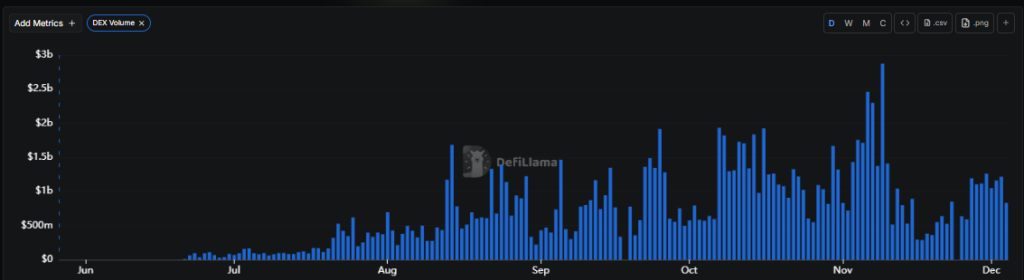
The $WET token was introduced as the protocol’s staking and fee-rebate asset and was promoted as a community-driven distribution using Jupiter’s DTF platform.

The incident has revived broader concerns over token distribution fairness across launchpads.

In September, Bubblemaps also flagged a separate Sybil attack linked to the MYX token airdrop, where roughly 100 newly created wallets claimed nearly $170 million in tokens after being funded simultaneously from OKX.

That case similarly raised questions about identity controls and launch design weaknesses.

Jupiter DTF was introduced as a transparent, trust-minimized alternative to traditional token launches, combining curation and on-chain verification. The $WET sale was its first live deployment, making the failure a major test for the model.

Neither Jupiter Exchange nor the individuals accused have issued a detailed technical breakdown of what failed at the infrastructure level.

The post Exposed: “Ramarxyz” Sniped 70% of $WET Presale With 1,000+ Wallets – Then Demanded Refund appeared first on Cryptonews.

Before yesterdayMain stream

Ripple Reveals How It’s Hijacking A $16 Trillion Industry Using The XRP Ledger

3 December 2025 at 11:00

Crypto firm Ripple has revealed how it is capturing the projected $16 trillion tokenization industry by onboarding several institutions onto the XRP Ledger (XRPL). The firm alluded to security and how its custody service is helping solve this issue. 

Ripple Comments On How It Is Capturing The Tokenization Industry Using XRP Ledger

In an X post, Ripple indicated that it has managed to capture some of the projected $16 trillion industry onto the XRP Ledger through the adequate security it provides institutions. The crypto firm stated that it provides a security environment that mirrors the rigor of the banks it serves, combining HSM with FIPS-certified hardware to deliver security that scales. That way, they can protect assets without sacrificing operational speed. 

Ripple further noted that legitimate integration with the global financial system requires verification. That is why they adhere to SOC 2 Type II and ISO 27001 standards, ensuring that the infrastructure of these institutions that tokenize on the XRP Ledger is compliant with necessary regulations.  

Commenting on this, Ripple’s Head of Information Security, Akshay Wattal, said that in crypto, security isn’t a feature but the foundation of institutional trust. He added that effective custody requires in-depth architecture, battle-tested cryptography, and the governance rigor of a global financial institution. 

Notably, Ripple provides custody solutions to global banks, including BBVA, SG Fogre, DBS Bank, and DZ Bank. However, these banks are yet to tokenize on the XRP Ledger even as institutions move to tap into this $16 trillion industry. The crypto firm continues to propose several ways to onboard these institutions onto the network. 

One of Ripple’s proposals is the introduction of Confidential Multi-Purpose Tokens (MPTs) on the XRP Ledger in order to provide privacy for these institutions. The company’s developer, Ayo Akinyele, also recently proposed native XRP staking on the network, which could compel these institutions to build on XRPL, as they can earn yields while doing so. 

Progress On Other Sides Of Its Business

In addition to its custody service, Ripple is also making progress in other areas of its operations, which also drives value to the XRP Ledger. The company announced yesterday that it had partnered with fintech company RedotPay, which has integrated Ripple Payments to launch a crypto conversion feature for Nigerian users. 

The development also provides a huge boost for XRP, which will be one of the supported assets on RedotPay’s “Send Crypto, Receive NGN” feature. Ripple revealed that there are plans to support its RLSUD stablecoin in the future. Meanwhile, Bitcoinist reported that the crypto firm had scored a major win after the Monetary Authority of Singapore approved an expanded scope of payment activities for the company. This enables Ripple to broaden the range of regulated payment services it offers in the country.

Ripple

ORO: Turning Real Gold Into Digital Treasure on Solana

13 November 2025 at 10:02

ORO is bringing ancient treasure into the future by transforming real, certified gold into fast, flexible digital assets on the Solana blockchain. Each $GOLD token represents one full troy ounce of LBMA- and UAE-certified physical gold stored in secure, regulated vaults — so you’re not dealing with make-believe money, but the real shiny stuff kings used to guard with dragons. The magic happens when this gold becomes “liquid” on Solana: you can trade it instantly, borrow against it, use it in DeFi, or even redeem it for actual physical gold through vault transfers, delivery (where available), or in-person pickup in the UAE. And since Solana is lightning-fast, moving your gold feels more like playing a game than handling a centuries-old store of value.

But ORO doesn’t stop at making gold modern — it makes it fun. Every time you buy, sell, or stake gold inside the ORO app, you earn Nuggets, a reward system that turns responsible investing into a treasure hunt. It’s like getting bonus points just for managing your money. With $1.5 million raised in its pre-seed round, ORO isn’t just a cool idea — it’s a rapidly growing protocol building the bridge between timeless stability and futuristic finance. Want to try it yourself? Your adventure begins here

— — — — — — — — — — — — — — — — — — — — — — — — — — — — — — —

Best Crypto Platforms? I got you covered:

- Kucoin -

Other Articles You Might Be Interested In:

You Can Also Reach Me Here If You Need Any Help

— — — — — — — — — — — — — — — — — — — — — — — — — — — — — — —

Disclaimer: The information provided in this article is for educational and informational purposes only. It does not constitute investment advice, financial advice, trading advice, or any other sort of advice. You should conduct your own research and consult with a professional before making any investment decisions. We are not responsible for any investment decisions you make based on the information provided in this article. Investing in any cryptocurrency or token involves risk, and you should only invest money that you are willing to lose.

Please note that this article was generated with the assistance of AI technology. While the content has been reviewed and edited by a human, some aspects of the language, structure, and arguments may have been suggested by the AI model.

Disclaimer: Please note that this article includes referral links. If you click on one of these links and make a purchase or sign up for a service, we may receive a commission at no additional cost to you. We only recommend products and services that we have personally used or thoroughly researched. Thank you for supporting our work.


ORO: Turning Real Gold Into Digital Treasure on Solana was originally published in Coinmonks on Medium, where people are continuing the conversation by highlighting and responding to this story.

Top Performing Utility Tokens and their Real-World Use Cases

13 November 2025 at 07:47
Top Performing Utility Tokens
Top Performing Utility Tokens

Cryptocurrencies are not speculative digital assets anymore, but they are powering the ecosystems, applications, and business models of the decentralized economy. Among these, utility tokens have emerged as the origin of blockchain projects, which allow users to access the features, services, and decentralized networks.

In a landscape often dominated by hype and volatility, utility tokens stand out for one simple reason: they do something. They represent actual value within an ecosystem, providing a gateway to functionality rather than serving purely as an investment instrument.

The article describes the most promising examples of utility tokens, how they are changing the blockchain ecosystem in the modern world, and why they make them worthwhile in the long run. In the process of decentralizing applications or even transforming data infrastructure, these tokens are a prime example of how blockchain is shifting from speculation into the concept of utility.

What are Utility Tokens?

Utility tokens are digital tokens that are designed to give access to a product or service in a blockchain-based ecosystem. These are intended to drive participation, whether as paying transaction fees or accessing decentralized storage, voting on governance proposals, or staking to secure a network. They are placed at the intersection of innovation and usability, and allow the blockchain networks to be operational for both users and developers.

With the increasing adoption of blockchain, utility tokens have taken on essential roles in real-world use cases, including digital identity and games, decentralized finance (DeFi), and infrastructure protocols.

Top 5 Utility Tokens Leading the Charge

The following tokens exemplify real, working use cases that extend far beyond speculation. Each of them showcases how blockchain utility is evolving into something tangible that is scalable, functional, and integrated with mainstream industries.

BNB — Powering One of the Largest Blockchain Ecosystems

BNB (Build and Build) functions as the native utility token of one of the most active blockchain ecosystems. It’s used for transaction fees, staking, and payments across an expanding network of applications.

Its most prominent use is reducing transaction fees within the ecosystem, creating an incentive for traders and users alike. More than that, BNB can be used as fuel to support the BNB Chain, which provides smart contracts, decentralized apps (dApps), and Web3 services.

The performance metrics reflect the steady increase in transactions, provided by NFT integrations, DeFi applications, and corporate partnerships. The takeaway here is clear: A robust ecosystem will inherently lead to a token demand, transforming utility into long-term value.

ETH — The Foundational Utility Token Redefining DeFi

The ETH of Ethereum will be the prototype of utility tokens, which will be used as gas during transactions and the execution of smart contracts. It forms the basis of decentralized finance and the overall Web3 ecosystem.

Since it switched to a proof-of-stake mechanism, ETH has become more efficient and environmentally sustainable. The deflationary tokenomics of the network, where part of the ETH gets burned with each transaction, has introduced an economic dimension that strengthens the value proposition.

What makes ETH the “default utility benchmark” is its adaptability. It drives innovation at scale, from decentralized exchanges to metaverse platforms, proving that real utility can coexist with mainstream adoption.

SOL — Utility at the Speed of Scale

The SOL token of Solana is a demonstration of efficiency. It is described by large throughput and low transaction costs, which facilitate a fast-growing ecosystem of decentralized applications, NFT platforms, and payment systems.

Developers and enterprises are adopting Solana because of its ability to support thousands of transactions per second, which is a core characteristic of a Web3 world, and where scalability is a significant strength.

Solana Pay and game integrations are examples of use cases that indicate how SOL is making blockchain more connected to a user-friendly digital experience.

SOL demonstrates that utility isn’t just about purpose; it’s also about performance and accessibility.

LINK — The Bridge Between Blockchain and the Real World

Chainlink’s LINK token serves as the economic backbone of decentralized oracle networks. It is simplified as a process of introducing real-life data, such as market prices, weather news, and API data, to blockchain systems.

This feature is essential to the DeFi industry, as it allows smart contracts to communicate with external data securely. The partnerships of LINK with major players in the traditional finance market and cloud services are indicative of the increased institutional trust in blockchain interoperability.

It represents “utility infrastructure”, a token whose value derives from enabling others to function effectively.

AR — Utility in Permanent Data Storage

Arweave’s AR token introduces a new concept, which is permanent data storage. Unlike conventional cloud services, Arweave allows users to pay once to store data indefinitely on a decentralized network.

This concept appeals to projects needing immutable recordkeeping from archives and legal data to digital art. The trend towards “forever data” is increasing, and AR is at the centre of the change in the world of Web3.

Its real-world utility reaches into the maintenance of historical information and the support of decentralized applications that emphasize long-term transparency.

Key Sectors Driving the Growth of Utility Tokens

Utility tokens cover a wide range of industries, and each unlocks the various aspects of blockchain functionality:

  • Finance and DeFi: Tokens like ETH and LINK enable decentralized trading, lending, and liquidity provisioning.
  • Infrastructure: Tokens such as BNB and SOL drive ecosystems and developer platforms.
  • Data Storage: AR and similar tokens create frameworks for secure and permanent storage.
  • Gaming and Entertainment: Utility tokens fuel in-game economies and NFT marketplaces, connecting creators with users in transparent ecosystems.

These categories demonstrate how utility tokens form the foundation of blockchain usability, driving adoption across diverse industries.

To explore how utility tokens are built and integrated into modern blockchain ecosystems, you can refer to this detailed guide on utility token development, which explains their lifecycle from creation to deployment.

What Makes a Utility Token Sustainable

Not all tokens endure beyond their hype cycle. The sustainability of a utility token depends on several key factors:

  • Strong Ecosystem Demand — Consistent real-world use cases ensure value stability.
  • Clear Tokenomics — Transparent supply mechanisms and deflationary models help maintain price integrity.
  • Active Development Community — Regular updates and developer engagement sustain innovation.
  • Regulatory Clarity — Compliance helps projects scale without facing legal uncertainty.

A utility token with a defined purpose, active users, and a healthy economy tends to survive and thrive through market cycles.

Are Utility Tokens Safe from SEC Scrutiny?

Although utility tokens are not considered to be securities, regulators tend to evaluate whether they satisfy the Howey Test of investment contracts. Projects that offer tokens on pure speculation might be subject to scrutiny.

Nonetheless, tokens that have already demonstrated their functionality and integration into an ecosystem are more likely to retain their utility asset status. The key lies in transparency and aspects of use-case validation, which properly designed blockchain projects are now considering are becoming their priority to changes in regulatory frameworks.

Understanding the Investment Potential

Utility tokens may have long-term value to individuals who comprehend their ecosystem. It should also be focused on functionality and adoption as opposed to the price fluctuations in the short term. In assessing tokens, pay attention to such aspects as network activity, volume of transactions, and developer engagement.

Also Read>>> https://cryptiecraft.com/utility-token-vs-security-token-explained/

Common Myths about Utility Tokens

Myth 1: Utility tokens are just for tech experts.

Reality: Many platforms now simplify interaction through user-friendly apps and wallets.

Myth 2: They hold no financial value.

Reality: Their value is tied to real usage and demand, not speculation alone.

Myth 3: Utility tokens are all the same.

Reality: Each has a distinct function depending on its ecosystem, from powering transactions to enabling governance.

The Future of Utility Tokens

The future of utility tokens will be interoperability across chains, the integration of AI, and the tokenization of real-world assets. With the further evolution of blockchain technology, these tokens will become the foundation of decentralized services, uniting individuals, enterprises, and governments. They are becoming instruments of access to engines of digital transformation.

Upshots,

Utility tokens represent the essence of blockchain innovation in a practical, scalable, and purpose-driven sense. Their real power is not in speculation but rather in their ability to increase the digital interaction, decentralization, and transparency.

To entrepreneurs and developers who might want to develop their own blockchain solution, partnering with a crypto token development company can enable the process from idea to implementation in a short period of time. With the proper strategy, your token to go beyond the theory and become a real value in its ecosystem.


Top Performing Utility Tokens and their Real-World Use Cases was originally published in Coinmonks on Medium, where people are continuing the conversation by highlighting and responding to this story.

Guide to Listing Tokens on Centralized Exchanges

By: Dr-Hack
16 April 2024 at 14:29

There are hundreds of new crypto projects arising as the market is awakening after the long downtrend. The ultimate goal of every young project is to list token on exchange and gain exposure to a wide audience of traders and investors. The most efficient way is to list tokens on centralized exchanges (CEXs), for they provide a reliable and compliant trading environment. This article explains why listing on CEXs is so beneficial for new projects and how to list tokens correctly.

Benefits of CEX listing

Here are the benefits projects get with listing on CEX:

  • High liquidity. After listing, tokens become accessible to a broad audience of traders who start trading them and boost their liquidity. 
  • Greater base of crypto for institutional investors. Listing on a CEX increases tokens' visibility and credibility in the market. New market participants now know about the token and feel confident about its credibility.
  • Possible price growth. With the token becoming visible and tradeable, its trading volume will likely grow. It can potentially increase the price as well.
  • Compliance. Many CEXs fully comply with regulations. Listing tokens means a thorough check of the projects behind them. A listen token means the project was checked and approved by the CEX.
  • CEXs offer advanced trading tools such as margin and futures, which may also boost liquidity. 

Crucial Steps for Listing a Token on CEX

Here are the steps to list your token:

  • Choose an exchange. Evaluate trading volumes of different platforms. Choose those with higher volumes, which means greater liquidity.
  • Prepare documents. See the exchange’s requirements and prepare all the needed documents about your token. That may include token audits, compliance with regulations (AML and KYC), whitepaper, etc.
  • Submit the request for listing your token. Provide all the necessary information to highlight the unique features of your token and value. Be active and engage with the exchange community. Arrange AMA (ask me anything) sessions and communicate your project through social media.
  • Discuss fees and terms. There may be a fixed fee for listing, or you may negotiate this with the exchange directly. 
  • Once you have successfully negotiated the fees and terms, the listing process starts. It includes the token’s smart contract integration into the exchange’s trading platform. 

Once all the technical issues are solved, the exchange will announce your token listing and the pairs it will be traded with. 

Conclusion

Token listings on CEX allow for greater liquidity, exposure, and accessibility of tokens to a wider range of potential investors. Being listed on a CEX can increase a token’s credibility and legitimacy, as well as provide a platform for price discovery.

The post Guide to Listing Tokens on Centralized Exchanges first appeared on Internet Security Blog - Hackology.

❌
❌