
Normal view

There are new articles available, click to refresh the page.
Before yesterdayMain stream

NASA Completes Nancy Grace Roman Space Telescope Construction

4 December 2025 at 10:00

NASA’s next big eye on the cosmos is now fully assembled. On Nov. 25, technicians joined the inner and outer portions of the Nancy Grace Roman Space Telescope in the largest clean room at the agency’s Goddard Space Flight Center in Greenbelt, Maryland.

The complete observatory in a clean room
NASA’s Nancy Grace Roman Space Telescope is now fully assembled following the integration of its two major segments on Nov. 25 at the agency’s Goddard Space Flight Center in Greenbelt, Md. The mission is slated to launch by May 2027, but the team is on track for launch as early as fall 2026.
Credit: NASA/Jolearra Tshiteya

“Completing the Roman observatory brings us to a defining moment for the agency,” said NASA Associate Administrator Amit Kshatriya. “Transformative science depends on disciplined engineering, and this team has delivered—piece by piece, test by test—an observatory that will expand our understanding of the universe. As Roman moves into its final stage of testing following integration, we are focused on executing with precision and preparing for a successful launch on behalf of the global scientific community.”

After final testing, Roman will move to the launch site at NASA’s Kennedy Space Center in Florida for launch preparations in summer 2026. Roman is slated to launch by May 2027, but the team is on track for launch as early as fall 2026. A SpaceX Falcon Heavy rocket will send the observatory to its final destination a million miles from Earth.

“With Roman’s construction complete, we are poised at the brink of unfathomable scientific discovery,” said Julie McEnery, Roman’s senior project scientist at NASA Goddard. “In the mission’s first five years, it’s expected to unveil more than 100,000 distant worlds, hundreds of millions of stars, and billions of galaxies. We stand to learn a tremendous amount of new information about the universe very rapidly after Roman launches.”
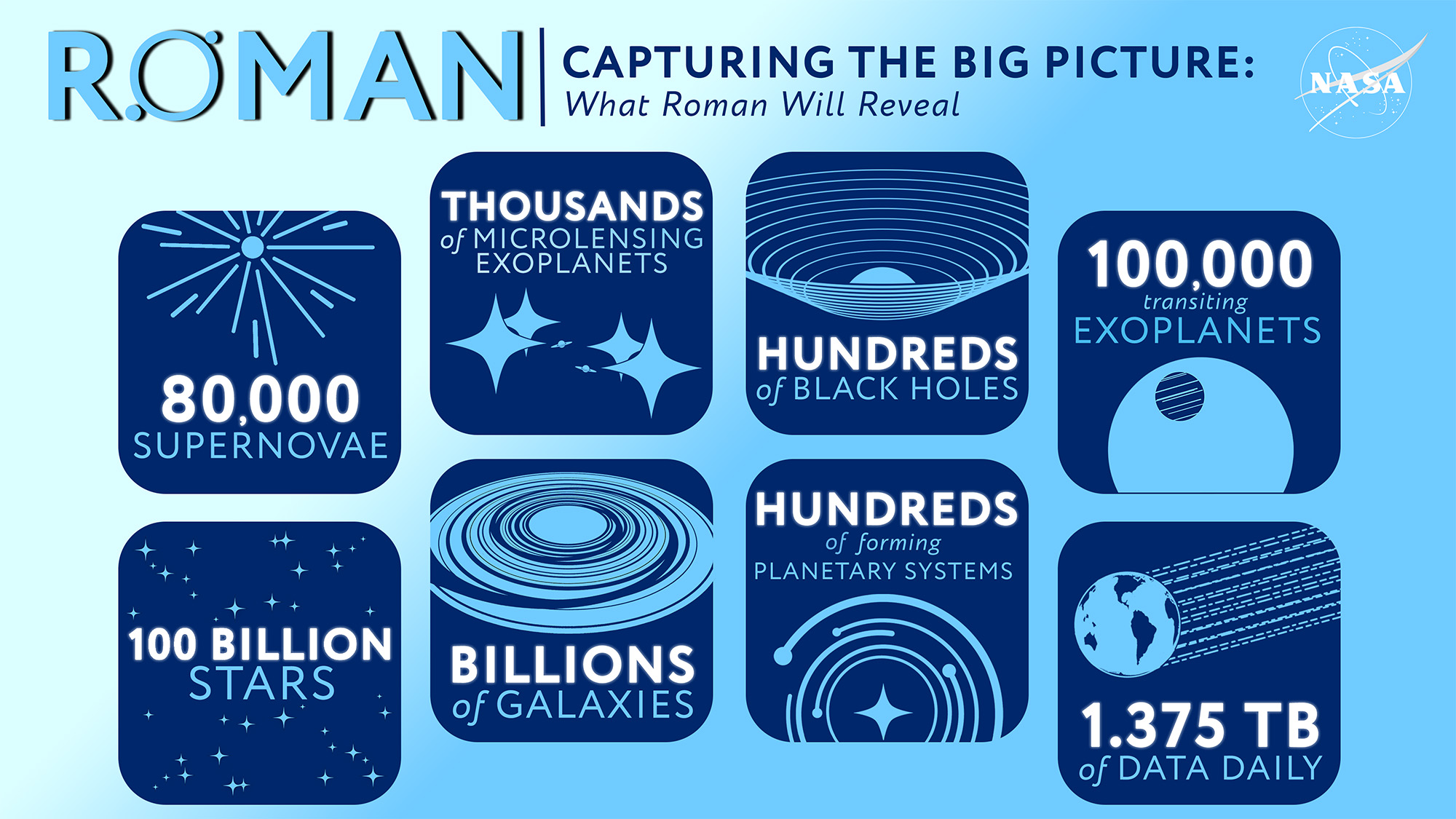
An infographic tallying up several things Roman will observe
NASA’s Nancy Grace Roman Space Telescope will survey vast swaths of sky during its five-year primary mission. During that time, scientists expect it to see an incredible number of new objects, including stars, galaxies, black holes and planets outside our solar system, known as exoplanets. This infographic previews some of the discoveries scientists anticipate from Roman’s data deluge.
Credit: NASA’s Goddard Space Flight Center

Observing from space will make Roman very sensitive to infrared light — light with a longer wavelength than our eyes can see — from far across the cosmos. Pairing its crisp infrared vision with a sweeping view of space will allow astronomers to explore myriad cosmic topics, from dark matter and dark energy to distant worlds and solitary black holes, and conduct research that would take hundreds of years using other telescopes.

“Within our lifetimes, a great mystery has arisen about the cosmos: why the expansion of the universe seems to be accelerating. There is something fundamental about space and time we don’t yet understand, and Roman was built to discover what it is,” said Nicky Fox, associate administrator, Science Mission Directorate, NASA Headquarters in Washington. “With Roman now standing as a complete observatory, which keeps the mission on track for a potentially early launch, we are a major step closer to understanding the universe as never before. I couldn’t be prouder of the teams that have gotten us to this point.”

Double vision

Roman is equipped with two instruments: the Wide Field Instrument and the Coronagraph Instrument technology demonstration.

The coronagraph will demonstrate new technologies for directly imaging planets around other stars. It will block the glare from distant stars and make it easier for scientists to see the faint light from planets in orbit around them. The Coronagraph aims to photograph worlds and dusty disks around nearby stars in visible light to help us see giant worlds that are older, colder, and in closer orbits than the hot, young super-Jupiters direct imaging has mainly revealed so far.

“The question of ‘Are we alone?’ is a big one, and it’s an equally big task to build tools that can help us answer it,” said Feng Zhao, the Roman Coronagraph Instrument manager at NASA’s Jet Propulsion Laboratory in Southern California. “The Roman Coronagraph is going to bring us one step closer to that goal. It’s incredible that we have the opportunity to test this hardware in space on such a powerful observatory as Roman.”

The coronagraph team will conduct a series of pre-planned observations for three months spread across the mission’s first year-and-a-half of operations, after which the mission may conduct additional observations based on scientific community input.

The Wide Field Instrument is a 288-megapixel camera that will unveil the cosmos all the way from our solar system to near the edge of the observable universe. Using this instrument, each Roman image will capture a patch of the sky bigger than the apparent size of a full moon. The mission will gather data hundreds of times faster than NASA’s Hubble Space Telescope, adding up to 20,000 terabytes (20 petabytes) over the course of its five-year primary mission.

“The sheer volume of the data Roman will return is mind-boggling and key to a host of exciting investigations,” said Dominic Benford, Roman’s program scientist at NASA Headquarters.

Over the course of several hours, technicians meticulously connected the inner and outer segments of NASA’s Nancy Grace Roman Space Telescope, as shown in this time-lapse. Next, Roman will undergo final testing prior to moving to the launch site at NASA’s Kennedy Space Center in Florida for launch preparations in summer 2026.
Credit: NASA/Sophia Roberts

Survey trifecta

Using the Wide Field Instrument, Roman will conduct three core surveys which will account for 75% of the primary mission. The High-Latitude Wide-Area Survey will combine the powers of imaging and spectroscopy to unveil more than a billion galaxies strewn across a wide swath of space and time. Astronomers will trace the evolution of the universe to probe dark matter — invisible matter detectable only by how its gravity affects things we can see — and trace the formation of galaxies and galaxy clusters over time.

The High-Latitude Time-Domain Survey will probe our dynamic universe by observing the same region of the cosmos repeatedly. Stitching these observations together to create movies will allow scientists to study how celestial objects and phenomena change over time periods of days to years. That will help astronomers study dark energy — the mysterious cosmic pressure thought to accelerate the universe’s expansion — and could even uncover entirely new phenomena that we don’t yet know to look for.

Roman’s Galactic Bulge Time-Domain Survey will look inward to provide one of the deepest views ever of the heart of our Milky Way galaxy. Astronomers will watch hundreds of millions of stars in search of microlensing signals — gravitational boosts of a background star’s light caused by the gravity of an intervening object. While astronomers have mainly discovered star-hugging worlds, Roman’s microlensing observations can find planets in the habitable zone of their star and farther out, including worlds like every planet in our solar system except Mercury. Microlensing will also reveal rogue planets—worlds that roam the galaxy untethered to a star — and isolated black holes. The same dataset will reveal 100,000 worlds that transit, or pass in front of, their host stars.

The remaining 25% of Roman’s five-year primary mission will be dedicated to other observations that will be determined with input from the broader scientific community. The first such program, called the Galactic Plane Survey, has already been selected.

Because Roman’s observations will enable such a wide range of science, the mission will have a General Investigator Program designed to support astronomers to reveal scientific discoveries using Roman data. As part of NASA’s commitment to Gold Standard Science, NASA will make all of Roman’s data publicly available with no exclusive use period. This ensures multiple scientists and teams can use data at the same time, which is important since every Roman observation will address a wealth of science cases.

NASA’s freshly assembled Nancy Grace Roman Space Telescope will revolutionize our understanding of the universe with its deep, crisp, sweeping infrared views of space. The mission will transform virtually every branch of astronomy and bring us closer to understanding the mysteries of dark energy, dark matter, and how common planets like Earth are throughout our galaxy. Roman is on track for launch by May 2027, with teams working toward a launch as early as fall 2026. Credit: NASA’s Goddard Space Flight Center

Roman’s namesake — Dr. Nancy Grace Roman, NASA’s first chief astronomer — made it her personal mission to make cosmic vistas readily accessible to all by paving the way for telescopes based in space.

“The mission will acquire enormous quantities of astronomical imagery that will permit scientists to make groundbreaking discoveries for decades to come, honoring Dr. Roman’s legacy in promoting scientific tools for the broader community,” said Jackie Townsend, Roman’s deputy project manager at NASA Goddard. “I like to think Dr. Roman would be extremely proud of her namesake telescope and thrilled to see what mysteries it will uncover in the coming years.”

The Nancy Grace Roman Space Telescope is managed at NASA’s Goddard Space Flight Center in Greenbelt, Maryland, with participation by NASA’s Jet Propulsion Laboratory in Southern California; Caltech/IPAC in Pasadena, California; the Space Telescope Science Institute in Baltimore; and a science team comprising scientists from various research institutions. The primary industrial partners are BAE Systems Inc. in Boulder, Colorado; L3Harris Technologies in Rochester, New York; and Teledyne Scientific & Imaging in Thousand Oaks, California.

To learn about the Roman Space Telescope, visit:

https://www.nasa.gov/roman

By Ashley Balzer
NASA’s Goddard Space Flight Center, Greenbelt, Md.

Media contact:

Claire Andreoli
NASA’s Goddard Space Flight Center, Greenbelt, Md.
301-286-1940

Share

Details

Last Updated
Dec 04, 2025
Editor
Ashley Balzer
Contact
Location
Goddard Space Flight Center

How AI is uncovering hidden geothermal energy resources

4 December 2025 at 08:00

Sometimes geothermal hot spots are obvious, marked by geysers and hot springs on the planet’s surface. But in other places, they’re obscured thousands of feet underground. Now AI could help uncover these hidden pockets of potential power.

A startup company called Zanskar announced today that it’s used AI and other advanced computational methods to uncover a blind geothermal system—meaning there aren’t signs of it on the surface—in the western Nevada desert. The company says it’s the first blind system that’s been identified and confirmed to be a commercial prospect in over 30 years. 

Historically, finding new sites for geothermal power was a matter of brute force. Companies spent a lot of time and money drilling deep wells, looking for places where it made sense to build a plant.

Zanskar’s approach is more precise. With advancements in AI, the company aims to “solve this problem that had been unsolvable for decades, and go and finally find those resources and prove that they’re way bigger than previously thought,” says Carl Hoiland, the company’s cofounder and CEO.  

To support a successful geothermal power plant, a site needs high temperatures at an accessible depth and space for fluid to move through the rock and deliver heat. In the case of the new site, which the company calls Big Blind, the prize is a reservoir that reaches 250 °F at about 2,700 feet below the surface.

As electricity demand rises around the world, geothermal systems like this one could provide a source of constant power without emitting the greenhouse gases that cause climate change. 

The company has used its technology to identify many potential hot spots. “We have dozens of sites that look just like this,” says Joel Edwards, Zanskar’s cofounder and CTO. But for Big Blind, the team has done the fieldwork to confirm its model’s predictions.

The first step to identifying a new site is to use regional AI models to search large areas. The team trains models on known hot spots and on simulations it creates. Then it feeds in geological, satellite, and other types of data, including information about fault lines. The models can then predict where potential hot spots might be.

One strength of using AI for this task is that it can handle the immense complexity of the information at hand. “If there’s something learnable in the earth, even if it’s a very complex phenomenon that’s hard for us humans to understand, neural nets are capable of learning that, if given enough data,” Hoiland says. 

Once models identify a potential hot spot, a field crew heads to the site, which might be roughly 100 square miles or so, and collects additional information through techniques that include drilling shallow holes to look for elevated underground temperatures.

In the case of Big Blind, this prospecting information gave the company enough confidence to purchase a federal lease, allowing it to develop a geothermal plant. With that lease secured, the team returned with large drill rigs and drilled thousands of feet down in July and August. The workers found the hot, permeable rock they expected.

Next they must secure permits to build and connect to the grid and line up the investments needed to build the plant. The team will also continue testing at the site, including long-term testing to track heat and water flow.

“There’s a tremendous need for methodology that can look for large-scale features,” says John McLennan, technical lead for resource management at Utah FORGE, a national lab field site for geothermal energy funded by the US Department of Energy. The new discovery is “promising,” McLennan adds.

Big Blind is Zanskar’s first confirmed discovery that wasn’t previously explored or developed, but the company has used its tools for other geothermal exploration projects. Earlier this year, it announced a discovery at a site that had previously been explored by the industry but not developed. The company also purchased and revived a geothermal power plant in New Mexico.

And this could be just the beginning for Zanskar. As Edwards puts it, “This is the start of a wave of new, naturally occurring geothermal systems that will have enough heat in place to support power plants.”

Why the grid relies on nuclear reactors in the winter

4 December 2025 at 06:00

As many of us are ramping up with shopping, baking, and planning for the holiday season, nuclear power plants are also getting ready for one of their busiest seasons of the year.

Here in the US, nuclear reactors follow predictable seasonal trends. Summer and winter tend to see the highest electricity demand, so plant operators schedule maintenance and refueling for other parts of the year.

This scheduled regularity might seem mundane, but it’s quite the feat that operational reactors are as reliable and predictable as they are. It leaves some big shoes to fill for next-generation technology hoping to join the fleet in the next few years.

Generally, nuclear reactors operate at constant levels, as close to full capacity as possible. In 2024, for commercial reactors worldwide, the average capacity factor—the ratio of actual energy output to the theoretical maxiumum—was 83%. North America rang in at an average of about 90%.

(I’ll note here that it’s not always fair to just look at this number to compare different kinds of power plants—natural-gas plants can have lower capacity factors, but it’s mostly because they’re more likely to be intentionally turned on and off to help meet uneven demand.)

Those high capacity factors also undersell the fleet’s true reliability—a lot of the downtime is scheduled. Reactors need to refuel every 18 to 24 months, and operators tend to schedule those outages for the spring and fall, when electricity demand isn’t as high as when we’re all running our air conditioners or heaters at full tilt.

Take a look at this chart of nuclear outages from the US Energy Information Administration. There are some days, especially at the height of summer, when outages are low, and nearly all commercial reactors in the US are operating at nearly full capacity. On July 28 of this year, the fleet was operating at 99.6%. Compare that with  the 77.6% of capacity on October 18, as reactors were taken offline for refueling and maintenance. Now we’re heading into another busy season, when reactors are coming back online and shutdowns are entering another low point.

That’s not to say all outages are planned. At the Sequoyah nuclear power plant in Tennessee, a generator failure in July 2024 took one of two reactors offline, an outage that lasted nearly a year. (The utility also did some maintenance during that time to extend the life of the plant.) Then, just days after that reactor started back up, the entire plant had to shut down because of low water levels.

And who can forget the incident earlier this year when jellyfish wreaked havoc on not one but two nuclear power plants in France? In the second instance, the squishy creatures got into the filters of equipment that sucks water out of the English Channel for cooling at the Paluel nuclear plant. They forced the plant to cut output by nearly half, though it was restored within days.

Barring jellyfish disasters and occasional maintenance, the global nuclear fleet operates quite reliably. That wasn’t always the case, though. In the 1970s, reactors operated at an average capacity factor of just 60%. They were shut down nearly as often as they were running.

The fleet of reactors today has benefited from decades of experience. Now we’re seeing a growing pool of companies aiming to bring new technologies to the nuclear industry.

Next-generation reactors that use new materials for fuel or cooling will be able to borrow some lessons from the existing fleet, but they’ll also face novel challenges.

That could mean early demonstration reactors aren’t as reliable as the current commercial fleet at first. “First-of-a-kind nuclear, just like with any other first-of-a-kind technologies, is very challenging,” says Koroush Shirvan, a professor of nuclear science and engineering at MIT.

That means it will probably take time for molten-salt reactors or small modular reactors, or any of the other designs out there to overcome technical hurdles and settle into their own rhythm. It’s taken decades to get to a place where we take it for granted that the nuclear fleet can follow a neat seasonal curve based on electricity demand. 

There will always be hurricanes and electrical failures and jellyfish invasions that cause some unexpected problems and force nuclear plants (or any power plants, for that matter) to shut down. But overall, the fleet today operates at an extremely high level of consistency. One of the major challenges ahead for next-generation technologies will be proving that they can do the same.

This article is from The Spark, MIT Technology Review’s weekly climate newsletter. To receive it in your inbox every Wednesday, sign up here.

Rare win for renewable energy: Trump admin funds geothermal network expansion

The US Department of Energy has approved an $8.6 million grant that will allow the nation’s first utility-led geothermal heating and cooling network to double in size.

Gas and electric utility Eversource Energy completed the first phase of its geothermal network in Framingham, Massachusetts, in 2024. Eversource is a co-recipient of the award along with the city of Framingham and HEET, a Boston-based nonprofit that focuses on geothermal energy and is the lead recipient of the funding.

Geothermal networks are widely considered among the most energy-efficient ways to heat and cool buildings. The federal money will allow Eversource to add approximately 140 new customers to the Framingham network and fund research to monitor the system’s performance.

Read full article

Comments

© Kevin Schafer via Getty Images

Horeb Energy and Veolia Are Mining Bitcoin At 2.5¢/kWh With Colombian Landfil Biogas

By: Juan Galt
3 December 2025 at 09:00

Bitcoin Magazine

Horeb Energy and Veolia Are Mining Bitcoin At 2.5¢/kWh With Colombian Landfil Biogas

Colombian Bitcoin and crypto mining company Horeb Energy reveals 2.5 cents per kWh of green biogas energy in the North Santander region of the Latin American country. The company has achieved energy prices 50% lower than the North American average of 3.5 to 6 cents per kwh for Bitcoin mining operations, through a strategic alliance with multinational energy company Veolia. 

Authorized in 1853 by Napoleon III to help build out public water works infrastructure in France, Veolia is a global leader in environmental services focused on water, waste, and energy solutions. Today in Norte de Santander, Colombia, the company operates critical facilities dedicated to biogas valorization and solid waste management — a common problem in Colombia and Latin America in general, known for massive landfills.  Veloia also operates the “Centro Inteligente de Gestión Ecológica” – CIGE Guayabal landfill, a pioneer in biogas systems development in the region. 

Horeb Energy — the Bitcoin mining arm of the operation — specializes in technological solutions for biogas treatment and renewable energy production from waste. “It’s collaboration with Veolia in this pilot project sets a milestone for new sustainable business models in the global cryptocurrency mining sector,” the company said in a press release, adding that “The project aims to reduce the region’s carbon footprint significantly and demonstrates Veolia’s strong commitment to accelerating the ecological transformation of local territories.”

Through this pilot project, biogas generated at the CIGE Guayabal landfill by Veolia is transformed into electricity to supply a secure, standalone data center dedicated to cryptocurrency mining. Horeb Energy oversees advanced biogas filtration and energy conversion processes, and the Bitcoin mining dimension, which unlocks new economic models for energy infrastructure development in the region.

One year after its launch, the program boasts tangible results with the production of “nearly 1,000 kWh of 100% renewable energy”, powering an entirely off-grid Bitcoin container and mining system. This unique approach in the Colombian market provides an alternative use for methane gas — a byproduct of waste decomposition that poses environmental challenges for landfills.


Humberto Posada Cifuentes, General Manager of Veolia in Norte de Santander, said in a press release that this pilot “demonstrates that with innovation and strong local leadership, we can turn waste into value and contribute meaningfully to the clean energy transition.”

Arley Lozano, Operations Manager of Horeb Energy, told Bitcoin Magazine that they had achieved 2.5 cents a kWh in green energy, adding that “we are proud that this project has been developed by local talent in partnership with Veolia. Our goal is to replicate this model in other municipalities across Colombia and throughout Latin America.”

This post Horeb Energy and Veolia Are Mining Bitcoin At 2.5¢/kWh With Colombian Landfil Biogas first appeared on Bitcoin Magazine and is written by Juan Galt.

Bill Gates’ TerraPower gets NRC green light for safety in construction of its first nuclear plant

1 December 2025 at 20:24
A mockup of a fuel bundle for TerraPower’s Natrium reactor. (TerraPower Photo)

Nuclear power company TerraPower has passed the Nuclear Regulatory Commission staff’s final safety evaluation for a permit to build a reactor in Wyoming. The Washington-based company backed by Bill Gates and NVIDIA could be the first to deploy a utility-scale, next-generation reactor in America.

TerraPower’s Natrium design pairs a small modular reactor (SMR) with an integrated thermal battery. The SMR generates 345 megawatts of continuous electrical power. The thermal battery, which stores excess heat in molten salt, allows the system to surge its output to 500 megawatts for more than five hours, generating enough energy to power 400,000 homes at maximum capacity.

“Today is a momentous occasion for TerraPower, our project partners and the Natrium design,” said company CEO Chris Levesque in a statement issued Monday. The favorable assessment “reflects years of rigorous evaluation, thoughtful collaboration with the NRC, and an unwavering commitment to both safety and innovation.”

The company launched in 2006 and is building on technology used in an experimental breeder reactor in Idaho that operated for nearly 30 years before shutting down.

TerraPower set a goal of producing power at the Kemmerer, Wyo., site by 2030. The reactor is located near a retiring coal plant.

There is tremendous renewed interest in nuclear as tech giants and data center operators scramble for new energy sources to power AI operations. Microsoft, Amazon and others have invested in a combination of existing nuclear plants that can be restarted and construction of new facilities. The Trump administration has pledged to expedite permitting.

“We’ve finished our technical work on the Kemmerer review a month ahead of our already accelerated schedule, as we aim to make licensing decisions for new, advanced reactors in no more than 18 months,” said Jeremy Groom, acting director of the NRC’s Office of Nuclear Reactor Regulation.

“We thank TerraPower for promptly addressing the agency’s questions to ensure safety and enable the NRC to efficiently process the application,” he added in a statement.

The NRC said there are no safety aspects that would preclude issuing a construction permit for the reactor. TerraPower last year broke ground in Wyoming on non-nuclear components of the facility.

In June the company announced $650 million in new funding from Gates, who helped start TerraPower, as well as the venture arm of chip giant NVIDIA. It previously raised more than $1 billion, including investments from Gates as well as South Korea-based SK Inc. and SK Innovation, according to PitchBook. TerraPower has additionally been awarded roughly $2 billion from the U.S. Department of Energy.

There are still additional permitting hurdles to complete:

  • In the coming weeks, the NRC staff will provide a safety evaluation and final environmental impact statement to the Commission for the final phase of the licensing.
  • The Commission then determines whether the staff’s review supports the findings required to issue the permit, and votes on whether to direct the staff to issue the permit.
  • If the NRC issues the permit, TerraPower will need to submit an operating license application for approval.

Elon Musk Calls Bitcoin a ‘Fundamental’ And ‘Physics-Based Currency’

1 December 2025 at 13:33

Bitcoin Magazine

Elon Musk Calls Bitcoin a ‘Fundamental’ And ‘Physics-Based Currency’

Tesla and SpaceX CEO Elon Musk has reignited some discussion around Bitcoin, describing it as a “fundamental physics-based currency” grounded in energy. 

Speaking on a recent podcast with Nikhil Kamath, Musk emphasized that Bitcoin’s value is tied to real-world energy expenditure, highlighting a distinction between digital assets and traditional fiat currencies.

“Energy is the true currency,” Musk said. “This is why I said Bitcoin is based on energy. You can’t legislate energy. You can’t just, you know… pass a law and suddenly have a lot of energy.” 

The Tesla founder drew attention to the difficulty of producing and harnessing energy, linking it to Bitcoin’s proof-of-work system, which requires substantial computational power and electricity to secure the network.

He also referenced the Kardashev scale — a method for measuring a civilization’s energy consumption — as a lens for understanding societal progress. He suggested that evaluating a civilization by its capacity to generate and manage energy mirrors Bitcoin’s design principles, where scarcity and computational effort underpin value.

Looking further ahead, Musk proposed that advancements in artificial intelligence and robotics could render money obsolete.

“In a future where anyone can have anything, I think that you no longer need money as a database for labor allocation,” he said, citing Iain M. Banks’ post-scarcity Culture series as a blueprint for societies where super-intelligent machines manage resources without monetary systems.

JUST IN: Elon Musk says #Bitcoin is a fundamental currency based on energy 👀

“Energy is the true currency” pic.twitter.com/sTWKLKV0Fd

— Bitcoin Magazine (@BitcoinMagazine) November 30, 2025

Musk: You can’t print energy

Musk also underscored the unique qualities of Bitcoin. Unlike fiat money, which governments can print at will, Bitcoin’s proof-of-work system ties its creation to energy and computing power, giving it a built-in scarcity and relative independence from political influence. 

“Governments can print money, but they cannot print energy,” Musk said.

While Musk envisions a future where energy might serve as a more fundamental measure of value, he acknowledged that traditional money remains dominant today. 

National currencies continue to govern commerce, wages, and savings, while cryptocurrencies like Bitcoin exist as alternative assets rather than replacements for everyday transactions.

Musk’s remarks provide a reminder of the philosophical underpinnings of Bitcoin, linking it to physics and energy rather than policy and government control. 

Earlier today, the Bitcoin price plunged 8% to the mid-$84,000s early Monday, extending a two-month drawdown that has erased over 30% since October’s record highs. 

The drop followed last week’s brief recovery above $92,500 after November lows near $81,000. 

This post Elon Musk Calls Bitcoin a ‘Fundamental’ And ‘Physics-Based Currency’ first appeared on Bitcoin Magazine and is written by Micah Zimmerman.

Elon Musk Predicts the Death of Money, Suggests Energy-Based Bitcoin Will Survive

1 December 2025 at 01:21

Elon Musk painted a future where money fades from everyday life, while energy-based value takes its place as the key measure of wealth and power.

Speaking on a recent podcast with Indian entrepreneur and investor Nikhil Kamath, Musk said that he thinks “money disappears as a concept” eventually.

He called that idea “kind of strange,” but argued that in a future where “anyone can have anything,” people “no longer need money as a database for labor allocation.”

He linked that vision directly to advances in artificial intelligence and robotics. “If AI and robotics are big enough to satisfy all human needs then, then money is no longer… its relevance declines dramatically,” he said.

To ground the idea, Musk pointed to science fiction. He cited the Culture series books by Scottish author Iain Banks, and recommended that people read them.

JUST IN: Elon Musk says #Bitcoin is a fundamental currency based on energy 👀

“Energy is the true currency” pic.twitter.com/sTWKLKV0Fd

— Bitcoin Magazine (@BitcoinMagazine) November 30, 2025

Energy Replaces Money In Musk’s Future Vision And Bitcoin Fits The Model

In that far future setting, he noted, “they don’t have money either, and everyone can pretty much have whatever they want.”

Even in such a post-scarcity world, Musk said that some forms of value still matter. There are “some fundamental currencies, if you will, that are physics-based,” he told Kamath, then shifted the conversation toward energy. “Energy is the true currency,” he said.

That line set up his argument for why Bitcoin fits this picture. “This is why I say Bitcoin is based on energy,” Musk continued.

The network’s design forces miners to spend real electricity and computation to secure the system, which in his view ties digital value to the physical world.

Musk Frames Energy As The Ultimate Store Of Power Outside Government Policy

Musk then drew a clear line between energy and political power. “You can’t legislate energy,” he said. “You can’t just, you know, pass a law and suddenly have a lot of energy.” He called it “very difficult to to generate energy, especially to harness energy in a useful way, to do useful work.”

“We probably will just have energy, power generation as the de facto currency,” he said. In that framing, whoever controls the most efficient and abundant energy sources effectively controls the strongest “currency.”

That idea resonates with Bitcoin’s proof-of-work model, which already converts electricity and hardware into verifiable digital scarcity. Supporters often argue that this link to real-world energy cost creates a monetary system that cannot be inflated by central banks or rewritten by politicians.

Regulators And Activists Still Clash Over Whether Bitcoin Hurts Or Helps Energy Systems

Musk’s remarks arrive while Bitcoin’s energy use remains one of the most contested issues in policy circles. Environmental critics worry about carbon footprints and grid strain, while advocates say mining can incentivize cleaner generation and better load balancing for power networks.

He did not set any timeline for a shift to an energy-based value regime, and his scenario assumes a level of AI and robotic abundance that is still speculative.

For now, national currencies and conventional payment rails continue to dominate trade, savings and salaries, while Bitcoin trades as an asset that doubles as a long-term bet on a different kind of monetary order.

The post Elon Musk Predicts the Death of Money, Suggests Energy-Based Bitcoin Will Survive appeared first on Cryptonews.

This year’s UN climate talks avoided fossil fuels, again

27 November 2025 at 06:00

If we didn’t have pictures and videos, I almost wouldn’t believe the imagery that came out of this year’s UN climate talks.

Over the past few weeks in Belem, Brazil, attendees dealt with oppressive heat and flooding, and at one point a literal fire broke out, delaying negotiations. The symbolism was almost too much to bear.

While many, including the president of Brazil, framed this year’s conference as one of action, the talks ended with a watered-down agreement. The final draft doesn’t even include the phrase “fossil fuels.”

As emissions and global temperatures reach record highs again this year, I’m left wondering: Why is it so hard to formally acknowledge what’s causing the problem?

This is the 30th time that leaders have gathered for the Conference of the Parties, or COP, an annual UN conference focused on climate change. COP30 also marks 10 years since the gathering that produced the Paris Agreement, in which world powers committed to limiting global warming to “well below” 2.0 °C above preindustrial levels, with a goal of staying below the 1.5 °C mark. (That’s 3.6 °F and 2.7 °F, respectively, for my fellow Americans.)

Before the conference kicked off this year, host country Brazil’s president, Luiz Inácio Lula da Silva, cast this as the “implementation COP” and called for negotiators to focus on action, and specifically to deliver a road map for a global transition away from fossil fuels.

The science is clear—burning fossil fuels emits greenhouse gases and drives climate change. Reports have shown that meeting the goal of limiting warming to 1.5 °C would require stopping new fossil-fuel exploration and development.

The problem is, “fossil fuels” might as well be a curse word at global climate negotiations. Two years ago, fights over how to address fossil fuels brought talks at COP28 to a standstill. (It’s worth noting that the conference was hosted in Dubai in the UAE, and the leader was literally the head of the country’s national oil company.)

The agreement in Dubai ended up including a line that called on countries to transition away from fossil fuels in energy systems. It was short of what many advocates wanted, which was a more explicit call to phase out fossil fuels entirely. But it was still hailed as a win. As I wrote at the time: “The bar is truly on the floor.”

And yet this year, it seems we’ve dug into the basement.

At one point about 80 countries, a little under half of those present, demanded a concrete plan to move away from fossil fuels.

But oil producers like Saudi Arabia were insistent that fossil fuels not be singled out. Other countries, including some in Africa and Asia, also made a very fair point: Western nations like the US have burned the most fossil fuels and benefited from it economically. This contingent maintains that legacy polluters have a unique responsibility to finance the transition for less wealthy and developing nations rather than simply barring them from taking the same development route. 

The US, by the way, didn’t send a formal delegation to the talks, for the first time in 30 years. But the absence spoke volumes. In a statement to the New York Times that sidestepped the COP talks, White House spokesperson Taylor Rogers said that president Trump had “set a strong example for the rest of the world” by pursuing new fossil-fuel development.

To sum up: Some countries are economically dependent on fossil fuels, some don’t want to stop depending on fossil fuels without incentives from other countries, and the current US administration would rather keep using fossil fuels than switch to other energy sources. 

All those factors combined help explain why, in its final form, COP30’s agreement doesn’t name fossil fuels at all. Instead, there’s a vague line that leaders should take into account the decisions made in Dubai, and an acknowledgement that the “global transition towards low greenhouse-gas emissions and climate-resilient development is irreversible and the trend of the future.”

Hopefully, that’s true. But it’s concerning that even on the world’s biggest stage, naming what we’re supposed to be transitioning away from and putting together any sort of plan to actually do it seems to be impossible.

This article is from The Spark, MIT Technology Review’s weekly climate newsletter. To receive it in your inbox every Wednesday, sign up here.

Here’s why there’s a solar canopy in a sprawling parking lot at the University of Washington

26 November 2025 at 13:21
The new solar canopies and EV charging at a University of Washington parking lot alongside Husky Stadium. (Trinity Energy)

The University of Washington is powering up its vision for a brighter, more sustainable future with a newly completed solar canopy installed in a sprawling parking lot north of Husky Stadium.

The 84-kilowatt solar array is paired with Level 2 EV charging that can accommodate 20 vehicles simultaneously. The $3.7 million project includes electrical infrastructure to support the future installation of panels capable of nearly 30 times more power generation — up to 2.5 megawatts. That’s enough capacity to power roughly 2,000 homes.

The solar canopy is a pilot project supporting the UW’s goals to cut its carbon footprint, said Mark Huppert, interim director of UW Transportation Services.

“Located on the site of the former Montlake landfill, the pilot demonstrates how the land can be put to work to achieve more sustainable outcomes,” Huppert said via email.

Project partners include Sea Con as the general contractor and Prime Electric as the electrical contractor. The canopy system was fabricated by Trinity Structures, which has since rebranded as Trinity Energy.

The installation is connected to electrical grids powering the City of Seattle and the UW’s campus. The ability to generate energy onsite can curb the university’s reliance on the utility grid while reducing the impacts of power outages and fluctuating electricity costs.

“Generating solar power from a parking lot may sound modest, but the strategic value is enormous,” said Darin Leonard, president of Trinity Energy, in a statement.

The idea for the project grew out of a collaboration between the student organization UW Solar; Anne Eskridge, the retired director of UW Transportation Services; and Jan Whittington, director of the UW’s Urban Infrastructure Lab.

The university is currently drafting its 2050 Sustainability Action Plan, which includes the long-term expansion of the parking lot solar canopies.

The UW Solar students “will continue to support the efforts to achieve the vision of a complete build-out,” Huppert said.

The project was funded by UW Transportation Services, Seattle City Light and Washington state’s Climate Commitment Act, administered through the Washington State Department of Commerce’s electric vehicle charging program.

Editor’s note: Story updated to provide additional information on project partners.

Solar’s growth in US almost enough to offset rising energy use

26 November 2025 at 13:45

Worries about the US grid’s ability to handle the surge in demand due to data center growth have made headlines repeatedly over the course of 2025. And, early in the year, demand for electricity had surged by nearly 5 percent compared to the year prior, suggesting the grid might truly be facing a data center apocalypse. And that rise in demand had a very unfortunate effect: Coal use rose for the first time since its recent collapse began.

But since the first-quarter data was released, demand has steadily eroded. As of yesterday’s data release by the Energy Information Administration (EIA), which covers the first nine months of 2025, total electricity demand has risen by 2.3 percent. That slowdown means that most of the increased demand could have been met by the astonishing growth of solar power.

Better than feared

If you look over data on the first quarter of 2025, the numbers are pretty grim, with total demand rising by 4.8 percent compared to the same period in the year prior. While solar power continued its remarkable surge, growing by an astonishing 44 percent, it was only able to cover a third of the demand growth. As a result of that and a drop in natural gas usage, coal use grew by 23 percent.

Read full article

Comments

© David Paul Morris/Bloomberg via Getty Images

Energy, AI, the Coming Reality Check

26 November 2025 at 02:49

Why Power Constraints Are About to Clarify Bitcoin’s Intrinsic Value

For years, investors, traditional finance professionals and even neighbors have debated whether Bitcoin has “intrinsic value.”

The answer may be obvious to those who understand physics, energy markets, and monetary systems , but not to the mainstream. That’s because society hadn’t yet reached the point where the world’s technological ambitions collided with a physical limit.

We’re now entering this moment.

The artificial intelligence boom , which is the most powerful technology cycle since the internet , is hitting a wall. That wall isn’t innovation, regulation, capital or demand; it’s energy.

This shift, paradoxically, is about to make the case for Bitcoin more compelling than ever.

AI’s Hidden Crisis: The Power Grid Can’t Keep Up

For the past two years, markets have priced AI companies as if compute could scale indefinitely. Every major company forecasts an exponential growth in model size, cluster count, and data-center deployment.

But there’s a problem; exponential compute requires exponential electricity.

Electricity is not infinite. At least not the ability to capture, transmit, and use it. The grid can’t expand fast enough. Transformers, substations, turbines, and nuclear buildouts take years.

Even hyperscalers, who are the largest energy consumers in the digital economy , now admit publicly what engineers have been whispering for months; power, not chips, is the bottleneck.

This marks the first time since the dot-com bubble that a major tech cycle faces a hard physical cap rather than investor skepticism. And when growth hits a ceiling, valuations unravel. NVIDIA, cloud hyperscalers, and the entire AI-dependent equity complex suddenly look fragile.

Ironically, it’s this same energy constraint that finally makes Bitcoin’s value proposition unmistakable.

Bitcoin’s Design Meets the World’s New Reality

Unlike artificial intelligence, Bitcoin does not require exponential energy growth; it requires secure, consistent, non-political energy input.

More importantly, Bitcoin is the only monetary asset whose issuance is anchored in energy and thermodynamics rather than policy decisions, political incentives, or debt cycles.

If the world is now discovering that our ability to generate and deliver energy is limited, electricity capacity is becoming scarce, and power has emerged as the true bottleneck of economic progress, then a currency backed by energy itself suddenly looks far less abstract.

This is the moment when Bitcoin’s intrinsic value becomes visible to the average person.

Bitcoin Is Not “Digital Gold” — It’s Monetary Energy Storage

Bitcoin miners already serve roles that traditional economists never anticipated:

  • acting as a buyer of last resort for excess energy
  • monetizing stranded renewables
  • balancing grid load during peak and off-peak cycles
  • incentivizing new energy production where demand is thin

In an energy-tight world, this is no longer a niche feature. Bitcoin becomes a synthetic battery, a grid optimizer, and a monetary representation of energy stored through time.

AI consumes energy to produce increasingly costly computations. Bitcoin consumes energy to produce final settlement and monetary security.

One market faces diminishing returns. The other faces increasing legitimacy. This distinction matters.

Michael Saylor grasps this dynamic because his background in engineering, thermodynamics, and enterprise software gives him a uniquely technical lens on money. He knows Bitcoin turns unused or cheap electricity into lasting economic value, while other technologies depend on constant increases in power that are getting harder to achieve. Strategy’s steady Bitcoin accumulation reflects his belief that energy-backed money will hold up better than systems that require ever-growing electricity to survive.

When Energy Becomes the Most Valuable Commodity, Bitcoin Re-prices

If the economic narrative shifts toward energy scarcity , which all signs suggest it will , then Bitcoin becomes a geopolitical asset, not a speculative one.

It is:

  • scarce
  • apolitical
  • globally distributed
  • energy-secured
  • impossible to inflate
  • rooted in physical constraints

And most importantly:

Bitcoin turns energy into value that holds, while fiat slowly loses value because business and government spending push against real physical limitations

This is the definition of intrinsic value:
A clear link between production, scarcity, and physical reality.

It just took an energy-dependent global technology boom to make this clear.

Why We Needed to Reach This Point

For years, the public struggled to grasp Bitcoin because the world still believed in infinite technological expansion. Markets assumed:

  • unlimited compute
  • unlimited growth
  • unlimited power
  • unlimited liquidity

Bitcoin has continuously been dismissed as a curiosity ; a “digital asset,” not a real asset.

But now, the same system that believed in limitless growth is being forced to confront real limits. AI is running into physics. Data centers are hitting the grid ceiling. Markets are realizing that innovation cannot outrun infrastructure.

In that moment, Bitcoin’s value becomes obvious.

A currency tied to energy , which is the foundational input of the entire economy , suddenly makes more sense than a currency tied to political committees or central-bank forecasts.

We needed this friction. We needed this path. We needed to reach the boundary of what the grid can deliver. We needed a real-world example of exponential demand colliding with a finite resource.

Only now will society clearly see why Bitcoin is built the way it is.

Conclusion: The Next Narrative Shift

The market is starting to sour on AI, not because AI is a failure, but because physics is the constraint. This will likely drive a broader correction in equities. The shift from gold and AI to Bitcoin may be the next step, because energy’s return to center stage only strengthens Bitcoin’s core thesis.

Bitcoin’s worth has always been tied to:

  • scarcity
  • energy
  • physics
  • security
  • and time

For the first time, the rest of the world will catch up to this realization.

Bitcoin’s intrinsic value isn’t theoretical anymore. It has become visible; because the world has hit the one limit Bitcoin was designed to make explicit.

Energy!


Energy, AI, the Coming Reality Check was originally published in Coinmonks on Medium, where people are continuing the conversation by highlighting and responding to this story.

Three things to know about the future of electricity

20 November 2025 at 04:00

One of the dominant storylines I’ve been following through 2025 is electricity—where and how demand is going up, how much it costs, and how this all intersects with that topic everyone is talking about: AI.

Last week, the International Energy Agency released the latest version of the World Energy Outlook, the annual report that takes stock of the current state of global energy and looks toward the future. It contains some interesting insights and a few surprising figures about electricity, grids, and the state of climate change. So let’s dig into some numbers, shall we?

We’re in the age of electricity

Energy demand in general is going up around the world as populations increase and economies grow. But electricity is the star of the show, with demand projected to grow by 40% in the next 10 years.

China has accounted for the bulk of electricity growth for the past 10 years, and that’s going to continue. But emerging economies outside China will be a much bigger piece of the pie going forward. And while advanced economies, including the US and Europe, have seen flat demand in the past decade, the rise of AI and data centers will cause demand to climb there as well.

Air-conditioning is a major source of rising demand. Growing economies will give more people access to air-conditioning; income-driven AC growth will add about 330 gigawatts to global peak demand by 2035. Rising temperatures will tack on another 170 GW in that time. Together, that’s an increase of over 10% from 2024 levels.  

AI is a local story

This year, AI has been the story that none of us can get away from. One number that jumped out at me from this report: In 2025, investment in data centers is expected to top $580 billion. That’s more than the $540 billion spent on the global oil supply. 

It’s no wonder, then, that the energy demands of AI are in the spotlight. One key takeaway is that these demands are vastly different in different parts of the world.

Data centers still make up less than 10% of the projected increase in total electricity demand between now and 2035. It’s not nothing, but it’s far outweighed by sectors like industry and appliances, including air conditioners. Even electric vehicles will add more demand to the grid than data centers.

But AI will be the factor for the grid in some parts of the world. In the US, data centers will account for half the growth in total electricity demand between now and 2030.

And as we’ve covered in this newsletter before, data centers present a unique challenge, because they tend to be clustered together, so the demand tends to be concentrated around specific communities and on specific grids. Half the data center capacity that’s in the pipeline is close to large cities.

Look out for a coal crossover

As we ask more from our grid, the key factor that’s going to determine what all this means for climate change is what’s supplying the electricity we’re using.

As it stands, the world’s grids still primarily run on fossil fuels, so every bit of electricity growth comes with planet-warming greenhouse-gas emissions attached. That’s slowly changing, though.

Together, solar and wind were the leading source of electricity in the first half of this year, overtaking coal for the first time. Coal use could peak and begin to fall by the end of this decade.

Nuclear could play a role in replacing fossil fuels: After two decades of stagnation, the global nuclear fleet could increase by a third in the next 10 years. Solar is set to continue its meteoric rise, too. Of all the electricity demand growth we’re expecting in the next decade, 80% is in places with high-quality solar irradiation—meaning they’re good spots for solar power.

Ultimately, there are a lot of ways in which the world is moving in the right direction on energy. But we’re far from moving fast enough. Global emissions are, once again, going to hit a record high this year. To limit warming and prevent the worst effects of climate change, we need to remake our energy system, including electricity, and we need to do it faster. 

This article is from The Spark, MIT Technology Review’s weekly climate newsletter. To receive it in your inbox every Wednesday, sign up here.

❌
❌