
Normal view

There are new articles available, click to refresh the page.
Yesterday — 5 December 2025Main stream

Here’s Why Bitcoin Volatility Sparks Fresh Attention On MicroStrategy

5 December 2025 at 15:00

The Bitcoin price volatility is once again drawing attention to MicroStrategy, the company whose strategy has become a major market reference point, with billions in accumulated BTC and a track record of aggressive buying during downturns. As traders search for stability in a shaky market, Strategy’s stance is being watched closely for what it might signal about the next phase of BTC’s trend.

Why MicroStrategy’s Next Move Could Redirect Market Momentum

Bitcoin’s recent volatility has put MicroStrategy (MSTR), the largest corporate holder of BTC, in the limelight. Walter Bloomberg has revealed on X that analysts are watching closely to see if the company could influence the cryptocurrency’s price if it sells some of its holdings.

According to JPMorgan, Strategy can avoid forced sales as long as its enterprise value-to-BTC holdings ratio stays above 1.0, which currently stands at 1.13 BTC. However, analysts continue to debunk these claims, accusing JPMorgan of spreading misinformation about market manipulation and the company.

Walter stated that if the ratio remains above this level, BTC markets may stabilize and ease recent market pressure. Due to the market pressure, the firm has slowed its BTC purchases, adding 9,062 BTC last month compared to 134,480 BTC a year ago, reflecting a more cautious accumulation approach amid a broader crypto downturn. Its stock has dropped roughly 42% over the past three months.

Additionally, challenges include the potential exclusion from MSCI indices, which could trigger $8.8 billion in passive fund outflows if index funds are forced to divest. However, MicroStrategy holds a $1.4 billion reserve for dividends and interest, helping it avoid selling its BTC even if the price falls further. In the meantime, there is no proof that MicroStrategy is in danger of liquidation.

How Institutional Behavior Builds A Higher Floor For Bitcoin

In a market speculation, Bitcoin is currently experiencing one of the most significant capital migrations in its history, fueled by institutional adoption. Analyst Matthew noted that the current BTC market cycle from 2022 to 2025 has already absorbed an unprecedented amount of new capital, surpassing all previous BTC cycles. This growth is a reflection of the market’s maturity and the ecosystem’s innovative approach to liquidity through regulated instruments.

Bitcoin

Furthermore, the network has incorporated more than $732 billion in fresh capital in the current cycle, surpassing the $388 billion that was injected during the 2018 to 2022 cycle. At that time, the surge helped push BTC market capitalization to an all-time high record of $1.1 trillion, a metric that indicates a much higher aggregate cost base for new institutional investors.

Related Reading: Why Bitcoin Traders Fear A Repeat Of July 2024’s Crash Next Week

Meanwhile, the total settlement volume in the decentralized BTC protocol was approximately $6.9 trillion in just 90 days. Despite this, the number of active on-chain entities dropped from 240,000 to 170,000 per day, which is a reflection of liquidity migration of capital flows into spot ETFs.
Bitcoin

Bitcoin Price Craters to $88,000, But JPMorgan Maintains $170,000 Target

5 December 2025 at 12:08

Bitcoin Magazine

Bitcoin Price Craters to $88,000, But JPMorgan Maintains $170,000 Target

Bitcoin price plunged to $88,000s on Friday, down over 4% in the past 24 hours. The cryptocurrency is trading near its seven-day low of $88,091, and about 4% below its seven-day high of $92,805. 

The global market capitalization for Bitcoin now stands at $1.77 trillion, with a 24-hour trading volume of $48 billion.

Despite the recent drop, Wall Street bank JPMorgan remains bullish on the Bitcoin price over the long term. The bank continues to maintain its gold-linked volatility-adjusted BTC target of $170,000 over the next six to twelve months. 

Analysts say the model accounts for fluctuations in price and mining costs.

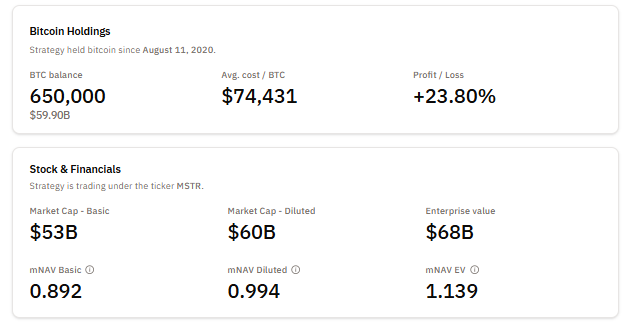
One key factor in the market is Strategy (MSTR), the largest corporate Bitcoin holder. The company owns 650,000 BTC. Its enterprise-value-to-Bitcoin-holdings ratio, known as mNAV, currently stands at 1.13. 

JPMorgan analysts describe this as “encouraging.” A ratio above 1.0 indicates Strategy is unlikely to face forced sales of its Bitcoin.

JUST IN: JPMorgan says it is sticking to its Bitcoin vs gold model target, which would see BTC hit $170,000 over the next year 🐂 pic.twitter.com/PNt9ojpBRv

— Bitcoin Magazine (@BitcoinMagazine) December 5, 2025

Strategy has also built a $1.44 billion U.S. dollar reserve. The reserve is designed to cover dividend payments and interest obligations for at least 12 months. The company aims to extend coverage to 24 months. 

Bitcoin mining pressure

Mining pressures continue to weigh on Bitcoin. The network’s hashrate and mining difficulty have fallen. High-cost miners outside China are retreating due to rising electricity costs and declining prices. Some miners have sold Bitcoin to remain solvent. 

JPMorgan now estimates Bitcoin’s production cost at $90,000, down from $94,000 last month. Falling hashrates can push production costs lower, but the short-term effect is sustained selling pressure from miners.

Institutional investors also show caution. BlackRock’s iShares Bitcoin Trust, or IBIT, has recorded six consecutive weeks of net outflows. Investors pulled more than $2.8 billion from the ETF over this period, according to Bloomberg.

The withdrawals highlight subdued appetite among traditional investors, even as Bitcoin prices stabilize. Analysts note that the trend marks a reversal from the persistent inflows seen earlier in the year.

The broader market is still recovering from the October 10 liquidation event. That crash wiped out over $1 trillion in crypto market value and pushed Bitcoin into a bear market.

Although the Bitcoin price has recovered some ground this week, momentum remains fragile.

JPMorgan analysts now say Bitcoin’s next major move depends less on miner behavior. Instead, it depends on Strategy’s ability to hold its Bitcoin without selling. The mNAV ratio and reserve fund provide confidence that the company can weather market volatility.

Other potential catalysts remain. The MSCI index decision on January 15 could impact Strategy’s stock and, indirectly, Bitcoin. Analysts say a positive outcome could trigger a strong rally.

Last week, Strategy’s Michael Saylor disputed MSCI index disputes and clarified that Strategy is a publicly traded operating company with a $500 million software business and a treasury strategy using Bitcoin, not a fund, trust, or holding company. 

He emphasized the firm’s recent activity, including five digital credit security offerings totaling over $7.7 billion in notional value.

Bitcoin price analysis

Bitcoin Magazine analysts believe that the bitcoin price correlation with Gold has recently strengthened mainly during market downturns, offering a clearer view of its purchasing power when analyzed against Gold instead of USD.

Breaking below the 350-day moving average (~$100,000) and the $100K psychological level signaled Bitcoin’s entry into a bear market, dropping roughly 20% immediately. 

While USD charts show a 2025 peak, Bitcoin measured in Gold peaked in December 2024 and has fallen over 50%, suggesting a longer bear phase. 

Historical Gold-based bear cycles indicate potential support zones approaching, with current declines at 51% over 350 days reflecting institutional adoption and constrained supply rather than cycle shifts.

For now, bitcoin price hovers near $88,000. 

Bitcoin price

This post Bitcoin Price Craters to $88,000, But JPMorgan Maintains $170,000 Target first appeared on Bitcoin Magazine and is written by Micah Zimmerman.

Bitcoin Price Could Hit $170K — But Strategy ‘Resilience’ Is Vital: JPMorgan

5 December 2025 at 06:06

JPMorgan analysts say the near-term direction of Bitcoin’s price now depends less on miner behavior and more on the financial resilience of Strategy, the world’s largest corporate holder of Bitcoin, even as mining pressure and market volatility persist.

In a report led by managing director Nikolaos Panigirtzoglou, the bank identified two forces currently weighing on Bitcoin. The first is a recent decline in Bitcoin’s network hashrate and mining difficulty.

The second is the growing market focus on Strategy’s balance sheet and its ability to avoid selling its Bitcoin holdings during the ongoing market downturn.

High-Cost Bitcoin Miners Capitulate as Hashrate Slips and Margins Collapse

The decline in hashrate reflects a combination of China reiterating its ban on private mining activity and high-cost miners outside the country retreating as falling Bitcoin prices and elevated electricity costs squeeze profitability.

JPMorgan now estimates Bitcoin’s production cost at $90,000, down from $94,000 last month. The estimate assumes electricity priced at $0.05 per kilowatt hour, with every $0.01 increase adding roughly $18,000 to production costs for higher-cost miners.

Source: Glassnode

With Bitcoin trading near $92,000, JPMorgan said the asset continues to hover close to its estimated production cost, creating sustained selling pressure from miners.

As profits tighten, several high-cost producers have been forced to liquidate Bitcoin holdings in recent weeks to remain solvent.

Despite those pressures, JPMorgan said miners are no longer the key driver of Bitcoin’s next major move. Instead, attention has shifted to Strategy’s ability to maintain its Bitcoin position without being forced into sales.

Strategy’s enterprise-value-to-Bitcoin-holdings ratio currently stands at 1.13. That figure reflects the combined market value of its debt, preferred stock, and equity relative to the market value of its Bitcoin treasury.

Source: BitcoinTreasuries.NET

According to JPMorgan, the fact that the ratio remains above 1.0 is “encouraging” because it shows that Strategy is unlikely to face pressure to sell Bitcoin to meet interest or dividend obligations.

The company recently reinforced that position by creating a $1.44 billion U.S. dollar reserve through ongoing at-the-market equity sales.

The reserve is designed to cover dividend payments and interest expenses for at least 12 months, with the company targeting coverage of up to 24 months.

JPMorgan said the reserve significantly reduces the risk of forced Bitcoin sales in the foreseeable future.

JPMorgan Sees $170K Bitcoin Scenario Despite Strategy’s MSCI Index Risk

Strategy’s Bitcoin accumulation has slowed sharply in recent months, though it remains deeply exposed to price movements.

In November, it added 8,178 BTC in its largest purchase since July, bringing total holdings to roughly 650,000 BTC. Its basic market capitalization stands near $54 billion, with an enterprise value of about $69 billion.

Markets are also watching an upcoming decision by MSCI on whether to remove Strategy and other digital-asset treasury companies from its equity indices. JPMorgan said the downside risk from exclusion is largely priced in.

Since MSCI launched its review in October, Strategy’s share price has fallen roughly 40%, underperforming Bitcoin by about $18 billion in market value.

JPMorgan estimates that an MSCI exclusion could trigger $2.8 billion in passive outflows, with as much as $8.8 billion at risk if other index providers follow suit.

Even so, the bank said further downside would likely be limited. By contrast, if MSCI keeps Strategy in major indices, JPMorgan said both Strategy and Bitcoin could rebound sharply toward pre-October levels.

Beyond corporate balance sheets, JPMorgan continues to point to broader crypto market structure for longer-term upside. The bank said perpetual futures deleveraging appears largely complete following record liquidations in October.

At the same time, Bitcoin’s volatility ratio relative to gold has improved, strengthening its risk-adjusted appeal to investors.

Based on those metrics, JPMorgan reiterated its volatility-adjusted comparison of Bitcoin to gold, which implies a theoretical Bitcoin price near $170,000 over the next six to twelve months if market conditions stabilize.

Notably, Bitcoin is currently trading about $68,000 below that level.

The post Bitcoin Price Could Hit $170K — But Strategy ‘Resilience’ Is Vital: JPMorgan appeared first on Cryptonews.

Before yesterdayMain stream

Making History With Bitcoin: What’s Going On With MicroStrategy And Wall Street?

4 December 2025 at 13:00

Market expert Shanaka recently explained how a historical event is unfolding with MicroStrategy and its Bitcoin strategy. This comes as the company faces a negative valuation from Wall Street while MSCI considers whether to remove MSTR from its indices. 

MicroStrategy’s Market Cap Drops Below the Value Of Bitcoin Holdings

In an X post, Shanaka noted that MicroStrategy, which is the world’s largest corporate Bitcoin holder, is now worth less than its BTC holdings. The company currently holds 650,000 BTC, valued at around $60 billion, while the MSTR stock has a market cap of $55 billion. The expert noted that Wall Street is valuing the company at a negative based on this. 

He further remarked that this is the sustained NAV inversion since MicroStrategy began the Bitcoin model in 2020. Shanaka noted that the company has created a $1.44 billion emergency reserve to pay dividends. This came after the CEO Phong Le admitted that they might have to sell BTC to fund dividend payments if the mNAV drops below 1. 

MicroStrategy’s woes could deepen as MSCI will decide by January whether to expel the company from global stock indices. MSCI is considering whether companies that hold Bitcoin should be regarded as funds or trusts rather than as companies. JPMorgan estimates the company could see $8.8 billion in outflows if other index providers make a similar move.

Shanaka described the math as “merciless,” noting that MicroStrategy has $8.2 billion in debt, $7.8 billion in preferred stock, and $16 billion in total obligations against a $45.7 billion shell. Meanwhile, the company currently holds its BTC at an average cost of $74,436, which the expert noted is 15% above breakeven. As such, he remarked that one sustained drop erases every gain since 2020. 

Shanaka stated that MicroStrategy’s current situation is not just about one company but about whether corporations can hold sound money without being destroyed by the very system they sought to escape. He added that the largest experiment in corporate Bitcoin adoption is breaking in real time. 

Saylor Confirms Talks With MSCI Over Potential Exclusion

According to a Reuters report, Michael Saylor confirmed that MicroStrategy is in talks with MSCI over a potential exclusion from their indices. MSCI is expected to decide by January 15 whether to remove digital-asset treasury companies that buy Bitcoin and other crypto assets, amid concerns that they are classified as investment funds.  

Saylor opined that MicroStrategy’s potential exclusion from MSCI indices won’t make any difference. He explained that his company is currently leveraged by a multiple of 1.11 and could survive a 95% Bitcoin crash. Meanwhile, it is worth noting that Phong Le has stated that it is unlikely they will sell any BTC over the next three years following the creation of the USD reserves, which should be sufficient for dividend payments during this period.

Bitcoin

You Won’t Believe How Much Bitcoin Companies Now Hold, What % Of Supply Do They Control?

2 December 2025 at 15:00

Bitocin treasury companies continue to accumulate a significant amount of BTC despite current market conditions and now control around 5% of the total BTC supply. These companies are led by Michael Saylor’s Strategy and Metaplanet, which have recently raised fresh capital to buy the dip. 

Bitcoin Treasury Companies Now Hold Over 1 Million In BTC

Bitcoin Treasuries data shows that the top 100 public Bitcoin treasury companies currently hold 1,058,929 BTC, while all public companies combined hold 1,061,697. Notably, Strategy is the largest public Bitcoin holder with 650,000 BTC. Michael Saylor’s company yesterday announced another 130 BTC purchase for $11.7 million. 

Meanwhile, the second-largest Bitcoin treasury company is BTC miner MARA holdings, which holds 53,250 BTC. Tether-backed Twenty One Capital, Metaplanet, and Bitcoin Standard Treasury Company complete the top 5, with 43,514, 30,823, and 30,021 BTC, respectively. Meanwhile, companies like Coinbase, Bullish, and Trump Media are among the top 10 largest BTC treasury companies. 

It is worth noting that these public companies account for only a part of the Bitcoin treasuries. Further data from Bitcoin Treasuries shows that there is currently 4 million BTC in treasuries as a whole, including the coins held by governments, private companies, exchanges, DeFi platforms, and ETFs.  

Bitcoin

BlackRock is currently the second-largest Bitcoin holder, only behind Satoshi Nakamoto. Strategy is third on the list, while Binance and the U.S. government complete the top 5, with BTC holdings of 628,868 and 323,588, respectively. The 4 million BTC held by these treasury companies as a group accounts for 19% of the total Bitcoin supply. 

Bitcoin treasury companies such as Strategy and Metaplanet have raised new capital amid the recent crash to buy more BTC. Saylor’s company recently raised $836 million from its STRE offering, which it used to buy 8,178 BTC. Meanwhile, Metaplanet raised $130 million to expand its BTC treasury. 

More Companies Set To Adopt Bitcoin

More Bitcoin treasury companies are set to emerge as $10 trillion asset manager, Vanguard, will start offering BTC ETFs from today. Notably, some companies gain BTC exposure through these ETFs rather than buying Bitcoin directly. On-chain analytics platform Arkham Intelligence revealed that the largest U.S. bank, JPMorgan, holds $300 million worth of BlackRock’s BTC ETF. 

Meanwhile, it is worth mentioning that Bitcoin treasuries such as Strategy are coming under immense pressure amid the current market downtrend. Strategy’s CEO, Phong Le, admitted that they might have to sell Bitcoin as a last resort to fund dividend payments if their mNAV drops below 1x and they can no longer raise capital. 

At the time of writing, the Bitcoin price is trading at around $87,000, up in the last 24 hours, according to data from CoinMarketCap.

Bitcoin

Hong Kong tightens crypto grip as HashKey clears path to IPO

1 December 2025 at 03:42
  • HashKey moves closer to IPO after clearing Hong Kong listing hearing, boosting regulated crypto ambitions.
  • HashKey leads Hong Kong’s licensed crypto trade but remains unprofitable despite a large client asset base.
  • Firm expands globally with approvals in Dubai, Bermuda, and Ireland ahead of planned public listing.

Hong Kong’s push to build a tightly regulated digital asset market has taken another step as HashKey Holdings secures approval to move forward with an initial public offering.

The operator of the city’s largest licensed crypto exchange confirmed in a Dec. 1 disclosure that it cleared the Hong Kong Stock Exchange’s listing hearing, a milestone that positions the company to advance its plans.

The development arrives as Hong Kong continues to present itself as a controlled and legally defined alternative to the crypto restrictions on the mainland, while seeking to attract institutional and retail participation through licensed platforms.

IPO progress strengthens regulated market ambitions

HashKey has not revealed the size or timing of the IPO, but earlier reports in October indicated that the company had explored raising to $500 million.

The filing shows that JPMorgan Chase, Guotai Haitong Securities, and Guotai Junan International are acting as joint sponsors, reinforcing the city’s intention to anchor crypto activity within traditional financial structures.

Local media reported that funds raised through the offering would be directed toward technology upgrades, wider product development, stronger operational capacity, and the expansion of services into new markets.

HashKey is also prioritising the improvement of its risk management systems as part of a broader plan for long-term growth.

Licensing gives HashKey a strategic foothold

HashKey operates under the Securities and Futures Commission’s regulatory framework and was among the first digital asset companies approved to serve both institutional and retail investors under Hong Kong’s updated licensing regime.

The company holds a Type 1 licence, permitting it to deal in securities that include tokenised versions of assets categorised as securities.

It also holds a Type 7 licence, which allows it to run an automated trading platform.

Alongside this, HashKey’s asset management arm is licensed to manage portfolios consisting of up to 100 percent virtual assets.

It is one of 11 licensed virtual asset trading platforms serving retail users in Hong Kong.

This stands in contrast to mainland China, where crypto activity remains banned, highlighting Hong Kong’s continued position as a regulated gateway within the region.

Market share grows but losses persist

According to the filing, HashKey handled more than three quarters of the region’s onshore digital asset trading volume in 2024. It also held nearly HK$20 billion (US$2.56 billion) in client assets, underscoring its dominance within Hong Kong’s regulated crypto landscape.

Despite its scale, the company remains unprofitable. HashKey recorded a net loss of HK$506 million in the first half of 2025, though this represented an improvement from the HK$777 million loss logged during the same period a year earlier.

The filing noted that performance has shifted in line with market volatility, which continues to shape activity across the sector.

HashKey has been working to expand its presence through investment initiatives, including the launch of a $500 million perpetual fund focused on institutional participation in digital asset treasury projects.

The fund aims to support blockchain ecosystems such as Ethereum and seeks to contribute to long term adoption and capital movement.

Global approvals broaden HashKey’s reach

In addition to its Hong Kong operations, HashKey has extended its regulatory footprint in 2025 by securing conditional approval to operate in Dubai.

It has also obtained regulatory permissions to run licensed platforms in Bermuda and Ireland, signalling an effort to widen its global relevance ahead of its public listing.

These gains support Hong Kong’s attempt to reinforce its position as a regulated crypto centre and highlight how the city is using licensed actors to shape a defined market structure for digital assets.

The post Hong Kong tightens crypto grip as HashKey clears path to IPO appeared first on CoinJournal.

XRP Price Suppression? Analyst Points To Big Banks And Private Equity Players

30 November 2025 at 13:00

Reports are circulating that big financial players may be quietly buying XRP while the price sits near $2.18. If true, that could help explain why XRP hasn’t pushed past $3 even as trader interest grows. Some observers point to shrinking exchange wallets and limited disclosures as hints that accumulation is happening off-exchange.

Are Institutions Buying?

On-chain data shows Coinbase’s XRP stash fell sharply — from almost 1 billion tokens to about 32 million in September. Some analysts read that as coins being moved into private custody, possibly under NDAs.

Market commentator Dr. Jim Willie has suggested banks like Bank of America and BNY Mellon could be building positions quietly. He’s also picked up on recent remarks from BlackRock’s Larry Fink about an XRP ETF and taken them as another sign of institutional involvement. That’s a possible explanation, not proof.

Hydraulic Shift And ETF Bets

Willie uses a “hydraulic” metaphor: money leaving Bitcoin and Ethereum could push large gains into XRP if flows shift that way. ETFs, he argues, could speed this process by giving institutions easier access — especially if over-the-counter supply tightens.

But analysts warn against assuming ETFs will automatically spark a rapid price surge. Liquidity, market sentiment and broader macro conditions still matter a lot.

Targets, Math And Past Rallies

XRP recently traded under $2.20, roughly $2.18 as November closed. Commentator Meme Whale floated targets of $5 (near-term) and $10 (longer-term) — rises of close to 130% and 358% from current levels by April 2026.

For perspective, XRP once jumped 340% in five weeks back in 2021, rising from $0.43 to $1.96. Past spikes show how volatile the crypto market can be, but they don’t guarantee a repeat.

My Prediction For Next 5 Months:$BTC: $140K-$200K+$ETH: $5K-$10K$BNB: $1500-$3000$SOL: $300-$600$XRP: $5-$10$WKC: $0.00001-$0.0001$FLOKI: $0.01-$0.1$SHIB: $0.001-$0.01$MANYU: $0.00001-$0.0001$CREPE: $0.001-$0.01$LUNC: $0.001-$0.01$SUI: $6-$10$PI: $5-$15$DTG:…

🐳𝓜𝓮𝓶𝓮 𝓦𝓱𝓪𝓵𝓮 🐳 🌟 (@MeMeWhAle0) November 28, 2025

Big Claims Vs. Reality

Willie has even suggested XRP could one day rival the US dollar in global trade, implying market caps as high as $100 trillion. Most experts call that extremely unlikely.

Skeptics say those projections far outstrip reality and demand hard evidence before accepting ideas about coordinated price suppression or ultra-high future valuations.

Institutional accumulation could be happening — it’s plausible — but there’s no airtight proof yet. Investors should weigh on-chain data and credible analysis against hype and bold forecasts. In short: interesting signs, but tread carefully.

Featured image from Unsplash, chart from TradingView

💾

In this episode, I sit down with Dr. Jim Willie, legendary macroeconomics and precious metals expert, to break down how Wall Street giants like BlackRock and...

Bitcoin Price Skyrockets Past $90,000 as BlackRock and JPMorgan Deepen Bitcoin Bets

26 November 2025 at 14:01

Bitcoin Magazine

Bitcoin Price Skyrockets Past $90,000 as BlackRock and JPMorgan Deepen Bitcoin Bets

Bitcoin price ripped higher above $90,000 on Wednesday, extending a sharp rally fueled by accelerating institutional demand and a new wave of Wall Street–engineered crypto products. 

The surge followed fresh disclosures showing BlackRock increasing its exposure to its own spot Bitcoin ETF, and JPMorgan pitching a complex, high-stakes structured note tied directly to BlackRock’s IBIT fund.

Bitcoin price touched 24-hour lows of $86,129 before rebounding above $90,300, continuing a volatile upswing that has defined the fourth quarter.

BlackRock’s latest regulatory filing shows the Strategic Income Opportunities Portfolio now holds 2,397,423 shares of IBIT, valued at $155.8 million as of September 30. That’s up 14% from June, when the fund reported 2,096,447 shares. 

The steady buildup underscores how the world’s largest asset manager is using its internal portfolios to deepen its Bitcoin-linked positions.

The moves arrive as demand for structured crypto-linked investments heats up among major banks. JPMorgan’s newly proposed derivative-style note gives institutional clients a way to bet on the future price of Bitcoin through IBIT, currently the largest Bitcoin ETF with nearly $70 billion in assets.

The product is unusual — and aggressive. The note sets a price for IBIT next month. If, one year from now, IBIT trades at or above that price, the note is automatically called and investors collect a fixed 16% return.

If IBIT trades below the set level in a year, investors stay in the product until 2028. Should IBIT exceed JPMorgan’s next target price by then, investors earn 1.5x their investment with no upside cap. If the Bitcoin price skyrockets, the payouts follow.

There’s downside protection, too. If IBIT finishes 2028 down no more than 30%, investors receive their full principal back. But if the ETF falls more than 30%, losses match IBIT’s decline.

The structure combines a bond-like wrapper with derivatives exposure, a formula FINRA classifies broadly under its “structured note” category. These notes blend a traditional security with options-based payouts tied to a reference asset — in this case BlackRock’s Bitcoin ETF.

The pitch to institutions is simple: predictable returns if Bitcoin price stalls next year, leveraged upside through 2028, and limited long-term downside. The tradeoff is equally clear: no interest payments, no FDIC insurance, and the risk of losing most or all principal.

Reporting from The Block helped with this article. 

Bitcoin price volatility

JPMorgan is explicit about the stakes. Its prospectus warns that investors “should be willing to lose a significant portion or all of their principal amount at maturity.” Volatility in Bitcoin, it adds, may be extreme, and the notes remain unsecured obligations of the bank.

The bank’s latest move also highlights an ongoing shift in Wall Street’s tone toward Bitcoin. CEO Jamie Dimon once mocked Bitcoin as “worse than tulip bulbs.” Yet JPMorgan is now engineering products that depend on the digital asset’s long-term trajectory.

Morgan Stanley has been exploring similar territory. Its own IBIT-linked structured note drew $104 million last month. The bank’s two-year “dual directional autocallable” product offers enhanced payouts if IBIT rises or stays flat, and modest gains if it falls up to 25%. But once losses exceed that level, investors take the hit with no cushion.

Analysts say these products reflect a revival in the structured-notes market. Bloomberg reported the sector is recovering from a decade-long slump after the collapse of Lehman Brothers wiped out billions tied to similar instruments.

The bitcoin price has fallen more than 30% from its October all-time high, slipping to around $87,000 as a nearly two-month drawdown keeps markets on edge. Mid-tier whale wallets holding 100+ BTC are ticking higher — a potential sign of bargain hunting — but larger whale cohorts continue to offload, contributing to weakened spot demand. 

Analysts warn that the key $80,000–$83,000 support zone is being tested repeatedly, while Citi says the market lacks the inflows needed to stabilize prices. 

At the time of writing, the bitcoin price is $90,049.

Bitcoin Price

This post Bitcoin Price Skyrockets Past $90,000 as BlackRock and JPMorgan Deepen Bitcoin Bets first appeared on Bitcoin Magazine and is written by Micah Zimmerman.

Strike CEO Jack Mallers Debanked by JPMorgan as Bank Faces Epstein Tensions

24 November 2025 at 11:58

Bitcoin Magazine

Strike CEO Jack Mallers Debanked by JPMorgan as Bank Faces Epstein Tensions

Strike CEO Jack Mallers said JPMorgan Chase abruptly closed his personal bank accounts last month without providing a clear explanation, sparking fresh debate over the banking industry’s treatment of crypto executives.

“Last month, J.P. Morgan Chase threw me out of the bank. It was bizarre. My dad has been a private client there for 30+ years,” Mallers wrote on social media platform X. When he pressed the bank for details, he said the only response was, “We aren’t allowed to tell you.”

Mallers shared a letter from JPMorgan Chase, which cited unspecified “concerning activity” on his accounts. The letter, which Mallers jokingly said he had framed, noted the bank’s obligations under the Bank Secrecy Act and warned that Chase “may not be able to open new accounts” for him in the future.

The revelation has reignited industry concerns over “Operation Chokepoint 2.0,” an alleged Biden-era initiative that sought to pressure banks into limiting services to crypto businesses and executives. The program’s existence has long been disputed, but critics say debanking remains a threat to the sector.

In August, President Donald Trump signed an executive order prohibiting financial institutions from closing accounts solely because of crypto-related activity. Trump’s Working Group on Digital Asset Markets said the administration had “ended Operation Choke Point 2.0 once and for all by working to end regulatory efforts that deny banking services to the digital assets industry.”

Despite this, industry figures quickly questioned whether debanking had truly stopped. Bo Hines, a former adviser on digital assets in the Trump administration and current strategic advisor to Tether, mocked Chase on X: “Hey Chase… you guys know Operation Choke Point is over, right? Just checking.”

Tether CEO Paolo Ardoino also commented on Mallers’ post, writing that the account closure might be “for the best.” In a separate post, Ardoino framed the situation as a testament to Bitcoin’s resilience: “Bitcoin will resist the test of time. Those organizations that try to undermine it will fail and become dust. Simply because they can’t stop people’s choice to be free.”

Senator Cynthia Lummis chimed in on the incident, “Operation Chokepoint 2.0 regrettably lives on. Policies like JP Morgan’s undermine confidence in traditional banks and send the digital asset industry overseas,” Lummis said on X. “It’s past time we put Operation Chokepoint 2.0 to rest to make America the digital asset capital of the world.”

JPMorgan and Jeffrey Epstein

Mallers, who has a history of publicly calling out JPMorgan’s CEO Jamie Dimon, used the moment to promote Bitcoin. He posted on X: “Seek truth. Stand with integrity. Fight for freedom. Protect Bitcoin at all costs.” Mallers also leads Twenty One, a public company backed by Tether and Bitfinex, which aims to rival Michael Saylor’s Strategy in acquiring bitcoin.

The incident has drawn further scrutiny amid ongoing controversy over JPMorgan’s past dealings. Mallers referenced a post by Senator Ron Wyden highlighting that JPMorgan executives were allegedly aware of $1 billion in suspicious transactions linked to Jeffrey Epstein.

While the bank has not elaborated on the “concerning activity” cited in Mallers’ case, the closure highlights the broader tension between crypto executives and traditional financial institutions. Industry observers say such actions continue to fuel fears of politically motivated or opaque “debanking,” even as regulators emphasize compliance and risk management obligations.

Senator Ron Wyden criticized JPMorgan Chase for evading accountability over its relationship with Jeffrey Epstein, rejecting the bank’s attempt to blame a single former employee. 

Wyden highlighted that multiple executives, including Mary Erdoes and Jes Staley, ignored internal warnings and delayed filing Suspicious Activity Reports (SARs) for six years after terminating Epstein in 2013, potentially violating federal law. 

The bank’s response lacked evidence countering reports that top leadership enabled Epstein’s crimes. Wyden issued a letter demanding extensive internal documents, communications, and transaction records to investigate who knew what, why Epstein remained a client, and the delay in regulatory reporting, signaling a call for federal scrutiny.

Last month, JPMorgan research suggested that Bitcoin may be undervalued relative to gold, with potential to reach $165,000 if the “debasement trade” continues gaining momentum. Analysts note that recent gold price gains make Bitcoin more attractive, especially as the Bitcoin-to-gold volatility ratio drops below 2.0. 

Based on volatility-adjusted comparisons, JPMorgan estimated Bitcoin’s $2.3 trillion market cap would need a roughly 42% increase to match gold’s $6 trillion in bars, coins, and ETFs.

Jack Mallers

This post Strike CEO Jack Mallers Debanked by JPMorgan as Bank Faces Epstein Tensions first appeared on Bitcoin Magazine and is written by Micah Zimmerman.

JPMorgan sees limited downside for Bitcoin, upside potential toward $170,000

13 November 2025 at 10:49
  • JPMorgan sets Bitcoin’s support price near $94K, citing rising mining costs.
  • Analysts project Bitcoin could climb to $170K based on gold market parity.
  • Bitcoin’s downside seen as limited after network difficulty raises production cost.

JPMorgan analysts said Bitcoin’s downside risk appears to be minimal at current levels, citing the cryptocurrency’s rising production cost as a key technical support.

In a note published Wednesday, the bank’s team led by Nikolaos Panigirtzoglou, managing director at JPMorgan, placed Bitcoin’s estimated support price around $94,000, suggesting the cryptocurrency has limited room to fall from its recent level of roughly $102,300.

Rising production costs set new support level

According to JPMorgan, the estimated cost to produce one bitcoin — often viewed as a proxy for the cryptocurrency’s “floor” price — has risen from about $92,000 to approximately $94,000.

This increase, the analysts said, is largely driven by a sharp rise in Bitcoin network difficulty, which measures how much computing power is required to mine new blocks.

As network difficulty climbs, miners must deploy more energy and hardware resources to maintain output, effectively increasing the marginal cost of producing new coins.

The analysts noted that Bitcoin’s price-to-production cost ratio now sits just above 1.0, placing it near the lower end of its historical range.

“The bitcoin production cost has empirically acted as a floor for bitcoin,” the analysts wrote, adding that “a $94,000 production cost implies very limited downside to the current bitcoin price.”

Historically, production costs have correlated closely with Bitcoin’s longer-term valuation trends, as mining profitability often influences both network participation and supply dynamics.

The current alignment, JPMorgan said, supports the view that downside risk is constrained unless broader market sentiment deteriorates further.

Upside scenario points to $170,000 target

While downside appears limited, JPMorgan reiterated its 6–12 month upside projection of about $170,000 for Bitcoin, based on a volatility-adjusted comparison to gold.

The analysts explained that Bitcoin currently consumes around 1.8 times more risk capital than gold, implying that its market capitalization could rise substantially to reach parity with gold’s level of private-sector investment.

At present, Bitcoin’s market cap stands near $2.1 trillion, while approximately $6.2 trillion is invested in gold via exchange-traded funds, bars, and coins.

“On that basis,” the note said, “Bitcoin’s market capitalization would need to rise by about 67%, implying a theoretical price close to $170,000.”

The analysts said this valuation framework reflects long-term potential rather than a near-term forecast.

Market sentiment, regulatory conditions, and liquidity factors will continue to influence how quickly Bitcoin might approach such levels.

Market context and sentiment shift

Last month, JPMorgan’s analysts issued a similar analysis, calling Bitcoin undervalued relative to gold and suggesting a possible year-end target around $165,000.

However, in a Block report, Panigirtzoglou said that recent liquidations and negative market sentiment made such a near-term rally unlikely.

Earlier in August, the same team projected a year-end target of about $126,000, which Bitcoin briefly surpassed on October 6, hitting an all-time high above $126,200 before a major liquidation event on October 10.

Despite recent volatility, JPMorgan’s latest note underscores a cautiously optimistic outlook.

With network fundamentals strengthening and production costs rising, analysts view current prices as near structural support levels — leaving room for long-term appreciation if broader market confidence returns.

The post JPMorgan sees limited downside for Bitcoin, upside potential toward $170,000 appeared first on CoinJournal.

JPMorgan: Bitcoin Looks Cheap Compared to Gold, Bitcoin Price to $170,000

6 November 2025 at 11:17

Bitcoin Magazine

JPMorgan: Bitcoin Looks Cheap Compared to Gold, Bitcoin Price to $170,000

JPMorgan strategists say Bitcoin (BTC) now appears undervalued relative to gold following a steep October sell-off driven by leveraged liquidations and market turmoil.

Bitcoin fell more than 20% last month after hitting an all-time high of $126,000, a drop that JPMorgan’s Nikolaos Panigirtzoglou attributed to heavy deleveraging in futures markets and fallout from a $128 million hack of the DeFi platform Balancer. 

He noted that the ratio of open interest in perpetual futures to Bitcoin’s market capitalization has since returned to average levels, suggesting that “excess leverage has largely been cleared.”

ETF outflows have been modest compared to prior inflows, Panigirtzoglou added, pointing to a more stable market backdrop. 

“Most of the deleveraging activity is now behind us,” he said, adding that the futures open interest ratio remains a key indicator for short-term price direction.

On a volatility-adjusted basis, Bitcoin is now trading at a discount compared to gold. JPMorgan’s analysis found that as gold’s price surged above $4,000 per ounce—bringing higher volatility—Bitcoin’s own volatility subsided. To reach parity with gold’s $6.2 trillion in private-sector investment on a risk-adjusted basis, Bitcoin’s price would need to climb roughly two-thirds, to around $170,000.

“Having been $36,000 too high compared with gold at the end of last year, Bitcoin is now around $68,000 too low,” Panigirtzoglou wrote.

JUST IN: $3.4 trillion JPMorgan strategist says #Bitcoin has “significant upside for the next 6-12 months” over gold. pic.twitter.com/KJlmnfsKes

— Bitcoin Magazine (@BitcoinMagazine) November 6, 2025

With leverage normalized and volatility easing, JPMorgan sees room for “significant upside” over the next six to twelve months if current conditions persist—an outlook that could strengthen Bitcoin’s appeal as a digital alternative to gold in investor portfolios.

Bitcoin price update

Bitcoin is currently trading at $101,977 after a tumultuous October. Bitcoin kicked off October with bull‑momentum, hitting a fresh all‑time high north of approximately $125,000–$126,000 around October 6.

But that euphoria proved short-lived. Soon after the peak, Bitcoin came under pressure: a massive liquidation of over $19 billion in perpetual futures contracts accelerated the unwind.

Macroeconomic jitters — trade tensions, central‑bank ambiguity and risk‑asset weakening — compounded the correction.

By month‑end, Bitcoin had recorded its first losing October since 2018, slipping around 4 %–5 % overall and suffering one of its worst October performances on record. 

Despite the recent fall, the year‑to‐date picture remained positive — though less exuberant than some bulls expected.

Earlier in October, JPMorgan put out some research that suggests Bitcoin could be undervalued versus gold, with potential to rise to $165,000 based on volatility-adjusted comparisons and growing investor demand.

This post JPMorgan: Bitcoin Looks Cheap Compared to Gold, Bitcoin Price to $170,000 first appeared on Bitcoin Magazine and is written by Micah Zimmerman.

JPMorgan to Accept Bitcoin as Loan Collateral by Year-End

24 October 2025 at 09:46

Bitcoin Magazine

JPMorgan to Accept Bitcoin as Loan Collateral by Year-End

JPMorgan Chase plans to let institutional clients use Bitcoin (BTC) and Ethereum (ETH) as collateral for loans by the end of 2025, according to a Bloomberg report

The new program, expected to roll out globally, will rely on a third-party custodian to safeguard pledged assets. The bank already allows crypto-linked exchange-traded funds (ETFs) as collateral, but this expansion would enable clients to borrow against their direct crypto holdings.

The shift could make it easier for institutions to access liquidity without selling long-term digital asset positions — a use case that has gained traction among hedge funds and family offices.

The development represents a broader acceptance of digital assets across the financial sector.  Other major banks, including Morgan Stanley, BNY Mellon, State Street, and Fidelity, have been expanding crypto custody and trading services amid increasing regulatory clarity in the U.S. and abroad.

JPMorgan first began exploring lending against Bitcoin in 2022 but the project was delayed, according to Bloomberg.

Jamie Dimon’s changing tone on crypto

JPMorgan CEO Jamie Dimon has long been one of crypto’s most vocal skeptics, previously calling Bitcoin a “fraud” and a “pet rock.” In 2023, he said he was “deeply opposed” to Bitcoin and claimed it was used mainly for illicit activity.

However, his tone has recently softened. “I don’t think we should smoke, but I defend your right to smoke,” Dimon said earlier this year. “I defend your right to buy Bitcoin, go at it.”

In 2023, JPMorgan CEO Jamie Dimon said he was "deeply opposed" to Bitcoin and that it was for criminals.

Today, JPMorgan plans to allow institutional clients to use Bitcoin as collateral. pic.twitter.com/WMPg8qy9UW

— Bitcoin Magazine (@BitcoinMagazine) October 24, 2025

Despite Dimon’s reservations, JPMorgan has steadily increased its crypto exposure. The bank has launched the J.P. Morgan Deposit Token (JPMD) — a blockchain-based alternative to stablecoins — and expanded its Kinexys blockchain network, which now processes more than $2 billion in daily transactions across carbon markets, supply chain finance, and cross-border payments.

Bitcoin and Ethereum prices rise

Following the news, Bitcoin rose in the past 24 hours to trade above $111,000, while Ethereum gained 2% to hover just below $4,000, according to Bitcoin Magazine Pro data.

Back in July, JPMorganChase and Coinbase announced a strategic partnership to make Bitcoin and crypto access easier for their customers. 

The deal included a direct bank-to-wallet connection, the ability to redeem Chase Ultimate Rewards points for crypto, and credit card funding for Coinbase accounts. Both the bank-to-wallet and rewards features were set to launch in 2026. 

This post JPMorgan to Accept Bitcoin as Loan Collateral by Year-End first appeared on Bitcoin Magazine and is written by Micah Zimmerman.

❌
❌