
Normal view

There are new articles available, click to refresh the page.
Yesterday — 24 January 2026Main stream

Binance Founder CZ Addresses Trump‑Related Controversy In Latest Statement

24 January 2026 at 04:00

Binance founder and former CEO Changpeng Zhao (CZ) has pushed back against growing scrutiny surrounding his relationship with President Donald Trump, saying his ties to the president and his family have been widely misunderstood following Trump’s decision to grant him a pardon last year.

CZ Rejects Allegations Of Binance’s Political Links

Attention on Zhao intensified after President Trump issued a pardon in October 2025, a move that prompted renewed criticism from Democratic lawmakers and fueled questions about Binance’s alleged political and business connections. 

Addressing the controversy in a recent interview with CNBC, Zhao said claims of a business relationship with the Trump family are inaccurate. “There’s no business relationship whatsoever,” Zhao stated. The former executive added that the narrative surrounding the pardon and Binance’s alleged ties to Trump had been “misconstrued.”

Much of the scrutiny centers on Binance’s connection to the Trump-linked decentralized finance (DeFi) venture World Liberty Financial (WLFI). 

That connection traces back to a $2 billion investment made in March 2025 by MGX, a state‑owned firm based in Abu Dhabi, United Arab Emirates. MGX invested in Binance using USD1, a stablecoin created by World Liberty Financial.

Zhao emphasized that the payment method was chosen by the investor, not Binance. “MGX is the investor. They choose USD1,” he said. “My request to them was they pay us in crypto. I don’t want to deal with banks, really.” 

According to Zhao, the use of the venture’s USD1 stablecoin has been wrongly interpreted as evidence of a deeper relationship. “Many people misconstrued that,” he added.

WLFI Push Back On Political Influence Claims

In a statement, WLFI spokesperson David Wachsman said the company played no role in the pardon process. “As we have stated many times, WLFI is not a political organization and had zero role in the pardon process,” Wachsman said. “To imply otherwise is dangerous and false.”

Trump himself downplayed any personal connection in a November interview with CBS’s 60 Minutes. “I have no idea who he is,” the president said of Zhao. Trump added that he had been told Zhao was “a victim, just like I was and just like many other people, of a vicious, horrible group of people in the Biden administration.”

Additional attention has focused on Binance’s lobbying efforts in Washington. NBC News reported during the week of the pardon that Binance had hired Checkmate Government Relations, a lobbying firm led by Charles McDowell, who is a friend of Donald Trump Jr. 

According to disclosures, the firm was paid $450,000 to lobby the White House and the Treasury Department on matters including “executive relief” and digital asset‑related financial services policy.

Zhao denied that any lobbying effort was connected to his pardon. “There is a lot of media saying that there is some deal in place to get me the pardon,” he told CNBC in Davos. “As far as I know, that does not exist at all.”

Binance’s former CEO also said he has never spoken directly with President Trump. “The closest that I got to him was today when he was doing the Board of Peace session,” Zhao said. “I was in the audience, about 30 to 40 feet away from him.”

Binance

At the time of writing, Binance Coin (BNB) was trading at $893, having recorded a 4% drop over the previous week. However, it is one of the few cryptocurrencies to have retained gains year-to-date, with an increase of 30% in that time. 

Featured image from OpenArt, chart from TradingView.com 
Before yesterdayMain stream

Trumps Crypto Empire: One-Fifth Of Family’s $6.8B Fortune Tied To Digital Assets

21 January 2026 at 01:00

A year into his presidency, US President Donald Trump and his family have reportedly seen a notable shift in their wealth distribution, with a growing concentration of crypto ventures linked to the presidential family.

Trump Family’s Wealth Gets Crypto Boost

On Tuesday, Bloomberg reported that the Trump family’s wealth has remained relatively steady over the past year despite the plunging value of their social media company, Trump Media & Technology Group Corp, and the massive gains of their new crypto ventures.

According to the report, the family’s overall net worth has not grown significantly since President Trump’s inauguration, remaining at around $6.8 billion, as data from the Bloomberg Billionaires Index shows.

Notably, the gains from their new projects were offset by the losses of Trump Media, whose shares have declined by around 66% over the past 12 months, despite efforts to diversify into various endeavors.

Nonetheless, “the way the Trumps’ wealth is distributed now — particularly its concentration in virtual assets and public companies, some of which didn’t exist when he left office in 2021 — represents a sea change in how they’ll earn money for years to come,” the report highlighted.

Per Bloomberg, the family’s most notable change has been the growing concentration of their net worth in cryptocurrencies, with one-fifth of their fortune coming from crypto projects for the first time.

As a result, “cryptocurrency projects became the key driver of the Trump family’s wealth last year,” generating around $1.4 billion from the different digital asset-related ventures managed by the President’s eldest sons, Eric and Donald Trump Jr.

In a statement to the news media outlet, Eric Trump reaffirmed that his family’s crypto push was driven by their experience with banks after the President’s first term. “Having been canceled by banks, out of political malice, led us to many incredible opportunities, as we redefine the future of finance,” he asserted.

Digital Asset Fortune Breakdown

Over the past year, various news outlets have estimated the first family’s crypto fortune, with some reports calculating its value at around $1 billion. In October, Eric Trump shared that the real number was “probably more.”

While the Trump family dived into multiple crypto-related projects, Bloomberg analysis highlighted three of their main ventures: World Liberty Financial (WLFI), American Bitcoin Corp., and the official TRUMP and MELANIA memecoins.

World Liberty Financial reportedly sold $550 million worth of tokens, generating $390 million for the presidential family, according to the news media outlet’s calculations. In August, the company announced its partnership with Alt5 Sigma and became an investor in the technology firm, which sought to raise $1.5 billion for its crypto treasury strategy based on WLFI.

According to Bloomberg, “the Trumps netted more than $500 million” from the deal. The company also launched its USD1 stablecoin in March, which has grown to more than $3 billion since its debut. Bloomberg estimated that the business could be worth more than $300 million.

Meanwhile, the official TRUMP and MELANIA memecoins, which launched the weekend before President Trump’s second inauguration, generated gains worth roughly $280 million from the family’s holdings and associated proceeds.

In addition, Eric Trump owns about 7.4% of American Bitcoin, worth roughly $114 million despite the company’s shares declining 82% since their September peak. Donald Jr. reportedly owns a smaller, undisclosed amount.

The report also noted that the Trump family’s fortune could be worth billions more on paper, as they still own founder WLFI tokens, worth $3.8 billion at current prices. Nonetheless, these tokens were not included in the calculations as they remain locked.

crypto, wlfi, wlfiusdt

WLFI Backlash as 9 ‘Team Wallets’ Swing 59% Vote on USD1 Growth Proposal

20 January 2026 at 14:28

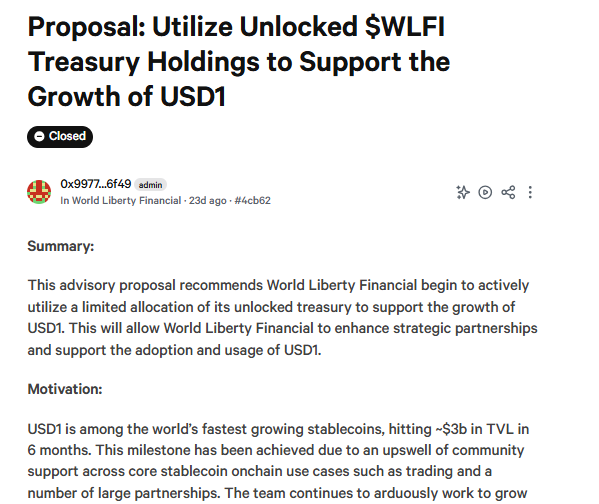
World Liberty Financial is facing mounting criticism from its community after a governance vote approving a USD1 growth proposal passed with decisive support from a small cluster of large wallets.

The vote saw objections from the community over the lack of voting access for locked WLFI holders, reigniting concerns about control, dilution, and the limits of WLFI’s on-chain governance.

Source: WLFI

On-chain voting data reviewed by market participants shows that the top nine wallets backing the proposal accounted for roughly 59% of the total voting power.

The single largest wallet alone represented 18.786% of votes cast in the snapshot.

WLFI Vote Passes 78%, but Access Dispute Overshadows Outcome

Analysis shared by pseudonymous trader and researcher DeFi^2 showed that several of these addresses are flagged by on-chain mapping tools as team-linked or strategic partner wallets, effectively allowing a narrow group of insiders to determine the outcome.

Haven’t seen anyone else talk about this yet, so I wanted to bring up an alarming governance vote by World Liberty Fi this month that appears to be the start of a slow extraction of value from WLFI holders by the team:

What you see above appears to be a rigged vote, where the… pic.twitter.com/CGsj7vVUUk

— DeFi^2 (@DefiSquared) January 20, 2026

The proposal itself authorized World Liberty Financial to deploy less than 5% of its unlocked WLFI treasury holdings to support the adoption of USD1, the project’s dollar-backed stablecoin.

The vote, created on December 28 and closed on January 4, attracted 2,931 participants and passed comfortably, with 3.3 billion votes, or 77.75%, in favor.

Votes against totaled 944.3 million, while abstentions were negligible. The quorum level reached 426%, far exceeding the threshold required for validity.

Source: WLFI

The backlash has centered less on the mechanics of the proposal and more on who was able to participate.

Many WLFI holders remain locked out of their tokens following the project’s token generation event and cannot vote on governance matters until unlock conditions are changed.

Several community members pointed out that while these holders are unable to influence decisions, team and partner wallets appear to have had full voting access.

DeFi^2 described the episode as an “alarming governance vote,” arguing that a measure unrelated to token unlocks was pushed through despite repeated calls from holders to address access restrictions first.

Tokenholders opposing the proposal have also questioned its economic logic.

WLFI holders are not entitled to protocol revenue, according to the project’s own documentation, which allocates 75% of revenue to the Trump family and 25% to the Witkoff family.

WLFI Holders Voice Frustration Over Incentives and Locked Supply

Against that backdrop, critics argue that using WLFI tokens to incentivize USD1 growth increases dilution without offering a direct upside to tokenholders.

One tokenholder who voted against the proposal said the project had previously deployed more than nine figures of investor capital to accumulate assets such as Bitcoin, Ether, and Chainlink, yet WLFI holders saw no tangible benefit from those holdings.

Tensions increased further after on-chain data showed a transfer of 500 million WLFI tokens to Jump Trading shortly after the vote concluded, while early investor allocations remain locked.

Just In: World Liberty Finance ( @worldlibertyfi ) sent 500M $WLFI worth $83.12M to #Jump Trading.

Data – @Nansen_ai pic.twitter.com/1IoOz3nrR1

— Onchain Lens (@OnchainLens) January 12, 2026

Community members have described the situation as asymmetric, with emissions rising and liquidity becoming available to select counterparties while long-term holders wait for unlocks.

Calls to release the remaining 80% of tokens for early investors have grown louder across social channels.

The governance dispute is unfolding as World Liberty Financial accelerates its broader expansion.

On January 8, the group disclosed that World Liberty Trust had filed a de novo application for a U.S. national banking charter with the Office of the Comptroller of the Currency.

🏦 World Liberty Financial filed for a US national banking charter, seeking OCC oversight to bring its dollar-backed stablecoin USD1 fully inside the regulatory perimeter. @worldlibertyfi#WLFI #OCC https://t.co/kDgbVB1c25

— Cryptonews.com (@cryptonews) January 8, 2026

If approved, the charter would allow the trust to issue and safeguard USD1 directly within the U.S. banking system.

Days later, on January 12, World Liberty Financial announced the launch of World Liberty Markets, a lending and borrowing platform built around USD1 and WLFI.

The post WLFI Backlash as 9 ‘Team Wallets’ Swing 59% Vote on USD1 Growth Proposal appeared first on Cryptonews.

Trump Family Crypto Haul Hits $1.4B as DJT Trades as $14.67

20 January 2026 at 12:31

The Trump family added about $1.4 billion in crypto-linked wealth since Jan. 20, 2025, while Trump Media & Technology Group (DJT) is trading at $14.67 (+2.81%), after a multi-month slide that Bloomberg flagged as the main drag on the family’s balance sheet.

JUST IN: 🇺🇸 Bitcoin and crypto projects now account for $1.4 BILLION of the Trump family’s $6.8B net worth (20%) — Bloomberg pic.twitter.com/X1O7GJqqu3

— Bitcoin Archive (@BitcoinArchive) January 20, 2026

The WLFI Economic Engine

Bloomberg’s Tuesday tally hinges on World Liberty Financial (WLFI) economics that route cash flows to a Trump-affiliated vehicle. World Liberty’s own terms state that DT Marks DeFi, LLC and affiliates, including Donald J. Trump, received 22,500,000,000 WLFI tokens and collect 75% of net protocol revenues (and separately 75% of WLFI token sale proceeds after deductions under a service agreement).

The mark-to-market swing sits in the locked paper. The report cited by The Block says the family still holds founder tokens worth roughly $3.8 billion that Bloomberg excluded from net-worth math because the tokens remain locked.

A second pillar now links Trump-branded real estate to token rails. The Trump Organization and Dar Global announced on Nov. 17, 2025, that the Trump International Hotel Maldives will tokenize the development phase, with Eric Trump calling it a “new benchmark” for tokenized real estate investment and Dar Global CEO Ziad El Chaar calling it a “global first.” The announcement targeted an end-of-2028 opening and cited ~80 villas in the initial plan.

On the equity leg, Trump Media’s latest filed quarterly disclosure showed revenue sensitivity and rising costs tied to its streaming buildout. In its Form 10-Q filed Nov. 7, 2025, DJT reported $972,900 revenue for the quarter ended Sept. 30, 2025, and cited higher content license and data center lease costs tied to Truth+.

What Traders Are Watching

For institutional trading desks, the current market environment represents a complex arbitrage between WLFI’s liquidity profile and broader policy-driven headline risk. The trade has evolved into a “political-beta” complex where the value of the 22.5 billion token grant and the 75% revenue-sharing agreement are inextricably linked to the administration’s regulatory posture.

Analysts are particularly focused on the March 2026 unlock schedule, viewing it as a potential liquidity cliff that could re-price the entire ecosystem. Because the protocol’s governance is highly concentrated—with a small number of affiliated wallets controlling the majority of the supply—institutions treat WLFI less as a decentralized utility and more as a centralized proxy for the family’s digital brand.

Consequently, DJT equity often acts as the listed vehicle for this sentiment, frequently “gapping” on news of token distributions, regulatory filings, or shifts in the protocol’s USD1 stablecoin supply. Any change in the enforcement environment or the transferability of these locked assets creates a dual-impact risk, affecting both the token float and the listed equity in a single correlated move.

The post Trump Family Crypto Haul Hits $1.4B as DJT Trades as $14.67 appeared first on Cryptonews.

Slow Rug? Trump-Associated World Liberty Fi Accused Of Value Extraction

20 January 2026 at 09:30

A governance vote at World Liberty Financial (WLFI), a DeFi project marketed around the Trump brand, is drawing allegations of “slow” value extraction after a prominent trader claimed affiliated wallets pushed through a proposal while many public holders remained unable to access or vote with their tokens.

DeFi^2 (@DeFiSquared), who describes himself as the #1 ranked trader on Bybit in 2023 and 2024, wrote on X that he was “bringing up an alarming governance vote by World Liberty Fi this month that appears to be the start of a slow extraction of value from WLFI holders by the team.”

World Liberty Fi Hit With ‘Rigged Vote’ Claims

DeFiSquared wrote: “What you see above appears to be a rigged vote, where the majority of top voters are indicated to be team wallets or strategic partner wallets by Bubble Maps. This is in contrast to the real voters lower in the screenshot, who have all been locked from accessing their WLFI tokens since TGE, and unable to vote on an unlock until the team allows it.”

The proposal at the center of the thread is what he calls the “USD1 growth proposal.” He argues it reads as “fairly mundane” on its face, but says the governance sequencing is the tell: “why would the team go out of their way to force this vote through, instead of voting on the WLFI token unlock that the majority of holders are asking for?”

World Liberty Financial votes

His thesis hinges on WLFI economics. DeFiSquared claims WLFI holders “are not entitled to ANY protocol revenue at all,” and says the project’s “Gold Paper” specifies revenue routing: “75% of protocol revenue goes to the Trump family, and 25% goes to the Witkoff family.” In his framing, that creates a perverse incentive: “It’s actually as crazy as it sounds: the team is forcing a vote to sell WLFI tokens at the expense of locked holders, in order to fund protocol revenue that goes only to themselves.”

He also alleges the vote’s outcome was manufactured late in the process. “This vote was actually failing by the time it reached quorum with a majority of votes rejecting the proposal, until the team / partners forced the vote through,” he wrote, adding token allocation context: “the WLFI team is allocated 33.5% of all tokens and strategic partners another 5.85%, while the public sale was allocated only 20%.”

Post-vote, he points to on-chain flows as corroboration, citing “fresh transfers such as this one of 500 million WLFI tokens to Jump Trading,” while “investor WLFI allocations remain forcibly locked.”

500 million WLFI tokens sent to Jump trading

DeFiSquared closes with a valuation and positioning call: “it’s difficult to see the intrinsic value behind a 17 billion dollar token that has no real governance power, no revenue share, and new foundation sell pressure occurring for their own benefit.” He adds he has shorted WLFI “on and off since pre-market prices above $0.34,” and expects continued downside “due to dilution, intentional extraction,” and “other factors related to Trump’s final term in office.

At press time, WLFI traded at $0.1608.

WLFI token price

Pakistan Partners With WLFI-Linked Company For USD1 Stablecoin Payments

15 January 2026 at 03:00

Pakistan has partnered with a company affiliated with Trump-linked World Liberty Financial (WLFI) to explore innovation in digital finance and the use of stablecoins for cross-border transactions.

Pakistan To Explore USD1 For Cross-Border Payments

On Wednesday, Pakistan announced it had signed a memorandum of understanding (MoU) with a crypto firm linked to the Trump Family’s main crypto business, World Liberty Financial.

According to a report by Reuters, the Pakistan Virtual Asset Regulatory Authority (PVARA) entered an agreement with SC Financial Technologies, a firm described as an affiliated entity of WLFI, to explore the use of its USD1 stablecoin for cross-border payments.

The memorandum is set to enable “dialogue and technical understanding around emerging digital payment architectures,” and was announced during WLFI founder and CEO Zach Witkoff’s visit to Pakistan.

Notably, Witkoff is also the CEO of SC Financial Technologies, which co-owns the USD1 stablecoin brand alongside World Liberty Financial, according to documentation on the stablecoin’s reserves reviewed by the news media outlet.

Under the agreement, the WLFI-linked company will collaborate with Pakistan’s central bank to integrate its USD 1 stablecoin into a regulated digital payments structure. A source involved in the deal detailed that this would allow the token to operate alongside Pakistan’s own digital currency infrastructure.

It’s worth noting that PVARA officials have previously affirmed that the country will launch a national stablecoin as part of its strategy to modernize payments and support tokenized debt. Additionally, the central bank is developing a pilot for a central bank digital currency (CBDC).

“Our focus is to stay ahead of the curve by engaging with credible global players, understanding new financial models, and ensuring that innovation, where explored, is aligned with regulation, stability, and national interest,” said Pakistan’s Finance Minister Muhammad Aurangzeb.

WLFI Faces New Conflict Of Interest Concerns

The news comes as WLFI faces some scrutiny in the US. On Tuesday, US Senator Elizabeth Warren sent a letter to Comptroller of the Currency (OCC), Jonathan Gould, pressing the agency to halt its review of the bank charter application submitted by the Trump-linked company.

On January 7, World Liberty Financial applied with the OCC to operate as a national trust bank purpose-built for stablecoin services in the US. The move is intended to facilitate the issuance of WLFI’s USD1 stablecoin. Moreover, it would allow the crypto company to provide custodial banking services and gain access to national payment networks under the OCC’s supervision.

The democratic senator cited fears she expressed in July, when she told newly appointed Jonathan Gould that “the OCC may soon be in the position where it has to review a stablecoin issuer application submitted by a company directly tied to President Trump and his family and to draft regulations that clearly influence the President’s finances.”

Unlike most of his predecessors, President Trump has not put his crypto ventures in a trust managed by an independent party, an October investigation stated, pointing out that instead, most of his businesses are owned by a revocable trust, of which he is the sole beneficiary, and managed by his son Donald Trump Jr.

According to the Tuesday letter, Warren’s concerns have gone from being “hypothetical,” as Gould reportedly called them, to being a reality. The senator argued that if the application is approved, the OCC would promulgate rules that “influence the profitability of the President’s company” and would also be responsible for “directly supervising and enforcing the law against the President’s company—and its competitors.”

Therefore, Warren requested that the OCC delay World Liberty Financial’s review until US President Donald Trump divests and eliminates all financial conflicts of interest involving himself or his family members and the company.

WLFI, WLFIUSDT

Senator Urges Banking Regulator To Block Crypto Charter Linked To Trump

14 January 2026 at 13:30

United States President Donald Trump’s family-backed crypto firm has applied for a national trust bank charter, and one of the Senate’s most vocal financial critics wants regulators to stop the process until the President severs his financial ties to the venture.

According to filings and public statements, the firm aims to use the charter to issue and manage a dollar-pegged stablecoin called USD1, which has grown quickly since launch.

Warren Raises Conflict Concerns With The OCC

US Senator Elizabeth Warren sent a formal letter to Comptroller Jonathan Gould asking the Office of the Comptroller of the Currency (OCC) to pause its review of the application until Trump divests and fully eliminates financial links to World Liberty Financial, reports say.

The senator wrote that approving a federally chartered bank while the sitting President retains ties to the business could create serious government ethics problems.

The Company’s Plan And Its Scale

World Liberty Financial wants a national trust bank that would offer stablecoin issuance, custody and conversion services.

The stablecoin USD1 has reached more than $3.3 billion in circulation since its launch, a figure regulators and lawmakers are watching closely as the firm seeks federal oversight.

The move would place certain crypto activities under the same kind of supervision given to traditional trust banks.

Pushback And Political Risk

Reports note that Warren’s demand is rooted in a concern about the public’s trust in regulators. She asked the OCC for a written reply by January 20, highlighting the urgency of the matter for lawmakers who oversee banking rules.

Other Democrats have signaled similar worries about the optics and legal questions that could follow if a regulator reviews a bank linked to the incumbent President.

Industry Context And Reaction

Several crypto firms have recently sought national charters or conditional approvals, prompting a broader debate over how stablecoins should be regulated. Supporters of bank charters say federal oversight can protect customers and bring clarity.

Critics argue that when a highly political figure is connected to an applicant, extra caution is required so that regulatory independence is preserved. Reporting on this case has focused on both the bank application and the potential effect on trust in federal agencies.

Other Developments Around The Firm

World Liberty and related affiliates have been active on multiple fronts, including new product launches and international talks. Some outlets noted a newly announced partnership with external parties to explore broader payment uses for USD1, an effort that underlines how quickly the stablecoin has spread.

Featured image from Inc/Getty Images, chart from TradingView

Pakistan signs deal to explore WLFI-linked stablecoin for payments

14 January 2026 at 05:38
  • Pakistan signs MoU with World Liberty affiliate to explore stablecoin-based cross-border payments.
  • USD1 stablecoin may integrate with Pakistan’s regulated payments system as digital finance efforts expand.
  • Deal highlights Pakistan’s push to become a key digital payments hub amid rising global stablecoin adoption.

Pakistan’s federal government has signed a memorandum of understanding (MoU) with SC Financial Technologies LLC, an affiliated entity of World Liberty Financial, to explore using World Liberty’s stablecoin for cross-border payments.

The announcement was made by the Pakistan Virtual Asset Regulatory Authority (PVARA), which described the agreement as enabling “dialogue and technical understanding around emerging digital payment architectures.”

The MoU comes amid a visit to Pakistan by Zach Witkoff, co-founder and chief executive of World Liberty and son of US special envoy Steve Witkoff.

During his visit, Witkoff met senior Pakistani stakeholders to discuss how countries are approaching secure, compliant, and transparent digital payment infrastructure, including innovations in cross-border settlement and foreign exchange processes.

“Our focus is to stay ahead of the curve by engaging with credible global players, understanding new financial models, and ensuring that innovation, where explored, is aligned with regulation, stability, and national interest,” said Finance Minister Muhammad Aurangzeb.

Industry observers note that this marks World Liberty Financial’s second engagement with Pakistan, reinforcing the country’s positioning as a potential early-stage partner for exploring new digital payment models, including the USD1 stablecoin.

The MoU builds on earlier efforts, including a Letter of Intent signed in April with the Pakistan Crypto Council, which laid the groundwork for knowledge-sharing and ecosystem-level dialogue around emerging financial technologies.

Stablecoin integration and global finance implications

Under the agreement, SC Financial Technologies will work with Pakistan’s central bank to integrate the USD1 stablecoin into a regulated digital payments structure.

This would allow the token to operate alongside Pakistan’s own digital currency infrastructure, potentially providing a new framework for cross-border settlement.

Stablecoins—digital tokens typically pegged to the US dollar—have expanded rapidly in global markets.

Under President Donald Trump, federal regulations in the United States have been widely viewed as supportive of the sector.

Countries worldwide are increasingly examining how stablecoins can complement existing payment systems, with regulatory compliance becoming a key consideration for global adoption.

World Liberty’s engagement with sovereign states has already demonstrated impact in other markets.

Reuters previously reported that in May, the state-controlled Abu Dhabi investment company MGX used World Liberty’s stablecoin to acquire a $2 billion equity stake in Binance, the world’s largest cryptocurrency exchange.

Pakistan’s growing digital finance ecosystem

Pakistan has actively pursued initiatives to strengthen its digital finance ecosystem.

The PVARA highlighted that the country is emerging as a compelling frontier market for digital payments, supported by over $38 billion in annual remittance inflows, a rapidly growing digital economy, an estimated 40 million crypto users, and an annual trading volume of up to $300 billion in digital assets.

Recent regulatory steps include the issuance of No Objection Certificates (NOCs) to Binance and HTX, allowing both platforms to initiate local incorporation in under five months—a faster timeline than in many other jurisdictions.

The visits of Changpeng Zhao, founder of Binance, and Justin Sun, founder of TRON, reflect ongoing international interest in Pakistan’s regulatory framework and growing digital finance market.

PVARA stated that with sustained global engagement and a structured, regulation-first approach, Pakistan is increasingly viewed as a market to watch in the evolution of digital finance, particularly as the country explores new models for cross-border payments and stablecoin integration.

Pakistan has been exploring digital currency initiatives as it looks to reduce cash usage and improve cross-border payments such as remittances, which are a key source of foreign exchange for the country.

In July, Pakistan’s central bank governor said the institution was preparing to launch a pilot for a digital currency, and that it was finalising legislation to regulate virtual assets.

The post Pakistan signs deal to explore WLFI-linked stablecoin for payments appeared first on CoinJournal.

Trump-Linked World Liberty seeks US trust bank charter for Stablecoin USD1

8 January 2026 at 02:43
  • The proposed trust bank would operate solely within stablecoin services under OCC supervision.
  • USD1 has reached over $3.3 billion in circulation within a year of launch.
  • The stablecoin is fully backed by US dollars and short-term US Treasury assets.

World Liberty Financial, a crypto firm linked to the Trump family, has applied for a national trust bank charter, a move that would place its stablecoin issuance and custody activities within the traditional banking regulatory framework.

USD1’s circulation rapidly increased to more than $3.3 billion within a year of its issuance.

Trust bank filing

According to filings with the US Office of the Comptroller of the Currency, World Liberty Financial has applied to launch World Liberty Trust Company through its subsidiary WLTC Holdings LLC.

The proposal outlines a national trust bank designed solely for stablecoin-related activity.

The trust bank would be authorised to issue, redeem, and custody USD1. It would not offer traditional lending or retail banking services.

Instead, it would operate within the long-established OCC trust bank framework, which requires strict asset segregation, independent reserve oversight, and regular examinations.

If approved, World Liberty Financial would operate under the same federal supervision applied to traditional trust institutions.

Stablecoin services

World Liberty Trust Company plans to offer three core services under US regulatory supervision.

These include minting and redeeming USD1, enabling conversion between US dollars and the stablecoin, and providing custody for USD1 and other approved stablecoins.

At launch, minting and redemption are expected to be fee-free.

All services would follow anti-money laundering rules, sanctions screening, and enhanced security controls.

The structure is also designed to align with the proposed GENIUS Act, which aims to establish clear federal standards for stablecoin issuers operating in the US.

USD1 growth

USD1 has expanded quickly since its launch, reaching about $3.3 billion in circulation within its first year. This growth places it among the fastest-scaling stablecoins so far.

The token is fully backed by US dollars and short-term US Treasury assets held with regulated financial institutions.

The stablecoin already operates across multiple blockchains, including Ethereum, Solana, BNB Smart Chain, TRON, Aptos, and AB Core.

It is also listed on major exchanges such as Binance and Coinbase, making it accessible to both retail and institutional users.

Regulatory pathway

If the OCC grants approval, the trust bank would initially focus on institutional clients seeking regulated stablecoin issuance and custody services.

The review process is expected to be detailed, covering capital adequacy, compliance infrastructure, and risk management systems.

The move follows earlier steps by US regulators to engage with crypto firms.

In December last year, the OCC issued conditional approvals to firms including Fidelity Digital Assets, Ripple, Paxos, and Circle.

More recently, Crypto.com and Coinbase have also submitted applications, reflecting a broader industry push toward federally regulated crypto banking structures.

The post Trump-Linked World Liberty seeks US trust bank charter for Stablecoin USD1 appeared first on CoinJournal.

Trump-linked crypto firm faces auditor scrutiny as financial turmoil deepens

29 December 2025 at 05:45
  • Alt5 Sigma faces scrutiny after missing filings and hiring an auditor whose licence expired earlier this year.
  • Trump-linked crypto deal draws attention as governance gaps and auditor penalties raise oversight concerns.
  • Board exits, audit delays, and legal disclosures put Alt5 Sigma at risk of Nasdaq delisting.

Alt5 Sigma, a US-listed crypto firm that struck a high-profile deal with a Trump-backed digital asset venture, is facing growing regulatory and governance scrutiny after a series of audit, filing, and board-level disruptions, Financial Times reported.

The company is yet to publish overdue financial results and is now working with an audit firm whose licence to practise lapsed earlier this year.

The developments have raised fresh questions about oversight at the company just months after it committed to holding large volumes of a politically connected crypto token.

Alt5 Sigma drew attention in August when it agreed to buy and hold tokens issued by World Liberty Financial, a crypto project backed by the Trump family.

The deal also saw Eric Trump join Alt5 Sigma as a board observer, while World Liberty Financial became an investor in the company.

Since then, Alt5 Sigma has struggled to meet its regulatory obligations, triggering concerns among investors and regulators.

Auditor under review

In December, Alt5 Sigma appointed Victor Mokuolu CPA PLLC as its new auditor.

However, filings in Texas show that the firm’s licence to practise expired in August and had not been renewed as of December 26.

Under state rules, the firm is barred from carrying out audit work until the licence is reactivated.

Alt5 Sigma told Financial Times, its auditor is undergoing a mandatory peer review under Texas State Board of Accountancy regulations, with the process expected to conclude by the end of January 2026.

The company said no audit or review of its financial statements will be issued until the firm’s licence becomes active.

While Victor Mokuolu renewed his personal certified public accountant licence on August 31, his firm’s licence remained inactive at year-end.

Past regulatory penalties

The audit firm has previously faced enforcement action.

In 2023, the Public Company Accounting Oversight Board fined Victor Mokuolu CPA PLLC $30,000 for failing to notify the regulator about audits of six public companies it conducted in 2022.

The Texas board imposed an additional $15,000 penalty last year for the same violations.

The firm has also been working for more than two years to address deficiencies that resulted in a failing grade under the profession’s peer review process in 2023.

Despite this, it disclosed 30 small-cap audit clients in a recent regulatory filing.

Mokuolu founded the firm in 2020 after working in the oil and gas industry.

Filing delays and board gaps

Alt5 Sigma has not filed its quarterly results for the period ending in late September, placing it at risk of being delisted from Nasdaq.

The company attributed the delay partly to the timeliness and responsiveness of its previous auditor, which formally resigned in November.

Governance issues have compounded the pressure.

Chief financial officer Jonathan Hugh, hired around the time of the Trump-linked deal, left after three months.

Chief executive Peter Tassiopoulos exited in October.

Board member David Danziger resigned last month, leaving Alt5 Sigma in violation of requirements to maintain an audit committee of a certain size with accounting expertise.

Corporate shifts and disclosures

Alt5 Sigma was incorporated in July 2024 by biotech firm JanOne Inc., which merged with Alt5 Sigma and adopted its name in the same month.

JanOne had previously rebranded in 2019, having earlier operated as Appliance Recycling Centers of America.

The company says it provides infrastructure that allows financial institutions to integrate with digital assets.

As of December 8, it held about 7.3 billion $WLFI tokens valued at roughly $1.1 billion.

Since August, its chair has been Zack Witkoff, co-founder of World Liberty Financial and son of Steve Witkoff, President Donald Trump’s special envoy for peace negotiations.

Alt5 Sigma has also disclosed that its Canadian subsidiary and former principal were found criminally liable by a Rwandan court in May for offences including illicit enrichment and money laundering.

That ruling is under appeal, with both parties denying wrongdoing.

The post Trump-linked crypto firm faces auditor scrutiny as financial turmoil deepens appeared first on CoinJournal.

❌
❌