
❌

Normal view

There are new articles available, click to refresh the page.
Before yesterdayMain stream

Need For Speed Map IRL

14 December 2025 at 04:00

When driving around in video games, whether racing games like Mario Kart or open-world games like GTA, the game often displays a mini map in the corner of the screen that shows where the vehicle is in relation to the rest of the playable area. This idea goes back well before the first in-vehicle GPS systems, and although these real-world mini maps are commonplace now, they don’t have the same feel as the mini maps from retro video games. [Garage Tinkering] set out to solve this problem, and do it on minimal hardware.

Before getting to the hardware, though, the map itself needed to be created. [Garage Tinkering] is modeling his mini map onΒ Need For Speed: Underground 2, including layers and waypoints. Through a combination of various open information sources he was able to put together an entire map of the UK and code it for main roads, side roads, waterways, and woodlands, as well as adding in waypoints like car parks, gas/petrol stations, and train stations, and coding their colors and gradients to match that of his favorite retro racing game.

To get this huge and detailed map onto small hardware isn’t an easy task, though. He’s using an ESP32 with a built-in circular screen, which means it can’t store the whole map at once. Instead, the map is split into a grid, each associated with a latitude and longitude, and only the grids that are needed are loaded at any one time. The major concession made for the sake of the hardware was to forgo rotating the grid squares to keep the car icon pointed β€œup”. Rotating the grids took too much processing power and made the map updates jittery, so instead, the map stays pointed north, and the car icon rotates. This isn’t completely faithful to the game, but it looks much better on this hardware.

The last step was to actually wire it all up, get real GPS data from a receiver, and fit it into the car for real-world use. [Garage Tinkering] has a 350Z that this is going into, which is also period-correct to recreate the aesthetics of this video game. Everything works as expected and loads smoothly, which probably shouldn’t be a surprise given how much time he spent working on the programming. If you’d rather take real-world data into a video game instead of video game data into the real world, we have also seen builds that do things like take Open Street Map data into Minecraft.

Thanks to [Keith] for the tip!
Extremely Rare Electric Piano Restoration

11 December 2025 at 14:30

Not only are pianos beautiful musical instruments that have stood the test of many centuries of time, they’re also incredible machines. Unfortunately, all machines wear out over time, which means it’s often not feasible to restore every old piano we might come across. But a few are worth the trouble, and [Emma] had just such a unique machine roll into her shop recently.

What makes this instrument so unique is that it’s among the first electric pianos to be created, and one of only three known of this particular model that survive to the present day. This is a Vivi-Tone Clavier piano which dates to the early 1930s. In an earlier video she discusses more details of its inner workings, but essentially it uses electromagnetic pickups like a guitar to detect vibrations in plucked metal reeds.

To begin the restoration, [Emma] removes the action and then lifts out all of the keys from the key bed. This instrument is almost a century old so it was quite dirty and needed to be cleaned. The key pins are lubricated, then the keys are adjusted so that they all return after being pressed. From there the keys are all adjusted so that they are square and even with each other. With the keys mostly in order, her attention turns to the action where all of the plucking mechanisms can be filed, and other adjustments made. The last step was perhaps the most tedious, which is β€œtuning” the piano by adjusting the pluckers so that all of the keys produce a similar amount or volume of sound, and then adding some solder to the reeds that were slightly out of tune.

With all of those steps completed, the piano is back in working order, although [Emma] notes that since these machines were so rare and produced so long ago there’s no real way to know if the restoration sounds like what it would have when it was new. This is actually a similar problem we’ve seen before on this build that hoped to model the sound of another electric instrument from this era called the Luminaphone.

Thanks to [Eluke] for the tip!

Off-Grid, Small-Scale Payment System

5 December 2025 at 04:00

An effective currency needs to be widely accepted, easy to use, and stable in value. By now most of us have recognized that cryptocurrencies fail at all three things, despite lofty ideals revolving around decentralization, transparency, and trust. But that doesn’t mean that all digital currencies or payment systems are doomed to failure. [Roni] has been working on an off-grid digital payment node called Meshtbank, which works on a much smaller scale and could be a way to let a much smaller community set up a basic banking system.

The node uses Meshtastic as its backbone, letting the payment system use the same long-range low-power system that has gotten popular in recent years for enabling simple but reliable off-grid communications for a local area. With Meshtbank running on one of the nodes in the network, accounts can be created, balances reported, and digital currency exchanged using the Meshtastic messaging protocols. The ledger is also recorded, allowing transaction histories to be viewed as well.

A system like this could have great value anywhere barter-style systems exist, or could be used for community credits, festival credits, or any place that needs to track off-grid local transactions. As a thought experiment or proof of concept it shows that this is at least possible. It does have a few weaknesses though β€” Meshtastic isn’t as secure as modern banking might require, and the system also requires trust in an administrator. But it is one of the more unique uses we’ve seen for this communications protocol, right up there with a Meshtastic-enabled possum trap.

An Introduction to Analog Filtering

4 December 2025 at 11:30

One of the major difficulties in studying electricity, especially when compared to many other physical phenomena, is that it cannot be observed directly by human senses. We can manipulate it to perform various tasks and see its effects indirectly, like the ionized channels formed during lightning strikes or the resistive heating of objects, but its underlying behavior is largely hidden from view. Even mathematical descriptions can quickly become complex and counter-intuitive, obscured behind layers of math and theory. Still, [lcamtuf] has made some strides in demystifying aspects of electricity in this introduction to analog filters.

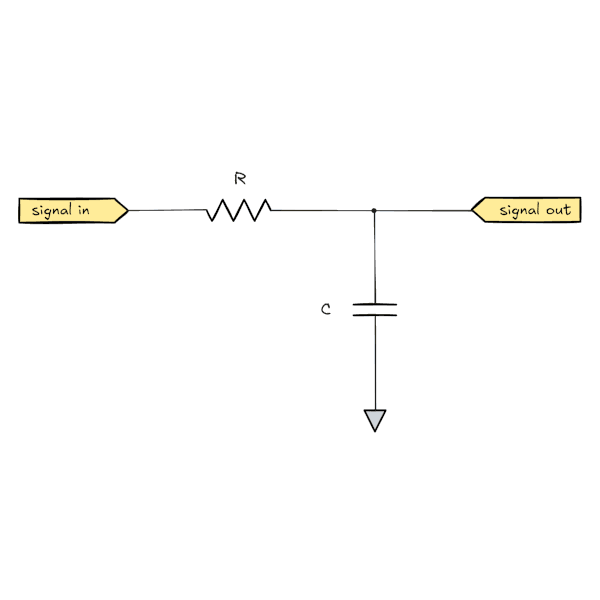
The discussion on analog filters looks at a few straightforward examples first. Starting with an resistor-capacitor (RC) filter, [lcamtuf] explains it by breaking its behavior down into steps of how the circuit behaves over time. Starting with a DC source and no load, and then removing the resistor to show just the behavior of a capacitor, shows the basics of this circuit from various perspectives. From there it moves into how it behaves when exposed to a sine wave instead of a DC source, which is key to understanding its behavior in arbitrary analog environments such as those involved in audio applications.

There’s some math underlying all of these explanations, of course, but it’s not overwhelming like a third-year electrical engineering course might be. For anyone looking to get into signal processing or even just building a really nice set of speakers for their home theater, this is an excellent primer. We’ve seen some other demonstrations of filtering data as well, like this one which demonstrates basic filtering using a microcontroller.

Ride On with FOSS and GoldenCheetah

3 December 2025 at 19:00

If you exclude certain companies like Peloton, the world of cycling technology is surprisingly open. It’s not perfect by any means, but there are enough open or open-ish standards for many different pieces of technology from different brands to interoperate with each other, from sensors and bike computers and even indoor trainers to some extent. This has also made it possible for open source software to exist in this realm as well, and the GoldenCheetah project has jumped in for all of us who value FOSS and also like to ride various bicycles from time to time.

GoldenCheetah focuses on gathering data from power meters, allowing cyclists to record their rides and save them in order to keep track of their training performance over time. It works well with sensors that use the ANT+ protocol, and once it has that data it can provide advanced analytics such as power curves, critical power modeling, and detailed charts for power, heart rate, and cadence. It can display and record live indoor-training data, and in some situations it can even run interval workouts, although not every indoor trainer is supported. There are no social features, subscriptions, or cloud requirements which can be refreshing in the modern world, but is a bit of a downside if you’re used to riding with your friends in something like Zwift.

All in all, though, it’s an impressive bit of software that encourages at least one realm of consumer electronics to stay more open, especially if those using bike sensors, computers, and trainers pick ones that are more open and avoid those that are proprietary, even if they don’t plan to use GoldenCheetah exclusively. And if you were wondering about the ANT+ protocol mentioned earlier, it’s actually used for many more things that just intra-bike wireless communications.

Converting a 1980s Broadcast Camera to HDMI

2 December 2025 at 01:00

Although it might seem like there was a sudden step change from analog to digital sometime in the late 1900s, it was actually a slow, gradual change from things like record players to iPods or from magnetic tape to hard disk drives. Some of these changes happened slowly within the same piece of hardware, too. Take the Sony DXC-3000A, a broadcast camera from the 1980s. Although it outputs an analog signal, this actually has a discrete pixel CCD sensor capturing video. [Colby] decided to finish the digitization of this camera and converted it to output HDMI instead of the analog signal it was built for.

The analog signals it outputs are those that many of us are familiar with, though: composite video. This was an analog standard that only recently vanished from consumer electronics, and has a bit of a bad reputation that [Colby] thinks is mostly undeserved. But since so many semi-modern things had analog video outputs like these, inspiration was taken from a Wii mod chip that converts these consoles to HDMI. Unfortunately his first trials with one of these had confused colors, but it led him to a related chip which more easily outputted the correct colors. With a new PCB in hand with this chip, a Feather RP2040, and an HDMI port the camera is readily outputting digital video that any modern hardware can receive.

Besides being an interesting build, the project highlights a few other things. First of all, this Sony camera has a complete set of schematics, a manual meant for the end user, and almost complete user serviceability built in by design. In our modern world of planned obsolescence, religious devotion to proprietary software and hardware, and general user-unfriendliness this 1980s design is a breath of fresh air, and perhaps one of the reasons that so many people are converting old analog cameras to digital instead of buying modern equipment.

Magnus Effect Drone Flies, Looks Impossible

30 November 2025 at 07:00

By now we’re all familiar with the quad-rotor design most popular among modern drones, and of course there are many variants using more or less propellers and even fixed-wing drones that can fly autonomously. We’ve even seen drones that convert from rotorcraft to fixed-wing mid flight. But there are even more esoteric drones out there that are far more experimental and use even more bizarre wing designs that look like they shouldn’t be able to fly at all. Take [Starsistor]’s latest design, which uses a single motor and an unconventional single off-center wing to generate lift.

This wing, though, is not a traditional foil shape typically found on aircraft. It uses the Magnus effect to generate lift. Briefly, the Magnus effect is when lift is generated from a spinning object in a fluid. Unlike other Magnus effect designs which use a motor to spin a cylinder, this one uses a design inspired by Savonius wind turbines where a wing is free to rotate around a shaft. A single propeller provides a rotational force to the craft, allowing this off-center wing to begin spinning and generating lift. The small craft was able to sustain several flights but was limited due to its lack of active control.

[Starsistor] went through a number of iterations before finally getting this unusual craft to fly. His first designs did not have enough rotational inertia and would flip over at speed, which was fixed by moving the propeller further away from the center of the craft. Eventually he was able to get a working design to prove his conceptual aircraft, and we hope to see others from him in the future.

Building a Low-Cost Satellite Tracker

26 November 2025 at 16:00

Looking up at the sky just after sunset or just before sunrise will reveal a fairly staggering amount of satellites orbiting overhead, from tiny cubesats to the International Space Station. Of course these satellites are always around, and even though you’ll need specific conditions to view them with the naked eye, with the right radio antenna and only a few dollars in electronics you can see exactly which ones are flying by at any time.

[Josh] aka [Ham Radio Crash Course] is demonstrating this build on his channel and showing every step needed to get something like this working. The first part is finding the correct LoRa module, which will be the bulk of the cost of this project. Unlike those used for most Meshtastic nodes, this one needs to be built for the 433 MHz band. The software running on this module is from TinyGS, which we have featured here before, and which allows a quick and easy setup to listen in to these types of satellites. This build goes much further into detail on building the antenna, though, and also covers some other ancillary tasks like mounting it somewhere outdoors.

With all of that out of the way, though, the setup is able to track hundreds of satellites on very little hardware, as well as display information about each of them. We’d always favor a build that lets us gather data like this directly over using something like a satellite tracking app, although those do have their place. And of course, with slightly more compute and a more directed antenna there is all kinds of other data beaming down that we can listen in on as well, although that’s not always the intent.

A Bird Watching Assistant

26 November 2025 at 01:00

When AI is being touted as the latest tool to replace writers, filmmakers, and other creative talent it can be a bit depressing staring down the barrel of a future dystopia β€” especially since most LLMs just parrot their training data and aren’t actually creative. But AI can have some legitimate strengths when it’s taken under wing as an assistant rather than an outright replacement.

For example [Aarav] is happy as a lark when birdwatching, but the birds aren’t always around and it can sometimes be a bit of a wild goose chase waiting hours for them to show up. To help him with that he built this machine learning tool to help alert him to the presence of birds.

The small device is based on a Raspberry Pi 5 with an AI hat nested on top, and uses a wide-angle camera to keep an eagle-eyed lookout of a space like a garden or forest. It runs a few scripts in Python leveraging the OpenCV library, which is a widely available machine learning tool that allows users to easily interact with image recognition. When perched to view an outdoor area, it sends out an email notification to the user’s phone when it detects bird activity so that they can join the action swiftly if they happen to be doing other things at the time. The system also logs hourly bird-counts and creates a daily graph, helping users identify peak bird-watching times.

Right now the system can only detect the presence of birds in general, but he hopes to build future versions that can identify birds with more specificity, perhaps down to the species. Identifying birds by vision is certainly one viable way of going about this process, but one of our other favorite bird-watching tools was demonstrated by [Benn Jordan] which uses similar hardware but listens for bird calls rather than looking for the birds with a vision-based system.

Expensive Batteries Hide Cheap Tricks

24 November 2025 at 01:00

In our modern world full of planned obsolescence helping to fuel cycles of consumerism, the thing that really lets companies dial this up to the max is locked-down electronics and software. We all know the key players in this game whether it’s an automotive manufacturer, video game console producer, smart phone developer, or fruit-based computer company of choice, but there are some lesser known players desperately trying to make names for themselves in this arena too. Many power tool manufacturers like Milwaukee build sub-par battery packs that will wear out prematurely as [Tool Scientist] shows in this video.

Determining that these packs don’t actually balance their cells isn’t as straightforward as looking for leads going to the positive terminal of each. The microcontrollers running the electronics in these packs are hooked up, but it seems like it’s only to communicate status information about the batteries and not perform any balancing. [Tool Scientist] tested this hypothesis through a number of tests after purposefully adding an imbalance to a battery pack, first by monitoring i2c communications, measuring across a resistor expected to show a voltage drop during balancing, let a battery sit 21 days on a charger, and then performing a number of charge and discharge cycles. After all of that the imbalance was still there, leading to a conclusion that Milwaukee still doesn’t balance their battery packs.

Giving them the benefit of the doubt, it could be that most packs will be just fine after years without balancing, so the added cost of this feature isn’t worth it. This video was put out nearly a year ago, so it’s possible Milwaukee has made improvements since then. But a more realistic take, especially in a world dominated by subscription services and other methods of value extraction, is that Milwaukee is doing this so that users will end up having to buy more batteries. They already make user serviceability fairly difficult, so this would be in line with other actions they’ve taken. Or it could be chalked up to laziness, similar to the Nissan Leaf and its lack of active thermal management in its battery systems.

Thanks to [Polykit] for the tip!

❌
❌