As we march toward one of the last weekends of the year, it’s time again to take a look at some homelab projects you should tackle. This weekend, I think it’s time you get your network in order. From setting up VLANs and configuring static IPs to having a VPN available to access your network when out of the house, here’s three homelab projects to tackle this weekend.
Lead Analysts: Jeewan Singh Jalal, Prabhakaran Ravichandhiran and Anand Bodke
Since November 3, 2025, KnowBe4 Threat Labs has been monitoring a highly sophisticated, multi-stage phishing operation that is actively targeting organizations to steal employees’ Microsoft 365 credentials. The campaign has been engineered to bypass traditional email security defenses, such as secure email gateways (SEGs), and multi-factor authentication (MFA) tools.
By the time the second group of NASA astronauts reach the Moon later this decade, the space agency would like to have a lunar rover waiting for them. But as the space agency nears a key selection, some government officials are seeking an insurance policy of sorts to increase the program’s chance of success.
At issue is the agency’s “Lunar Terrain Vehicle” (LTV) contract. In April 2024, the space agency awarded a few tens of millions of dollars to three companies—Intuitive Machines, Lunar Outpost, and Astrolab—to complete preliminary design work on vehicle concepts. NASA then planned to down-select to one company to construct one or more rovers, land on the Moon, and provide rover services for a decade beginning in 2029. Over the lifetime of the fixed-price services contract, there was a combined maximum potential value of $4.6 billion.
The companies have since completed their design work, including the construction of prototypes, and submitted their final bids for the much larger services contract in August. According to two sources, NASA has since been weighing those bids and is prepared to announce a final selection before the end of this month.
Are you in the market for a new NAS, but can’t decide between ARM and Intel/AMD? There are several reasons why you should go with ARM—most notably, it's way more power efficient. But traditional x86 does have one advantage you’ll want to consider.
Are you on the fence about paying for a password manager? Let me help you out: pay for one. I’ve used quite a few password managers over the years, including the one built into my browser. I’ve happily paid for 1Password for nearly a decade, and would have it no other way.
The Digital-Technik 2075 comes with a few components including a battery holder and 9 V battery, a push button, two 1 K resistors, a red LED, a 100 nF ceramic capacitor, a 100 µF electrolytic capacitor, a quad NAND gate IC, and a counter module which includes an IC and a 7-segment display. The kit also comes with wires, plugs, a breadboard, and a tool for extracting modules.
The Digital-Technik 2075 doesn’t use the spring terminals we see in other project labs of the time, such as the Science Fair kits from Radio Shack, and it doesn’t use modular Denshi blocks, such as we saw from the Gakken EX-150, but rather uses wire in conjunction with yellow plastic plugs. This seems to work well enough.
In the video, after showing us how to do switch debouncing, [Jason] runs us through making a counter with the digital components and then getting the counter to reset after it counts to five. This is done using NAND gates. Before he gets stuck into doing a project he takes a close look at the manual (which is in German) including some of the advertisements for other project labs from Busch which were available at the time. As he doesn’t speak German [Jason] prints out an English translation of the manual before working through it.
We’ve heard from [Jason] at Hackaday in recent history when we saw his Microtronic Phoenix Computer System which referenced the 2090 Microtronic Computer System which was also made by Busch.
Lead analysts: Louis Tiley, Lucy Gee and James Dyer
Between 1:48pm ET on October 29 and 6:53pm ET on October 30, 2025, KnowBe4 threat analysts observed a high volume of phishing emails detected by KnowBe4 Defend that were sent from the legitimate domain of one of the world’s largest sportswear brands.
The company that pioneered small launch has had a big year.
Rocket Lab broke its annual launch record with the Electron booster—17 successful missions this year, and counting—and is close to bringing its much larger Neutron rocket to the launch pad.
The company also expanded its in-space business, including playing a key role in supporting the landing of Firefly’s Blue Ghost mission on the Moon and building two small satellites just launched to Mars.
Welcome to Edition 8.20 of the Rocket Report! For the second week in a row, Blue Origin dominated the headlines with news about its New Glenn rocket. After a stunning success November 13 with the launch and landing of the second New Glenn rocket, Jeff Bezos’ space company revealed a roadmap this week showing how engineers will supercharge the vehicle with more engines. Meanwhile, in South Texas, SpaceX took a step toward the first flight of the next-generation Starship rocket. There will be no Rocket Report next week due to the Thanksgiving holiday in the United States. We look forward to resuming delivery of all the news in space lift the first week of December.
As always, we welcome reader submissions. If you don’t want to miss an issue, please subscribe using the box below (the form will not appear on AMP-enabled versions of the site). Each report will include information on small-, medium-, and heavy-lift rockets, as well as a quick look ahead at the next three launches on the calendar.
Northrop’s Pegasus rocket wins a rare contract. A startup named Katalyst Space Technologies won a $30 million contract from NASA in August to build a robotic rescue mission for the agency’s Neil Gehrels Swift Observatory in low-Earth orbit. Swift, in space since 2004, is a unique instrument designed to study gamma-ray bursts, the most powerful explosions in the Universe. The spacecraft lacks a propulsion system and its orbit is subject to atmospheric drag, and NASA says it is “racing against the clock” to boost Swift’s orbit and extend its lifetime before it falls back to Earth. On Wednesday, Katalyst announced it selected Northrop Grumman’s air-launched Pegasus XL rocket to send the rescue craft into orbit next year.
It took the California Science Center more than three years to erect its new Samuel Oschin Air and Space Center, including stacking NASA’s space shuttle Endeavour for its launch pad-like display.
Now the big work begins.
“That’s completing the artifact installation and then installing the exhibits,” said Jeffrey Rudolph, president and CEO of the California Science Center in Los Angeles, in an interview. “Most of the exhibits are in fabrication in shops around the country and audio-visual production is underway. We’re full-on focused on exhibits now.”
Brink, the Bitcoin development organization, recently funded the first ever independent security audit of Bitcoin Core conducted by a third party (the full report is available here). The audit was conducted by Quarkslab, a software security firm, with the help of the Open Source Technology Improvement Fund (OSTIF) and collaboration with Bitcoin Core developers Niklas Gögge, from Brink, and Antoine Poinsot, from Chaincode Labs.
This security audit marks a milestone in the development history of Bitcoin Core, the most widely adopted and reference client of the Bitcoin network and protocol.
While Bitcoin Core security policies and practices have been steadily hardened and revised to be more thorough and comprehensive over the last few years, an external audit by a third party specialized in security review is a new bar to meet. It was met.
The audit involved manual code review, static and dynamic analysis with automated tools, and advanced fuzz testing, which takes automatically generated input and runs it through different code paths attempting to reveal unexpected or detrimental behavior.
No critical, high, or medium-severity bugs were discovered in the audit. Two low-severity issues were different, and thirteen other issues that are not classified as vulnerabilities under Bitcoin Core’s vulnerability classification criteria.
The entire process also resulted in improvements in Bitcoin Core’s testing infrastructure, including new fuzz testing infrastructure for block connection and chain reorganization scenarios, a new area to be covered by testing, file system improvements speeding up and improving fuzz testing in general, new utilities for testing back sliding code performance, and suggestions for improving code readability for reviewers and new developers.
Some of these improvements are already being worked on for eventual review and merging into the Bitcoin Core repository.
The results of this independent security audit have reinforced that Bitcoin Core’s improvements over recent years in security policy, testing, and overall quality review have had a meaningful impact on the project.
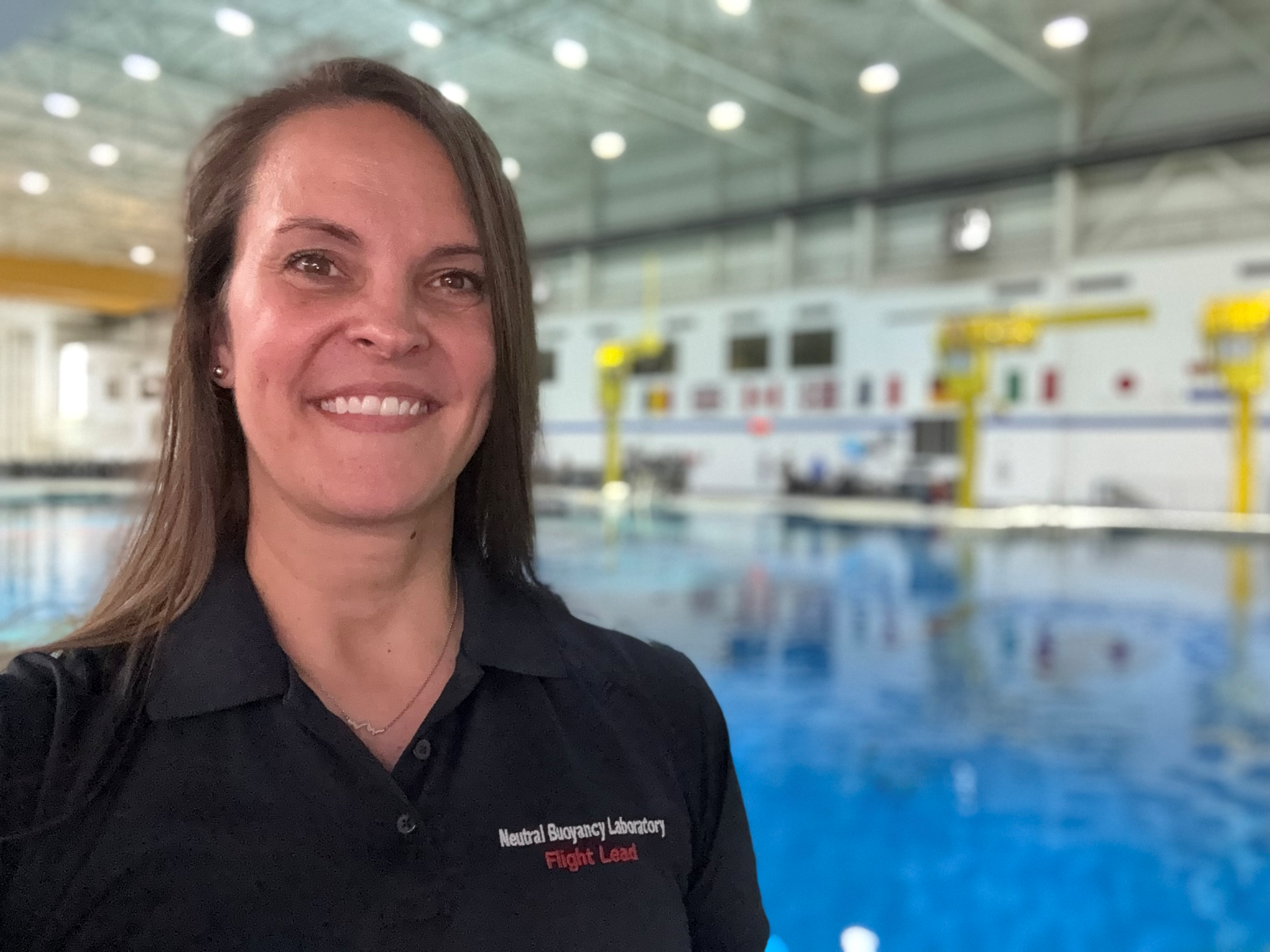
Alyssa Yockey supports the International Space Station from NASA’s Johnson Space Center in Houston as a flight lead at the Neutral Buoyancy Laboratory. The Neutral Buoyancy Laboratory is one of the world’s largest indoor pools where astronauts and support teams conduct trainings and other large-scale operations, both in the water and on the pool deck.
In this role, Yockey guides teams through integration efforts, including test readiness reviews to ensure all requirements are met, and helps prepare for suited or other testing events. She ensures smooth planning and execution of each mission-focused activity. Yockey also serves as a safety diver during astronaut suited testing events, giving her a unique perspective on both the planning and execution of Neutral Buoyancy Laboratory operations.
Read on to learn about Yockey’s career with NASA and more!
Alyssa Yockey, flight lead at the Neutral Buoyancy Laboratory in the Sonny Carter Training Facility in Houston.
Alyssa Yockey
Where are you from?
Friendswood, Texas.
How long have you been working for NASA?
Eleven and a half years.
What was your path to NASA?
My path to NASA has been a unique blend of science and hands-on experience. I grew up in Friendswood, Texas, surrounded by the influence of NASA and the space community. While many around me were drawn to engineering, I knew early on that wasn’t the path I wanted to take. Instead, I followed my curiosity for the natural world and earned a master’s degree in marine biology, which gave me a strong foundation in research, problem-solving, and working in challenging environments. From there, I pursued opportunities that built on those skills, including completing offshore water survival training at the Neutral Buoyancy Laboratory for the job I held at the time. This role also allowed me to learn more about the wide range of opportunities at the facility. In addition, I became a certified scuba diver during college, which strengthened my capability and confidence in underwater and extreme environments. Together, these experiences combined my academic background with practical training, and ultimately guided me toward my role at NASA.
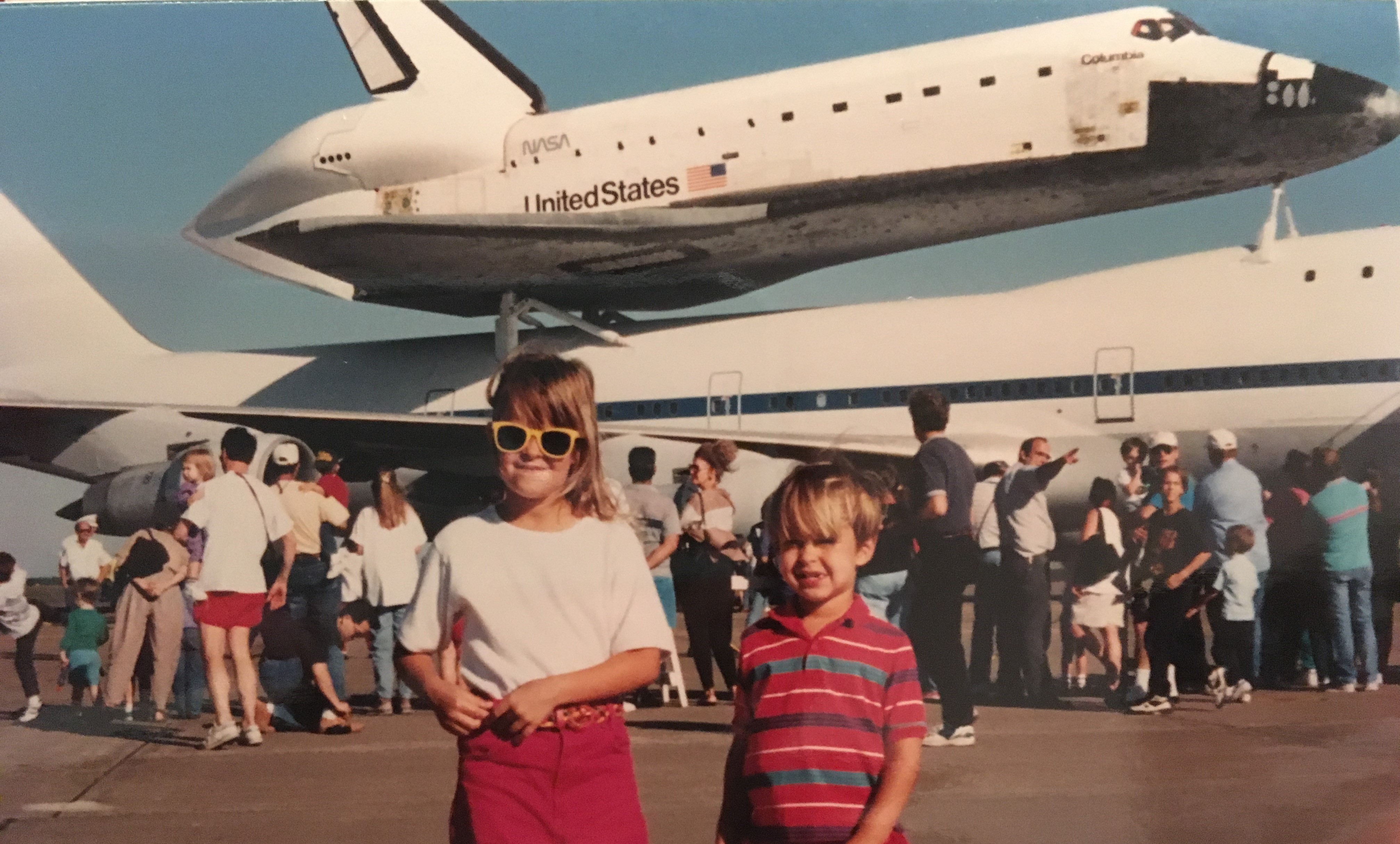
Alyssa Yockey and her younger brother with Space Shuttle Columbia at Ellington Field, early 1990s.
Alyssa Yockey
How would you describe your job to family or friends that may not be familiar with NASA?
When I explain my job to family and friends, I usually say I help make sure “astronaut pool days” go smoothly. I work with different teams to get their projects ready for NASA’s giant pool – the Neutral Buoyancy Laboratory – where astronauts practice for spacewalks both on the International Space Station and on the lunar surface. That means taking care of the paperwork, preparing checklists for mock-up setup, and ensuring everything’s ready before anyone puts on a suit and hops in the water. When I am not doing that, I sometimes have the opportunity to jump in myself as a safety diver, which essentially makes me an underwater lifeguard for the astronauts.
Alyssa Yockey (right) supporting NASA astronaut Chris Cassidy (left) as a safety diver during his last suited event in the Neutral Buoyancy Laboratory prior to his retirement.
NASA
What advice would you give to young individuals aspiring to work in the space industry or at NASA?
The space field is built on innovation and problem-solving, so don't be afraid to ask questions, explore different disciplines, and step outside your comfort zone.
Alyssa Yockey
Neutral Buoyancy Laboratory Flight Lead
Stay curious, be resilient, and never stop learning. Seek internships, research opportunities, and mentorships, as they can open doors and give you hands-on experience. Most importantly, remember that there is no single path into this industry. Whether you come from engineering, science, business, policy, or even the arts, your unique perspective can contribute to pushing the boundaries of what’s possible in space exploration.
Is there a space figure you’ve looked up to or someone that inspires you?
For me, it hasn’t been about looking up to one individual but rather being inspired by the collective effort it takes to make space exploration possible. What inspires me most is seeing how different disciplines and perspectives unite toward a single goal, often under intense pressure. That kind of teamwork and dedication motivates me to give my best and reminds me that every role, no matter how big or small, contributes to the larger success of the space program.
Every mission is the result of countless people—engineers, divers, scientists, technicians, trainers, flight controllers, and more—all bringing their expertise together to solve complex problems.
Alyssa Yockey
Neutral Buoyancy Laboratory Flight Lead
What is your favorite NASA memory or the most meaningful project you’ve worked on during your time with NASA?
My favorite NASA memory is getting to witness, over multiple years, the collaboration of various NASA groups in developing the choreography for the four Alpha Magnetic Spectrometer (AMS) spacewalks. It was incredible to be part of that process from the very beginning. I was lucky enough to see the very first development run at the Neutral Buoyancy Laboratory, and then later watch as ESA (European Space Agency) astronaut Luca Parmitano and NASA astronaut Drew Morgan performed those same spacewalks on orbit. Being able to see all that preparation, teamwork, and problem-solving come full circle was both rewarding and unforgettable.
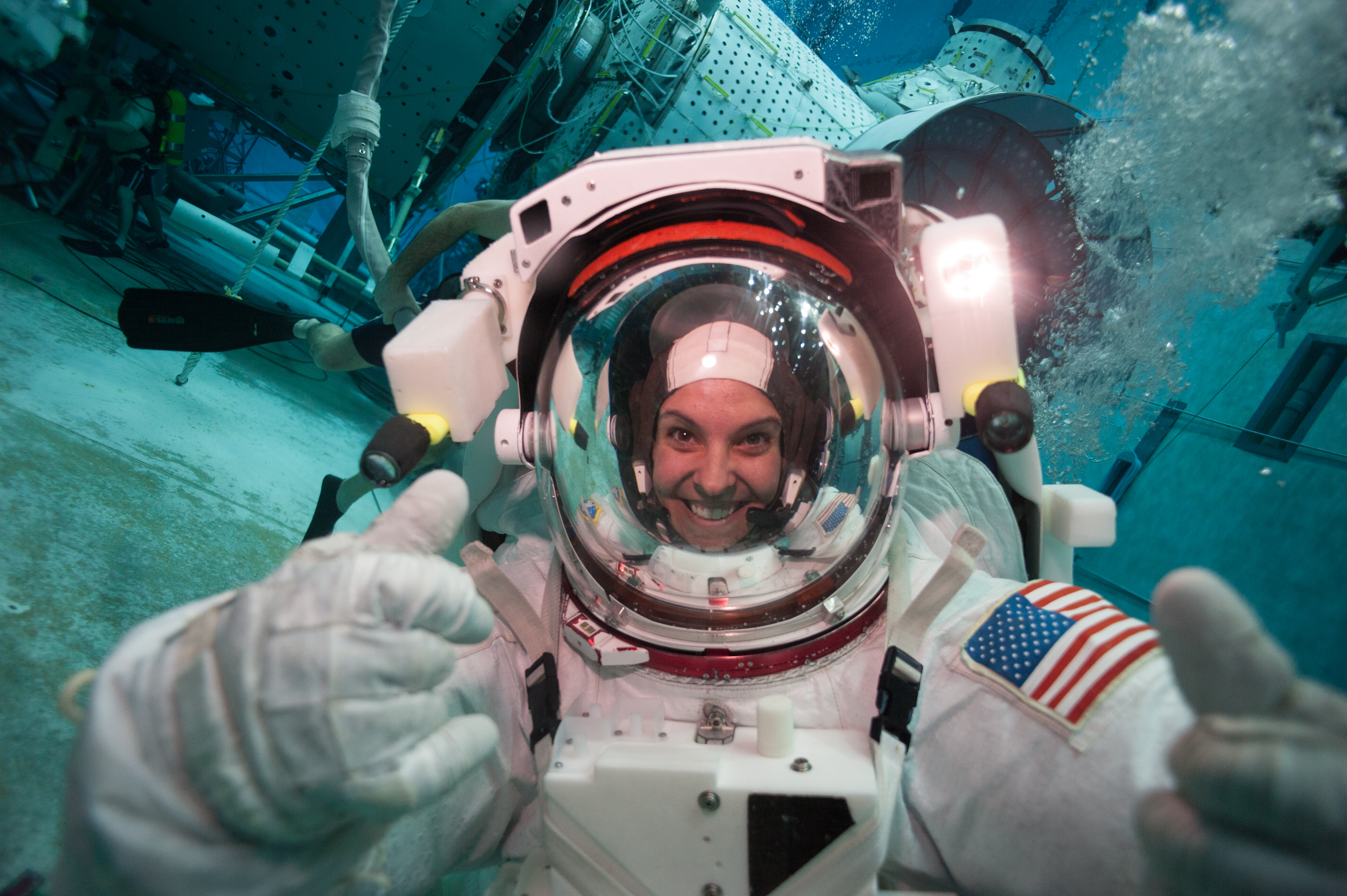
Alyssa Yockey in the Extravehicular Mobility Unit during a suited egress training at the Neutral Buoyancy Laboratory.
NASA
What do you love sharing about station?
I love sharing how the space station connects directly back to life on Earth. People often think of it only as a place for astronauts to live and work in space, but it’s really a one-of-a-kind laboratory that helps us solve problems here at home. From medical research that leads to new treatments, to technology that improves clean water and sustainability, to international cooperation that shows what we can achieve when we work together—the station is a powerful reminder that exploration drives innovation and benefits everyone on Earth.
November 2, 2025, marks 25 years of continuous human presence. What does this milestone mean to you?
This milestone is inspiring – it represents the innovation, persistence, and teamwork required to make the extraordinary seem routine. Personally, it reminds me why exploration matters: it connects us across nations, pushes the limits of what’s possible, and builds the foundation for the next steps in our journey beyond Earth.
If you could have dinner with any astronaut, past or present, who would it be?
I would choose Karen Nyberg. Not only did she contribute significantly as a NASA astronaut and engineer, but she also brought a very human and creative element to her time in space. I admire how she combined her professional expertise with her passion for sewing and quilting, even creating a quilt block while aboard the space station. As someone who enjoys quilting myself, I think it would be fascinating to hear about how she balanced technical work with creative expression in such a unique environment. I imagine our conversation would cover both science and stitching, which is the perfect blend of my own interests.
Do you have a favorite space-related memory or moment that stands out to you?
One of my favorite space-related memories is getting to meet and chat with former NASA flight director Gene Kranz during a book signing. It was fun to hear stories firsthand from someone who played such a pivotal role in NASA’s history, and to gain insight into the dedication, teamwork, and problem-solving that make spaceflight possible. Meeting him brought history to life and reinforced why I’m grateful to be part of this field.
Alyssa Yockey (center) and her husband (left) meeting Gene Kranz (right) at a book signing event.
Alyssa Yockey
What are some of the key projects you have worked on during your time at NASA? What have been your favorite?
During my time at NASA, I first served as a dive operations training officer, where I was responsible for training and supporting divers in the Neutral Buoyancy Laboratory. From there, I took on the role of flight lead, supporting a range of projects including Axiom Space’s integration into the Neutral Buoyancy Laboratory, working with the Micro-G Neutral Buoyancy Experiment Design Teams (Micro-G NExT) student experiment design teams, and participating in various lunar operations testing events. Each of these projects has been rewarding in different ways, whether through helping commercial partners prepare for their missions, mentoring and guiding students as they see their concepts come to life, or contributing to the future of lunar exploration. I especially enjoy the challenges each project brings, as they push me to adapt, collaborate across disciplines, and continuously grow in my role.
What are your hobbies/things you enjoy doing outside of work?
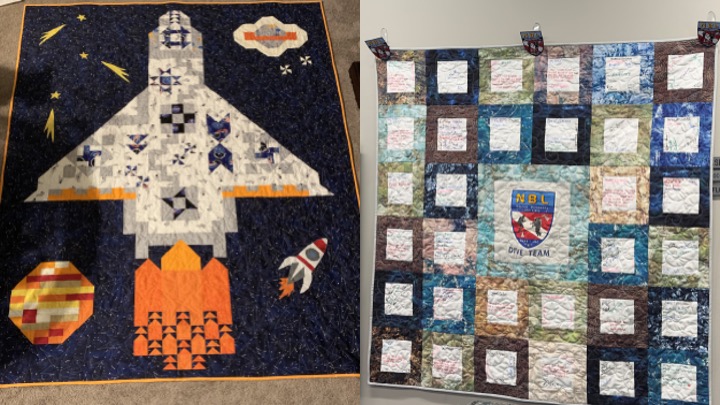
Outside of work, I enjoy spending time outdoors with my husband and our pups, traveling and camping in different state and national parks. Hiking is one of our favorite ways to explore new places and take in the scenery together. At home, I like to unwind with a good book or by sewing and quilting. Quilting has become a truly rewarding creative outlet for me — I love selecting fabrics, experimenting with patterns, and watching a design come to life piece by piece. Each quilt has its own story, whether it’s made for a friend, a family member, or simply for the joy of creating something new.
Left: “One Giant Stitch” quilt, crafted by Alyssa Yockey with unique modifications. Original pattern by Kelli Fannin Quilt Designs. Right: Signature Quilt made by Alyssa Yockey featuring fabric from retired astronaut Karen Nyberg’s “Earth Views” line, created from her favorite photos taken from space.
Alyssa Yockey
Day launch or night launch?
Night launch!
Favorite space movie?
Hidden Figures.
NASA Worm or Meatball logo?
Worm!
NASA and its partners have supported humans continuously living and working in space since November 2000. After 25 years of continuous human presence, the space station remains a training and proving ground for the future of commercial space stations, deep space missions, enabling NASA’s Artemis campaign, lunar exploration, and future Mars missions.
Every day, we are conducting exciting research aboard our orbiting laboratory that will help us explore farther into space and bring benefits back to people on Earth. You can keep up with the latest news, videos, and pictures about space station science on the Station Research & Technology news page. It is a curated hub of space station research digital media from Johnson and other centers and space agencies.
Sign up for our weekly email newsletter to get the updates delivered directly to you.
Follow updates on social media at @Space_Station on X, and on the space station accounts on Facebook and Instagram.
The first multi-spacecraft science mission to launch to Mars is now on its way, and catching a ride on the twin probes are the first kiwis to fly to the red planet.
NASA’s ESCAPADE (Escape and Plasma Acceleration and Dynamics Explorers) mission lifted off on a 22-month trip to Mars on Thursday aboard a New Glenn rocket. Once there, the identical satellites will enter Martian orbit to study in real time how space weather affects the planet’s hybrid magnetosphere and how the interaction drove Mars to lose its once-dense atmosphere.
Led by the Space Sciences Laboratory at the University of California, Berkeley—the two spacecraft are named “Blue” and “Gold” after the school’s colors—the ESCAPADE probes are the first Mars-bound vehicles to be designed, built, and tested by Rocket Lab, the end-to-end space company headquartered in California but founded in New Zealand.
The rocket company founded a quarter-century ago by billionaire Jeff Bezos made history Thursday with the pinpoint landing of an 18-story-tall rocket on a floating platform in the Atlantic Ocean.
The on-target touchdown came nine minutes after the New Glenn rocket, built and operated by Bezos’ company Blue Origin, lifted off from Cape Canaveral Space Force Station, Florida, at 3:55 pm EST (20:55 UTC). The launch was delayed from Sunday, first due to poor weather at the launch site in Florida, then by a solar storm that sent hazardous radiation toward Earth earlier this week.
“We achieved full mission success today, and I am so proud of the team,” said Dave Limp, CEO of Blue Origin. “It turns out Never Tell Me The Odds (Blue Origin’s nickname for the first stage) had perfect odds—never before in history has a booster this large nailed the landing on the second try. This is just the beginning as we rapidly scale our flight cadence and continue delivering for our customers.”
Barbecue fans love a great mash-up — and rib wings are exactly that. Part baby back rib, part chicken wing in spirit, these trimmed rib bites deliver crispy bark and tender, smoky meat in a single bite. Perfect for tailgates or backyard feasts, they’re easy to cook hot and fast over live fire, with that irresistible “rib-by” chew that keeps everyone reaching for more.
So the next way cool thing that will rock the barbecue blogosphere?
We’re putting our Bitcoins on Rib Wings.
Rib Wings are made by slicing a rack of ribs into individual ribs before cooking. The process resembles how chicken wings are divided into drumettes and flats.
Which brings us to the debate as to who in the barbecue world first created the rib wing. Forbes.com writer and Barbecue University alum Larry Olmsted credits Mike Hiller with the Rib Wing (Forbes, May 2021).
I’m a diehard mad scientist when it comes to barbecue. I love experimenting when I cook. I like to see how changing the rub, the sauce, or the grill produces new flavors and textures. For example, the ribs I cook low and slow in a Big Green Egg XL will taste and look different than the ribs I hang in my Pit Barrel Cooker. Check out my “Ultimate Rib” blog to read more about my ribs experiments.
Rib Wings are my latest experiment. A rack of ribs is typically sliced into individual ribs after cooking; why not cook them that way? And why did no one think of it earlier?
How to Grill Rib Wings
Here is how my Rib Wings came together. I started by slicing a rack of St Louis cut spareribs into individual ribs. I normally remove the membrane from a rack of ribs before cooking. Slicing the ribs before cooking eliminates that tedious step per Hiller. I liberally seasoned the ribs with one of my homemade spice rubs. (You could also use Steven’s Kansas City Smoke Rub.
I then placed the ribs on a wire rack to make it easier to move them on and off the grill. I left space between each rib so the smoke would circulate evenly. My plan was to cook the ribs low and slow, spray the ribs with an apple cider vinegar mixture while cooking, and then baste with barbecue sauce at the end as outlined by Hiller.
I set up a Big Green Egg XL for indirect grilling by inserting the diffuser plate and obtained a temperature of 250 degrees. I used apple chucks to create wood smoke. After smoking the ribs for one hour, I started spraying the ribs with a mixture of apple cider vinegar, Worcestershire, and hot sauce.
I continued to spray the ribs every 30 minutes. To finish the ribs, I increased the temperature to 375 degrees for the last 20 minutes and basted the ribs with my homemade spicy peach barbecue sauce. Total cooking time was three and half hours. I knew the ribs were done when the meat was pulled back from the bones.
Here is what I learned by cooking ribs individually. The smaller ribs cooked faster than the meatier middle ribs. The ribs from the ends of the rack were fall of the bone tender, but I prefer my ribs to hold together when I take a bite. The meatier ribs held together beautifully. The ribs developed a dark mahogany color, almost to the point of looking burnt. I feel the dark color was a result of the Worcestershire sauce in the spray mixture. The dark color occurred before I added the spicy peach barbecue sauce, so it was not due to burning the sauce.
The process of seasoning and smoking the ribs individually definitely boosts the flavor compared to the whole rack method. Every bite had a heightened level of sweetness, spiciness, and smokiness. The combination of the rub and smoke created a crisp texture that reminded me of the “bark” I love on brisket. One minor shortcoming of smoking individual ribs is the smaller end ribs were a hint less tender on the inside. The most noticeable advantage to the “Rib Wing” is that each bite of the rib has a blast of flavor that comes from exposing all sides of the rib to spice rub and smoke.
I think Rib Wings would make a great appetizer for a cookout. I wondered if I could cook enough to make a meal, so I ran a second test. The second test was going to be performed on my Pit Barrel Cooker, which is one of my favorite methods to cook multiple racks of ribs or wings for a large group. I can hang 6-8 racks of ribs or cook over seventy chicken wings on the hanging skewers in the barrel cooker. I sliced the ribs and seasoned them with Steven’s Kansas City rub. Apple wood chips were added to create wood smoke. The barrel cooks at a higher temperature so I anticipated a different texture and shorter cooking time.
I wanted to skewer the ribs and hang them like I do chicken wings. After a few attempts, I didn’t feel the ribs were secure on the hanging skewers and might fall off as the meat pulls back from the bones. Disappointed, I placed the individual ribs on the grate.
I started to spray the ribs with the same apple cider vinegar mixture after 30 minutes. The ribs started to pull back from the bones after an hour and a quarter. I then basted the ribs with Steven’s Chipotle Molasses barbecue sauce and cooked for an additional 15 minutes. Total cooking time was an hour and a half.
Due to the higher temperature of the barrel cooker the rub and sauce caramelized and produced a sweet and smoky exterior. The aroma of wood smoke was present despite the shorter time exposed to the smoke. The time required to cook the larger ribs caused the smaller end ribs to become too crispy. The ribs developed the same dark color on the ribs as in the first test. The ribs had an appealing sweet with a little heat flavor due to the combination of Steven’s rub and sauce. The ribs held together with each bite. The only drawback? I was disappointed I could not hang the ribs. I thought it would be a cool way to cook enough rib wings for a larger group.
I enjoyed both experiments because they were so incredibly tasty. Seasoning all sides of the ribs and adding sauce elevated the flavor of the ribs. I hope this inspires you to run your own flavorful experiment.
So blogsphere—get ready for rib wings. You’ll never think about ribs—or wings—the same way!
Rib wings are one of those sleeper hits that turn a regular cookout into something memorable. Once you’ve tried them, you’ll wonder why more people don’t grill ribs this way. For more creative rib ideas and live-fire inspiration, check out Project Smoke, Project Fire, or browse the Ribs section on BarbecueBible.com.
Steve Nestor is the fire wrangler on Project Fire and at Barbecue University. More importantly, he’s an incredibly skilled physical therapist in the Boston area. If leaning over a hot grill or pulling heavy briskets from smoker leaves you with weak knees or a sore back, give him a call. At very least, sign up for his newsletter.
Rib wings are sections cut from the baby back rib rack near the loin. They’re smaller than full ribs, with just enough meat and fat to cook quickly and still stay juicy.
How do you grill rib wings?
Season with your favorite rub, then grill over medium-high heat (375–400°F) for about 20–25 minutes, turning often until the meat is browned and tender. Brush with sauce at the end if desired.
Should I use direct or indirect heat?
Start over direct heat to crisp the exterior, then finish over indirect heat until the internal temperature reaches about 190°F. This gives you a tender bite without burning the rub.
What rubs or sauces pair best?
Try Steven Raichlen’s Basic Barbecue Rub or Project Smoke All-Purpose Rub for seasoning. Finish with your favorite barbecue sauce or glaze for a sweet-smoky finish.
Can rib wings be smoked instead of grilled?
Absolutely. Smoke them at 250–275°F for 1.5 to 2 hours with fruitwood or hickory until tender and lightly charred. They’ll take on a deeper, more traditional barbecue flavor.
Cybercriminals want their payday. Unfortunately for the targets of phishing (and the organizations they work for) that means they’re constantly refining their tactics to create more sophisticated attacks that are harder to detect – by both email security products and people.
From empty offices in 2020 to AI colleagues in 2025, the way we work has been completely rewired over the past five years. Our guest on this week’s GeekWire Podcast studies these changes closely along with her colleagues at Microsoft.
As Stallbaumer explains in the book, the five-year period starting with the pandemic and continuing to the current era of AI represents one continuous transformation in the way we work, and it’s not over yet.
“Change is the only constant—shifting norms that once took decades to unfold now materialize in months or weeks,” she writes. “As we look to the next five years, it’s nearly impossible to imagine how much more work will change.”
Listen below for our conversation, recorded on Microsoft’s Redmond campus. Subscribe on Apple or Spotify, and continue reading for key insights from the conversation.
The ‘Hollywood model’ of teams: “What we’re seeing is this movement in teams, where we’ll stand up a small squad of people who bring their own domain expertise, but also have AI added into the mix. They come together just like you would to produce a film. A group of people comes together to produce a blockbuster, and then you disperse and go back to your day job.”
The concept of the ‘frontier firm’: “They’re not adding AI as an ingredient. AI is the business model. It’s the core. And these frontier firms can have a small number of people using AI in this way, generating a pretty high run rate. So it’s a whole new way to think about shipping, creating, and innovating.”
The fallacy of ‘AI strategy’: “The idea that you just need to have an ‘AI strategy’ is a bit of a fallacy. Really, you kind of want to start with the business problem and then apply AI. … Where are you spending the most and where do you have the biggest challenges? Those are great areas to actually think about putting AI to work for you.”
Adapting to AI: “You have to build the habit and build the muscle to work in this new way and have that moment of, ‘Oh, wait, I don’t actually need to do this.’ “
The biggest risk related to AI: “The biggest risk is not AI in and of itself. It’s that people won’t evolve fast enough with AI. It’s the human risk and ability to actually start to really use these new tools and build the habit.”
Human creativity and AI: “It still takes that spark and that seed of creativity. And then when you combine it with these new tools, that’s where I have a lot of hope and optimism for what people are going to be able to do and invent in the future.”
Restaurant style pepper chicken fry was in my to-do list for way too long simply because we both love this South Indian classic since the time we discovered it! Finally it is up here for all of you to make and enjoy!
If you love spicy preparations of chicken, then you have come to the right page today!
This authentic South Indian pepper chicken fry will blow your mind and also your taste buds with its incredible taste, flavor and texture!
We have had our fair share of this exemplary dish in many good restaurants in Bangalore and now it was high time to create it in my own kitchen and share with you guys.
Thanks to my love for spicy South Indian delicacies, I had already shared South Indian mutton sukka which has received immense love from my readers; hence it’s time now for another classic!
What is Restaurant Style Pepper Chicken Fry?
After moving to the Southern part of India more than a decade ago, we not only discovered, but also fell in love with a few unique dishes of the region and pepper chicken fry is definitely one of them!
As you can see from the stunning pictures, pepper chicken fry is an Indian stir fry dish made with small bone-in pieces of chicken infused with loads of black pepper along with a few other spices!
This is a classic South Indian dish which is super popular among the meat & spices lovers and that’s the exact foodie segment we fall in too!

 Login
Login