Call it by any name it has a lot of nutritional value and is a powerhouse of nutrients. Snake gourd belongs to the summer squash family, mostly a summer produce ,it is available all round the year in India.
Rich in dietary fiber , vitamins A and C ,snake gourds help in digestion ,prevent bloating and constipation . Helps in detoxification of the body because of its diuretic properties. Due to water content present in the snake gourd it helps maintain body's hydration.
Podalangai Thayir pachadi is a new addition to my kitchen and hence it is making it to the blog .
Amma would make it frequently during summer, but over the years I had totally forgotten about this recipe . As a flash,this recipe occurred to me this morning when I was contemplating what to make with fresh and tender snake gourd that I had just bought. The snake gourds have to be tender. Overly ripe ones taste bitter and become hard and chewy . So while buying, make sure the snake gourd vine is easy to twist and tender to feel. If you find it hard or it easily cracks ,then don't buy that .
Podalangai thayir pachadi is very easy to make and gets done in no time . A tasty paste is made using fresh coconut, ginger,green chillies and curry leaves which is added to thick whipped yogurt and boiled snake gourd is mixed along with this followed by a tempering of mustard, dry red chillies and asafoetida.
Podalangai thayir pachadi is also made during Amavasya, pithrupaksha and Shraadh cooking in a typical Tamil Brahmin household . Vishu and Onam Sadhyas also feature padavalanga kichadi as one of the Sadhya menu items.
Officially, though it is still winter/spring in India , we are already feeling the warmth in my part of the city. There is hardly any chillness felt and the afternoon sun is at its peak .
As always, with summer setting in; buttermilk,lassi,raita and yogurt based curries make a lot of appearance in my kitchen . Yogurt based curries are light on stomach and easy to digest as well .Most importantly it keeps the body cool during harsh summer and it maintains hydration.
Avarakkai kootu is a popular side dish from the Tambrahm cuisine made from just moong dhall (yellow split gram) , fresh coconut paste and a Sizzling tempering of mustard seeds ,curry leaves in coconut oil.
Avarakkai(tamil),Avrekkai(Kannada), chikkidkaay (Telugu) is a native Indian vegetable and used extensively across cuisines in India . In the Maharashtra and Gujarat it is called as Vaal papdi or papdi and Sem in Hindi .
Avrakkai is a diabetic friendly vegetable and also rich in protein, dietary fibre,vitamin A ,potassium and folates. Consuming avarekkai is a good source of plant protein and apt for vegetarians to meet their dietary requirements of protein intake. The fibre present in the Indian flat broad beans helps to manage cholesterol in the body.
Since, Avarekkai is a native vegetable, it is used during the Mahalaya Paksha , Amavasya cooking and also for cooking during Shraadh or Devasam. During Shraadh , Amavasai or Mahalaya paksha avrekkai is mostly used in the form of kootu but some families also make a simple stir fry known as Thenga pota curry .
I shall share the recipe of the simple yet flavorful curry very soon. You may refer to Mildly Indian Seema's Kothavarangai Poriyal and in the same way you can make avarekkai poriyal .
Avrekkai kootu can be mixed with rice or can also be served as an accompaniment to sambar ,vethakuzhambu, milagu kuzhambu along with some toasted papads and a simple paruppu Thogayal or pudina Thogayal.
If making kootu to mix with rice, make it a little runny else we can have a thicker consistency.
Avrakkai kootu is purely Saatvik and Vegan making it No Onion No garlic and Jain friendly .
You may also want to try some lip smacking healthy and delicious kootu recipes from my blog
Preparation Time - 10 mins Cooking Time - 25mins Complexity - Simple Serves - 2 to 3
Ingredients
150 gms Indian broad beans /avarekkai 1 cup moong dhall 1/2 cup fresh grated coconut 1 tsp jeera/cumin 8 to 10 pepper corns 2 dried red chillies Few curry leaves Pinch of turmeric Salt as needed 1 tsp coconut oil 1/2 tsp mustard seeds Pinch of asafoetida
Method
Wash the broad beans and trim the head and tail. Bundle them up and chop into medium cuts.
Wash the moong dhall under running water 3 to 4 times.
Add the washed moong dhall,chopped avrakkai ,turmeric , 2 cups water and pressure cook for 3 whistles. Let the pressure release naturally.
Grind the coconut, cumin,red chillies ,pepper with water to a fine paste .
Once ,the pressure cools down,lightly mash and mix the lentil and add the ground coconut paste to this along with required amount of salt.
If too thick,add 1/4 cup water and bring it to a quick boil with occasional stirring. Coconut paste has a tendency to stick to the bottom and the kootu will get burnt.
Turn off the stove when the kootu thickens and the raw flavor from the coconut paste is gone.
Prepare a tempering of mustard seeds,fresh curry leaves,asafoetida in hot coconut oil and pour it over the delicious kootu.
Millet Dal Khichdi is a healthy one pot meal made from foxtail millet and a combination of various pulses . Khichdi is a very healthy Indian meal similar to a porridge or a gruel and is a staple meal for patients recovering from illness especially fever and stomach related issues.
Foxtail millet also known as Thinai (Tamil) , Kangni (Hindi) is low in glycemic index and rich in fibre and beta carotene.Consuming foxtail millets helps in keeping the sugar spikes under control and the presence of beta carotene makes it good for the eyes too. Beta carotene is what is found in carrots too .
Unlike,rice dal khichdi the quantity of millets used is less because it gives a good yield on cooking. It is preferred to soak the millets for min of 6 to 8 hrs before cooking because that helps in maximum absorption of the nutrients.
So,if you plan on making dal khichdi for dinner ,then soak the foxtail millet during your lunch time ,so by the time you make dinner around 7pm the millets have soaked sufficiently giving you the best benefits.
Before cooking the millets, discard the water in which they were soaked and cook it using fresh water .
To make dal khichdi, I use a combination of thoor dal (pigeon peas) , moong dhall(yellow split peas) , handful of whole moong (green beans) and black udad dhall (unhusked black lentil) along with mild whole spices. I make khichdi as a one pot meal ,where I cook the millets and pulses in the pressure cooker and temper mustard seeds, curry leaves in ghee and pour it over the khichdi before serving .
Khichdi is very mildly spiced and it pairs well with Kadhi or raita . A side of pickle and some ghee on top is how the khichdi is generally served. In my home, we relish it with khatta meetha Gujarati Kadhi and some roasted papads . At times I also make some potato curry,to be served if I make dal khichdi for lunch . I like my khichdi to be gooey and slightly runny ,but if you like your khichdi to be thick ,then adjust water accordingly.
Soaking Time - 8 hrs Preparation Time - 20mins Cooking Time - 30 to 40 mins Serves - 2 to 3
Skip the ghee if you are following vegan diet.
Ingredients
3/4 cup foxtail Millet (soaked) 1/4 cup thoor dhall (pigeon peas) 1/4 cup moong dhall (split yellow peas) 2 tbsp split black udad dhall 2 tbsp whole green moong dhall (green gram) 2 medium tomatoes chopped 2 to 3 green chillies chopped 2 to 3 cloves 1 inch cinnamon Finely chopped ginger Freshly chopped coriander Handful of curry leaves 2 tbsp ghee / cooking oil 1 tsp mustard/raai 1tsp cumin /jeera 2 to 3 dry red chillies Pinch of asafoetida Salt as needed Pinch of turmeric
Method
Drain the water from soaked millet and wash the lentils multiple times .
In a deep bottom pressure cooker,add the millet,lentils ,chopped tomatoes, green chillies, ginger,turmeric, salt with 4 cups of water .
Pressure cook for 5 to 6 whistles and let pressure release naturally.
Open the lid and using a ladle mash the cooked khichdi nicely till it turns mushy. Add a cup of hot water if you feel it is too dry and thick .Adjust salt if needed.
Prepare a tempering of mustard ,cumin,dry red chillies,asafoetida and curry leaves in ghee and pour it over the khichdi .
Garnish with a lot of fresh coriander and serve hot .
Keerai is the Tamil name for Green Leafy vegetables in general . Spinach is known as palak keerai , fenugreek is known as Vendhiya Keerai , Amaranthus is known as Arai Keerai , Dill Leaves is known as Soi Keerai ,Drumstick leaves as Murunga keerai so on and so forth.
We all know how healthy and beneficial is the inclusion of greens in our daily diet . So pls do make it a point to include greens as a part of diet atleast once or twice a week . Of course please exercise caution and consult your Doctor if greens need to be avoided due to underlying medical conditions.
Keerai kootu has been my childhood favorite and I would eat this almost everyday as a little girl . The mild sweetness from the cooked moong dal blends well with the coconut jeera paste and cooked palak and the final tempering of mustard in coconut oil simply elevates the flavor profile of the kootu. You can pair it with some delicious sambar rice or mix this kootu with some steamed rice and ghee and enjoy as is. You can use any variety of keerai for this kootu,but I personally love palak. I don't like Methi in kootu as it imparts a slightly bitter taste to the kootu which puts me off.
The green Leafy vegetables need to be cleaned very well before using. There may be a chance of lot of weeds or some rotten leaves hidden in the bunch . I am sharing a detailed video on how to clean the green Leafy vegetables at ease. If the stems are tender,I chop them finely and use it too while making the kootu.
If you are a lover of exotic greens, then Baby Bokchoy and Shitaake stir fry by Preethi will be the best choice. I was paired with Preethi for August's Theme of Leafy Greens theme suggested by Seema of Mildly Indian.
A simple lunch platter of keerai kootu, jeera pepper rasam and beetroot curry with fried papads. (Pic updated on Nov 5th 2024)
Preparation Time - 15 mins Cooking Time - 20 mins Serves - 2 to 3
Complexity - easy
Ingredients
2 small bunch spinach/palak 1.5 cup cooked moong dhall 1/4 cup grated coconut 1tsp jeera 1/2 tsp pepper 2 to 3 dry red chillies / 1 tsp red chilli powder 2 tsp coconut oil 1 tsp mustard seeds 1/2 tsp udad dhall Pinch of asafoetida Salt as needed
Method
Clean and wash the spinach bunch well . Finely chop the palak and cook it well . No need to pressure cook .you can cook it in regular open pot until the raw flavor is lost. Use a heavy bottomed pan always.
Grind the coconut, jeera ,pepper, red chillies to a fine paste with sufficient water.
Once the palak is cooked, add this coconut paste,bring it to a rolling boil and then add the cooked moong dhall .
Ensure the cooking is on medium flame and you are stirring constantly to avoid burning . Moong dhall and coconut paste will stick to the pan very quickly.
Once the kootu reaches a rolling boil,turn off and prepare a tempering of mustard, udad dhall and asafoetida in coconut oil and pour it over the kootu . Relish the kootu with rice and papads.
Kichadi (Pachadi) is an integral part of a festive meal (Sadhya) in Kerala. Kerala style kichadi must not be confused with the North Indian Khichdi which is a rice based main course recipe.
Onam and Vishu Sadhya is incomplete without serving a kichadi . Kichadi also known as Pachadi in few regions of Kerala,is a yogurt based side dish often made from various vegetables like Okra/ladies finger ,ginger ,tomato, Cucumbers, ash gourd etc .
Kichadi pairs well with Sambar Rice and a coconut based vegetable stir fry . One can even make it as a part of day to day meal as well. Why wait for a special occasion to savor such a healthy delicacy ?
Vendakkai Thayir Kichadi/Pachadi is made from okra/ladies finger . Ladies finger is known as Vendakka or Vendakkai in Malayalam/ Tamil.
Chopped ladies finger is shallow fried in coconut oil and then added to the coconut chilli paste mixed in yogurt. The yogurt must not be spur, else it will ruin the taste of the kichadi /pachadi.
Some recipes call for cooking the coconut chilli paste + yogurt ,but in this recipe I am not cooking the yogurt mixture . I am going to just add the fried Okra to the yogurt mix along with the tempering.
Some popular kichadi /pachadi served as part of Sadhya
This month in our SHHH Secretly Cooking Challenge food group,we are celebrating Sadhya special hosted by me . My fellow bloggers have come up with amazing and authentic Kerala Sadhya recipes . My partner for this month ,Radha Rajagopalan has dished out the traditional Ada Pradhaman ,which is a classic dessert from Kerala. Do check out her recipe for Ada Pradhaman without fail .
To know more about the dishes served in a typical Sadhya for Onam / Vishu, check out the list soon after the recipe of Vendakkai Kichadi. I am giving you a complete list of authentic recipes.
Preparation Time - 10mins Cooking Time- 5 mins Complexity - simple Serves - 2 to 3
Ingredients
1/4 cup fresh grated coconut 2 green chillies 1/2 tsp jeera/cumin 8 to 10 tender ladies finger/okra/vendakkai 200ml thick yogurt/dahi/thayir Salt as needed 2 tsp coconut oil 1/2 tsp mustard seeds 1 dry red chilli Few curry leaves
Method
Wash and dry the ladies finger. Cut into medium sized roundels.
Whisk the yogurt well and make it lump free and smooth.
Grind the green chillies, coconut,jeera with 1tbsp yogurt and some water into a smooth paste.
Add this paste to the yogurt and mix it well with adequate salt.
In a frying pan,heat 1tsp of coconut oil and roast the ladies finger until it crispy ,add a little salt to the roasted ladies finger in the end .
Prepare a tempering of mustard seeds,red chilli and curry leaves in the remaining coconut oil .
Add the roasted ladies finger ,tempering to the yogurt mixture and mix it well .Delicious and tasty vendakkai kichadi is ready to be served .
Sadhya recipes on the blog. Click on the individual items below to get detailed recipe
Paruppu Urundai Mor Kuzhambu is an authentic and traditional recipe made in most Tamil homes . It is a festive dish and relished by all .
The lentil dumplings are made by soaking and grinding thoor dhall along with red chillies ,curry leaves and some salt . This ground mixture is then shaped as balls and steamed to be further simmered along with the yogurt gravy until the flavors are absorbed into the urundais.
Some use a combination of lentils /paruppu to make the urundais while some use just thoor dhall . This time I have used just thoor dhall and a handful of udad dhall to get the softness. Pair this delicious paruppu urundai more kulambu with a simple vegetable stir fry with coconut gratings and mix along with piping hot rice to have a wholesome and delicious lunch .
You may also want to try Paruppu Urundai Kuzhambu which is a tamarind based gravy for another gastronomic feast .
Onset of January brings about a lot of festivals in India and the best way to enjoy them is by cooking and eating a delicious feast.This month on our food bloggers' group Shhh Cooking Secretly Challenge , we are celebrating a festive theme suggested by me . I was partnered with the versatile and fantastic food blogger ,Mayuri ji who has prepared a Holi special Thandai Flavored Rava cake
Some more lipsmacking and tasty Mor Kuzhambu variations on my blog
250ml thick yogurt 100 ml water 2 tsp oil 1 tsp mustard 2 to 3 dry red chillies fresh curry leaves pinch of turmeric Pinch of asafoetida salt To grind 6 to 7 tbsp fresh grated coconut 1/2 tsp jeera/cumin 3 to 4 green chillies 1 tsp channa dhall /bengal gram 2 tsp dhaniya /corriander seeds Small piece ginger
Method
To make the Paruppu Urundais
Wash and soak the lentils in sufficient water for 2 to 3 hrs .
Drain the water and grind the lentils along with chillies ,curry leaves, salt and asafoetida to a fine paste .
Make small lemon sized balls out of these and steam it until it is half done . Don't steam until the lentils become hard ,else they won't absorb the flavor of gravy into them . Keeping them half cooked helps it remain soft and easy to eat .
To make the Mor Kuzhambu
Soak all the ingredients under the "to grind" section in water for 10 to 15 mins and grind into a fine paste.
Whisk the yogurt until is creamy and smooth.
Add in the ground spice paste to the whisked yogurt along with salt and turmeric powder and mix well with water mentioned . Donot add too much water , else the mor kuzhambu will be runny and will split on boiling.
Add the steamed lentil dumplings to the mor kuzhmabu as soon as it starts frothing up.Simmer for a few mins and turn it off.
Prepare a tempering of mustard seeds, dry red chillies and fresh curry leaves in oil and pour it over the mor kuzhambu.
Winter is in the air ; the chill and pleasant weather calls for nice soul satisfying hot meals from the pan to the plate . We at home,prefer piping hot parathas or rotis for dinner .
Parathas are filling and healthy as you can include almost as many veggies you wish either by kneading it along with the dough or even by stuffing it into the rolled bread .
Doodhi Parathas are a family favorite during winter, so this time when I had some fresh Zucchini in my fridge I thought of making some delicious parathas with them. I have used green zuchini ,but you can also use the yellow zuchini which are widely available in the market .
Zucchinis belong to the squash family and are used in a variety of recipes across cuisines . Unlike cucumber ,zucchini needs to be cooked before eating. Zucchini may either be shredded, grated , sliced or even used as cubes depending on the recipe that it is being used in .
For the paratha,I have peeled the zucchini and then grated it finely and kneaded along with the wheat flour with various spices and flavorings.
If you want to try some healthy,delicious and tasty parathas, please click on the recipe links below
Preparation Time - 20 mins Cooking Time - 2 mins per Paratha Complexity - medium Makes 10 to 12 parathas
Ingredients
1.5 cups whole wheat flour 2 cups grated zucchini 1 tsp red chilli powder 1/2 tsp haldi powder 1 tsp jeera powder 2 tbsp finely chopped corriander Salt as needed Oil to roast the paratha
Method
Squeeze out the excess water from grated zucchini and add it a mixing bowl along with the spices (red chilli powder , haldi powder , jeera powder and salt) . Mix it well with your fingers .
Add the wheat flour and the corriander and knead into a smooth and firm dough without cracks .Apply some oil over the dough and keep covered for 10 mins.
Pinch out big lemon sized balls from the dough and roll them into a medium thick roti .
Heat a tawa or griddle and place the rolled out paratha on the tawa .
Flip it over when you see small bubbles and brown spots on the under side .
Apply some oil around the paratha and roast it until its well done.
Take it off the tawa and serve hot with some chilled curd or raita of your choice.
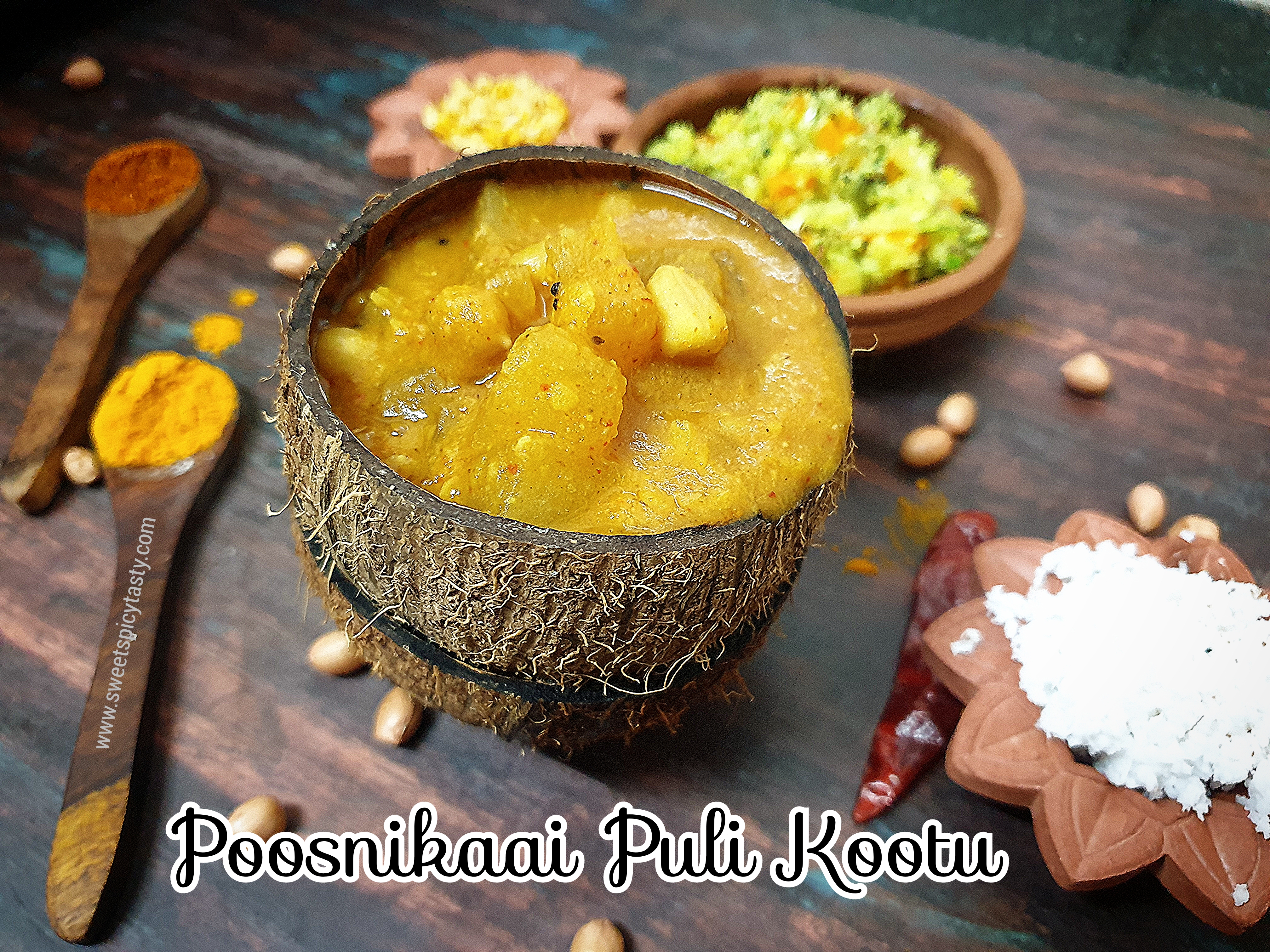
Puli Kootu or Pulippu Kootu is an authentic Tamil brahmin recipe and is made quite frequently in most homes .It is a must have on the wedding feast menu and hence also known as Kalyana Kootu .
Puli kootu is very tasty as it has a balance of all flavors and the tanginess from the tamarind extract gives it an altogether different flavor profile.
Pulippu kootu fits perfectly for those following a Vegan Diet and also being a No onion No garlic recipe it is Saatvik and Jain Friendly as well.
Pulippu kootu can be made with brinjals, ash gourd /white pumpkin or chayote/chou chou . In traditional tambrahm weddings puli kootu is made from ash gourd/poosanikaai and has either boiled chick peas or groundnuts added to the kootu .
In my recipe today ,I am going to use boiled peanuts but I also make it using boiled chickpeas many a times and both of them taste really delicious.
Puli kootu with hot rice and some coconut based vegetable stir fry is an amazing combination for lunch. In my home most often the left over puli kootu is paired with chapati for night and it pairs well .
Preparation Time - 15 mins Cooking Time - 30 mins Complexity- simple Serves - 2 to 3
Ingredients
2 cups chopped ash gourd /poosanikaai 1/4 cup thoor dal /pigeon peas/thuvaram paruppu 1/4 cup peanuts Small lemon sized tamarind ball Few curry leaves Pinch of turmeric Salt as needed 2 tsp oil 1/2 tsp mustard seeds Pinch of asafoetida
To roast and grind 1 tbsp channa dal 1 tbsp dhaniya/corriander seeds 2 tbsp coconut grated 3 to 4 dry red chillies
Method
In a pan heat 1/4 tsp oil and roast the channa dhall until crisp and golden brown followed by the dhaniya and red chillies.Allow it to cool and the grind into a fine paste with coconut and set aside.
Soak the tamarind in hot water for 10 mins and then extract the pulp . Strain the impurities and keep ready .
Boil the chopped ash gourd in sufficient water until it is cooked well..it has to be firm but well cooked .
Pressure cook the thoor dhall and peanuts in 2 separate containers in the same cooker .Mash the thoor dhall well and set aside. This saves a lot of time and effort as well.
In a thick bottomed vessel,add the boiled ashgoured ,peanuts and the tamarind extract with 1/4 cup water and boil it until the raw smell of the tamarind is lost.
Next add the coconut paste , cooked thoor dhall and another 1/2 cup water and bring to a rolling boil.Adjust salt at this stage . Donot boil too much as the dhall will begin to start sticking to the bottom of the pan and it may get burnt..we don't want a burnt kootu .
Prepare a tempering of mustard seeds, curry leaves and asafoetida and pour it on the pulippu kootu.
Millets are a very good alternative to rice due to their low glycemic index (GI) value which helps in control of insulin and absorption of carbohydrates into the blood stream making it ideal for people with Diabetes.
Millets also help in weight loss as they are rich in proteins and fibre.
There are lot of millets available like Jowar, Bajra, Ragi ,Little millet, Kodo millet , Barnyard Millet etc . You can very conveniently replace the usage of rice with millet and work towards a healthy lifestyle.
I am slowly trying to transition into using millets in my daily diet and I am certainly seeing a lot of difference. Sudden hunger pangs, mid morning cravings have reduced a lot and millets keep me full for a long time.
Little Millet is known as Samo Chawal/Kutki (Hindi), Samai Arisi (Tamil), Saame (Kannada) , Samaalu (Telugu) .
Little millet is very rich in Magnesium, Vit B components and also in phosphorous and zinc which help in building energy in the body.
Making little millet poha is very easy, almost same as making the Poha using Flattened rice. You can flavor and season it with the spices of your choice.
Little millet flakes are available in most leading super markets and shops .Also there are many exclusive outlets selling millet based products from where we can procure them easily .
Preparation Time - 10 mins Cooking Time - 10 mins Complexity - easy Serves - 2 to 3
Ingredients
1.5 cups little millet poha /flakes 2 tbsp oil Handful of peanuts Handful of frozen peas (thawed ) 1tsp cumin /jeera 2 green chillies chopped Few curry leaves Salt as needed 2 tsp lemon juice Pinch of turmeric
Method
Wash the little millet flakes under running water and let it rest in a colander for 10 15 mins . The millet flakes absorb the water and turn soft.
Heat the oil in a kadai, fry the peanuts followed by cumin ,green chillies, curry leaves.
Throw in some salt and turmeric followed by the soaked little millet flakes and also the green peas .
Toss it well ,cover and cook for 3 to 4 mins . Lastly mix the lemon juice and garnish with fresh corriander and serve hot.