 Login
LoginDigital artist Beeple put his face on a $100K robot dog next to Elon Musk and Picasso – it sold first
5 December 2025 at 19:35
The project marks at least the second time Winkelmann has become the art world's main character.



Next-generation drone flight software is just one of 25 technologies for the Red Planet that the space agency funded for development this year.
When NASA engineers want to test a concept for exploring the Red Planet, they have to find ways to create Mars-like conditions here on Earth. Then they test, tinker, and repeat.
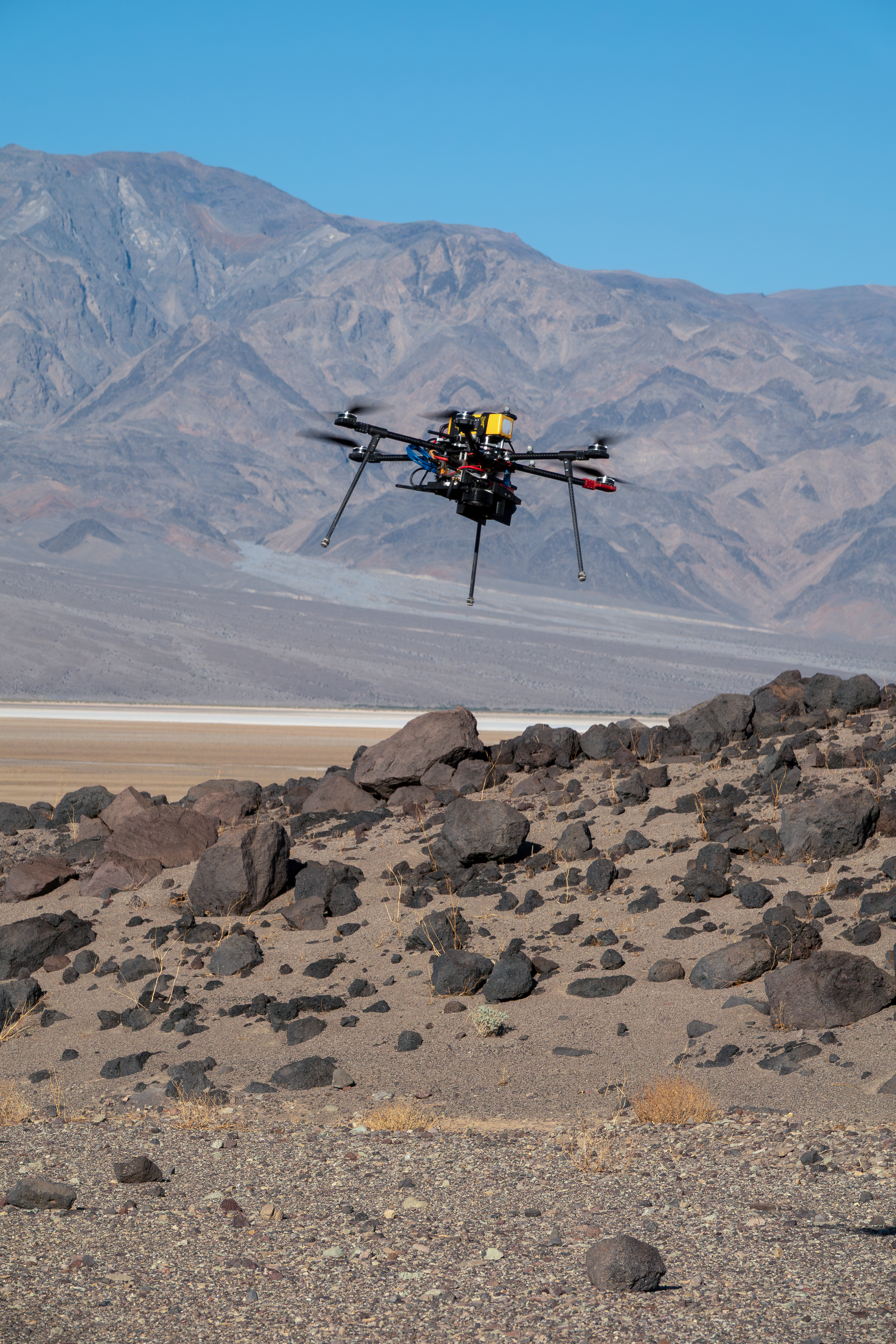
That’s why a team from NASA’s Jet Propulsion Laboratory in Southern California took three research drones to California’s Death Valley National Park and the Mojave Desert earlier this year. They needed barren, featureless desert dunes to hone navigation software. Called Extended Robust Aerial Autonomy, the work is just one of 25 projects funded by the agency’s Mars Exploration Program this past year to push the limits of future technologies. Similar dunes on Mars confused the navigation algorithm of NASA’s Ingenuity Mars Helicopter during several of its last flights, including its 72nd and final flight on the Red Planet.
“Ingenuity was designed to fly over well-textured terrain, estimating its motion by looking at visual features on the ground. But eventually it had to cross over blander areas where this became hard,” said Roland Brockers, a JPL researcher and drone pilot. “We want future vehicles to be more versatile and not have to worry about flying over challenging areas like these sand dunes.”
Whether it’s new navigation software, slope-scaling robotic scouts, or long-distance gliders, the technology being developed by the Mars Exploration Program envisions a future where robots can explore all on their own — or even help astronauts do their work.
NASA scientists and engineers have been going to Death Valley National Park since the 1970s, when the agency was preparing for the first Mars landings with the twin Viking spacecraft. Rubbly volcanic boulders on barren slopes earned one area the name Mars Hill, where much of this research has taken place. Almost half a century later, JPL engineers tested the Perseverance rover’s precision landing system by flying a component of it in a piloted helicopter over the park.
For the drone testing, engineers traveled to the park’s Mars Hill and Mesquite Flats Sand Dunes in late April and early September. The JPL team received only the third-ever license to fly research drones in Death Valley. Temperatures reached as high as 113 degrees Fahrenheit (45 degrees Celsius); gathered beneath a pop-up canopy, team members tracked the progress of their drones on a laptop.
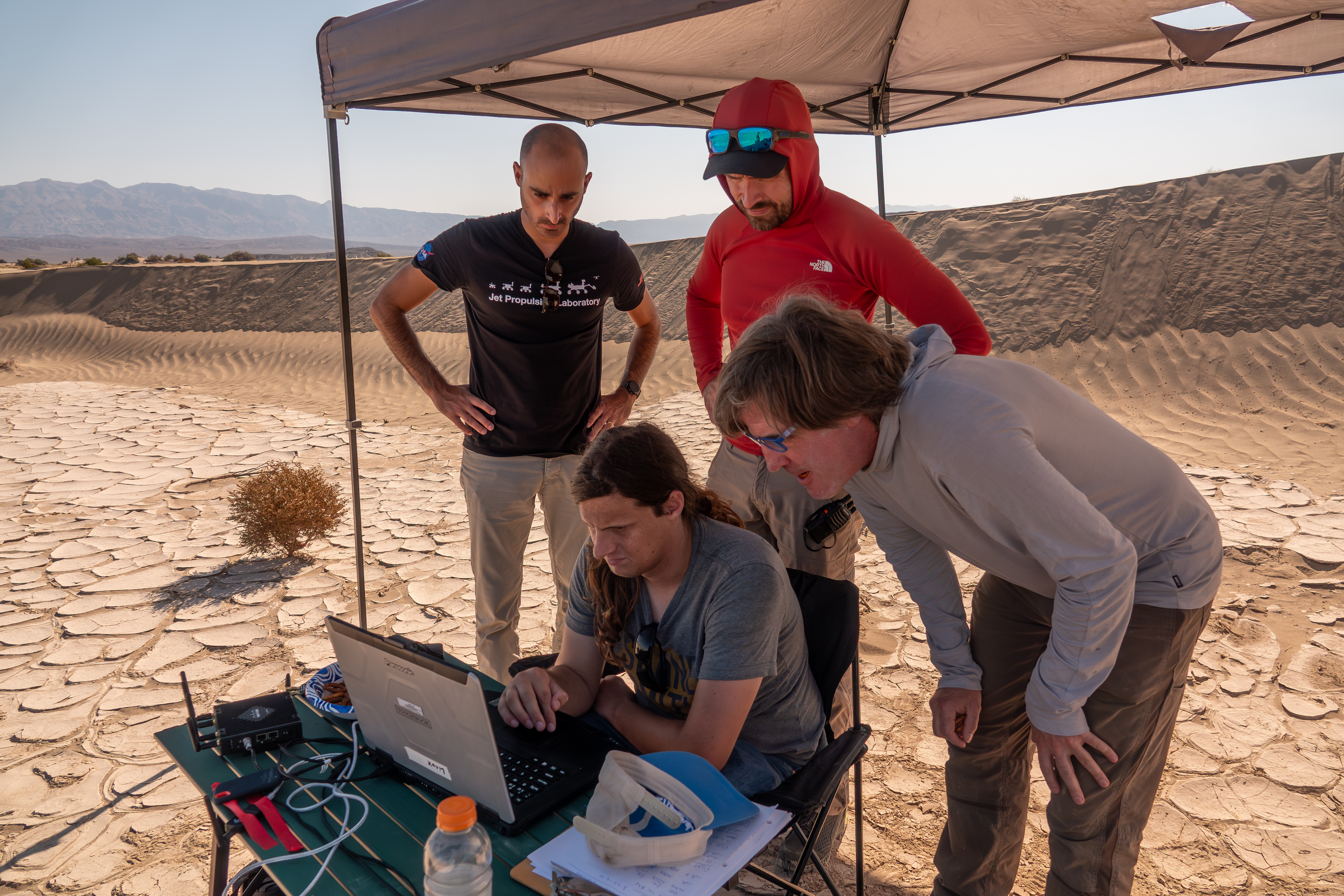
The test campaign has already resulted in useful findings, including how different camera filters help the drones track the ground and how new algorithms can guide them to safely land in cluttered terrain like Mars Hill’s.
“It’s incredibly exciting to see scientists using Death Valley as a proving ground for space exploration,” said Death Valley National Park Superintendent Mike Reynolds. “It’s a powerful reminder that the park is protected not just for its scenic beauty or recreational opportunities, but as a living laboratory that actively helps us understand desert environments and worlds beyond our own.”
For additional testing during the three-day excursion, the team ventured to the Mojave Desert’s Dumont Dunes. The site of mobility system tests for NASA’s Curiosity rover in 2012, the rippled dunes there offered a variation of the featureless terrain used to test the flight software in Death Valley.
“Field tests give you a much more comprehensive perspective than solely looking at computer models and limited satellite images,” said JPL’s Nathan Williams, a geologist on the team who previously helped operate Ingenuity. “Scientifically interesting features aren’t always located in the most benign places, so we want to be prepared to explore even more challenging terrains than Ingenuity did.”
The California desert isn’t the only field site where Mars technology has been tested this year. In August, researchers from NASA’s Johnson Space Center in Houston ventured to New Mexico’s White Sands National Park, another desert location that has hosted NASA testing for decades.
They were there with a doglike robot called LASSIE-M (Legged Autonomous Surface Science In Analogue Environments for Mars). Motors in the robot’s legs measure physical properties of the surface that, when combined with other data, lets LASSIE-M shift gait as it encounters terrain that is softer, looser, or crustier — variations often indicative of scientifically interesting changes.
The team’s goal is to develop a robot that can scale rocky or sandy terrain — both of which can be hazardous to a rover — as it scouts ahead of humans and robots alike, using instruments to seek out new science.
Another Mars Exploration Program concept funded this past year is an autonomous robot that trades the compactness of the Ingenuity helicopter for the range that comes with wings. NASA’s Langley Research Center in Hampton, Virginia, has been developing the Mars Electric Reusable Flyer (MERF), which looks like a single wing with twin propellers that allow it to lift off vertically and hover in the air. (A fuselage and tail would be too heavy for this design.) While the flyer skims the sky at high speeds, instruments on its belly can map the surface.
At its full size, the MERF unfolds to be about as long as a small school bus. Langley engineers have been testing a half-scale prototype, sending it soaring across a field on the Virgina campus to study the design’s aerodynamics and the robot’s lightweight materials, which are critical to flying in Mars’ thin atmosphere.
With other projects focused on new forms of power generation, drills and sampling equipment, and cutting-edge autonomous software, there are many new ways for NASA to explore Mars in the future.
News Media Contacts
Andrew Good
Jet Propulsion Laboratory, Pasadena, Calif.
818-393-2433
andrew.c.good@jpl.nasa.gov
Alise Fisher / Alana Johnson
NASA Headquarters, Washington
202-617-4977 / 202-672-4780
alise.m.fisher@nasa.gov / alana.r.johnson@nasa.gov
2025-131
Mars is the only planet we know of inhabited entirely by robots. Learn more about the Mars Missions.
NASA’s Mars Reconnaissance Orbiter (MRO) is the second longest-lived spacecraft to orbit Mars, after 2001 Mars Odyssey.
Overview Among other ongoing achievements, data collected by Mars Reconnaissance Orbiter continues to help Mars scientists and engineers characterize potential…
NASA Participation In partnership with their European colleagues, U.S. scientists are participating in the scientific instrument teams of the Mars…
It’s a regrettable reality that there is never enough time to cover all the interesting scientific stories we come across each month. In the past, we’ve featured year-end roundups of cool science stories we (almost) missed. This year, we’re experimenting with a monthly collection. November’s list includes forensic details of the medieval assassination of a Hungarian duke, why woodpeckers grunt when they peck, and more evidence that X’s much-maligned community notes might actually help combat the spread of misinformation after all.
Credit:
Tamás Hajdu et al., 2026
Back in 1915, archaeologists discovered the skeletal remains of a young man in a Dominican monastery on Margaret Island in Budapest, Hungary. The remains were believed to be those of Duke Bela of Masco, grandson of the medieval Hungarian King Bela IV. Per historical records, the young duke was brutally assassinated in 1272 by a rival faction and his mutilated remains were recovered by the duke’s sister and niece and buried in the monastery.
© Eötvös Loránd University
ARX Robotics has confirmed a major order from Ukraine for its GEREON-series unmanned ground systems, a move that will establish what the company describes as “the world’s largest networked military robotics fleet.” The announcement was made on November 18, 2025, from the company’s headquarters in Munich. According to ARX Robotics, the contract includes the delivery […]Belgium has selected the BLAZE autonomous interceptor, developed by Latvia-based Origin Robotics, as part of a newly approved €50 million ($58 million) national counter-drone package aimed at immediately reinforcing the country’s ability to detect and neutralize aerial threats. According to Origin Robotics, the selection comes in response to “several weeks of escalating drone incursions over […]From humanoids to hyper-TPUs, the week's biggest headlines prove automation is moving faster than management manuals can keep up.
The post Batteries, Bots, and Broken Neck Bolts: The Best of Daily Tech Insider (Nov. 10–14) appeared first on TechRepublic.
From humanoids to hyper-TPUs, the week's biggest headlines prove automation is moving faster than management manuals can keep up.
The post Batteries, Bots, and Broken Neck Bolts: The Best of Daily Tech Insider (Nov. 10–14) appeared first on TechRepublic.
AI is the technology in which intelligent machines are designed in such a way as to act like human beings. AI is the hottest topic to discuss in 2025 and beyond. And in the next decade, it is going to be the hottest career opportunity.
Any student planning to pursue his career in AI would definitely be having the brightest future opportunities for his career in 2023. This field requires sufficient knowledge of logic, mathematics, statistics, and data analysis.
In the next decade, AI technology is going to overpower a huge part of the technology industry. In older technology, AI was based on mere pre-programmed conditions. Modern AI is more customizable. You can adapt and change it according to your requirements. AI is often referred to as machine learning.
It is the technology that every business wants to implement.
Artificial Intelligence is proven to be the most reliable and accurate technology in every kind of data management and analysis.
Students eager to get the best career opportunities should learn it as it is used in:
In this digital age, everything is possible by using technology and the internet. We see that doctors can communicate with their patients and diagnose their diseases from a remote position. This has minimized the need for personal interaction with the doctor. In the same way, the patient’s condition is checked by a predefined system of medication and algorithms to prescribe a solution. This has revolutionized the whole health industry. It could facilitate both patient and the doctor. A doctor could maintain a complete record of every patient and make a treatment plan.
Smartphones are considered digital wallets. They are no longer considered a medium of communication. They even work as your personal assistant. Relevant to personal assistant, “Siri” could be the best example of an introduction to artificial intelligence and machine learning. “Siri” is designed to answer all your queries on the basis of your personal data added to it and even gives you valuable suggestions. So we can easily predict that the next generation would be having a smartphone working on voice commands such as “Siri” AI is also useful to learn for people in cellular phone technology.
Have you ever thought about a car or airplane which is driven by no driver? Now, this is not limited to just thought. Many types of research are in the process to make it actually happen. The future of AI is bright in the automobile industry.
AI technology is also useful for people engaged in the retail business. They really want such a system that helps them understand the proper purchase pattern and enhance their sale.AI method is very useful to understand the buying patterns and access the customers to choose products.
It will help them suggest:
We know that the customers really feel coaxed when they are observed to evaluate buying pattern and their selected products. Amazon has devised its solution named,” pantry”. They have such an automated system to help you select your desired product and they deliver it by an automatic system on a periodic basis. So this is a clear indication of the performance of AI technology in the retail business.
The system of monitoring the fraud section is a breakthrough for us as our money is protected by getting a proper transaction system. Whenever you withdraw some amount from your bank, you receive an email or text message. This shows the recent transaction activity in your bank account. This system is powered by AI technology. The transactions, amount withdrawal,s or use of ATM cards all this data is stored and analyzed to keep an eye on suspicious activities. AI algorithm is designed to make you alert of any suspicious activity regarding your account.
Now every business has an online presence. They have a website to represent their business and products. With the increase in the use of smartphones and the internet, a large number of customers like to take any kind of information through the internet. Many online businesses have a system of online chat with customers to respond immediately. This is certainly impossible for any human being to be present all the time to answer any of the queries of customers. So to ensure that a business is live all day active most businesses are choosing the option of information bots that act like real humans. They reply to you on the basis of contended in the system. This system is getting more and more popular due to its provision of accurate and quick information.
As we know that security is the basic need of any individual or organization. Setting up an effective security system with a security camera and security monitoring system is really beneficial for any business. But watching a number of cameras and maintaining strict security checks all the time is not an easy job. A predefined algorithm system linked with all security monitoring is the best option to choose from. It would work on your specific security demands and analyze any suspicious activity. It has a system to automatically make alert human security guards to handle suspicious activity.
A system is also amazing for you while you are listening to your favorite music or watching a movie. It recommends you automatically about your next song or movie. It is a system based on your interests and browsing history. This system is much more fruitful for music and movie-producing companies By observing your browsing history and previous online activities, it would promote specific brands or music videos.
AI also helps you to respond to your emails in an essay and a quick way by analyzing your email contents. A predefined reply is provided as tags during an email reply.
AI wonderfully keeps a strict check on the temperature and lighting needs of your house. It works according to your preferred requirements.
Artificial Intelligence training from a professional institute like Knowledgehut can make you a skilled and efficient worker having excellent knowledge of AI. It also awards certificates on completion so that you can upgrade your CV and get an AI job.
Originally posted 2019-10-17 21:43:58. Republished by Blog Post Promoter
The post Top 10 Reasons to Learn AI in 2025 and beyond first appeared on Information Technology Blog.
At Tesla’s 2025 shareholder meeting, Elon Musk warned supplier output may fall short and floated a ‘Terrafab’, a gigantic chip fab to secure Tesla’s AI chips.
The post Elon Musk Floats ‘Terafab’ as Tesla’s Next Big AI Chip Bet appeared first on TechRepublic.
At Tesla’s 2025 shareholder meeting, Elon Musk warned supplier output may fall short and floated a ‘Terrafab’, a gigantic chip fab to secure Tesla’s AI chips.
The post Elon Musk Floats ‘Terafab’ as Tesla’s Next Big AI Chip Bet appeared first on TechRepublic.
Amazon this morning offered the first official glimpse of a new “store within a store” concept it’s testing to bring name-brand items to Whole Foods Market without sullying the grocer’s signature organic vibe.
The approach, first reported a few days ago by The Wall Street Journal, puts screens on the shelves that let shoppers scan a QR code to browse a wider Amazon selection in the app — picking items like Kraft Mac & Cheese, Tide Pods, or Pepsi for quick pickup at a nearby counter after they check out.
Behind the scenes, a 10,000-square-foot automated “micro-fulfillment center” inside the store uses robots to pull items from Amazon’s expanded inventory: popular snacks, cleaning supplies, frozen foods, personal care products, etc.
The system, built on technology from Silicon Valley startup Fulfil, prepares orders within minutes so they’re ready for customers by the time they finish shopping.
It’s one of the tightest integrations between Amazon and Whole Foods since the tech giant bought the grocer for $13.7 billion in 2017. Under Whole Foods CEO Jason Buechel, who now oversees all of Amazon’s grocery stores, the company is looking to bring more of its tech expertise to a brand known for its strict ingredient standards and natural-foods identity.
Amazon has been trying to figure out the broader grocery business for 18 years, dating back to the original launch of Amazon Fresh delivery in the Seattle area in 2007. Thin margins and huge volumes make grocery one of the toughest and most tantalizing segments in retail.
The company has reported recent success with an initiative that offers perishable groceries for free same-day delivery as part of a unified cart when people check out on Amazon.com. CEO Andy Jassy called this approach a “game changer” on the company’s earnings call last week.
As part of its Whole Foods announcement this morning, Amazon confirmed that it’s testing the new concept at a store in Plymouth Meeting, Pa., and said for the first time that it plans to expand the approach to additional Whole Foods locations after gathering feedback.
It’s not the only concept currently in testing. The Wall Street Journal also reported on a separate trial in Chicago where Amazon replaced a coffee shop in the flagship Whole Foods’ lobby with a 3,800-square-foot “Amazon Grocery” kiosk to sell brands like Doritos and Chips Ahoy.
Reaction to a huge round of layoffs rippled across Amazon and beyond on Tuesday as the Seattle-based tech giant confirmed that it was slashing 14,000 corporate and tech jobs.
We’ve rounded up some of what’s being said online and/or shared with GeekWire:
A megathread on Reddit served as a collection of comments by impacted employees who posted about their level, location, org and years of service at Amazon.
Workers across ads, recruitment, robotics, retail, Prime Video, Amazon Games, business development, North American Stores, finance, devices and services, Amazon Autos, and more used the thread to vent.
Kristi Coulter, author of Exit Interview: The Life and Death of My Ambitious Career, a memoir about what she learned in her 12 years at Amazon, weighed in about the timing of apparent text messages that were sent to impacted employees.
“Wait, I’m sorry: Amazon made people relocate, switch their kids’ schools, and bookend their days with traffic for RTO only to lay them off via a 3 a.m. text? What happened to the vibe and conversations that only being together at the office could allow?” Coulter wrote on LinkedIn.
Some employees shared how they were quickly locked out of work laptops, expressing confusion about whether that was how they were supposed to learn about being terminated.
“I lost access to everything immediately :( ,” one Reddit user said.
Others discussed how they should have found time to transfer important work examples or positive interactions related to their performance over to personal computers.
“One thing I would recommend for everyone is to back up your personal files onto your personal laptop,” one user said on Reddit. “I used to keep all my accolades and praise in a quip file along with all my 2×2 write ups and MBR/QBR write ups cataloging my wins. When I found out I got laid off my head was spinning so I went outside for a walk, by the time I returned I was locked out of my laptop and no longer had access to anything.”
Is this Amazon’s way of saying 100% laid off?
— Aravind Naveen (@MydAravind) October 28, 2025
Any Amazon folks on the timeline – seen this before?#Amazon #layoffs #amazonlayoffs pic.twitter.com/1MCxoXjfHQ
Amazon human resources chief Beth Galetti pinned the layoffs in part on the need to reduce bureaucracy and become more efficient in the new era of artificial intelligence. Others looked for deeper meaning in the cuts.
In a post on LinkedIn, Yahoo! Finance Executive Editor Brian Rozzi said stock price is likely a key consideration when it comes to top execs and the Amazon board signing off on such mass layoffs.
Amazon’s stock was up about 1% on Tuesday to $229 per share.
“If the layoffs keep jacking up the stock price, maybe I can retire instead,” one longtime employee told GeekWire.
Entrepreneur and investor Jason Calacanis posted on X about how AI was coming for middle managers and those with “rote jobs” faster than anyone expected. He encouraged workers to become a founder and do a startup before it’s too late.
Mid-level managers in Amazon’s retail division were heavily impacted by Tuesday’s cuts, according to internal data obtained by Business Insider.
More than 78% of the roles eliminated were held by managers assigned L5 to L7 designations, BI reported. (L5 is typically the starting point for managers at Amazon, with more seniority assigned to higher levels.)
BI also said that U.S.-focused data showed that more than 80% of employees laid off Tuesday worked in Amazon’s retail business, spanning e-commerce, human resources, and logistics.
Bloomberg and others reported that significant cuts are also being felt by Amazon’s video games unit.
Steve Boom, VP of audio, Twitch, and games said in a memo shared with The Verge that “significant role reductions” would be felt at studios in Irvine and San Diego, Calif., as well on Amazon’s central publishing teams.
“We have made the difficult decision to halt a significant amount of our first-party AAA game development work — specifically around MMOs [massively multiplayer online games] — within Amazon Game Studios,” Boom wrote.
Current titles in Amazon’s MMO lineup include “New World: Aeternum,” “Throne and Liberty,” and “Lost Ark.” Amazon also previously announced that it would be developing a “Lord of the Rings” MMO.
Jon Scholes, president and CEO of the Downtown Seattle Association (DSA), has previously praised Amazon for its mandate calling for employees to return to the office five days per week, saying that the foot traffic from thousands of tech workers in the city is a necessary element to helping downtown Seattle rebound from the pandemic.
On Tuesday, Scholes reacted to Amazon’s layoffs in a statement to GeekWire:
“As downtown’s largest employer, a workforce change of this scale has ripple effects throughout the community — on individual employees and families and our small businesses that rely on the weekday foot traffic customer base. In addition, these jobs buttress our tax base that helps fund the city services we all depend on. Employers have options for where they locate jobs, and we want to ensure downtown Seattle is the most attractive place to invest and grow. We must provide vibrancy and a predictable regulatory environment in a competitive landscape because other cities would welcome the jobs currently based in downtown.”
SAN FRANCISCO — Amazon showed off its latest robotics and AI systems this week, presenting a vision of automation that it says will make warehouse and delivery work safer and smarter.
But the tech giant and some of the media at its Delivering the Future event were on different planets when it came to big questions about robots, jobs, and the future of human work.
The backdrop: On Tuesday, a day before the event, The New York Times cited internal Amazon documents and interviews to report that the company plans to automate as much as 75% of its operations by 2033. According to the report, the robotics team expects automation to “flatten Amazon’s hiring curve over the next 10 years,” allowing it to avoid hiring more than 600,000 workers even as sales continue to grow.
In a statement cited in the article, Amazon said the documents were incomplete and did not represent the company’s overall hiring strategy.
On stage at the event, Tye Brady, chief technologist for Amazon Robotics, introduced the company’s newest systems — Blue Jay, a setup that coordinates multiple robotic arms to pick, stow, and consolidate items; and Project Eluna, an agentic AI model that acts as a digital assistant for operations teams.
Later, he addressed the reporters in the room: “When you write about Blue Jay or you write about Project Eluna … I hope you remember that the real headline is not about robots. The real headline is about people, and the future of work we’re building together.”
He said the benefits for employees are clear: Blue Jay handles repetitive lifting, while Project Eluna helps identify safety issues before they happen. By automating routine tasks, he said, AI frees employees to focus on higher-value work, supported by Amazon training programs.
Brady coupled that message with a reminder that no company has created more U.S. jobs over the past decade than Amazon, noting its plan to hire 250,000 seasonal workers this year.
His message to the company’s front-line employees: “These systems are not experiments. They’re real tools built for you, to make your job safer, smarter, and more rewarding.”
Later, during a press conference, a reporter cited the New York Times report, asking Brady if he believes Amazon’s workforce could shrink on the scale the paper described based on the internal report.
Brady didn’t answer the question directly, but described the premise as speculation, saying it’s impossible to predict what will happen a decade from now. He pointed instead to the past 10 years of Amazon’s robotics investments, saying the company has created hundreds of thousands of new jobs — including entirely new job types — while also improving safety.
He said Amazon’s focus is on augmenting workers, not replacing them, by designing machines that make jobs easier and safer. The company, he added, will continue using collaborative robotics to help achieve its broader mission of offering customers the widest selection at the lowest cost.
In an interview with GeekWire after the press conference, Brady said he sees the role of robotics as removing the “menial, mundane, and repetitive” tasks from warehouse jobs while amplifying what humans do best — reasoning, judgment, and common sense.
“Real leaders,” he added, “will lead with hope — hope that technology will do good for people.”
When asked whether the company’s goal was a “lights-out” warehouse with no people at all, Brady dismissed the idea. “There’s no such thing as 100 percent automation,” he said. “That doesn’t exist.”
Instead, he emphasized designing machines with real utility — ones that improve safety, increase efficiency, and create new types of technical jobs in the process.
When pressed on whether Amazon is replacing human hands with robotic ones, Brady pushed back: “People are much more than hands,” he said. “You perceive the environment. You understand the environment. You know when to put things together. Like, people got it going on. It’s not replacing a hand. That’s not the right way to think of it. It’s augmenting the human brain.”
Brady pointed to Amazon’s new Shreveport, La., fulfillment center as an example, saying the highly automated facility processes orders faster than previous generations while also adding about 2,500 new roles that didn’t exist before.
“That’s not a net job killer,” he said. “It’s creating more job efficiency — and more jobs in different pockets.”
The New York Times report offered a different view of Shreveport’s impact on employment. Describing it as Amazon’s “most advanced warehouse” and a “template for future robotic fulfillment centers,” the article said the facility uses about 1,000 robots.
Citing internal documents, the Times reported that automation allowed Amazon to employ about 25% fewer workers last year than it would have without the new systems. As more robots are added next year, it added, the company expects the site to need roughly half as many workers as it would for similar volumes of items under previous methods.
Analysts, meanwhile, are taking the potential impact seriously. A Morgan Stanley research note published Wednesday — the same day as Amazon’s event and in direct response to the Times report — said the newspaper’s projections align with the investment bank’s baseline analysis.
Rather than dismissing the report as speculative, Morgan Stanley’s Brian Nowak treated the article’s data points as credible. The analysts wrote that Amazon’s reported plan to build around 40 next-generation robotic warehouses by 2027 was “in line with our estimated slope of robotics warehouse deployment.”
More notably, Morgan Stanley put a multi-billion-dollar price tag on the efficiency gains. Its previous models estimated the rollout could generate $2 billion to $4 billion in annual savings by 2027. But using the Times’ figure — that Amazon expects to “avoid hiring 160,000+ U.S. warehouse employees by ’27” — the analysts recalculated that the savings could reach as much as $10 billion per year.
Back at the event, the specific language used by Amazon executives aligned closely with details in the Times report about the company’s internal communications strategy.
According to the Times, internal documents advised employees to avoid terms such as “automation” and “A.I.” and instead use collaborative language like “advanced technology” and “cobots” — short for collaborative robots — as part of a broader effort to “control the narrative” around automation and hiring.
On stage, Brady’s remarks closely mirrored that approach. He consistently framed Amazon’s robotics strategy as one of augmentation, not replacement, describing new systems as tools built for people.
In the follow-up interview, Brady said he disliked the term “artificial intelligence” altogether, preferring to refer to the technology simply as “machines.”
“Intelligence is ours,” he said. “Intelligence is a very much a human thing.”
Seattle agriculture-tech startup Carbon Robotics raised $20 million in new funding to support the creation of another piece of AI-powered machinery for farms.
With its signature LaserWeeder and relatively new Autonomous Tractor Kit (ATK) already being used by hundreds of customers, Carbon founder and CEO Paul Mikesell told GeekWire that “a brand new AI robot” is coming.
Mikesell said the machine, which is at least nine months away from being revealed, will leverage the same AI system used in Carbon’s other equipment but perform tasks beyond weeding.
“It’s very flexible, capable of doing a lot with the world around it, understanding what it’s seeing, what’s happening,” Mikesell said of Carbon’s system that uses an array of AI, computer vision and machine learning technology. “We see our ability to reinvest in that platform and double down on what it can do in some new activities.
“It’ll blow your mind,” he added.
Founded in 2018, Carbon Robotics made its name across ag-tech with the LaserWeeder, a machine which can be pulled behind a tractor and uses its tech to detect plants in fields and then target and eliminate weeds with lasers. The latest iteration, the LaserWeeder G2, was released in February.
In March, the company unveiled the Carbon ATK, previously called the AutoTractor. That autonomous platform is designed to fit on and control existing farm equipment and serve as an answer to labor shortages and increased productivity in farming.
Both platforms are continuing to grow and scale, and “things are moving really fast,” according to Mikesell, a longtime technologist and entrepreneur who previously co-founded data storage company Isilon Systems.
LaserWeeders are active on farms across the U.S. and in 14 countries around the world. Mikesell said revenue continues to grow every year, but Carbon is not yet profitable.
Ranked No. 9 on the GeekWire 200 list of top privately held startups based across the Pacific Northwest, Carbon has previously been backed by NVIDIA and Seattle-based Voyager Capital.
The Series D-2 extension round attracted Giant Ventures as lead investor. The UK-based VC invests across a variety of “purpose-driven” startups, and Mikesell said, “They got what we were trying to do.”
Giant previously invested in a $140 million round for Tidal Vision, a Bellingham, Wash.-based company turning discarded crab shells into a valuable industrial chemical called chitosan.
Beyond the secretive new machine, Carbon is revealing more about the “large plant model” at the heart of how it does computer vision through its AI systems.
Mikesell said the company is at the point where it has enough training data and labeled images that it can teach its AI to learn about the basic structure of the plants it’s seeing. This allows Carbon to run one model on every machine in the world.
“If new weeds pop up in an onion field in France, and those are eventually going to show up in a carrot field in the U.S., the first time we see that weed anywhere it can be part of the model and be ready to go,” Mikesell said. “It also means that if we want to go into a new crop that we’ve never seen before, we can do it immediately.”
A LaserWeeder is designed to target the meristem of a weed to kill it as quickly as possible and the large plant model helps it understand where to precisely target its zap.
Carbon Robotics, which has raised $177 million to date, now employs about 260 people. The company runs a manufacturing facility in Richland, Wash., and added another in the Netherlands to offset some trade and tariff issues as well as speed deployment of machines in Europe.
Mikesell said as far as competition, there are some companies in Europe who claim to be building some version of a LaserWeeder, but he’s never seen one in a field or competed against one.
“It’s very hard to create a LaserWeeder,” he said. “The targeting system is so special, and the AI is so special. It’s not just about detecting where the weeds are. The trick to making it work is you need a targeting camera to be able to keep the lasers on target [while moving], and everybody I’ve seen that says they’re gonna build a LaserWeeder doesn’t understand that concept.”
