Normal view

There are new articles available, click to refresh the page.
Before yesterdayMain stream

NASA Software Raises Bar for Aircraft Icing Research 

4 December 2025 at 10:00

4 min read

Preparations for Next Moonwalk Simulations Underway (and Underwater)
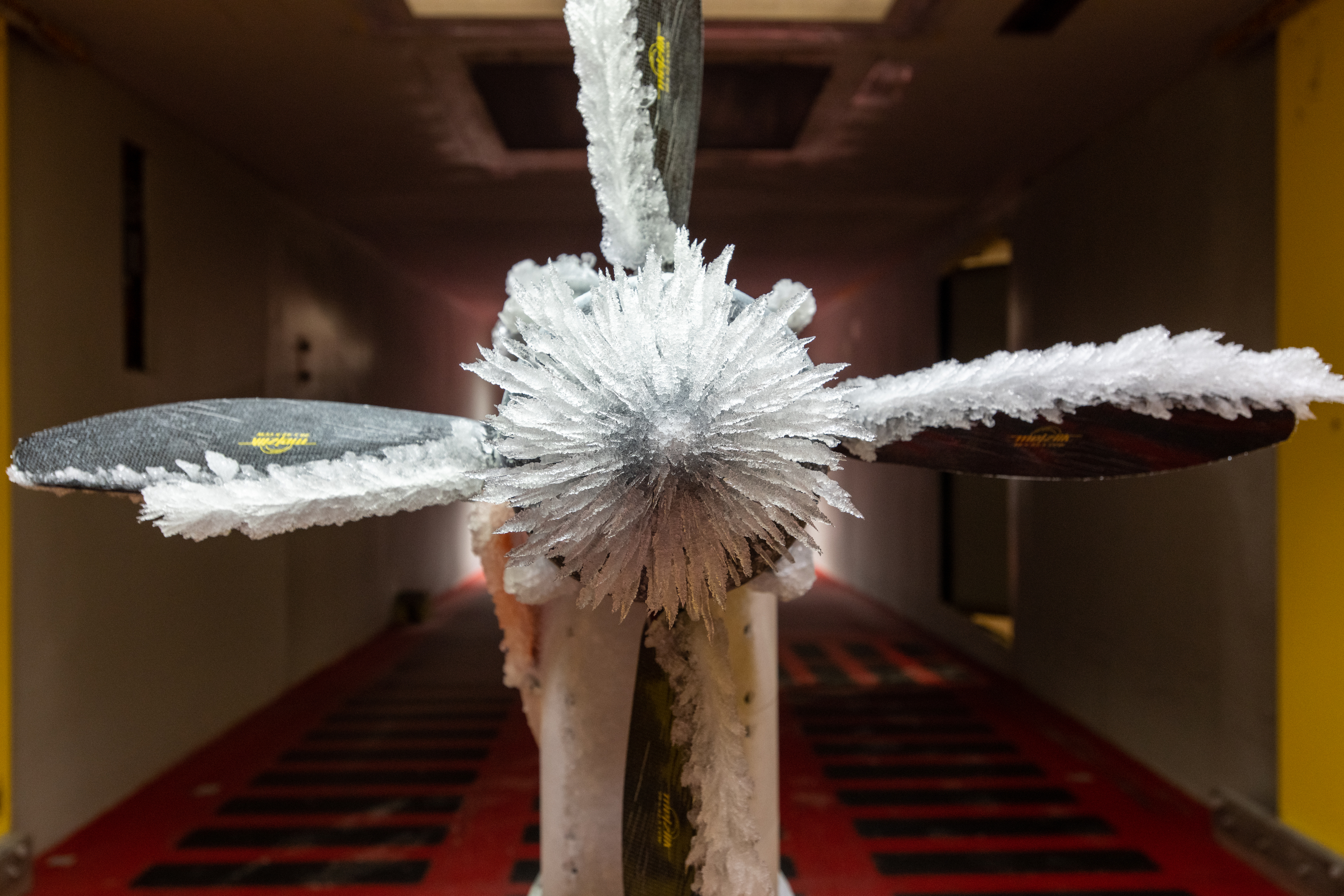
An up-close view of ice that covers propeller blades inside the Icing Research Tunnel.
Researchers at NASA’s Glenn Research Center in Cleveland used the Glenn Icing Computational Environment (GlennICE) software to create 3D computational models of this advanced air mobility rotor and study propeller icing issues. The physical model of this rotor was installed and tested in the Icing Research Tunnel in 2023 as part of an icing evaluation study, which also sought to validate the computational models.  
Credit: NASA/Jordan Cochran

When flying in certain weather conditions, tiny freezing water droplets floating in the air can pose a risk to aircraft. If not taken into consideration, these water droplets can accumulate on an aircraft as ice and pose a safety risk. 

But NASA software tools such as Glenn Icing Computational Environment (GlennICE) are working to keep passengers and pilots safe. 

NASA developed GlennICE, a new NASA software code, to transform the way we explore, understand, and prevent ice buildup on aircraft wings and engines, as well as control surfaces like rudders and elevators.  

Owing to decades of world-class NASA research, engineers nationwide can now use GlennICE to design aircraft in such a way that ice buildup will either occur rarely or pose very little risk. 

Named for NASA’s Glenn Research Center in Cleveland, GlennICE is part of NASA’s work to provide the aviation industry with computational tools, including design software, to improve aircraft safety and enable innovation. For icing research and modeling, NASA computer codes have become the industry standard over the past several decades. And GlennICE builds on this work, performing highly advanced digital modeling of water and ice particles in just about any atmospheric condition you can imagine. 

With updated capabilities and a streamlined user experience, GlennICE will enable users to advance the state of the art – particularly researchers working on complex, unusual future aircraft designs. 

“The legacy codes are well formulated to handle simulations of traditional tube-and-wing shaped aircraft,” said Christopher Porter, lead for GlennICE’s development. “But now, we have new vehicles with new designs that present icing research challenges. This requires a more advanced tool, and that’s where GlennICE comes in.” 

So far, dozens of industry partners as well as other government agencies have started using GlennICE, which is available on NASA’s software catalog

Timelapse video of an ice accretion on the 65% common research model.
Credit: NASA/Jordan Cochran

Ice buildup: not cool

Though based on legacy NASA codes such as LEWICE 3D, GlennICE is a whole different ballgame. The new toolkit can be tailored to unique situations and is compatible with other software tools. In other words, it is more configurable, and much less time consuming for researchers to set up and use. 

This streamlined process, along with its more-advanced ability to model icing, allows GlennICE to easily tackle 21st-century concepts such as supersonic planes, advanced air mobility drones and other aircraft, unconventionally shaped wings, open-rotor turbofan designs, or new configurations for conventional aircraft such as radar domes. 

But how does this simulation process work? 

“Imagine an aircraft flying through a cloud,” Porter said. “Some of those water and ice droplets hit the aircraft and some of them don’t. GlennICE simulates these droplets and exactly where they will end up, both on the aircraft and not.” 

When these water droplets hit the aircraft, they attach, freeze, and start to gather even more droplets that do the same. The software simulates exactly where this will occur, and what shape the ice will take over time. 

“We’re not just dealing with the airplane, but the physics of the air and water as well,” Porter said. 

Because it’s designed for simulating droplets, researchers have expressed interest in using GlennICE to simulate other conditions involving sand and ash. These substances, when ingested by aircraft engines, can pose separate risks that aeronautical engineers work to prevent. 
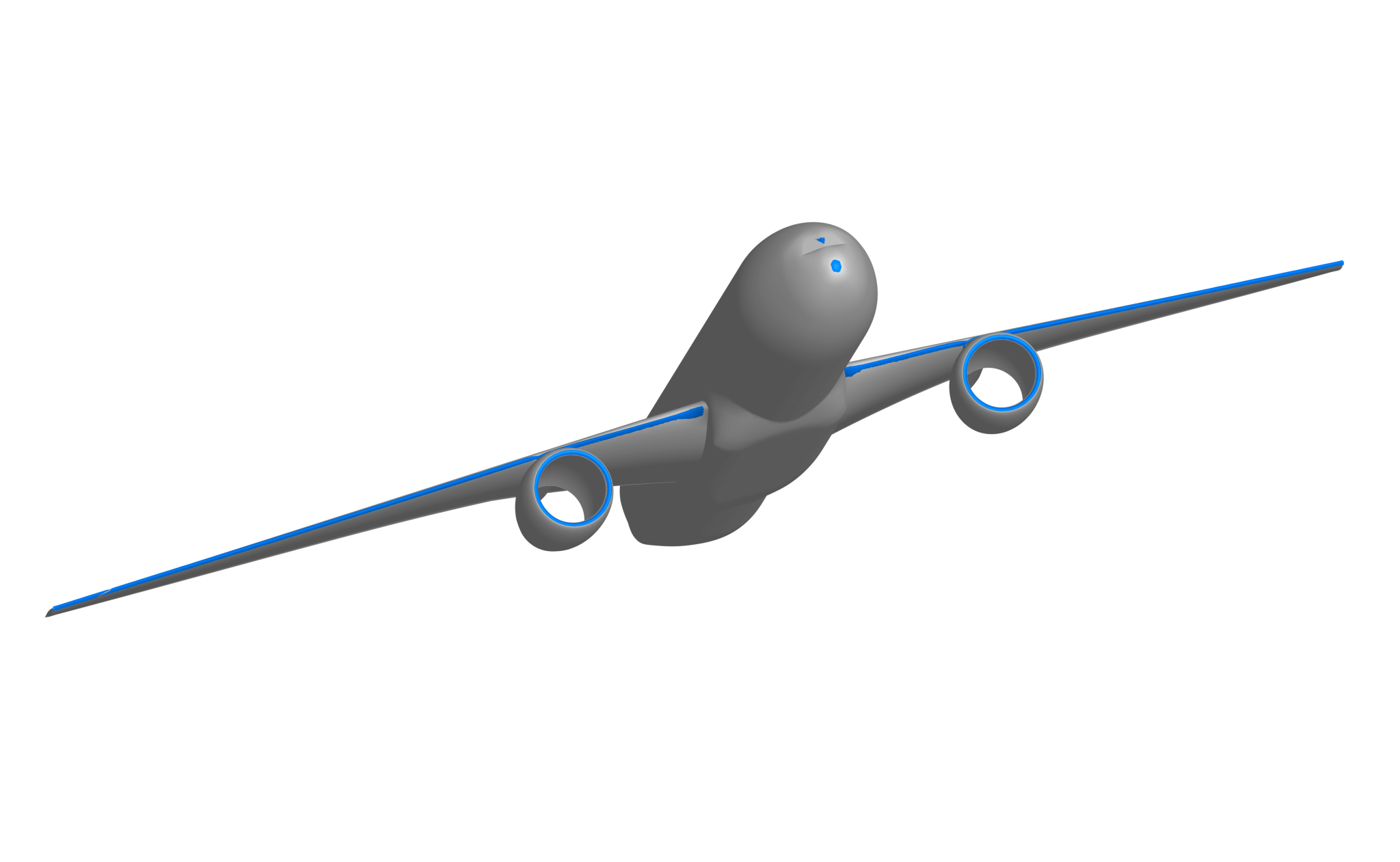
A computer-generated image of a gray aircraft with blue-colored areas to show where ice would form on the aircraft.
Glenn Icing Computational Environment (GlennICE) simulated ice accretions (blue) on the High Lift Common Research Model (gray). 
Credit: NASA/Thomas Ozoroski

World-class research

Icing research is fundamental to aviation safety, and NASA fulfils a key role in ensuring pilots and passengers fly more safely and ice-free. The agency’s wind tunnels, for instance, have world-class icing research capabilities not commonly found in aeronautics research. 

Paired with wind tunnel testing, GlennICE offers a holistic set of capabilities to researchers. While wind tunnels can verify and validate data with real-world models and conditions, tools like GlennICE can fill gaps in research not easily achieved with wind tunnels. 

“Some environments we need to test in are impractical with wind tunnels because of the tunnel size required and complex physics involved,” Porter said. “But with GlennICE, we can do these tests digitally. For example, we can model all the icing conditions noted in new regulations.” 

The GlennICE development falls under NASA’s Transformative Aeronautics Concept and Advanced Air Vehicles programs. Those programs supported GlennICE to further NASA’s work on computational tool development for aerospace design. More about the history of icing research at NASA is available on the agency’s website

About the Author

John Gould

John Gould

Aeronautics Research Misson Directorate
Keep Exploring

Discover More Topics From NASA

NASA Awards Liquid Hydrogen Supply Contracts

21 November 2025 at 16:15
The letters NASA on a blue circle with red and white detail, all surrounded by a black background
Credit: NASA

NASA has selected Plug Power, Inc., of Slingerlands, New York, and Air Products and Chemicals, Inc., of Allentown, Pennsylvania, to supply up to approximately 36,952,000 pounds of liquid hydrogen for use at facilities across the agency.

The NASA Agency-wide Supply of Liquid Hydrogen awards are firm-fixed-price requirements contracts that include multiple firm-fixed-price delivery orders critical for the agency’s centers as they use liquid hydrogen, combined with liquid oxygen, as fuel in cryogenic rocket engines, and the commodity’s unique properties support the development of aeronautics. The total value for the combined awards is about $147.2 million.

The contracts begin Monday, Dec. 1, and each consists of a two-year base period followed by three one-year option periods that, if exercised, would extend the contracts to Nov. 30, 2030.

Air Products and Chemicals Inc. will supply up to about 36.5 million pounds of liquid hydrogen to NASA’s Kennedy Space Center and Cape Canaveral Space Force Station in Florida; NASA’s Marshall Space Flight Center in Huntsville, Alabama; and NASA’s Stennis Space Center in Bay St. Louis, Mississippi, for a maximum contract value of approximately $144.4 million.

Plug Power, Inc. will deliver up to approximately 480,000 pounds of the commodity to NASA’s Glenn Research Center in Cleveland, Ohio, and at Neil A. Armstrong Test Facility in Sandusky, Ohio, for a maximum contract value of about $2.8 million.

For additional information about NASA and agency programs, visit:

https://www.nasa.gov/

-end-

Tiernan Doyle
Headquarters, Washington
tiernan.doyle@nasa.gov
202-358-1600

Amanda Griffin
Kennedy Space Center, Fla.
amanda.griffin@nasa.gov
321-593-6244

NASA’s IMAP Mission to Study Boundaries of Our Home in Space

17 September 2025 at 11:12

6 min read

NASA’s IMAP Mission to Study Boundaries of Our Home in Space

Summary

  • NASA’s new Interstellar Mapping and Acceleration Probe, or IMAP, will launch no earlier than Tuesday, Sept. 23 to study the heliosphere, a giant shield created by the Sun.
  • The mission will chart the heliosphere’s boundaries to help us better understand the protection it offers life on Earth and how it changes with the Sun’s activity.
  • The IMAP mission will also provide near real-time measurements of the solar wind, data that can be used to improve models predicting the impacts of space weather ranging from power-line disruptions to loss of satellites, to the health of voyaging astronauts.

Space is a dangerous place — one that NASA continues to explore for the benefit of all. It’s filled with radiation and high-energy particles that can damage DNA and circuit boards alike. Yet life endures in our solar system in part because of the heliosphere, a giant bubble created by the Sun that extends far beyond Neptune’s orbit.

With NASA’s new Interstellar Mapping and Acceleration Probe, or IMAP, launching no earlier than Tuesday, Sept. 23, humanity is set to get a better look at the heliosphere than ever before. The mission will chart the boundaries of the heliosphere to help us better understand the protection it offers and how it changes with the Sun’s activity. The IMAP mission will also provide near real-time measurements of space weather conditions essential for the Artemis campaign and deep space travel. 

“With IMAP, we’ll push forward the boundaries of knowledge and understanding of our place not only in the solar system, but our place in the galaxy as a whole,” said Patrick Koehn, IMAP program scientist at NASA Headquarters in Washington. “As humanity expands and explores beyond Earth, missions like IMAP will add new pieces of the space weather puzzle that fills the space between Parker Solar Probe at the Sun and the Voyagers beyond the heliopause.”

Download this video from NASA’s Scientific Visualization Studio.

Domain of Sun

The heliosphere is created by the constant outflow of material and magnetic fields from the Sun called the solar wind. As the solar system moves through the Milky Way, the solar wind’s interaction with interstellar material carves out the bubble of the heliosphere. Studying the heliosphere helps scientists understand our home in space and how it came to be habitable.

As a modern-day celestial cartographer, IMAP will map the boundary of our heliosphere and study how the heliosphere interacts with the local galactic neighborhood beyond. It will chart the vast range of particles, dust, ultraviolet light, and magnetic fields in interplanetary space, to investigate the energization of charged particles from the Sun and their interaction with interstellar space.

The IMAP mission builds on NASA’s Voyager and IBEX (Interstellar Boundary Explorer) missions. In 2012 and 2018, the twin Voyager spacecraft became the first human-made objects to cross the heliosphere’s boundary and send back measurements from interstellar space. It gave scientists a snapshot of what the boundary looked like and where it was in two specific locations. While IBEX has been mapping the heliosphere, it has left many questions unanswered. With 30 times higher resolution and faster imaging, IMAP will help fill in the unknowns about the heliosphere.

Energetic neutral atoms: atomic messengers from our heliosphere’s edge

Of IMAP’s 10 instruments, three will investigate the boundaries of the heliosphere by collecting energetic neutral atoms, or ENAs. Many ENAs originate as positively charged particles released by the Sun but after racing across the solar system, these particles run into particles in interstellar space. In this collision, some of those positively charged particles become neutral, and an energetic neutral atom is born. The interaction also redirects the new ENAs, and some ricochet back toward the Sun.

Charged particles are forced to follow magnetic field lines, but ENAs travel in a straight line, unaffected by the twists, turns, and turbulences in the magnetic fields that permeate space and shape the boundary of the heliosphere. This means scientists can track where these atomic messengers came from and study distant regions of space from afar. The IMAP mission will use the ENAs it collects near Earth to trace back their origins and construct maps of the boundaries of the heliosphere, which would otherwise be invisible from such a distance.

“With its comprehensive state-of-the-art suite of instruments, IMAP will advance our understanding of two fundamental questions of how particles are energized and transported throughout the heliosphere and how the heliosphere itself interacts with our galaxy,” said Shri Kanekal, IMAP mission scientist at NASA’s Goddard Space Flight Center in Greenbelt, Maryland.

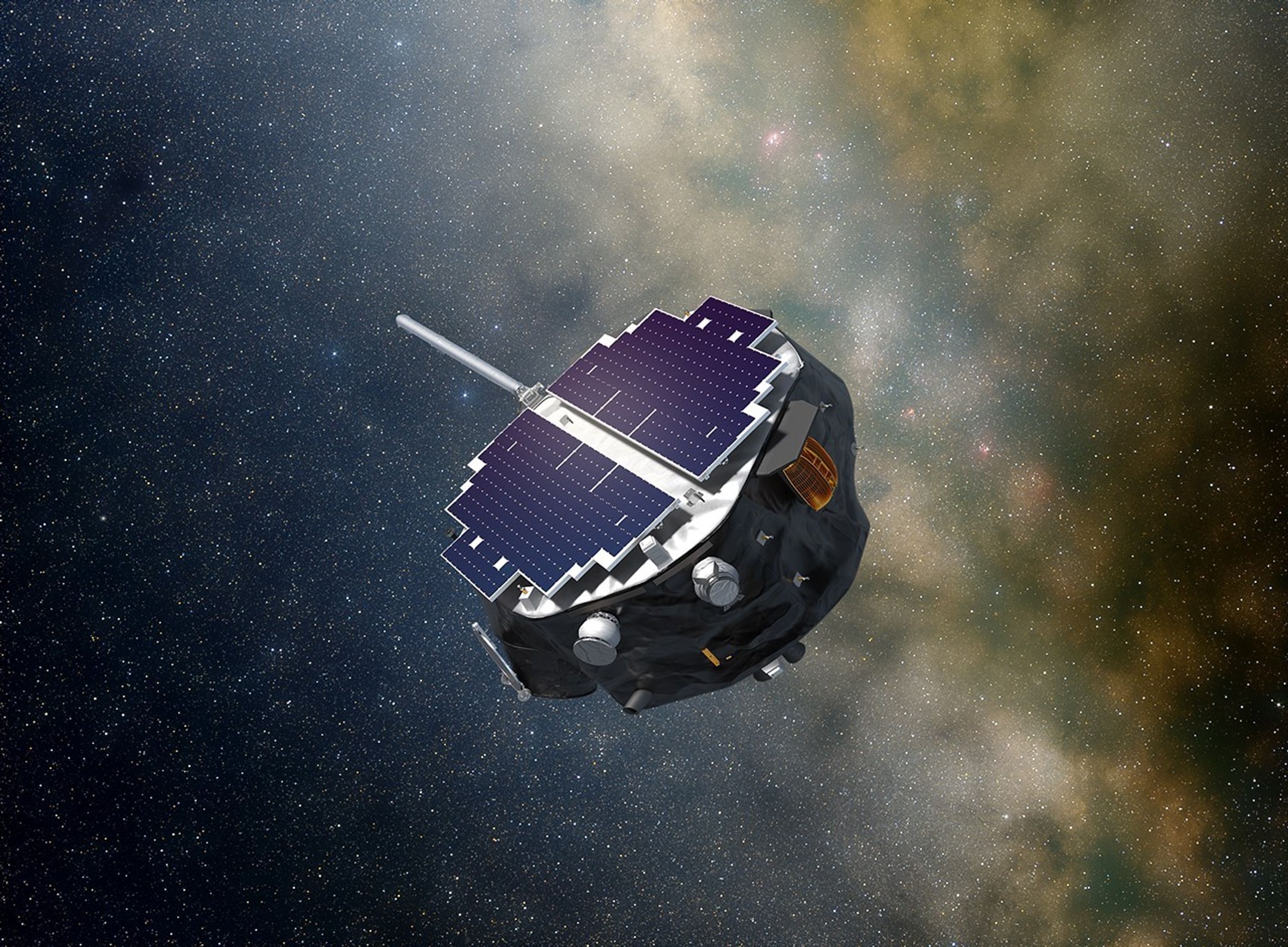
A circular spacecraft floats in space with stars and dust visible in the background.
The IMAP mission will study the heliosphere, our home in space.
NASA/Princeton University/Patrick McPike

Space weather: monitoring solar wind

The IMAP mission will also support near real-time observations of the solar wind and energetic solar particles, which can produce hazardous conditions in the space environment near Earth. From its location at Lagrange Point 1, about 1 million miles from Earth toward the Sun, IMAP will provide around a half hour’s warning of dangerous particles headed toward our planet. The mission’s data will help with the development of models that can predict the impacts of space weather ranging from power-line disruptions to loss of satellites.

“The IMAP mission will provide very important information for deep space travel, where astronauts will be directly exposed to the dangers of the solar wind,” said David McComas, IMAP principal investigator at Princeton University.

Cosmic dust: hints of the galaxy beyond

In addition to measuring ENAs and solar wind particles, IMAP will also make direct measurements of interstellar dust — clumps of particles originating outside of the solar system that are smaller than a grain of sand. This space dust is largely composed of rocky or carbon-rich grains leftover from the aftermath of supernova explosions. 

The specific elemental composition of this space dust is a postmark for where it comes from in the galaxy. Studying cosmic dust can provide insight into the compositions of stars from far outside our solar system. It will also help scientists significantly advance what we know about these basic cosmic building materials and provide information on what the material between stars is made of.

David McComas leads the mission with an international team of 27 partner institutions. APL is managing the development phase and building the spacecraft, and it will operate the mission. IMAP is the fifth mission in NASA’s Solar Terrestrial Probes Program portfolio. The Explorers and Heliophysics Projects Division at NASA Goddard manages the STP Program for the agency’s Heliophysics Division of NASA’s Science Mission Directorate. NASA’s Launch Services Program, based at NASA’s Kennedy Space Center in Florida, manages the launch service for the mission.

By Mara Johnson-Groh
NASA’s Goddard Space Flight Center, Greenbelt, Md.

Keep Exploring

Discover More Topics From NASA

Regions on Asteroid Explored by NASA’s Lucy Mission Get Official Names

16 September 2025 at 11:01

The IAU (International Astronomical Union), an international non-governmental research organization and global naming authority for celestial objects, has approved official names for features on Donaldjohanson, an asteroid NASA’s Lucy spacecraft visited on April 20. In a nod to the fossilized inspiration for the names of the asteroid and spacecraft, the IAU’s selections recognize significant sites and discoveries on Earth that further our understanding of humanity’s origins.

The asteroid was named in 2015 after paleoanthropologist Donald Johanson, discoverer of one of the most famous fossils ever found of a female hominin, or ancient human ancestor, nicknamed Lucy. Just as the Lucy fossil revolutionized our understanding of human evolution, NASA’s Lucy mission aims to revolutionize our understanding of solar system evolution by studying at least eight Trojan asteroids that share an orbit with Jupiter.

The Lucy spacecraft cartoon character peeking out from behind an artistic rendering of the two-lobed asteroid Donaldjohanson with the words “Greetings from Donaldjohanson.”
Postcard commemorating NASA’s Lucy spacecraft April 20, 2025, encounter with the asteroid Donaldjohanson.
NASA’s Goddard Space Flight Center

Donaldjohanson, located in the main asteroid belt between the orbits of Mars and Jupiter, was a target for Lucy because it offered an opportunity for a comprehensive “dress rehearsal” for Lucy’s main mission, with all three of its science instruments carrying out observation sequences very similar to the ones that will occur at the Trojans.

After exploring the asteroid and getting to see its features up close, the Lucy science and engineering team proposed to name the asteroid’s surface features in recognition of significant paleoanthropological sites and discoveries, which the IAU accepted.

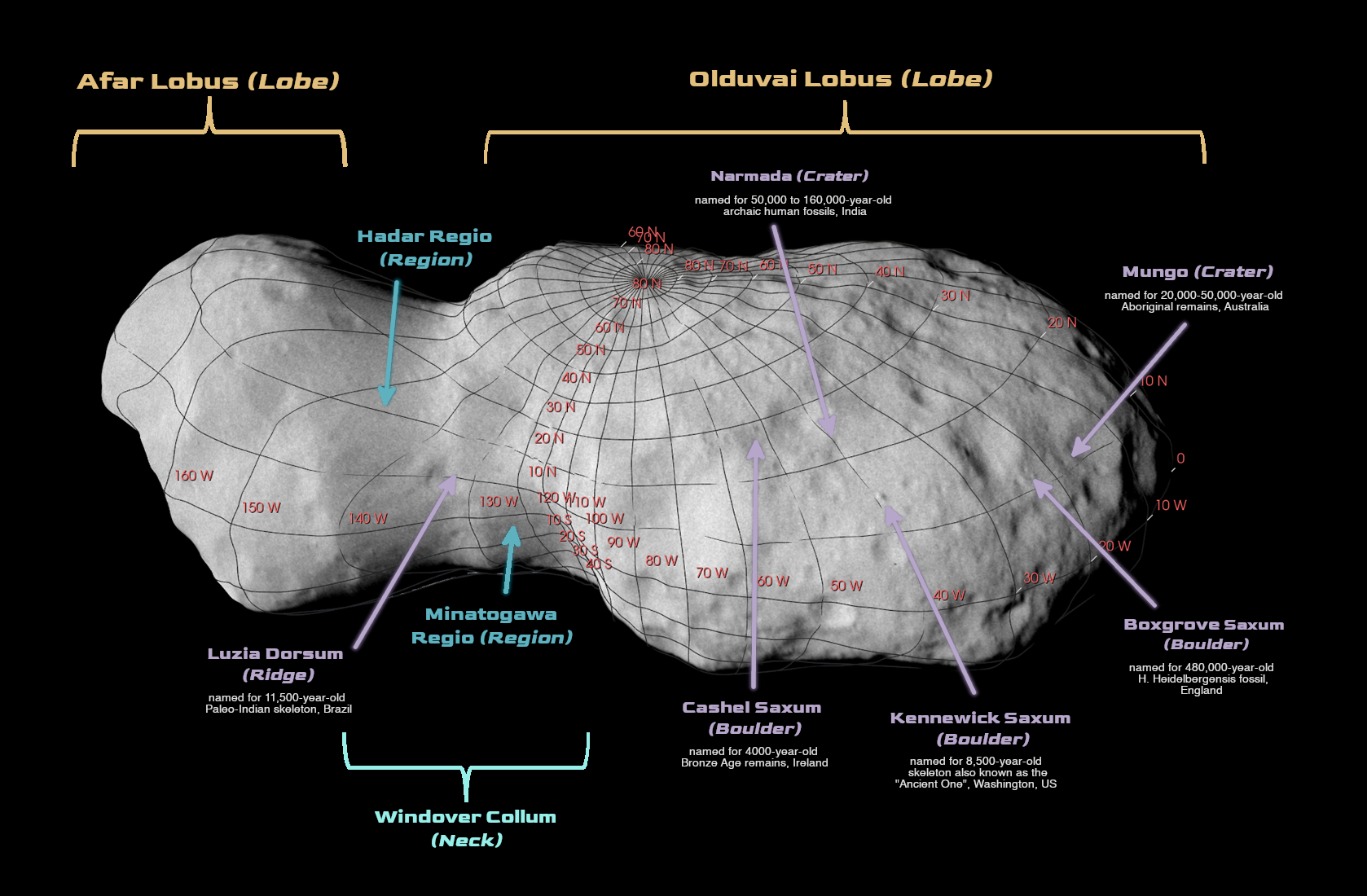
The smaller lobe is called Afar Lobus, after the Ethiopian region where Lucy and other hominin fossils were found. The larger lobe is named Olduvai Lobus, after the Tanzanian river gorge that has also yielded many important hominin discoveries.

The asteroid’s neck, Windover Collum, which joins those two lobes, is named after the Windover Archeological Site near Cape Canaveral Space Force Station in Florida — where NASA’s Lucy mission launched in 2021. Human remains and artifacts recovered from that site revolutionized our understanding of the people who lived in Florida around 7,300 years ago.

The asteroid Donaldjohanson with latitude and longitude lines and arrows indicating the names of various features on the surface.
Officially recognized names of geologic features on the asteroid Donaldjohanson.
NASA Goddard/SwRI/Johns Hopkins APL

Two smooth areas on the asteroid’s neck are named Hadar Regio, marking the specific site of Johanson’s discovery of the Lucy fossil, and Minatogawa Regio, after the location where the oldest known hominins in Japan were found. Select boulders and craters on Donaldjohanson are named after notable fossils ranging from pre-Homo sapiens hominins to ancient modern humans. The IAU also approved a coordinate system for mapping features on this uniquely shaped small world.

As of Sept. 9, the Lucy spacecraft was nearly 300 million miles (480 million km) from the Sun en route to its August 2027 encounter with its first Trojan asteroid called Eurybates. This places Lucy about three quarters of the way through the main asteroid belt. Since its encounter with Donaldjohanson, Lucy has been cruising without passing close to any other asteroids, and without requiring any trajectory correction maneuvers.

The team continues to carefully monitor the instruments and spacecraft as it travels farther from the Sun into a cooler environment.

Stay tuned at nasa.gov/lucy for more updates as Lucy continues its journey toward the never-before-explored Jupiter Trojan asteroids, and download a postcard commemorating the Donaldjohanson encounter.

By Katherine Kretke
Southwest Research Institute

Media Contact:

Lonnie Shekhtman

lonnie.shekhtman@nasa.gov

NASA’s Goddard Space Flight Center, Greenbelt, Md.

❌
❌