Normal view

There are new articles available, click to refresh the page.
Yesterday — 5 December 2025Main stream

NASA-JAXA XRISM Finds Elemental Bounty in Supernova Remnant

4 December 2025 at 10:01

4 min read

NASA-JAXA XRISM Finds Elemental Bounty in Supernova Remnant

For the first time, scientists have made a clear X-ray detection of chlorine and potassium in the wreckage of a star using data from the Japan-led XRISM (X-ray Imaging and Spectroscopy Mission) spacecraft.

The Resolve instrument aboard XRISM, pronounced “crism,” discovered these elements in a supernova remnant called Cassiopeia A or Cas A, for short. The expanding cloud of debris is located about 11,000 light-years away in the northern constellation Cassiopeia.

“This discovery helps illustrate how the deaths of stars and life on Earth are fundamentally linked,” said Toshiki Sato, an astrophysicist at Meiji University in Tokyo. “Stars appear to shimmer quietly in the night sky, but they actively forge materials that form planets and enable life as we know it. Now, thanks to XRISM, we have a better idea of when and how stars might make crucial, yet harder-to-find, elements.”

A paper about the result published Dec. 4 in Nature Astronomy. Sato led the study with Kai Matsunaga and Hiroyuki Uchida, both at Kyoto University in Japan. JAXA (Japan Aerospace Exploration Agency) leads XRISM in collaboration with NASA, along with contributions from ESA (European Space Agency). NASA and JAXA also codeveloped the Resolve instrument.
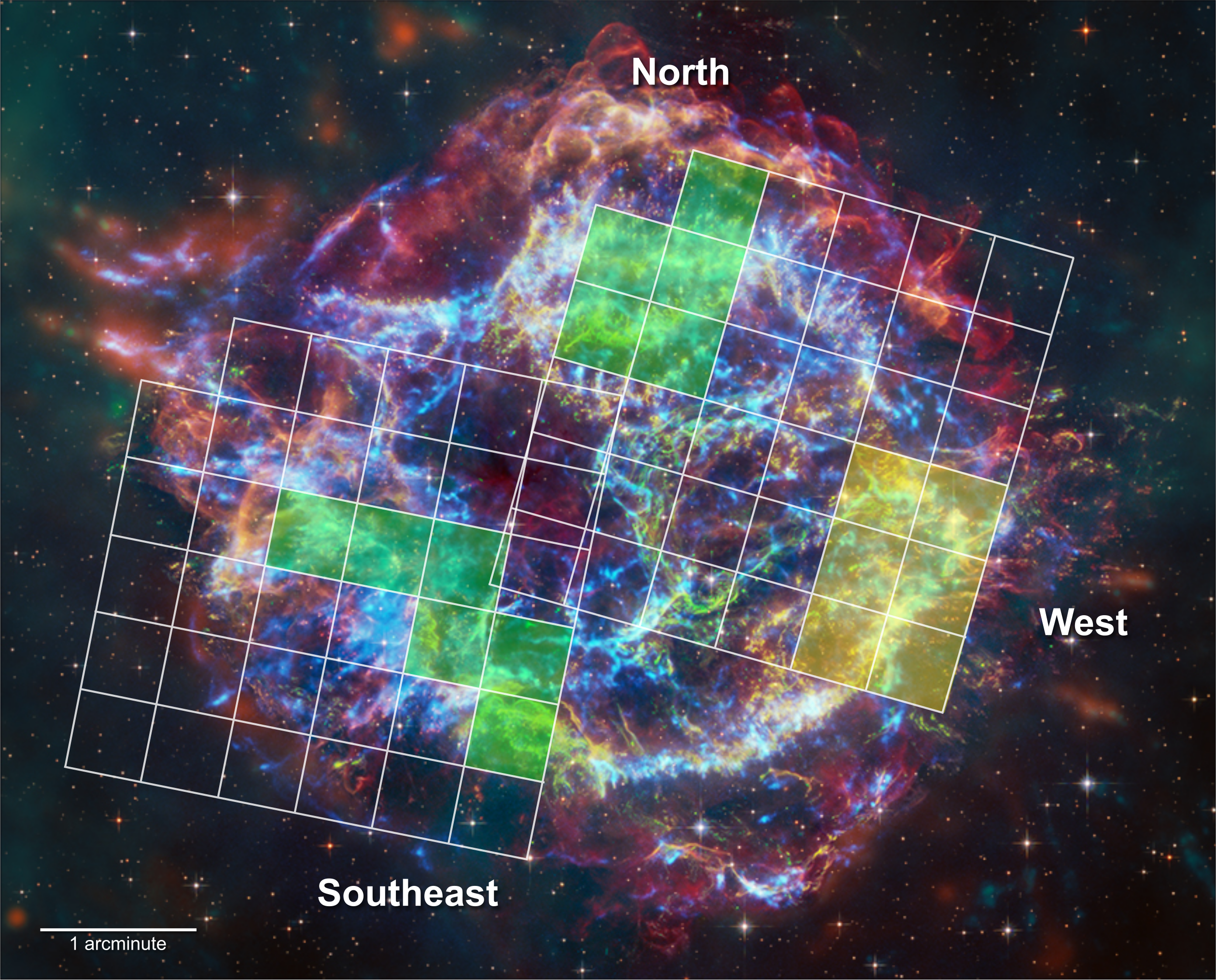
The Cassiopeia A supernova remnant with the XRISM Resolve fields of view
Observations of the Cassiopeia A supernova remnant by the Resolve instrument aboard the NASA-JAXA XRISM (X-ray Imaging and Spectroscopy Mission) spacecraft revealed strong evidence for potassium (green squares) in the southeast and northern parts of the remnant. Grids superposed on a multiwavelength image of the remnant represent the fields of view of two Resolve measurements made in December 2023. Each square represents one pixel of Resolve’s detector. Weaker evidence of potassium (yellow squares) in the west suggests that the original star may have had underlying asymmetries before it exploded.
NASA’s Goddard Space Flight Center; X-ray: NASA/CXC/SAO; Optical: NASA/ESA/STScI; IR: NASA/ESA/CSA/STScI/Milisavljevic et al., NASA/JPL/CalTech; Image Processing: NASA/CXC/SAO/J. Schmidt and K. Arcand

Stars produce almost all the elements in the universe heavier than hydrogen and helium through nuclear reactions. Heat and pressure fuse lighter ones, like carbon, into progressively heavier ones, like neon, creating onion-like layers of materials in stellar interiors.

Nuclear reactions also take place during explosive events like supernovae, which occur when stars run out of fuel, collapse, and explode. Elemental abundances and locations in the wreckage can, respectively, tell scientists about the star and its explosion, even after hundreds or thousands of years.

Some elements — like oxygen, carbon, and neon — are more common than others and are easier to detect and trace back to a particular part of the star’s life.

Other elements — like chlorine and potassium — are more elusive. Since scientists have less data about them, it’s more difficult to model where in the star they formed. These rarer elements still play important roles in life on Earth. Potassium, for example, helps the cells and muscles in our bodies function, so astronomers are interested in tracing its cosmic origins.

The roughly circular Cas A supernova remnant spans about 10 light-years, is over 340 years old, and has a superdense neutron star at its center — the remains of the original star’s core. Scientists using NASA’s Chandra X-ray Observatory had previously identified signatures of iron, silicon, sulfur, and other elements within Cas A.

In the hunt for other elements, the team used the Resolve instrument aboard XRISM to look at the remnant twice in December 2023. The researchers were able to pick out the signatures for chlorine and potassium, determining that the remnant contains ratios much higher than expected. Resolve also detected a possible indication of phosphorous, which was previously discovered in Cas A by infrared missions.

Watch to learn more about how the Resolve instrument aboard XRISM captures extraordinary data on the make-up of galaxy clusters, exploded stars, and more using only 36 pixels.
Credit: NASA’s Goddard Space Flight Center

“Resolve’s high resolution and sensitivity make these kinds of measurements possible,” said Brian Williams, the XRISM project scientist at NASA’s Goddard Space Flight Center in Greenbelt, Maryland. “Combining XRISM’s capabilities with those of other missions allows scientists to detect and measure these rare elements that are so critical to the formation of life in the universe.”

The astronomers think stellar activity could have disrupted the layers of nuclear fusion inside the star before it exploded. That kind of upheaval might have led to persistent, large-scale churning of material inside the star that created conditions where chlorine and potassium formed in abundance.

The scientists also mapped the Resolve observations onto an image of Cas A captured by Chandra and showed that the elements were concentrated in the southeast and northern parts of the remnant.

This lopsided distribution may mean that the star itself had underlying asymmetries before it exploded, which Chandra data indicated earlier this year in a study Sato led.

“Being able to make measurements with good statistical precision of these rarer elements really helps us understand the nuclear fusion that goes on in stars before and during supernovae,” said co-author Paul Plucinsky, an astrophysicist at the Center for Astrophysics | Harvard & Smithsonian in Cambridge, Massachusetts. “We suspected a key part might be asymmetry, and now we have more evidence that’s the case. But there’s still a lot we just don’t understand about how stars explode and distribute all these elements across the cosmos.”

By Jeanette Kazmierczak
NASA’s
Goddard Space Flight Center, Greenbelt, Md.

Media Contact:
Claire Andreoli
301-286-1940
NASA’s Goddard Space Flight Center, Greenbelt, Md.
Facebook logo
Instagram logo
Before yesterdayMain stream

Mapping Dark Matter

14 November 2025 at 12:44
Webb near-infrared data combined with Chandra X-ray data of the Bullet Cluster show many overlapping objects, including foreground stars, galaxies in galaxy clusters, and distorted background galaxies behind the galaxy clusters. The objects are all at various distances set against the black background of space. Most galaxies appear as tiny fuzzy ovals in white, orange, or red. A slightly larger, very bright, light blue spiral galaxy is at center. To its immediate left and right are two large bright pink splotches representing X-rays. The right pink area has a rounded nose facing right, where it is darker pink, and fades to the left as a triangular shape. This is referred to as the Bullet. To the far left and far right, next to the pink regions, are two blue regions representing dark matter mass. The left blue region is a large, long oval at an angle. The blue region at right is a far smaller oval.
NASA, ESA, CSA, STScI, CXC

This image released on June 30, 2025, combines data from NASA’s James Webb Space Telescope and NASA’s Chandra X-ray Observatory to visualize dark matter. Researchers used Webb’s observations to carefully measure the mass of the galaxy clusters shown here as well as the collective light emitted by stars that are no longer bound to individual galaxies.

Learn more.

Image credit: NASA, ESA, CSA, STScI, CXC

IC Stars

22 September 2025 at 13:27
Material resembling a tangle of dark pink hair swirls dramatically across the image. The picture is dotted with dozens of colorful orbs in various sizes.
IC 348 is a star-forming region in our Milky Way galaxy.
X-ray: NASA/CXC/SAO; Infrared: NASA/ESA/CSA/STScI; Image Processing: NASA/CXC/SAO/J. Major

Data from NASA’s Chandra X-ray Observatory and NASA’s James Webb Space Telescope combine to reveal an otherworldly view of the star-forming region IC 348. In this image released on July 23, 2025, X-rays from Chandra are red, green, and blue, while infrared data from Webb are pink, orange, and purple.

The wispy structures that dominate the image are interstellar material that reflect the light from the cluster’s stars; this is known as a reflection nebula. The point-like sources in Chandra’s X-ray data are young stars in the cluster developing there.

Text credit: Megan Watzke

Image credit: X-ray: NASA/CXC/SAO; Infrared: NASA/ESA/CSA/STScI; Image Processing: NASA/CXC/SAO/J. Major

NASA’s Chandra Finds Black Hole With Tremendous Growth

By: Lee Mohon
18 September 2025 at 13:31
An artist's concept of a supermassive black hole, a surrounding disk of material falling towards the black hole and a jet containing particles moving away at close to the speed of light. This black hole represents a recently-discovered quasar powered by a black hole. New Chandra observations indicate that the black hole is growing at a rate that exceeds the usual limit for black holes, called the Eddington Limit. Credit: NASA/CXC/SAO/M. Weiss
An artist’s concept of a supermassive black hole, a surrounding disk of material falling towards the black hole and a jet containing particles moving away at close to the speed of light. This black hole represents a recently-discovered quasar powered by a black hole. New Chandra observations indicate that the black hole is growing at a rate that exceeds the usual limit for black holes, called the Eddington Limit. Credit: NASA/CXC/SAO/M. Weiss
X-ray: NASA/CXC/INAF-Brera/L. Ighina et al.; Illustration: NASA/CXC/SAO/M. Weiss; Image Processing: NASA/CXC/SAO/N. Wolk

A black hole is growing at one of the fastest rates ever recorded, according to a team of astronomers. This discovery from NASA’s Chandra X-ray Observatory may help explain how some black holes can reach enormous masses relatively quickly after the big bang.

The black hole weighs about a billion times the mass of the Sun and is located about 12.8 billion light-years from Earth, meaning that astronomers are seeing it only 920 million years after the universe began. It is producing more X-rays than any other black hole seen in the first billion years of the universe.

The black hole is powering what scientists call a quasar, an extremely bright object that outshines entire galaxies. The power source of this glowing monster is large amounts of matter funneling around and entering the black hole.

While the same team discovered it two years ago, it took observations from Chandra in 2023 to discover what sets this quasar, RACS J0320-35, apart. The X-ray data reveal that this black hole appears to be growing at a rate that exceeds the normal limit for these objects.

“It was a bit shocking to see this black hole growing by leaps and bounds,” said Luca Ighina of the Center for Astrophysics | Harvard & Smithsonian in Cambridge, Massachusetts, who led the study.

When matter is pulled toward a black hole it is heated and produces intense radiation over a broad spectrum, including X-rays and optical light. This radiation creates pressure on the infalling material. When the rate of infalling matter reaches a critical value, the radiation pressure balances the black hole’s gravity, and matter cannot normally fall inwards any more rapidly. That maximum is referred to as the Eddington limit.

Scientists think that black holes growing more slowly than the Eddington limit need to be born with masses of about 10,000 Suns or more so they can reach a billion solar masses within a billion years after the big bang — as has been observed in RACS J0320-35. A black hole with such a high birth mass could directly result from an exotic process: the collapse of a huge cloud of dense gas containing unusually low amounts of elements heavier than helium, conditions that may be extremely rare.

If RACS J0320-35 is indeed growing at a high rate — estimated at 2.4 times the Eddington limit — and has done so for a sustained amount of time, its black hole could have started out in a more conventional way, with a mass less than a hundred Suns, caused by the implosion of a massive star.

“By knowing the mass of the black hole and working out how quickly it’s growing, we’re able to work backward to estimate how massive it could have been at birth,” said co-author Alberto Moretti of INAF-Osservatorio Astronomico di Brera in Italy. “With this calculation we can now test different ideas on how black holes are born.”

To figure out how fast this black hole is growing (between 300 and 3,000 Suns per year), the researchers compared theoretical models with the X-ray signature, or spectrum, from Chandra, which gives the amounts of X-rays at different energies. They found the Chandra spectrum closely matched what they expected from models of a black hole growing faster than the Eddington limit. Data from optical and infrared light also supports the interpretation that this black hole is packing on weight faster than the Eddington limit allows.

“How did the universe create the first generation of black holes?” said co-author Thomas of Connor, also of the Center for Astrophysics. “This remains one of the biggest questions in astrophysics and this one object is helping us chase down the answer.”

Another scientific mystery addressed by this result concerns the cause of jets of particles that move away from some black holes at close to the speed of light, as seen in RACS J0320-35. Jets like this are rare for quasars, which may mean that the rapid rate of growth of the black hole is somehow contributing to the creation of these jets.

The quasar was previously discovered as part of a radio telescope survey using the Australian Square Kilometer Array Pathfinder, combined with optical data from the Dark Energy Camera, an instrument mounted on the Victor M. Blanco 4-meter Telescope at the Cerro Tololo Inter-American Observatory in Chile. The U.S. National Science Foundation National Optical-Infrared Astronomy Research Laboratory’s Gemini-South Telescope on Cerro Pachon, Chile was used to obtain the accurate distance of RACS J0320-35.

A paper describing these results has been accepted for publication in The Astrophysical Journal and is available here.

NASA’s Marshall Space Flight Center in Huntsville, Alabama, manages the Chandra program. The Smithsonian Astrophysical Observatory’s Chandra X-ray Center controls science operations from Cambridge, and flight operations from Burlington, Massachusetts.

Learn more about the Chandra X-ray Observatory and its mission here:

https://www.nasa.gov/chandra

https://chandra.si.edu

Visual Description

This release features a quasar located 12.8 billion light-years from Earth, presented as an artist’s illustration and an X-ray image from NASA’s Chandra X-ray Observatory.

In the artist’s illustration, the quasar, RACS J0320-35, sits at our upper left, filling the left side of the image. It resembles a spiraling, motion-blurred disk of orange, red, and yellow streaks. At the center of the disk, surrounded by a glowing, sparking, brilliant yellow light, is a black egg shape. This is a black hole, one of the fastest-growing black holes ever detected. The black hole is also shown in a small Chandra X-ray image inset at our upper right. In that depiction, the black hole appears as a white dot with an outer ring of neon purple.

The artist’s illustration also highlights a jet of particles blasting away from the black hole at the center of the quasar. The streaked silver beam starts at the core of the distant quasar, near our upper left, and shoots down toward our lower right. The blurry beam of energetic particles appears to widen as it draws closer and exits the image.

News Media Contact

Megan Watzke
Chandra X-ray Center
Cambridge, Mass.
617-496-7998
mwatzke@cfa.harvard.edu

Corinne Beckinger
Marshall Space Flight Center, Huntsville, Alabama
256-544-0034
corinne.m.beckinger@nasa.gov

Keep Exploring

Discover More Topics From NASA

An Eye-catching Star Cluster

16 September 2025 at 12:40
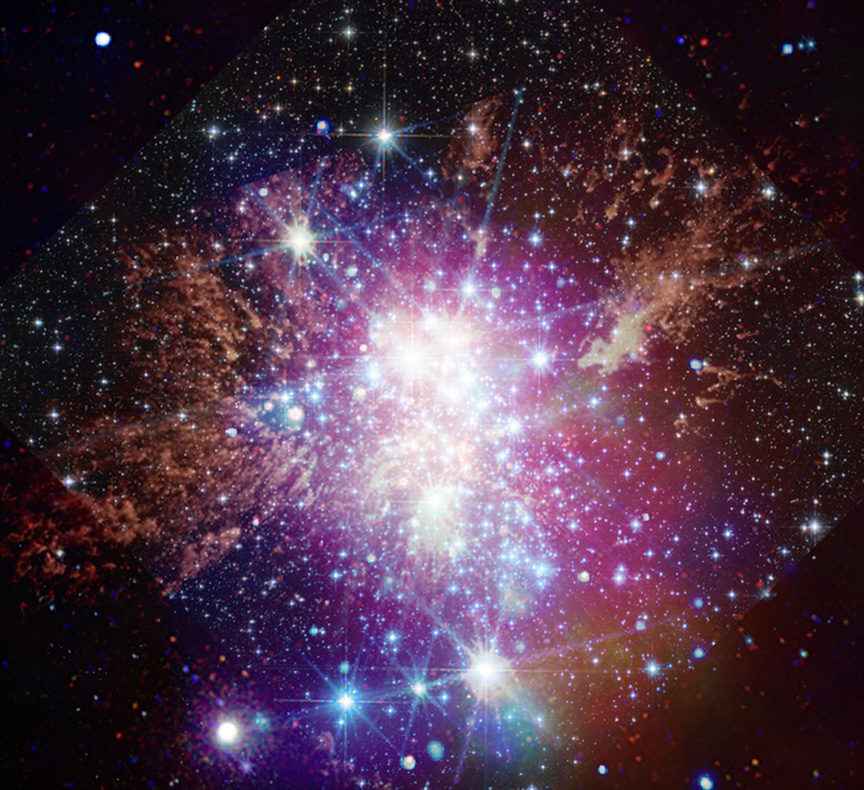
Scores of gleaming white orbs and tiny specks pack the blackness of space, surrounded by a purple haze, and mottled golden clouds.
X-ray: NASA/CXC/SAO; Optical: NASA/ESA/STScI; IR: NASA/ESA/CSA/STScI; Processing: NASA/CXC/SAO/L. Frattare

Westerlund 1, the biggest and closest “super” star cluster to Earth, dazzles in this image released on July 23, 2025. This view combines x-ray data from NASA’s Chandra X-ray Observatory (in pink, blue, purple, and orange), infrared data from NASA’s James Webb Space Telescope (in yellow, gold, and blue), and optical data from NASA’s Hubble Space Telescope (in cyan, grey, and light yellow).

Data from Chandra and other telescopes is helping astronomers delve deeper into this galactic factory where stars are vigorously being produced. Observations from Chandra have uncovered thousands of individual stars pumping out X-ray emission into the cluster.

This image is part of a compilation of images featuring data from Chandra along with a host of other telescopes.

Image credit: X-ray: NASA/CXC/SAO; Optical: NASA/ESA/STScI; IR: NASA/ESA/CSA/STScI; Processing: NASA/CXC/SAO/L. Frattare

❌
❌