❌

Normal view

There are new articles available, click to refresh the page.
Before yesterdayMain stream

Calyx Cure Solves Critical Post-Harvest Problems and Helps Growers Finish Strong

19 November 2025 at 07:20

Every grower hates this moment. You’ve done the work in the grow, everything’s dialed, and then somewhere between the curing process and the jar being opened by the customer, the nose softens, color fades, and the scale trends the wrong way. Post-harvest is where great flower can quietly lose its edge – and with it, valuable weight and terpenes that drive aroma, potency, and price integrity.

For cannabis cultivators, this phase represents a critical and costly challenge. Without proper atmosphere control during the cure, moisture escapes, leading to overall weight loss. At the same time, volatile terpene compounds degrade quickly without the right barriers and anti-absorption technology, diminishing the final product’s flavor and entourage profile.

Drying and curing are critical and costly for cannabis cultivators. Lack of atmospheric control causes weight loss, while inadequate barriers lead to rapid terpene degradation, harming flavor and entourage.

Innovation Driven by Industry Needs

Calyx Containers, long known for its packaging innovations, built Calyx Cure to solve these problems at the source. The flat-bottom curing pouch stabilizes humidity and oxygen, resists terpene absorption, limits UV rays, and reduces static so trichomes stay on the bud instead of the bag.

The Science of a Better Cure

In partnership with the Cannabis Research Coalition, Calyx Cure was tested in a 60/60 environment without active humidification. The results were striking: Calyx Cure maintained a tighter, higher water-activity band than commodity bags, leading to better weight outcomes while retaining a higher amount of key monoterpenes like limonene compared to competitive products as well as the standard turkey bags.

That environment stability translated into practical advantages: more repeatable cures, less dry-down, and a nose that holds longer on the shelf. The study also showed a consistent, predictable relationship between moisture content and water activity under Calyx conditions – simplifying QC workflows and reducing variability.

The Nine Layers of Innovation

Each layer of the Calyx Cure pouch performs a precise role in protecting product integrity:

  • Layer 9: A rugged outer shell that resists punctures and warehouse abrasion.
  • Layer 8: UV filtration that shields cannabinoids and color like sunglasses for your flower.
  • Layer 7: Reinforced micro-strands for puncture resistance against stems and corners.
  • Layer 6: A dense oxygen barrier that slows oxidation and preserves potency.
  • Layer 5: A modified-atmosphere membrane that self-balances COβ‚‚ and Oβ‚‚ for ideal cure conditions.
  • Layer 4: Moisture-control tech that keeps humidity in the sweet spot – no extra packs required.
  • Layer 3: Terpene-lock barrier that prevents aromatic oils from escaping during storage or transit.
  • Layer 2: Anti-static discharge protection that keeps trichomes on the flower, not stuck to the film.
  • Layer 1: Food-safe contact layer that’s non-leaching, neutral, and taste-free.

Together, these layers form a self-regulating microclimate that protects your crop through every stage of post-harvest handling.

Results That Show Up Where It Matters

Operators notice the benefits immediately. Weight stays closer to target, aroma carries from seal to sale, maintaining terp-forward character and supporting premium pricing for the maximum amount of product. The pouch stands open for quick loading, resists pallet rub, and locks out odor and light – built for real cultivation environments, not just lab conditions.

Economics That Add Up

The math is simple: retain more weight in cure, have more weight to sell. Even a 2–3% improvement in retained moisture multiplied by your wholesale dollars per gram can translate into significant annual gains. Add the value of terpene retention and longer shelf life, and Calyx Cure often pays for itself within just a few turns.

Your Partner in Cultivation

As markets tighten and regulations shift, the clearest lever for success remains the flower itself – and how it finishes. The last container a bud touches can protect that finish or erode it. Calyx Cure is built to protect it – turning a vulnerable post-harvest phase into a controlled, repeatable advantage.

The post Calyx Cure Solves Critical Post-Harvest Problems and Helps Growers Finish Strong appeared first on Cannabis Now.
After Harvest: From Drying to Selling Cannabis

23 October 2025 at 03:00

The joys and challenges of being a small farm cannabis cultivator are myriad. Beginning in the spring, when we first β€œcrack” our seeds in preparation for planting, the thrill is there. Each delicate little sprout is carefully placed in living soil, and for the following seven months, we have the supreme joy of watching those tiny shoots develop into glorious big girls, laden with luscious buds.

Naturally, there can be setbacks along the way, whether from climate, bugs, disease, predators or basic human errors. Generally, the pleasure overrides the problems. By autumn, the time comes to harvest the crop and begin the drying and curing process.

Drying and Curing Cannabis

Just when you think you are in the clear because the harvest is in the barn, now is when the conscious cultivator must really be aware. All too often we hear of farmers losing their entire crops to mold or mildew due to improper drying and curing. We also see many supply chain problems.

Once the cannabis is properly cured at the farm, it’s sent off to the processor for trimming and packaging, and it’s no longer in the cultivator’s control. During the long journey from garden to consumer, any number of issues can cause even the highest quality flowers to degrade.

Nevertheless, the first step after harvest is the proper drying, curing and bucking down of the cannabis. At the Swami Select farm, located in California’s Emerald Triangle, we hang our cannabis branches upside down on nylon netting for at least two weeks in the dark in our timber frame barn. The temperature and humidity should both hover just around 60 degrees to ensure proper drying. If it’s wet outside, we use dehumidifiers to maintain the humidity levels. We also have a fire burning in the wood stove when the outside temperatures dip too low, which also helps to control the humidity.

When the tiny stems break instead of bending, it tells us that the buds are dry enough. Then we gently take the branches down off the drying nets and place them on long sheets of unbleached Kraft paper, which are rolled up like burritos open at the top. We keep them stored in the barn, and after a few more days of careful observation, we roll up the top of the β€œburritos” so they are enclosed. When fully dried and ready for the curing process, we place the rolls into non-scented contractor bags and store them in the barn until ready to be bucked down.

Bucking Cannabis

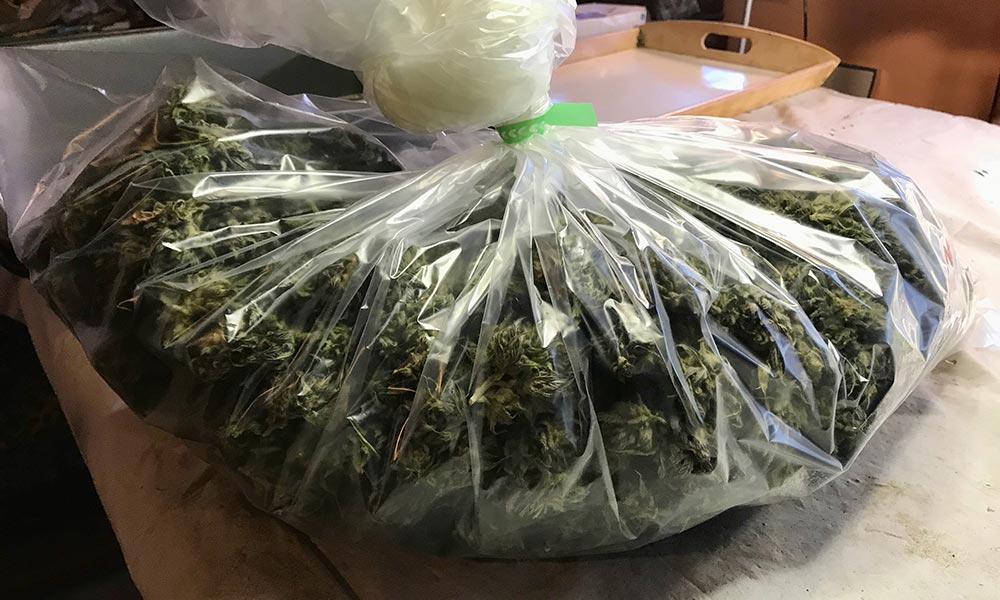
A β€œturkey bag” of bucked cannabis.

Swami and I do our own bucking here at the ranch. Bucking means cutting the full buds off of the branches and removing any large fan leavesβ€”the ones that you would never want to smoke because they have no β€œsugar” on them. We leave the smaller sugar leaves around the buds to protect them until the final trim when they become β€œtrim shake.”

Once bucked down, the buds are placed in turkey bags (also known as β€œoven bags”) and then into large tubs which are labeled with the Metrc numbers of the plants inside. We are required to weigh the buds of each plant when they leave the ranch and report the weights to Metrc. We also have to report the weight of the stems and leaves that are cut away and put on the compost pile.

Processing and Packaging Cannabis

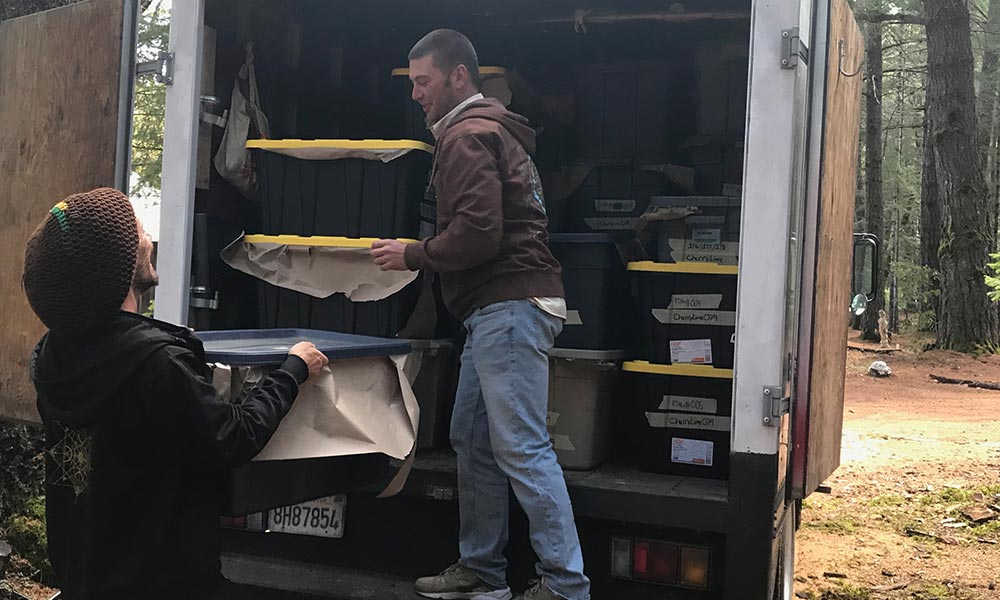
Loading up the Distro Van at Swami Select.

Finally, the time has arrived to send the girls off to school, or that’s what it feels like. After eight or nine months of carefully tending our precious plants, a large white unmarked van will show up at our ranch, and the tubs full of bucked flowers will be driven away. At this point, we have little control over their journey through the supply chain and pray the flowers are in good hands and not mistreated by the time the consumer receives them.

We used to trim and package it all at home, but now, because of Department of Cannabis Control regulations which prohibit commercial cannabis operations in residential dwellings, as well as city and county zoning ordinances and building codes, most farmers can no longer perform their own trimming and packaging. Instead, the flowers will be trimmed by a professional crew at a processing center that typically packages them as well.

When specifying hand-trimmed bud, many farmers complain that no matter how much they instruct the trimmers to only hold the buds by the stem to keep the trichomes intact, many ignore these instructions. Some processors use a machine to buck or remove leaves and then do a hand finish in order to claim that the cannabis is β€œhand-trimmed.” However, this treatment can knock off the trichrome heads as well. Packaging is also a delicate operation which involves properly weighing out and placing the buds into their final jars or bags for sale.

Once the flowers have been packaged, the distributor will keep them in storage while waiting for test results and order placements. To maintain the quality of the flower and prevent it from becoming too dry, the temperature/humidity parameters during both the operations and storage phases are critical. How many storage areas, on a boiling hot California summer day, for example, are truly kept at 60 degrees or cooler? Not many is what we’ve discovered. How many delivery vans are refrigerated properly? It’s rare to find a processor and distributor who will give the flower the same love and care as the farmer would have.

Maintaining Control of Your Craft Cannabis

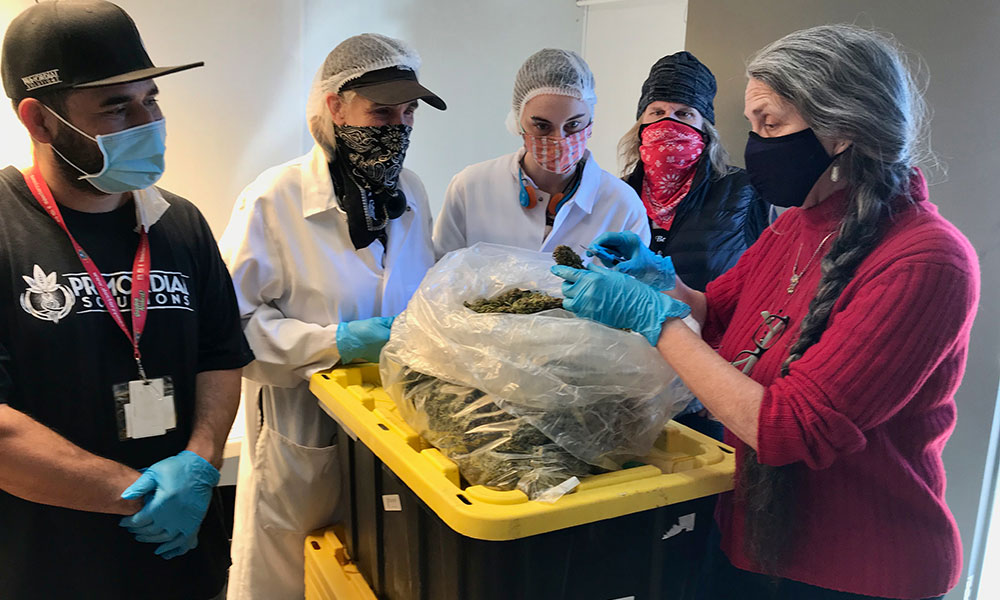
Nikki gives instruction to the Seed2Soul Trim Crew.

Even with a perfect curing operation, once the flowers leave the farmer, there’s not much the farmers can do to protect them. Hence, by the time consumers purchase their flower, it may no longer be at optimum quality. This dilemma is a very real problem.

So, what is the solution? For starters, farmers must keep as close an eye on their processor/distributor/retailer as possible to ensure proper trimming and packaging techniques, as well as monitoring transport and storage conditions. This can be a real challenge considering many farms are miles away in distant rural communities.

The other option is to invest in a microbusiness license which allows growing, processing and packaging at the farm, as well as a being your own distributor with a retail location or non-storefront retail delivery license. But this is an expensive proposition; it requires commercial buildings and extensive security measures and ADA access, as well as a delivery vehicle and driver. Several small farmers are considering alternative ways to form collectives to make it more possible.

The old days of just growing great weed, trimming it at home, and driving a few pounds in turkey bags down to the city are long gone. But that doesn’t mean that craft farmers, who insist on the highest quality, cannot still maintain control. It is a challenge, but well worth it.

The post After Harvest: From Drying to Selling Cannabis appeared first on Cannabis Now.

Can I Harvest Green Tomatoes? Tips for Ripening and Harvesting

17 September 2025 at 08:30

It’s just days away from the first frost, and you’re looking at your green tomatoes wishing they would ... Read More

The post Can I Harvest Green Tomatoes? Tips for Ripening and Harvesting appeared first on Garden Therapy.

❌
❌