
❌

Normal view

There are new articles available, click to refresh the page.
Before yesterdayMain stream

Benchmarking Chinese CPUs

By: Lewin Day
26 November 2025 at 19:00

When it comes to PCs, Westerners are most most familiar with x86/x64 processors from Intel and AMD, with Apple Silicon taking up a significant market share, too. However, in China, a relatively new CPU architecture is on the rise. A fabless semiconductor company called Loongson has been producing chips with its LoongArch architecture since 2021. These chips remain rare outside China, but some in the West have been benchmarking them.

[Daniel Lemire] has recently blogged about the performance of the Loongson 3A6000, which debuted in late 2023. The chip was put through a range of simple benchmarking tests, involving float processing and string transcoding operations. [Daniel] compared it to the Intel Xeon Gold 6338 from 2021, noting the Intel chip pretty much performed better across the board. No surprise given its extra clock rate. Meanwhile, the gang over at [Chips and Cheese] ran even more exhaustive tests on the same chip last year. The Loongson was put through typical tasks likeΒ  compressing archives and encoding video. The outlet came to the conclusion that the chip was a little weaker than older CPUs like AMD’s Zen 2 line and Intel’s 10th generation Core chips. It’s also limited as a four-core chip compared to modern Intel and AMD lines that often start at 6 cores as a minimum.

If you find yourself interested in Loongson’s product, don’t get too excited. They’re not exactly easy to lay your hands on outside of China, and even the company’s own website is difficult to access from beyond those shores. You might try reaching out to Loongson-oriented online communities if you seek such hardware.

Different CPU architectures have perhaps never been more relevant, particularly as we see the x86 stalwarts doing battle with the rise of desktop and laptop ARM processors. If you’ve found something interesting regarding another obscure kind of CPU, don’t hesitate to let the tipsline know!
Supersized Calculator Brings the Whole Intel 4004 Gang Together

16 November 2025 at 22:00

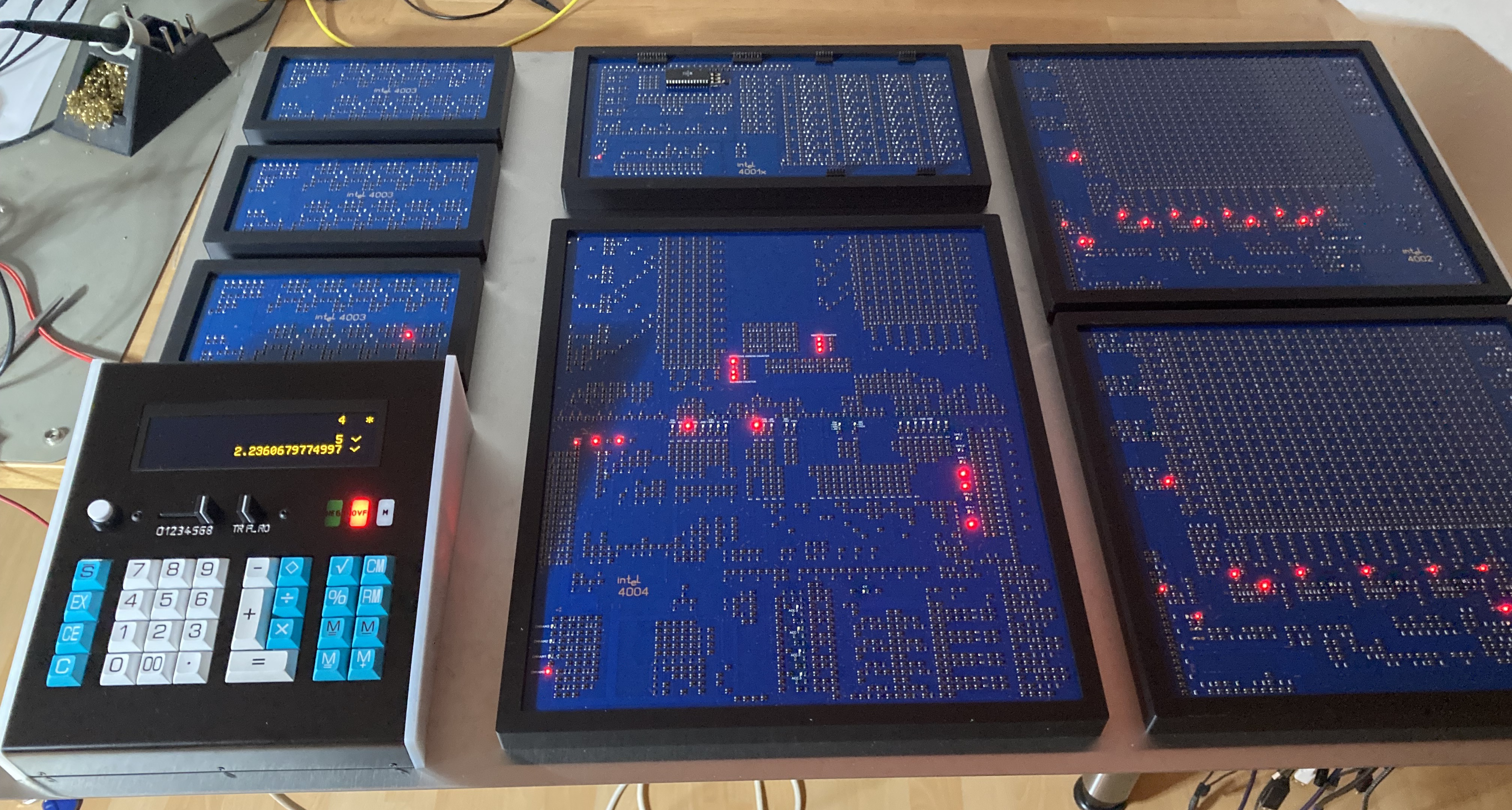
Though mobile devices and Apple Silicon have seen ARM-64 explode across the world, there’s still decent odds you’re reading this on a device with an x86 processor β€” the direct descendant of the world’s first civilian microprocessor, the Intel 4004. The 4004 wasn’t much good on its own, however, which is why [Klaus Scheffler] and [Lajos Kintli] have produced super-sized discrete chips of the 4001 ROM, 4002 RAM, and 4003 shift register to replicate a 1970s calculator at 10x the size and double the speed, all in time for the 4004’s 50th anniversary.

We featured this project a couple of years back, when it was just a lonely microprocessor. Adding the other MSC-4 series chips enabled the pair to faithfully reproduce the logic of a Busicom 141-PF calculator, the very first to market with Intel’s now-legendary microprocessor. Indeed, this calculator is the raison d’etre for the 4004: Busicom commissioned the whole Micro-Computer System 4-bit (MCS-4) set of chips specifically for this calculator. Only later, once they realized what they had made, did Intel buy the rights back from the Japanese calculator company, and the rest, as they say, is history.

Since its history, it belongs in a museum– and that’s where this giant, FET-based calculator is going. If you happen to be in Solothurn, Switzerland, you’ll be able to see it at a new history of technology exhibit opening at the Enter Museum in 2026. Do check out the write-up and links at 4004.com if you want to learn about this important piece of human history.

The museum-quality hack. Three 4003 shift registers are on the left, with a 4001 ROM above the 4004 CPU in the center, flanked by three 4002 RAM β€œchips” on the right. Photo by [Klaus Scheffler].
We had to specify β€œfirst civilian microprocessor” at the start of this article because the US Navy beat them to the punch by a whole year, and kept it secret until 1998. There’s something very 1970s about the fact that top-secret US military technology was reinvented for a Japanese calculator within a year. It honestly makes [Federico Faggin], the man credited with the design, seem no less visionary than when we thought he was first out of the gate.

❌
❌