❌

Normal view

There are new articles available, click to refresh the page.
Before yesterdayMain stream

The Zen Must Flow From Arrakis Sand Table

25 November 2025 at 14:30

InΒ Dune, the Fremen people of Arrakis practice an odd future hybrid religion called β€œzensunni.” This adds an extra layer of meaning to the title of [Mark Rehorst]’s Arrakis 3.0 sand table, given that the inspiration for the robotic sand table seems to be Zen gardens from Japan.

The dunes on the tabletop version of Arrakis owe nothing to sand worms, but are instead created a rolling metal ball. With all workings happening below, it looks quite magical to the uninitiated, but of course it’s not magic: it’s magnets. Just beneath the tabletop and its sands, the steel ball is being dragged along by the magnetic field of a powerful neodynium magnet.

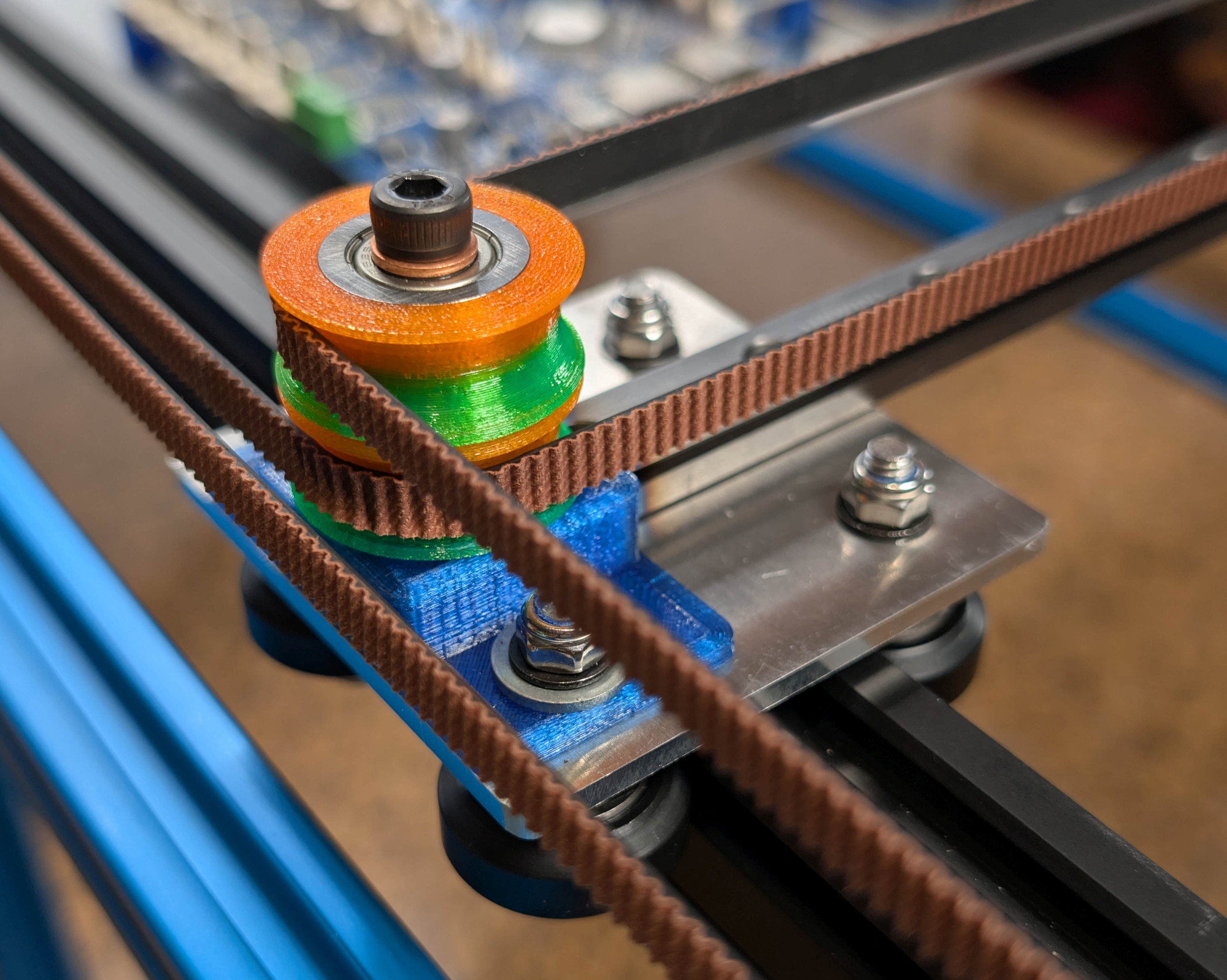
That magnet is mounted in a CoreXY motion system that owes more than a little bit to modern 3D printers. Aside from the geometry, it’s using the standard G6 belt we see so often, along with a Duet3D mainboard, NEMA 17 steppers, and many 3D printed parts to hold its aluminum extrusions together. Thanks to that printer-inspired motion system, the ball can whirl around at 2000 mm/s, though [Mark] prefers to run slower: the demo video below shows operation at 1000 mm/s before the sand has been added.

This build was designed for ease of construction and movement: sized at 2’x4β€² (about 61 cm x 122 cm), it fits through doors and fits an off-the-shelf slab of coffee table glass, something that [Mark] wishes he’d considered when building version two. That’s the nice thing about jumping in on a project someone’s been iterating for a while: you’ve got the benefit of learning from their mistakes. You can see the roots of this design, and what has changed, from the one he showed us in 2020.Β 

Naturally you’re not limited to CoreXY for a sand table, though it is increasingly popular β€” we’ve seen examples with polar mechanisms and even a SCARA arm.

Β 

NDSS 2025 – Towards Understanding Unsafe Video Generation

24 November 2025 at 11:00

SESSION
Session 3D: AI Safety

-----------

-----------

Authors, Creators & Presenters: Yan Pang (University of Virginia), Aiping Xiong (Penn State University), Yang Zhang (CISPA Helmholtz Center for Information Security), Tianhao Wang (University of Virginia)

-----------

PAPER
Towards Understanding Unsafe Video Generation
Video generation models (VGMs) have demonstrated the capability to synthesize high-quality output. It is important to understand their potential to produce unsafe content, such as violent or terrifying videos. In this work, we provide a comprehensive understanding of unsafe video generation.

First, to confirm the possibility that these models could indeed generate unsafe videos, we choose unsafe content generation prompts collected from 4chan and Lexica, and three open-source SOTA VGMs to generate unsafe videos. After filtering out duplicates and poorly generated content, we created an initial set of 2112 unsafe videos from an original pool of 5607 videos. Through clustering and thematic coding analysis of these generated videos, we identify 5 unsafe video categories: Distorted/Weird, Terrifying, Pornographic, Violent/Bloody, and Political. With IRB approval, we then recruit online participants to help label the generated videos. Based on the annotations submitted by 403 participants, we identified 937 unsafe videos from the initial video set. With the labeled information and the corresponding prompts, we created the first dataset of unsafe videos generated by VGMs. We then study possible defense mechanisms to prevent the generation of unsafe videos. Existing defense methods in image generation focus on filtering either input prompt or output results. We propose a new approach called sysname, which works within the model's internal sampling process. sysname can achieve 0.90 defense accuracy while reducing time and computing resources by 10 times when sampling a large number of unsafe prompts. Our experiment includes three open-source SOTA video diffusion models, each achieving accuracy rates of 0.99, 0.92, and 0.91, respectively. Additionally, our method was tested with adversarial prompts and on image-to-video diffusion models, and achieved nearly 1.0 accuracy on both settings. Our method also shows its interoperability by improving the performance of other defenses when combined with them.

-----------

ABOUT NDSS
The Network and Distributed System Security Symposium (NDSS) fosters information exchange among researchers and practitioners of network and distributed system security. The target audience includes those interested in practical aspects of network and distributed system security, with a focus on actual system design and implementation. A major goal is to encourage and enable the Internet community to apply, deploy, and advance the state of available security technologies.

-----------

Our thanks to the Network and Distributed System Security (NDSS) Symposium for publishing their Creators, Authors and Presenter’s superb NDSS Symposium 2025 Conference content on the Organizations' YouTube Channel.

Permalink

The post NDSS 2025 – Towards Understanding Unsafe Video Generation appeared first on Security Boulevard.

NDSS 2025 – GAP-Diff: Protecting JPEG-Compressed Images From Diffusion-Based Facial Customization

23 November 2025 at 11:00

SESSION
Session 3D: AI Safety

-----------

-----------

Authors, Creators & Presenters: Haotian Zhu (Nanjing University of Science and Technology), Shuchao Pang (Nanjing University of Science and Technology), Zhigang Lu (Western Sydney University), Yongbin Zhou (Nanjing University of Science and Technology), Minhui Xue (CSIRO's Data61)

-----------

PAPER
GAP-Diff: Protecting JPEG-Compressed Images From Diffusion-Based Facial Customization
Text-to-image diffusion model's fine-tuning technology allows people to easily generate a large number of customized photos using limited identity images. Although this technology is easy to use, its misuse could lead to violations of personal portraits and privacy, with false information and harmful content potentially causing further harm to individuals. Several methods have been proposed to protect faces from customization via adding protective noise to user images by disrupting the fine-tuned models.
Unfortunately, simple pre-processing techniques like JPEG compression, a normal pre-processing operation performed by modern social networks, can easily erase the protective effects of existing methods. To counter JPEG compression and other potential pre-processing, we propose GAP-Diff, a framework of Generating data with Adversarial Perturbations for text-to-image Diffusion models using unsupervised learning-based optimization, including three functional modules. Specifically, our framework learns robust representations against JPEG compression by backpropagating gradient information through a pre-processing simulation module while learning adversarial characteristics for disrupting fine-tuned text-to-image diffusion models. Furthermore, we achieve an adversarial mapping from clean images to protected images by designing adversarial losses against these fine-tuning methods and JPEG compression, with stronger protective noises within milliseconds. Facial benchmark experiments, compared to state-of-the-art protective methods, demonstrate that GAP-Diff significantly enhances the resistance of protective noise to JPEG compression, thereby better safeguarding user privacy and copyrights in the digital world.

ABOUT NDSS
The Network and Distributed System Security Symposium (NDSS) fosters information exchange among researchers and practitioners of network and distributed system security. The target audience includes those interested in practical aspects of network and distributed system security, with a focus on actual system design and implementation. A major goal is to encourage and enable the Internet community to apply, deploy, and advance the state of available security technologies.

Our thanks to the Network and Distributed System Security (NDSS) Symposium for publishing their Creators, Authors and Presenter’s superb NDSS Symposium 2025 Conference content on the Organizations' YouTube Channel.

Permalink

The post NDSS 2025 – GAP-Diff: Protecting JPEG-Compressed Images From Diffusion-Based Facial Customization appeared first on Security Boulevard.

NDSS 2025 – Explanation As A Watermark

22 November 2025 at 11:00

SESSION
Session 3D: AI Safety

-----------

-----------

Authors, Creators & Presenters: Shuo Shao (Zhejiang University), Yiming Li (Zhejiang University), Hongwei Yao (Zhejiang University), Yiling He (Zhejiang University), Zhan Qin (Zhejiang University), Kui Ren (Zhejiang University)

-----------

PAPER
Explanation as a Watermark: Towards Harmless and Multi-bit Model Ownership Verification via Watermarking Feature Attribution
Ownership verification is currently the most critical and widely adopted post-hoc method to safeguard model copyright. In general, model owners exploit it to identify whether a given suspicious third-party model is stolen from them by examining whether it has particular properties 'inherited' from their released models. Currently, backdoor-based model watermarks are the primary and cutting-edge methods to implant such properties in the released models. However, backdoor-based methods have two fatal drawbacks, including harmfulness and ambiguity. The former indicates that they introduce maliciously controllable misclassification behaviors ( backdoor) to the watermarked released models. The latter denotes that malicious users can easily pass the verification by finding other misclassified samples, leading to ownership ambiguity.

In this paper, we argue that both limitations stem from the 'zero-bit' nature of existing watermarking schemes, where they exploit the status (misclassified) of predictions for verification. Motivated by this understanding, we design a new watermarking paradigm "Explanation as a Watermark (EaaW)", that implants verification behaviors into the explanation of feature attribution instead of model predictions. Specifically, EaaW embeds a 'multi-bit' watermark into the feature attribution explanation of specific trigger samples without changing the original prediction. We correspondingly design the watermark embedding and extraction algorithms inspired by explainable artificial intelligence. In particular, our approach can be used for different tasks (image classification and text generation). Extensive experiments verify the effectiveness and harmlessness of our EaaW and its resistance to potential attacks.

-----------

ABOUT NDSS
The Network and Distributed System Security Symposium (NDSS) fosters information exchange among researchers and practitioners of network and distributed system security. The target audience includes those interested in practical aspects of network and distributed system security, with a focus on actual system design and implementation. A major goal is to encourage and enable the Internet community to apply, deploy, and advance the state of available security technologies.

Our thanks to the Network and Distributed System Security (NDSS) Symposium for publishing their Creators, Authors and Presenter’s superb NDSS Symposium 2025 Conference content on the Organizations' YouTube Channel.

Permalink

The post NDSS 2025 – Explanation As A Watermark appeared first on Security Boulevard.

NDSS 2025 – THEMIS: Regulating Textual Inversion For Personalized Concept Censorship

21 November 2025 at 15:00

SESSION
Session 3D: Al Safety

-----------

-----------

Authors, Creators & Presenters: Yutong Wu (Nanyang Technological University), Jie Zhang (Centre for Frontier AI Research, Agency for Science, Technology and Research (A*STAR), Singapore), Florian Kerschbaum (University of Waterloo), Tianwei Zhang (Nanyang Technological University)

-----------

PAPER
THEMIS: Regulating Textual Inversion for Personalized Concept Censorship

Personalization has become a crucial demand in the Generative AI technology. As the pre-trained generative model (e.g., stable diffusion) has fixed and limited capability, it is desirable for users to customize the model to generate output with new or specific concepts. Fine-tuning the pre-trained model is not a promising solution, due to its high requirements of computation resources and data. Instead, the emerging personalization approaches make it feasible to augment the generative model in a lightweight manner. However, this also induces severe threats if such advanced techniques are misused by malicious users, such as spreading fake news or defaming individual reputations. Thus, it is necessary to regulate personalization models (i.e., achieve concept censorship) for their development and advancement. In this paper, we focus on the regulation of a popular personalization technique dubbed textbf{Textual Inversion (TI)}, which can customize Text-to-Image (T2I) generative models with excellent performance. TI crafts the word embedding that contains detailed information about a specific object. Users can easily add the word embedding to their local T2I model, like the public Stable Diffusion (SD) model, to generate personalized images. The advent of TI has brought about a new business model, evidenced by the public platforms for sharing and selling word embeddings (e.g., Civitai [1]). Unfortunately, such platforms also allow malicious users to misuse the word embeddings to generate unsafe content, causing damages to the concept owners. We propose THEMIS to achieve the personalized concept censorship. Its key idea is to leverage the backdoor technique for good by injecting positive backdoors into the TI embeddings. Briefly, the concept owner selects some sensitive words as triggers during the training of TI, which will be censored for normal use. In the subsequent generation stage, if a malicious user combines the sensitive words with the personalized embeddings as final prompts, the T2I model will output a pre-defined target image rather than images including the desired malicious content. To demonstrate the effectiveness of THEMIS, we conduct extensive experiments on the TI embeddings with Latent Diffusion and Stable Diffusion, two prevailing open-sourced T2I models. The results demonstrate that THEMIS is capable of preventing Textual Inversion from cooperating with sensitive words meanwhile guaranteeing its pristine utility. Furthermore, THEMIS is general to different uses of sensitive words, including different locations, synonyms, and combinations of sensitive words. It can also resist different types of potential and adaptive attacks. Ablation studies are also conducted to verify our design.

-----------

ABOUT NDSS
The Network and Distributed System Security Symposium (NDSS) fosters information exchange among researchers and practitioners of network and distributed system security. The target audience includes those interested in practical aspects of network and distributed system security, with a focus on actual system design and implementation. A major goal is to encourage and enable the Internet community to apply, deploy, and advance the state of available security technologies.

##################

Our thanks to the Network and Distributed System Security (NDSS) Symposium for publishing their Creators, Authors and Presenter’s superb NDSS Symposium 2025 Conference content on the Organizations' YouTube Channel.

Permalink

The post NDSS 2025 – THEMIS: Regulating Textual Inversion For Personalized Concept Censorship appeared first on Security Boulevard.

NDSS 2025 – A Key-Driven Framework For Identity-Preserving Face Anonymization

21 November 2025 at 11:00

SESSION
Session 3D: Al Safety

-----------

-----------

Authors, Creators & Presenters: Miaomiao Wang (Shanghai University), Guang Hua (Singapore Institute of Technology), Sheng Li (Fudan University), Guorui Feng (Shanghai University)

-----------

PAPER
A Key-Driven Framework for Identity-Preserving Face Anonymization

Virtual faces are crucial content in the metaverse. Recently, attempts have been made to generate virtual faces for privacy protection. Nevertheless, these virtual faces either permanently remove the identifiable information or map the original identity into a virtual one, which loses the original identity forever. In this study, we first attempt to address the conflict between privacy and identifiability in virtual faces, where a key-driven face anonymization and authentication recognition (KFAAR) framework is proposed. Concretely, the KFAAR framework consists of a head posture-preserving virtual face generation (HPVFG) module and a key-controllable virtual face authentication (KVFA) module. The HPVFG module uses a user key to project the latent vector of the original face into a virtual one. Then it maps the virtual vectors to obtain an extended encoding, based on which the virtual face is generated. By simultaneously adding a head posture and facial expression correction module, the virtual face has the same head posture and facial expression as the original face. During the authentication, we propose a KVFA module to directly recognize the virtual faces using the correct user key, which can obtain the original identity without exposing the original face image. We also propose a multi-task learning objective to train HPVFG and KVFA. Extensive experiments demonstrate the advantages of the proposed HPVFG and KVFA modules, which effectively achieve both facial anonymity and identifiability.

-----------

ABOUT NDSS
The Network and Distributed System Security Symposium (NDSS) fosters information exchange among researchers and practitioners of network and distributed system security. The target audience includes those interested in practical aspects of network and distributed system security, with a focus on actual system design and implementation. A major goal is to encourage and enable the Internet community to apply, deploy, and advance the state of available security technologies.

Our thanks to the Network and Distributed System Security (NDSS) Symposium for publishing their Creators, Authors and Presenter’s superb NDSS Symposium 2025 Conference content on the Organizations' YouTube Channel.

Permalink

The post NDSS 2025 – A Key-Driven Framework For Identity-Preserving Face Anonymization appeared first on Security Boulevard.

A Quick Primer On TinkerCAD’s New Features

By: Lewin Day
18 November 2025 at 11:30

TinkerCAD had its first release all the way back in 2011 and it has come a long way since then. The latest release has introduced a raft of new, interesting features, and [HL ModTech] has been nice enough to sum them up in a recent video.

He starts out by explaining some of the basics before quickly jumping into the new gear. There are two headline features: intersect groups and smooth curves. Where the old union group tool simply merged two pieces of geometry, intersect group allows you to create a shape only featuring the geometry where two individual blocks intersect. It’s a neat addition that allows the creation of complex geometry more quickly. [HL ModTech] demonstrates it with a sphere and a pyramid and his enthusiasm is contagious.

As for smooth curves, it’s an addition to the existing straight line and BΓ©zier curve sketch tools. If you’ve ever struggled making decent curves with BΓ©zier techniques, you might appreciate the ease of working with the smooth curve tool, which avoids any nasty jagged points as a matter of course.

While it’s been gaining new features at an impressive rate, ultimately TinkerCAD is still a pretty basic tool β€” it’s not the sort of thing you’d expect to see in the aerospace world or anything. ut it’s a great way to start whipping up custom stuff on your 3D printer.

German firms develop mobile 3D printing system for field use

17 November 2025 at 08:39
German technology companies NEXOS.Group and CR-3D have announced a strategic partnership to integrate industrial-grade additive manufacturing systems into modular automation and mobile production platforms. The collaboration, unveiled at the Formnext 2025 trade show in Frankfurt, is aimed at bridging 3D printing, robotics, and system integration from research to serial production β€” with applications ranging from […]
❌
❌