
Normal view

There are new articles available, click to refresh the page.
Before yesterdayMain stream

NASA Chase Aircraft Ensures X-59’s Safety in Flight 

By: Jim Banke
20 January 2026 at 14:11

5 min read

Preparations for Next Moonwalk Simulations Underway (and Underwater)
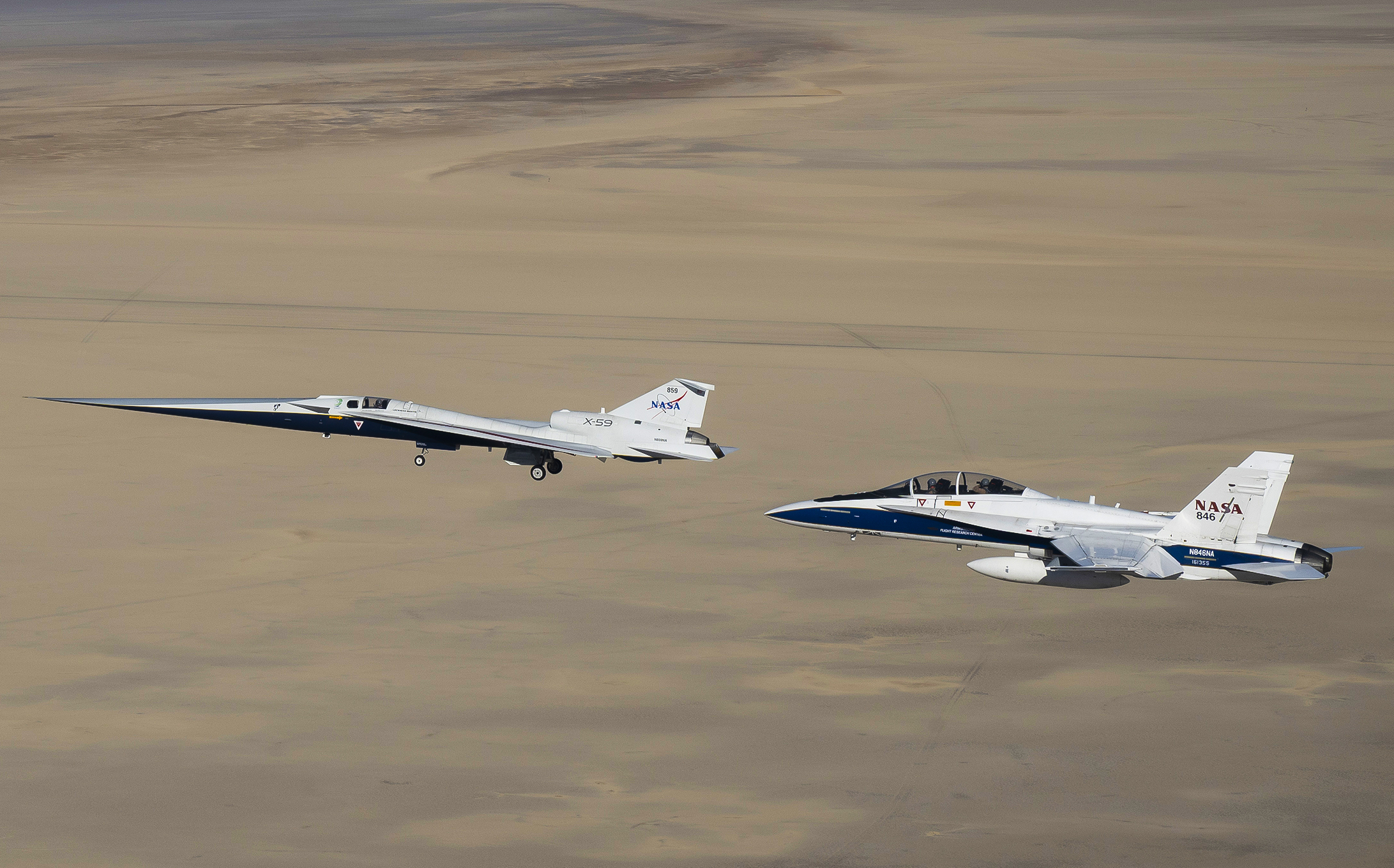
NASA’s X-59 flies above the Mojave Desert with a NASA F-15 chase aircraft nearby.
NASA’s X-59 quiet supersonic research aircraft flies above Palmdale and Edwards, California, during its first flight Oct. 28, 2025, accompanied by a NASA F/A-18 research aircraft serving as chase.
NASA/Jim Ross

As NASA’s X-59 quiet supersonic research aircraft continues a series of flight tests over the California high desert in 2026, its pilot will be flying with a buddy closely looking out for his safety. 

That colleague will be another test pilot in a separate chase aircraft. His job as chase pilot: keep a careful watch on things as he tracks the X-59 through the sky, providing an extra set of eyes to help ensure the flight tests are as safe as possible. 

Having a chase pilot watch to make sure operations are going smoothly is an essential task when an experimental aircraft is exercising its capabilities for the first time. The chase pilot also takes on tasks like monitoring local weather and supplementing communications between the X-59 and air traffic control. 

“All this helps reduce the test pilot’s workload so he can concentrate on the actual test mission,” said Jim “Clue” Less, a NASA research pilot since 2010 and 21-year veteran U.S. Air Force flyer. 

Less served as chase pilot in a NASA F/A-18 research jet when NASA test pilot Nils Larson made the X-59’s first flight on Oct. 28. Going forward, Less and Larson will take turns flying as X-59 test pilot or chase pilot. 
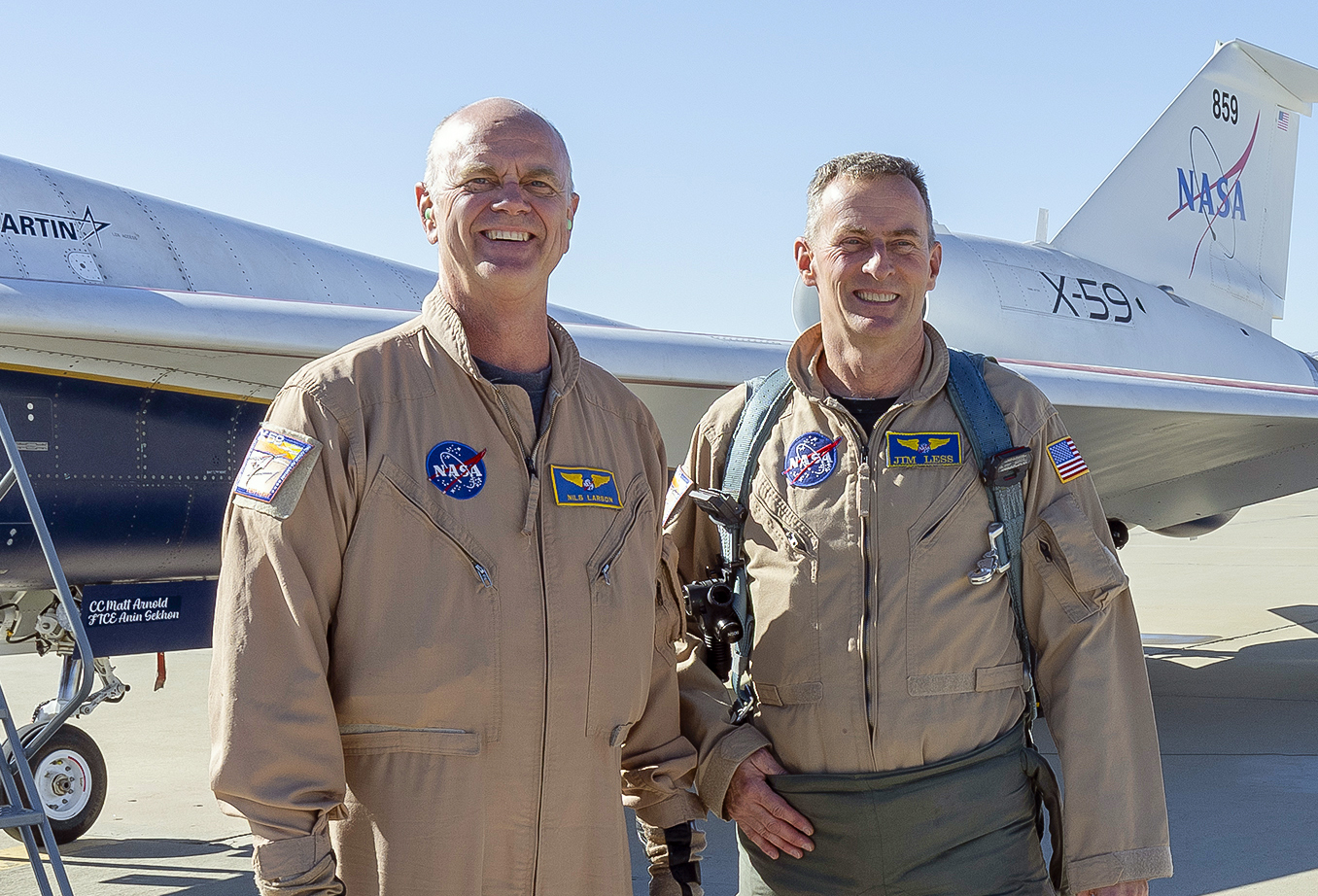
Two NASA pilots wearing flight gear pose in front of the X-59 experimental aircraft.
NASA pilots Jim “Clue” Less (left) and Nils Larson celebrate the X-59’s first flight on Oct. 28, 2025. Less flew an F-18 chase aircraft while Larson flew the X-59.
NASA/Genaro Vavuris

Staying Close

So how close does a chase aircraft fly to the X-59? 

“We fly as close as we need to,” Less said. “But no closer than we need to.” 

The distance depends on where the chase aircraft needs to be to best ensure the success of the test flight. Chase pilots, however, never get so close as to jeopardize safety. 

We fly as close as we need to, but no closer than we need to.

Jim "clue" LESS

Jim "clue" LESS

NASA Test Pilot

For example, during the X-59’s first flight the chase aircraft moved to within a wingspan of the experimental aircraft. At that proximity, the airspeed and altitude indicators inside both aircraft could be compared, allowing the X-59 team to calibrate their instruments. 

Generally, the chase aircraft will remain about 500 and 1,000 feet away—or about 5-10 times the length of the X-59 itself—as the two aircraft cruise together. 

“Of course, the chase pilot can move in closer if I need to look over something on the aircraft,” Less said. “We would come in as close as needed, but for the most part the goal is to stay out of the way.” 

Airborne Photo Op

The X-59 quiet supersonic research aircraft flies above California. The plane has a distinctive shape with a long, sharply pointed nose. The nose is silver, while the rest of the body looks white. The words "NASA" and "X-59" are on the body of the aircraft. In the background, we can see brown earth below the plane as well as hazy mountains in the distance.
In a view captured from a NASA F/A-18 chase aircraft, the X-59 quiet supersonic research aircraft lifts off for its first flight Oct. 28, 2025, from U.S. Air Force Plant 42 in Palmdale, California.
NASA/Lori Losey

The up-close-and-personal vantage point of the chase aircraft also affords the opportunity to capture photos and video of the test aircraft.  

For the initial X-59 flight, a NASA photographer—fully trained and certified to fly in a high-performance jet—sat in the chase aircraft’s rear seat to record images and transmit high-definition video down to the ground. 

“We really have the best views,” Less said. “The top focus of the test team always is a safe flight and landing. But if we get some great shots in the process, it’s an added bonus.” 

Chase aircraft can also carry sensors that gather data during the flight that would be impossible to obtain from the ground. In a future phase of X-59 flights, the chase aircraft will carry a probe to measure the X-59’s supersonic shock waves and help validate that the airplane is producing a quieter sonic “thump,” rather than a loud sonic boom to people on the ground. 

The instrumentation was successfully tested using a pair of NASA F-15 research jets earlier this year. 

As part of NASA’s Quesst mission, the data could help open the way for commercial faster-than-sound air travel over land. 

Choice of Chase Aircraft
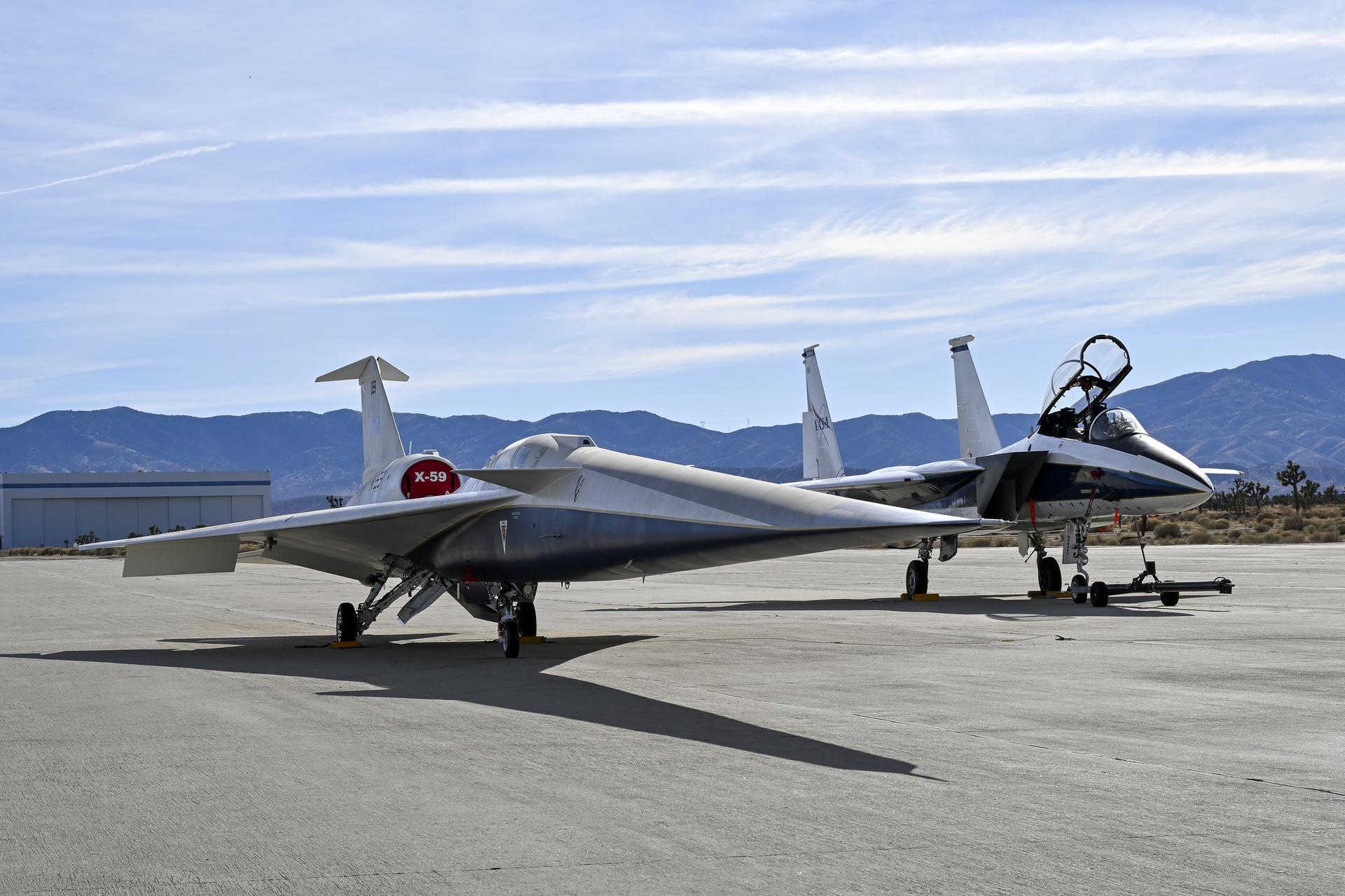
A NASA F-15 aircraft sits 20 feet off the left side of the X-59 aircraft, with a white hangar and hills in the background, during electromagnetic interference testing.
NASA/Carla Thomas

Chase aircraft have served as a staple of civilian and military flight tests for decades, with NASA and its predecessor—the National Advisory Committee for Aeronautics—employing aircraft of all types for the job. 

Today, at NASA’s Armstrong Flight Research Center in Edwards, California, two different types of research aircraft are available to serve as chase for X-59 flights: NASA-operated F/A-18 Hornets and F-15 Eagles

While both types are qualified as chase aircraft for the X-59, each has characteristics that make them appropriate for certain tasks. 

The F/A-18 is a little more agile flying at lower speeds. One of NASA’s F/A-18s has a two-seat cockpit, and the optical quality and field of view of its canopy makes it the preferred aircraft for Armstrong’s in-flight photographers. 

At the same time, the F-15 is more capable of keeping pace with the X-59 during supersonic test flights and carries the instrumentation that will measure the X-59’s shock waves. 

“The choice for which chase aircraft we will use for any given X-59 test flight could go either way depending on other mission needs and if any scheduled maintenance requires the airplane to be grounded for a while,” Less said. 

About the Author

Jim Banke

Jim Banke

Managing Editor/Senior Writer

Jim Banke is a veteran aviation and aerospace communicator with more than 40 years of experience as a writer, producer, consultant, and project manager based at Cape Canaveral, Florida. He is part of NASA Aeronautics' Strategic Communications Team and is Managing Editor for the Aeronautics topic on the NASA website.

Facebook logo
Instagram logo
Linkedin logo
Keep Exploring

Discover More Topics From NASA

💾

After years of design, development, and testing, NASA’s X-59 quiet supersonic research aircraft took to the skies for the first time on Oct. 28, 2025, markin...

NASA Adds Two F-15 Aircraft to Support Supersonic Flight Research

15 January 2026 at 15:58

3 min read

Preparations for Next Moonwalk Simulations Underway (and Underwater)

Alt Text: A ground crew member wearing hearing protection raises both arms to guide an F-15 aircraft taxiing on the ramp at NASA Armstrong Flight Research Center.
Oregon Air National Guard ground crew guides one of the NASA’s newest F-15 aircraft onto the ramp at the agency’s Armstrong Flight Research Center in Edwards, California, on Monday, Dec. 22, 2025. The retired U.S. Air Force F-15s come from the Oregon Air National Guard’s 173rd Fighter Wing and will transition from military service to support NASA’s flight research fleet.
NASA/Christopher LC Clark
U.S. Air Force and NASA flight crew stand on the ramp at NASA’s Armstrong Flight Research Center, facing the runway, with a desert landscape and an aircraft visible in the distance.
Oregon Air National Guard and NASA flight crew look out across the desert while awaiting the arrival of the NASA’s newest F-15 aircraft from the Oregon Air National Guard’s 173rd Fighter Wing to NASA’s Armstrong Flight Research Center in Edwards, California, on Monday, Dec. 22, 2025
NASA/Christopher LC Clark
Two F-15 aircraft sit side by side on the ramp at NASA’s Armstrong Flight Research Center, displaying tail numbers 045 and 063 and tail markings that read “Oregon” above an eagle graphic. A NASA hangar with the agency’s logo is visible in the background
NASA’s newest F-15 aircraft arrive at the agency’s Armstrong Flight Research Center in Edwards, California, on Monday, Dec. 22, 2025. The two retired U.S. Air Force F-15s will support ongoing supersonic flight research for NASA’s Flight Demonstrations and Capabilities Project and the Quesst mission’s X-59 quiet supersonic research aircraft.
NASA/Christopher LC Clark
U.S. Air Force service members in uniform and NASA civilians stand in two rows in front of a gray F-15 with its canopy open and a ladder attached on the ramp at NASA Armstrong Flight Research Center, posing for a photo with a hangar and NASA logo visible in the background.
NASA staff and Oregon Air National Guard’s 173rd Fighter Wing crew pose for a group photo at NASA’s Armstrong Flight Research Center in Edwards, California, on Monday, Dec. 22, 2025. The group stands in front of one of two F-15 aircraft added to the agency’s flight research fleet.
NASA/Christopher LC Clark
Two U.S. Air Force pilots in flight suits and a NASA civilian walk away from the agency’s newest F-15 aircraft; two gray F-15s, a white truck, and the desert are visible in the background.
Oregon Air National Guard pilots deliver NASA’s newest F-15 aircraft from the Oregon Air National Guard’s 173rd Fighter Wing at Kingsley Field to NASA’s Armstrong Flight Research Center in Edwards, California, on Monday, Dec. 22, 2025. After completing their final flights with the Air Force, the two aircraft begin their new role supporting NASA’s flight research.
NASA/Christopher LC Clark

Two retired U.S. Air Force F-15 jets have joined the flight research fleet at NASA’s Armstrong Flight Research Center in Edwards, California, transitioning from military service to a new role enabling breakthrough advancements in aerospace.

The F-15s will support supersonic flight research for NASA’s Flight Demonstrations and Capabilities project, including testing for the Quesst mission’s X-59 quiet supersonic research aircraft. One of the aircraft will return to the air as an active NASA research aircraft. The second will be used for parts to support long-term fleet sustainment.

“These two aircraft will enable successful data collection and chase plane capabilities for the X-59 through the life of the Low Boom Flight Demonstrator project” said Troy Asher, director for flight operations at NASA Armstrong. “They will also enable us to resume operations with various external partners, including the Department of War and commercial aviation companies.”

The aircraft came from the Oregon Air National Guard’s 173rd Fighter Wing at Kingsley Field. After completing their final flights with the Air Force, the two aircraft arrived at NASA Armstrong Dec. 22, 2025. 

“NASA has been flying F-15s since some of the earliest models came out in the early 1970s,” Asher said. “Dozens of scientific experiments have been flown over the decades on NASA’s F-15s and have made a significant contribution to aeronautics and high-speed flight research.”

The F-15s allow NASA to operate in high-speed, high-altitude flight-testing environments. The aircraft can carry experimental hardware externally – under its wings or slung under the center – and can be modified to support flight research.

Now that these aircraft have joined NASA’s fleet, the team at Armstrong can modify their software, systems, and flight controls to suit mission needs. The F-15’s ground clearance allows researchers to install instruments and experiments that would not fit beneath many other aircraft.

NASA has already been operating two F-15s modified so their pilots can operate safely at up to 60,000 feet, the top of the flight envelop for the X-59, which will cruise at 55,000 feet. The new F-15 that will fly for NASA will receive the same modification, allowing for operations at altitudes most standard aircraft cannot reach. The combination of capability, capacity, and adaptability makes the F-15s uniquely suited for flight research at NASA Armstrong.

“The priority is for them to successfully support the X-59 through completion of that mission,” Asher said. “And over the longer term, these aircraft will help position NASA to continue supporting advanced aeronautics research and partnerships.”

❌
❌