
Normal view

There are new articles available, click to refresh the page.
Before yesterdayMain stream

Tron Founder Justin Sun Invests $8M in River’s Stablecoin Abstraction Technology

22 January 2026 at 09:59

Tron founder Justin Sun invested $8 million in DeFi project River to support ecosystem integration on the Tron blockchain and deployment of River’s chain abstraction stablecoin infrastructure.

The deal positions Tron to leverage River’s cross-chain technology through satUSD, a stablecoin mintable at a 1:1 ratio with USDT, USDD, or USD1.

River announced the funding on X, emphasizing its mission to build a system that connects every asset to its opportunity while allowing value to flow freely across ecosystems without locking capital away.

$8M Strategic investment by @justinsuntron

This investment supports ecosystem integration on @trondao and the deployment of River’s chain abstraction stablecoin infrastructure.

River connects cross ecosystem assets and liquidity into TRON through satUSD, which can be minted 1… pic.twitter.com/3t9P069tPI

— River (@RiverdotInc) January 21, 2026

The investment comes weeks after MaelstromFund, founded by BitMEX co-founder Arthur Hayes, also backed the project in early January.

River Bags Stablecoin Integration Across the Tron Ecosystem

Per the announcement, Justin Sun’s capital will support multiple deployments, including stablecoin pools alongside USDT and USDD on SUN, lending and borrowing on JustLend, and price feeds provided by WinkLink.

Integration extends across core assets,s including USDT, TRX, wBTC, BTT, JST, SUN, WIN, and NFT use cases, with native sTRX staking yield serving as the initial entry point.

River also plans to launch Smart Vault and Prime Vault products targeting yield strategies for stablecoins, TRX, and other core Tron assets.

Since the funding announcement, River’s ($RIVER) token appreciated over 20%, reaching an all-time high of $48.74.

The token posted over 800% gains in the last 30 days to reach a market capitalization of around $840 million, jumping from $8 to the current $42.68 after starting January with approximately $100 million market cap.

Justin Sun River's Stablecoin Abstraction Technology - RIVER Token Chart
Source: Coingecko

Hayes’ Maelstrom investment in early January triggered a 600% surge for RIVER within weeks, with the token rising from around $3 to $19.

Market observers attributed the rally to Hayes’ endorsement and his stated belief in chain abstraction technology as fundamental to DeFi’s next growth phase.

River currently integrates with over 30 protocols across major ecosystems, including Ethereum, BNB Chain, and Base, with satUSD circulation exceeding $100 million.

Legal Challenges Shadow Sun’s Investment Activity

Sun’s recent capital commitment unfolds amid ongoing legal scrutiny around the alleged misappropriation of TrueUSD (TUSD) stablecoin reserves.

Last November, a judge at the Dubai International Financial Centre imposed a worldwide freeze on $456 million in assets tied to TUSD reserves, linked to Sun’s earlier bailout of the token.

According to case filings, Techteryx, which acquired TrueUSD in 2020, failed to redeem a large portion of its U.S. dollar reserves managed by First Digital Trust between 2022 and 2023.

Counsel for Techteryx stated that reserves originally custodied in Hong Kong saw around $468 million invested in the Aria Commodity Finance Fund, though nearly $456 million was transferred directly to Aria Commodities DMCC.

The diverted funds gave rise to claims of breach of trust and knowing receipt, prompting the proprietary injunction and subsequent global asset freeze.

Beyond Dubai, Congressional Democrats on January 15 formally accused the Securities and Exchange Commission of operating a pay-to-play scheme in its handling of crypto enforcement cases, with particular focus on the agency’s treatment of Sun.

Representative Maxine Waters sent a detailed letter to SEC Chairman Paul Atkins highlighting Sun’s extensive financial relationship with Trump family ventures, noting his $75 million investment in World Liberty Financial.

Sun is also a top holder of Trump’s memecoin, which earned him an invitation to a May 2025 White House dinner for major investors.

🎁 Tron founder @justinsuntron has received a Trump-branded Golden Tourbillon watch for being the top holder of President @realDonaldTrump’s memecoin.#Trump #Sunhttps://t.co/NI4bVy3smJ

— Cryptonews.com (@cryptonews) May 23, 2025

Regulators also claimed Sun engineered the offer and sale of two crypto asset securities without proper registration while directing hundreds of thousands of TRX wash trades that generated approximately $31 million from unsuspecting investors.

Judge Vernon Broderick of the Southern District of New York sustained core allegations in a parallel private class action, finding that plaintiffs plausibly alleged Sun and Tron illegally sold TRX as an unregistered security.

Despite these ongoing legal challenges, Sun continues to expand his cryptocurrency portfolio and investments, with Bloomberg estimating his net worth at approximately $12.5 billion.

The post Tron Founder Justin Sun Invests $8M in River’s Stablecoin Abstraction Technology appeared first on Cryptonews.

NASA’s IMAP Mission Captures ‘First Light,’ Looks Back at Earth 

16 December 2025 at 09:30

3 min read

NASA’s IMAP Mission Captures ‘First Light,’ Looks Back at Earth 

All 10 instruments aboard NASA’s newly launched IMAP (Interstellar Mapping and Acceleration Probe) mission have successfully recorded their first measurements in space. With these “first light” observations, the spacecraft is now collecting preliminary science data as it journeys to its observational post at Lagrange point 1 (L1), about 1 million miles from Earth toward the Sun. 

“We are extremely pleased with the initial in-flight performance of the IMAP mission. All instruments have successfully powered on and our commissioning remains on track. We have already collected useful data including exercising our near-real-time space weather data stream,” said Brad Williams, IMAP program executive at NASA Headquarters in Washington. “This successful milestone is quickly setting the stage for the start of our primary science operations.”

As a modern-day celestial cartographer, IMAP will chart the boundaries of the heliosphere — a huge bubble created by the Sun’s wind that encapsulates our entire solar system — and study how the heliosphere interacts with the local galactic neighborhood beyond.

To map the heliosphere’s boundaries, IMAP is equipped with three instruments that measure energetic neutral atoms: IMAP-Lo, IMAP-Hi, and IMAP-Ultra. These uncharged particles, called ENAs for short, are cosmic messengers formed at the heliosphere’s edge that allow scientists to study the boundary region and its variability from afar. 

An animated GIF shows a large oval that is initially filled with large rectangular pixels of different colors from dark blue, light blue, green, yellow, orange, red, and pink. The pixels change color rapidly. The oval then goes from filled to only having two large vertical bands of colored pixels and then two thinner vertical bands of pixels, with the rest of the oval becoming gray, with no data. At the center of the oval a white dot is labeled
These partial maps of the heliosphere’s boundaries were compiled from first-light data from the IMAP-Hi, IMAP-Lo, and IMAP-Ultra instruments. These initial looks offer a first glimpse at the detail NASA’s IMAP (Interstellar Mapping and Acceleration Probe) will be able to capture. The warmer colors show regions with more energetic neutral atoms (ENAs).
NASA

“It’s just astounding that within the first couple weeks of observations, we see such clear and consistent ENA data across the factor of 10,000 in energy covered collectively by the three imagers,” said David McComas, Princeton University professor and principal investigator for the IMAP mission. “This, plus excellent first light data from all seven of the other instruments, makes for a 10 out of 10, A-plus start to the mission.”

As IMAP travelled away from Earth, the IMAP-Ultra instrument looked back at the planet and picked up ENAs created by Earth’s magnetic environment. These terrestrially made ENAs, which overwhelm ENAs coming from the heliosphere in sheer numbers, is a reason why IMAP will be stationed at L1. There the spacecraft will have an unobstructed view of ENAs coming from the heliosphere’s boundaries.

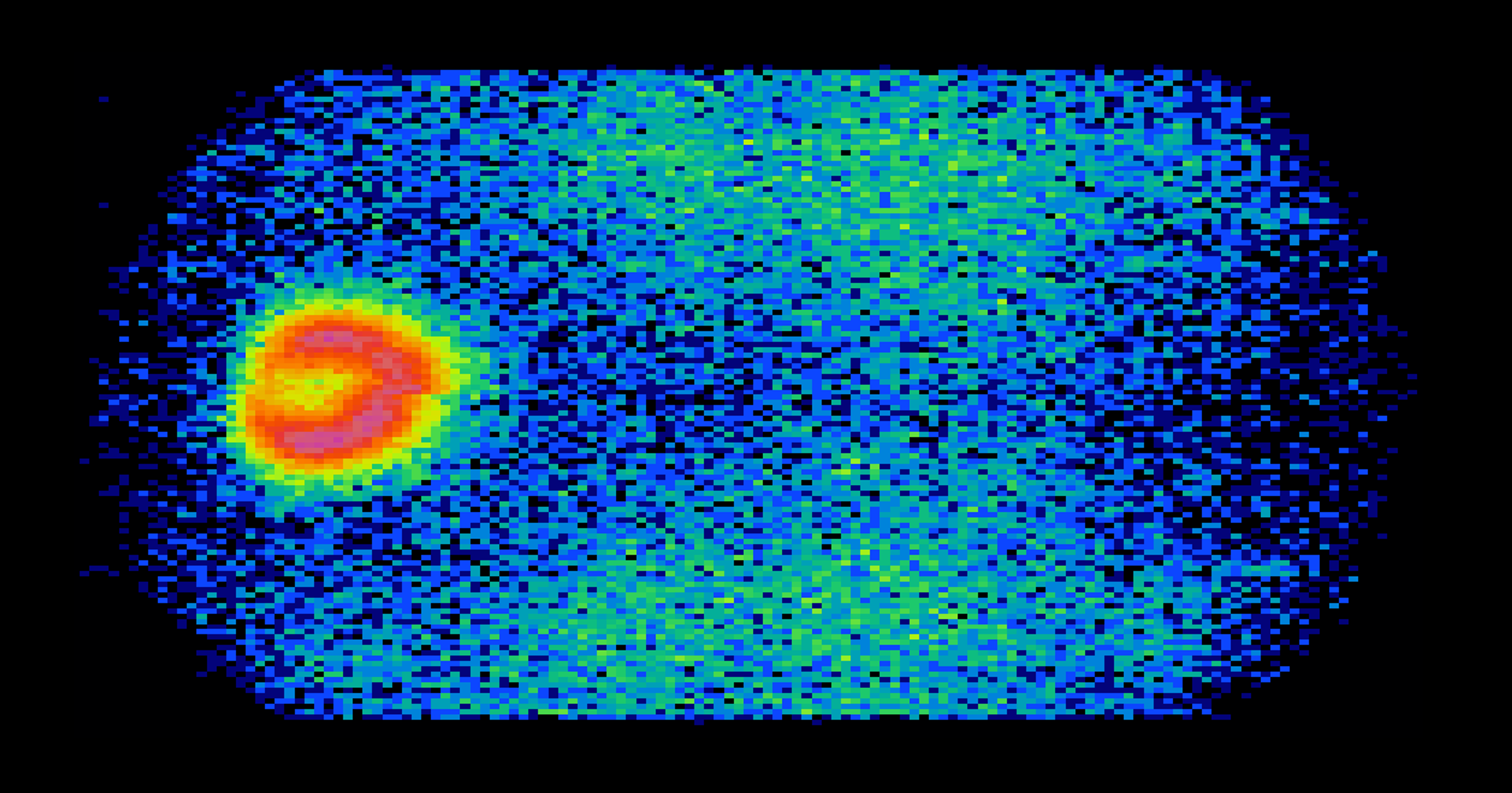
An elongated, horizontal colorized map shows rectangular pixels of different colors, mostly blue and green but dominated by a large circular feature in red, orange, and yellow on the far left. The background is mostly blue but two large swatches of green appear near the top center and bottom center.
Earth’s magnetic environment can be seen glowing bright in this image taken by the IMAP-Ultra instrument, which includes ENA data as well as noise. Earth sits at the center of the red donut-shaped structure. This image was taken as IMAP left Earth for its post at Lagrange point 1.
NASA

The mission will also study the solar wind, a continuous flow of charged particles coming from the Sun. Solar wind observations from five of IMAP’s instruments will be used by the IMAP Active Link for Real-Time (I-ALiRT) system to provide roughly a half hour’s warning to voyaging astronauts and spacecraft near Earth about harmful space weather and radiation coming their way. The IMAP instruments are already making near-real-time solar wind measurements that can be used to support space weather forecasts. The I-ALiRT network is being exercised and will be ready for space weather forecasters when IMAP starts its regular science mission at L1.

With all of IMAP’s instruments up and running, the mission has nearly completed its commissioning stage and will arrive at L1 in early January. The mission is now working to complete the final commissioning steps and instrument calibration with the goal of being ready to take operational science data starting Saturday, Feb. 1, 2026. 

Here’s a look at IMAP’s instruments and what they’ve seen in their first-light observations.

A square image is mottled with black and blue pixels with an elongated oval-shaped feature in light blue, green, yellow, and orange at the bottom left. In the upper right is a smaller box around two smaller elongated streaks in green.
IMAP-Lo, IMAP-Hi, and IMAP-Ultra
The three ENA (energetic neutral atom) instruments, IMAP-Lo, IMAP-Hi, and IMAP-Ultra, will help construct maps of the boundaries of the heliosphere, which will advance our understanding of how the solar wind interacts with our local galaxy. The green streak in this image from IMAP-Hi shows the instrument’s ability to separate ENAs from other particles such as cosmic rays (green and yellow blob).
NASA
Four rectangular charts show graphs with blue lines that have small vertical variations on the left and middle but significantly large variations on the right.
MAG
The magnetometer instrument measures magnetic fields from the Sun that stretch across the solar system. Its first-light data clearly shows dynamic changes in the solar wind’s magnetic field due to a shockwave created by the solar wind (squiggles at right).
NASA
A graph shows lines in a rainbow of colors, from dark blue to green to yellow to red, each line with two peaks near the center.
SWAPI
The Solar Wind and Pickup Ions (SWAPI) instrument measures ions from the solar wind and charged particles from beyond the solar system. Initial data from SWAPI showed a change in the composition of the solar wind over one day. This image shows particles from a coronal mass ejection on Nov. 11 and 12, 2025.
NASA
A chart shows several blobs of color that are circled in black. They are labeled from top to bottom as Fe, Ne-Si, O, He, and H.
CoDICE
The Compact Dual Ion Composition Experiment (CoDICE) instrument measures ions from the solar wind and charged particles from beyond the solar system. It detected different types of oxygen, hydrogen, and helium atoms in its first-light data.
NASA
Scatter plot with logarithmic axes showing particle distributions labeled as Electrons, Hydrogen, Helium, Carbon, Nitrogen, Oxygen, Neon, Magnesium, Silicon, and Iron, with denser blue points at lower energies.
HIT
The High-energy Ion Telescope (HIT) measures energetic ions and electrons from the Sun. Early ion data shows the common elements up through iron.
NASA
A graph shows a black curved line with four peaks. The first peak on the left is labeled Comet C/2025 K1 (Atlas). The second peak is labeled alpha Leo. The third peak is labeled kappa Vel b01Car iCar. The fourth, much taller peak on the far right has no label. The vertical axis is labeled photon flux and the horizontal axis is labeled spin angle.
GLOWS
Unlike other IMAP instruments that study particles, the GLObal Solar Wind Structure (GLOWS) instrument images ultraviolet light called the helioglow that is created in part by the solar wind. The first data taken with GLOWS showed helioglow and bright stars, matching scientists’ expectations for the instrument. Unexpectedly, the signature of comet C/2025 K1 (ATLAS), shown by the first small bump from the left in the image, was also seen before it disappeared from GLOWS’ view.
NASA
A rectangular chart shows bands of colors from red at the bottom to yellow, green, blue, and purple at the top. On the right side of the image, the red and yellow extend vertically upward into the yellow and green bands. The vertical axis is labeled Energy and the horizontal axis is labeled with the dates October 11, October 12, and October 13 from left to right.
SWE
As its name suggests, the Solar Wind Electron (SWE) instrument measures electrons from the solar wind. In its first data collection, SWE successfully captured electrons at a range of energy levels. On Nov. 12, a solar storm passed through the solar system and SWE captured the resulting spike in the number of electrons at each energy level.
NASA
A graph shows a blue line with several spikes labeled with different atoms. From left to right the peaks are labeled C, O, Mg, Si, and H2S. The vertical axis is labeled Signal, while the horizontal axis is labeled Mass.
IDEX
The Interstellar Dust Experiment (IDEX) measures cosmic dust — conglomerations of particles originating outside of the solar system that are smaller than a grain of sand. Prior to IMAP, few of these dust particles had been measured. With two new detections already completed, IDEX has demonstrated its ability to become an unrivaled dust detector. This observation of one of the dust particles shows tentative identifications of the particle’s chemical composition, which includes carbon, oxygen, magnesium, silicon, and hydrogen sulfide.
NASA

By Mara Johnson-Groh
NASA’s Goddard Space Flight Center, Greenbelt, Md.

❌
❌