❌

Normal view

There are new articles available, click to refresh the page.
Today β€” 19 December 2025Main stream

A recent court ruling could reshape how agencies source under the Trade Agreements Act

Interview transcript

Terry Gerton Before we get into the case that we’re going to talk about today, can you give us a rundown of the difference between the Trade Agreements Act and the Buy America Act, because that plays into the case we’ll examine.

Dan Ramish Absolutely. So there are two domestic sourcing regimes that apply to government contracts, the Trade Agreements Act and the Buy American Act. And generally, the line between the two statutory regimes is dictated by the value of the procurement. So the Buy American Act applies to contracts that are below the free trade agreement thresholds. The most notable one is the World Trade Agreement Government Procurement Agreement, or WTO GPA, which has thresholds of 174,000 for supply and service contracts and then 6,708,000 construction contracts. The sort of basic difference is, of course, the Buy American Act has been around a long time and establishes preferences for American-made goods. The Trade Agreements Act kind of came in with the free trade movement and established equal treatment for trading partner countries. And there are also a number of other so-called designated countries, mostly developing countries. And the products of those countries can also be used along with domestic products. But there’s a critical point on how these two frameworks are applied, which is that the Buy American Act institutes a price preference, whereas the Trade Agreements Act prohibits procurement of foreign products that are not designated countries.

Terry Gerton Sounds like it could be a pretty confusing space for contracting officers, so I think it will be helpful to walk through this case. The Veterans Affairs Department was engaged in buying medical supplies and pharmaceuticals. Tell us about this particular case.

Dan Ramish Yes. So the procurement was for a drug called Prasugrel, which is a blood thinner that’s used to reduce risk of heart attacks and strokes. And the prasugrel was available to the VA on Cosette’s federal supply schedule contract and also on an open market basis. But the agency wanted to establish a standardized contract to obtain volume discounts essentially and have set prices that it could rely on and anticipated that the contract would be used both by the VA and also by other agencies, the Department of Defense and Indian Health Service and the Bureau of Prisons. And so they established in the solicitation fixed price indefinite delivery requirements contract that was gonna have a base year and four option periods. And so, they put this out for bid, Golden State Medical Supplies proposed a generic version of the Prasugrel drug that was manufactured in India. And India is not compliant with the Trade Agreements Act, they’re not a trading partner, not a developing country that is a designated country for TAA, so non-compliant with TAA. Cosette Pharmaceuticals proposed to supply a brand name version of the drug that was much more expensive. And their drug was manufactured in Germany, the active pharmaceutical ingredient was from Japan. Now, in some cases, they’re questions about which is the actual country of origin for Trade Agreements Act purposes, but both Germany and Japan are TAA compliant countries. So that wasn’t an issue. Everyone agreed that Cosette’s drug was compliant with TAA and Golden State Medical Supplies’ drug was not compliant. And there were a number of other drugs also from India that other offerors supplied, all generic. So the VA decided to award to Golden State Medical Supplies. They argued that the Trade Agreements Act exception applied because Cosette’s price was excessively high and they argued that the offer was therefore insufficient to fulfill the government’s requirement, which is one of the narrow exceptions of the Trade Agreements Act.

Terry Gerton I’m speaking with Dan Ramish. He’s a partner at Haynes Boone. So Dan, if you’re the contracting officer and you’re looking at this wide differential in prices, how would you know to make a choice one way or the other?

Dan Ramish Well, so the solicitation in this case was lowest price technically acceptable. So of course, the VA wanted to get the, you know, the lowest available price for these drugs, they’re standardized. And so it was understandable. And I think the court certainly saw where the agency was coming from in trying to get a good deal for the taxpayer. However, the court said, well, you have to look at the language of the statute and this exception for offers where no offers are received that meet the government’s requirement isn’t intended to encompass price. And in part, the court looked at the difference between the Buy American Act, which does actually specifically have an unreasonable cost exception, and the Trade Agreements Act, which only says, well, if you don’t receive any compliant offers or offers that meet the government requirement than you can procure from foreign sources.

Terry Gerton So the Court of Federal Claims sided with Cosette, the more expensive one that met the Trade Agreement Act requirements. What did the court say specifically about VA’s interpretation of the Trade Agreements Act?

Dan Ramish The VA’s approach was, in one part, to say that it was making use of this insufficiency to fulfill the government’s requirement exception. They also essentially excluded Cosette from the competitive range because of their price. And the court said, well, that approach wasn’t appropriate and didn’t comply with the Trade Agreements Act because you’re not allowed to effectively compare the price of a compliant, Trade Agreements Act product with non-compliant products, that that’s an apples to oranges comparison, and that that couldn’t be a valid basis for excluding Cosette from the competitive range.

Terry Gerton So does that mean that government agencies are locked into buying these really expensive products if they’re the only TAA compliant option? Do they have other choices? What did the court say about that?

Dan Ramish So the court pointed out that the statute, among other things, includes the option of a waiver issuance by the agency head, which is available on a case-by-case basis when it’s in the national interest. There was no waiver here. So the agency, if they felt there was a compelling interest, could have the agency head issue a waiver. They also could cancel solicitation, issue the drug, solicitation on the open market. And so they weren’t locked into making an award. And of course they needed to establish that there was a fair and reasonable price that they were paying for the award, but they couldn’t ignore the requirements of the Trade Agreements Act and award to a non-compliant offer when there was Trade Agreement Act compliant offer that was received.

The post A recent court ruling could reshape how agencies source under the Trade Agreements Act first appeared on Federal News Network.

Β© The Associated Press

In this June 15, 2018 photo, pharmaceuticals are seen in North Andover, Mass. Two senior senators β€” a Republican and a Democrat β€” unveiled compromise legislation Tuesday to reduce prescription drug costs for millions of Medicare recipients, while saving money for federal and state health care programs that serve seniors and low-income people. (AP Photo/Elise Amendola)

Solana AI Token Ava Plunges 96% After β€˜Insiders’ Snipe 40% of Supply

19 December 2025 at 12:26

Solana-based AI token Ava, known by its ticker AVA, has plunged more than 96% from its peak after new on-chain analysis raised questions about how the token’s supply was distributed at launch and whether insiders coordinated early purchases.

The latest findings come from blockchain analytics firm Bubblemaps, which published an analysis on X showing that around 40% of AVA’s total supply was accumulated at launch by a cluster of wallets linked to the token’s deployer.

Remember $AVA?

40% bundled at launch, linked to the deployer

Your AI girlfriend took all your money 🧡 pic.twitter.com/31uMnlglfi

β€” Bubblemaps (@bubblemaps) December 18, 2025

Wallet Clustering Points to AVA Token Sniping at Launch

According to Bubblemaps, the wallets were funded shortly before launch, showed no prior on-chain activity, and bought large amounts of AVA as soon as the token became available.

AVA launched on Nov. 13, 2024, on Pump.fun, a Solana-based memecoin launch platform that promotes fair and decentralized token launches.

The project gained early attention as one of the first 3D AI agent tokens, backed by Holoworld AI, a Polychain Capital portfolio company.

By January 2025, AVA had reached a fully diluted valuation of roughly $300 million, driven by a surge of interest in AI-themed crypto projects.

Bubblemaps said its analysis identified 23 wallets, including the deployer, that were funded within tight time windows through centralized exchanges such as Binance and Bitget.

Source: Bubblemaps

The wallets received similar amounts of SOL and then used automated trading strategies to buy AVA at launch.

The firm added that additional wallets connected to this initial cluster followed similar funding and timing patterns, which it said strongly suggests coordination rather than independent participation.

In crypto markets, this practice is commonly referred to as sniping, where bots are used to purchase new tokens the moment they become tradable, often securing large allocations before retail participants can react.

While sniping itself is not illegal, a heavy concentration of supply among early wallets can increase the risk of sharp sell-offs if those holders decide to exit.

The firm said the analysis shows that despite AVA’s public positioning as a community-driven launch, a single coordinated entity ended up controlling a large share of the supply.

AVA’s Market Reality Sets In as Token Sheds 96% From All-Time High

More than a year after launch, the impact is visible in the token’s market performance.

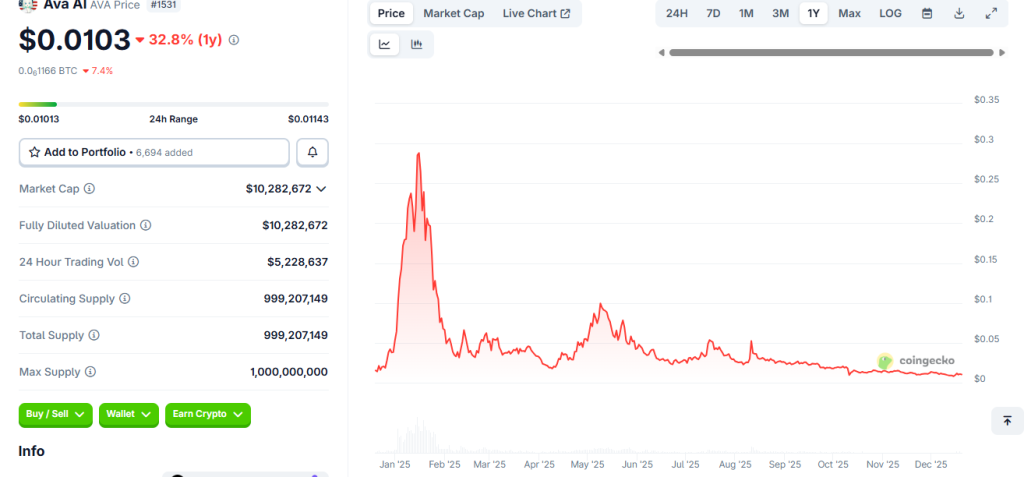
AVA is down over 79% from its launch price and more than 96% from its all-time high of about $0.33, reached on Jan. 15, 2025, according to CoinGecko data.

Source: CoinGecko

The token now trades near $0.01, erasing most of its early gains.

This decline has occurred despite continued development by the team behind Holoworld AI. The project describes Ava as the first AI agent virtual image token, designed to power audiovisual AI agents capable of interaction and emotional expression.

Holoworld claims to have created more than 10,000 3D virtual characters, partnered with over 25 IP and NFT brands, and attracted more than 1 million users.

Even so, those developments have not prevented a steep drop in AVA’s market value. AVA has a fixed total supply of 1 billion tokens, with 50 million released at launch as part of a 5% public sale.

The broader token distribution includes long-term allocations for community incentives, the team, private investors, liquidity, and ecosystem development, many of which are subject to vesting schedules.

The episode adds to a growing list of cases where Bubblemaps has flagged concentrated token ownership shortly after launch.

In recent months, the firm has published similar analyses involving PEPE, the $WET presale on Solana, MYX Finance’s airdrop, and other high-profile tokens, often pointing to coordinated wallet behavior and heavy early sell pressure.

While not all cases resulted in enforcement action or project failures, they have intensified scrutiny around fair-launch claims and insider transparency.

The post Solana AI Token Ava Plunges 96% After β€˜Insiders’ Snipe 40% of Supply appeared first on Cryptonews.

Tech Moves: Nintex CEO to depart; Raikes Foundation names leader; Qualtrics exec now at Workday

19 December 2025 at 12:35
Amit Mathradas. (LinkedIn Photo)

β€” Nintex CEO Amit Mathradas announced that he’s leaving to take the helm of Five9 beginning on Feb. 2. Mathradas has led Nintex, a Bellevue, Wash.-based workflow automation company, for nearly three years. His previous roles include chief operating officer at Avalara, general manager at PayPal, and a 14-year run at Dell.

Five9 is a California-based software company specializing in AI-powered customer experience solutions.

β€œIt is an honor to join such a dynamic company that I have long admired as being at the cutting edge of AI-driven CX,” Mathradas said on LinkedIn.

ZoΓ« Stemm-Calderon. (WRF Photo)

β€” Starting Jan. 1, ZoΓ« Stemm-Calderon will take the role of executive director at the Raikes Foundation, where she has worked for a decade. She is transitioning from her current position as senior director of Youth Serving Systems.

During her tenure, Stemm-Calderon has managed yearly investments of $20 million directed toward initiatives focused on K-12 and higher education, along with youth homelessness programs.

Jeff and Tricia Raikes are the co-founders of the foundation, which launched in 2002. Jeff Raikes was at Microsoft for close to three decades and served as CEO of the Gates Foundation for more than five years. Tricia Raikes is co-founder of Giving Compass.

Emily Heffter. (LinkedIn Photo)

β€” Emily Heffter is now senior director of thought leadership and research for Workday, a finance and HR software company with offices in Seattle. Heffter joins the company from Qualtrics, where she was vice president of global communications. She was previously Zillow Group’s director of corporate communications.

β€œI’m joining Workday’s amazing communications team to help tell one of the most dynamic stories in the business world: the future of work.” Heffter said on LinkedIn. That includes β€œhow people, technology, and leadership are evolving together β€” and helping business leaders see around the corner.”

Lance Ludman. (LinkedIn Photo)

β€” Seattle’s Lance Ludman has joined SurveyMonkey as its new chief financial officer. Ludman was most recently CFO at the social impact company Benevity. He also served as CFO at DreamBox Learning, a Bellevue, Wash.-based edtech company that was acquired in 2023.

SurveyMonkey CEO Eric Johnson praised Ludman’s β€œunique leadership style,” adding in a statement that β€œhe maintains a persistent curiosity and business-partnership mindset.”

β€” Seattle-area rocket company Stoke Space appointed Matt White to its board of directors. White is executive vice president and CFO for Linde and serves on the board as a representative for Industrious Ventures.

β€” Laurent Boinot, Microsoft’s head of power and utilities in the Americas, has joined the board of LF Energy, an open-source foundation supporting energy deployment.

β€” Vivek Ladsariya, general partner and managing director at Seattle’sΒ Pioneer Square Labs, joined the board of Seattle startup Tin Can, makers of a Wi-Fi-enabled landline-style phone for kids.

β€” Washington Research Foundation named Joe Albe as the new manager of grants and venture research at the organization, which helps universities and other nonprofits in the state commercialize and license their technologies. Albe recently earned his doctorate degree in immunology from the University of Washington.

The foundation also announced its 2026 postdoctoral fellows:

  • Stefany Cruz, a software engineer working at the UW on agentic Al technologies.
  • Winston Dredge, who joins the UW to research the impact of genetic variation on early human development.
  • Nastacia Goodwin, a neuroscientist who will study the impacts of climate change on bee behavior at the UW.
  • Kunal Lodaya, a chemist coming to the UW to work on high-capacity redox flow batteries.
  • Allyson Martin, an entomologist joining WSU to study pollinators in orchard settings.
  • Jongbeom Park, a molecular biologist studying the effect of developmental and environmental variations on mammalian newborns at the UW.
  • Zoe Rand, who joins the UW and NOAA’s Northwest Fisheries Science Center to study harmful algal bloom detection and management.
  • Nathaniel Ritz, a neuroscientist joining the Institute for Systems Biology to investigate host-microbe communication.
  • Jonas Wilhelm, a biochemist coming to the UW’s Institute for Protein Design (IPD) to create catalysts for greenhouse-gas removal.
  • Marcus Wong, who joins the UW to study immune responses to malaria and other infectious diseases.
  • Chuanyun Xu, a biologist joining the IPD to design proteins for cellular sensing and control.
  • Lu Yu, a biochemist using DNA nanotechnology to advance targeted cancer therapy at the UW.

Decapsulating a PIC12F683 to Examine Its CMOS Implementation

19 December 2025 at 13:00
Using GIMP for visual analysis

In a recent video, [Andrew Zonenberg] takes us through the process of decapsulating a PIC12F683 to take a peak at its CMOS implementation.

This is a multipart series with five parts done and more to come. The PIC12F683 is an 8-pin flash-based, 8-bit microcontroller from Microchip. [Andrew] picked the PIC12F683 for decapsulation because back in 2011 it was the first microcontroller he broke read-protection on and he wanted to go back and revisit this chip, given particularly that his resources and skills had advanced in the intervening period.

The five videos are a tour de force. He begins by taking a package cross section, then decapsulating and delayering. He collects high-resolution photos as he goes along. In the process, he takes some time to explain the dangers of working with acid and the risk mitigations he has in place. Then he does what he calls a β€œfloorplan analysis” which takes stock of the entire chip before taking a close look at the SRAM implementation.

If you’re interested in decapsulating integrated circuits you might want to take a look at Laser Fault Injection, Now With Optional Decapping, A Particularly Festive Chip Decapping, or even read through the transcript of the Decapping Components Hack Chat With John McMaster.

Thanks to [Peter Monta] for the tip.

Hackaday Podcast Episode 350: Damnation for Spreadsheets, Praise for Haiku, and Admiration for the Hacks In Between

19 December 2025 at 12:30

This week’s Hackaday Podcast sees Elliot Williams joined by Jenny List for an all-European take on the week, and have we got some hacks for you!

In the news this week is NASA’s Maven Mars Orbiter, which may sadly have been lost. A sad day for study of the red planet, but at the same time a chance to look back at what has been a long and successful mission.

In the hacks of the week, we have a lo-fi camera, a very refined Commodore 64 laptop, and a MIDI slapophone to entertain you, as well as taking a detailed look at neutrino detectors. Then CYMK printing with laser cut stencils draws our attention, as well as the arrival of stable GPIB support for Linux. Finally both staffers let loose; Elliot with an epic rant about spreadsheets, and Jenny enthusiastically describing the Haiku operating system.

Check out the links below if you want to follow along, and as always, tell us what you think about this episode in the comments!

It’s dangerous to go alone. Here, take this MP3.

Where to Follow Hackaday Podcast

Episode 349 Show Notes:

News:

What’s that Sound?

  • Congratulations to [kenbob] for guessing the spinning down washing machine. Everyone else tune in next year for your shot at the first sound of 2026.

Interesting Hacks of the Week:

Quick Hacks:

Can’t Miss Articles:

NotebookLM can turn your messy data into structured tables for Google Sheets

19 December 2025 at 13:29

NotebookLM’s new Data Tables feature automatically organizes information from your sources into structured tables that can be exported to Google Sheets or Docs cutting out hours of manual copy-paste work.

The post NotebookLM can turn your messy data into structured tables for Google Sheets appeared first on Digital Trends.

❌
❌