Normal view

There are new articles available, click to refresh the page.
Today — 15 December 2025Main stream

Unexpected Trajectory: Erin Sholl’s Path to Human Spaceflight Safety

15 December 2025 at 05:00

Career paths are rarely a straight line and often include some unexpected curves. That is certainly true for Erin Sholl, deputy chief of the Space Transportation Systems Division within the Safety and Mission Assurance Directorate at NASA’s Johnson Space Center in Houston. From struggling with multiplication tables in elementary school to supporting the International Space Station from the Mission Control Center, her journey has been full of twists and turns.
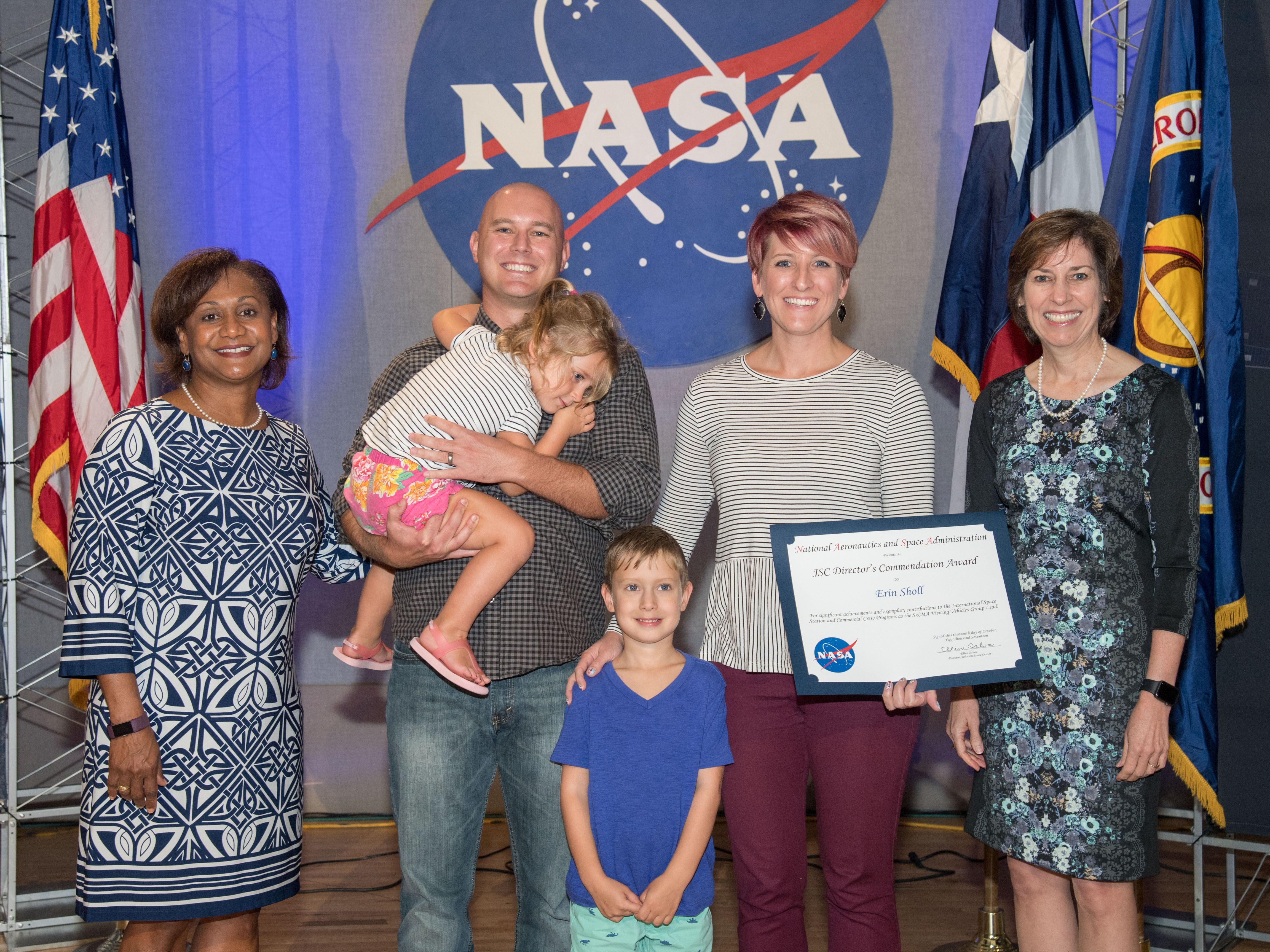
A woman receives a paper certificate on a stage with the American, Texas, and NASA flags. She stands with her husband, two children, and two other women in professional attire.
Erin Sholl (second from right) received the Johnson Space Center Director’s Commendation Award in 2017 for significant achievements and exemplary contributions to the International Space Station and Commercial Crew Programs as the Safety and Mission Assurance Visiting Vehicles Group lead.
NASA/James Blair

Despite her early difficulties in math and science, Sholl eventually grew to love and excel in both subjects. She planned to study chemical engineering in college – inspired by a love of chemistry and a favorite high school teacher – but discovered a greater affinity for physics once she arrived at Pennsylvania State University. She switched her major to aerospace engineering and soon met a classmate who had interned at Johnson. After that, Sholl declared, “The dream was born!”

Her first position at Johnson was as a trajectory operations officer for the Flight Operations Directorate. She spent six years supporting the space station on console in the Mission Control Center, describing the experience as “something out of the movies.” When Sholl went looking for a new challenge, she landed in the Safety and Mission Assurance Directorate.
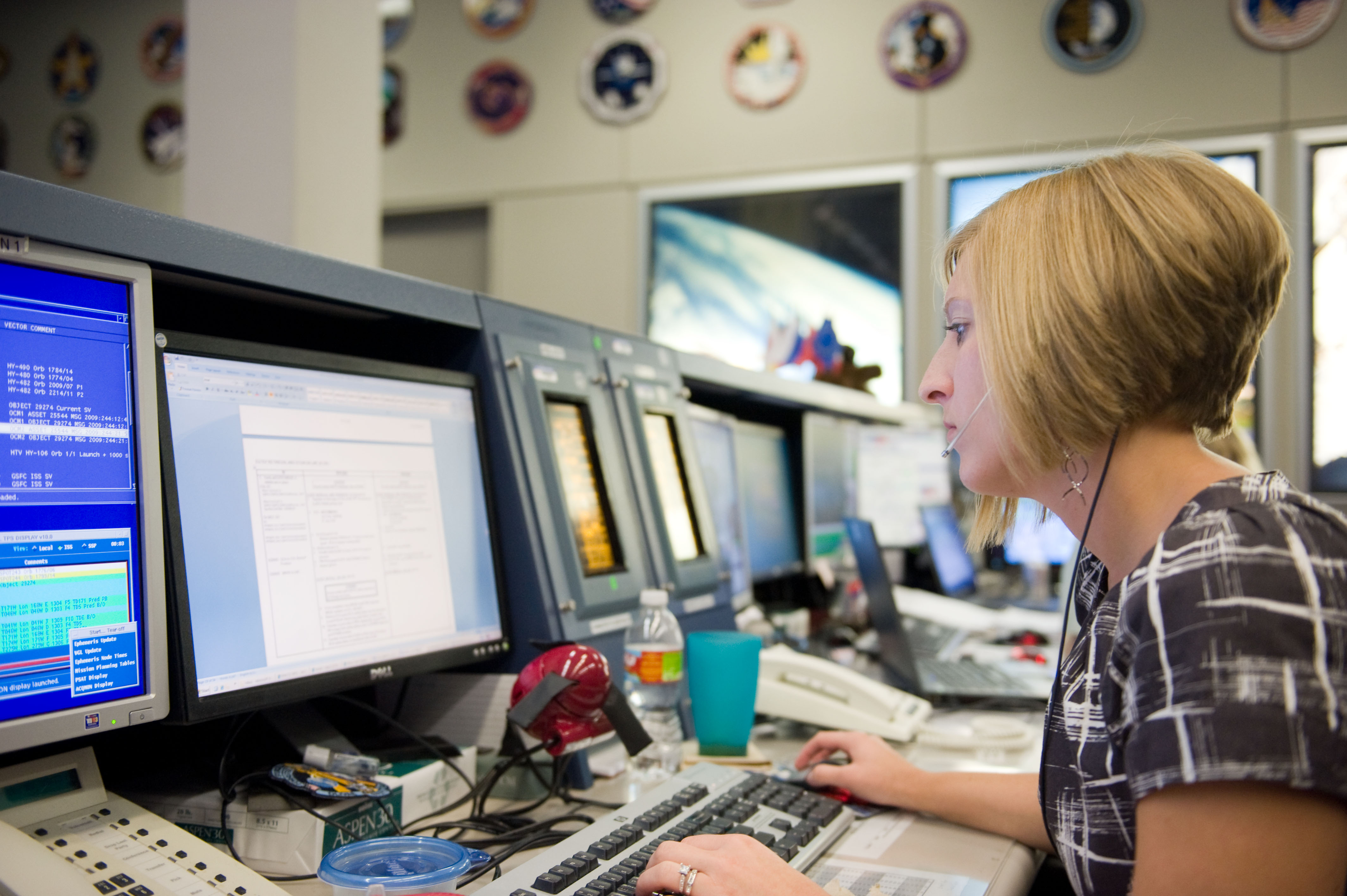
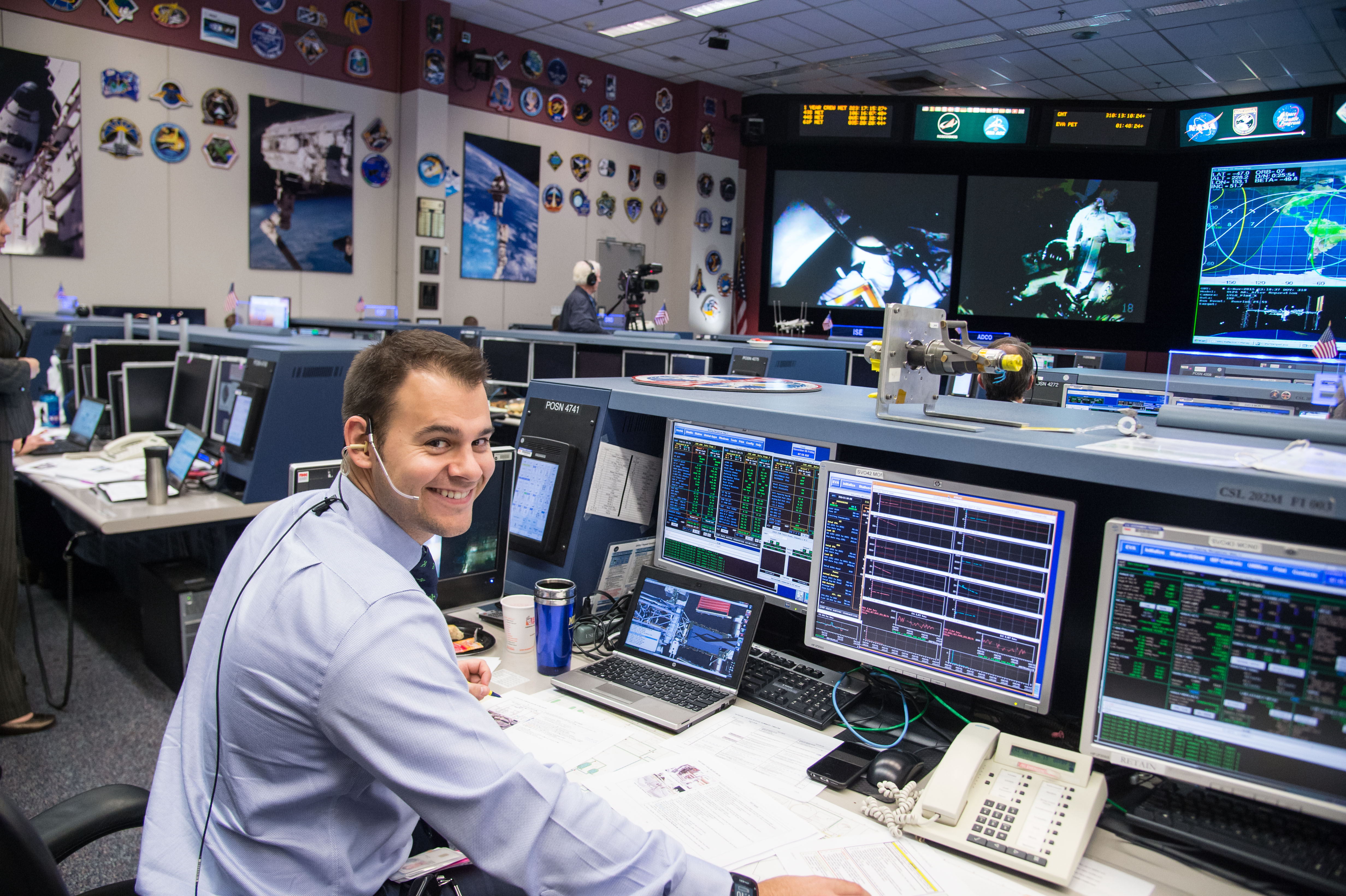
A woman sits in front of a bank of computer screens in the Mission Control Center at Johnson Space Center.
Erin Sholl working on console as a trajectory operations officer in the Mission Control Center during the STS-128/17A mission in 2009.
NASA/Lauren Harnett

“I was drawn to the Operations and Visiting Vehicles Branch because it had many similar aspects to my previous position – real-time operations and visiting vehicles,” she said. “I worked various roles over the next 12 years, gradually taking on more responsibility, and eventually becoming a group lead, then branch chief.” Sholl also served as acting deputy chief for the Space Habitation Systems Division, which oversees the Operations and Visiting Vehicles Branch. Her performance drew the attention of the Space Transportation Systems Division’s chief. “He asked me to come be his deputy, and that is where I still am today!”

The Space Transportation Systems Division provides system safety, reliability, and risk analysis for human spaceflight programs. The division works with the different program offices to reduce risk through technical assessments and guidance on Safety and Mission Assurance requirements throughout program and project lifecycles.

Sholl works closely with the division chief to support strategic planning, budgeting, and operations. “A key part of my role is connecting with people – both inside and outside the division – to ensure smooth communication and representation of the team’s needs,” she said. She leverages her relationship-building and strategic thinking skills to lead initiatives that advance the division’s and the directorate’s goals and to mentor employees.
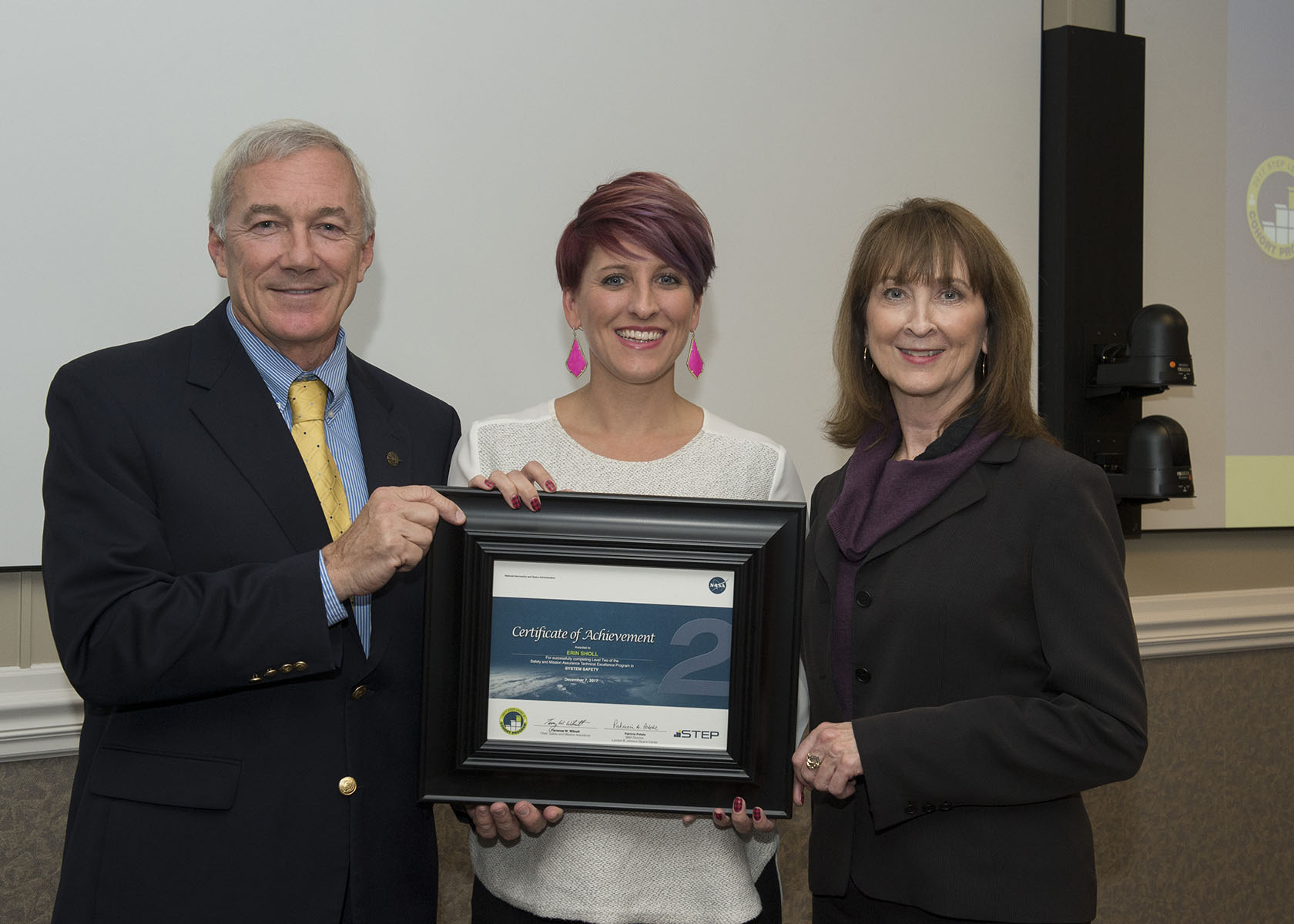
A woman receives a framed honor from two colleagues, a man and a woman.
Erin Sholl (center) receives a certificate of achievement from Terrence Wilcutt, former director of the Office of Safety and Mission Assurance (SMA) at NASA Headquarters, and Patricia Petete, former director of SMA at Johnson, after completing requirements for the Safety and Mission Assurance Technical Excellence Program in System Safety.
Image courtesy of Erin Sholl

Sholl believes strongly in the power of mentorship. “Having various mentors, both formal and informal, has been so important throughout my career,” she said. “Listening to what these people were saying about my strengths led me to a path I’d never considered because I hadn’t seen those things in myself.” Being a mentor and advocate for team members is one of Sholl’s favorite parts of the leadership positions she has held, particularly as branch chief. “I really felt like I could connect with my people and advocate for them in a way that felt meaningful,” she said.

She encourages young professionals to seek out mentors or opportunities to shadow colleagues in different roles. “Relationships are the key to everything,” she said. “The more people you meet and the more you learn about different paths in space exploration, the better off you will be in your career.”
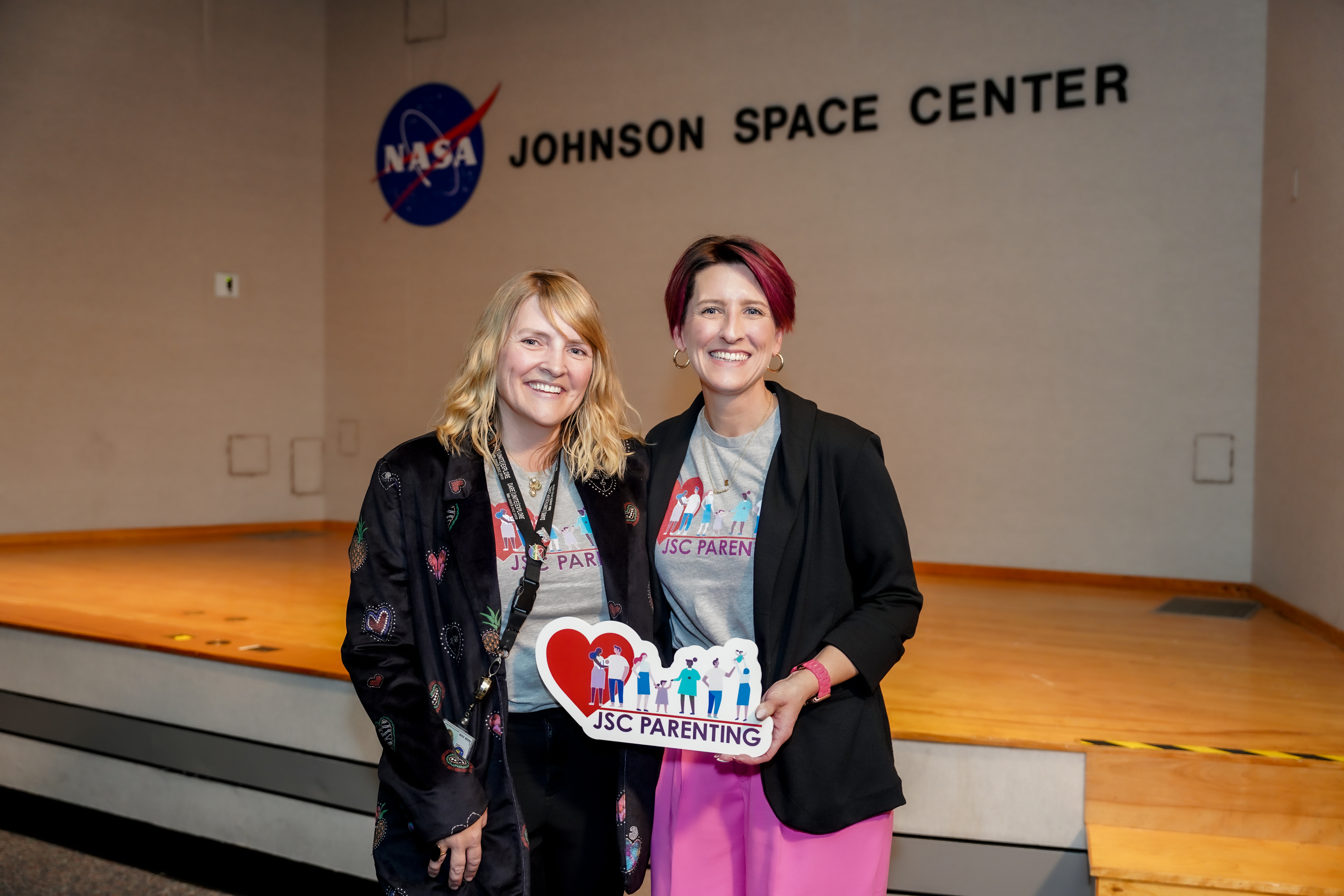
Two women hold a sign reading JSC Parenting while standing in front of a wooden stage.
Susan Schuh, Flight Crew Integration Operational Habitability (OpsHab) team lead and Erin Sholl host a JSC Parenting community event in 2023.
Image courtesy of Erin Sholl

Sholl noted that professional relationships can be bolstered by activities outside of the office. She played a key role in establishing and growing JSC Parenting, a virtual community of about 600 employees who share information and support each other on issues related to caregiving, schooling, and balancing work with family life. “My leadership within the community enhances my professional leadership and positively impacts my colleagues,” she said.

Sholl also emphasized the importance of being open to trying new things, even if an opportunity seems to diverge from your expected career path. “I volunteer for everything because I am always eager to learn more and find out what else I might be good at and how else I can serve my team,” she said. “I think it’s easy to feel intimidated hearing about other people’s career paths, because they often sound so perfectly planned and successful. You rarely hear about the pivots, setbacks, or decisions made for personal reasons.”

The reality, she added, is more complex. “I tried for many roles I didn’t get, and it took a lot of trial and error to find my path to a career I really love.”

Before yesterdayMain stream

25 Years of Space Station Technology Driving Exploration 

10 December 2025 at 15:50

NASA and its partners have supported humans continuously living and working in space since November 2000. After 25 years of habitation, the International Space Station continues to be a proving ground for technology that powers NASA’s Artemis campaign, future lunar missions, and human exploration of Mars.  

Take a look at key technology advancements made possible by research aboard the orbiting laboratory.  

Robots at work in orbit  

NASA astronaut and Expedition 72 Commander Suni Williams onboard space station with the Astrobee robotic free-flyer in the Kibo laboratory module.
NASA astronaut Suni Williams checks out the Astrobee robotic free-flyer inside the International Space Station’s Kibo laboratory module during a demonstration of satellite capture techniques. This technology could help extend the life of satellites and reduce space debris.
NASA

Robots have been critical to the space station’s success. From the Canadian-built Canadarm2, which assembled large portions of the orbiting laboratory and continues to support ongoing operations, especially during spacewalks, robotic technology on station has evolved to include free-flying assistants and humanoid robots that have extended crew capabilities and opened new paths for exploration. 

The station’s first robotic helpers arrived in 2003. The SPHERES robots – short for Synchronized Position Hold, Engage, Reorient, Experimental Satellite – served on station for over a decade, supporting environmental monitoring, data collection and transfer, and materials testing in microgravity.  

NASA’s subsequent free-flying robotic system, Astrobee, built on the lessons learned from SPHERES. Known affectionately as Honey, Queen, and Bumble, the three Astrobees work autonomously or via remote control by astronauts, flight controllers, or researchers on the ground. They are designed to complete tasks such as inventory, documenting experiments conducted by astronauts, or moving cargo throughout the station, and they can be outfitted and programmed to carry out experiments. 

NASA and partners have also tested dexterous humanoid robots aboard the space station. Robonaut 1 and its more advanced successor, Robonaut 2, were designed to use the same tools as humans, so they could work safely with crew with the potential to take over routine tasks and high-risk activities.  

Advanced robotic technologies will play a significant role in NASA’s mission to return to the Moon and continue on to Mars and beyond. Robots like Astrobee and Robonaut 2 have the capacity to become caretakers for future spacecraft, complete precursor missions to new destinations, and support crew safety by tackling hazardous tasks. 

Closing the loop: recycling air and water in space 

A woman replaces a tank aboard the space station.
ESA (European Space Agency) astronaut Samantha Cristoforetti works on a Regenerative Environmental Control and Life Support System (ECLSS) recycle tank remove-and-replace task aboard the orbiting laboratory. 
ESA

Living and working in space for more than two decades requires technology that makes the most of limited resources. The space station’s life support systems recycle air and water to keep astronauts healthy and reduce the need for resupply from Earth. 

The station’s Environmental Control and Life Support System (ECLSS) removes carbon dioxide from the air, supplies oxygen for breathing, and recycles wastewater—turning yesterday’s coffee into tomorrow’s coffee. It is built around three key components: the Water Recovery System, Air Revitalization System, and Oxygen Generation System. The water processor reclaims wastewater from crew members’ urine, cabin humidity, and the hydration systems inside spacesuits for spacewalks, converting it into clean, drinkable water. 

A man drinks a cup of coffee aboard the space station.
NASA astronaut Kjell Lindgren celebrates International Coffee Day aboard the orbital outpost with a hand-brewed cup of coffee in space, brewed using the Capillary Beverage Cup.
NASA

The air revitalization system filters carbon dioxide and trace contaminants from the cabin atmosphere, ensuring the air stays safe to breathe. The oxygen generation system uses electrolysis to split water into hydrogen and oxygen, providing a steady supply of breathable air. Today, these systems can recover around 98% of the water brought to the station, a vital step toward achieving long-duration missions where resupply will not be possible. 

The lessons learned aboard the space station will help keep Artemis crews healthy on the Moon and shape the closed-loop systems needed for future expeditions to Mars. 

Advancing 3D printing technology for deep space exploration 


A space station crew member holds the first metal part that was 3D printed in space.
The first metal part 3D printed in space.
ESA

Additive manufacturing, also known as 3D printing, is regularly used on Earth to quickly produce a variety of devices. Adapting this process for space could let crew members create tools and parts for maintenance and repair as needed and save valuable cargo space. 

Research aboard the orbiting laboratory is helping to develop this capability.  

The space station’s first 3D printer was installed in November 2014. That device produced more than a dozen plastic tools and parts, demonstrating that the process could work in low Earth orbit. Subsequent devices tested different printer designs and functionality, including the production of parts from recycled materials and simulated lunar regolith. In August 2024, a device supplied by ESA produced the first metal 3D-printed product.    

The space station also has hosted studies of a form of 3D printing called biological printing or bioprinting. This process uses living cells, proteins, and nutrients as raw materials to potentially produce human tissues for treating injury and disease. So far, a knee meniscus and live human heart tissue have been printed onboard.

The ability to manufacture things in space is especially important in planning for future missions to the Moon and Mars because additional supplies cannot quickly be sent from Earth and cargo capacity is limited. 

We have the solar power 

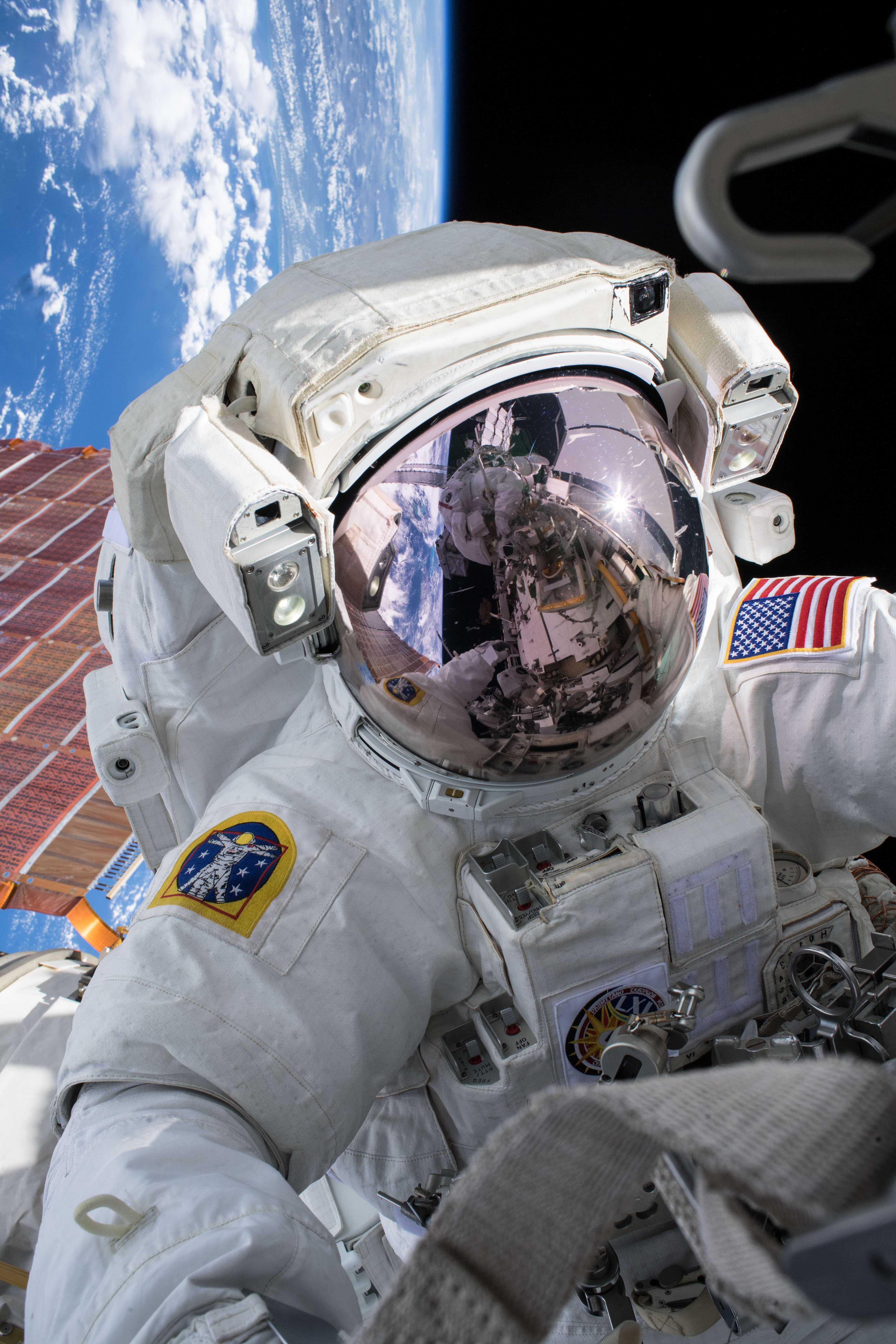
An astronaut outside of the International Space Station has one hand on a truss near a solar panel. Her other hand is by her head. Reflected in her helmet is astronaut Nichole Ayers, also in a white spacesuit, taking the photo. Earth's blue water and white clouds can be seen in the background.
NASA astronaut and Expedition 72 flight engineer Anne McClain is pictured near one of the space station’s main solar arrays during a spacewalk to upgrade the orbital outpost’s power generation system and relocate a communications antenna.
NASA/Nichole Ayers

As the space station orbits Earth, its four pairs of solar arrays soak up the sun’s energy to provide electrical power for the numerous research and science investigations conducted every day, as well as the continued operations of the orbiting laboratory. 

In addition to harnessing the Sun’s energy for its operations, the space station has provided a platform for innovative solar power research. At least two dozen investigations have tested advanced solar cell technology – evaluating the cells’ on-orbit performance and monitoring degradation caused by exposure to the extreme environment of space. These investigations have demonstrated technologies that could enable lighter, less expensive, and more efficient solar power that could improve the design of future spacecraft and support sustainable energy generation on Earth.  

One investigation – the Roll-Out Solar Array – has already led to improvements aboard the space station. The successful test of a new type of solar panel that rolls open like a party favor and is more compact than current rigid panel designs informed development of the ISS Roll-Out Solar Arrays (iROSAs). The six iROSAs were installed during a series of spacewalks between 2021 and 2023 and provided a 20% to 30% increase in space station power. 

Connecting students to station science 

A group of people sit around a circular table in a dark room, engaged in a video call displayed on a large screen showing the interior of a space module with an astronaut visible.
The Kibo-RPC students watch in real time as the free-flying robot Astrobee performs maneuvers aboard the space station, executing tasks based on their input to test its capabilities.
NASA/Helen Arase Vargas

For 25 years, the orbital outpost has served as a global learning platform, advancing STEM education and connecting people on Earth to life in space. Every experiment, in-flight downlink, and student-designed payload helps students see science in action and share humanity’s pursuit of discovery. 

The first and longest-running education program on the space station is ISS Ham Radio, known as Amateur Radio on the International Space Station (ARISS), where students can ask questions directly to crew members aboard the space station. Since 2000, ARISS has connected more than 100 astronauts with over 1 million students across 49 U.S. states, 63 countries, and every continent. 

Through Learn with NASA, students and teachers can explore hands-on activities and astronaut-led experiments that demonstrate how physics, biology, and chemistry unfold in microgravity. 

Students worldwide also take part in research inspired by the space station. Programs like Genes in Space and Cubes in Space let learners design experiments for orbit, while coding and robotics competitions such as the Kibo Robot Programming Challenge allows students to program Astrobee free-flying robots aboard the orbiting laboratory. 

As NASA prepares for Artemis missions to the Moon, the space station continues to spark curiosity and inspire the next generation of explorers. 

Artemis II Vehicle Manager Branelle Rodriguez Gets Orion Ready for “Go”

8 December 2025 at 05:00

By the time the Artemis II Orion spacecraft launches to the Moon next year, its many components will already have traveled thousands of miles and moved across multiple facilities before coming together at NASA’s Kennedy Space Center. Branelle Rodriguez, Artemis II vehicle manager for the Orion Program, has overseen many parts of that journey. Her job is to ensure the spacecraft is ready for its historic mission – carrying humans to the Moon for the first time in over 50 years.

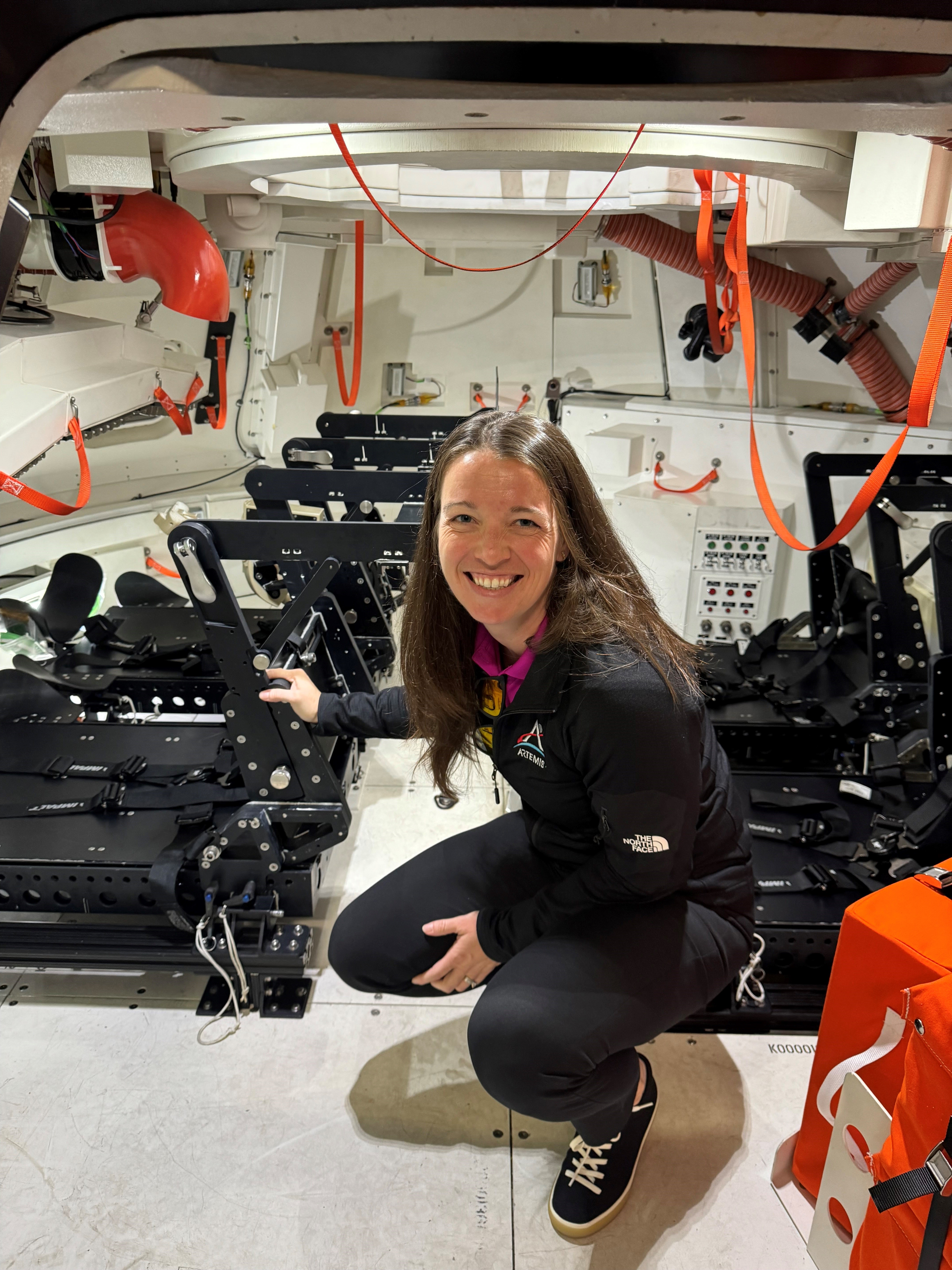
A woman crouches inside the mockup of a spacecraft that is equipped with seats for crewmembers.
Branelle Rodriguez crouches inside an Orion spacecraft training unit aboard the USS San Diego in March 2024. The training unit was used during a full recovery simulation with the Artemis II crew.
Image courtesy of Branelle Rodriguez

Based at NASA’s Johnson Space Center in Houston, Rodriguez has been involved in every stage of the spacecraft’s lifecycle – from development and production through testing and final launch readiness. Her program-level leadership focuses on ensuring the spacecraft’s hardware and subsystems are integrated and flight-ready. Most recently, she collaborated closely with Exploration Ground Systems at Kennedy to oversee the spacecraft’s move to the Vehicle Assembly Building, where it was mated with NASA’s SLS (Space Launch System) rocket. “We are getting our teams trained and ready so that we are GO for the Artemis II mission,” she said.

Her 21-year NASA career spans numerous roles at Johnson. She started in the center’s Engineering Directorate, developing and building life support and habitation hardware for the Space Shuttle Program and the International Space Station Program. She went on to lead teams of engineers and flight controllers tasked with real-time resolution of anomalies aboard the International Space Station before transitioning to the Orion Program in 2022.

“Looking back, every role I’ve held, every team I’ve been a part of, and every milestone we’ve achieved together has been truly remarkable,” she said. “I’m incredibly proud to have played a part in it all.”

Rodriguez has been fascinated by space since she was a little girl. “Growing up in northern Minnesota, I was lucky to experience the beauty of clear, starlit skies on a regular basis,” she recalled. When Rodriguez was a teenager, her family encouraged her to attend Space Academy in Huntsville, Alabama, where she participated in mock astronaut training, flight controller simulations, and hands-on engineering projects. “It was a pivotal experience that only deepened my passion for space exploration.”

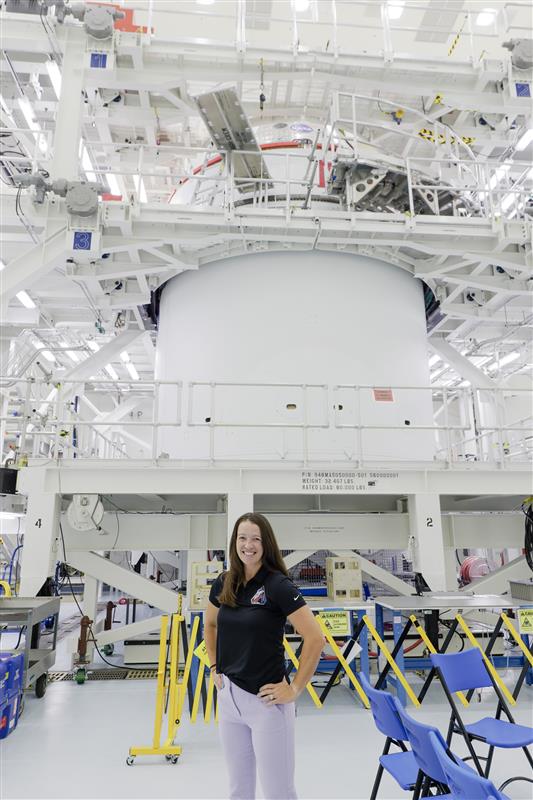
A woman stands in front of an Orion spacecraft that is elevated on a staging platform.
Branelle Rodriguez stands in front of the Artemis II Orion spacecraft as it completes processing in the Multi-Payload Processing Facility at NASA’s Kennedy Space Center in Florida.
Image courtesy of Branelle Rodriguez

Rodriguez applied to NASA’s internship program while studying mechanical engineering at the University of North Dakota. She was not accepted, but she did not give up. She spent a semester interning at Dow Chemical to gain more experience while continuing to apply for internships across multiple NASA centers. “On my eighth attempt, I was accepted at Johnson,” she said. Three internships and one graduation later, Rodriguez landed a full-time position in the Engineering Directorate’s Crew and Thermal Systems Division. “It’s been an incredible journey—and a dream realized,” she said.

As a student athlete, Rodriguez knew the importance of teamwork from a young age, but said its value really became clear after joining NASA. “Some goals take time. There will be setbacks and struggles, but when you stick together, you build the kind of trust and relationships that are the foundation for long-term success,” she said. “That’s exactly what NASA represents. We take on some of the most complex and ambitious challenges imaginable—and we do it as a team.”

She added, “Especially now, it’s more important than ever to remember what we’re capable of when we work together, and to celebrate the wins—big or small—because each one brings us closer to the extraordinary.”

Rodriguez also appreciates having a team outside of the office. One of the greatest challenges she has faced is balancing the demands of a fulfilling, high-impact career with the needs of her family. “Like many parents, there are days when everything feels in sync, and days when I know I’ve fallen short,” she said, acknowledging that she must continually adapt to shifting needs and prioritize tasks to remain focused on what matters most at any given moment. “I’m beyond grateful for my family,” she said. “They are my foundation, and they truly understand and support my passion for the work I do. Without their love, and the broader village that helps make it all possible, I wouldn’t be where I am today.”

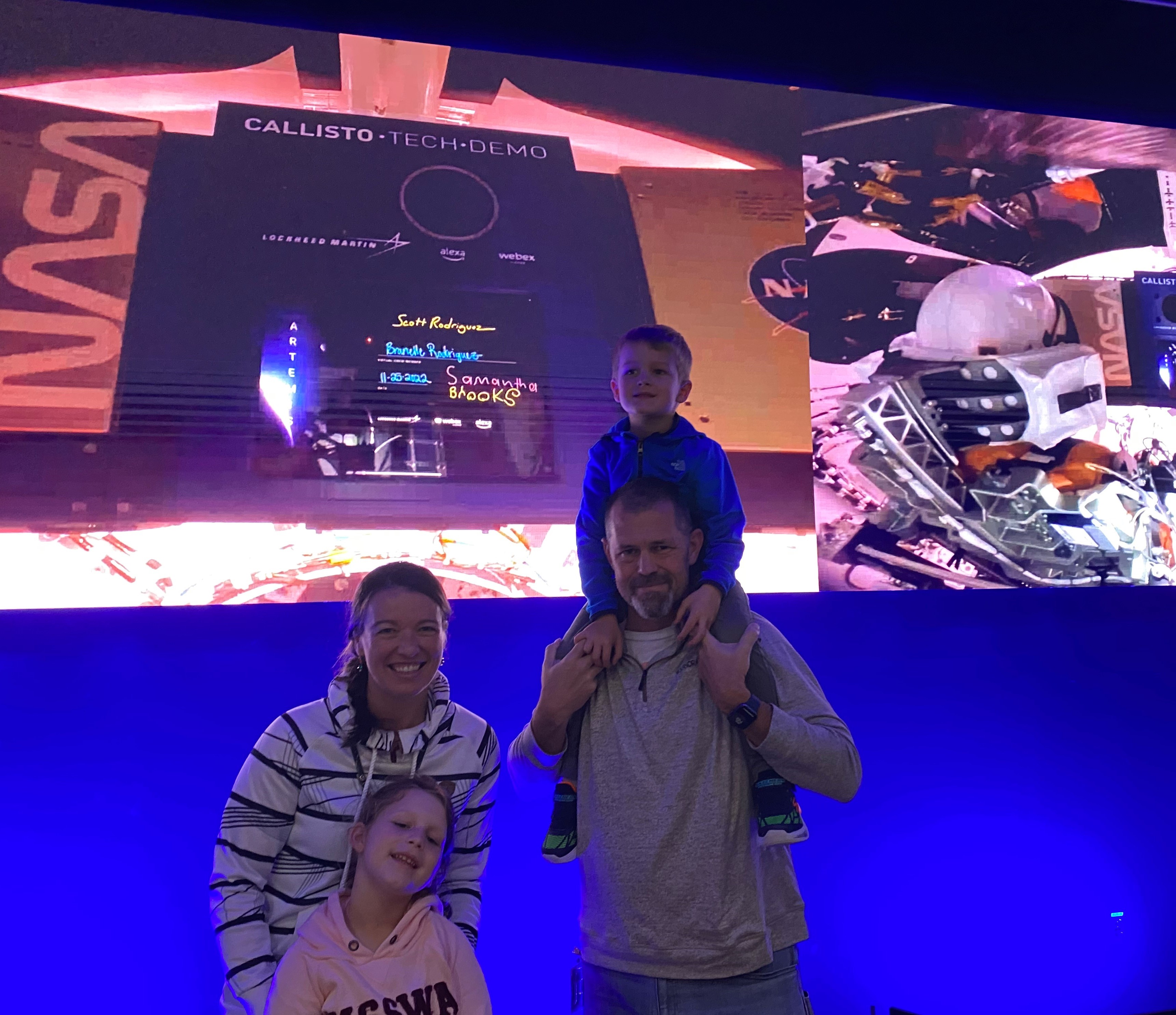
A family of four - mom, dad, and two young children - stand in front of a large screen showing video from inside the Artemis I spacecraft.
Branelle Rodriguez, her husband Scott, and her children Samantha and Brooks in the Mission Control Center at Johnson Space Center during the Artemis I mission in 2022. The family had an opportunity to ask the Artemis I Orion spacecraft questions via the Callisto technology demonstration carried aboard the 25-day mission.
Image courtesy of Branelle Rodriguez

To her children and future generations, Rodriguez hopes to pass on a desire to keep exploring. “As humans, we are naturally driven to grow, learn, and push beyond our limits,” she said. “Space exploration is still in its early stages when viewed through the lens of history, and the achievements of the next generation will be truly extraordinary. I want them to carry forward the curiosity, courage, and determination needed to reach new frontiers and unlock the unknown.”

The International Space Station Marks 25 Years of Continuous Human Presence 

2 December 2025 at 06:00

On Nov. 2, 2025, NASA honored 25 years of continuous human presence aboard the International Space Station. What began as a fragile framework of modules has evolved into a springboard for international cooperation, advanced scientific research and technology demonstrations, the development of a low Earth orbit economy, and NASA’s next great leaps in exploration, including crewed missions to the Moon and Mars. 

The first expedition

Expedition 1
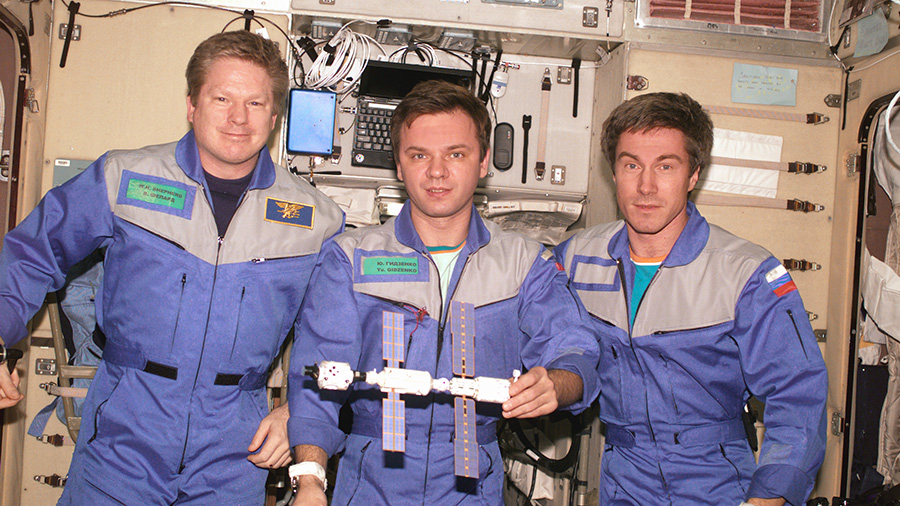
The Expedition One crew in the Zvezda Service module aboard the International Space Station. From left: commander William Shepherd, Soyuz commander Yuri Gidzenko and Flight Engineer Sergei Krikalev.
NASA

This legacy of achievement in global human endeavors began with the first crew’s arrival to the space station on Nov. 2, 2000. Expedition 1 crew members NASA astronaut William M. Shepherd and Russian Aviation and Space Agency, now Roscosmos, cosmonauts Yuri P. Gidzenko and Sergei K. Krikalev launched from the Baikonur Cosmodrome in Kazakhstan two days prior. After a successful docking, the crew transferred aboard the station and began bringing it to life. Their primary tasks during their four-month mission included installing and activating the life support and communications systems and working with three visiting space shuttle crews to continue the station’s assembly. The trio returned to Earth in March 2001 aboard space shuttle Discovery, after having turned the station over to the Expedition 2 crew. 

(Space)walking into history 

NASA astronaut Andrew Morgan conducts a spacewalk at the Port- 6 (P6) truss structure work site to upgrade International Space Station power systems.
NASA astronaut Andrew Morgan conducts a spacewalk at the Port- 6 truss structure work site to upgrade International Space Station systems.
NASA/Christina Koch

Assembly and maintenance of the International Space Station would not be possible without the skilled work of crew members performing intricate tasks, in bulky spacesuits, in the harsh environment of space. In addition to station upkeep, spacewalks provide a platform for testing and improving spacesuits and tools – critical information for future exploration of the Moon and Mars. Other spacewalks have included operations for scientific research. In Jan. 2025, for example, crew members collected samples for an investigation examining whether microorganisms have exited through station vents and can survive in space, to better inform spacecraft design that helps prevent human contamination of Mars and other destinations. 

More than 270 spacewalks dedicated to the space station have been accomplished in the last quarter century. Several made station and human spaceflight history: 

  • May 1999: NASA astronaut Tamara Jernigan became the first woman to complete a spacewalk at the space station, in support of its construction. 
  • September 2000: Also during space station assembly, NASA astronaut Edward T. “Ed” Lu and Roscosmos cosmonaut Yuri I. Malenchenko conducted the first U.S.-Russian spacewalk. 
  • March 10, 2001: NASA astronauts James Voss and Susan Helms set the record for longest spacewalk in U.S. history, at 8 hours and 56 minutes. 
  • First spacewalks by international partners included: 
  • April 2001 – Canadian Space Agency astronaut Chris Hadfield 
  • July 2005 – Japan Aerospace Exploration Agency astronaut Soichi Noguchi 
  • Aug. 2006 – European Space Agency astronaut Thomas Reiter 
  • Feb. 26, 2004: NASA astronaut Mike Foale and Russian cosmonaut Aleksandr Y. Kaleri complete the first spacewalk with no one inside the station.  
  • Oct. 18, 2019: The first all-female spacewalk in history, conducted by NASA astronauts Christina Koch and Jessica Meir. 

Orbiting laboratory welcomes first commercial crew 

The Expedition 63 crew has expanded to five members
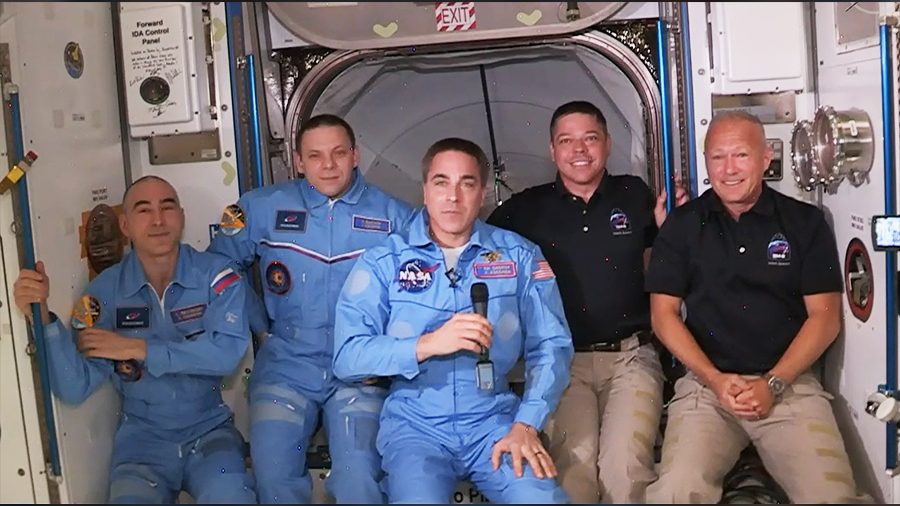
The Expedition 63 crew expanded to five members with the arrival of NASA’s SpaceX Crew Dragon on May 31, 2020. From left: Anatoly Ivanishin, Ivan Vagner, Chris Cassidy, Bob Behnken and Doug Hurley.
NASA

The International Space Station welcomed its first commercial crew members on May 31, 2020, when former NASA astronauts Robert Behnken and Douglas Hurley joined Expedition 63 Commander and NASA astronaut Chris Cassidy and Roscosmos cosmonauts Anatoly Ivanishin and Ivan Vagner aboard the orbiting laboratory.  

Behnken and Hurley lifted off from Kennedy Space Center in Florida the day before on NASA’s SpaceX Demo-2 test flight – the first launch of American astronauts from U.S. soil since the space shuttle’s retirement in 2011.  

The duo quickly integrated with the rest of the crew and participated in a number of scientific experiments, spacewalks, and public engagement events during their 62 days aboard station. Overall, the pair spent 64 days in orbit, completed 1,024 orbits around Earth, and contributed more than 100 hours of time to supporting the orbiting laboratory’s investigations before splashing down on Aug. 2.  

Successful completion of the Demo-2 mission paved the way for regular SpaceX flights carrying astronauts to and from the space station. With another certified crew transportation system in place, the International Space Station Program added research time and increased the opportunity for discovery aboard humanity’s testbed for exploration, including preparations for human exploration of the Moon and Mars. 

Frank Rubio’s record-breaking year in space  

A man in a dark polo shirt smiles at the camera with his arms crossed. He is in the cupola of the International Space Station, an area with multiple windows through which Earth and space can be seen. Earth's clouds can be seen through the windows behind him.
NASA astronaut and Expedition 68 Flight Engineer Frank Rubio inside the cupola, the International Space Station’s “window to the world,” as the orbiting laboratory flew 263 miles above southeastern England on Oct. 1, 2022.
NASA/Frank Rubio

On Sept. 27, 2023, NASA astronaut Frank Rubio returned to Earth after spending 371 days aboard the International Space Station—the longest single spaceflight by a U.S. astronaut in history. His mission surpassed the previous record of 355 days, set by NASA astronaut Mark Vande Hei, and provided scientists with an unprecedented look at how the human body adapts to more than a year in microgravity. 

Rubio’s record-setting mission supported six human research studies, including investigations into diet, exercise, and overall physiology and psychology. He was the first astronaut to test whether limited workout equipment could still maintain health and fitness, an important consideration for future spacecraft with tighter living quarters. He also contributed biological samples, surveys, and tests for NASA’s Spaceflight Standard Measures, a study that collects health data from astronauts to better understand how the body adapts to space—knowledge that helps prepare crews for the Artemis campaign to the Moon and future trips to Mars. 

Alongside his fellow crew members, Rubio participated in dozens of investigations and technology demonstrations, from growing tomato plants with hydroponic and aeroponic techniques to materials science experiments that advance spacecraft design. 

Long-duration missions help inform future spaceflight and lay the groundwork for the next era of human exploration.  

A global foundation for growing a low Earth orbit economy 

Facilities around the world support the operation and management of the International Space Station.
NASA

The space station is one of the most ambitious international collaborations ever attempted. It brings together international flight crews, multiple launch vehicles, globally distributed launch and flight operations, training, engineering, and development facilities, communications networks, and the international scientific research community for the benefit of all humanity.  

An international partnership of space agencies operates the elements of the orbiting laboratory: NASA, Roscosmos, ESA (European Space Agency), JAXA (Japan Aerospace Exploration Agency), and CSA (Canadian Space Agency). Each partner takes primary responsibility for managing and running the station hardware it provides, as well as on-Earth construction, launch support, mission operations, communications, and research and technology facilities that support the station. 

At least 290 individuals representing 26 countries, and the five international partners have visited the orbiting laboratory during its 25 years of continuous human presence. Some of those visitors flew to the station on private astronaut missions. These missions contribute to scientific, outreach, and commercial activities. They also help demonstrate the demand for future commercial space stations and are an important component of NASA’s strategy for enabling a robust and competitive commercial economy in low Earth orbit. 

The results of the international partnership created through the space station and its accomplishments exemplifies how countries can work together to overcome complex challenges and achieve collaborative goals. 


The Overview Effect: Astronaut Perspectives from 25 Years in Low Earth Orbit

23 November 2025 at 18:00

To see Earth from space is to be forever changed by the view. Since Alan Shepard became the first American to lay eyes on our home planet from above, countless NASA astronauts have described feeling awed by the astonishing sight and a profound shift in perspective that followed.

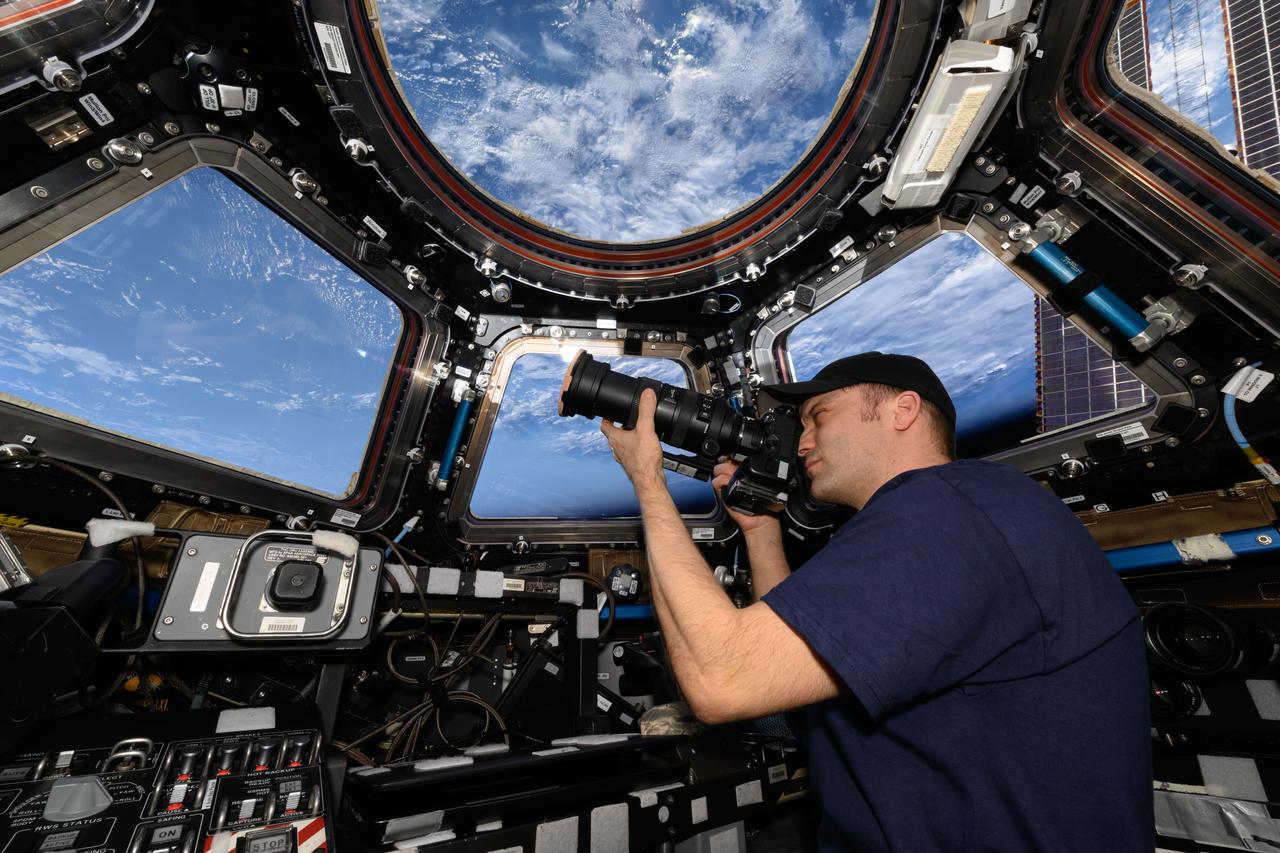
NASA astronaut Matthew Dominick points his camera through a cupola window as the International Space Station orbits 262 miles above the Atlantic Ocean off the coast of Africa.
NASA

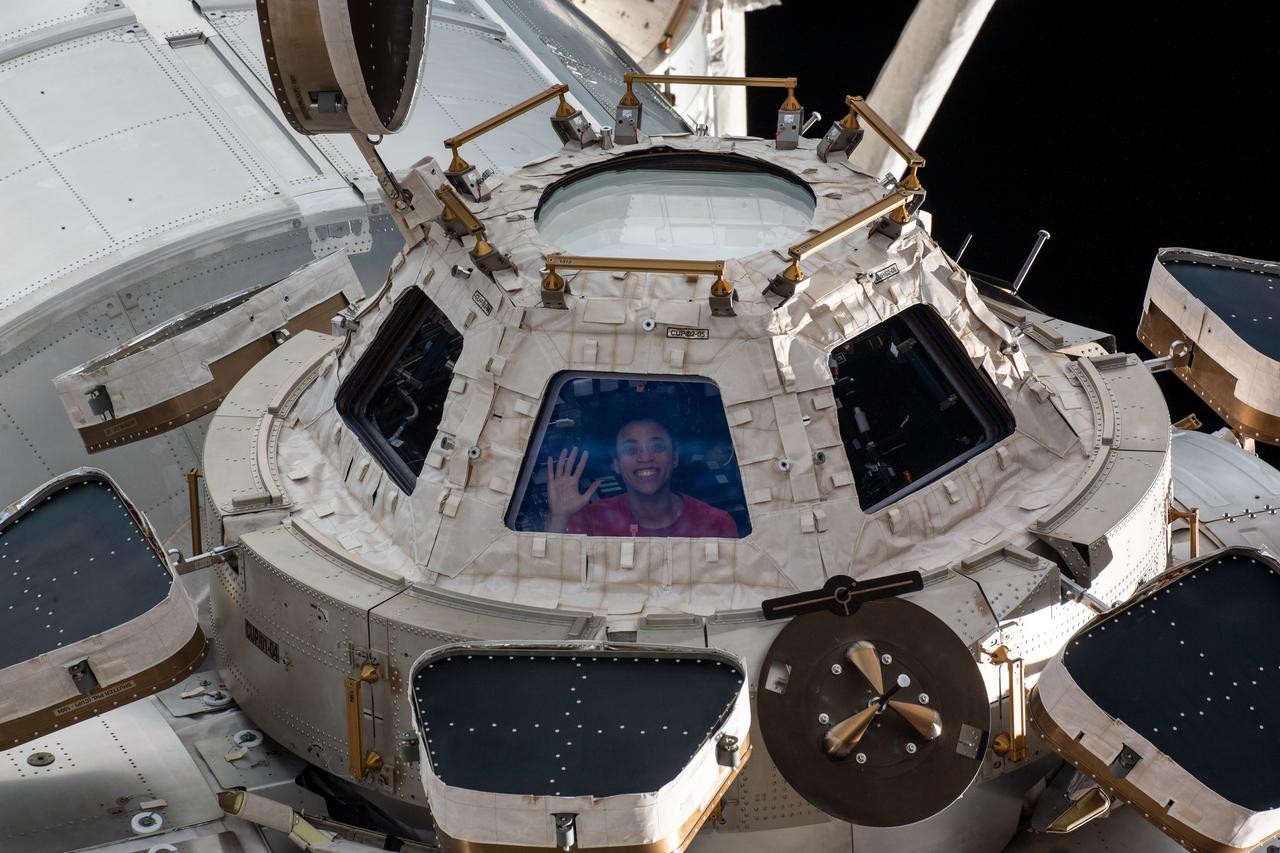
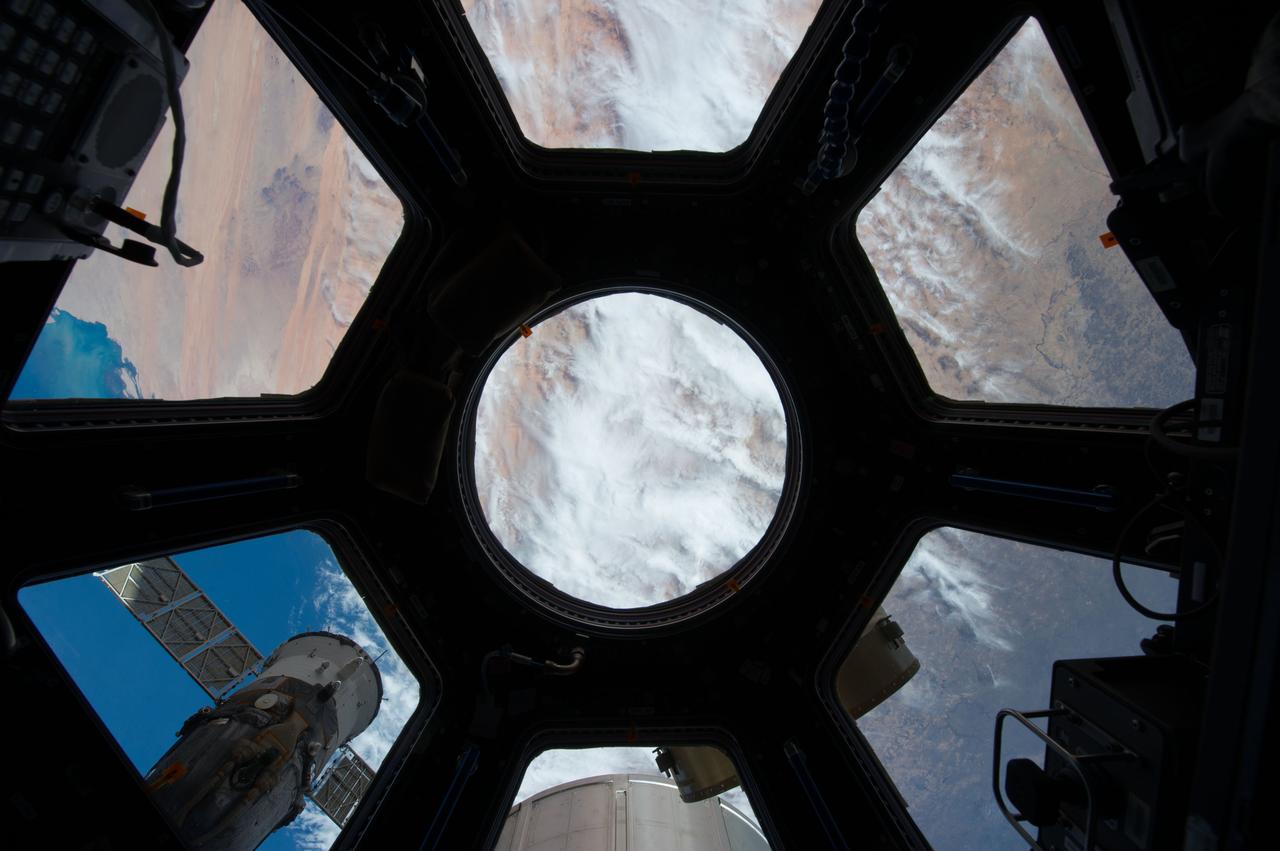
This unique experience is known as the overview effect – a term coined in 1987 by space philosopher and author Frank White in a book of the same name. The phenomenon creates powerful changes in the way astronauts think about Earth and life and can be particularly strong for those who lived and worked aboard the International Space Station during its 25 years of continuous human presence. The orbiting laboratory’s cupola module, equipped with seven windows looking down on Earth, provides the perfect place for observation and reflection.

NASA astronaut Jessica Watkins is pictured looking out from the International Space Station's cupola window.
NASA astronaut Jessica Watkins is pictured looking out from the International Space Station’s “window to the world” – the cupola. Astronauts use the seven-windowed observation module to monitor the arrival of spacecrafts at the orbiting laboratory and view the Earth below.
NASA

As Artemis II Mission Specialist Christina Koch explained:

    “The overview effect is when you’re looking through the cupola and you see the Earth as it exists with the whole universe in the background. You see the thin blue line of the atmosphere, and then when you’re on the dark side of the Earth, you actually see this very thin green line that shows you where the atmosphere is. What you realize is every single person that you know is sustained and inside of that green line and everything else outside of it is completely inhospitable. You don’t see borders, you don’t see religious lines, you don’t see political boundaries. All you see is Earth and you see that we are way more alike than we are different.”

Koch’s Artemis II crewmate, NASA astronaut Victor Glover, said the overview effect’s potency is closely tied to the “sea level effect” – humanity’s shared experience on Earth. “You come back to sea level, and then you have a choice,” he explained. “Are you going to try to live your life a little differently? Are you going to really choose to be a member of this community of Earth?”

NASA astronaut Don Pettit, Expedition 30 flight engineer, is pictured in a window of the cupola of the International Space Station, backdropped by Earth’s horizon and the blackness of space.
NASA

Many astronauts emphasize the importance of unity after experiencing the overview effect. “You see that it’s a single planet with a shared atmosphere. It’s our shared place in this universe,” said former NASA astronaut Bob Behnken. “I think that perspective, as we go through things like the pandemic or we see the challenges across our nation or across the world, we recognize that we all face them together.”

Seeing the Earth from space can also change their concept of home. Former NASA astronaut Nicole Stott recalls wanting to see her home state of Florida during her first mission to the International Space Station. “Finally, we were flying over Florida. I wanted to go to the window and see it, and then realized somewhere down the line that I wasn’t looking at Florida that same way anymore,” she said. “I still wanted to see Florida, but Florida had just become this special part of home, which is Earth. We’re all earthlings.”

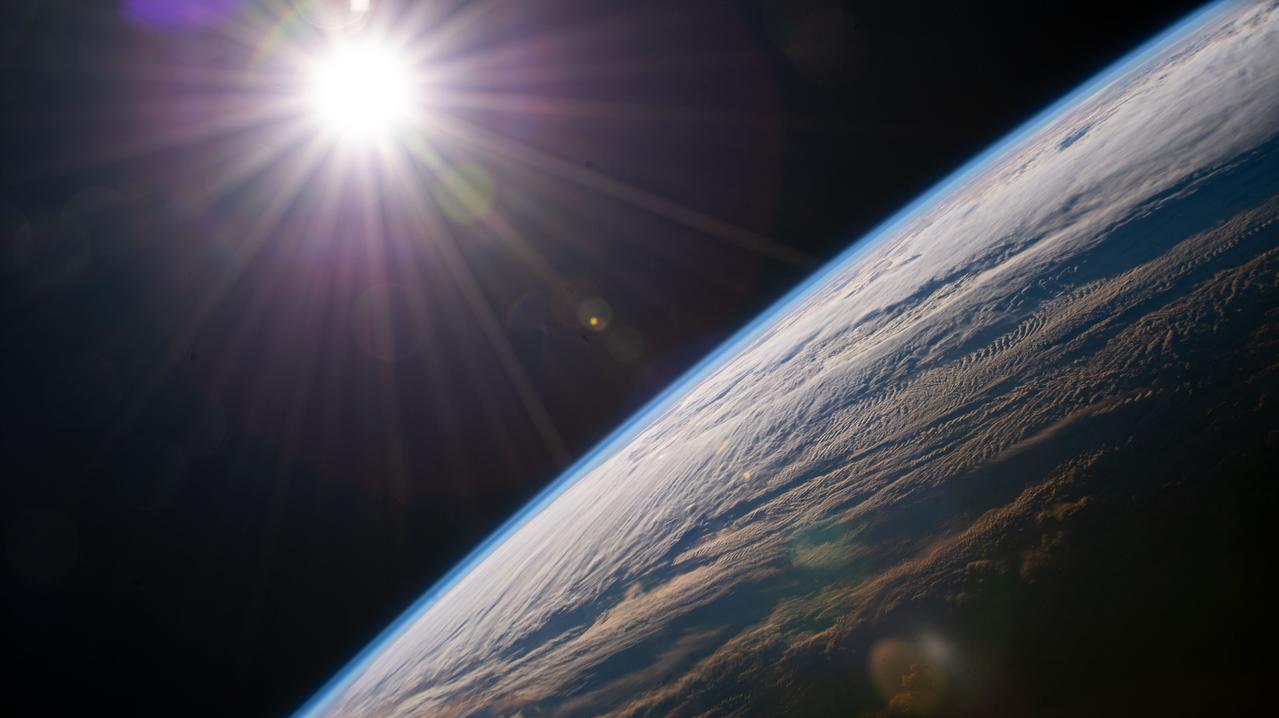
The sun shines above Earth's horizon as the space station orbits 264 miles above the Canadian province of Quebec.
The sun shines above Earth’s horizon as the space station orbits 264 miles above the Canadian province of Quebec.
NASA

For some astronauts, their perspective shift inspired them to make changes on the ground. “I think if you’re not a conservationist before you go to space, you’re at least partly a conservationist when you come back. Because when you see how thin that atmosphere is, that protective layer that we have here, you think, wow, we really have to take care of this because it does look so fragile from space,” said retired NASA astronaut Mike Foreman.

Others hope to share the overview effect with more people. “That perspective helps you grow. It has really inspired me to try to get more people this experience and to get a permanent foothold in the stars for our species,” said former NASA astronaut Jack Fischer. “I want to do everything I possibly can to help the human species, humanity as a whole, go further and grow and evolve like I know they’re capable of.”

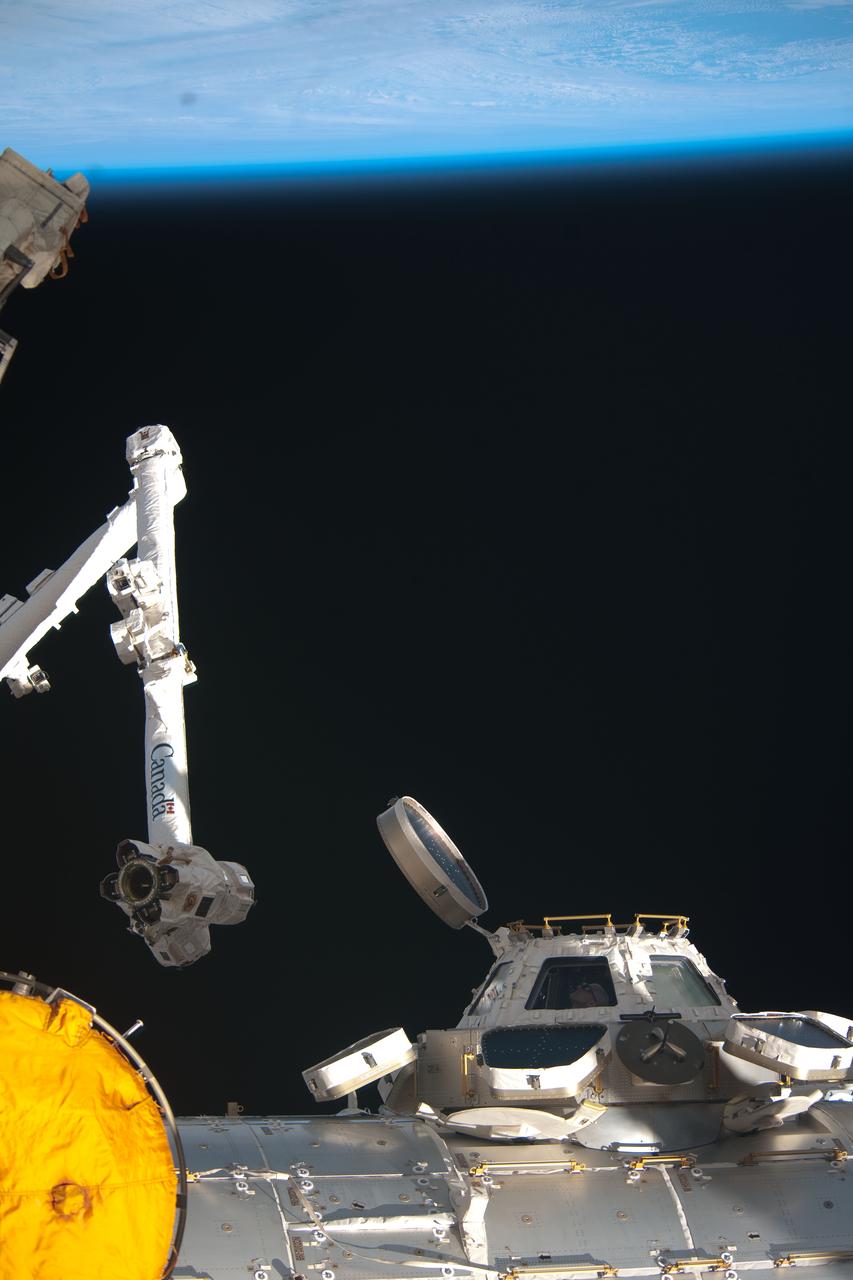
An Earth observation taken through cupola windows by the Expedition 39 crew. Portions of the International Space Station are in view.
NASA

Future crews to the orbiting laboratory can look forward to a similar experience. “In that instant, when you’re overwhelmed with that vista, when your eyes see nothing but the beauty of the Earth – every single crew member that I brought in [the cupola] for that exposure, cried,” said retired NASA astronaut T.J. Creamer. “It is heart stopping. It is soul pounding. It is breathtaking.”

For more astronaut perspectives from the International Space Station, watch “Down to Earth” on NASA+.

Guiding Artemis: Brian Alpert Turns Lessons Learned Into Lunar Progress

18 November 2025 at 05:00

Brian Alpert’s path was always destined for the aerospace industry, but his journey turned toward NASA’s Johnson Space Center during his sophomore year in college. That was when Tricia Mack, who works in NASA’s Transportation Integration Office within the International Space Station Program, spoke to his aerospace seminar about planning spacewalks, training crews, and supporting operations from the Mission Control Center in Houston.

Alpert was inspired to join the agency and later earned a spot as an engineering co-op student at Johnson. “My first stop after new employee orientation was Tricia’s office,” he said.

A man wearing a headset sits at a computer console in the Mission Control Center at Johnson Space Center.
Brian Alpert supports a spacewalk outside of the International Space Station from the Mission Control Center at Johnson Space Center in 2015.
NASA/Bill Stafford

Eighteen years later, Alpert is the cross-program integration deputy for NASA’s human landing system (HLS) – the mode of transportation that will take astronauts to the lunar surface as part of the Artemis campaign. In his role, Alpert is responsible for coordinating with other Artemis programs, like the Orion Program, on issue resolution, joint agreements, data exchanges, hardware integration, and reviews. He also co-leads the Exploration Atmospheres Issue Resolution Team, assessing risks to and impacts on space vehicle atmosphere, spacesuit pressure, and operational timelines for Artemis missions.

Alpert has enjoyed the opportunity to participate in several proposal reviews for Artemis program contracts as well. “NASA’s model of embracing public-private partnerships to achieve its strategic goals and objectives is exciting and will continue to expand opportunities in space,” he said.

He applies lessons learned and skills gained from his previous roles as a spacewalk crew instructor, flight controller, and systems engineer to his current work on HLS. “I hope to pass on to the next generation that skills and lessons you learn as a student or a young employee can and will help you in your future work,” he said.

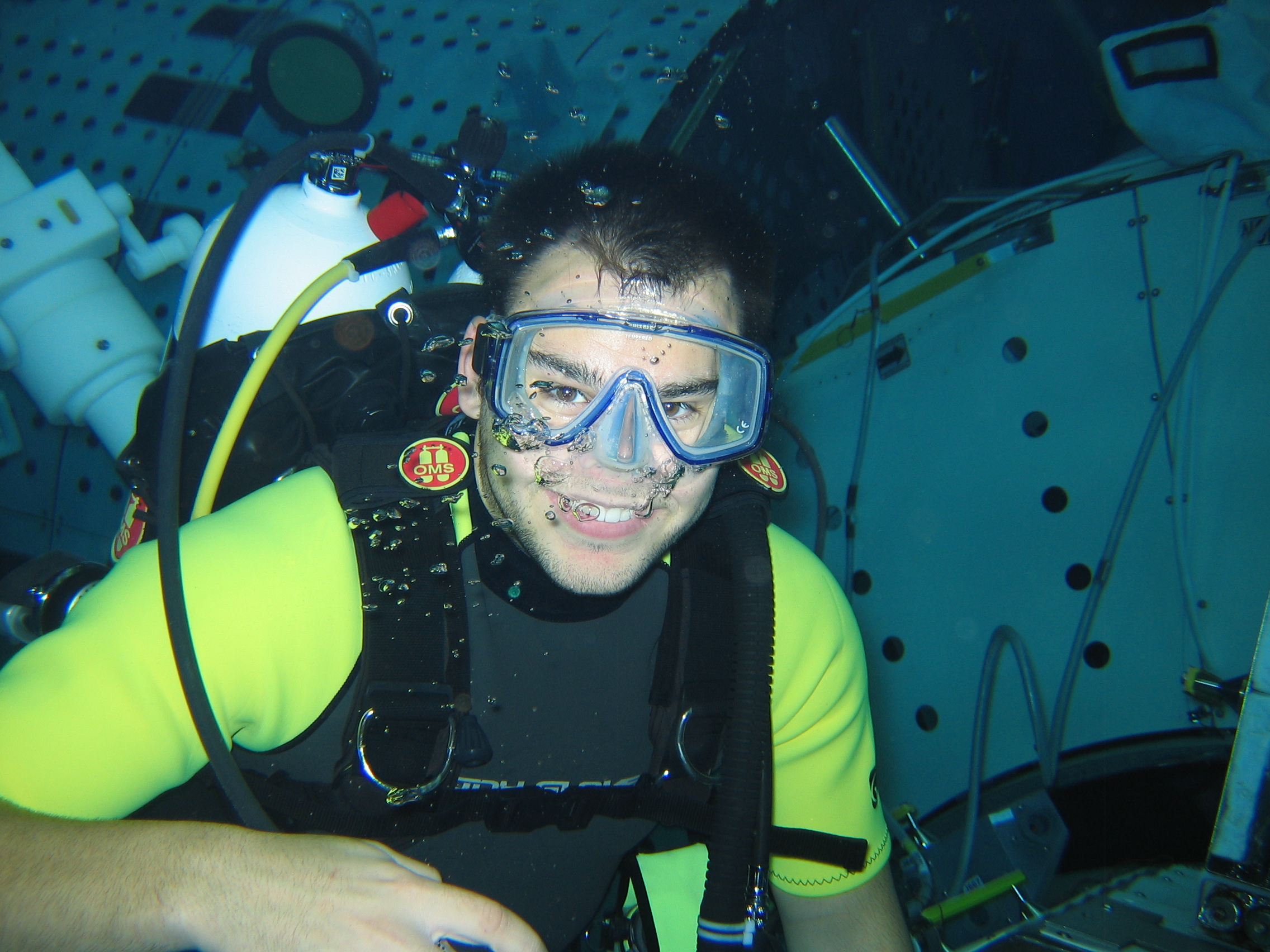
Underwater image of a man wearing scuba gear, smiling at the camera, with a mockup of the International Space Station in the background.
Brian Alpert routes cables in the Johnson Space Center’s Neutral Buoyancy Laboratory in preparation for a crew training run in 2011.
Image courtesy of Brian Alpert

Alpert’s prior NASA roles involved memorable experiences like working to address spacesuit and vehicle failures that occurred during a spacewalk on International Space Station Expedition 32. He was serving as the lead spacewalk systems flight controller in the Mission Control Center at the time and played a key role in getting NASA astronaut Suni Williams and JAXA (Japan Aerospace Exploration Agency) astronaut Aki Hoshide safely back aboard the space station. Since Williams and Hoshide did not complete the spacewalk’s primary objective – replacing a Main Bus Switching Unit – a backup spacewalk was scheduled several days later. Alpert was on console for that spacewalk, too.

“One important lesson that I have learned through my career to date is how exceptionally talented, passionate, and hard-working everyone is here at NASA,” he said. “Whenever work gets stressful or problems get hard, there are teams of people that have your back, are willing to problem-solve with you, and can bring another perspective to finding a solution that you may not have considered.” He added that his colleagues are the best part of his job. “As much as I love what we do at NASA, what really gets me excited to come to work is all the outstanding people I get to work with every day.”

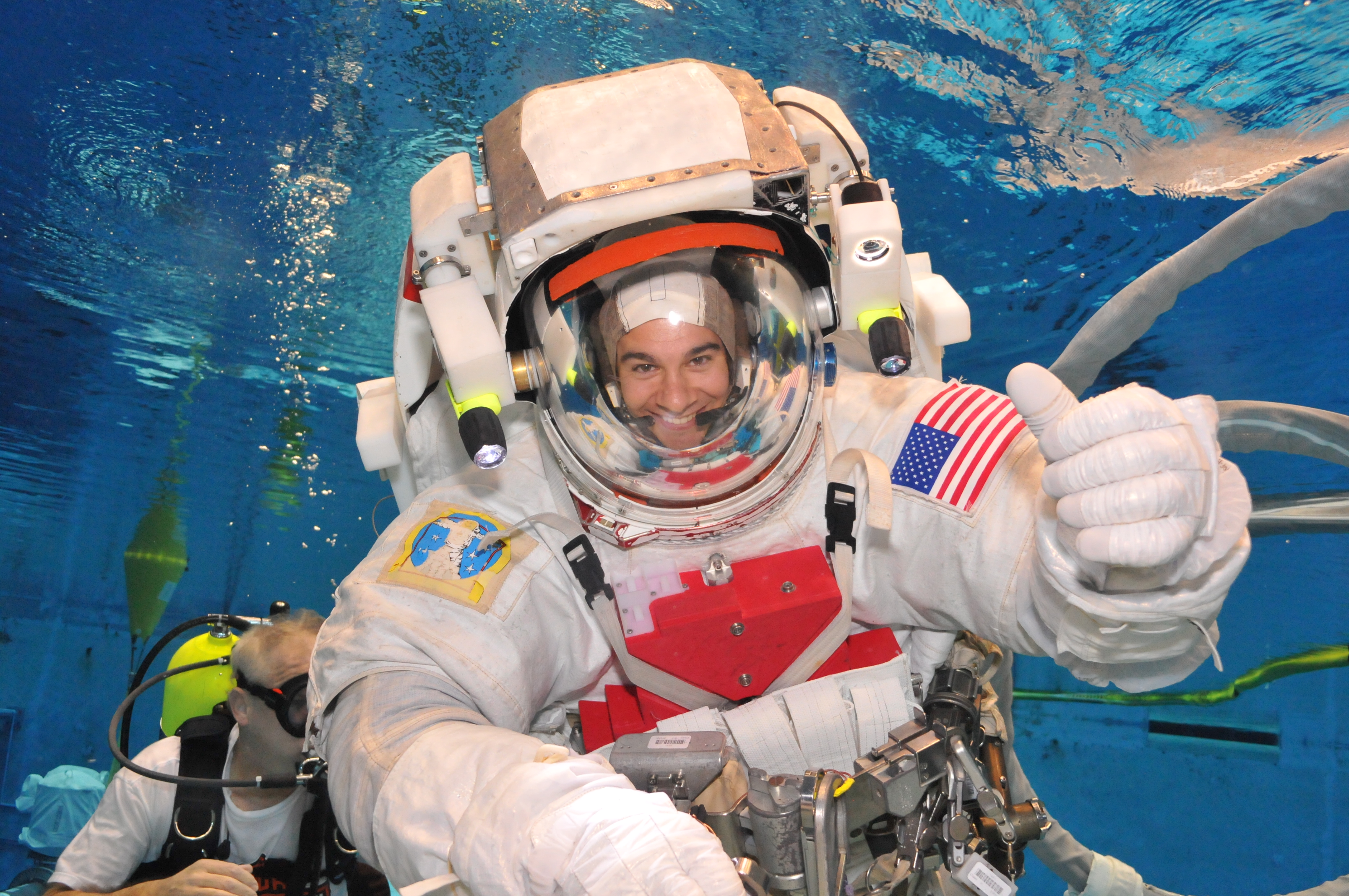
A man wears a full spacesuit underwater while conducting a test dive at NASA's Neutral Buoyancy Laboratory.
Brian Alpert completes a dive in NASA Johnson Space Center’s Neutral Buoyancy Laboratory for a spacesuit familiarization exercise in 2009.
Image courtesy of Brian Alpert

Learning how to navigate change has been an important lesson for Alpert, as well. “NASA has been through a lot of change since I became a full-time employee in 2009,” he said. “Making sure that I have clear goals for myself, my work, and my team helps us all stay focused on the mission and the work at hand and helps us prioritize projects and tasks as questions or challenges inevitably arise.”

One challenge Alpert especially enjoys? Johnson’s annual Chili Cookoff. He has participated in many cookoffs as part of the Cosmic Chili team, noting that he often dons a Wolverine costume as part of the festive fun. He also welcomes a space trivia challenge – and a chance to add to his collection of trivia trophies.

Astronaut Candidates Get to Work at Johnson Space Center

29 September 2025 at 11:08

NASA announced its newest class of astronaut candidates on Sept. 22, 2025, at the agency’s Johnson Space Center in Houston. After the welcome ceremony, the 10 highly qualified individuals rolled up their sleeves and prepared for the next step in their journey to the stars: nearly two years of training to become flight-eligible for missions to low Earth orbit, the Moon, and ultimately, Mars.

An astronaut wears a VR headset and holds controllers in his hands during a training exercise.
NASA astronaut Chris Williams participates in a spacewalk safety system training in the virtual reality lab at NASA’s Johnson Space Center.
NASA/Riley McClenaghan

The training astronaut candidates complete is comprehensive and rigorous. They learn about NASA’s history and vision, and how astronauts advance the agency’s mission. They take classes on space health – gaining an understanding of radiation exposure, microgravity’s effects on the human body, space food and nutrition, and how to use the exercise equipment aboard the International Space Station. They also study first aid and practice providing medical care for crewmates. Each candidate will receive flight training, learning to pilot or improving their current piloting skills through the T-38 supersonic jet and other aviation platforms.

Three astronauts in casual clothing test life support systems, including a face mask, inside a space station mockup.
NASA astronauts Andre Douglas, Christina Birch, and Deniz Burnham during life support systems training in a mockup of an International Space Station airlock at Johnson Space Center.
NASA/James Blair

With NASA’s plans for the future of exploration, this class of astronauts may have opportunities to fly to low Earth orbit, or even beyond. Some may contribute to research and technology investigations taking place aboard the space station – which is about to celebrate 25 years of continuous human presence in space. Others may venture to the Moon to prepare for future Mars missions.   

A man uses a small magnifying glass to study a rock that is being held up by a woman wearing a bucket hat.
NASA astronaut Marcos Berríos studies a rock sample during Earth and planetary sciences field training in northern Arizona.
NASA/Riley McClenaghan

To be ready for any destination, this class will complete both space station training and advanced preparation for deep space. These exercises allow astronaut candidates to work through problems and build relationships with their classmates while preparing them for space flights.

“Training was such an intense period that we got to know each other really well,” said NASA astronaut Anil Menon, who joined the agency as part of the 2021 class – astronaut group 23. “Now when we come together, there are these moments – like we might be handing off a capcom shift, or we might be flying a jet together – and in those moments, I feel like I know them so well that we know how to navigate all sorts of challenges together and just be our best selves as a team.”

A NASA astronaut wearing a blue flight suit is pictured climbing a ladder into a T-38 training jet.
NASA astronaut Luke Delaney prepares for a training flight in a T-38 jet.
NASA/Robert Markowitz

Astronaut candidate training also teaches foundational skills that can be applied to any destination in space. The group will complete several dives in the Neutral Buoyancy Laboratory, simulating spacewalks in different environments and learning how to do maintenance tasks in microgravity with a full-scale underwater mockup of the International Space Station as their worksite. They will also train inside other mockups of space vehicles, learning emergency procedures, maintenance, and repair of spacecraft, along with how to contribute to future developmental programs.

A NASA astronaut is helped into a spacesuit on the deck of the large training pool in NASA's Neutral Buoyancy Laboratory.
NASA astronaut Anil Menon suits up before completing a training dive in the Neutral Buoyancy Laboratory at Johnson Space Center.
NASA/Josh Valcarcel

Robotics training will prepare them to use the station’s Canadarm2 robotic arm. They will trek through the wilderness as part of their land and water survival training, and they will study geology in the classroom and in the field. The group will practice tasks in a variety of simulations, leveraging Johnson’s world-class facilities, virtual reality, and immersive technologies. Additionally, the class will work shifts in the Mission Control Center in Houston to experience a day in the life of the people who keep watch over the astronauts and vehicles.

Astronaut candidates who successfully complete the training program celebrate their achievement in a graduation ceremony, after which they are officially flight-eligible members of NASA’s astronaut corps. They will also receive office and ground support roles at Johnson while they await future flight assignments.

Three people wearing brown camouflage build a shelter out of branches in the woods.
NASA astronauts Anil Menon, Nichole Ayers, and Andre Douglas work to build a shelter during wilderness survival training at Ft. Rucker, Alabama.
NASA/Robert Markowitz

“I’ve been exposed to a lot of different parts of what we do at Johnson Space Center, working both with the current increment of supporting operations aboard the International Space Station, as well as supporting some development of the Orion spacecraft and Artemis II preparations,” said NASA astronaut Chris Birch, another member of astronaut group 23.

Many members of NASA’s active astronaut corps emphasize that the learning does not stop when astronaut candidate training ends. “You have the foundational training and you continue to build off of that,” said Deniz Burnham, adding that the hardest days can be the most educational. “You get to learn, you get to improve, and then you’re still getting the opportunity. It’s such a positively unique experience and environment, and you can’t help but be grateful.”

As NASA astronaut Frank Rubio, class mentor, told the group, “You’ll become part of a legacy of those who trained before you, continuing the adventure they started, and looking ahead to future human exploration.”

❌
❌