The IRS is setting new limits on telework for employees who are facing a variety of temporary hardships.
The agency said in an internal memo Monday that hardship-based requests for full-time telework that employees submitted, but were still awaiting approval, will be “closed,” effective immediately.
The memo, obtained by Federal News Network, cites the Trump administration’s return-to-office mandate for federal employees as the reason for the policy change.
“As a result of return to office, the current hardship program process and approvals will be adjusted to ensure compliance,” the memo states.
According to the memo, IRS employees are generally limited to five days of telework per calendar year.
Employees can still submit hardship-based telework requests, but approvals must come from the agency’s leadership or its human capital office, which is inundated with paperwork from employees retiring under the deferred resignation program.
The IRS lost more than a quarter of its employees this year through voluntary separation incentives.
Several IRS employees told Federal News Network that the IRS in the past has granted hardship-based telework to accommodate a range of emergencies, including employees facing domestic violence or employees who are immunocompromised following organ transplants.
It’s not clear how long employees will wait for hardship approvals under this policy change. Federal News Network has reached out to the IRS and the Treasury Department for comment.
The memo states that requests for short-term telework arrangements lasting fewer than 90 days will still be reviewed and considered on a case-by-case basis.
Short-term telework arrangements for less than 30 days must get approval from the agency’s human capital office. Hardship requests for more than 30 days of telework will require approval from the agency’s chief operating officer.
The new IRS policy comes as other agencies are setting restrictions on telework as a reasonable accommodation for employees with disabilities.
The Department of Health and Human Services rolled out a new reasonable accommodation policy last week that required all telework, remote work, or reassignment requests to be reviewed and approved by an assistant secretary or a higher-level official — a decision that is likely to slow the approval process.
Meanwhile, IRS employees have been under scrutiny from an agency watchdog to ensure they are complying with the Trump administration’s return-to-office mandate.
Federal News Network reported in August that the Treasury Inspector General for Tax Administration conducted an audit, at the request of the Treasury Department, to see if IRS employees were reporting to the office as often as they claimed.
The Trump administration, more broadly, has required agencies to collect data, including badge swipes into office buildings, to determine if federal employees are following the return-to-office mandate.
According to the National Treasury Employees Union’s 2022 national agreement with the IRS, when an employee is experiencing a temporary hardship, the agency “will make every reasonable effort to approve a temporary telework location,” including moving the employee to another office location.
Under this labor agreement, the IRS can approve a permanent hardship in cases where an employee or an immediate family member faces a “significant hardship” that threatens their life or livelihood. Examples include seeking specialized care for serious medical conditions that affect major life functions, a spouse faced with relocation or the loss of their job, or employees facing domestic violence or other similar “threats to life or limb.”
Temporary hardship requests are granted on a broader basis than permanent hardship requests. NTEU and the IRS included temporary hardship requests in their labor contract, based on discussions around medical issues impacting an employee’s immediate family members.
The 2022 agreement states the IRS may approve a temporary hardship for up to a year, depending on the circumstances of the hardship and “subject to staffing and workload needs.” Management can further extend a temporary hardship for a maximum of one more year.
IRS denials of hardship requests are supposed to be resolved through the union’s grievance procedure. The IRS, however, no longer recognizes NTEU, given the Trump administration’s rollback of collective bargaining rights across the federal workforce.
NTEU is leading a lawsuit challenging those executive orders targeting federal employee unions. The U.S. Court of Appeals for the District of Columbia will hear oral arguments in the case next Monday.
The IRS memo states that the agency will still grant requests for “situational” telework for “unforeseen, non-recurring emergencies.”
Those include an employee dealing with an illness or medical appointment that would normally require sick leave, an employee needing to stay home to meet with a service provider for urgent home repairs, or a school or caregiving facility closure with less than 24 hours’ notice.
The memo states that IRS managers can provide up to 90 days of telework as an interim accommodation for employees waiting for the agency to process their request for reasonable accommodation.
Federal agencies are required under the Rehabilitation Act to provide reasonable accommodations to qualified employees with disabilities, as long as that accommodation does not result in an “undue hardship” for agencies.
“Treasury recognizes the role that limited telework can play to support achieving the mission and employees’ work-life balance,” the IRS memo states.
However, Tax Notes reported last week that the IRS faces a growing backlog of more than 8,000 reasonable accommodation requests.
NASA Begins Moon Mission Plume-Surface Interaction Tests
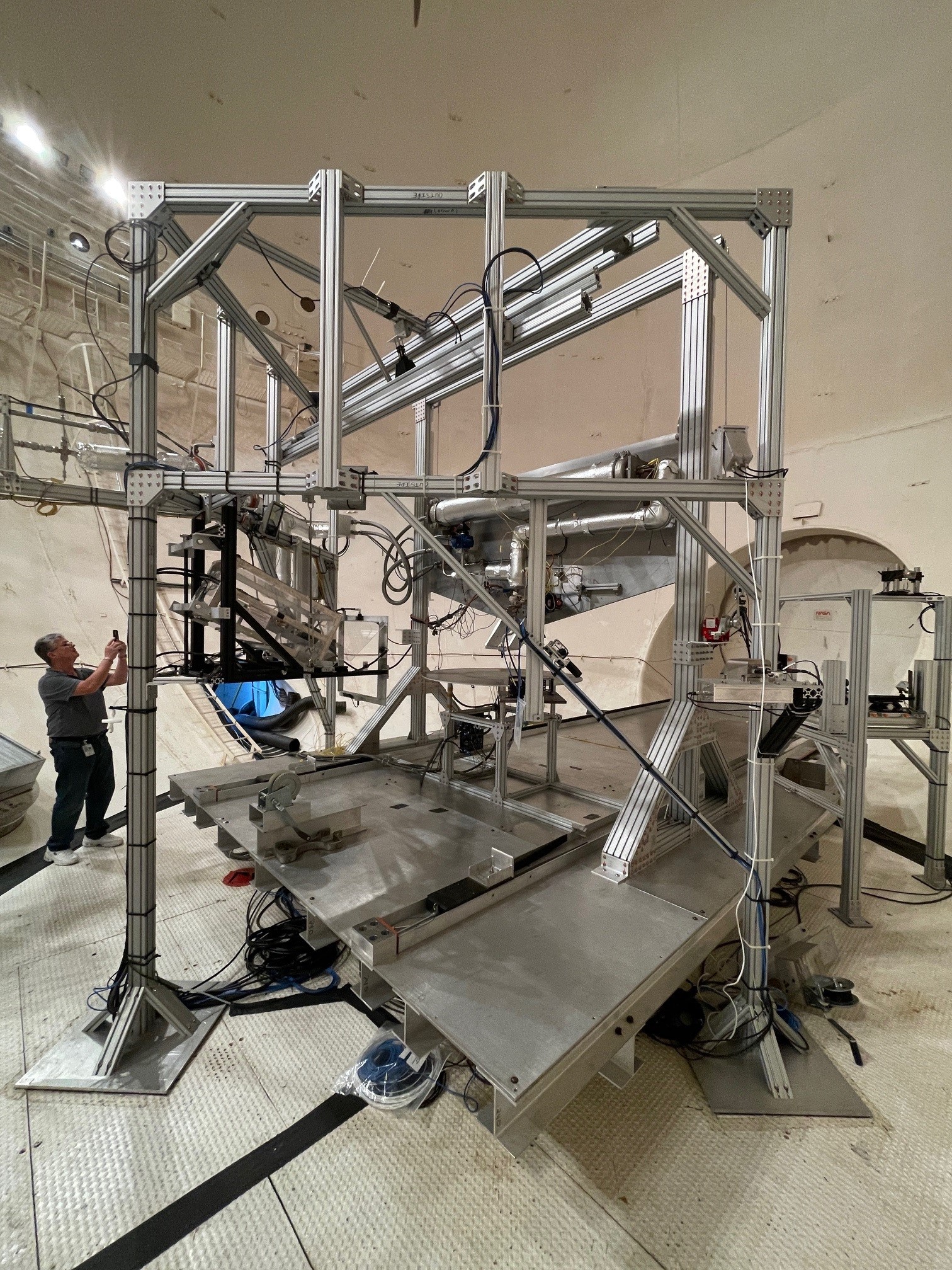
Views of the 60-foot vacuum sphere in the which the plume-surface interaction testing is happening.
Credits: NASA/Joe Atkinson
In March, NASA researchers employed a new camera system to capture data imagery of the interaction between Firefly Aerospace Blue Ghost Mission-1 lander’s engine plumes and the lunar surface.
Through NASA’s Artemis campaign, this data will help researchers understand the hazards that may occur when a lander’s engine plumes blast away at the lunar dust, soil, and rocks.
The data also will be used by NASA’s commercial partners as they develop their human landing systems to safely transport astronauts from lunar orbit to the Moon’s surface and back, beginning with Artemis III.
To better understand the science of lunar landings, a team at NASA’s Langley Research Center in Hampton, Virginia, has initiated a series of plume-surface interaction tests inside a massive 60-foot spherical vacuum chamber.
This plume-surface interaction ground test is the most complex test of its kind to be undertaken in a vacuum chamber
Ashley Korzun
PSI Testing Lead at NASA Langley
“This plume-surface interaction ground test is the most complex test of its kind to be undertaken in a vacuum chamber,” said Ashley Korzun, testing lead at NASA Langley. “If I’m in a spacecraft and I’m going to move all that regolith while landing, some of that’s going to hit my lander. Some of it’s going to go out toward other things — payloads, science experiments, eventually rovers and other assets. Understanding those physics is pivotal to ensuring crew safety and mission success.”
The campaign, which will run through spring of 2026, should provide an absolute treasure trove of data that researchers will be able to use to improve predictive models and influence the design of space hardware. As Korzun mentioned, it’s a big undertaking, and it involves multiple NASA centers, academic institutions, and commercial entities both small and large.
Korzun’ s team will test two types of propulsion systems in the vacuum sphere. For the first round of tests this fall, they are using an ethane plume simulation system designed by NASA’s Stennis Space Center near Bay St. Louis, Mississippi, and built and operated by Purdue University in West Lafayette, Indiana. The ethane system generates a maximum of about 100 pounds of thrust — imagine the force necessary to lift or support a 100-pound person. It heats up but doesn’t burn.
A view of the ethane nozzle researchers are using during the first phase of testing. NASA/Wesley Chambers
After completing the ethane tests, the second round of tests will involve a 14-inch, 3D-printed hybrid rocket motor developed at Utah State University in Logan, Utah, and recently tested at NASA’s Marshall Space Flight Center in Huntsville, Alabama. It produces around 35 pounds of thrust, igniting both solid propellant and a stream of gaseous oxygen to create a hot, powerful stream of rocket exhaust, simulating a real rocket engine but at smaller scale for this test series.
Researchers will test both propulsion systems at various heights, firing them into a roughly six-and-a-half-foot diameter, one-foot-deep bin of simulated lunar regolith, called Black Point-1 that has jagged, cohesive properties similar to lunar regolith.
“It gives us a huge range of test conditions,” Korzun said, “to be able to talk about spacecraft of all different kinds going to the Moon, and for us to understand what they’re going to do as they land or try to take back off from the surface.”
Researchers will use this 14-inch, 3D-printed hybrid rocket motor during the second phase of testing.
The data from these tests at NASA Langley will be critical in developing and validating models to predict the effects of plume surface interaction for landing on the Moon and even Mars, ensuring mission success for the HLS landers and the safety of our astronauts
Daniel Stubbs
Engineer with HLS Plume and Aero Environments Team at NASA Marshall
Korzun sees this test campaign as more than a one-shot, Moon-specific thing. The entire operation is modular by design and can also prepare NASA for missions to Mars. The lunar regolith simulant can be replaced with a Mars simulant that’s more like sand. Pieces of hardware and instrumentation can be unbolted and replaced to represent future Mars landers. Rather than take the vacuum sphere down to really low pressure like on the Moon, it can be adjusted to a pressure that simulates the atmosphere on the Red Planet. “Mars has always been in our road maps,” Korzun said.
But for now, the Moon looms large.
A number of instruments, including SCALPSS cameras similar to the ones that captured imagery of the plume-surface interaction between Firefly Aerospace’s Blue Ghost lander and the Moon in March, will capture data on the sphere tests.
NASA/Ryan Hill
“This test campaign is one of the most flight-relevant and highly instrumented plume-surface interaction test series NASA has ever conducted,” said Daniel Stubbs, an engineer with the human landing systems plume and aero environments team at NASA Marshall. “The data from these tests at NASA Langley will be critical in developing and validating models to predict the effects of plume-surface interaction for landing on the Moon and even Mars, ensuring mission success for the human landing systems and the safety of our astronauts.”
Through the Artemis campaign, NASA will send astronauts to explore the Moon for scientific discovery, economic benefits, and to build upon our foundation for the first crewed missions to Mars – for the benefit of all.
A team at NASA Langley is firing engine plumes into simulated lunar soil because as the United States returns to the Moon, both through NASA’s Artemis campai...
Our top laptop and tablet picks can be the perfect gifts for this holiday season. We've spent hundreds of hours testing the most popular devices and shortlisted our favorites for gaming, working and content creation.
Identity management vendors like Okta see an opening to calm CISOs worried about agents running amok
The fear of AI agents running amok has thus far halted the wide deployment of these digital workhorses, Okta's president of Auth0, Shiv Ramji, told The Register.…
The team behind Parrot OS (often shortened to Parrot) has announced the beta release of Parrot 7.0. The update, now in testing, brings several upgrades and improvements to the distribution that emphasizes security, including a switch to KDE Plasma as the default desktop.
Ring has started rolling out its AI-powered facial recognition feature, Familiar Faces, to video doorbell owners across the United States. This addition means your smart doorbell can now identify your visitors, a major step forward for personalization that also brings significant privacy concerns.
Over the last year, the Google Photos app has seen a series of redesigns. The image editor was one of the first things to be refreshed, and now Google has moved on to videos. If you’ve been relying on third-party apps like CapCut for simple video edits, get ready to tap the "Uninstall" button.
The Supreme Court’s conservative justices appear ready to overturn a 90-year-old precedent that said the president cannot fire a Federal Trade Commission member without cause. A ruling for Trump would give him more power over the FTC and potentially other independent agencies such as the Federal Communications Commission.
Former FTC Commissioner Rebecca Kelly Slaughter, a Democrat, sued Trump after he fired both Democrats from the commission in March. Slaughter’s case rests largely on the 1935 ruling in Humphrey’s Executor v. United States, in which the Supreme Court unanimously held that the president can only remove FTC commissioners for inefficiency, neglect of duty, or malfeasance in office.
Chief Justice John Roberts said during yesterday’s oral arguments that Humphrey’s Executor is a “dried husk” despite being the “primary authority” that Slaughter’s legal team is relying on. Roberts said the court’s 2020 ruling in Seila Law made it “pretty clear… that Humphrey’s Executor is just a dried husk of whatever people used to think it was because, in the opinion itself, it described the powers of the agency it was talking about, and they’re vanishingly insignificant, have nothing to do with what the FTC looks like today.”
On Monday, US District Court Judge Patti Saris vacated a Trump executive order that brought a halt to all offshore wind power development, as well as some projects on land. That order had called for the suspension of all permitting for wind power on federal land and waters pending a review of current practices. This led states and an organization representing wind power companies to sue, claiming among other things that the suspension was arbitrary and capricious.
Over 10 months since the relevant government agencies were ordered to start a re-evaluation of the permitting process, testimony revealed that they had barely begun to develop the concept of a review. As such, the only reason they could offer in defense of the suspension consisted of Trump’s executive order and a Department of the Interior memo implementing it. “Whatever level of explanation is required when deviating from longstanding agency practice,” Judge Saris wrote, “this is not it.”
Lifting Trump’s suspension does not require the immediate approval of any wind projects. Instead, the relevant agencies are likely to continue following Trump’s wishes and slow-walking any leasing and licensing processes, which may force states and project owners to sue individually. But it does provide a legal backdrop for any suits that ultimately occur, one in which the government’s actions have little justification beyond Trump’s personal animosity toward wind power.
Amazon is rolling out new shopping features for its AI-powered Alexa+ assistant, most notably a price tracker that automatically purchases items when they drop to a specified price. This removes the need to constantly refresh pages waiting for a deal, because it will give you updates on changes.
If you’re anything like me, you know how important it is to get ideas and to-dos out of your brain so you actually remember them later. After bringing the iconic smartwatch back this year, Pebble is hoping its next product will help in these situations. It’s a smart ring called the Index 01.
Nobody wants to believe their new phone is the best it will ever be on the day they bought it, but that’s the reality for many Android owners. However, if you use a Google Pixel, there’s a solid argument to be made that it gets better with time.
Firefox 146 is rolling out, bringing a major, long-awaited display improvement for users running Linux with the Wayland compositor. The newest build now natively supports fractional scaling on Linux, which should make the rendering experience much better and snappier.
Foreign secretary set to address senior diplomats later today
The UK's foreign secretary is calling for closer collaboration with Europe to combat the growing threat of information warfare as hybrid attacks target countries on the continent.…
Digital native? Cloud native? No, we need to be AI native, says Riyadh Air
IBM and Riyadh Air have upgraded their contracted agreement, meaning the Saudi operation will not be the world's first digitally native airline, but will instead be the first AI native operator.…
The text editor is the most critical tool in a programmer's arsenal, acting as the daily workbench, primary interface, and engine for creation. For years, Microsoft's Visual Studio Code (VS Code) has dominated, becoming the default choice for millions of developers across nearly every programming language and operating system.
 Login
Login