Normal view

There are new articles available, click to refresh the page.
Before yesterdayMain stream

Two big opportunities are on the horizon for veterans: one to land a job, another to launch a business

20 November 2025 at 14:34

Interview transcript

Terry Gerton I want to start with a big picture question because the last few months of downsizing in the federal workforce and the ramifications that has had on contractor workforces have really had a significant impact on military veterans and military spouses. Can you help us understand why those groups are so vulnerable in those particular sectors to downsizing.

Dan Clare Absolutely. I mean, veterans comprise a large percentage of the federal workforce. There is some preference given to disabled veterans, veterans who have certain decorations from their service if they’ve been on campaigns and things like that. And there are federal set-asides as well for government contractors. There’s a lot of disabled veterans, particularly, who are working for the federal government. And those folks, some of them faced a fork in the road — some of them have been furloughed for a long period of time, some of them are looking for different career opportunities now that the government doesn’t seem maybe as steady as it used to be. So we’re hearing from a lot of veterans who [are] just looking at other opportunities, basically. And some of them have been without work for a good while. So we are helping them out. And then on the contracting side, both as employees and as business owners, veterans are disproportionately affected by interruptions in contracts, by government shutdowns, all those sorts of things.

Terry Gerton And the federal government had a special hiring authority for military spouses, correct?

Dan Clare It’s a great question because military spouses are always disadvantaged, they’re always sacrificing for our country alongside their loved one, whether that be a man or woman. And those folks, the portability of their careers is very important to them. So for them, having opportunities in employment, having opportunities to have a business that they can take with them as they go along their journey, those are both very important things for them.

Terry Gerton How is DAV engaged in the veteran employment space? That might not be the first place that folks would expect the Disabled American Veterans Group to be involved.

Dan Clare You would think, but you know going back a hundred years — DAV has been around for a long time — that was one of the original issues that we faced from World War I veterans coming home. Veterans who are changed as a result of their service — they’re at a disadvantage sometimes when they’re looking for jobs, so … we’ve always advocated for employment opportunities, program services for veterans, but this is a chance for us to connect veterans directly with employers who want to hire them, who recognize the unique skills and talents that they bring. So we’re so proud as an organization to be able to partner with these employers who recognize that value and they’re making it a serious effort to hire and retain veterans.

Terry Gerton What are some of the lessons you’re learning through that involvement about today’s employment market? What are big opportunities? What are employers looking for and how do veterans fit in?

Dan Clare Well, I think one of the things we tell veterans frequently is that you’re in military service and you might have a job specialty or an occupational specialty that doesn’t seem like it translates particularly well to civilian life. Some do. You know, if you’re a firefighter in the military, being a firefighter or a crash rescue guy on the civilian side lines up pretty nice. But we find that there are a lot of soft skills and real talent and job experiences that veterans have that help them out a lot. So we’re talking to all industries right now when we’re talking about our employers. And there are so many different positions that they offer and so many different talents that veterans bring. I mean, people think about maintenance, aircraft maintenance, they think about logistics, but there’s great management opportunities. There’s people who’ve worked with budgets in an operational environment. There’s all kinds of different reasons why veterans are uniquely suited to be resilient as job searchers.

Terry Gerton I’m speaking with Dan Clare. He’s chief communications and outreach officer at the Disabled American Veterans. Dan, DAV is hosting a nationwide virtual job fair next week. Tell us about that.

Dan Clare It’s a virtual career fair. These are awesome events. You’re going to find some great opportunities there. We have AT&T, Department of Energy, Wells Fargo, Border Patrol, Discount Tire. Those are some of the top level companies who we think of, you know, they have names that are pretty recognizable to most of us, but there are a lot of other employers who are gonna be there. And as a veteran or spouse who is looking for a job, you might think, well, I’m not gonna work in the waste management industry because I’m disabled and for me, hiking trash cans isn’t gonna be a career for me. But you have to recognize that all of those companies have different opportunities and different positions within them that might be a perfect fit for a veteran’s experiences so far.

Terry Gerton What helpful hints would you have for veterans and military spouses who are interested in participating? How can they best prepare?

Dan Clare Well, I mean, having a good resume is very important. If you’re going in advance and looking at the job fair, there’s a page there. You can look at the types of positions that are out there and kind of earmark some opportunities specifically. And if you can, you can then tailor a resume a little bit more towards what the requirements are of that position. So those are important things. Veterans know how to dress nice, fortunately. So we have that going for us. You should look great going into it. And then developing a little bit of a pitch for yourself, an elevator pitch, where you say, this is who I am, this is what I’m about professionally, this is the kind of opportunity that I’m looking for, and this is what I hope to do through that opportunity for the company I work for … That’s some of the advice that we’re giving veterans to prepare.

Terry Gerton And not every veteran wants to work for someone else. Many of them want to start their own business. And DAV has a program, the Patriot Boot Camp, to help veterans understand how to start a business. Tell us about that.

Dan Clare It’s an incredible program. It’s cohort based, it’s two and a half days of very intensive training … you’re going be able to talk and interact with people about funding, which is one of the biggest, biggest shortfalls for veterans as entrepreneurs. We’re gonna talk about team building, sales, marketing, branding, and you’re gonna get mentorship. You’re going to get about four hours of mentorship with CEO-level professionals who can help you and they’re driven because they wanna help you avoid making the mistakes that they might have made earlier in their careers. And these people will fly across the country to be there with us. Our next event is Feb. 11 through 13 in Myrtle Beach. And I encourage people to travel for these events because sometimes as an entrepreneur, when you’re closer to home, it’s impossible to avoid some of the details and things that you need to work on for your venture. So Feb. 11th through 13, this is a free opportunity. And we want to get as many veteran entrepreneurs and spouses involved as possible.

Terry Gerton Do you give folks a real taste of the challenges of entrepreneurship? I mean, it’s not the easiest way to move forward.

Dan Clare No, it’s extremely risky. By definition, being an entrepreneur is being a risk-taker, and we recognize that. And we recognize, too, not all these ventures are going to succeed. But the veterans having the experience, getting involved — we find they’re naturally resilient, they’re creative. They’re good at strategy, good at planning. There are just some areas every veteran entrepreneur seems to have where they’re an A+ across the board. And then when it comes to marketing or sales, maybe they’re a D-. So we can address that there. And also they walk away with the community. Each cohort is its own network. And that includes all of the mentors who participate. So we’re really excited. What this does to transform a veteran’s life and make them someone who hires people is extremely exciting for us. And we’re always looking for mentors, always looking for veterans who want to get involved. And it’s extremely meaningful to be involved with.

Terry Gerton What message do you have for employers or business leaders who want to get involved from the hiring side in these activities?

Dan Clare I mean, it’s accessible to you too. Hiring veterans, the people who come to these career fairs, we have them there all the time. Tons of veterans coming through all the times. They tell us that the value is there. The reason why they’re there isn’t — I mean yes, they wanna do the right thing, they’re patriotic, they believe it’s right thing for America to hire veterans — but they’re also making a good deal. They’re finding people who are already trained or trainable. They’re finding people who are disciplined, who show up on time. They find people who’re great team workers and abnormally loyal to companies and institutions that they get involved with. I mean, it makes good business sense for you to hire veterans. If you visit our website, jobs.dav.org, we have an employer resource there where you can kind of validate that decision or make that decision if you want. We have a recognition program called the Patriot Employers Program. That you can access where we’re actually going to help you recruit because you’re going to be able to show veterans with a digital seal that it’s something that you’re focused on. So there are a lot of great ways to get involved. Hiring veterans is good for you and it’s good for our country.

Terry Gerton For veterans and military spouses who might be interested in participating either in the job fair or in the Patriot Boot Camp, where do they go to find out more?

Dan Clare You can find more at jobs.dav.org. There’s all kinds of stuff on there, so check it out. You can hear about success stories, hear about things that are working for other folks, and just visit us … Nov. 25, that virtual career fair could change someone’s life, so we wanna get as many people involved as possible.

The post Two big opportunities are on the horizon for veterans: one to land a job, another to launch a business first appeared on Federal News Network.

© The Associated Press

FILE - A person waits in a line for a prospective employer at a job fair, Aug. 29, 2024, in Sunrise, Fla. (AP Photo/Lynne Sladky, File)

VA says it’s helping a record number of homeless veterans find permanent housing

  • The Department of Veterans Affairs said it’s helping a record number of homeless veterans find permanent housing. The VA said it assisted nearly 52,000 formerly homeless veterans with housing in fiscal 2025. That’s more than any previous year tracked by the department. The VA provides subsidies to help some veterans afford rent on houses or apartments. In other cases, it helps reunite homeless veterans with family or friends.
  • A bipartisan push to extend a cybersecurity information sharing law may have a path forward in the Senate. A 10-year extension of the Cybersecurity Information Sharing Act of 2015 could be included in a future spending package. That’s according to Sens. Gary Peters (D-Mich.) and Mike Rounds (R-S.D.), the co-sponsors of the bill. Senate Homeland Security and Governmental Affairs Committee Chairman Rand Paul (R-Ky.) has been blocking their bill. But Peters and Rounds told the audience at the Aspen Institute Cyber Summit on Tuesday that the bill would have plenty of support if it can reach the Senate floor as part of a package. Congress included a short-term extension of the CISA 2015 law in the continuing resolution.
    (Aspen Institute Cyber Summit - Aspen Institute )
  • The Army has selected nine installations as potential sites for microreactor power plants under its next-generation Janus nuclear power program. Meanwhile, the Defense Innovation Unit issued a solicitation for commercial advanced nuclear technologies to support the effort. The nine sites the Army identified through comprehensive analysis include Fort Bragg in North Carolina and Redstone Arsenal in Alabama. The Army said the final number and location for these microreactors will be determined as part of the acquisition process, but the service is committed to maximizing the number of sites.
  • Army Secretary Daniel Driscoll instructed unit leaders to check in on their soldiers daily now through Jan. 15. In a memo to the force, Driscoll mandated every officer and noncommissioned officer to "deliberately" check in on every soldier to see if they need help. “The holidays can be a high-risk period for self-harm. We know it’s a problem, it happens every year, so we’ll address it head-on,” Driscoll said in the memo. The effort is based on initiatives like in the 11th Airborne Division in Alaska, where they “systemically prioritized soldier checks” to combat a high suicide rate.
  • The Office of Personnel Management has kicked off another human resources IT modernization effort. OPM is reviewing responses to an RFI and meeting with vendors for how to modernize the USA Hire platform. Agencies use USA Hire to conduct assessments of applicants for jobs. In fiscal 2024, agencies used the program to assess approximately one million applicants for over 20,000 job opportunity announcements. OPM expects agency use to continue to grow, especially from TSA and ICE as they hire more employees. OPM plans to release a draft solicitation in January and a final request for proposals in October to modernize the USA Hire platform.
  • The Office of Personnel Management is close to finalizing its effort to strip job protections from tens of thousands of federal employees. OPM’s proposed regulations for the so-called “Schedule Policy/Career” classification have been moved into the “final rule stage,” according to the White House’s regulatory agenda. Those regulations are slated for possible finalization by the end of November. OPM’s final rule will impact career employees in “policy-influencing positions,” making them at-will and easier to fire.
  • NASA is moving quickly to consolidate up to a quarter of its suburban Maryland campus. The International Federation of Professional and Technical Engineers said the NASA Goddard Space Flight Center in Greenbelt, Maryland, is embarking on plans to close 13 buildings on its campus. The union said NASA began work closing buildings and labs in late September and that this work continued through the government shutdown. The agency is looking to reduce 25% of the campus’s real estate by 2037.
  • The General Services Administration continues to lower the price for access to AI tools. First it was $1, then it was 50 cents. Now for a quarter, agencies are able to buy artificial intelligence tools through the GSA schedule contract. Under a new deal signed with the GSA, Perplexity is offering its AI research and drafting capabilities for a mere 25 cents for the next 18 months. GSA said it structured the deal to make the software available directly from Perplexity through the GSA schedule. Previously, agencies could only access Perplexity through a reseller. This is the first OneGov agreement GSA signed that is directly with an original equipment manufacturer, or OEM.
  • Agencies are likely to see an uptick in Freedom of Information Act delays and backlogs. That’s because agency FOIA offices were furloughed through the shutdown, but the law requires agencies to count normal working days during the shutdown as part of the FOIA processing time. That’s according to new Justice Department guidance to federal FOIA offices. DOJ said there were 29 days during the shutdown that will count toward FOIA requests and administrative appeals processing.
    (Calculating FOIA response times after 2025 government shutdown - Justice Dept. Office of Information Policy)
  • The Trump administration’s cuts to the federal workforce are becoming more apparent across the country. Close to half of respondents in a nonprofit’s recent survey said they or someone they know have been personally affected by the government cuts. Six months ago, less than a third of respondents said the same. The new survey from the Partnership for Public Service also found that the impacts are disproportionately affecting younger adults.

The post VA says it’s helping a record number of homeless veterans find permanent housing first appeared on Federal News Network.

© AP Photo/R.J. Rico

This photo shows one of the the Veterans Empowerment Organization apartment buildings that offer permanent housing for 41 veterans, Tuesday, Oct. 31, 2023 in Atlanta. Veterans pay a small amount of rent, with funds from the Department of Veterans Affairs making up the difference. (AP Photo/R.J. Rico)

OpenAI Offers Free ChatGPT Plus Access to US Veterans

10 November 2025 at 16:17

OpenAI is offering US veterans free access to ChatGPT Plus, using AI tools to help service members transition into civilian careers and new opportunities.

The post OpenAI Offers Free ChatGPT Plus Access to US Veterans appeared first on TechRepublic.

OpenAI Offers Free ChatGPT Plus Access to US Veterans

10 November 2025 at 16:17

OpenAI is offering US veterans free access to ChatGPT Plus, using AI tools to help service members transition into civilian careers and new opportunities.

The post OpenAI Offers Free ChatGPT Plus Access to US Veterans appeared first on TechRepublic.

The Healing Art: Military Veteran Portraits Highlight PTSD & Cannabis

11 September 2025 at 03:38

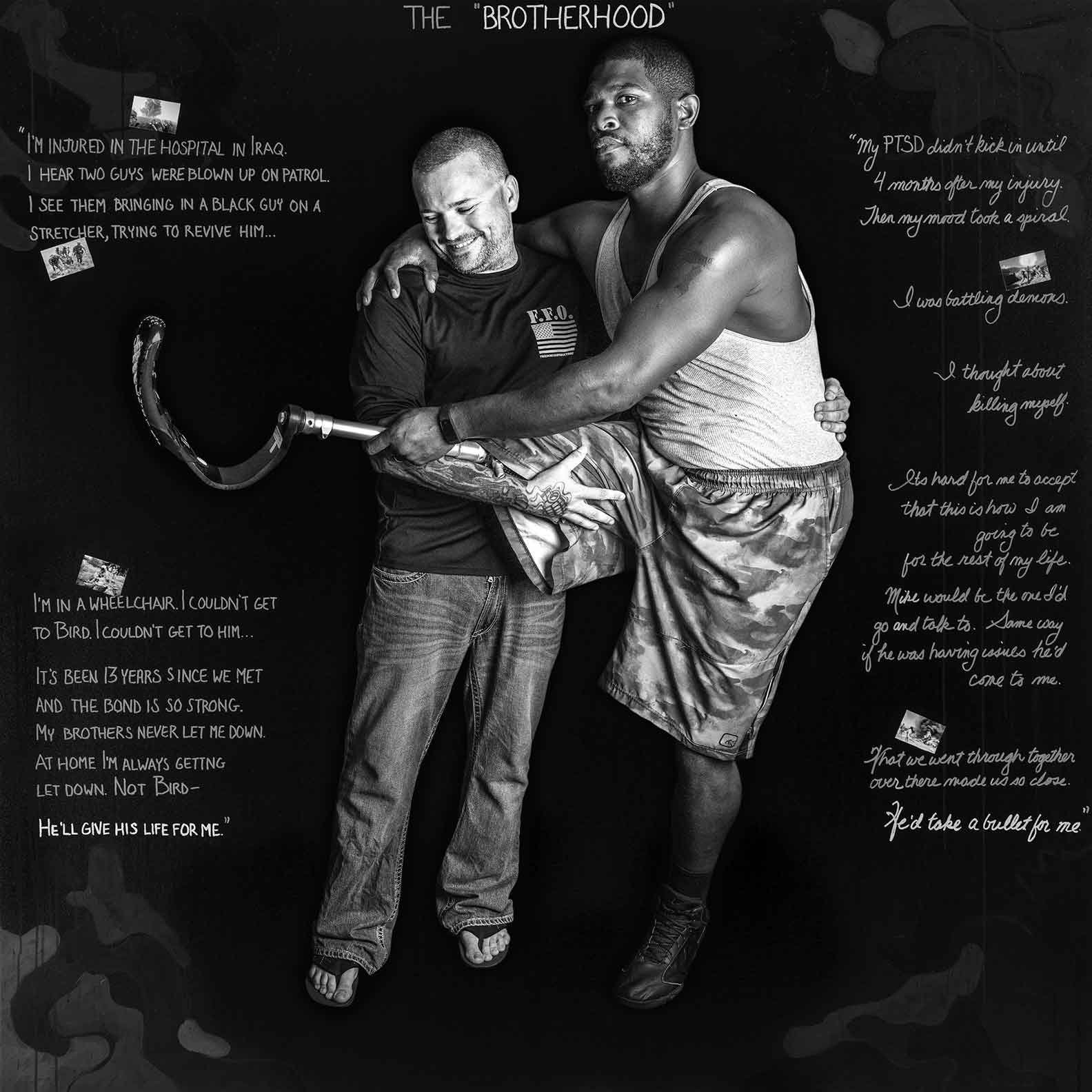
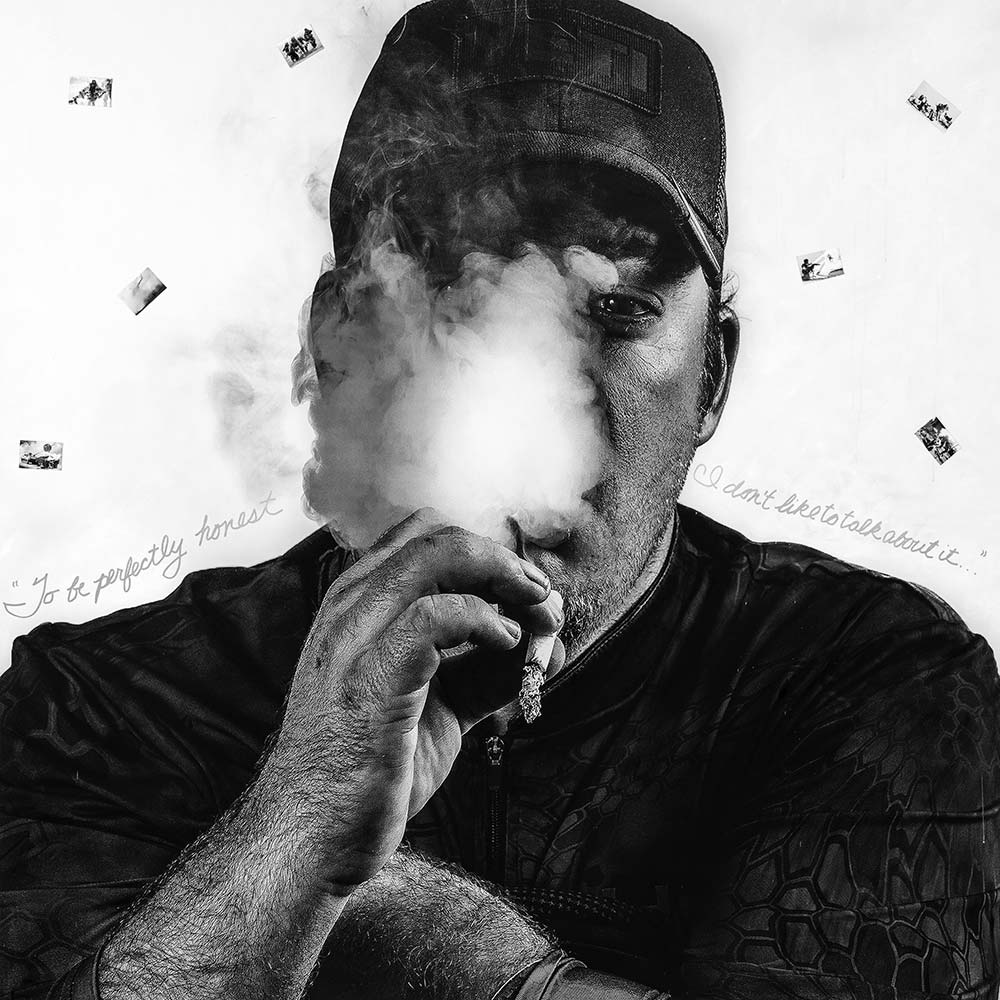
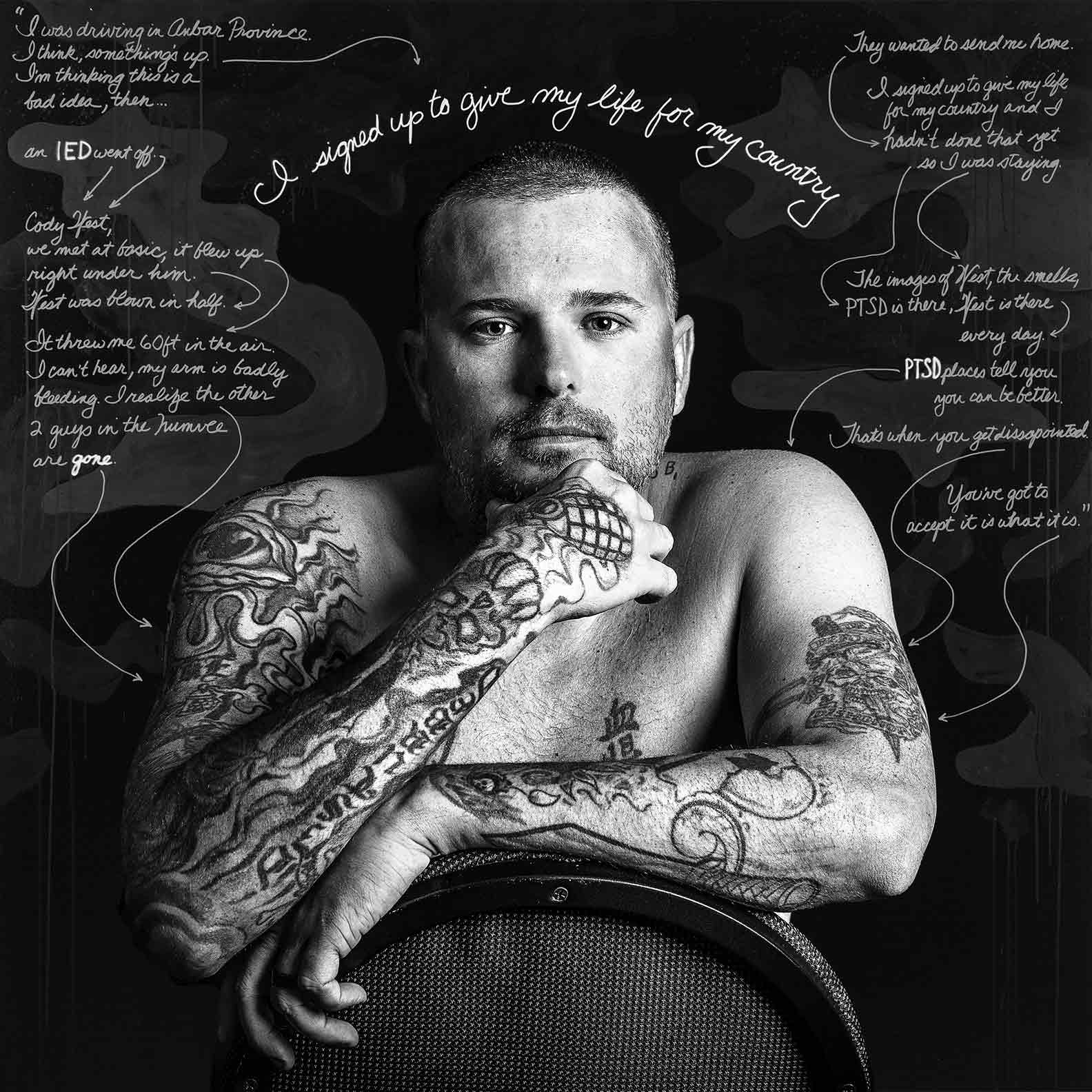
One of the worst nights of Susan Barron’s career came a few years ago, when the artist was in Manhattan to unveil her mixed-media art series, Depicting The Invisible. Military veteran portraits adorned with paint and text comprised the collection, which Barron designed to highlight veteran struggles with post-traumatic stress disorder (PTSD).

Just before the show, Barron’s phone rang. On the other end of the line was the mother of one of her photographic subjects. “She said he had succumbed to PTSD and taken his own life,” Barron says. “It was a gut punch.”

Nearly three million service members have deployed in support of the Global War on Terror since 2001. Of those who served in Iraq or Afghanistan, between 11 and 20 percent now suffer from PTSD. These glaring statistics have left an interminable trail of suicide victims in their wake—individuals, like Barron’s friend, who quietly endure the invisible wounds of combat, personal loss or sexual assault.

22 veterans per day. The suicide statistic has circulated extensively since such data first reached the public sphere. In 2020, the Department of Veterans Affairs reported 6,146 military vets died by suicide, an astonishing 17 per day. And while that number amounted to the lowest total since 2006, any semblance of empathy would suggest it stands at 6,146 too many.

It was learning about this epidemic that inspired Barron to create “Depicting The Invisible,” an exhibit that, since its launch, has occupied the hallowed halls of the National Veterans Memorial and Museum in Columbus, OH, and the Army and Navy Club in Washington, DC. among others.

“Mike” 72in x 72in Mixed Media on Canvas, 2019.
Susan Barron Exhibition Artwork
“Rena” 72in x 72in Mixed Media on Canvas, 2019.
“The Brotherhood” 72in x 72in Mixed Media on Canvas, 2019.

“I’m really grateful these very brave men and women shared their stories with me,” Barron says. “I wanted to shine a light on this epidemic of PTSD and suicide and help break down the stigma around issues of mental health. Every one of us needs to do whatever we can to help. As an artist, this is what I felt I could do.”

Barron’s photo series was shot using a classical black-and-white style that she says, “was intentionally in direct contrast to the brutality of their stories.”

“They’re heroic. They’re elegant,” Barron says.

The works also proved to be conversation starters, eventually becoming the subject of an NPR podcast and an award-winning short documentary of the same name.

“This project has had so many hands lift it up, and throughout all of it, I’ve been contacted by people I don’t even know telling me what a huge difference it made in their life or in their spouse’s life,” Barron says. “Sons, mothers, grandmothers—so many family members have been thankful for destigmatizing this, for honoring this as a wound of war and not a mental illness.”

Shattering stigmas has also opened the door to a more expansive network of PTSD treatment options for veterans, cannabis principal among them.

Susan Barron's artword "Herbert"
“Herbert” 72 in x 72 in Mixed Media on Canvas, 2019.

Ryan Cauley may not be one of Barron’s subjects, but his story, like the myriad of veterans enduring the trials of neurological trauma, is remarkably similar. Originally from Pendleton, Indiana, Cauley joined the Army in 2004 and served as a cavalry scout until 2007 with the service’s 1st Squadron, 32nd Cavalry Regiment, 101st Airborne Division.

Life after the service proved difficult. Post-traumatic stress impacted Cauley’s ability to connect. Depression and anxiety became a viciously cyclical norm. His attitude and behavior soured, and in turn, his marriage and personal relationships eroded.

Months of anger management and cognitive behavioral therapy helped Cauley understand how to manage the condition, but it wasn’t until his 2016 foray into medical cannabis—and subsequent launch of the cannabis and PTSD advocacy company Combat Cultivators—that he’d experience a real transformation.

“I had to convince my wife about using cannabis, but almost instantly, she was able to see the change in my attitude,” Cauley says. “I was able to give more love and be more compassionate. I could focus on tasks and not be consumed by negative thoughts.”

Noticeable attitude changes eventually manifested a genuine interest in the industry, and in 2018, Cauley set out to complete his first grow. “I was such a baby,” he says, smiling at the memory. “I wanted to grow my own cannabis, because, at the time, prices were more expensive than they are now. Today, we grow our own because it’s better than anything in the dispensaries.”

Cauley’s infantile curiosity soon blossomed into a profession. He became a lead grower at a company in Michigan, learning the ins and outs of large-scale growth, environmental control and cloning. He even recruited his best friend from the Army, Carlos Ozuna, to work in the same role. Together, the duo launched the Combat Cultivators Instagram account to be a vehicle of contacting other veteran cannabis advocates struggling with PTSD.

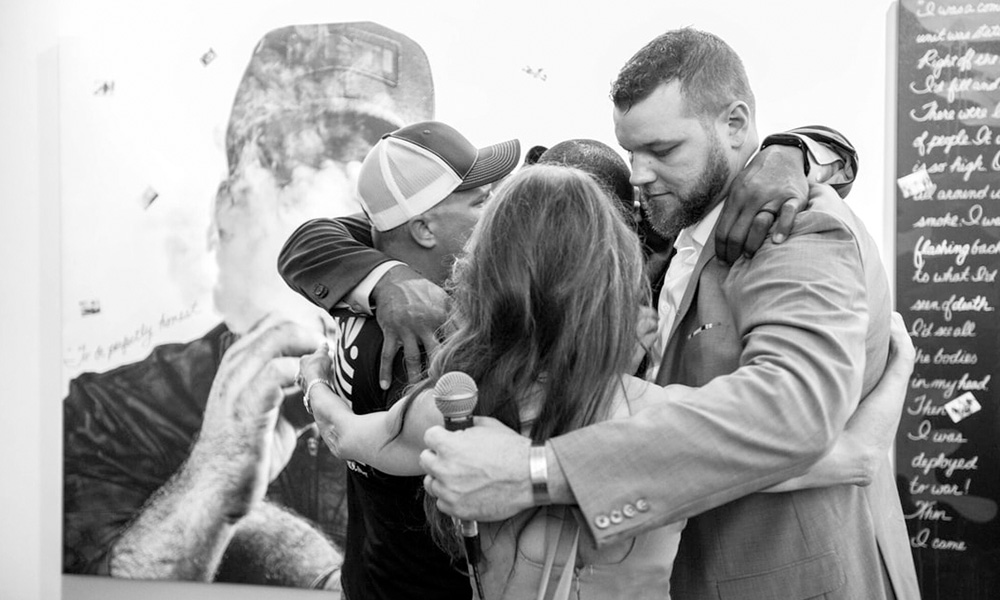
Susan Barron with Veterans
Susan Barron with Veterans at the “Depicting The Invisible” exhibition.

And while the friends have since left the company, Cauley credits the knowledge the two accumulated there for the duo’s success with Combat Cultivators. More than that, however, has been the remarkable difference cannabis has made in Cauley’s personal life. “It’s given me so much of my life back,” he says. “That sense of doing something for a reason. It also gave Carlos and I the opportunity to work together again.”

The number of ways veterans are learning to confront PTSD is ever-expanding. For Barron and Cauley, using their respective platforms has injected life into a conversation about mental health that remained dormant for far too long.

The dreaded phone call Barron received that day in Manhattan is one that many of today’s veterans and military family members have endured ad nauseam. Every story is unique, but the excruciating pain of loss is undeniably similar. Preventing that from happening to anyone else, Barron says, is a calling we should all gravitate toward.

“That day was a personal low for me, but it ignited an even stronger drive to get these stories out there,” Barron says. “We all just really need to do more.”

This story was originally published in issue 47 of the print edition of Cannabis Now.

The post The Healing Art: Military Veteran Portraits Highlight PTSD & Cannabis appeared first on Cannabis Now.

A Profound Loss: How Veteran Suicide Touches Us All

9 September 2025 at 08:57

The Hidden Costs We All Share

Kristin Wood and Sarah Kneller are Co-Founders of August Interactive. They have spent much of the last two years speaking with the military and veteran community about the ongoing suicide epidemic.

OPINION — 10 September is World Suicide Prevention Day.

While all loss of life is tragic, we particularly want to draw attention to something not widely known outside of military circles: some 140,000 veterans have died by suicide since 2001, and suicide rates also have significantly increased in the active-duty population over the same period.

Each one leaves behind not just a grieving family, but a community forever altered. It's the kind of loss that cannot be contained. It reaches across dinner tables, classrooms, workplaces, and communities—sometimes without us even realizing it.

If you think this crisis doesn’t affect you—think again.

Every veteran and military service member is a thread in the tapestry of our society. When that thread is lost, the fabric weakens. The impact is more than emotional; it’s deeply practical and economic. Their absence means fewer experienced mentors in our workplaces, fewer volunteers in our neighborhoods, and fewer leaders in our communities. The loss of each veteran is also a loss to our economy—potential contributions, innovations, and wisdom that will never be realized.

Authors’ Note: Discussing the economic impact of veteran suicide is undeniably delicate—no number can ever reflect the true cost of a human life or the pain felt by loved ones left behind. Our intention is not to reduce this tragedy to dollars and cents, but to shed light on just how deeply these losses affect all of us, especially for those who may feel far removed from military life. By bringing this conversation into focus, we hope to inspire greater understanding, compassion, and action—because veteran mental health is a concern for every community, not just those in uniform.

The Ripple Effects—Seen and Unseen

The People We Lean On

Veterans and military service members often become the coaches, small business owners, first responders, and volunteers who make our communities strong. When we lose them, we all lose.

-When Vietnam veteran Harold Johnson passed away, hundreds in his neighborhood attended a memorial walk he started years earlier to support local charities. Former students, neighbors, and fellow veterans shared stories of how Harold’s mentorship and volunteerism shaped their lives. The event became an annual tradition, preserving his influence on the community.

Invisible Wounds, Visible Consequences

Each suicide sends ripples through families, units, and neighborhoods. Research tells us that every loss directly touches more than 100 people—friends, coworkers, neighbors—who carry the weight of grief, and sometimes, renewed risk.

-Retired Army sergeant Justin Anderson started offering free car snow plow services. His efforts strengthened trust and support among local residents, who later rallied to support him during his own health challenges. The story underscores the deep connections veterans can foster in their communities.

The Burden Carried by Families

Spouses, parents, and children often become caregivers long before a loss occurs, sometimes sacrificing their own dreams and financial security. When the worst happens, communities step in to help, but the support is rarely enough to fill the space left behind.

-Stacey Hawley, a 2024 Dole Caregiver Fellow, became the full-time caregiver for her son, a wounded veteran, and saw her savings dwindle to the point that she had to donate plasma to make ends meet. Her experience exemplifies the immense financial and emotional sacrifices made by more than 14 million military and veteran caregivers in the U.S., many of whom face poverty, food insecurity, and mental health challenges as they support their loved ones.

Diminished Voices in Our Democracy

Veterans vote, volunteer, and run for office at higher rates than most Americans. Their loss means quieter communities, with fewer voices willing to bridge divides or step up in times of need.

-A recent study by the Center for Effective Lawmaking suggests that veterans often foster unity and bipartisanship, bridging political divides and facilitating constructive dialogue on critical issues.

The Cipher Brief brings expert-level context to national and global security stories. It’s never been more important to understand what’s happening in the world. Upgrade your access to exclusive content by becoming a subscriber.

The Economic Impact Is Closer Than You Think

We can never put a true price on human life. Full stop. But thinking about the economic consequences for all of us show that they reach far beyond what we might initially see:

Lost Productivity and Innovation: Each veteran or military member lost represents $1.4 to $2.1 million in potential economic contribution. Across 140,000 lives, this is nearly $200 billion in lost value—resources that would have supported families, started businesses, and built stronger communities.

Healthcare and Social Costs: The costs of crisis care, medical treatment, and survivor support add up quickly—and are often borne by our shared healthcare and social service systems.

Fewer Volunteers and Community Builders: Veterans give 25% more volunteer time than non-veterans. Their absence means millions of hours of community service and leadership never realized.

Why This Matters to All of Us

Military and veteran suicide are not just military issues or private tragedies—they are losses that quietly reshapes the communities we all share. When a veteran is lost, we lose a neighbor who might have coached Little League, a mentor who could have inspired a young entrepreneur, or a friend who would have stepped up in a crisis. We lose the unique perspectives and leadership that come from service and sacrifice.

This is why prevention matters—not just for those who served, but for all of us. Investing in mental health support, community connection, and honoring our national promise to veterans strengthens the very foundation of our society.

Moving Forward—Together

The numbers are sobering, but they only hint at the true cost. The empty seat at a community dinner, the missing voice in civic life, the innovation never born—these are losses we all feel, even if we never know the name or the story.

We all have a role to play. Reach out. Listen. Advocate for strong support systems. When we support veterans and their families, we are not only honoring their service—we are investing in the strength and resilience of our own communities.

Veteran suicide is a national crisis, but it is also deeply personal. It touches us all, whether we realize it or not.

And together, we can make a difference.

Statistics in this document are based on research and estimates from the CDC, Department of Veterans Affairs, and academic studies. While we strive for accuracy, the true human impact extends far beyond what any analysis can capture.

The Cipher Brief is committed to publishing a range of perspectives on national security issues submitted by deeply experienced national security professionals.

Opinions expressed are those of the author and do not represent the views or opinions of The Cipher Brief.

Have a perspective to share based on your experience in the national security field? Send it to Editor@thecipherbrief.com for publication consideration.

Read more expert-driven national security insights, perspective and analysis in The Cipher Brief

An Amarillo Veteran Went From Managing a Nuclear Arsenal to Tending Offset Smokers

22 August 2025 at 08:00
The stress of running a barbecue trailer is nothing compared with keeping the country’s nuclear arsenal safe. “It’s not work if you love what you’re doing,” Charles Carr, owner of Class-1 Barbecue, in Amarillo, told me when he explained why smoking meat became his retirement plan. He had been a facility manager at the Pantex plant, northeast of Amarillo, “where the U.S. arsenal for nuclear weapons is assembled and disassembled,” Carr explained. That position followed thirteen years of military service and three tours in the Army for Carr. “I got tired of running and gunning,” he said. He opened the trailer with his wife, Maria, last November.You could say he went from Class V (ammunition and explosives) to Class I (food and water), which are…

The post An Amarillo Veteran Went From Managing a Nuclear Arsenal to Tending Offset Smokers appeared first on Texas Monthly.

Innovator Spotlight: StrikeReady

By: Gary
1 September 2025 at 18:36

Security’s Silent Revolution: How StrikeReady is Transforming SOC Operations Security operations centers (SOCs) have long been the unsung heroes of cybersecurity, battling endless alerts and wrestling with fragmented toolsets. But...

The post Innovator Spotlight: StrikeReady appeared first on Cyber Defense Magazine.

Ready, Vet, Go: Meet Glen Coyle

14 August 2025 at 02:28

Glen Coyle may not be exactly as he appears.

As a proud military veteran, Canadian-born Glen Coyle named his company, Six One Charlie, after his Army call sign to honor his service and the brotherhood that comes with it. He says his focus is to provide all veterans access to the highest quality cannabis. Six One Charlie currently offers edibles, pre-rolls and topicals that focus on both flavor and wellness benefits as well as branded fashion.

“This isn’t a money thing for me,” Coyle says. “My goal is to help people, to help vets. And Six One Charlie isn’t just about cannabis. It’s about community.”

Who wouldn’t share a foxhole with this dude?

The post Ready, Vet, Go: Meet Glen Coyle appeared first on Cannabis Now.

❌
❌