
Normal view

There are new articles available, click to refresh the page.
Before yesterdayMain stream

Ore Formation: A Surface Level Look

4 December 2025 at 10:00

The past few months, we’ve been giving you a quick rundown of the various ways ores form underground; now the time has come to bring that surface-level understanding to surface-level processes.

Strictly speaking, we’ve already seen one: sulfide melt deposits are associated with flood basalts and meteorite impacts, which absolutely are happening on-surface. They’re totally an igneous process, though, and so were presented in the article on magmatic ore processes.

For the most part, you can think of the various hydrothermal ore formation processes as being metamorphic in nature. That is, the fluids are causing alteration to existing rock formations; this is especially true of skarns.

There’s a third leg to that rock tripod, though: igneous, metamorphic, and sedimentary. Are there sedimentary rocks that happen to be ores? You betcha! In fact, one sedimentary process holds the most valuable ores on Earth– and as usual, it’s not likely to be restricted to this planet alone.

Placer? I hardly know ‘er!

We’re talking about placer deposits, which means we’re talking about gold. In dollar value, gold’s great expense means that these deposits are amongst the most valuable on Earth– and nearly half of the world’s gold has come out of just one of them. Gold isn’t the only mineral that can be concentrated in placer deposits, to be clear; it’s just the one everyone cares about these days, because, well, have you seen the spot price lately?
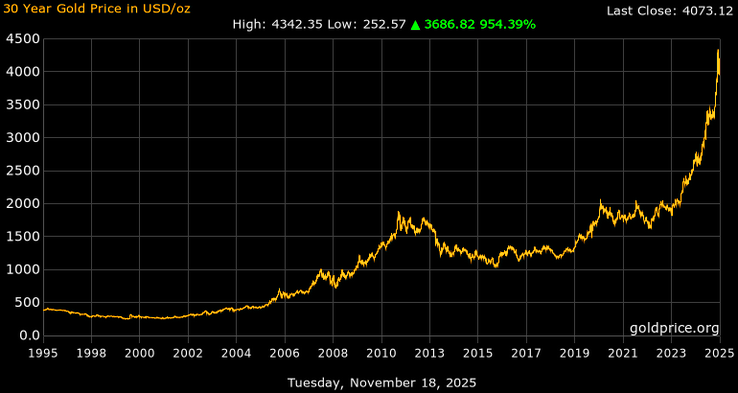
The spot price of gold going back 30 years. Oof.
Oof. Data from Goldprice.org

Since we’re talking about sediments, as you might guess, this is a secondary process: the gold has to already be emplaced by one of the hydrothermal ore processes. Then the usual erosion happens: wind and water breaks down the rock, and gold gets swept downhill along with all the other little bits of rock on their way to becoming sediments. Gold, however, is much denser than silicate rocks. That’s the key here: any denser material is naturally going to be sorted out in a flow of grains. To be specific, empirical data shows that anything denser than 2.87 g/cm3 can be concentrated in a placer deposit. That would qualify a lot of the sulfide minerals the hydrothermal processes like to throw up, but unfortunately sulfides tend to be both too soft and too chemically unstable to hold up to the weathering to form placer deposits, at least on Earth since cyanobacteria polluted the atmosphere with O2.
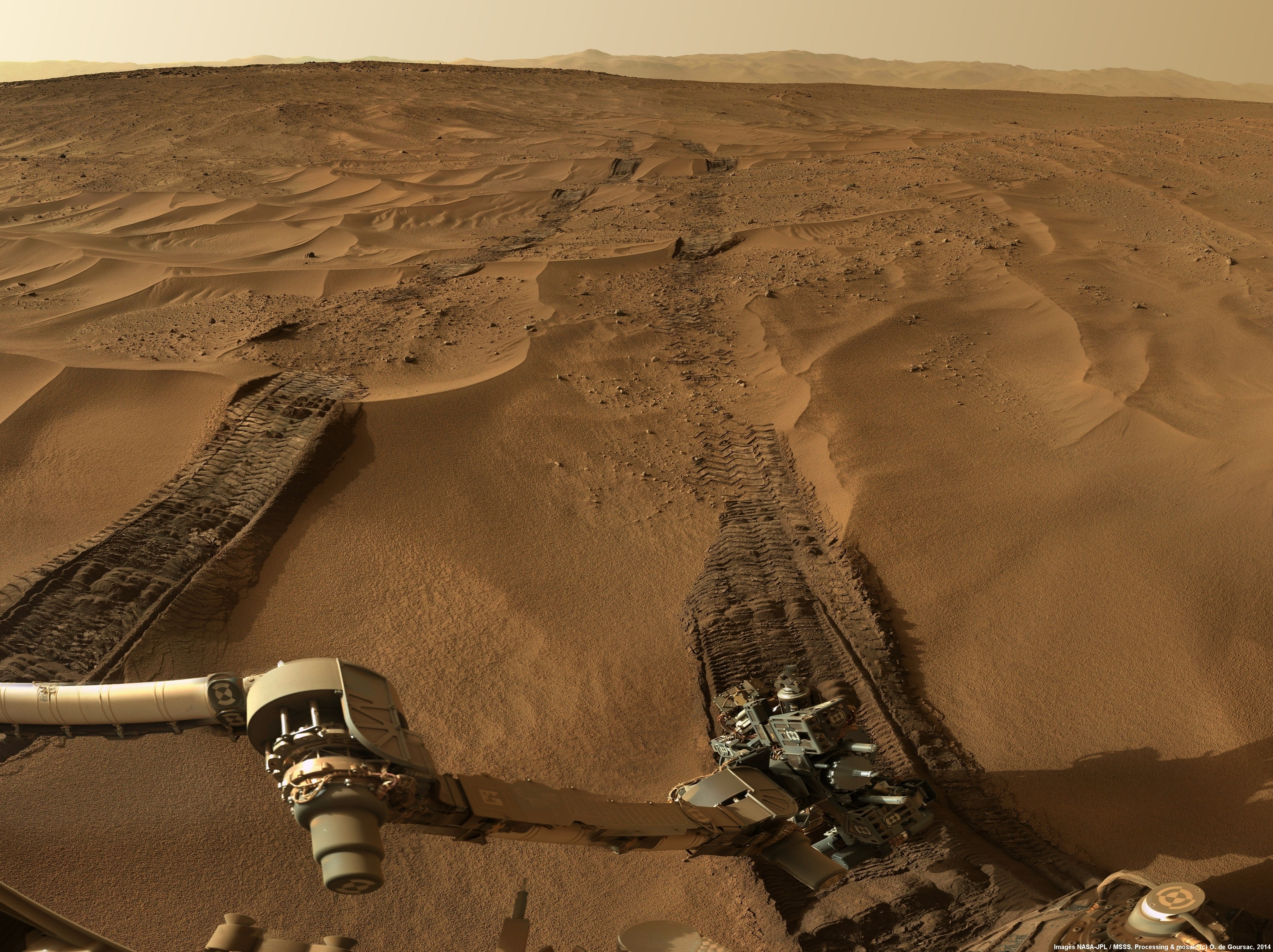
Windswept dunes on Mars as pictured by MSL.
Dry? Check. Windswept? Check. Aeolian placer deposits? Maybe!
Image: “MSL Sunset Dunes Mosaic“, NASA/JPL and Olivier de Goursac

One form of erosion is from wind, which tends to be important in dry regions – particularly the deserts of Australia and the Western USA. Wind erosion can also create placer deposits, which get called “aeolian placers”. The mechanism is fairly straightforward: lighter grains of sand are going to blow further, concentrating the heavy stuff on one side of a dune or closer to the original source rock. Given the annual global dust storms, aeolian placers may come up quite often on Mars, but the thin atmosphere might make this process less likely than you’d think.

We’ve also seen rockslides on Mars, and material moving in this matter is subject to the same physics. In a flow of grains, you’re going to have buoyancy and the heavy stuff is going to fall to the bottom and stop sooner. If the lighter material is further carried away by wind or water, we call the resulting pile of useful, heavy rock an effluvial placer deposit.

Still, on this planet at least it’s usually water doing the moving of sediments, and it’s water that’s doing the sortition. Heavy grains fall out of suspension in water more easily. This tends to happen wherever flow is disrupted: at the base of a waterfall, at a river bend, or where a river empties into a lake or the ocean. Any old Klondike or California prospector would know that that’s where you’re going to go panning for gold, but you probably wouldn’t catch a 49er calling it an “Alluvial placer deposit”. Panning itself is using the exact same physics– that’s why it, along with the fancy modern sluices people use with powered pumps, are called “placer mining”. Mars’s dry river beds may be replete with alluvial placers; so might the deltas on Titan, though on a world where water is part of the bedrock, the cryo-mineralogy would be very unfamiliar to Earthly geologists.

Back here on earth, wave action, with the repeated reversal of flow, is great at sorting grains. There aren’t any gold deposits on beaches these days because wherever they’ve been found, they were mined out very quickly.  But there are many beaches where black magnetite sand has been concentrated due to its higher density to quartz. If your beach does not have magnetite, look at the grain size: even quartz grains can often get sorted by size on wavy beaches. Apparently this idea came after scientists lost their fascination with latin, as this type of deposit is referred to simply as a “beach placer” rather than a “littoral placer”.
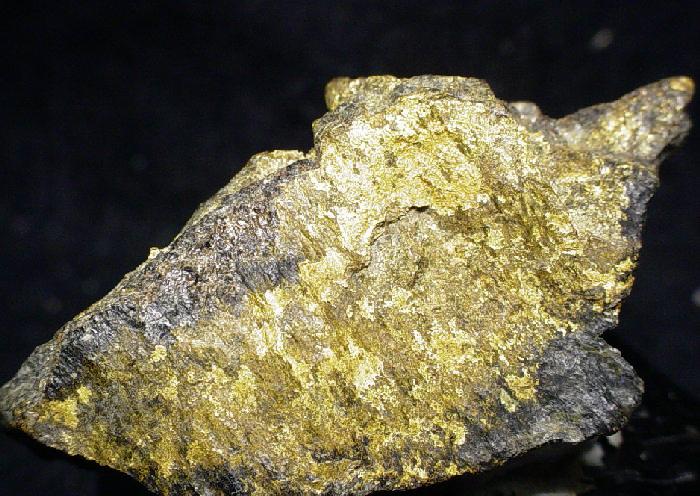
Kondike, eat your heart out: Fifty thousand tonnes of this stuff has come out of the mines of Witwatersrand.

While we in North America might think of the Klondike or California gold rushes– both of which were sparked by placer deposits– the largest gold field in the world was actually in South Africa: the Witwatersrand Basin. Said basin is actually an ancient lake bed, Archean in origin– about three billion years old. For 260 million years or thereabouts, sediments accumulated in this lake, slowly filling it up. Those sediments were being washed out from nearby mountains that housed orogenic gold deposits. The lake bed has served to concentrate that ancient gold even further, and it’s produced a substantial fraction of the gold metal ever extracted– depending on the source, you’ll see numbers from as high as 50% to as low as 22%. Either way, that’s a lot of gold.

Witwatersrand is a bit of an anomaly; most placer deposits are much smaller than that. Indeed, that’s in part why you’ll find placer deposits only mined for truly valuable minerals like gold and gems, particularly diamonds. Sure, the process can concentrate magnetite, but it’s not usually worth the effort of stripping a beach for iron-rich sand.

The most common non-precious exception is uraninite, UO2, a uranium ore found in Archean-age placer deposits. As you might imagine, the high proportion of heavy uranium makes it a dense enough mineral to form placer deposits. I must specify Archean-age, however, because an oxygen atmosphere tends to further oxidize the uraninite into more water-soluble forms, and it gets washed to sea instead of forming deposits. On Earth, it seems there are no uraninite placers dated to after the Great Oxygenation; you wouldn’t have that problem on Mars, and the dry river beds of the red planet may well have pitchblende reserves enough for a Martian rendition of “Uranium Fever”.
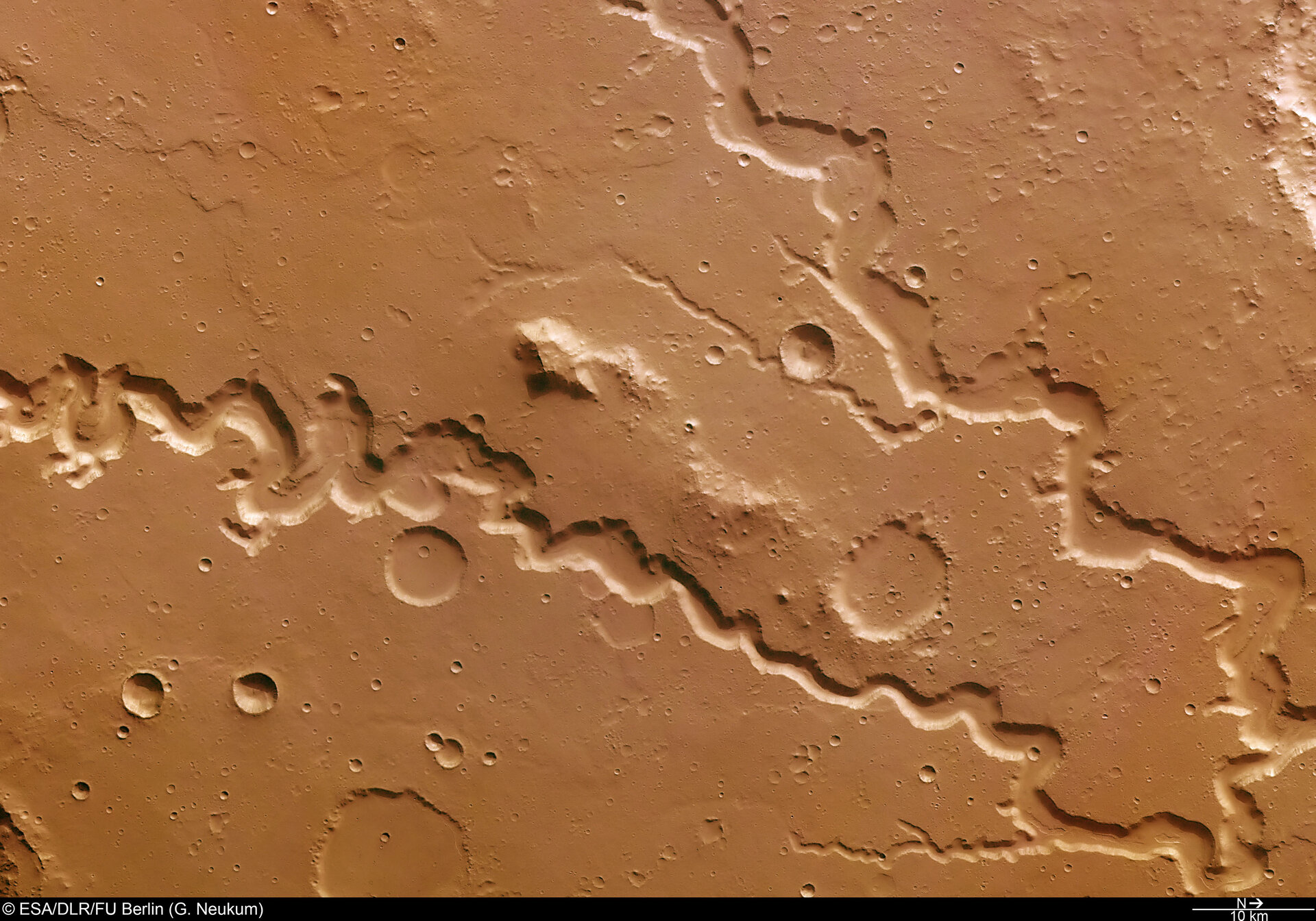
If you were the Martian, would you rather find uranium or gold in those river bends?
Image: Nandes Valles valley system, ESA/DLR/FU Berlin

While uranium is produced at Witwatersrand as a byproduct of the gold mines, uranium ore can be deposited exclusively of gold. You can see that with the alluvial deposits in Canada, around Elliot Lake in Ontario, which produced millions of pounds of the uranium without a single fleck of gold, thanks to a bend in a three-billion-year-old riverbed. From a dollar-value perspective, a gold mine might be worth more, but the uranium probably did more for civilization.

Lateritization, or Why Martians Can’t Have Pop Cans

Speaking of useful for civilization, there’s another type of process acting on the surface to give us ores of less noble metals than gold. It is not mechanical, but chemical, and given that it requires hot, humid conditions with lots of water, it’s almost certainly restricted to Sol 3. As the subtitle gives it away, this process is called “lateritization” and is responsible for the only economical aluminum deposits out there, along with a significant amount of the world’s nickel reserves.

The process is fairly simple: in the hot tropics, ample rainfall will slowly leech any mobile ions out of clay soils. Ions like sodium and potassium are first to go, followed by calcium and magnesium but if the material is left on the surface long enough, and the climate stays hot and wet, chemical weathering will eventually strip away even the silica. The resulting “Laterite” rock (or clay) is rich in iron, aluminum, and sometimes nickel and/or copper. Nickel laterites are particularly prevalent in New Caledonia, where they form the basis of that island’s mining industry. Aluminum-rich laterites are called bauxite, and are the source of all Earth’s aluminum, found worldwide. More ancient laterites are likely to be found in solid form, compressed over time into sedimentary rock, but recent deposits may still have the consistency of dirt. For obvious reasons, those recent deposits tend to be preferred as cheaper to mine.
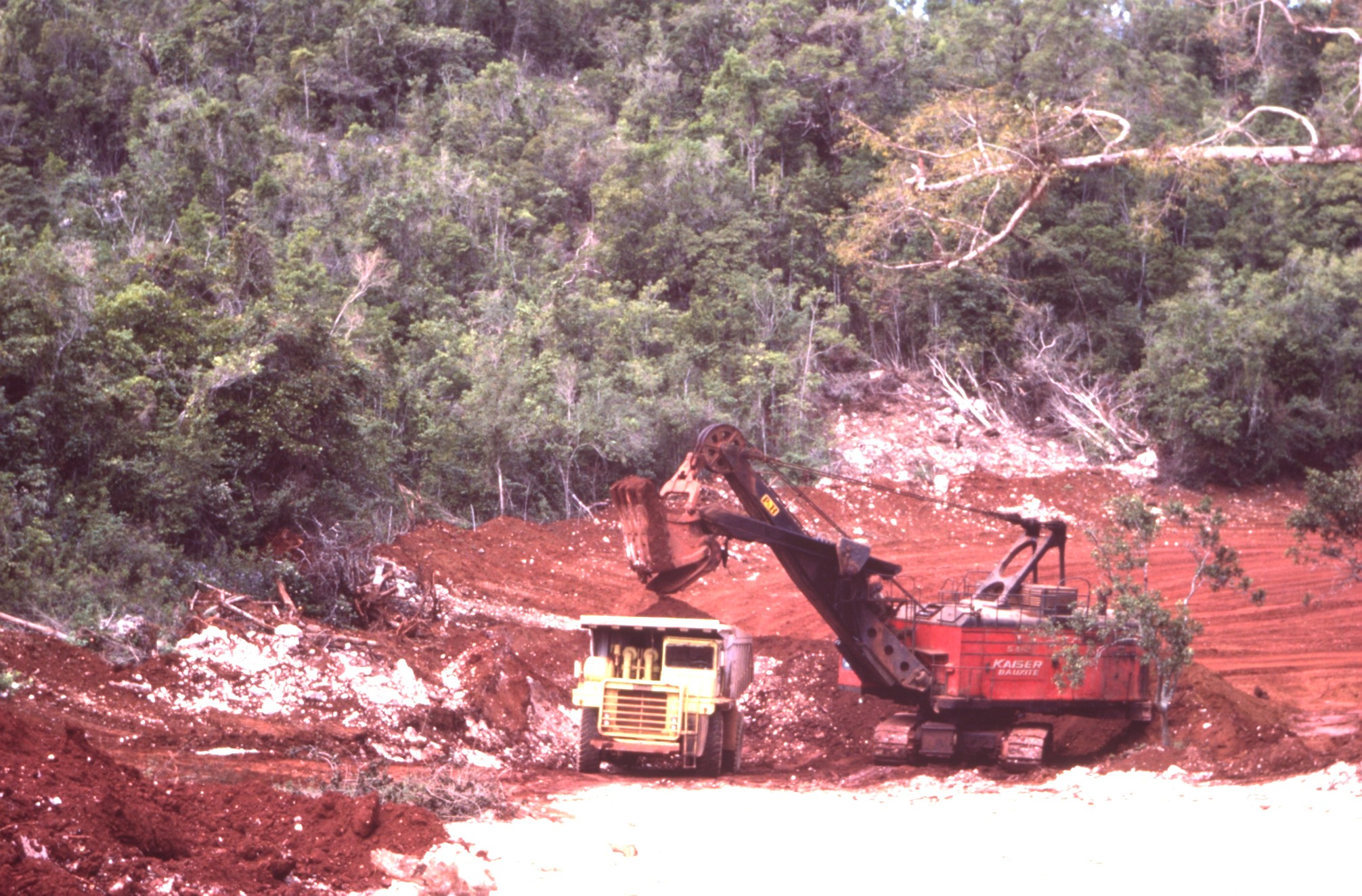
That red dirt is actually aluminum ore, from a 1980s-era operation on the island of Jamaica. Image from “Bauxite” by Paul Morris, CC BY-SA 2.0

When we talk about a “warm and wet” period in Martian history, we’re talking about the existence of liquid water on the surface of the planet– we are notably not talking about tropical conditions. Mars was likely never the kind of place you’d see lateritization, so it’s highly unlikely we will ever find bauxite on the surface of Mars. Thus future Martians will have to make due without Aluminum pop cans. Of course, iron is available in abundance there and weighs about the same as the equivalent volume of aluminum does here on Earth, so they’ll probably do just fine without it.

Most nickel has historically come from sulfide melt deposits rather than lateralization, even on Earth, so the Martians should be able to make their steel stainless. Given the ambitions some have for a certain stainless-steel rocket, that’s perhaps comforting to hear.

It’s important to emphasize, as this series comes to a close, that I’m only providing a very surface-level understanding of these surface level processes– and, indeed, of all the ore formation processes we’ve discussed in these posts. Entire monographs could be, and indeed have been written about each one. That shouldn’t be surprising, considering the depths of knowledge modern science generates. You could do an entire doctorate studying just one aspect of one of the processes we’ve talked about in this series; people have in the past, and will continue to do so for the foreseeable future. So if you’ve found these articles interesting, and are sad to see the series end– don’t worry! There’s a lot left to learn; you just have to go after it yourself.

Plus, I’m not going anywhere. At some point there are going to be more rock-related words published on this site. If you haven’t seen it before, check out Hackaday’s long-running Mining and Refining series. It’s not focused on the ores– more on what we humans do with them–but if you’ve read this far, it’s likely to appeal to you as well.


Special Report: Nat Sec EDGE 2025

29 September 2025 at 09:45


The Cipher Brief's Special Report on Nat Sec EDGE 2025

The Nat Sec EDGE 2025 conference took place June 5–6, 2025 in Austin, Texas.

Foreword

The 2025 Nat Sec EDGE Conference brought together a diverse coalition of leaders from government, industry, investment, and innovation to confront a shared reality: America’s national security advantage is eroding-and our ability to adapt at speed will determine the outcome of future conflicts.

Across two days of discussions, senior officials, technologists, operators, and investors delivered a clear message: the U.S. is engaged in an unprecedented strategic competition with near-peer adversaries who are moving faster, with fewer constraints, in an effort to achieve dominance in emerging domains. While the U.S. still holds an innovation edge, our traditional systems for acquisition, classification, and risk management are too slow, too fragmented, and too siloed to respond to the velocity of today’s threats.

What emerged from this gathering in Austin, TX was not just urgency-but clarity. The U.S. needs a new model for national security innovation-one built around speed, trust, integration, and mission-first execution. This means enabling “new primes” that can move at the pace of technology, equipping the defense industrial base with secure pathways to scale, and empowering operators and decision-makers with the tools to bridge policy, procurement, and operational need.

It also means recognizing that the problem is no longer technological- it’s sociological. The innovation exists. The capital exists. The threat is clear. What’s missing are the connective tissues: the incentives, partnerships, and trust frameworks that can accelerate solutions from concept to deployment.

This report captures the most critical messages and moments from Nat Sec EDGE. It is intended as both a record and a roadmap-for those shaping the future of American security.

Download the Report Here

Suzanne Kelly, Brad Christian, Ethan Masucol and Connor Curfman contributed to this report.

Sign up for the Cyber Initiatives Group Sunday newsletter, delivering expert-level insights on the cyber and tech stories of the day – directly to your inbox. Sign up for the CIG newsletter today.

Read more expert-driven national security insights, perspective and analysis in The Cipher Brief because National Security is Everyone’s Business.

Saudi Crown Prince Prepares for a Washington Reset — With Trillions at Stake

24 August 2025 at 14:39


EXCLUSIVE EXPERT INTERVIEW -- Saudi Crown Prince Mohammed bin Salman is expected to visit Washington this November according to sources cited by Bloomberg, as the two countries work to finalize details around the hundreds of millions of dollars in business deals that were signed during the U.S. president’s visit to Riyadh in May.

Though the White House hasn’t publicly confirmed the meeting, it would mark the Crown Prince’s first visit to the U.S. since the murder of Saudi journalist Jamal Khashoggi in 2018, and is expected to focus primarily on commitments to invest in artificial intelligence, defense and energy as well as regional stability concerns.

Beyond the business though, analysts say the meetings need to further deepen trust between Saudi Arabia and Washington at a time when alliances are having a significant impact in every region of the world.

“The time may well be coming when the U.S. and China will face off and we will need to ask our Gulf partners to stand with us in that tough moment,” former National Intelligence Manager for Iran at ODNI Norm Roule. “To do this, we need closer and more regular visits by the Saudi Crown Prince, as well as the Emirati President of the United Arab Emirates Mohammed bin Zayed.”

In a Cipher Brief exclusive expert interview, we asked Roule, who now works as an energy analyst and routinely travels to the Middle East for high-level talks with officials, about framing realistic expectations for a possible November visit.

Norman T. Roule

Norman Roule is a geopolitical and energy consultant who served for 34 years in the Central Intelligence Agency, managing numerous programs relating to Iran and the Middle East. He also served as the National Intelligence Manager for Iran (NIM-I) at ODNI, where he was responsible for all aspects of national intelligence policy related to Iran.

The Cipher Brief: What do you expect will be the key issues on the table during this meeting in November at the White House, if it does indeed happen?

Roule: The purpose of the trip is to complete the multiple commercial, economic, defense, and energy agreements developed during the unprecedented meetings by President Trump, U.S. cabinet ministers, and several dozen senior U.S. business leaders in the Kingdom in May 2025. These deals are viewed as socially and economically transformational agreements by the Kingdom. For the U.S., these deals will bring decades of valuable commercial engagement, worth somewhere between USD 600 billion and USD 1.5 trillion in trade to the U.S. The Crown Prince will travel to the U.S. as Prime Minister and a guest of the White House which requires a different protocol than in 2018. The schedule will likely be more formal. I would expect his visit, therefore, to be focused on the White House, Congress, and the Department of Commerce.

The Cipher Brief: We saw a number of agreements signed during President Trump’s visit to Riyadh in May, as you mentioned. How would you expect those agreements to be furthered during this trip? In other words, what would success look like in November?

Roule: For the U.S., it will be easy to look to the financial size of each deal, the number of jobs each brings, and where, and so on. Indeed, that’s important and I expect policymakers will cite these achievements. But we should also think about this architecturally. What will these investments mean to the associated industries of each country in the long term? The real benefits lay in the answer to that question because here we see how the success will transform the societies of each country.

Beyond business, the trip needs to deepen the relationship to allow us to turn to each other on other issues in the future. Events – good or bad – are all sitting on the horizon. They are best managed with partners we trust who are seen as stabilizing actors. The best way to build trust is to increase the frequency of contact between our various leaders.

The existing process of semiannual strategic dialogues is useful, but more of this is needed to build the trust and confidence needed to respond to the challenges our countries now confront. The time may well be coming when the U.S. and China will face off and we will need to ask our Gulf partners to stand with us in that tough moment. To do this, we need closer and more regular visits by the Saudi Crown Prince, as well as the Emirati President of the United Arab Emirates Mohammed bin Zayed.

Over the last decade, Gulf leaders have become routine players on the world stage. For example, over the last three years, around fifty world leaders have visited Riyadh, including those of the U.S., China, Russia, and India. Riyadh has hosted summits of leaders from Africa, Central Asia, the Caribbean, the GCC, the Arab League, and Islamic countries. The Crown Prince himself has visited around ten countries in Europe, Asia, and the Middle East. And it was no coincidence that Ukrainian President Volodymyr Zelenskiy called the Saudi Crown Prince in the build-up to the meeting between Presidents Trump and Putin in Alaska.

The bottom line is that the issues we each confront, the investments we are making in each other, and the scale of our respective security commitments requires the sort of communication and relationship that can best be achieved by frequent personal interaction between Saudi leaders and our own public and private sector officials here in the U.S.

The Cipher Brief: Let’s go back to the May 2025 deals for a moment. How have follow-up discussions proceeded since those deals were announced? And beyond high-tech and energy, what other sectors of trade do you consider essential to the U.S. and Saudi Arabia?

Roule: We should look at this in two parts. First, Gulf and U.S. private sector partners have continued to meet. At least a half dozen major agreements have been concluded since May. In terms of the official management of the commercial and technical agreements, my understanding is that the Trump administration remains fully committed to doing whatever it can to fulfill the promises made by the President. In fairness, these deals are complicated, and the Department of Commerce has had quite a bit to do over the summer with tariff deals, but I expect the major issues will be sorted by November.

In terms of other sectors, it may not be the first thing that comes to mind, but we and the Saudis have significant shared interests in mining and critical minerals. Cooperation between Washington and Riyadh in the mining sector has grown significantly in recent years. It is a subject that touches national security, economic, energy, industrial development, China, Africa, private/public sector partnerships, state capital deployment, and other strategic issues that cut across government departments.

Mining license issuance has more than doubled in the Kingdom in the first half of this year alone as the Kingdom seeks local and foreign sources of lithium, copper, nickel, and other minerals needed to build renewable energy systems. This issue hasn’t been lost on the Trump administration, which signed an MOU on mining and mineral cooperation during the President’s visit for joint exploration, processing, and the integration of critical mineral supply chains essential for our manufacturing, defense technologies, and renewable energy sectors. The hope is that by aligning Saudi Arabia’s largely untapped mineral wealth with U.S. technology and training, the Kingdom will achieve its Vision 2030 goals while diversifying its supply chain by reducing China’s hold on critical minerals.

The Cipher Brief Threat Conference is happening October 19-22 in Sea Island, GA. The world's leading minds on national security from both the public and private sectors will be there. Can you afford to miss out? Apply for your seat at the table today.

I don’t expect many surprises from the meeting in November, but I do think we should expect the Trump administration to be forward leaning in terms of engagement. We may see an expansion in the sale of significant military technology. If the U.S. believes the region needs to play a greater role in this area, sooner or later, we will need to sell them a military deterrent against Iran. If we can sell advanced military technology to Israel to deter Iran, many will reasonably argue that there is no reason why we shouldn’t be selling the same technology to Riyadh and Abu Dhabi.

The Cipher Brief: On the foreign policy front, with the ongoing Israeli operation in Gaza, how might the current Saudi role in Palestinian, Syrian, and Lebanese issues play out during the November trip?

Roule: The world can change many times between now and November, but at present, the visit is not expected to have any connection to Israel or the Palestinian issue. In terms of Saudi foreign policy in that area, it has been robust. The Saudis have maintained their posture as the leading diplomatic actor in the region, a difficult challenge given the intensity of the Gaza humanitarian issue, the complexity of Syrian and Lebanese politics, and the many different viewpoints within the Arab League and Gulf Cooperation Council. But I think we can point to several examples of successful Saudi foreign policy that are consistent with long-standing U.S. foreign policy goals.”

First, on Palestine, the Saudis played a leading role in a recent Arab League statement calling on Hamas to disarm and transfer control of Gaza to the Palestinian Authority in a two-state solution with Israel that also calls for a freeze on Israeli settlement expansion. Riyadh recently signed several agreements with the Palestinian Authority in which it will assist with human resources development, education curriculum development, and the establishment of an electronic system by which Palestinians can access their payments from and administrative engagement with the Palestinian Authority. Seemingly mundane, this will allow reforms in areas that many have claimed have promoted the worst form of extremism and even terrorism within the Palestinian territories. The Kingdom has also committed $300 million to infrastructure assistance for Gaza and the West Bank.

On Syria and Lebanon, Riyadh has engaged both politically and economically with Beirut and Damascus for months and in close cooperation with Washington. It is no secret that the Saudis have sought to reduce Iran’s influence in these countries and see the revival of the Lebanese and Syrian economies and establishment of stable governments in these countries as the keys to doing so. Riyadh encouraged the Trump administration to lift sanctions on Syria and sent its investment minister, along with a number of business professionals to Damascus, accompanied by an offer of commitment of more than $6 billion in investment to spur Syrian employment. Riyadh and Doha also paid off Syria’s outstanding World Bank loans, enabling more funding to Damascus from that institution. This consistent attention to stability in the Levant has huge potential for the entire region and deserves our strongest support.

The Cipher Brief: We always close with a question on the Saudi economy and oil. Give us a quick run through on the status of the economy, its strengths, weaknesses, and near-term outlook.

Roule: Despite the downturn in oil prices and intense regional competition for foreign investment, the Kingdom’s economy is doing relatively well. The loss of revenue will delay some projects, but the Kingdom’s overall modernization strategy and the main projects seen as crucial to achieving that strategy remain unchanged. This unwavering focus and the level of planning behind each project – and some recent cost cutting – has been the secret of their overall success.

In terms of economic details, let me run through some numbers. Inflation is approximately 2.3 percent, unemployment about 2.8 percent, and women make up more than 36 percent of the workforce. Perhaps the best news in the recent IMF report was that youth and female unemployment have been cut in half over the past four years.

Non-oil is now more than half of the economy, in line with Saudi targets. Entertainment has been a particularly strong support. Liberalizing mortgages helped the local construction industry. And this month will see another E-sports world cup in the Kingdom. It remains ironic that the Kingdom has found success in a tourist event that is held during the hottest month of the year by recognizing that this event can only be held indoors. On sports, Riyadh continues to be keen on increasing its role in golf and tennis. I think we will hear more about this in the future as the associated leagues seem to be coming to terms with the Kingdom’s involvement. But Saudi economists won’t be able to take much for granted. Fortunately, Riyadh boasts some impressive economists and technical planners, so I don’t think this will be a significant problem.

Looking forward, oil will continue to account for a significant share of government revenue. This will gradually decline over time, but I suspect not as fast as Riyadh would like. Competition for foreign investment will continue to intensify in the region but such competition is good for everyone.

The challenge is that if revenue is maintained at a respectable level, spending won’t let up. Vision 2030 and Vision 2040 revenue demands probably seem insatiable to ministers. I don’t expect that to change. Deficits are likely to remain a new normal throughout this decade. And Riyadh will keep looking more to the private sector for local investment and liberalizing foreign ownership to encourage foreign investors. Careful borrowing is also expected to become the new normal.

In terms, of specific projects, ministers will work hard to expand local manufacturing in the automotive and semiconductor sectors to meet ambitious Vision 2030 goals. The Kingdom will also need to keep a close eye on giga projects to ensure they don’t drain capital and resources from the broader infrastructure development ecosystem.

All of this will be tough work. But my conversations with the Kingdom’s leaders tell me they are aware of these issues and believe they’re up to the task.

Are you Subscribed to The Cipher Brief’s Digital Channel on YouTube? There is no better place to get clear perspectives from deeply experienced national security experts.

Read more expert-driven national security insights, perspective and analysis in The Cipher Brief because National Security is Everyone’s Business.

❌
❌