
❌

Normal view

There are new articles available, click to refresh the page.
Before yesterdayMain stream

An Introduction to Analog Filtering

4 December 2025 at 11:30

One of the major difficulties in studying electricity, especially when compared to many other physical phenomena, is that it cannot be observed directly by human senses. We can manipulate it to perform various tasks and see its effects indirectly, like the ionized channels formed during lightning strikes or the resistive heating of objects, but its underlying behavior is largely hidden from view. Even mathematical descriptions can quickly become complex and counter-intuitive, obscured behind layers of math and theory. Still, [lcamtuf] has made some strides in demystifying aspects of electricity in this introduction to analog filters.
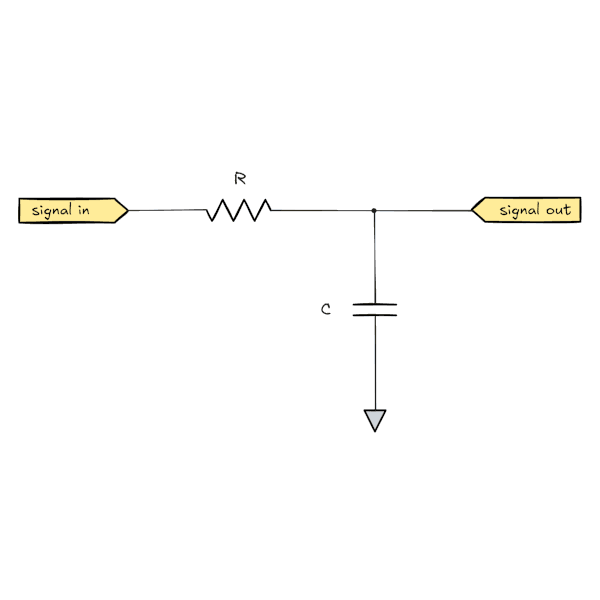
The discussion on analog filters looks at a few straightforward examples first. Starting with an resistor-capacitor (RC) filter, [lcamtuf] explains it by breaking its behavior down into steps of how the circuit behaves over time. Starting with a DC source and no load, and then removing the resistor to show just the behavior of a capacitor, shows the basics of this circuit from various perspectives. From there it moves into how it behaves when exposed to a sine wave instead of a DC source, which is key to understanding its behavior in arbitrary analog environments such as those involved in audio applications.

There’s some math underlying all of these explanations, of course, but it’s not overwhelming like a third-year electrical engineering course might be. For anyone looking to get into signal processing or even just building a really nice set of speakers for their home theater, this is an excellent primer. We’ve seen some other demonstrations of filtering data as well, like this one which demonstrates basic filtering using a microcontroller.

Popular Swiss Crypto Law Just Got A Massive Delay, Here’s The New Timeline

29 November 2025 at 04:00

The Swiss government has announced a delay in its plans to implement a major crypto law. This comes as governments worldwide face difficulty in achieving uniform crypto tax regulations, even as the crypto industry heats up with wider adoption.Β 

Swiss Government Delays Implementation Of Popular Crypto Law

In a press release, the Swiss Federal Council announced that the new Crypto-Asset Reporting Framework (CARF) will be enshrined into law from January 2026, but will not be implemented until 2027 at the earliest. The National Council’s Economic Affairs and Taxation Committee (ETAC) earlier this month suspended deliberations on the partner states with which Switzerland intends to exchange data under the crypto law, which prompted this decision.

The Federal Council also determined that the provisions on crypto assets contained in the Federal Act on the Automatic Exchange of Information in Tax Matters (AEOIA) and AEOI Ordinance shall not apply next year. Meanwhile, the government approved amendments to the Automatic Exchange of Information in Tax Matters (AEOI Ordinance).Β 

The release noted that the crypto law contains implementing provisions on amending the Federal Act on the AEOIA. As part of the amendments, the AEOI Ordinance now includes the crypto service providers’ duty to report, duty to conduct due diligence, and duty to register. It also specifies their nexus to Switzerland.Β 

Furthermore, under the crypto law, crypto service providers such as exchanges will now directly apply to associations and foundations, and their accounts will be subject to the law. However, they are excluded from the AEOI if they meet certain conditions under the revised ordinance. Lastly, the law also contains transitional provisions that make it easier for the affected parties to implement the amended CRS and the CARF.Β 

The Crypto-Asset Reporting Framework (CARF) will enable the automatic exchange of tax information on crypto transactions between countries. Other countries, including the U.S. and the U.K., are working to implement this global standard of crypto tax reporting into their legal frameworks.Β 

U.K. Also Moves To Implement CARF

In a release, the U.K. government announced that it is implementing the CARF for the first international data exchanges in 2027. The government noted that the CARF requires U.K. reporting crypto asset service providers (RCASPs) to collect relevant tax information and undertake due diligence in relation to their users on an annual basis.Β 

These U.K. RCASPs will also be required to collect information concerning U.K. resident customers. This means that the country’s tax authority, HMRC, will have CARF data on all taxpayers using a U.K.-based RCASP. Meanwhile, it is worth noting that the U.S. is also planning to implement the crypto law. Bitcoinist recently reported that the Treasury Department has dispatched the CARF regulations to the White House for review.

Crypto

France conducts high-intensity armored drills in UAE

25 November 2025 at 07:16
French forces deployed to the United Arab Emirates completed three days of high-intensity military training in desert conditions, operating Leclerc tanks, CAESAR artillery systems, and VBCI infantry fighting vehicles as part of a broader joint exercise with Emirati partners, according to material released by the French military. The training included maneuver drills, live-fire sequences, and […]

Intel GPUs on Raspberry Pi Is So Wrong it Feels Right

15 November 2025 at 01:00

While you might not know it from their market share, Intel makes some fine GPUs. Putting one in a PC with an AMD processor already feels a bit naughty, but AMD’s x86 processors still ultimately trace their lineage all the way back to Intel’s original 4004. Putting that same Intel GPU into a system with an ARM processor, like a Raspberry Pi, or even better, a RISC V SBC? Why, that seems downright deviant, and absolutely hack-y. [Jeff Geerling] shares our love of the bizarre, and has been working tirelessly to get a solid how-to guide written so we can all flout the laws of god and man together.

According to [Jeff], all of Intel’s GPUs should work, though not yet flawlessly. In terms of 3D acceleration, OpenGL works well, but Vulkan renders are going to get texture artifacts if they get textures at all. The desktop has artifacts, and so do images; see for yourself in the video embedded below. Large language models are restricted to the not-so-large, due to memory addressing issues. ARM and RISC V both handle memory somewhat differently than x86 systems, and apparently the difference matters.

The most surprising thing is that we’re now at a point that you don’t need to recompile the Linux kernel yourself to get this to work. Reconfigure, yes, but not recompile. [6by9] has a custom kernel all ready to go. In testing on his Pi5, [Jeff] did have to manually recompile Mesa, however–unsurprisingly, the version for Raspberry Pi wasn’t built against the iris driver for Intel GPUs, because apparently the Mesa devs are normal.

Compared to AMD cards, which already work quite well, the Intel cards don’t shine on the benchmark, but that wasn’t really the point. The point is expanding the hardware available to SBC users, and perhaps allowing for sensible chuckle at the mis-use of an β€œIntel Inside” sticker. (Or cackle of glee, depending on your sense of humour. We won’t judge.) [Jeff] is one of the people working at getting these changes upstreamed into the Linux kernel and Raspberry Pi OS, and we wish him well in that endeavour.

Now, normally we wouldn’t encourage a completely unknown fellow like this [Jeff] of whom no one has ever heard of to be poking about in the kernel, but we have a good feeling about this guy. It’s almost as if like he’s been at this a while. That couldn’t be, could it? Surely we’d have noticed him.

❌
❌