❌

Normal view

There are new articles available, click to refresh the page.
Today β€” 6 December 2025Hackaday

Bridging RTL-433 To Home Assistant

By: Lewin Day
6 December 2025 at 16:00

If you’ve got an RTL-SDR compatible receiver, you’ve probably used it for picking up signals from all kinds of weird things. Now, [Jaron McDaniel] has built a tool to integrate many such devices into the world of Home Assistant.

It’s called RTL-HAOS, and it’s intended to act as a bridge. Whatever you can pick up using the RTL_433 tool, you can set up with Home Assistant using RTL-HAOS. If you’re unfamiliar with RTL_433, it’s a multitalented data receiver for picking up all sorts of stuff on a range of bands using RTL-SDR receivers, as well as a range of other hardware. While it’s most closely associated with products that communicate in the 433 MHz band, it can also work with products that talk in 868 MHz, 315 MHz, 345 MHz, and 915 MHz, assuming your hardware supports it. Out of the box, it’s capable of working with everything from keyless entry systems to thermostats, weather stations, and energy monitors. You can even use it to listen to the tire pressure monitors in your Fiat Abarth 124 Spider, if you’re so inclined.

[Jaron’s] tool integrates these devices nicely into Home Assistant, where they’ll appear automatically thanks to MQTT discovery. It also offers nice signal metrics like RSSI and SNR, so you can determine whether a given link is stable. You can even use multiple RTL-SDR dongles if you’re so inclined. If you’re eager to pull some existing environmental sensors into your smart home, this may prove a very easy way to do it.

The cool thing about Home Assistant is that hackers are always working to integrate more gear into the ecosystem. Oftentimes, they’re far faster and more efficient at doing this than big-name corporations. Meanwhile, if you’re working on your own hacks for this popular smart home platform, we’d probably like to know about it. Be sure to hit up the tips lineΒ in due time.

Emulate ROMs at 12MHz With Pico2 PIO

6 December 2025 at 13:00

Nothing lasts forever, and that includes the ROMs required to make a retrocomputer run. Even worse, what if you’re rolling your own firmware? Period-appropriate EPROMs and their programmers aren’t always cheap or easy to get a hold of these days. [Kyo-ta04] had that problem, and thanks to them, we now all have a solution: Pico2ROMEmu, a ROM emulator based on, you guessed it, the Raspberry Pi Pico2.

The Pico2ROMEmu in its natural habitat on a Z80 SBC.

The ROM emulator has been tested at 10MHz with a Z80 processor and 12MHz with an MC68000. An interesting detail here is that rather than use the RP2350’s RISC-V or ARM cores, [kyo-ta04] is doing all the work using the chip’s powerful PIO. PIO means β€œprogrammable I/O,” and if you need a primer, check this out. Using PIO means the main core of the microcontroller needn’t be involved β€” and in this context, a faster ROM emulator.

We’ve seen ROM emulators before, of course β€” the OneROM comes to mind, which can also use the RP2350 and its PIOs. That project hasn’t been chasing these sorts of speeds as it is focused on older, slower machines. That may change in the newest revision. It’s great to see another contender in this space, though, especially one to serve slightly higher-performance retrocomputers.Β  Code and Gerbers for the Pico2RomeEMU are available on GitHub under an MIT license.

Thanks to [kyo-ta04] for the tip.

Β 

Β 

Something New Every Day, Something Relevant Every Week?

6 December 2025 at 10:00

The site is called Hackaday, and has been for 21 years. But it was only for maybe the first half-year that it was literally a hack a day. By the 2010s, we were putting out four or more per day, and in the later 20-teens, we settled into our current cadence of eight hacks per day, plus some original pieces over the top. That’s a lot of hacks per day! (But β€œEight-to-Ten-Hacks-a-Day” just isn’t as catchy.)

With that many posts daily, we also tend to reach out to a broader array of interests. Quite simply, not every hack is necessarily going to be just exactly what you are looking for, but we wouldn’t be writing it up if we didn’t think that someone was looking for it. Maybe you don’t like CAN bus hacks, but you’re into biohacking, or retrocomputing. Our broad group of writers helps to make sure that we’ll get you covered sooner or later.

What’s still surprising to me, though, is that a couple of times per week, there is a hack that is actually relevant to a particular project that I’m currently working on. It’s one thing to learn something new every day, and I’d bet that I do, but it’s entirely another to learn something new and relevant.

So I shouldn’t have been shocked when Tom and I were going over the week’s hacks on the podcast, and he picked an investigation of injecting spray foam into 3D prints. I liked that one too, but for me it was just β€œlearn something new”. Tom has been working on an underwater ROV, and it perfectly scratched an itch that he has – how to keep the top of the vehicle more buoyant, while keeping the whole thing waterproof.

That kind of experience is why I’ve been reading Hackaday for 21 years now, and it’s all of our hope that you get some of that too from time to time. There is a lot of β€œnew” on the Internet, and that’s a wonderful thing. But the combination of new and relevant just can’t be beat! So if you’ve got anything you want to hear more about, let us know.

This article is part of the Hackaday.com newsletter, delivered every seven days for each of the last 200+ weeks. It also includes our favorite articles from the last seven days that you can see on the web version of the newsletter. Want this type of article to hit your inbox every Friday morning? You should sign up!

Electronic Dice Built The Old Fashioned Way

By: Lewin Day
6 December 2025 at 07:00

If you wanted to build an electronic dice, you might grab an Arduino and a nice OLED display to whip up something fancy. You could even choose an ESP32 and have it log your rolls to the cloud. Or, you could follow the lead of [Axiometa] and do it the old-school way.

The build is based around the famous 555 timer IC. It’s paired with a 4017 decade counter IC, which advances every time it receives a clock signal from the 555. With the aid of some simple transistor logic, this lights the corresponding LEDs for the numbers 1 to 6, which are laid out like the face of a typical six-sided die. For an added bit of fun, a tilt sensor is used to trigger the 555 and thus the roll of the dice. A little extra tweak to the circuit ensures the 555 keeps counting just a little while after you stop shaking. This makes the action feel like an actual dice roll.

Schematics are available for the curious. We’d love to see this expanded to emulate a range of other diceβ€”like a D20 version that could blink away on the D&D table. We’ve covered some very exciting technology in that area as well.

Sudo Clean Up My Workbench

6 December 2025 at 04:00

[Engineezy] might have been watching a 3D printer move when inspiration struck: Why not build a robot arm to clean up his workbench? Why not, indeed? Well, all you need is a 17-foot-long X-axis and a gripper mechanism that can pick up any strange thing that happens to be on the bench.

Like any good project, he did it step by step. Mounting a 17-foot linear rail on an accurately machined backplate required professional CNC assistance. He was shooting for a 1mm accuracy, but decided to settle for 10mm.

With the long axis done, the rest seemed anticlimactic, at least for moving it around. The system can actually support his bodyweight while moving. The next step was to control the arm manually and use a gripper to open a parts bin.

The arm works, but is somewhat slow and needs some automation. A great start to a project that might not be practical, but is still a fun build and might inspire you to do something equally large.

We have large workbenches, but we tend to use tiny ones more often in our office. We also enjoy ones that are portable.

Blue Hedgehog, Meet Boing Ball: Can Sonic Run on Amiga?

6 December 2025 at 01:00

The Amiga was a great game system in its day, but there were some titles it was just never going to get. Sonic the Hedgehog was one of them– SEGA would never in a million years been willing to port its flagship platformer to another system. Well, SEGA might not in a million years, but [reassembler] has started that process after only thirty four.

Both the SEGA Mega Drive (that’s the Genesis for North Americans) and Amiga have Motorola 68k processors, but that doesn’t mean you can run code from one on the other: the memory maps don’t match, and the way graphics are handled is completely different. The SEGA console uses so-called β€œchunky” graphics, which is how we do it today. Amiga, on the other hand, is all about the bitplanes; that’s why it didn’t get a DOOM port back in the day, which may-or-may not be what killed the platform.

In this first video of what promises to be a series, [reassembler] takes us through his process of migrating code from the Mega Drive to Amiga, starting specifically with the SEGA loading screen animation, with a preview of the rest of the work to come. While watching someone wrestle with 68k assembler is always interesting, the automation he’s building up to do it with python is the real star here. Once this port is done, that toolkit should really grease the wheels of bringing other Mega Drive titles over.

It should be noted that since the Mega Drive was a 64 colour machine, [reassembler] is targeting the A1200 for his Sonic port, at least to start. He plans to reprocess the graphics for a smaller-palette A500 version once that’s done. That’s good, because it would be a bit odd to have a DOOM-clone for the A500 while being told a platformer like Sonic is too much to ask. If anyone can be trusted to pull this project off, it’s [reassembler], whose OutRun: Amiga Edition is legendary in the retro world, even if we seem to have missed covering it.

If only someone had given us a tip off, hint hint.

Yesterday β€” 5 December 2025Hackaday

Adding Electronics to a Classic Game

5 December 2025 at 22:00
A circular 3D-printed board is shown, with a roughly star-shaped pattern of white LEDs glowing through the surface. Yellow and green LEDs are also visible through the surface at a few points.

Like many classic board games, Ludo offers its players numerous opportunities to inflict frustration on other players. Despite this, [Viktor Takacs] apparently enjoys it, which motivated him to build a thoroughly modernized, LED-based, WiFi-enabled game board for it (GitHub repository).

The new game board is built inside a stylish 3D-printed enclosure with a thin white front face, under which the 115 LEDs sit. Seven LEDs in the center represent a die, and the rest mark out the track around the board and each user’s home row. Up to six people can play on the board, and different colors of the LEDs along the track represent their tokens’ positions. To prevent light leaks, a black plastic barrier surrounds each LED. Each player has one button to control their pieces, with a combination of long and short presses serving to select one of the possible actions.

The electronics themselves are mounted on seven circuit boards, which were divided into sections to reduce their size and therefore their manufacturing cost. For component placement reasons, [Viktor] used a barrel connector instead of USB, but for more general compatibility also created an adapter from USB-C to a barrel plug. The board is controlled by an ESP32-S3, which hosts a server that can be used to set game rules, configure player colors, save and load games, and view statistics for the game (who rolled the most sixes, who sent other players home most often, etc.).

If you prefer your games a bit more complex, we’ve also seen electronics added to Settlers of Catan. On a rather larger scale, there is also this LED-based board game which invites humans onto the board itself.

Thanks to [Victoria Bei] for the tip!

Magic Magikarp Makes Moves

By: Ian Bos
5 December 2025 at 19:00
A picture of a life sized magikarp from pokemon

One of the most influential inventions of the 20th century was Big Mouth Billy Bass. A celebrity bigger than the biggest politicians or richest movie stars, there’s almost nothing that could beat Billy. That is, until [Kiara] from Kiara’s Workshop built a Magikarp version of Big Mouth Billy Bass.

Sizing in at over 2 entire feet, the orange k-carp is able to dance, it is able to sing, and it is able to stun the crowd. Magikarp functions the same way as its predecessor; a small button underneath allows the show to commence. Of course, this did not come without its challenges.

Starting the project was easy, just a model found online and some Blender fun to create a basic mold. Dissecting Big Mouth Billy Bass gave direct inspiration for how to construct the new idol in terms of servos and joints. Programming wasn’t even all that much with the use of Bottango for animations. Filling the mold with the silicone filling proved to be a bit more of a challenge.

After multiple attempts with some minor variations in procedure, [Kirara] got the fish star’s skin just right. All it took was a paint job and some foam filling to get the final touches. While this wasn’t the most mechanically challenging animatronic project, we have seen our fair share of more advanced mechanics. For example, check out this animatronic that sees through its own eyes!

Garage Fridge Gets New DIY Controller

By: Lewin Day
5 December 2025 at 16:00

[Rick] had a problem. His garage refrigerator was tasked with a critical dutyβ€”keeping refreshing beverages at low temperature. Unfortunately, it had failedβ€”the condenser was forever running, or not running at all. The beverages were either frozen, or lukewarm, regardless of the thermostat setting. There was nothing for itβ€”the controller had to be rebuilt from scratch.

Thankfully, [Rick]’s junk drawer was obliging. He was able to find an Arduino Uno R4, complete with WiFi connectivity courtesy of the ESP32 microcontroller onboard. This was paired with a DHT11 sensor, which provided temperature and humidity measurements. [Rick] began testing the hardware by spitting out temperature readings on the Uno’s LED matrix.

Once that was working, the microcontroller had to be given control over the fridge itself. This was achieved by programming it to activate a Kasa brand smart plug, which could switch mains power to the fridge as needed. The Uno simply emulated the action of the Kasa phone app to switch the smart plug on and off to control the fridge’s temperature, with the fridge essentially running flat out whenever it was switched on. The Uno also logs temperature to a server so [Rick] can make sure temperatures remain in the proper range.

We’ve seen some great beverage-cooling hacks over the years. If you’ve mastered your own hacky methods of keeping the colas chilled, don’t hesitate to let us know on the tipsline.

Reason versus Sentimental Attachment for Old Projects

5 December 2025 at 14:30

We have probably all been there: digging through boxes full of old boards for projects and related parts. Often it’s not because we’re interested in the contents of said box, but because we found ourselves wondering why in the name of project management we have so many boxes of various descriptions kicking about. This is the topic of [Joe Barnard]’s recent video on his BPS.shorts YouTube channel, as he goes through box after box of stuff.

For some of the β€˜trash’ the answer is pretty simple; such as the old rocket that’s not too complex and can have its electronics removed and the basic tube tossed, which at least will reduce the volume of β€˜stuff’. Then there are the boxes with old projects, each of which are tangible reminders of milestones, setbacks, friendships, and so on. Sentimental stuff, basically.

Some rules exist for safety that make at least one part obvious, and that is that every single Li-ion battery gets removed when it’s not in use, with said battery stored in its own fire-resistant box. That then still leaves box after box full of parts and components that were ordered for projects once, but not fully used up. Do you keep all of it, just in case it will be needed again Some Dayβ„’? The same issue with boxes full of expensive cut-off cable, rare and less rare connectors, etc.

One escape clause is of course that you can always sell things rather than just tossing it, assuming it’s valuable enough. In the case of [Joe] many have watched his videos and would love to own a piece of said history, but this is not an option open to most. Leaving the question of whether gritting one’s teeth and simply tossing the β€˜value-less’ sentimental stuff and cheap components is the way to go.

Although there is always the option of renting storage somewhere, this feels like a cheat, and will likely only result in the volume of β€˜stuff’ expanding to fill the void. Ultimately [Joe] is basically begging his viewers to help him to solve this conundrum, even as many of them and our own captive audience are likely struggling with a similar problem. Where is the path to enlightenment here?

Hackaday Podcast Episode 348: 50 Grams of PLA Hold a Ton, Phreaknic Badge is Off The Shelf, and Hackers Need Repair Manuals

By: Tom Nardi
5 December 2025 at 12:00

Join Hackaday Editors Elliot Williams and Tom Nardi as they go over their picks for the best stories and hacks from the previous week. Things start off with a warning about the long-term viability of SSD backups, after which the discussion moves onto the limits of 3D printed PLA, the return of the Pebble smart watch, some unconventional aircraft, and an online KiCad schematic repository that has plenty of potential. You’ll also hear about a remarkable conference badge made from e-waste electronic shelf labels, filling 3D prints with foam, and a tiny TV powered by the ESP32. The episode wraps up with our wish for hacker-friendly repair manuals, and an interesting tale of underwater engineering from D-Day.

Check out the links below if you want to follow along, and as always, tell us what you think about this episode inΒ the comments!

As always, this episode is available in DRM-free MP3.

Where to Follow Hackaday Podcast

Episode 348 Show Notes:

News:

What’s that Sound?

  • Congratulations to [for_want_of_a_better_handle] for guessing the data center ambiance!

Interesting Hacks of the Week:

Quick Hacks:

Can’t-Miss Articles:

Mac System 7 On a G4? Why Not!

5 December 2025 at 11:00

Over the many years Apple Computer have been in operation, they have made a success of nearly-seamlessly transitioning multiple times between both operating systems and their underlying architecture. There have been many overlapping versions, but there’s always a point at which a certain OS won’t run on newer hardware. Now [Jubadub] has pushed one of those a little further than Apple intended, by persuading classic Mac System 7 to run on a G4.

System 7 was the OS your Mac would have run some time in the mid ’90s, whether it was a later 68000 machine or a first-gen PowerMac. In its day it gave Windows 3.x and even 95 a run for their money, but it relied on an older Mac ROM architecture than the one found on a G4. The hack here lies in leaked ROMS, hidden backwards compatibility, and an unreleased but preserved System 7 version originally designed for the ’90s Mac clone programme axed by Steve Jobs.Β  It’s not perfect, but they achieved the impossible.

As to why, it seems there’s a significant amount of software that needs 7 to run, something mirrored in the non-Mac retrocomputing world. Even this hack isn’t the most surprising System 7 one we’ve seen recently, as an example someone even made a version for x86 machines.


Thumbnail Image Art: Apple PowerMac G4 by baku13, CC BY-SA 3.0

This Week in Security: React, JSON Formatting, and the Return of Shai Hulud

5 December 2025 at 10:00

After a week away recovering from too much turkey and sweet potato casserole, we’re back for more security news! And if you need something to shake you out of that turkey-induced coma, React Server has a single request Remote Code Execution flaw in versions 19.0.1, 19.1.2, and 19.2.1.

The issue is insecure deserialization in the Flight protocol, as implemented right in React Server, and notably also used in Next.js. Those two organizations have both issued Security Advisories for CVSS 10.0 CVEs.

There are reports of a public Proof of Concept (PoC), but the repository that has been linked explicitly calls out that it is not a true PoC, but merely research into how the vulnerability might work. As far as I can tell, there is not yet a public PoC, but reputable researchers have been able to reverse engineer the problem. This implies that mass exploitation attempts are not far off, if they haven’t already started.

Legal AI Breaks Attorney-Client Privilege

We often cover security flaws that are discovered by merely poking around the source of a web interface. [Alex Schapiro] went above and beyond the call of duty, manually looking through minified JS, to discover a major data leak in the Filevine legal AI. And the best part, the problem isn’t even in the AI agent this time.

The story starts with subdomain enumeration β€” the process of searching DNS records, Google results, and other sources for valid subdomains. That resulted in a valid subdomain and a not-quite-valid web endpoint. This is where [Alex] started digging though Javascript, and found an Amazon AWS endpoint, and a reference to BOX_SERVICE. Making requests against the listed endpoint resulted in both boxFolders and a boxToken in the response. What are those, and what is Box?

Box is a file sharing system, similar to a Google Drive or even Microsoft Sharepoint. And that boxToken was a valid admin-level token for a real law firm, containing plenty of confidential records. It was at this point that [Alex] stopped interacting with the Filevine endpoints, and contacted their security team. There was a reasonably quick turnaround, and when [Alex] re-tested the flaw a month later, it had been fixed.

JSON Formatting As A Service

The web is full of useful tools, and I’m sure we all use them from time to time. Or maybe I’m the only lazy one that types a math problem into Google instead of opening a dedicated calculator program. I’m also guilty of pasting base64 data into a conversion web site instead of just piping it through base64 and xxd in the terminal. Watchtowr researchers are apparently familiar with such laziness efficiency, in the form of JSONformatter and CodeBeautify. Those two tools have an interesting feature: an online save function.

You may see where this is going. Many of us use Github Gists, which supports secret gists protected by long, random URLs. JSONformatter and CodeBeautify don’t. Those URLs are short enough to enumerate β€” not to mention there is a Recent Links page on both sites. Between the two sites, there are over 80,000 saved JSON snippets. What could possibly go wrong? Not all of that JSON was intended to be public. It’s not hard to predict that JSON containing secrets were leaked through these sites.

And then on to the big question: Is anybody watching? Watchtowr researchers beautified a JSON containing a Canarytoken in the form of AWS credentials. The JSON was saved with the 24 hour timeout, and 48 hours later, the Canarytoken was triggered. That means that someone is watching and collecting those JSON snippets, and looking for secrets. The moral? Don’t upload your passwords to public sites.

Shai Hulud Rises Again

NPM continues to be a bit of a security train wreck, with the Shai Hulud worm making another appearance, with some upgraded smarts. This time around, the automated worm managed to infect 754 packages. It comes with a new trick: pushing the pilfered secrets directly to GitHub repositories, to overcome the rate limiting that effected this worm the first time around. There were over 33,000 unique credentials captured in this wave. When researchers at GitGuardian tested that list a couple days later, about 10% were still valid.

This wave was launched by a PostHog credential that allowed a malicious update to the PostHog NPM package. The nature of Node.js means that this worm was able to very quickly spread through packages where maintainers were using that package. Version 2.0 of Shai Hulud also includes another nasty surprise, in the form of a remote control mechanism stealthily installed on compromised machines. It implies that this is not the last time we’ll see Shai Hulud causing problems.

Bits and Bytes

[Vortex] at ByteRay took a look at an industrial cellular router, and found a couple major issues. This ALLNET router has an RCE, due to CGI handling of unauthenticated HTTP requests. It’s literally just /cgi-bin/popen.cgi?command=whoami to run code as root. That’s not the only issue here, as there’s also a hardcoded username and password. [Vortex] was able to derive that backdoor account information and use hashcat to crack the password. I was unable to confirm whether patched firmware is available.

Google is tired of their users getting scammed by spam phone calls and texts. Their latest salvo in trying to defeat such scams is in-call scam protection. This essentially detects a banking app that is opened as a result of a phone call. When this scenario is detected, a warning dialogue is presented, that suggests the user hangs up the call, and forces a 30 second waiting period. While this may sound terrible for sophisticated users, it is likely to help prevent fraud against our collective parents and grandparents.

What seemed to be just an illegal gambling ring of web sites, now seems to be the front for an Advanced Persistent Threat (APT). That term, btw, usually refers to a government-sponsored hacking effort. In this case, instead of a gambling fraud targeting Indonesians, it appears to be targeting Western infrastructure. One of the strongest arguments for this claim is the fact that this network has been operating for over 14 years, and includes a mind-boggling 328,000 domains. Quite the odd one.

Warnings About Retrobright Damaging Plastics After 10 Year Test

5 December 2025 at 07:00

Within the retro computing community there exists a lot of controversy about so-called β€˜retrobrighting’, which involves methods that seeks to reverse the yellowing that many plastics suffer over time. While some are all in on this practice that restores yellow plastics to their previous white luster, others actively warn against it after bad experiences, such as [Tech Tangents] in a recent video.

Uneven yellowing on North American SNES console. (Credit: Vintage Computing)

After a decade of trying out various retrobrighting methods, he found for example that a Sega Dreamcast shell which he treated with hydrogen peroxide ten years ago actually yellowed faster than the untreated plastic right beside it. Similarly, the use of ozone as another way to achieve the oxidation of the brominated flame retardants that are said to underlie the yellowing was also attempted, with highly dubious results.

While streaking after retrobrighting with hydrogen peroxide can be attributed to an uneven application of the compound, there are many reports of the treatment damaging the plastics and making it brittle. Considering the uneven yellowing of e.g. Super Nintendo consoles, the cause of the yellowing is also not just photo-oxidation caused by UV exposure, but seems to be related to heat exposure and the exact amount of flame retardants mixed in with the plastic, as well as potentially general degradation of the plastic’s polymers.

Pending more research on the topic, the use of retrobrighting should perhaps not be banished completely. But considering the damage that we may be doing to potentially historical artifacts, it would behoove us to at least take a step or two back and consider the urgency of retrobrighting today instead of in the future with a better understanding of the implications.

Off-Grid, Small-Scale Payment System

5 December 2025 at 04:00

An effective currency needs to be widely accepted, easy to use, and stable in value. By now most of us have recognized that cryptocurrencies fail at all three things, despite lofty ideals revolving around decentralization, transparency, and trust. But that doesn’t mean that all digital currencies or payment systems are doomed to failure. [Roni] has been working on an off-grid digital payment node called Meshtbank, which works on a much smaller scale and could be a way to let a much smaller community set up a basic banking system.

The node uses Meshtastic as its backbone, letting the payment system use the same long-range low-power system that has gotten popular in recent years for enabling simple but reliable off-grid communications for a local area. With Meshtbank running on one of the nodes in the network, accounts can be created, balances reported, and digital currency exchanged using the Meshtastic messaging protocols. The ledger is also recorded, allowing transaction histories to be viewed as well.

A system like this could have great value anywhere barter-style systems exist, or could be used for community credits, festival credits, or any place that needs to track off-grid local transactions. As a thought experiment or proof of concept it shows that this is at least possible. It does have a few weaknesses though β€” Meshtastic isn’t as secure as modern banking might require, and the system also requires trust in an administrator. But it is one of the more unique uses we’ve seen for this communications protocol, right up there with a Meshtastic-enabled possum trap.

Biogas Production For Surprisingly Little Effort

5 December 2025 at 01:00

Probably most people know that when organic matter such as kitchen waste rots, it can produce flammable methane. As a source of free energy it’s attractive, but making a biogas plant sounds difficult, doesn’t it? Along comes [My engines] with a well-thought-out biogas plant that seems within the reach of most of us.

It’s based around a set of plastic barrels and plastic waste pipe, and he shows us the arrangement of feed pipe and residue pipe to ensure a flow through the system. The gas produced has CO2 and H2s as undesirable by-products, both of which can be removed with some surprisingly straightforward chemistry. The home-made gas holder meanwhile comes courtesy of a pair of plastic drums one inside the other.

Perhaps the greatest surprise is that the whole thing can produce a reasonable supply of gas from as little as 2 KG of organic kitchen waste daily. We can see that this is a set-up for someone with the space and also the ability to handle methane safely, but you have to admit from watching the video below, that it’s an attractive idea. Who knows, if the world faces environmental collapse, you might just need it.

Before yesterdayHackaday

Building a Microscope without Lenses

4 December 2025 at 22:00
A mirrorless camera is mounted on a stand, facing downwards toward a rotating microscope stage made of wood. A pair of wires come down from the stage, and a man's hand is pointing to the stage.

It’s relatively easy to understand how optical microscopes work at low magnifications: one lens magnifies an image, the next magnifies the already-magnified image, and so on until it reaches the eye or sensor. At high magnifications, however, that model starts to fail when the feature size of the specimen nears the optical system’s diffraction limit. In a recent video, [xoreaxeax] built a simple microscope, then designed another microscope to overcome the diffraction limit without lenses or mirrors (the video is in German, but with automatic English subtitles).

The first part of the video goes over how lenses work and how they can be combined to magnify images. The first microscope was made out of camera lenses, and could resolve onion cells. The shorter the focal length of the objective lens, the stronger the magnification is, and a spherical lens gives the shortest focal length. [xoreaxeax] therefore made one by melting a bit of soda-lime glass with a torch. The picture it gave was indistinct, but highly magnified.

A roughly rectangular red pattern is shown, with brighter streaks converging toward the center.
A cross section of the diffraction pattern of a laser diode shining through a pinhole, built up from images at different focal distances.

Besides the dodgy lens quality given by melting a shard of glass, at such high magnification some of the indistinctness was caused by the specimen acting as a diffraction grating and directing some light away from the objective lens. [xoreaxeax] visualized this by taking a series of pictures of a laser shining through a pinhole at different focal lengths, thus getting cross sections of the light field emanating from the pinhole. When repeating the procedure with a section of onion skin, it became apparent that diffraction was strongly scattering the light, which meant that some light was being diffracted out of the lens’s field of view, causing detail to be lost.

To recover the lost details, [xoreaxeax] eliminated the lenses and simply captured the interference pattern produced by passing light through the sample, then wrote a ptychography algorithm to reconstruct the original structure from the interference pattern. This required many images of the subject under different lighting conditions, which a rotating illumination stage provided. The algorithm was eventually able to recover a sort of image of the onion cells, but it was less than distinct. The fact that the lens-free setup was able to produce any image at all is nonetheless impressive.

To see another approach to ptychography, check out [Ben Krasnow’s] approach to increasing microscope resolution. With an electron microscope, ptychography can even image individual atoms.

Preventing a Mess with the Weller WDC Solder Containment Pocket

4 December 2025 at 19:00

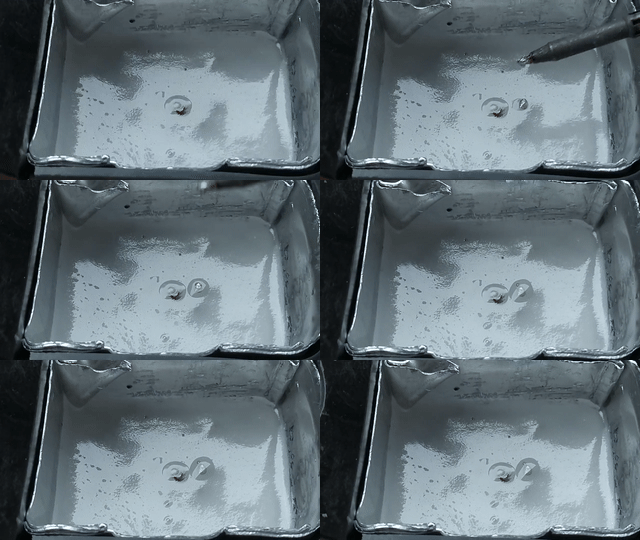
Resetting the paraffin trap. (Credit: MisterHW)

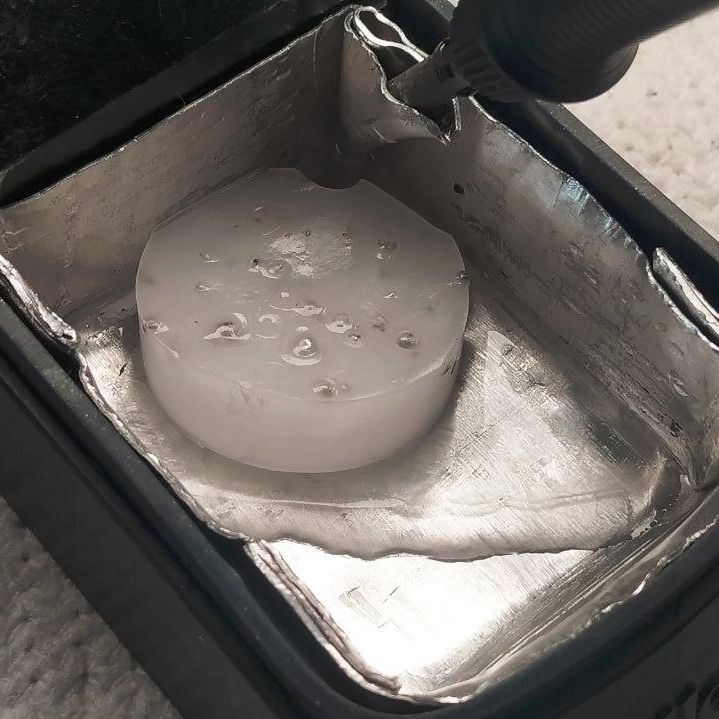
Have you ever tipped all the stray bits of solder out of your tip cleaner by mistake? [MisterHW] is here with a bit of paraffin wax to save the day.

Hand soldering can be a messy business, especially when you wipe the soldering iron tip on those common brass wool bundles that have largely come to replace moist sponges. The Weller Dry Cleaner (WDC) is one of such holders for brass wool, but the large tray in front of the opening with the brass wool has confused many as to its exact purposes. In short, it’s there so that you can slap the iron against the side to flick contaminants and excess solder off the tip.

Along with catching some of the bits of mostly solder that fly off during cleaning in the brass wool section, quite a lot of debris can be collected this way. Yet as many can attest to, it’s quite easy to flip over brass wool holders and have these bits go flying everywhere.

The trap in action. (Credit: MisterHW)

That’s where [MisterHW]’s pit of particulate holding comes into play, using folded sheet metal and some wax (e.g. paraffin) to create a trap that serves to catch any debris that enters it and smother it in the wax. To reset the trap, simply heat it up with e.g. the iron and you’ll regain a nice fresh surface to capture the next batch of crud.

As the wax is cold when in use, even if you were to tip the holder over, it should not go careening all over your ESD-safe work surface and any parts on it, and the wax can be filtered if needed to remove the particulates. When using leaded solder alloys, thisΒ  setup also helps to prevent lead-contamination of the area and generally eases clean-up as bumping or tipping a soldering iron stand no longer means weeks, months or years of accumulations scooting off everywhere.

Build A Pocket-Sized Wi-Fi Analyzer

By: Lewin Day
4 December 2025 at 16:00

Wi-Fi! It’s everywhere, and yet you can’t really see it, by virtue of the technology relying on the transmission of electromagnetic waves outside the visual spectrum. Never mind, though, because you can always build yourself a Wi-Fi analyzer to get some insight into your radio surroundings, as demonstrated by [moononournation].

The core of the build is the ESP32-C5. The popular microcontroller is well-equipped for this task with its onboard dual-band Wi-Fi hardware, even if the stock antenna on most devboards is a little underwhelming. [moononournation] has paired this with a small rectangular LCD screen running the ILI9341 controller. The graphical interface is drawn with the aid of the Arduino_GFX library. It shows a graph of access points detected in the immediate area, as well as which channels they’re using and their apparent signal strength.

If you’re just trying to get a basic read on the Wi-Fi environment in a given locale, a tool like this can prove pretty useful. If your desires are more advanced, you might leap up to tinkering in the world of software defined radio. Video after the break.

Raising a GM EV1 from the Dead

4 December 2025 at 14:30

Probably the biggest story in the world of old cars over the past couple of weeks has been the surfacing of a GM EV1 electric car for sale from an auto salvage yard. This was the famous electric car produced in small numbers by the automaker in the 1990s, then only made available for lease before being recalled. The vast majority were controversially crushed with a few units being donated to museums and universities in a non-functional state.

Finding an old car isn’t really a Hackaday story in itself, but now it’s landed in [The Questionable Garage]. It’s being subjected to a teardown as a prelude to its restoration, offering a unique opportunity to look at the state of the art in 1990s electric automotive technology.

The special thing about this car is that by a murky chain of events it ended up as an abandoned vehicle. GM’s legal net covers the rest of the surviving cars, but buying this car as an abandoned vehicle gives the owner legal title over it and frees him from their restrictions. The video is long, but well worth a watch as we see pieces of automotive tech never before shown in public. As we understand it the intention is to bring it to life using parts from GM’s contemporary S10 electric pickup truck β€” itself a rare vehicle β€” so we learn quite a bit about those machines too.

Along the way they find an EV1 charger hiding among a stock of pickup chargers, take us through the vehicle electronics, and find some galvanic corrosion in the car’s structure due to water ingress. The windscreen has a huge hole, which they cover with a plastic wrap in order to 3D scan so they can create a replacement.

This car will undoubtedly become a star of the automotive show circuit due to its unique status, so there will be plenty of chances to look at it from the outside in future. Seeing it this close up in parts though is as unique an opportunity as the car itself. We’ve certainly seen far more crusty conventional cars restored to the road, but without the challenge of zero parts availability and no donor cars. Keep an eye out as they bring it closer to the road.

❌
❌