If marijuana rescheduling is finalized as President Donald Trump instructed on Thursday, the practical policy impact on the federal level will be somewhat limited, as cannabis would remain illegal. But lawmakers in states like Pennsylvania and Tennessee say the political effect could ultimately prove more impactful as they work to enact local reforms in the next year.
The executive order Trump signed directs the attorney general to complete a process to move cannabis from Schedule I to Schedule III under the Controlled Substances Act (CSA), which would let cannabis businesses take federal tax deductions and lift certain research barriers.
While it wouldn’t legitimize state marijuana programs in the eyes of the federal government, the decision by a Republican president to loosen longstanding cannabis laws and recognize its medical benefits could embolden on-the-fence legislators at the state level, who may see it as a signal that the politics of the issue are shifting and there’s a lower risk of federal enforcement action.
In Pennsylvania, for example, bipartisan lawmakers who’ve been working to enact adult-use legalization over recent sessions without success so far say Trump’s rescheduling action could grease the wheels in the new year.
(This is a contributed guest column. To be considered as an MJBizDaily guest columnist, please submit your request here.)
President Donald Trump’s historic executive order Thursday expediting the reclassification of cannabis from Schedule 1 to Schedule 3 is the most meaningful federal cannabis policy win – ever. It’s an acknowledgment many in this industry have long awaited: cannabis has accepted medical use and does not belong in the same category as the most dangerous narcotics.
All that said, it’s important to separate substance from symbolism. Marijuana rescheduling creates real opportunity, but it also comes with limits, responsibilities for legal operators and a reminder that there’s a longer road ahead.
ADVERTISEMENT
What marijuana rescheduling actually changed
Once rescheduling is finalized, federal law will no longer
During Thursday’s event, Trump noted strong public support for marijuana reform and said numerous people called him to voice support for cannabis rescheduling.
“I don’t think I received any calls on the other side of it,” he said.
That comment didn’t sit right with Sen. Ted Budd (R-NC), who says he in fact called the president to express his opposition to rescheduling marijuana just days ago.
“I called him personally Friday last week and let him know,” the senator told Punchbowl News.
Budd said he is also aware that other lawmakers had called Trump to urge him not to enact the federal reclassification of marijuana.
“I was aware of people calling him then—against rescheduling,” he said. “So I knew that my colleagues had been calling him.”
“I called him personally Friday last week and let him know. He said that others had been calling him on the issue,” Budd said in an interview. “I was aware of people calling him then —
Cannabis is NOT legal. And the fight is far from over. Yesterday, President Trump signed an Executive Order directing the Attorney General to expedite rescheduling marijuana to Schedule III. To the casual observer, this looks like victory. To those of us who have spent years in advocacy, documenting the racist criminalization of cannabis, it feels […]
When recurring sinus infections back in 2016 forced TribeTokes co-founder Degelis Pilla to cut back on smoking and vaping cannabis, she began searching for an alternative consumption method that would work just as well as inhalation for long-term use. She explored the market but found nothing that checked all the boxes. She wanted something plant-based, vegan, free of artificial colors or additives, and with a precise dose that left no room for error.
“My whole life, I loved smoking. Chronic sinus infections, surgeries and losing my voice made me realize that there needed to be an alternative way of utilizing the product and making sure dosing is on point,” Pilla explains. When her hunt came up short, Pilla decided to team up with her friend Kymberly Byrnes in 2017 to create a range of products of their very own—they called it TribeTokes.
It’s a clean, luxury cannabis brand built on transparency, intention and enhancing the user experience. Tribetokes offers a variety of products, such as pre-rolls and vapes. Their flagship product, their gummies, are fully vegan, flavored with real fruit extract, and carefully formulated for specific effects. Whether you need support sleeping, increasing libido or getting a good buzz, each gummy delivers exactly that while providing a real fruit-like flavor, thanks to natural ingredients.
TribeTokes understands what customers need because the founders, Pilla and Byrnes, experienced the challenges themselves. Many people can’t consume artificial colors or additives, which means most edibles on the market don’t work for them. TribeTokes uses pectin instead of gelatin to achieve that gummy texture. And all of their products use only natural, high-quality ingredients paired with a high standard of processes to maintain product integrity. They also know that people want a more discreet way of consuming cannabis. As Pilla says, “Maybe you’re at your in-laws’ house and you need to microdose your way through dinner without pulling out a vape pen.”
Pilla and Byrnes have a community-first approach to customer service, doing everything in their power to show up for customers. “We specialize in answering questions about dosing, explaining how different cannabinoids work, and helping people find the right product for their specific needs,” Pilla explains. If their product line seems daunting, don’t be afraid to reach out for guidance. The team is more than happy to help you choose the product that suits you best.
While TribeTokes is praised for their range of products, including flower, pre-rolls, tinctures, vapes, topicals, and even remedies for your furry friends, we’re impressed by their five gummy offerings, which we take a deeper look into below.
Good Things Come in Small Packages
Every one of TribeTokes gummies is a tailored sensory experience. Dege designed the gummies to have specific effects that she needed and wanted. Using natural ingredients and precision dosing, every recipe combines a unique profile of cannabinoids—carefully formulated to support distinct effects and purposeful moments. Because of the specialized nature of each member of the portfolio, it only makes sense to dive in deep and review them one by one to fully appreciate what TribeTokes has to offer.
Formula:This specific edible was designed for experienced cannabis consumers committed to the journey. Buzzed delivers 10 mg Delta‑9 THC along with 20 mg Delta‑8 THC per gummy. This is a more potent combination than other edibles within the TribeTokes product portfolio.
Flavor & Effect: Pineapple tastes like pineapple! Vibrant tropical flavors are bursting as you chew. Onset is faster: effects begin as early as 35–40 minutes as opposed to the typical one hour-and-asses mark. It’s a swift trip into a clear, euphoric high with relaxing effects on the body. The peak intensity of the experience lasts about three hours. We recommend pairing this with nighttime rituals because, sometimes, there’s a lingering effect towards the end of the experience.
Suggested Use: This is a “clear your calendar” gummy—great for parties, movies or late-night creativity. Not for beginners, and not for mid-day tasks.
Formula: This functional gummy includes 10mg of CBD, 20mg of CBC and a proprietary blend of Maca, Muira Puama, Catuaba and Mucuna. This is a mixture of traditional aphrodisiacs to target mood, blood flow and body awareness.
Flavor & Effect: The dark fruit flavor of cherry dominates the palette, layered with botanical and herb undercurrents. The body effects took about 90 minutes to appear, starting with a subtle body heat and mild euphoria, like a tickle behind the eyes and consciousness. Peak sensations hovered in the 2 to 3-hour window, with increased tactile sensitivity and mood elevation, though more subtle than traditional buzz-forward gummies. This was not just a libido-based use case. After a terrible headache, this specific gummy lifted the pain and pressure without the psychoactive effects. It felt good to just be.
Suggested Use: This gummy sets the tone for intimacy, like pregaming for a fun-filled evening. It’s helpful for unwinding in a sensual way, getting in touch with the body and breathwork. This edible is less about intensity and more about a subtle, soft and embodied presence.
Formula: Each gummy is composed of 10 mg Delta‑9 THC, 20 mg CBN, 1 mg B6 and 250 mg L‑Tryptophan. When thinking of edibles as medicine with curated effects, this is one of TribeTokes’ most targeted blends. It was created specifically to ease users into restful slumber. Figuring out dosage over a month-long period is key here, as you test the specific amount your body needs for restful sleep while still being able to wake up feeling up refreshed and unfogged.
Flavor & Effect: The mixed berry flavor is rich and herbalicious. Around 60–75 minutes post-consumption, the effects of this journey are built with a heady buzz followed by full-body relaxation. The blend doesn’t knock the user out abruptly, but rather guides them gently into sleep. Most users will sleep 6-8 hours with minimal disruption; however, it takes a little bit of experimentation around dosage to prevent waking up groggy.
Suggested Use:This gummy is perfect for winding down after a long day, or when traditional sleep aids like Melatonin aren’t quite enough. This blend is strong and highly effective.
Formula: Each gummy contains 10 mg of live rosin THC, extracted via heat and pressure (without solvents), to preserve the terpene profile in addition to the minor cannabinoids. According to their website, “rosin is considered the champagne of cannabis extracts because it is all-natural, incredibly pure, and delivers a full-spectrum experience.” It’s a curious process as the cannabis is flash frozen to access the full spectrum of both cannabinoids and terpenes that are expertly extracted in a way that distillate is unable to deliver on.
Flavor & Effect: The watermelon flavor is juicy with potent herb undertones. Effects set in about one hour later and bring about a warm body sensation followed by a light euphoric head high. Peak intensity was reached by the second hour, maintaining a comfortable plateau through the fifth hour, and tapering gently over the next few. Of course, timing will vary from person to person.
Suggested Use: Best suited for deep creative work, mellowing out, or early evening unwinding after work. The effect is present but not in the same way as the Buzzed: Pineapple. This is a portfolio piece that captures the mythos of what solventless “clean cannabis” highs can achieve.
Formula: Each mango gummy blends 10mg Delta‑9 THC with 20mg CBD, using live resin extract to access the full-spectrum qualities while simultaneously softening the THC’s psychoactive effects. According to the TribeTokes website, this live resin extract gummies developed a following among cannabis enthusiasts because of their unique effects, including deep relaxation and staying asleep throughout the night.
Flavor & Effect: A rich, mango flavor leads the experience. The journey leans both introspective and cerebral, setting in around 45 minutes with a notable mental shift. The added CBD grounds the trip, keeping anxiety and overstimulation at bay by focusing on the body effects. The peak experience holds steady between hours two and three, with a soft fade by hour six. Unlike the other gummies in the portfolio, it’s suggested that you start with smaller dosing before working up to the ideal dose. This is a trip that can get intense quick.
Suggested Use: This is a great option for those solo evenings like out of a Kid Cudi song, deep introspection, or media immersion. This doesn’t inspire the same couch lock as other formulas. Like goldilocks, we would describe this experience as not too intense, hitting a balanced middle ground between intensity and calm.
TribeTokes Leads The Clean Cannabis Movement
TribeTokes’ mission to deliver premium quality to their customers carries on beyond the consumption experience. This is a female-owned brand that you partner with for long-term sustainable use; it’s a relationship you can grow and perform with. We know processes are key for accessing both major and minor cannabinoids. Additionally, Pilla and Byrnes are spearheading the Clean Cannabis Movement, and you can help be a part of this paradigm shift while enjoying a luxury cannabis high that tastes as good as it feels.
Interested in joining the tribe? Get 20% off your purchase with code FEELGOOD20.
“Since before President Trump took office, many of us…have argued against the rescheduling of marijuana as a Schedule I drug,” the attorneys general of Indiana, Iowa, Idaho, Kansas, Louisiana, Nebraska, Oklahoma and Wyoming said in a joint statement on Thursday. “We all believe the science surrounding marijuana—which has become only more clear in recent weeks—properly establishes it as a Schedule I drug, and we have seen firsthand the harm the drug has caused in our communities.”
The statement, led by Nebraska Attorney General Mike Hilgers (R), who has separately sought to overturn his state’s voter-approved medical cannabis law, says the “negative impacts of expanded marijuana use, especially on children and adolescents, are worrisome.”
“And the public policy challenges, such as the exponential increase in difficult-to-combat driving under the influence, are both significant and serious,” the coalition of GOP AGs said. “We have conveyed our concerns to the Administration, and we are grateful for the Administration’s good faith consideration of our views.”
Florida Gov. Ron DeSantis (R) campaigned heavily against an earlier version of the legalization proposal, which received a majority of voters last year but not enough to meet the 60 percent threshold required to pass a constitutional amendment. Former Attorney General Ashley Moody (R) unsuccessfully contested the prior initiative in the courts.
So far, while there’s litigation surrounding certification issues—as well as a separate legal challenge over about 200,000 signatures deemed invalid by the state—the latest filings from
Marijuana can “make people feel much better” and serve as a “substitute for addictive and potentially lethal opioid painkillers,” President Donald Trump said on Thursday as he issued an executive order to federally reschedule cannabis and promote access to CBD for therapeutic purposes. He clarified, however, that he personally has no interest in using marijuana himself.
Although the president emphasized that he’s repeatedly lectured his children about abstaining from drug use, he said that “the facts compel the federal government to recognize that marijuana can be legitimate in terms of medical applications when carefully administered.”
“In some cases, this may include the use [of cannabis] as a substitute for addictive and potentially lethal opioid painkillers—they cause tremendous problems,” he said, surrounded by health officials, industry stakeholders and advocates. “This can do it in a much lesser way—can make people feel much better that are living through tremendous pain and problems.”
That said, Trump made clear that he has no plans to use cannabis.
“I don’t want it,” he said. “I’m not going to be taking it, but a lot of people do want it. A lot of people need it.”
Trump’s drug policy positions can be sometimes enigmatic—with a historic
A GOP senator says the while a bipartisan marijuana banking bill remains stalled, with no recent discussions about advancing it as lawmakers focus on other legislative priorities, President Donald Trump’s move to reschedule cannabis could clear the path for further reform.
Sen. Bernie Moreno (R-OH), who is expected to sponsor the Secure and Fair Enforcement Regulation (SAFER) Banking Act in his chamber, told Marijuana Moment this week that there have still been “no” conversations about moving the legislation, despite previously predicting it would be taken up in the fall.
As the season comes to a close, however, Congress remains preoccupied with competing priorities such as extending health care subsidies and passing spending bills to keep the government funded.
“The line is deep in terms of getting stuff done, so that’s something we’ll think about once we get through all these things,” the senator said. But the cannabis banking bill could gain momentum under Trump’s plan to facilitate rescheduling, he added in a second interview.
The order issued on Thursday directs federal agencies to complete the process of moving marijuana from Schedule I to Schedule III of the Controlled Substances Act (CSA) and clears the way for a pilot program to
GOP lawmakers mount anti-marijuana effort; Senate amendment on hospital visits & cannabis; VA marijuana resentencing bill; MI psychedelics
Subscribe to receive Marijuana Moment’s newsletter in your inbox every weekday morning. It’s the best way to make sure you know which cannabis stories are shaping the day.
Your support makes Marijuana Moment possible…
Your good deed for the day: donate to an independent publisher like Marijuana Moment and ensure that as many voters as possible have access to the most in-depth cannabis reporting out there.
Hemp-derived THC beverages could be legally sold in New Jersey liquor stores under certain restrictions if bill currently working its way through the state Legislature becomes law.
Senate Bill 4509, which passed a state Senate committee on Monday, would establish a regulatory framework for the products while repealing previous laws related to intoxicating hemp.
ADVERTISEMENT
If passed, the New Jersey Cannabis Regulatory Commission (CRC) would be required to establish a licensing process allowing liquor stores to sell hemp-derived beverages.
Business that hold wholesale or retail distribution licenses from the Division of Alcoholic Beverage Control can continue to do so until the commission implements the new regulations.
Once the rules are released, manufacturers and retailers will have 120 days to comply and must
President Donald Trump’s historic move to direct the reclassification of marijuana on Thursday has elicited a wave of positive feedback from top lawmakers, state officials, advocates and industry stakeholders—reflecting the uniquely bipartisan way cannabis reform has bridge political divides during an especially divisive time.
While several Democratic lawmakers have made clear that simply moving cannabis from Schedule I to Schedule III of the Controlled Substances Act (CSA) does not go far enough, even some of Trump’s sharpest critics have generally agreed that the executive order directing the incremental reform is a step in the right direction.
The order directs the attorney general to complete a rescheduling process that was initiated under the Biden administration. The reclassification wouldn’t legalize marijuana, but it would loosen research restrictions, allow cannabis businesses to take federal tax deductions and symbolically recognize that the plant holds medical value—breaking from the federal government’s decades-long position that it is therapeutically ineffective with a high abuse potential.
The order also has implications for the hemp market, with a call to reevaluate how the crop is defined under a newly enacted spending bill that stakeholders say would ultimately eradicate the industry by banning most consumable cannabinoid products.
President Donald Trump on Thursday dismissed the concerns of GOP lawmakers who oppose his freshly signed executive order to reschedule marijuana, pointing out that an overwhelming majority of Americans support the reform and that cannabis can help people—including his personal friends—who are suffering from serious health issues.
At a signing ceremony, the president issued an order directing the attorney general to “complete” the process of moving marijuana from Schedule I to Schedule III in the “most expeditious manner,” while also announcing plans to make full-spectrum CBD products available to patients through their health providers that could be covered by Medicare.
The president said he’d prefer to have the medical professionals in attendance at the event take that question, but emphasized that polling has found that four in five Americans are in favor of rescheduling cannabis. The reform wouldn’t legalize marijuana, but it would ease research restrictions and let marijuana businesses take federal tax deductions available to other traditional industries.
Marijuana will be federally rescheduled under an executive order signed by President Donald Trump on Thursday.
The directive also aims to address federal hemp laws to promote access to full-spectrum CBD that could be covered under federal health insurance plans.
“We have people begging for me to do this, people that are in great pain for decades,” Trump said. “This action has been requested by American patients suffering from extreme pain, incurable diseases, aggressive cancers, seizure disorders, neurological problems, and more—including numerous veterans with service-related injuries and older Americans who live with chronic medical problems that severely degrade their quality of life.”
This marks one of the most significant developments in federal marijuana policy since its prohibition a half a century ago, with a Schedule III reclassification recognizing that marijuana has medical value and a lower abuse potential compared to other Schedule I drugs like heroin.
Rescheduling will not federally legalize cannabis. However, the policy change will enable state-licensed marijuana businesses to claim federal tax deductions that they've been previously denied under an Internal Revenue Service (IRS) code known as Section 280E. It will also remove certain research barriers applied to Schedule I drugs.
The change may also spur additional states to modernize their own policies on cannabis, as some lawmakers have cited the federal government's restrictive classification of marijuana as a reason they have been uncomfortable with enacting legalization or at least allowing medical use.
In addition to directing the attorney general to expedite the completion of the process of rescheduling marijuana to Schedule III of the CSA, the executive order also includes a novel proposal to allow Medicare recipients to access non-intoxicating CBD that'd be covered under the federal health care plan.
Marijuana Moment first reported on leaked details from a White House briefing about the plan on Thursday ahead of the signing event. That includes a directive for top White House staff to work with Congress to give patients access to full-spectrum CBD products, “while still restricting the sale and access to products that cause serious and potentially life-threatening health risks.”
The order also urges Congress to examine updating the definition of hemp to ensure that full-spectrum CBD is accessible to patients—a policy change that could mitigate some concerns in the sector about a recent spending bill Trump signed with provisions that would broadly ban consumable hemp products.
Separate from Trump's order, Mehmet Oz, administrator for the Centers for Medicare & Medicaid Services (CMS), will also be announcing “a model that will allow a number of CMS beneficiaries to benefit from receiving CBD under doctor recommendation at no cost,” a White House official said during the briefing.
Trump endorsed rescheduling—as well as industry banking access and a Florida adult-use legalization initiative—on the campaign trail last year. The president had been largely silent on the issue since taking office during his second term, until an August briefing, where, in response to a reporter's question, he announced that the administration would decide on rescheduling within weeks.
By moving forward with the plan, Trump is completing a process initiated under the Biden administration. That involved a scientific review by the U.S. Department of Health and Human Services (HHS)—which concluded that Schedule III is a more appropriate category for marijuana—as well as the Drug Enforcement Administration (DEA).
Recent news reports revealed that Trump was planning to issue the executive order directing federal agencies to move ahead with cannabis rescheduling following a meeting with marijuana industry executives, HHS Secretary Robert F. Kennedy Jr., and Centers for Medicare and Medicaid Services Administrator Mehmet Oz. During that meeting, Trump reportedly phoned House Speaker Mike Johnson (R-LA), who expressed his opposition to rescheduling cannabis.
Meanwhile, amid the heightened rumors that the Trump administration would be moving forward on marijuana rescheduling, multiple top congressional Democrats made the case that the reform would not go far enough—including one senator who said the move is only an attempt by the president to “gaslight” voters into thinking he legalized cannabis to boost his “pathetic” approval ratings.
President Donald Trump on Thursday ushered in the most momentous shift in federal marijuana policy since 1970 with an executive order reclassifying cannabis as a less dangerous drug and recognizing for the first time its medical benefits.
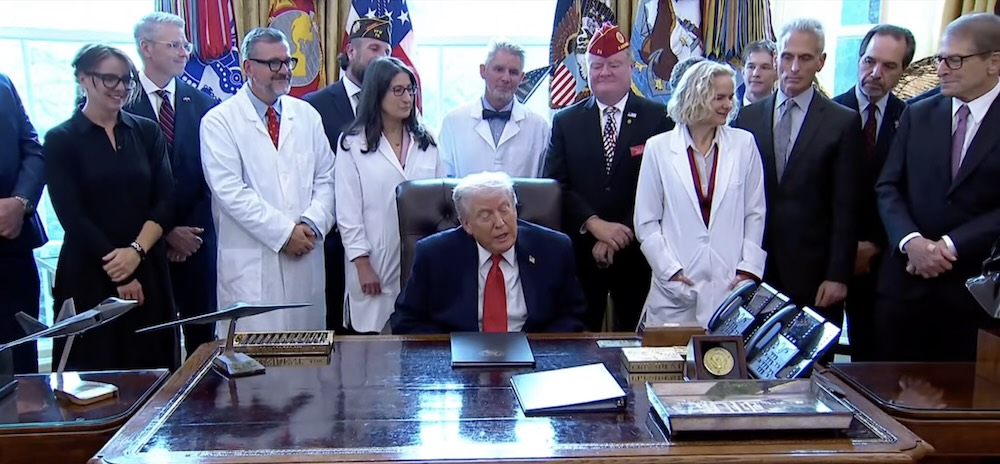
“I promised to be the president of common sense, and that is exactly what we are doing,” said the president, flanked by doctors and veterans advocates during an Oval Office signing ceremony.
“This is really something having to do with common sense.”
ADVERTISEMENT
The executive order directs the Justice Department to move marijuana from Schedule 1 to Schedule 3 of the Controlled Substances Act.
Exactly when cannabis would become Schedule 3, a designation that recognizes marijuana’s medical value under federal law, was not immediately clear.
Marijuana will be federally rescheduled under an executive order signed by President Donald Trump on Thursday.
The directive also aims to address federal hemp laws to promote access to full-spectrum CBD that could be covered under federal health insurance plans.
“We have people begging for me to do this, people that are in great pain for decades,” Trump said. “This action has been requested by American patients suffering from extreme pain, incurable diseases, aggressive cancers, seizure disorders, neurological problems and more—including numerous veterans with service-related injuries and older Americans who live with chronic medical problems that severely degrade their quality of life.”
The president emphasized that his order “doesn’t legalize marijuana in any way, shape or form, and in no way sanctions its use as a recreational drug.”
This marks one of the most significant developments in federal marijuana policy since its prohibition a half a century ago, with a Schedule III reclassification recognizing that marijuana has medical
President Donald Trump today signed an executive order expediting the reclassification of cannabis as a less dangerous drug—moving it from Schedule I to Schedule III of the Controlled Substances Act.
The president was joined by several medical leaders during the signing, including Administrator of the Centers for Medicare & Medicaid Services, Dr. Mehmet Oz; Dr. Nora Volkow of the National Institute on Drug Abuse; FDA Commissioner Dr. Martin Makary; and Secretary of Health and Human Services Robert F. Kennedy Jr., among others.
“I have a very distinguished group of people behind me, mostly medical people and brilliant people and they really know what they’re doing,” the president said, prior to announcing he would sign an order to reschedule cannabis.
Trump emphasized the large public support for the reclassification, adding that the move polled at 82% in favor and will help patients “live a far better life.” He also made clear that the rescheduling is not the same as legalization saying, “I want to emphasize the order I’m about to sign doesn’t legalize marijuana in any way, shape or form.”
President Trump signs an executive order in the White House’s Oval Office. Washington, D.C.
Substances classified as Schedule I have a “high abuse potential with no accepted medical use; medications within this schedule may not be prescribed, dispensed or administered,” states the National Library of Medicine. Heroin, LSD, MDMA and cannabis currently fall under this categorization. Last Spring, the United States Drug Enforcement Agency (DEA), proposed that the substance be moved to the list of Schedule III drugs, which have less potential for abuse and are accepted for medical treatments. Other substances classified as Schedule III drugs include ketamine, testosterone and anabolic steroids.
While today’s executive order falls short of full legalization, the reclassification marks one of the most significant reversals in US drug policy in decades. This decision could have wide-ranging effects on the cannabis industry, criminal enforcement and access to research funding.
“Rescheduling cannabis to Schedule III is a meaningful step forward that will finally give legitimate cannabis businesses access to basic banking, tax relief, and the tools needed to operate like any other industry,” says Eugenio Garcia, Cannabis Now’s founder and CEO. “While this progress is welcome, true reform must also include justice—no one should remain incarcerated for cannabis as the nation moves toward acceptance and regulation. This moment is about unlocking economic opportunity while correcting the human cost of prohibition.”
Jamie Pearson, New Holland Group’s president and founder, comments on the progress as well as the work that remains for the cannabis industry: “Today’s executive action is a meaningful and long-overdue step toward aligning federal policy with medical reality. Directing the rescheduling of cannabis to Schedule III acknowledges its accepted medical use and begins to remove structural barriers to research, clinical guidance and responsible access,” she says. This was the message largely put forth by Trump and his supporters during the signing as well.
“That said, rescheduling is not legalization, nor does it resolve all of the regulatory and economic challenges facing the industry,” she says. “The real work now lies in thoughtful implementation, ensuring that research, patient access and public safety advance together, and that policy clarity follows intent. This is progress, and it should be treated with both optimism and discipline.
The prospect of reclassifying cannabis from Schedule I to Schedule III has prompted swift and varied reactions across the political and cannabis landscapes.
“It shows incredible leadership for the president to have the courage to take the lead on cannabis reform,” comments Dave Marrow, CEO of Lume Cannabis MI.
“Today’s executive order to reclassify cannabis is a meaningful step toward aligning federal policy with science and economic reality. Moving cannabis to Schedule III acknowledges its medical value while bringing long-overdue clarity to how cannabis is cultivated, researched, and commercialized. While it’s not the final destination, this shift will accelerate innovation, unlock investment and help professional cultivators and operators continue to raise standards across the industry. At FOHSE Lighting, we see this as real progress for sustainable growth in cannabis cultivation,” says FOHSE Lighting CEO and Co-founder Brett Stevens.
During the signing, those in attendance congratulated Trump for his leadership on the matter. “Thank you for your leadership and vision and finally getting to closure on this issue,” Kennedy, Jr. said. “This is a scientific question that has divided our country for many, many years.”
Trump allowed those alongside him to weigh in, ultimately reinforcing their shared view that increased research into cannabis is essential for advancing medical understanding and improving quality of life. “Research is crucial. Yes, cannabis can be addictive, but we cannot close our eyes to research,” he said. “What we need to do is research and learn how to optimally use it.”
Putting pen to paper, Trump said, “It’s an honor to do this.”

 Login
Login