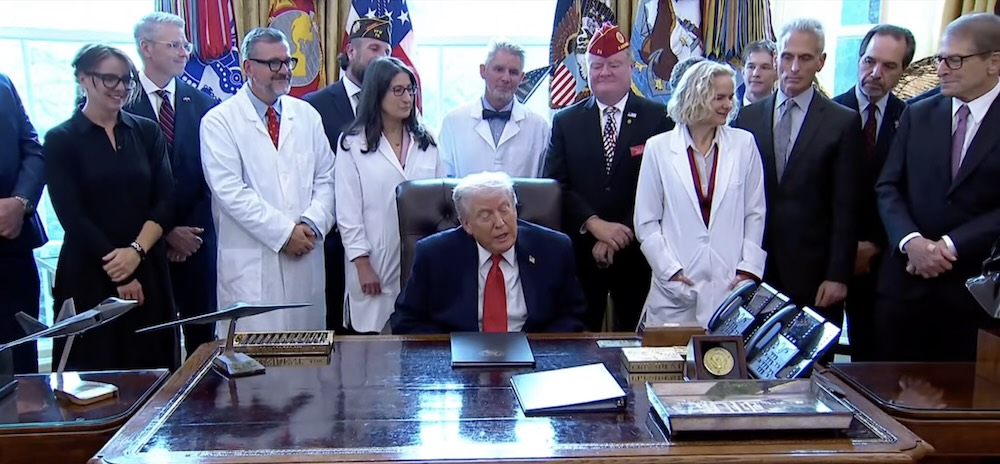
Marijuana can “make people feel much better” and serve as a “substitute for addictive and potentially lethal opioid painkillers,” President Donald Trump said on Thursday as he issued an executive order to federally reschedule cannabis and promote access to CBD for therapeutic purposes. He clarified, however, that he personally has no interest in using marijuana himself.
Although the president emphasized that he’s repeatedly lectured his children about abstaining from drug use, he said that “the facts compel the federal government to recognize that marijuana can be legitimate in terms of medical applications when carefully administered.”
“In some cases, this may include the use [of cannabis] as a substitute for addictive and potentially lethal opioid painkillers—they cause tremendous problems,” he said, surrounded by health officials, industry stakeholders and advocates. “This can do it in a much lesser way—can make people feel much better that are living through tremendous pain and problems.”
That said, Trump made clear that he has no plans to use cannabis.
“I don’t want it,” he said. “I’m not going to be taking it, but a lot of people do want it. A lot of people need it.”
Trump’s drug policy positions can be sometimes enigmatic—with a historic
A GOP senator says the while a bipartisan marijuana banking bill remains stalled, with no recent discussions about advancing it as lawmakers focus on other legislative priorities, President Donald Trump’s move to reschedule cannabis could clear the path for further reform.
Sen. Bernie Moreno (R-OH), who is expected to sponsor the Secure and Fair Enforcement Regulation (SAFER) Banking Act in his chamber, told Marijuana Moment this week that there have still been “no” conversations about moving the legislation, despite previously predicting it would be taken up in the fall.
As the season comes to a close, however, Congress remains preoccupied with competing priorities such as extending health care subsidies and passing spending bills to keep the government funded.
“The line is deep in terms of getting stuff done, so that’s something we’ll think about once we get through all these things,” the senator said. But the cannabis banking bill could gain momentum under Trump’s plan to facilitate rescheduling, he added in a second interview.
The order issued on Thursday directs federal agencies to complete the process of moving marijuana from Schedule I to Schedule III of the Controlled Substances Act (CSA) and clears the way for a pilot program to
GOP lawmakers mount anti-marijuana effort; Senate amendment on hospital visits & cannabis; VA marijuana resentencing bill; MI psychedelics
Subscribe to receive Marijuana Moment’s newsletter in your inbox every weekday morning. It’s the best way to make sure you know which cannabis stories are shaping the day.
Your support makes Marijuana Moment possible…
Your good deed for the day: donate to an independent publisher like Marijuana Moment and ensure that as many voters as possible have access to the most in-depth cannabis reporting out there.
Hemp-derived THC beverages could be legally sold in New Jersey liquor stores under certain restrictions if bill currently working its way through the state Legislature becomes law.
Senate Bill 4509, which passed a state Senate committee on Monday, would establish a regulatory framework for the products while repealing previous laws related to intoxicating hemp.
ADVERTISEMENT
If passed, the New Jersey Cannabis Regulatory Commission (CRC) would be required to establish a licensing process allowing liquor stores to sell hemp-derived beverages.
Business that hold wholesale or retail distribution licenses from the Division of Alcoholic Beverage Control can continue to do so until the commission implements the new regulations.
Once the rules are released, manufacturers and retailers will have 120 days to comply and must
President Donald Trump’s historic move to direct the reclassification of marijuana on Thursday has elicited a wave of positive feedback from top lawmakers, state officials, advocates and industry stakeholders—reflecting the uniquely bipartisan way cannabis reform has bridge political divides during an especially divisive time.
While several Democratic lawmakers have made clear that simply moving cannabis from Schedule I to Schedule III of the Controlled Substances Act (CSA) does not go far enough, even some of Trump’s sharpest critics have generally agreed that the executive order directing the incremental reform is a step in the right direction.
The order directs the attorney general to complete a rescheduling process that was initiated under the Biden administration. The reclassification wouldn’t legalize marijuana, but it would loosen research restrictions, allow cannabis businesses to take federal tax deductions and symbolically recognize that the plant holds medical value—breaking from the federal government’s decades-long position that it is therapeutically ineffective with a high abuse potential.
The order also has implications for the hemp market, with a call to reevaluate how the crop is defined under a newly enacted spending bill that stakeholders say would ultimately eradicate the industry by banning most consumable cannabinoid products.
President Donald Trump on Thursday dismissed the concerns of GOP lawmakers who oppose his freshly signed executive order to reschedule marijuana, pointing out that an overwhelming majority of Americans support the reform and that cannabis can help people—including his personal friends—who are suffering from serious health issues.
At a signing ceremony, the president issued an order directing the attorney general to “complete” the process of moving marijuana from Schedule I to Schedule III in the “most expeditious manner,” while also announcing plans to make full-spectrum CBD products available to patients through their health providers that could be covered by Medicare.
The president said he’d prefer to have the medical professionals in attendance at the event take that question, but emphasized that polling has found that four in five Americans are in favor of rescheduling cannabis. The reform wouldn’t legalize marijuana, but it would ease research restrictions and let marijuana businesses take federal tax deductions available to other traditional industries.
Marijuana will be federally rescheduled under an executive order signed by President Donald Trump on Thursday.
The directive also aims to address federal hemp laws to promote access to full-spectrum CBD that could be covered under federal health insurance plans.
“We have people begging for me to do this, people that are in great pain for decades,” Trump said. “This action has been requested by American patients suffering from extreme pain, incurable diseases, aggressive cancers, seizure disorders, neurological problems, and more—including numerous veterans with service-related injuries and older Americans who live with chronic medical problems that severely degrade their quality of life.”
This marks one of the most significant developments in federal marijuana policy since its prohibition a half a century ago, with a Schedule III reclassification recognizing that marijuana has medical value and a lower abuse potential compared to other Schedule I drugs like heroin.
Rescheduling will not federally legalize cannabis. However, the policy change will enable state-licensed marijuana businesses to claim federal tax deductions that they've been previously denied under an Internal Revenue Service (IRS) code known as Section 280E. It will also remove certain research barriers applied to Schedule I drugs.
The change may also spur additional states to modernize their own policies on cannabis, as some lawmakers have cited the federal government's restrictive classification of marijuana as a reason they have been uncomfortable with enacting legalization or at least allowing medical use.
In addition to directing the attorney general to expedite the completion of the process of rescheduling marijuana to Schedule III of the CSA, the executive order also includes a novel proposal to allow Medicare recipients to access non-intoxicating CBD that'd be covered under the federal health care plan.
Marijuana Moment first reported on leaked details from a White House briefing about the plan on Thursday ahead of the signing event. That includes a directive for top White House staff to work with Congress to give patients access to full-spectrum CBD products, “while still restricting the sale and access to products that cause serious and potentially life-threatening health risks.”
The order also urges Congress to examine updating the definition of hemp to ensure that full-spectrum CBD is accessible to patients—a policy change that could mitigate some concerns in the sector about a recent spending bill Trump signed with provisions that would broadly ban consumable hemp products.
Separate from Trump's order, Mehmet Oz, administrator for the Centers for Medicare & Medicaid Services (CMS), will also be announcing “a model that will allow a number of CMS beneficiaries to benefit from receiving CBD under doctor recommendation at no cost,” a White House official said during the briefing.
Trump endorsed rescheduling—as well as industry banking access and a Florida adult-use legalization initiative—on the campaign trail last year. The president had been largely silent on the issue since taking office during his second term, until an August briefing, where, in response to a reporter's question, he announced that the administration would decide on rescheduling within weeks.
By moving forward with the plan, Trump is completing a process initiated under the Biden administration. That involved a scientific review by the U.S. Department of Health and Human Services (HHS)—which concluded that Schedule III is a more appropriate category for marijuana—as well as the Drug Enforcement Administration (DEA).
Recent news reports revealed that Trump was planning to issue the executive order directing federal agencies to move ahead with cannabis rescheduling following a meeting with marijuana industry executives, HHS Secretary Robert F. Kennedy Jr., and Centers for Medicare and Medicaid Services Administrator Mehmet Oz. During that meeting, Trump reportedly phoned House Speaker Mike Johnson (R-LA), who expressed his opposition to rescheduling cannabis.
Meanwhile, amid the heightened rumors that the Trump administration would be moving forward on marijuana rescheduling, multiple top congressional Democrats made the case that the reform would not go far enough—including one senator who said the move is only an attempt by the president to “gaslight” voters into thinking he legalized cannabis to boost his “pathetic” approval ratings.
President Donald Trump on Thursday ushered in the most momentous shift in federal marijuana policy since 1970 with an executive order reclassifying cannabis as a less dangerous drug and recognizing for the first time its medical benefits.
“I promised to be the president of common sense, and that is exactly what we are doing,” said the president, flanked by doctors and veterans advocates during an Oval Office signing ceremony.
“This is really something having to do with common sense.”
ADVERTISEMENT
The executive order directs the Justice Department to move marijuana from Schedule 1 to Schedule 3 of the Controlled Substances Act.
Exactly when cannabis would become Schedule 3, a designation that recognizes marijuana’s medical value under federal law, was not immediately clear.
Marijuana will be federally rescheduled under an executive order signed by President Donald Trump on Thursday.
The directive also aims to address federal hemp laws to promote access to full-spectrum CBD that could be covered under federal health insurance plans.
“We have people begging for me to do this, people that are in great pain for decades,” Trump said. “This action has been requested by American patients suffering from extreme pain, incurable diseases, aggressive cancers, seizure disorders, neurological problems and more—including numerous veterans with service-related injuries and older Americans who live with chronic medical problems that severely degrade their quality of life.”
The president emphasized that his order “doesn’t legalize marijuana in any way, shape or form, and in no way sanctions its use as a recreational drug.”
This marks one of the most significant developments in federal marijuana policy since its prohibition a half a century ago, with a Schedule III reclassification recognizing that marijuana has medical
President Donald Trump today signed an executive order expediting the reclassification of cannabis as a less dangerous drug—moving it from Schedule I to Schedule III of the Controlled Substances Act.
The president was joined by several medical leaders during the signing, including Administrator of the Centers for Medicare & Medicaid Services, Dr. Mehmet Oz; Dr. Nora Volkow of the National Institute on Drug Abuse; FDA Commissioner Dr. Martin Makary; and Secretary of Health and Human Services Robert F. Kennedy Jr., among others.
“I have a very distinguished group of people behind me, mostly medical people and brilliant people and they really know what they’re doing,” the president said, prior to announcing he would sign an order to reschedule cannabis.
Trump emphasized the large public support for the reclassification, adding that the move polled at 82% in favor and will help patients “live a far better life.” He also made clear that the rescheduling is not the same as legalization saying, “I want to emphasize the order I’m about to sign doesn’t legalize marijuana in any way, shape or form.”
President Trump signs an executive order in the White House’s Oval Office. Washington, D.C.
Substances classified as Schedule I have a “high abuse potential with no accepted medical use; medications within this schedule may not be prescribed, dispensed or administered,” states the National Library of Medicine. Heroin, LSD, MDMA and cannabis currently fall under this categorization. Last Spring, the United States Drug Enforcement Agency (DEA), proposed that the substance be moved to the list of Schedule III drugs, which have less potential for abuse and are accepted for medical treatments. Other substances classified as Schedule III drugs include ketamine, testosterone and anabolic steroids.
While today’s executive order falls short of full legalization, the reclassification marks one of the most significant reversals in US drug policy in decades. This decision could have wide-ranging effects on the cannabis industry, criminal enforcement and access to research funding.
“Rescheduling cannabis to Schedule III is a meaningful step forward that will finally give legitimate cannabis businesses access to basic banking, tax relief, and the tools needed to operate like any other industry,” says Eugenio Garcia, Cannabis Now’s founder and CEO. “While this progress is welcome, true reform must also include justice—no one should remain incarcerated for cannabis as the nation moves toward acceptance and regulation. This moment is about unlocking economic opportunity while correcting the human cost of prohibition.”
Jamie Pearson, New Holland Group’s president and founder, comments on the progress as well as the work that remains for the cannabis industry: “Today’s executive action is a meaningful and long-overdue step toward aligning federal policy with medical reality. Directing the rescheduling of cannabis to Schedule III acknowledges its accepted medical use and begins to remove structural barriers to research, clinical guidance and responsible access,” she says. This was the message largely put forth by Trump and his supporters during the signing as well.
“That said, rescheduling is not legalization, nor does it resolve all of the regulatory and economic challenges facing the industry,” she says. “The real work now lies in thoughtful implementation, ensuring that research, patient access and public safety advance together, and that policy clarity follows intent. This is progress, and it should be treated with both optimism and discipline.
The prospect of reclassifying cannabis from Schedule I to Schedule III has prompted swift and varied reactions across the political and cannabis landscapes.
“It shows incredible leadership for the president to have the courage to take the lead on cannabis reform,” comments Dave Marrow, CEO of Lume Cannabis MI.
“Today’s executive order to reclassify cannabis is a meaningful step toward aligning federal policy with science and economic reality. Moving cannabis to Schedule III acknowledges its medical value while bringing long-overdue clarity to how cannabis is cultivated, researched, and commercialized. While it’s not the final destination, this shift will accelerate innovation, unlock investment and help professional cultivators and operators continue to raise standards across the industry. At FOHSE Lighting, we see this as real progress for sustainable growth in cannabis cultivation,” says FOHSE Lighting CEO and Co-founder Brett Stevens.
During the signing, those in attendance congratulated Trump for his leadership on the matter. “Thank you for your leadership and vision and finally getting to closure on this issue,” Kennedy, Jr. said. “This is a scientific question that has divided our country for many, many years.”
Trump allowed those alongside him to weigh in, ultimately reinforcing their shared view that increased research into cannabis is essential for advancing medical understanding and improving quality of life. “Research is crucial. Yes, cannabis can be addictive, but we cannot close our eyes to research,” he said. “What we need to do is research and learn how to optimally use it.”
Putting pen to paper, Trump said, “It’s an honor to do this.”
President Donald Trump will be signing an executive order on Thursday that will direct the attorney to “expedite” and “complete” the marijuana rescheduling process, throw a lifeline to the hemp industry, allow doctors to prescribe CBD products that would be eligible for Medicare coverage and more, a White House official told reporters at a readout ahead of the signing event.
Marijuana Moment wasn’t invited to attend the background briefing, but obtained the transcript of the conversation.
Many details are consistent with reporting about the plan to move marijuana from Schedule I to Schedule III of the Controlled Substances Act (CSA), but the discussion revealed additional information about the order and how the administration is framing the reform.
The official started by emphasizing that the “common sense” administrative action is “focused on increasing medical research for medical marijuana and CBD” to “better inform patients and doctors.”
That means expediting the finalization of a rule to reschedule marijuana, they said. The move wouldn’t legalize cannabis, but it would help promote research while also letting marijuana businesses take federal tax deductions they’ve been barred from under an Internal Revenue Service (IRS) code known as 280E.
Here are new details about Trump’s executive order
Republican congressional lawmakers are making a last-ditch attempt to convince President Donald Trump not to follow through with reported plans to reschedule marijuana—with a pair of letters from House and Senate members who say the move would be a mistake.
The House letter says rescheduling cannabis would “send the wrong message to America’s children, enable drug cartels, and make our roads more dangerous.”
The representatives—led by Reps. Pete Sessions (R-TX) and Andy Harris (R-TX)—said cannabis is a “harmful drug that is worsening our nation’s addiction crisis.”
The Senate letter, organized by Sen. Ted Budd (R-NC), told Trump that moving marijuana to Schedule III would “undermine your strong efforts to Make America Great Again and to usher in America’s next economic Golden Age.”
The House members’ letter attempts to appeal to Trump by characterizing the reform as a “Biden Administration rescheduling decision,” saying that the former president’s team tried to “expand the use of an addictive drug for partisan gain.”
“Rescheduling marijuana will not make America great,” the lawmakers wrote. “You have always been a role model for America’s youth, telling young people for years that they should never do drugs. We hope that you consider the harms of marijuana rescheduling

 Login
Login