
 Login
Login
Keebin’ with Kristina: the One with the Curious Keyboards

I love first builds! They say so much about a person, because you see what’s paramount to them in a keyboard. You can almost feel their frustration at other keyboards come through their design choices. And the Lobo by [no-restarts] is no exception to any of this.
There’s just something about this Corne-like object with its custom case and highly-tappable and variously tilted keycaps. The list of reasons for being begins innocently enough with [no-restarts] wanting a picture of their dog on the case.

Overall, [no-restarts] is happy with it, but has some ideas for revision. Yep, that sounds about right. The Lobo is all hand-wired, and there’s a PCB with hot swap sockets in its future. If you’re interested in the case files, GitHub is your friend.
Getting a Handle on Grabshell
[kurisutofujp] recently saw a GrabShell in the flesh, and why haven’t I heard of this keyboard before? The next best time is now, so here we go with the explanation, both for myself and the other 9,999.

But you don’t have to use it that way, see. You can stand it up on the desk if you don’t want to type in mid-air. It can also be opened sort of halfway and used like a SafeType vertical keyboard.
If none of this excites you, GrabShell can also be laid flat on the desk. The distance between the two halves in this configuration is quite generous, and frankly, I’m a bit jealous.
So let’s talk about the generous thumbing-around area. As you’ll see in the video below, the left has a joystick and a toggle switch that flips it from arrow keys to mouse cursor. There’s a serious-looking scroll wheel beneath that. All three of these can be pushed in for additional inputs.
The right side of the thumb panel has a sweet-looking trackball that’s housed in a really cool-looking way. Another cool thing: there’s a frigging I2C port on the top, just exposed and hanging out because reasons.
Switch-wise, the board is a mix of hot-swappable Gateron G Pro browns and low-profile Gaterons under double-shot ABS keycaps. I think it sounds nice in the video below; others say it sounds cheap and hollow. To each their own.
The Centerfold: ZMK Dongle Repackaged As Vintage Computer
![A three-panel shot of a Apple ][-inspired ZMK dongle.](https://hackaday.com/wp-content/uploads/2025/12/ZMK-dongle-centerfold.png)
This is a ZMK dongle, like I said in the subheading, and [mharzhyall] put a new case around it. Basically it lets you connect keyboards wirelessly.
Do you rock a sweet set of peripherals on a screamin’ desk pad? Send me a picture along with your handle and all the gory details, and you could be featured here!
Historical Clackers: the Edland Typewriter Was a Total Flop
The Antikey Chop reports that this curious little rook-looking index typewriter was such as flop as to be nearly lost to history entirely.
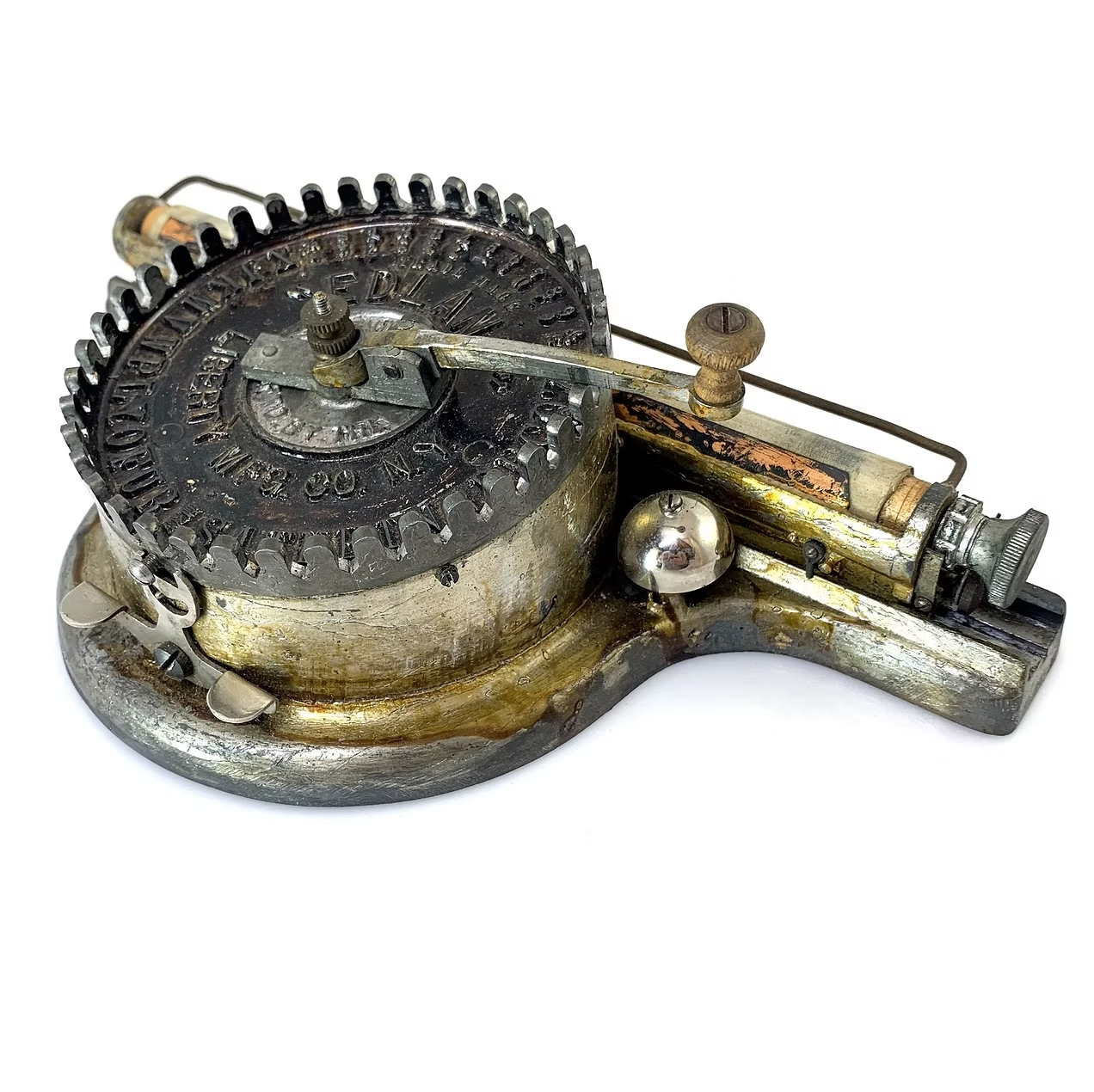
Produced between 1891 and 1893 by the Liberty Mfg. Company, the machine was conceived by Joseph Laurentius Edland of Brooklyn, NY. All seemed lost until 1964, when a handful of Edlands were found languishing in a warehouse in Galway, NY.
Although only made for two years, there were three different versions developed. The one pictured here is the second, with a metal base and embossed index, whereas the first had a wood base and flat index.
The third version, the Typewheel Edland, had a typewheel for a print element à la the Blick. Edlands cost a semi-reasonable $5 at the outset, but eventually doubled in price.
So, why the absolute failure? It was no better or worse a machine than its contemporaries, but perhaps just wasn’t well-marketed. Another theory is that the Edland failed because they were made of pot metal. Seems reasonable. Want to know how to use one? RTFM (PDF).
Finally, a Keyboard with a Mechanical Watch Movement
Wait, what? Why though? Well, it ticks along as you type, is that cool? It might be fun to see if you can keep up a certain number of keystrokes per second. Okay, I’m warming up to this idea pretty quickly, can you tell?
The Nama keyboard, dubbed after the scientific term for the mammoth, is appropriately named. It can weigh up to an astonishing 19.4 lbs (8.8 kg) depending on the case material. (Consider that a Model M, a proper bludgeoning device in its own right, weighs just 5 lbs (2.2 kg).)
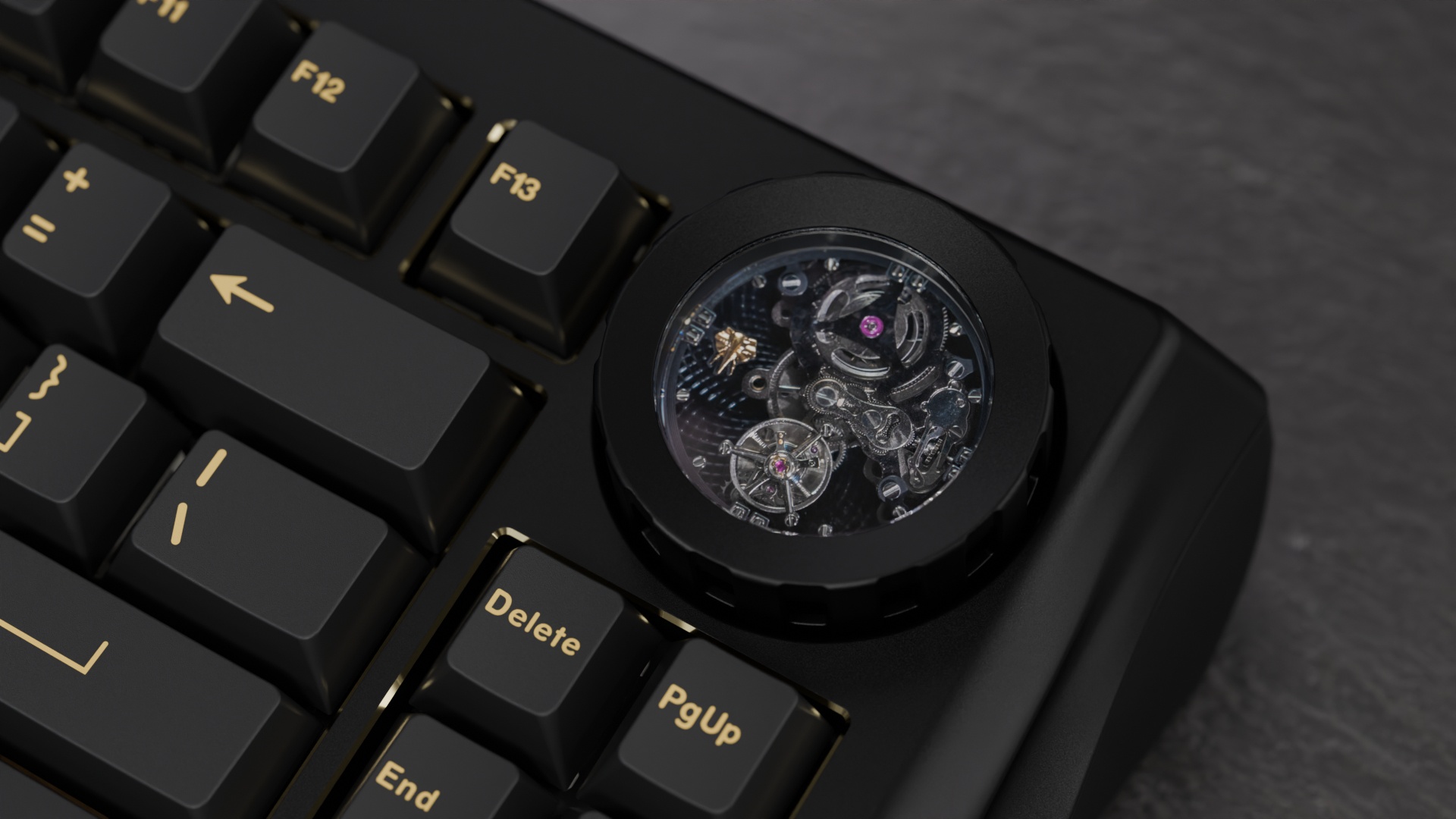
Nama comes from Wuque Studio, and was built as an ode to their manufacturing capabilities. Now this is starting to make more sense. They are the Banana Republic to vendor Chilkey’s Old Navy, who are the brand behind the ND75, if that rings any bells.
Now the Nama looks like your basic mechanical keyboard on the surface, but five years of design decisions went into this line. You can get it with an aluminium case (14.5 lbs / 6.6 kg) or a brass CNC’d case (18.95 lbs / 8.6 kg), which of course is what makes it so heavy.
But yeah, the defining feature is definitely the watch movement. You bet your Backspace it’s fully functional except as a watch, and it doubles as a volume control knob, so you don’t have to settle for touching it with just your eyeballs.
Yeah, so the astute among you will have noticed that there are no numbers or hands on the watch movement, which would be, what, tacky? I don’t know anymore. At any rate, it’s protected by a piece of sapphire glass, which should keep Cheetos dust and such out of there.
Oh, you want to know the cost? $749 for the bare-bones with no movement, and $1299 for the brass-bottomed boy with the tourbillion. That’s… actually not that bad for a tourbillion movement.
Got a hot tip that has like, anything to do with keyboards? Help me out by sending in a link or two. Don’t want all the Hackaday scribes to see it? Feel free to email me directly.
