
Normal view

There are new articles available, click to refresh the page.
Before yesterdayMain stream

Re-Coup Winter Costs: Grow Outdoor

7 December 2025 at 19:53

When planting outdoors, it’s highly probable that there will be problems that may leave plants in a less than perfect state. Even the best cocktail of nutrient and trace chemicals can still allow a nutrient deficiency. Grasshoppers may rear their ugly green heads or the nutrient will attract unsavory company, leading to an infestation that must be dealt with.

There are many variables to growing outdoors, but the most common of nutrient deficiencies will be encountered during the green foliage growth period. Lack of nitrogen is the most common deficiency. A large green leafy plant requires a very high level of nitrogen to achieve its full glory. The first sign is a gradual creep of yellow among the lowest and therefore leaves of the plant. If this happens, be sure to add a full ration of nitrogen to the next watering session. The yellow creep can be cured in only a few days if it hasn’t progressed to a point at which the tips of the leaves are curling and black or brown. At that point, it’s a permanent situation that can’t be remedied. It will be necessary to increase the amount of nitrogen so it doesn’t damage any newer leaves that would be higher on the plant. Some other symptoms of a nitrogen deficiency include red stems, smaller new leaves and slow growth.

A phosphorus deficiency rears its head by slow and stunted growth. The newer leaves of the plant will be smaller and a darker green than usual. As with nitrogen deficiency, a red color appears on the stems. The leaves may also develop a nasty red or purple color in the veins on the underside of the leaf. If phosphorous isn’t added, the older leaves will start to die. The affected leaves won’t be healed, but the progression of the damage will be stopped. The leaves will lighten in color to the beautiful green and the growth rate will pick up.

A potassium deficiency is often a tricky one to diagnose. Most of the time a potassium deficient plant will be tall and healthy looking, though they may be slightly phototropic in appearance. The indicators are the phototropic appearance and browning of the ends of the oldest leaves. A phototropic plant is one who expends all of its energy to reach a feeble light source, thus the tall spindly look they have. Recovery from a potassium deficiency is usually slow and is measured in weeks. The leaves that have been browned already usually die off. The leaves will have brown spots on them, particularly along the prominent center vein. As with most deficiencies of a serious nature, the stems and underside veins have a reddish or purple hue to them. The most common source of potassium is wood ash; so if last year the crop had a potassium deficiency, add a cup of wood ash this year to the nutrient or growing medium.

There are also deficiencies to be had with the elements iron, manganese, boron, molybdenum, zinc and copper. Because most outdoor growing mediums tend to be natural in source, nature has already included the other trace elements required for most of their life. However, adding trace elements two or three times in the life of the plant is always a good idea. If the plants don’t require them, they simply won’t take them up.

For those of growers in the country and planting in the backyard, the easiest way to keep pests and animals away from the plants is to plant geraniums around them. The common geranium secretes a substance that acts as an all-around pest repellent. This is its natural way to combat predators and has been working great for a lot longer than humans have been growing grass, so take note. Both animals and pests will shy away from your crop.

Whatever growing medium that will be used will eventually attract a pest, then many pests. This infestation of the growing medium can be tricky to get rid of. If the little critters are in the topmost inch or so of the growing medium, that medium will have to be replaced. Be gentle with the root system and deluge the area with a good garden-safe insecticide after removal of the top inch. It’s important to replace the growing medium with a chemically-inert medium. Test and alter the pH of the medium as required to hit a neutral value of seven. The growing medium will eventually adjust itself to the pH levels the plant is accustomed to over a space of about a week.

Growing outdoors is an easy and productive means to reduce or even replace the costs incurred by our green friend over the winter. With the right knowledge this year’s crop should thrive.

What are some of your outdoor growing tips? Share with our community on Facebook.

The post Re-Coup Winter Costs: Grow Outdoor appeared first on Cannabis Now.
Your Home Grow Journey Starts With I Love Growing Marijuana

14 October 2025 at 03:02

There’s nothing quite like growing your own cannabis at home. Watching a tiny seed turn into a beautiful, potent plant that twinkles with trichomes, smelling those first terpenes, knowing you did it all yourself, is unmatched. But for many people, the dream of growing at home hits a brick wall before they even get started. It’s easy to feel like you’ll mess it up and lose a bunch of time and cash. Thankfully, I Love Growing Marijuana (ILGM) is here to help ensure that doesn’t happen. 

A Dutch cannabis seed company operating exclusively in the US market, ILGM was built on a simple, powerful belief: Anyone can grow their own cannabis.

They are dedicated to providing not only top-tier seeds, but also the expert knowledge and a foolproof safety net you can count on. Expect success at every step of your journey.

From a Simple Blog to a Thriving Community

The company’s story started with its founder, Robert Bergman, a Dutch grower who genuinely loved the plant but was tired of the misinformation around it. So, he started a low-key blog to share what he knew so everyone could grow weed at home. He wanted to pull back the curtain on cultivation and show that it wasn’t some big secret for a few pros. His straightforward approach resonated with the canna-curious and amateur cultivators around the world.

“Getting started can feel like the hardest part,” says ILGM CEO Ernst Rustenhoven. “But if you have a knowledgeable friend who guides you through it, that big hurdle turns into a small step. We are that friend.”

That blog turned into a buzzing community. Growers would jump into the comments to ask questions, share tips and celebrate their wins. It was a true collaboration built on trust and a shared love for growing. That’s what eventually led to the launch of a trusted seedbank.

The seedbank is a huge part of ILGM’s DNA—the belief that the best weed is the one you grew yourself and the best way to do that is with a solid community behind you. It’s this grower-first mindset, mixed with a deep understanding of what US home growers actually need, that gives them their edge.

Top-Shelf Seeds, All The Way To Harvest

The heart of ILGM lies in its genetics, as showcased in their cannabis seed bank. All the cultivars that are carefully selected because they’re easy to grow, tough and have killer terpene profiles. ILGM has done the homework for you, so you can pick a strain that’s a perfect fit for your location.

ILGM also does limited drops from some of the best craft breeders in the country. With every single strain, you get the whole backstory—the breeding intent and the best way to grow it.

But a great cannabis seed is just the start. To really succeed, you need to know what you’re doing. That’s why ILGM has built the industry’s best educational support. Every strain comes with a detailed, step-by-step grow guide. It’s like having a cheat sheet for everything from planting to watering to fertilizing.

And if you ever hit a roadblock, the free ILGM Grow Guide Library is a goldmine. It’s packed with expert-written content on everything from spotting pests to mastering advanced techniques. It’s a resource the company is proud of because it shows they’re in this with you, from the first day to the last.

“Learning to grow cannabis, like everything else, begins with the basics,” Rustenhoven says. “Our grow guides are designed to take you through each stage, from your first grow to advanced techniques, one step at a time.”

The Germination Guarantee: Your Safety Net

One of the biggest anxieties for a new grower is a seed that won’t sprout. It can stop a grow journey before it even gets going. That’s why ILGM created its Germination Guarantee. It’s pretty simple: If your seeds don’t pop, the company will send you new ones, no questions asked. This is a game-changer. It takes the fear of failure off the table and lets you start your grow with a ton of confidence. It’s one of the few truly grower-friendly return policies you’ll find in this business, and it’s ILGM’s way of proving they’ve got your back.

The customer support team is legendary for a reason, too. They’re not just some call center reps; they’re real growers who get it. They offer genuine advice and help, not canned responses.

Ready to Get Growing?

If you’re ready to start your own grow adventure, ILGM is making it easy for you. Check out their wide selection of high-quality seeds, from classic strains to exciting new drops. And while you’re there, be sure to visit the deals page for special bundles and offers, especially if you’re just starting out.

Ultimately, ILGM’s mission is making home cultivation easier and way more fun. They combine top-tier genetics with expert guidance and a promise that you’re set up for success every step of the way. Because when it’s all said and done, the best flower is the one you grew yourself.

The post Your Home Grow Journey Starts With I Love Growing Marijuana appeared first on Cannabis Now.

Truthful Facts About Growing Marijuana Indoor – Time Factor

By: press
8 December 2022 at 09:00

Truthful Facts About Growing Marijuana Indoor – Time Factor, It Takes Longer Than You Think. This is the first in a series of articles I’m calling; Truthful Facts About Growing Pot Indoors.

I’ll be posting them over the next few weeks. I love to read your comments and answer questions. Please use the comment section after each page or article.  Thanks!!

It’s a great idea; grow your own and save some money, you’ll know exactly what you have, you’ll know how it was grown and you will save some of your hard earned cash in exchange for a little labor.

The problem is how long it takes to get your first crop versus just running to the store (or finding the weed guy) and buying a bag of weed whenever you need it. The answer is to buy enough reefer to get you through the 147 days you’ll need before you can smoke your pot.

You can start your first grow from seeds or a female clone.

Seeds take from a couple of days to around 12 to sprout. Once they sprout and grow for a few weeks in a peat ring, they are ready to be transplanted into your large pot. I suggest 6 or 7 gallon pots but use whatever fits your grow area. Read this article about pot size.

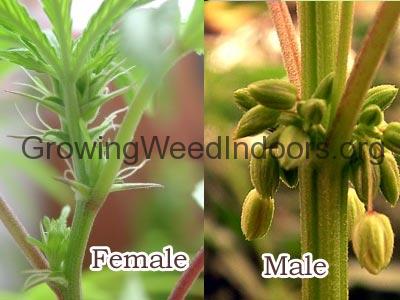
Once they are transplanted, start the flowering cycle (switch your lights to 12 hours on and 12 hours off) to find out which plants are boys and which ones are girls.

It can take up to 15 days or so for the girls to show themselves. Once that happens, you can toss the male plants and switch the girls back to the vegetative light schedule you’re using.

Once you find your girls; they will have tiny wisps of white hairs and you’ll see tiny little buds starting to grow, boys will show little ball sacks, move the boys out and revert back to the vegetative cycle (GLR or 18 hours on 6 hours off), and let them to grow for another 50 days than they’ll be ready for flowering.


female plant and male pot plant

When plants revert they will grow a few odd shaped leafs through the flowers. They don’t hurt anything; you can snip them off or let them grow out.

Restart the flowering cycle by switching back to the 12 hours on 12 hours off lighting schedule.

Of course depending on strain, your flowers reach their full potential and size when the trichomes start turning amber in from 45 to 60 days or possibly longer.

NOTE: the time frames listed are approximate and are dependent on the strain you’re growing, the grow environment and your skills as an indoor gardener. For example; not adhering to a strict light cycle of 18 hours on and 6 hours off. For the best grow, you want the lights the same every day and you MUST refrain from disturbing your girls when the lights are off. Just let them be.


12 days to sprout

15 days as a seedling

10 days of lights on the flowering cycle to sex the plants

50 days vegetative cycle depending on your strain and environment

60 days in the flower cycle.

Total = 147 days for your harvest.

You’ll also need another 14 days to dry and cure your buds giving you a total of 161 days.

You can cheat a little and pick young small buds but before you know it you will have smoked the whole plant. A good way to dry fresh bud you want to sample is using a portable oil heater.

Read the full article about drying wet bud here.

There are many more tips and tricks about growing your own pot at Growing Weed Indoors. Soil mix, nutrients, lighting schedule and equipment used to grow awesome pot; the kind of pot where you’re feeling it after one hit from a one hitter, are fully explained.

Growing marijuana is a whole lot easier with a little help from people like me who actually grow weed indoors at home. This is an important fact when reading or watching how to grow articles and videos. Is it really from somebody with a stealth grow or somebody just trying to sell you something?

Love to hear your comments and answer any questions. Please use the comment section below each post, page or article.

Thanks!

❌
❌