That (probably) familiar connector you see up there is known as a "Molex" connector, and modern power supplies and computer peripherals rarely of ever still have this type of power connector—and for good reason.
NASes are not for everyone. They can be expensive, and oftentimes, they provide features that, frankly, a lot of people don't need. A NAS is what you get when you want your own cloud storage of sorts, but if you don't need the cloud part, a DAS can be a better option.
It seems like forever ago that we first read about melting GPU power connectors and small fires starting inside PCs as the wattage was cranked up to unbelievable levels. You'd think that, by now, this issue would be definitively solved, but it's still happening, and the "fixes" all seem like stopgaps. So what's happening?
The graphics card market is a fickle beast. One year, it'll be teeming with options for every price range; the next, it'll be barren during a shortage. The ongoing RAM-pocalypse is definitely pushing us toward that latter state, but there are still GPUs left to buy—for now.
Just 10 years ago, thumb drives were commonplace everywhere. You probably carried one around in your keys, or you had one in your backpack. Things have changed a lot, though.
RAM prices have skyrocketed over the past few months, and it doesn’t look like they’re coming down anytime soon. With upgrades threatening to hurt your wallet more than ever, maybe it’s time to take a different approach: making smarter use of the RAM you already have.
I had a horrible habit that I've worked really hard to get rid of. I used my "Downloads" storage as a disorganized bin of important and non-important files—and it bit me in the rear when I mistakenly deleted some very important files when I tried flushing the several-gigabyte-sized folder.
For years, PC builders have followed the “classic” airflow setup: pulling cool air in from the front (and sometimes the bottom), while rear and top fans push hot air out. But what if we’ve been doing it wrong all along, and a single top fan could be the reason your CPU is overheating and underperforming?
For many people, a desktop PC is more than just a functional device. PC building has become a fine art in some circles, and in the pursuit of the perfect PC build, some enthusiasts have resorted to a mild kind of fakery, in the form of "dummy" RAM.
Just when did USB ports become such a complete mess? They're easy to follow on the surface, with two relevant types to pay attention to. But if you look closer, they're all kinds of confusing.
If you have a big house, or if you just have thick walls, a mesh network is a really good way to make your network reach every corner of your home. But you'd be surprised by how many people mess up the installation.
There was an age where partitioning drives was not only common, but encouraged. But PCs have changed a lot in the past few years. Nowadays, while partitioning is still an option, I'd argue that 90% of users probably shouldn't.
A critical remote code execution (RCE) vulnerability, dubbed ‘React2Shell’, affecting React Server Components (RSC) and Next.js, is allowing unauthenticated attackers to perform server-side code attacks via malicious HTTP requests.
Discovered by Lachlan Davidson, the flaw stems from insecure deserialization in the RSC ‘Flight’ protocol and impacts packages including react-server-dom-webpack, react-server-dom-parcel, and react-server-dom-turbopack. Exploitation is highly reliable, even in default deployments, and a single request can compromise the full Node.js process. The flaw is being tracked as CVE-2025-55182. Originally tagged as a CVE for Next.js, NIST subsequently rejected CVE-2025-66478, as it is a duplicate of CVE-2025-55182.
This blog post includes the critical, immediate actions recommended to secure your environment, new and existing Platform Detection Rules designed to defend against this vulnerability, and information on how SentinelOne Offensive Security Engine, a core component of the Singularity Cloud Security solution, allows our customers to quickly identify potentially vulnerable workloads.
What is React2Shell? Background & Impact
On December 3, 2025, the React and Next.js teams disclosed two related vulnerabilities in the React Server Components (RSC) Flight protocol: CVE-2025-55182 (React) and CVE-2025-66478 (Next.js), with the latter CVE now marked by NIST as a duplicate.
Both enable unauthenticated RCE, impacting applications that use RSC directly or through popular frameworks such as Next.js. These vulnerabilities are rated critical (CVSS 10.0) because exploitation requires only a crafted HTTP request. No authentication, user action, or developer-added server code is needed for an attacker to gain control of the underlying Node.js process.
The vulnerability exists because RSC payloads are deserialized without proper validation, exposing server functions to attacker-controlled inputs. Since many modern frameworks enable RSC as part of their default build, some teams may be exposed without being aware that server-side RSC logic is active in their environment.
Security testing currently shows:
Exploitation can succeed with near 100% reliability
Default configurations are exploitable, including a standard Next.js app created with create-next-app and deployed with no code changes
Applications may expose RSC endpoints even without custom server functions
A single malicious request can escalate to full Node.js process compromise
Security researchers warn that cloud environments and server-side applications using default React or Next.js builds are particularly at risk. Exploitation could allow attackers to gain full control over servers, access sensitive data, and compromise application functionality. Reports have already emerged of China-nexus threat groups “racing to weaponize” the flaw.
Companies are advised to review deployments, restrict unnecessary server-side exposure, and monitor logs for anomalous RSC requests. Securing default configurations, validating deserialized input, and maintaining a regular patch management schedule can prevent attackers from exploiting framework-level vulnerabilities in production applications.
Update React by installing the patched versions of React as listed above.
Update Next.js and other RSC-enabled frameworks as listed above. Ensure the latest framework and bundler releases are installed so they ship the patched React server bundles.
Review deployment behavior by checking whether your organization’s workloads expose RSC server function endpoints. These may exist regardless of whether developers added custom server functions.
How SentinelOne Protects Our Customers
Cloud Native Security – Offensive Security Engine
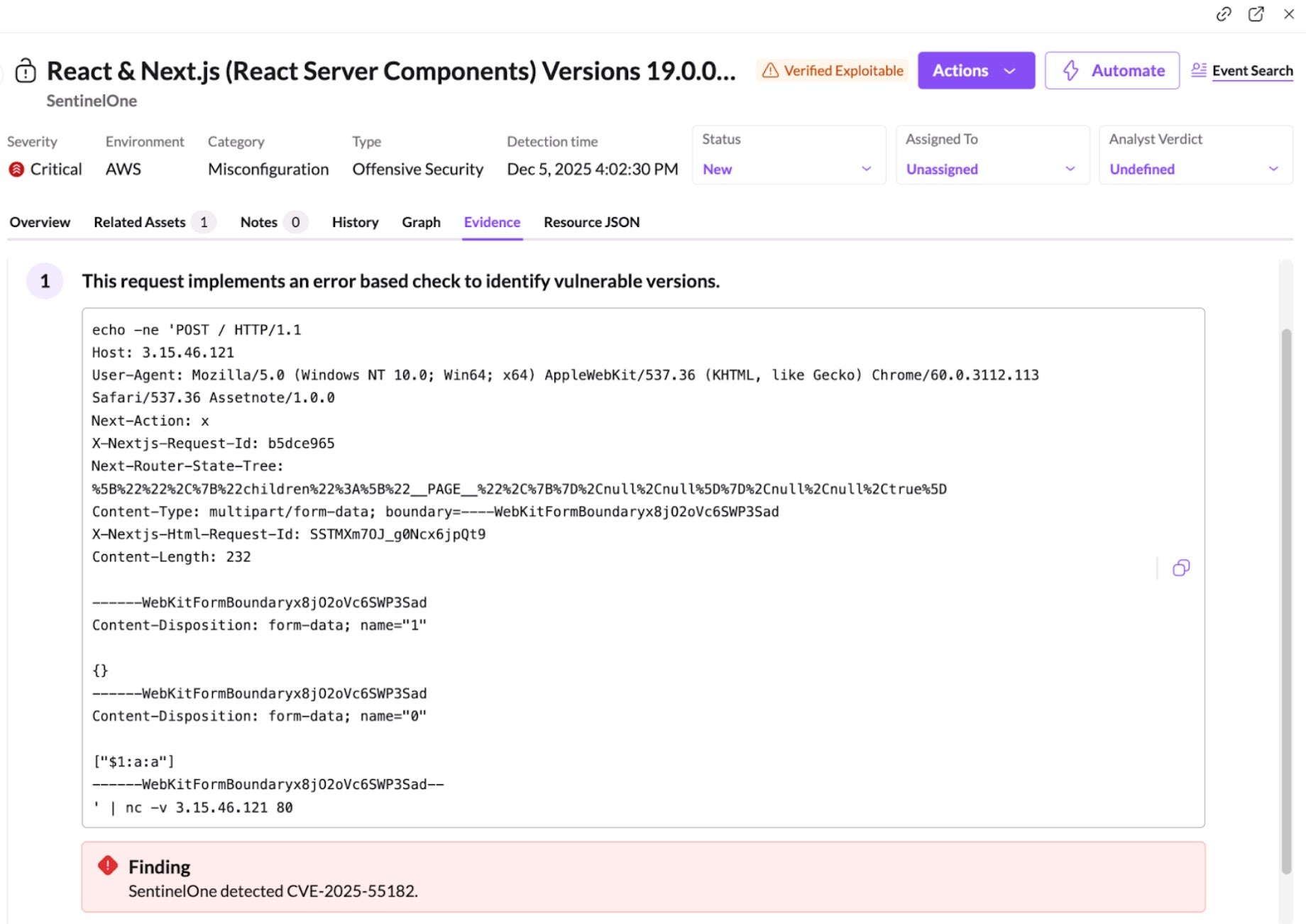
SentinelOne’s Offensive Security Engine (OSE), core component of its Singularity Cloud Security solution, proactively distinguishes between theoretical risks and actual threats by simulating an attacker’s methodology. Rather than relying solely on static scans that flag every potential misconfiguration or vulnerability, this engine automatically conducts safe, harmless simulations against your cloud infrastructure to validate exploitability.
This approach delivers differentiated outcomes by radically reducing alert fatigue and focusing security teams on immediate, confirmed dangers. By providing concrete evidence of exploitability—such as screenshots or code snippets of the successful simulation—it eliminates the need for manual validation and “red teaming” of every alert. Shift from chasing hypothetical vulnerabilities to remediating verified attack vectors, ensuring resources are always deployed against the risks that pose a genuine threat to their environment.
In response to this vulnerability, SentinelOne released a new OSE plugin which can verify exploitability of these vulnerabilities for publicly accessible workloads using a defanged (i.e., harmless) HTTP payload.
Viewing Misconfigurations in the SentinelOne Console
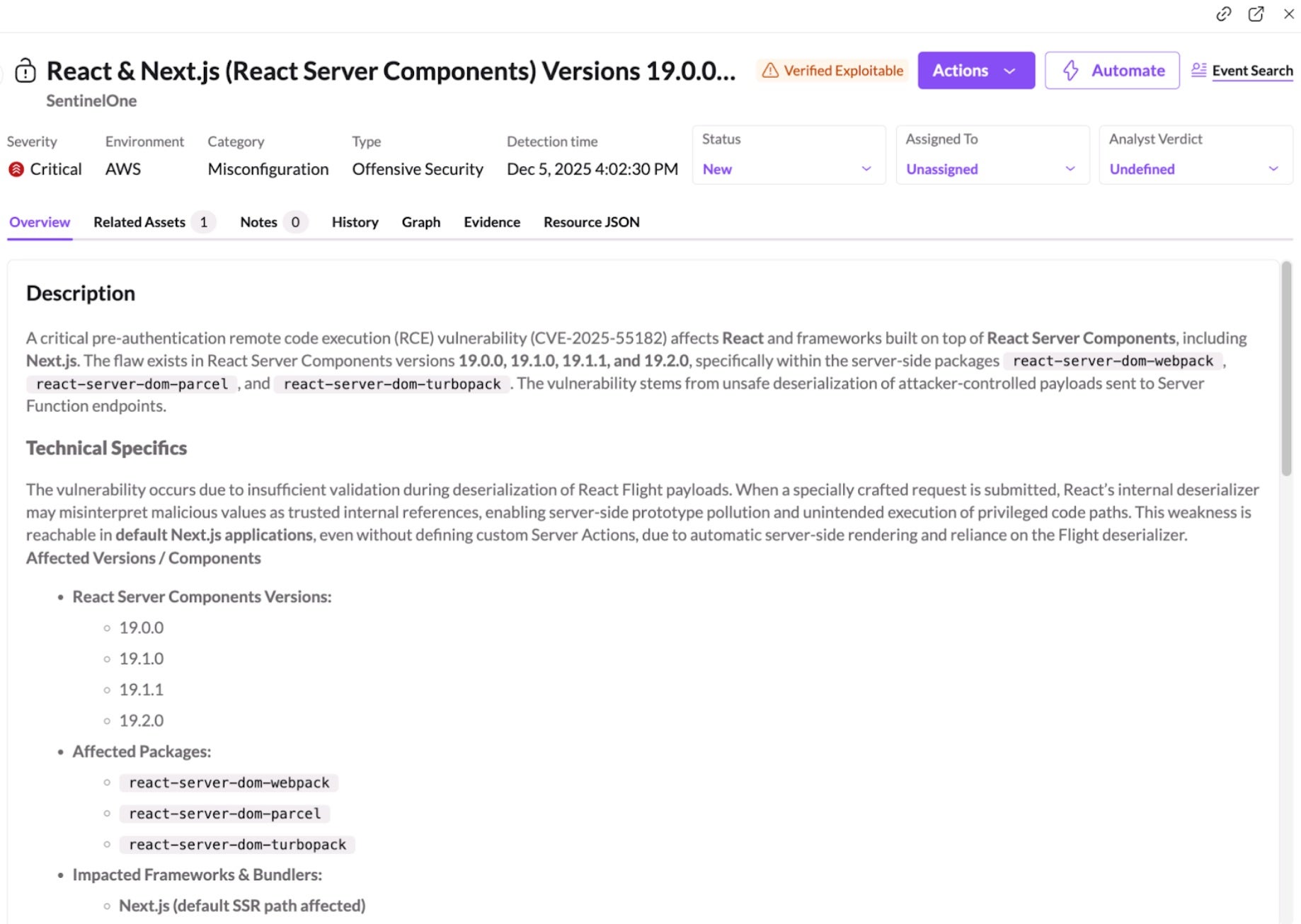
SentinelOne customers can quickly identify potentially vulnerable workloads using the Misconfigurations page in the SentinelOne Console.
Search for:
React & Next.js (React Server Components) Versions 19.0.0–19.2.0 Vulnerable to Pre-Authentication Remote Code Execution via Unsafe Deserialization (CVE-2025-55182)
This highlights Node.js workloads that are exposing RSC-related server function endpoints. Once identified, affected assets can be patched or temporarily isolated. SentinelOne CWS also detects suspicious Node.js behaviors associated with exploitation attempts, including downloaders and reverse shells, and provides Live Security Updates to maintain protection as new detections are deployed.
It identifies verified exploitable paths on your publicly exposed assets, confirming which systems are truly at risk. By validating exploitability rather than simply flagging theoretical vulnerabilities, Singularity Cloud Security minimizes noise and provides concrete evidence so security teams can focus on what matters.
Wayfinder Threat Hunting
The Wayfinder Threat Hunting team is proactively hunting for this emerging threat by leveraging comprehensive threat intelligence. This includes, but is not limited to, indicators and tradecraft associated with known active groups such as Earth Lamia and Jackpot Panda.
Our current operational coverage includes:
Atomic IOC Hunting: We have updated our atomic IOC library to include known infrastructure and indicators from these threat actors, as well as broader intelligence regarding this campaign.
Behavioral Hunting: We are actively building and executing hunts designed to detect behavioral TTP matches that identify suspicious activity beyond static indicators.
Notification & Response All identified true positive findings will generate alerts within the console for the affected sites. For clients with MDR, the MDR team will actively review these alerts and manage further escalation as required.
Platform Detection Rules
SentinelOne’s products provide a variety of detections for potential malicious follow-on reverse shell behaviors and other actions which may follow this exploit. As of December 5, 2025, SentinelOne released new Platform Detection Rules specifically to detect observed in-the-wild exploit activity. We recommend customers apply the latest detection rule, Potential Exploitation via Insecure Deserialization of React Server Components (RSC), urgently to ensure maximum protection.
Additionally, SentinelOne recommends customers verify the following existing rules have also been enabled:
Potential Reverse Shell via Shell Processes
Potential Reverse Shell via Node
Potential Reverse Shell via Python
Reverse Shell via Perl Utility
Potential Reverse Shell via AWK Utility
Potential Reverse Shell via GDB Utility
Potential Reverse Shell via Lua Utility
Potential Reverse Shell via Netcat
Potential Reverse Shell using Ruby Utility
Potential Reverse Shell via Socat Utility
Conclusion
CVE-2025-55182 and CVE-2025-66478 represent critical risks within the React Server Components Flight protocol. Because frameworks like Next.js enable RSC by default, many environments may be exposed even without intentional server-side configuration. Updating React, updating dependent frameworks, and verifying whether RSC endpoints exist in your organization’s workloads are essential steps.
Singularity Cloud Security helps organizations reduce risk by identifying vulnerable workloads, flagging misconfigurations, and detecting malicious Node.js behavior linked to RCE exploitation. This provides immediate visibility and defense while patches are applied.
Learn more about SentinelOne’s Cloud Security portfolio here or book a demo with our expert team today.
Third-Party Trademark Disclaimer:
All third-party product names, logos, and brands mentioned in this publication are the property of their respective owners and are for identification purposes only. Use of these names, logos, and brands does not imply affiliation, endorsement, sponsorship, or association with the third-party.
Since RGB software entered the PC market many moons ago, it’s been a disorganized mess. Every company that makes hardware with RGB has its own software to control it. Few of these utilities, if any, can sync with one another. So you might have Corsair RAM, an Asus GPU/motherboard, and an NZXT CPU cooler, all with RGB. Good luck getting any synced-up lighting pattern going between those components.
This fractured RGB software ecosystem has been the bane of bling-loving gamers for years. Additionally, the software is usually unintuitive and crash-y. At least, that’s our experience with utilities from Gigabyte, Asus, MSI, and Corsair. Now Microsoft is stepping into this quagmire with what could be a divine solution: integrating RGB control directly into Windows 11.
News of Microsoft’s plans was revealed in a recent Insider build. It shows a new section named “Lighting” listed under the Personalization area in Settings. Twitter user @albacore posted screenshots showing various RGB devices listed in the menu. They include a mouse, an Asus CPU cooler, a Steam Deck, and a generic keyboard. This still leaves out memory, mousepads, and GPUs, but it does seem to include all RGB devices connected to the system. This isn’t the case with most current RGB software, which usually only shows devices from the software manufacturer.
(Image: @albacore on Twitter)
A second panel allows you to tweak each device’s lighting. The options are limited; instead of getting about a dozen presets to choose from, there’s just a handful. The lighting effects seem limited to a solid color, blinking, or a rainbow. That’s quite pedestrian, at least compared with our personal experience using Corsair iCue. This software presents myriad options and also allows you to download custom profiles.
(Image: @albacore on Twitter)
What’s interesting is the source also posted a link to a request made by a Microsoft employee to create this in 2018. The technical paper clearly states the problem: a wide range of devices have “lamps” with no universal location to control them. According to OP, it was thought that work on this feature was cancelled, which apparently isn’t the case. It now appears in Insider Build 25295, even though Microsoft didn’t mention it in the release notes.
Even the most jaded Windows user would welcome this addition to Windows. In fact, this feature alone could be enough to convince people to “upgrade” to Windows 11, in our opinion. It’s been such a long-running national nightmare that a lot of users have given up on the dream of ever unifying all of their RGB lighting. There are alternatives like OpenRGB, but it’s not easy to use in our experience. Plus, in addition to making it easier to control lighting, you’d no longer have to install four or more separate utilities to change the lighting on something. If you’re reading this, Microsoft, please bring this to the masses as soon as possible.

 Login
Login