
❌

Normal view

There are new articles available, click to refresh the page.
Before yesterdayMain stream

Lead Acid Battery Upgraded to Lithium Iron Phosphate

23 January 2026 at 19:00

Lithium batteries have taken over as the primary battery chemistry from applications ranging from consumer electronics to electric vehicles and all kinds of other things in between. But the standard lithium ion battery has a few downsides, namely issues operating at temperature extremes. Lead acid solves some of these problems but has much lower energy density, and if you want to split the difference with your own battery you’ll need to build your own lithium iron phosphate (LiFePO4) pack.

[Well Done Tips] is building this specific type of battery because the lead acid battery in his electric ATV is on the decline. He’s using cylindrical cells that resemble an 18650 battery but are much larger. Beyond the size, though, many of the design principles from building 18650 battery packs are similar, with the exception that these have screw terminals so that bus bars can be easily attached and don’t require spot welding.

With the pack assembled using 3D printed parts, a battery management system is installed with the balance wires cleverly routed through the prints and attached to the bus bars. The only problem [Well Done Tips] had was not realizing that LiFePO4 batteries’ voltages settle a bit after being fully charged, which meant that he didn’t properly calculate the final voltage of his pack and had to add a cell, bringing his original 15S1P battery up to 16S1P and the correct 54V at full charge.

LiFePO4 has a few other upsides compared to lithium ion as well, including that it delivers almost full power until it’s at about 20% charge. It’s not quite as energy dense but compared to the lead-acid battery he was using is a huge improvement, and is one of the reasons we’ve seen them taking over various other EV conversions as well.
Co-Extrusion Carbon Fiber FDM Filament Investigated

7 January 2026 at 22:00

After previously putting carbon fiber-reinforced PLA filament under the (electron) microscope, the [I built a thing] bloke is back with a new video involving PLA-CF, this time involving co-extrusion rather than regular dispersed chopped CF. This features a continuous CF core that is enveloped by PLA, with a sample filament spool sent over by BIQU in the form of their CarbonCore25 filament.

In the previous video chopped CF in PLA turned out to be essentially a contaminant, creating voids and with no integration of the CF into the polymer matrix. Having the CF covered by PLA makes the filament less abrasive to print, which is a definitely advantage, but does it help with the final print’s properties? Of note is that this is still chopped CF, just with a longer fiber length (0.3-0.5 mm).

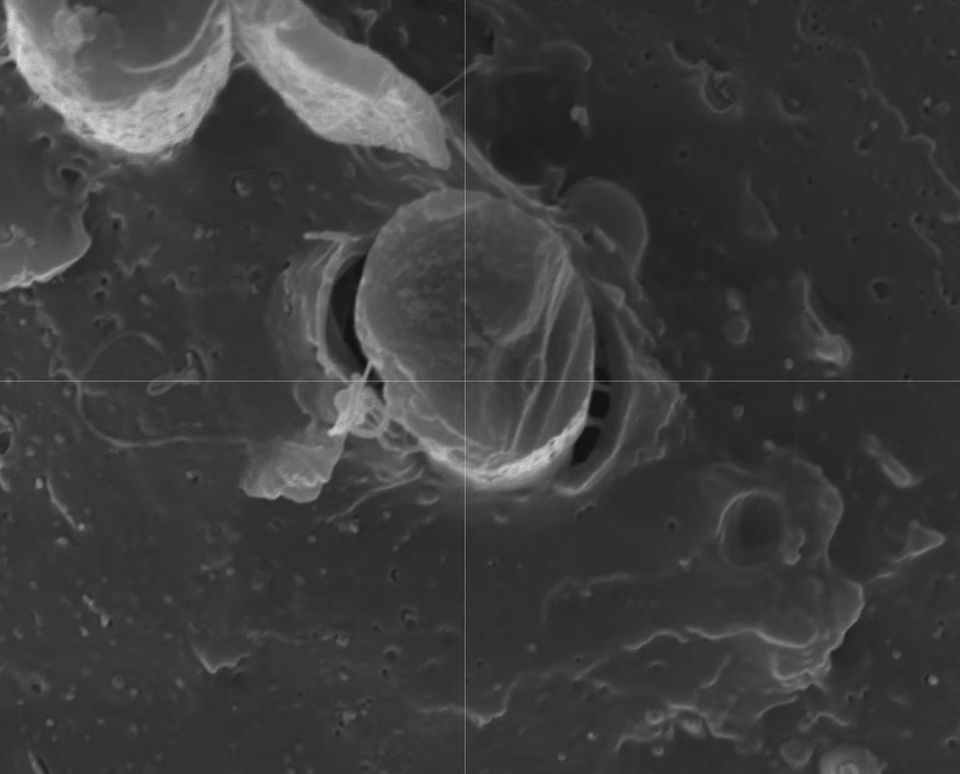
Samples of the BIQU filament were printed on a Bambu Lab H2D printer with AMS. In order to create a clean fracture surface, a sample was frozen in liquid nitrogen to make it easy to snap. After this it was coated with gold using a gold sputtering system to prepare it for the SEM.

Carbon fiber in PLA after FDM printing, showing clear voids. (Credit: I built a thing, YouTube)

Compared to the finer chopped CF PLA-CF, what is notable here is that CF is not present between the layers, which is a good thing as this degrades layer adhesion significantly. Less good is that the same lack of polymer matrix integration is visible here, with the PLA clearly detaching from the CF and leaving behind voids.

This shows that BIQU’s PLA-CF filament fails to address the fundamental problem with PLA-CF of extremely poor matrix integration. To verify this, an undisturbed sample was put into the Micro CT scanner.

Fascinating about the Micro CT findings was that there is carbon black in the filament, which is ironically highly abrasive.

Also in the images were again what looked like air bubbles, much like in the previous video’s results. TheseΒ  bubbles turned out to be always linked to a CF strand, which could be due to how the PLA-CF mixture cools with the mismatch between the solid CF inside the still liquid PLA.

After a series of mechanical tests on the printed samples, the conclusion is that the part is stiffer by about 15% and due to the CF contaminant not intruding between layers it’s also better than typical PLA-CF. Of course, regular PLA outperforms both types of PLA-CF in most tests by a considerable margin, so most people are probably still better off with regular PLA.

Pumpkin Carving for Halloween

30 September 2022 at 10:47

Carving Pumpkins for Halloween Now is the time to consider about the great pumpkin you’ll be carving this Halloween. As you know, Linus would wait all night for the Great Pumpkin, but I wouldn’t take a cue from Linus. I’d head directly to the patch with the kids in tow. Once there, after your children have moved, rolled and lifted […]

The post Pumpkin Carving for Halloween appeared first on Backyard Gardener.

❌
❌