ESA/Webb, NASA & CSA, J. H. Kastner (Rochester Institute of Technology)
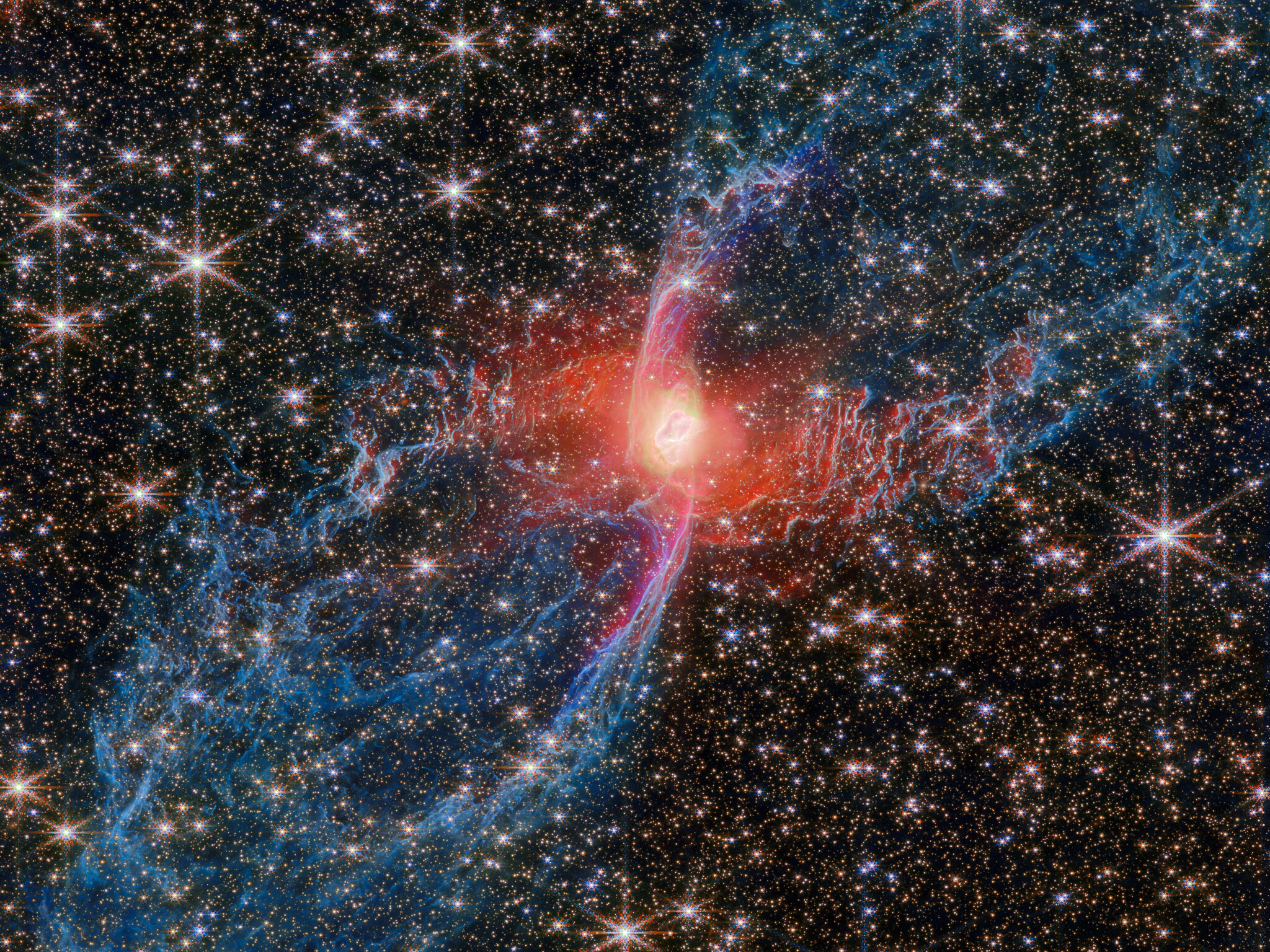
Using its Near-InfraRed Camera (NIRCam), NASA’s James Webb Space Telescope captured never-before-seen details of the Red Spider Nebula, a planetary nebula, in this image released on Oct. 26, 2025. NIRCam is Webb’s primary near-infrared imager, providing high-resolution imaging and spectroscopy for a wide variety of investigations.
Webb’s new view of the Red Spider Nebula reveals for the first time the full extent of the nebula’s outstretched lobes, which form the ‘legs’ of the spider. These lobes, shown in blue, are traced by light emitted from H2 molecules, which contain two hydrogen atoms bonded together. Stretching over the entirety of NIRCam’s field of view, these lobes are shown to be closed, bubble-like structures that each extend about 3 light-years. Outflowing gas from the center of the nebula has inflated these massive bubbles over thousands of years.
Image credit: ESA/Webb, NASA & CSA, J. H. Kastner (Rochester Institute of Technology)
Webb First to Show 4 Dust Shells ‘Spiraling’ Apep, Limits Long Orbit
5 Min Read
Webb First to Show 4 Dust Shells ‘Spiraling’ Apep, Limits Long Orbit
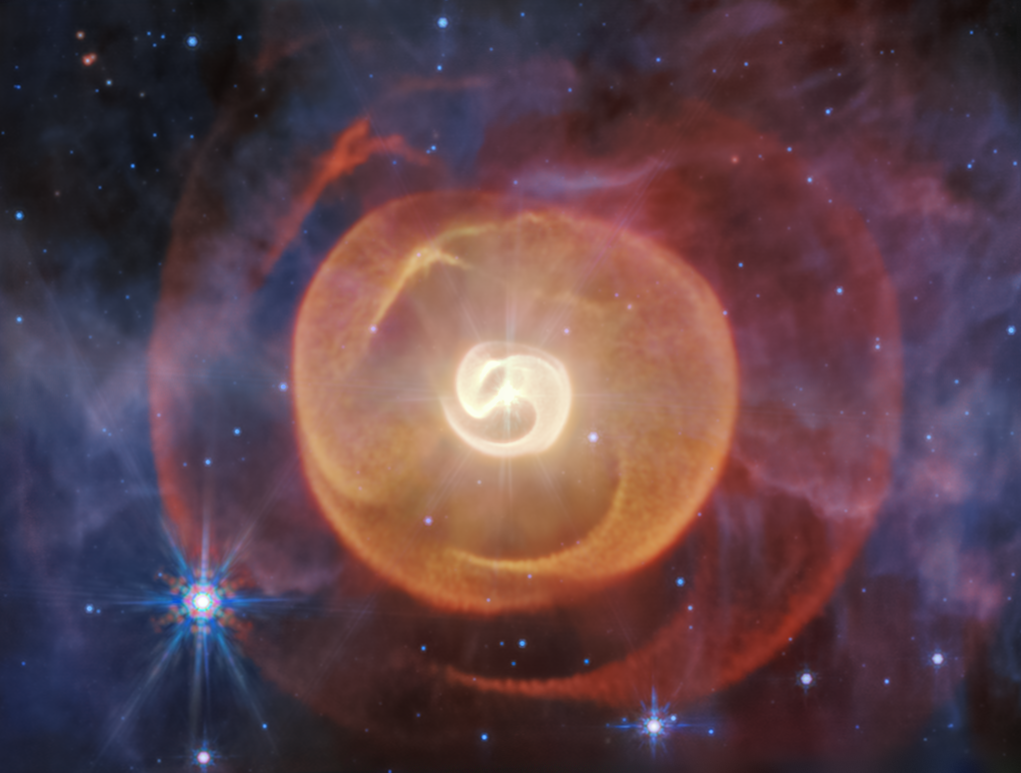
Webb’s mid-infrared image shows four coiled shells of dust around a pair of Wolf-Rayet stars known as Apep for the first time. Previous observations by other telescopes showed only one. Webb’s data also confirmed that there are three stars gravitationally bound to one another.
Credits: Image: NASA, ESA, CSA, STScI; Science: Yinuo Han (Caltech), Ryan White (Macquarie University); Image Processing: Alyssa Pagan (STScI)
NASA’s James Webb Space Telescope has delivered a first of its kind: a crisp mid-infrared image of a system of four serpentine spirals of dust, one expanding beyond the next in precisely the same pattern. (The fourth is almost transparent, at the edges of Webb’s image.) Observations taken prior to Webb only detected one shell, and while the existence of outer shells was hypothesized, searches using ground-based telescopes were unable to uncover any. These shells were emitted over the last 700 years by two aging Wolf-Rayet stars in a system known as Apep, a nod to the Egyptian god of chaos.
Webb’s image combined with several years of data from the European Southern Observatory’s Very Large Telescope (VLT) in Chile narrowed down how often the pair swing by one another: once every 190 years. Over each incredibly long orbit, they pass closely for 25 years and form dust.
Webb also confirmed that there are three stars gravitationally bound to one another in this system. The dust ejected by the two Wolf-Rayet stars is “slashed” by a third star, a massive supergiant, which carves holes into each expanding cloud of dust from its wider orbit. (All three stars are shown as a single bright point of light in Webb’s image.)
Image A: Wolf-Rayet Apep (MIRI Image)
Webb’s mid-infrared image shows four coiled shells of dust around a pair of Wolf-Rayet stars known as Apep for the first time. Previous observations by other telescopes showed only one. Webb’s data also confirmed that there are three stars gravitationally bound to one another.
Image: NASA, ESA, CSA, STScI; Science: Yinuo Han (Caltech), Ryan White (Macquarie University); Image Processing: Alyssa Pagan (STScI)
“Looking at Webb’s new observations was like walking into a dark room and switching on the light — everything came into view,” said Yinuo Han, the lead author of a new paper in The Astrophysical Journal and postdoctoral researcher at Caltech in Pasadena, California. “There is dust everywhere in Webb’s image, and the telescope shows that most of it was cast off in repetitive, predictable structures.” Han’s paper coincides with the publication of Ryan White’s paper in The Astrophysical Journal, a PhD student at Macquarie University in Sydney, Australia.
Han, White, and their co-authors refined the Wolf-Rayet stars’ orbit by combining precise measurements of the ring location from Webb’s image with the speed of the shells’ expansion from observations taken by the VLT over eight years.
“This is a one-of-a-kind system with an incredibly rare orbital period,” White said. “The next longest orbit for a dusty Wolf-Rayet binary is about 30 years. Most have orbits between two and 10 years.”
When the two Wolf-Rayet stars approach and pass one another, their strong stellar winds collide and mix, forming and casting out heaps of carbon-rich dust for a quarter century at a time. In similar systems, dust is shot out over mere months, like the shells in Wolf-Rayet 140.
High-speed ‘skirmish’
The dust-producing Wolf-Rayet stars in Apep aren’t exactly on a tranquil cruise. They are whipping through space and sending out dust at 1,200 to 2,000 miles per second (2,000 to 3,000 kilometers per second).
That dust is also very dense. The specific makeup of the dust is another reason why Webb was able to observe so much more: It largely consists of amorphous carbon. “Carbon dust grains retain a higher temperature even as they coast far away from the star,” Han said. While the exceptionally tiny dust grains are considered warm in space, the light they emit is also extremely faint, which is why it can only be detected from space by Webb’s MIRI (Mid-Infrared Instrument).
Slicing dust
To find the holes the third star has cut like a knife through the dust, look for the central point of light and trace a V shape from about 10 o’clock to 2 o’clock. “The cavity is more or less in the same place in each shell and looks like a funnel,” White said.
“I was shocked when I saw the updated calculations play out in our simulations,” he said. “Webb gave us the ‘smoking gun’ to prove the third star is gravitationally bound to this system.” Researchers have known about the third star since the VLT observed the brightest innermost shell and the stars in 2018, but Webb’s observations led to an updated geometric model, clinching the connection. (See the system in 3D by watching the visualization below.)
Video A: Wolf-Rayet Apep Visualization
This scientific visualization models what three of the four dust shells sent out by two Wolf-Rayet stars in the Apep system look like in 3D based on mid-infrared observations from NASA’s James Webb Space Telescope. Apep is made up of two Wolf-Rayet binary stars that are orb…
Image: NASA, ESA, CSA, STScI; Simulation: Yinuo Han (Caltech), Ryan White (Macquarie University); Visualization: Christian Nieves (STScI); Image Processing: Alyssa Pagan (STScI)
“We solved several mysteries with Webb,” Han said. “The remaining mystery is the precise distance to the stars from Earth, which will require future observations.”
Future of Apep
The two Wolf-Rayet stars were initially more massive than their supergiant companion, but have shed most of their mass. It’s likely that both Wolf-Rayet stars are between 10 and 20 times the mass of the Sun, and that the supergiant is 40 or 50 times as massive compared to the Sun.
Eventually, the Wolf-Rayet stars will explode as supernovae, quickly sending their contents into space. Either may also emit a gamma-ray burst, one of the most powerful events in the universe, before possibly becoming a black hole.
Wolf-Rayet stars are incredibly rare in the universe. Only a thousand are estimated to exist in our Milky Way galaxy, which contains hundreds of billions of stars overall. Of the few hundred Wolf-Rayet binaries that have been observed to date, Apep is the only example that contains two Wolf-Rayet stars of these types in our galaxy — most only have one.
The James Webb Space Telescope is the world’s premier space science observatory. Webb is solving mysteries in our solar system, looking beyond to distant worlds around other stars, and probing the mysterious structures and origins of our universe and our place in it. Webb is an international program led by NASA with its partners, ESA (European Space Agency) and CSA (Canadian Space Agency).
Webb’s mid-infrared image shows four coiled shells of dust around a pair of Wolf-Rayet stars known as Apep for the first time. Previous observations by other telescopes showed only one. Webb’s data also confirmed that there are three stars gravitationally bound to one another.
Wolf-Rayet Apep (MIRI Compass Image)
This image of the Wolf-Rayet binary Apep, captured by the James Webb Space Telescope’s MIRI (Mid-Infrared Instrument), shows compass arrows, scale bar, and color key for reference.
Wolf-Rayet Apep Visualization
This scientific visualization models what three of the four dust shells sent out by two Wolf-Rayet stars in the Apep system look like in 3D based on mid-infrared observations from NASA’s James Webb Space Telescope. Apep is made up of two Wolf-Rayet binary stars that are orb…
IC 348 is a star-forming region in our Milky Way galaxy.
X-ray: NASA/CXC/SAO; Infrared: NASA/ESA/CSA/STScI; Image Processing: NASA/CXC/SAO/J. Major
Data from NASA’s Chandra X-ray Observatory and NASA’s James Webb Space Telescope combine to reveal an otherworldly view of the star-forming region IC 348. In this image released on July 23, 2025, X-rays from Chandra are red, green, and blue, while infrared data from Webb are pink, orange, and purple.
The wispy structures that dominate the image are interstellar material that reflect the light from the cluster’s stars; this is known as a reflection nebula. The point-like sources in Chandra’s X-ray data are young stars in the cluster developing there.
Text credit: Megan Watzke
Image credit: X-ray: NASA/CXC/SAO; Infrared: NASA/ESA/CSA/STScI; Image Processing: NASA/CXC/SAO/J. Major

 Login
Login