Normal view

There are new articles available, click to refresh the page.
Before yesterdayMain stream

Students Across New England Contribute to Climate Science Through NASA’s GLOBE Green Down

21 January 2026 at 14:29

3 min read

Students Across New England Contribute to Climate Science Through NASA’s GLOBE Green Down
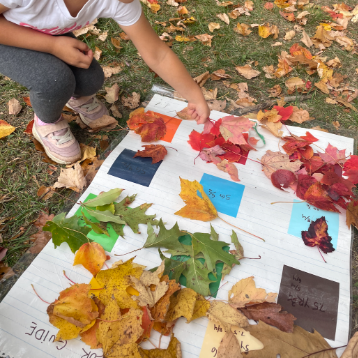
A student is kneeling down to reach a large color chart on the ground where they are comparing the color of leaves.
Students made observations and tracked the changing color of leaves on a variety of species.

In fall 2025, more than 50 educators and over 1,500 young people across Maine and New Hampshire participated in NASA’s Global Learning and Observation to Benefit the Environment (GLOBE) Green Down, a citizen science (also known as participatory science or community science) initiative that engages students and volunteers in tracking seasonal changes in plant life. By observing and documenting leaf color change and leaf drop, participants contributed valuable data used by scientists studying how ecosystems respond to a changing climate.

GLOBE Green Down is part of NASA’s Global Learning and Observation to Benefit the Environment (GLOBE) Program, which connects students, educators, and the public with authentic scientific research. Using a standardized color guide and observation protocols, participants measured changes in plant health as autumn progressed, generating consistent, high-quality data that can be analyzed alongside observations collected worldwide.

The 2025 field season was led by the Gulf of Maine Research Institute and focused on supporting educators in taking learning outdoors while strengthening students’ scientific observation and data literacy skills. Students from pre-kindergarten through high school studied a wide range of tree species—including maple, oak, birch, ash, beech, poplar, and apple—by making repeated observations in their local environments.

In Portland, Maine, students from five elementary schools conducted observations in their own schoolyards as part of environmental literacy and science education programs. Beyond New England, learners from Machias, Maine to British Columbia, and many locations in between, contributed observations, creating a geographically diverse dataset that reflects regional and continental patterns of seasonal change.

As they collected data, students also began asking their own research questions—mirroring the inquiry process used by scientists. Their questions explored differences in species behavior, the influence of sunlight, drought, wildfire smoke, and the built environment, and how these factors might affect the timing and progression of leaf color change.

Educators reported that participation in GLOBE Green Down helped students develop a stronger connection to their local ecosystems while gaining experience working with real-world scientific data. Many noted that learners were able to use their observations to discuss environmental change at both local and global scales, including potential climate change impacts on seasonal patterns.

This field season was hosted through NASA’s Science Activation program as part of the Learning Ecosystems Northeast (https://science.nasa.gov/sciact-team/gmri/) (LENE) project. LENE brings together educator learning communities across Maine, New Hampshire, Vermont, New York, and Massachusetts, fostering collaboration between school-based and out-of-school educators. Through this network, educators support STEM learning, data literacy, and local ecosystem stewardship—empowering young people to contribute meaningfully to NASA-supported scientific research.

Get Involved with GLOBE

  • Educators, students, and community members interested in doing NASA science can get involved. The GLOBE Observer app offers hands-on opportunities to collect and share environmental data used by scientists around the world, while building science skills and local environmental awareness. Learn more: https://science.nasa.gov/citizen-science-old/globe-observer/
  • LENE is supported by NASA under cooperative agreement award number NNX16AB94A and is part of NASA’s Science Activation Portfolio. Learn more about how Science Activation connects NASA science experts, real content, and experiences with community leaders to do science in ways that activate minds and promote deeper understanding of our world and beyond: https://science.nasa.gov/learn/about-science-activation/

NASA’s Universe of Learning Unveils Fresh Facilitator Guides Inspired by Community Feedback

21 January 2026 at 14:01

3 min read

NASA’s Universe of Learning Unveils Fresh Facilitator Guides Inspired by Community Feedback

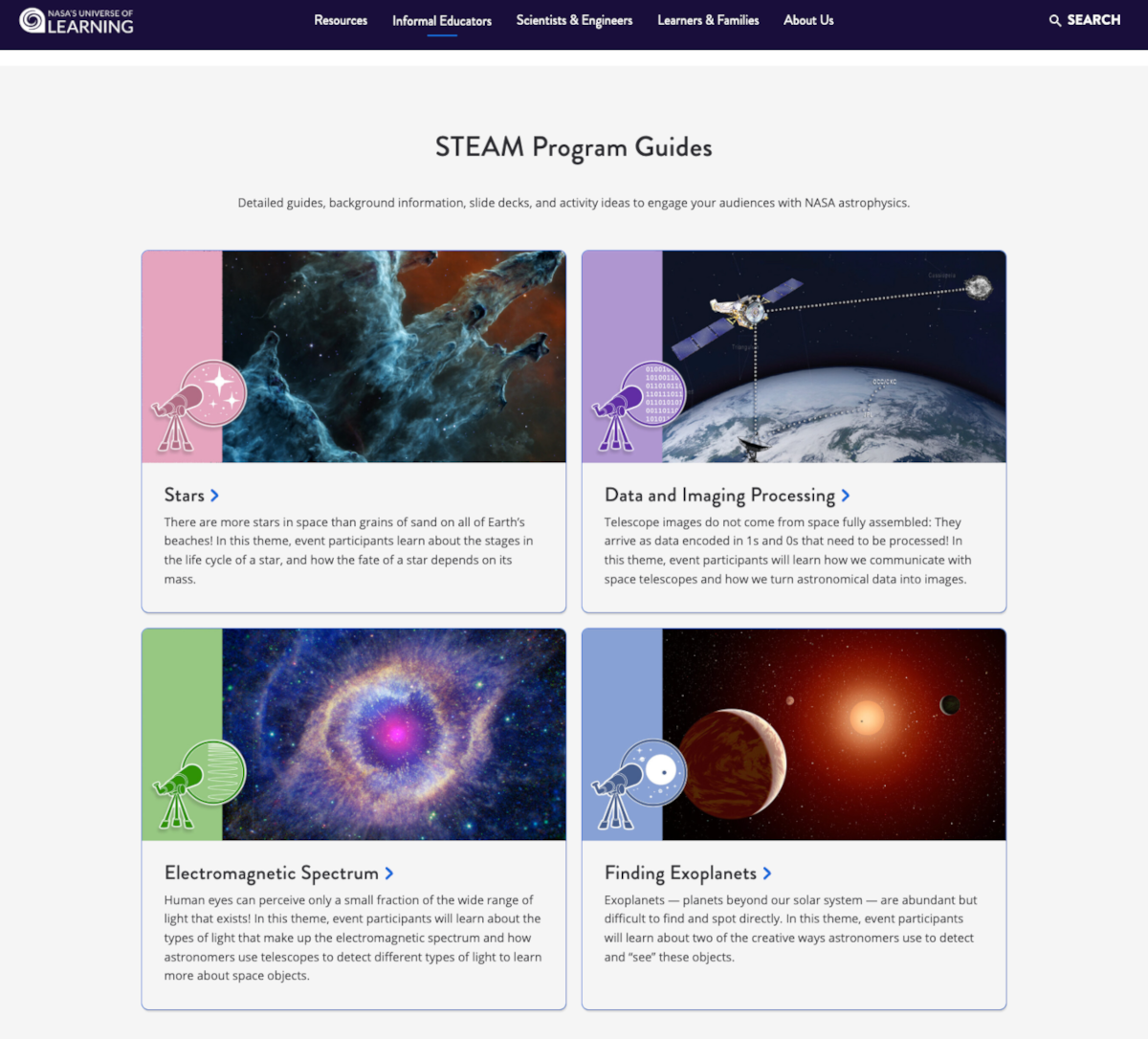
Screenshot of NASA’s Universe of Learning Program Guides webpage. Header shows program name and logo, menu, and search bar on a dark blue background. Below, title “STEAM Program Guides” and description of educational resources. Four panels feature themes: Stars, Data & Imaging Processing, Electromagnetic Spectrum, and Finding Exoplanets, each with related images and brief descriptions.
NASA’s Universe of Learning Program Facilitator Guides provide educators with detailed resources, including background information, activities, and slide decks to engage audiences in exploring astrophysics themes such as Stars, Data & Image Processing, the Electromagnetic Spectrum, and Finding Exoplanets.

The goal of NASA’s Universe of Learning (UoL) is to connect the public to the data, discoveries, and experts that span NASA’s Astrophysics missions. To make this possible, the NASA’s UoL team creates engaging STEM experiences that let people explore data and discoveries from NASA’s Astrophysics missions and learn from the experts behind them.

Our science center does a lot of work with after school groups weekly. I can’t wait to use this program guide [Finding Exoplanets] to help run some programs for our ‘space week’ this fall. I also appreciate the adaptations for different age groups.

Facilitator

Southern Arizona

One example is the Program Facilitator Guides—a series of resources for informal educators that cover different astrophysics themes and empower organizations to share NASA science with their audiences. Since their introduction, these guides have supported libraries and community centers in delivering engaging STEM learning experiences. “”The Programming Guide is just amazing … that resource alone is really great for planning. There’s so many opportunities for programs… and there’s room for your own creativity as well,”” shared one educator.

The NASA’s UoL team is excited to announce the refresh of several Program Facilitator Guides, along with the introduction of a new guide. These resources have been updated based on feedback from the informal education community, collected through evaluation surveys, focus groups, and webinars. From events held last year before the updates, the guides received a highly favorable rating—91% of educators found them useful as a resource, emphasizing their value in supporting informal STEM education. To make them more effective, we implemented the following updates:

  • Easy and direct access to all Program Facilitator Guides through a dedicated web page under the “Informal Educators” menu on NASA’s Universe of Learning.
  • Creating an easy-to-access URL for the Program Facilitator Guides: https://universe-of-learning.org/program-guides.
  • Making available PowerPoint slides and Kahoot Quizzes for the facilitator to complement the Program Facilitator Guide themes.
  • Moving activity guides to a more user-friendly and standard template.
  • Designing a set of resources around some of the methods astronomers use to find exoplanets — worlds beyond the solar system — in collaboration with a NASA Science Mission Directorate Community of Practice for Education (SCoPE) grantee:
    • The “Finding Exoplanets” Program Facilitator Guide.
    • The “Lights, Coronagraph, Action!” Activity Guide that demonstrates how astronomers find exoplanets via direct imaging.
    • The “Exoplanet Detectives” Activity Guide that shows how astronomers find exoplanets by measuring the amount of light that gets blocked when a planet transits its host star.

The new and updated resources are available now through the following URL: https://www.universe-of-learning.org/program-guides.

For any questions or suggestions, please contact:

The NASA’s Universe of Learning team
Email: info@universe-of-learning.org
Website: https://www.universe-of-learning.org/

2025 Science Activation Opportunity

18 December 2025 at 11:40

2 min read

2025 Science Activation Opportunity

NASA Science encourages all people to actively participate in science through activities and resources developed by a collaborative network of project teams drawing on NASA SMD assets (science content, experts, data, etc.). Your team can apply to be part of this program.

Opportunity

NASA SMD seeks a portfolio of projects that together :

  • Cover the full breadth of NASA science disciplines 
  • Operate across all 50 states plus U.S. territories 
  • Reach people of all ages and backgrounds
  • Work in both formal and informal learning contexts
  • Engage community partners to deepen and extend the reach and impact of NASA science

Projects

NASA seeks a balance of projects that (1) seek to broadly share resources and opportunities that leverage NASA assets, and (2) seek to meet specific community (both geographically- and interest-based) needs through NASA assets .

Eligibility

Participation is open to all categories of U.S. institutions, except media organizations since broadcast communication is not a focus.

Non-U.S. participation in teaming arrangements or leveraging relationships on proposals submitted by U.S. institutions may only be proposed at no cost to NASA.

Important Dates

January 9, 2 pm Eastern: Pre-proposal Webinar (see opportunity for access details)

Notice of Intent requested by 1/26/2026

Proposals due 3/31/2026

More details

Full details on the Science Activation opportunity can be found here.

Keep Exploring

Discover More Topics From NASA

NASA eClips STEM Student Ambassadors Shine at STEM Exploration Community Event

18 December 2025 at 10:19

3 min read

NASA eClips STEM Student Ambassadors Shine at STEM Exploration Community Event

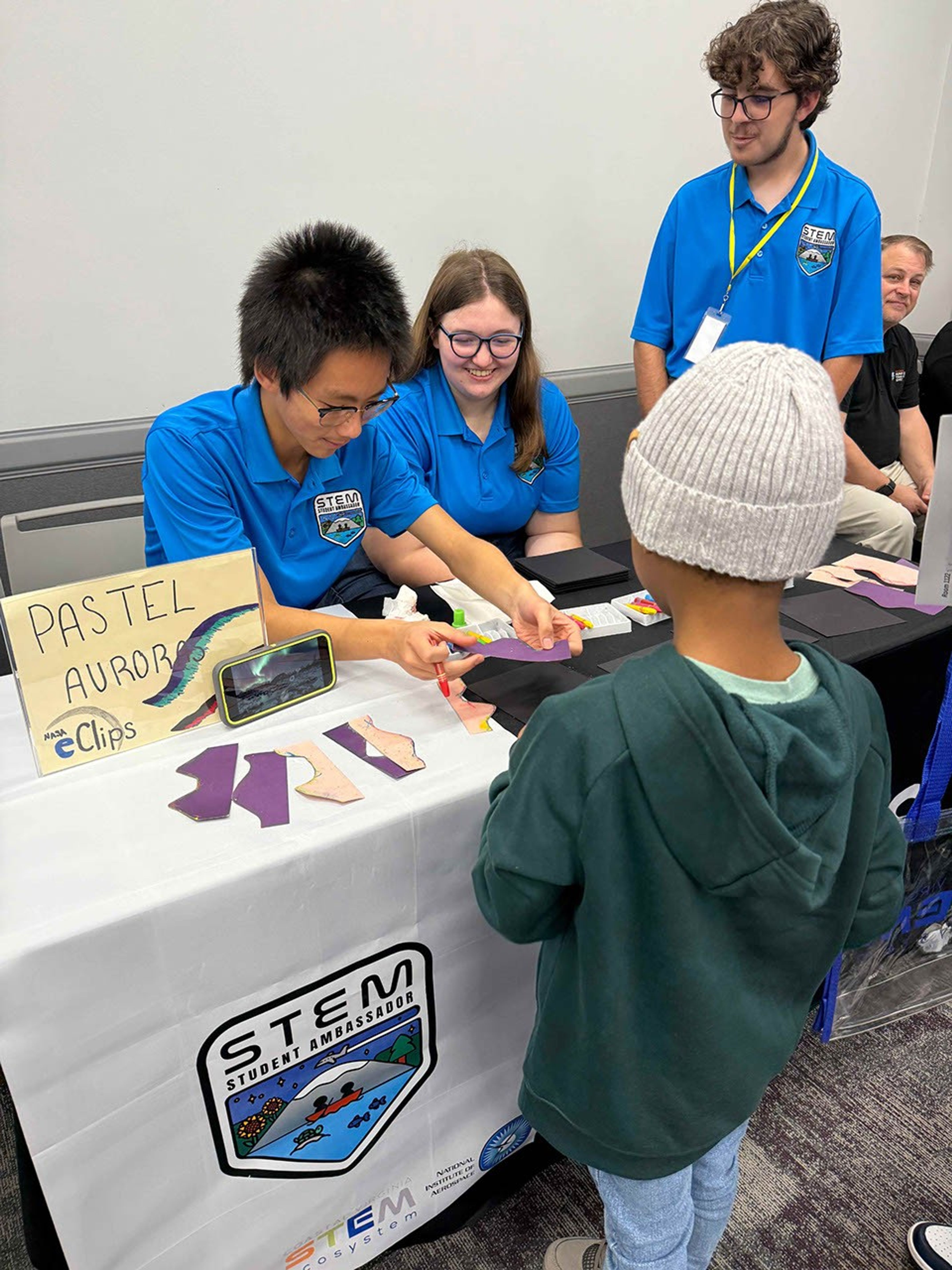
STEM Ambassadors assist a young boy in making a pastel aurora.
STEM Student Ambassadors engage the community in learning about auroras.

The 5th Annual Science, Technology, Engineering, & Mathematics (STEM) Exploration Community Event hosted by the Coastal Virginia STEM Hub and the NASA eClips Education Team from the National Institute of Aerospace Center for Integrative STEM Education (NIA-CISE) lit up the Professional Workforce Development Center at Virginia Peninsula Community College on Saturday, November 8, 2025. The hard work of 12 NASA eClips STEM Student Ambassadors brought extraordinary energy, expertise, and heart to the more than 1,000 attendees on National STEM Day.

The STEM Student Ambassador Program was initiated to help grow the STEM ecosystem in coastal Virginia by extending the reach of the NASA eClips Education Team. The Ambassadors are high school students selected through a highly competitive regional recruiting process who undergo a rigorous training with the NASA eClips Education Team and NASA Science Communication interns.

“NASA eClips STEM Student Ambassadors enjoyed inspiring community members by sharing their knowledge about the Sun.”

Betsy McAllister

Educator in Residence National Institute of Aerospace – Center for Integrative STEM Education

At the STEM Exploration Community Event, the NASA eClips exhibit quickly became a hub of excitement as the Ambassadors used art as a launchpad to explore heliophysics concepts, guiding visitors from preK-adult in creating chalk coronas and pastel auroras. The enthusiasm was contagious: children leaned in, families asked questions, and even adults rediscovered a sense of wonder as the Ambassadors connected hands-on creativity to the science of the Sun. The Ambassadors shared their personal STEM journeys, encouraged younger learners to pursue curiosity, and modeled what it looks like to be confident, informed science communicators.

The Ambassadors worked behind the scenes to support event logistics, networked with STEM leaders, and even represented the high-school perspective on a STEM panel. Ambassador Layla Criner offered practical advice on how students can get involved, and stay involved, in STEM. The powerful impact of the Ambassadors underscored why this NASA eClips program matters: it empowers students not only to communicate NASA
science, but to lead it.

NASA eClips, led by the NIA-CISE, is supported by NASA under cooperative agreement award number NNX16AB91A and is part of NASA’s Science Activation Portfolio. The mission of NASA eClips is to engage and inspire students in STEM through the lens of NASA by delivering standards-aligned, web-based resources that support learning both in and out of the classroom. The STEM Student Ambassador Program is funded by a grant from the Virginia Coastal STEM Hub through the Virginia General Assembly. Learn more about how Science Activation connects NASA science experts, real content, and experiences with community leaders to do science in ways that activate minds and promote deeper understanding of our world and beyond: https://science.nasa.gov/learn/about-science-activation/

❌
❌