U.S. President Donald Trump said Wednesday that he wants to sign sweeping cryptocurrency market structure legislation “very soon,” arguing that digital assets are both a political priority and a strategic battleground in the United States’ economic competition with China.
Speaking during a wide-ranging address to world leaders and financial executives at the World Economic Forum in Davos, Switzerland, Trump framed his administration’s embrace of crypto as central to preserving U.S. leadership in financial innovation.
His comments came as bitcoin surged above $90,000, extending gains amid optimism that clearer U.S. regulation could further legitimize the asset class.
“To unleash innovation and savings and financing, I’m also working to ensure America remains the crypto capital of the world,” Trump said.
He pointed to legislation he said he signed last year — the GENIUS Act, focused on stablecoins — as a foundational step toward that goal, while signaling that broader crypto market structure rules are now close to becoming law.
“Congress is working very hard on crypto market structure legislation — bitcoin, all of them — which I hope to sign very soon,” Trump said, adding that the effort would unlock new pathways for Americans to achieve what he described as “financial freedom.”
Trump openly acknowledged the political calculus behind his support for crypto, saying it delivered “tremendous political support,” but stressed that geopolitical competition was the more important driver.
“China wanted that market too,” he said. “It’s just like they want the AI. And we’ve got that market, I think, pretty well locked up.”
He also took aim at former President Joe Biden, claiming Democrats only softened their stance on crypto late in the 2024 election cycle after realizing how many voters cared about digital assets.
“All of a sudden they loved it very much, but it was too late,” Trump said. “They blew it.”
Trump’s support for crypto legislation in the United States
Trump’s remarks come as U.S. lawmakers continue to negotiate a long-awaited framework to define how cryptocurrencies are regulated, including whether tokens fall under securities or commodities law and which agencies will oversee the sector.
The Senate is currently advancing market structure legislation through multiple committees, though final language has yet to be released and markups keep getting delayed.
Political action committees backed by crypto firms spent hundreds of millions of dollars during the 2024 election cycle and are already mobilizing ahead of the 2026 midterms.
As Trump speaks, Bitcoin is trading at $89,942, down 1% over the past 24 hours on $60 billion in volume, leaving it about 1% below its seven-day high of $90,778 and 2% above its seven-day low of $87,902.
This summer, Helion Energy broke ground in Eastern Washington on what it hopes could be the world’s first utility-scale fusion plant — but TAE Technologies on Thursday announced plans to begin siting work on what it claims will be the first facility to hit that target. TAE plans to merge with Trump Media & Technology Group in pursuit of the goal. (Helion Photo)
The $6 billion planned merger between Trump Media & Technology Group and California’s TAE Technologies has sent a shock wave through the fusion industry — and is drawing skepticism from competitors in the Pacific Northwest’s fusion hub.
The partnership aims to site and begin building what it calls the world’s first utility-scale fusion plant next year, with Trump Media committing $300 million in near-term funding.
Physicists for decades have pursued fusion energy, a nearly limitless source of carbon-free power produced by smashing together light atoms in conditions hotter than the sun. So far, no one has demonstrated a fusion technology that’s financially viable for putting electricity on the grid, and some experts believe the field is still many years from that goal.
TAE, however, claimed on Thursday that it has cracked the riddle.
“We have the science solved,” Michl Binderbauer, CEO of TAE, told The New York Times. TAE has the engineering ready, he said, but has lacked sufficient capital despite raising $1.3 billion from investors.
President Trump is the largest shareholder of Trump Media, the publicly traded parent company of the social media platform Truth Social. His stake — reportedly worth more than $1 billion — is held in a trust managed by his eldest son
Trump Media’s value spiked nearly 50% following news of the merger, which would make TAE one of the first fusion companies to go public.
Washington competitors push back
TAE’s claims triggered pushback in Washington state, home to several fusion companies racing to commercialize the technology.
Helion Energy in July broke ground on what it says will be the first fusion plant to put power on the grid starting in 2028. Pragav Jain, Helion’s chief financial officer, welcomed the merger news while reasserting the company’s head start.
“This is a positive signal for the industry as a whole,” Jain said via email. “The world needs fusion and we’re seeing strong support both from customers and investors, so it’s not surprising to see deals like this.”
Everett-based Helion has raised more than $1 billion and is actively constructing Orion, its planned commercial facility in Eastern Washington. “We’re leading the way to make fusion a reality,” Jain added.
Zap Energy, a fusion company located down the road from Helion, didn’t provide an official comment on the deal when contacted by GeekWire. But spokesperson Andy Freeberg challenged the assertion that anyone has mastered fusion.
“The science has come a long way over several decades of work and is mature enough to build ventures around, that’s very exciting,” Freeberg said on LinkedIn. “But even a superficial knowledge of the state of the technology will show you it’s far from ‘solved’ and statements like this from someone who obviously knows better are completely disingenuous.”
Zap has $330 million from investors and notched scientific milestones, but has been more cautious in setting its own near-time deadlines for commercialized fusion.
Robin Langtry, co-founder and CEO of Seattle-based Avalanche Energy, which is building smaller-scale fusion devices, praised the deal.
TAE has made “some significant breakthroughs recently” that fusion proponents “should celebrate,” Langtry said via email. He added that the substantial funding needed for fusion infrastructure is tough to raise through venture capital or a traditional IPO.
“In that context a merger with a public company that in principle already has the deep pockets to raise the necessary funds makes a lot of sense,” Langtry added.
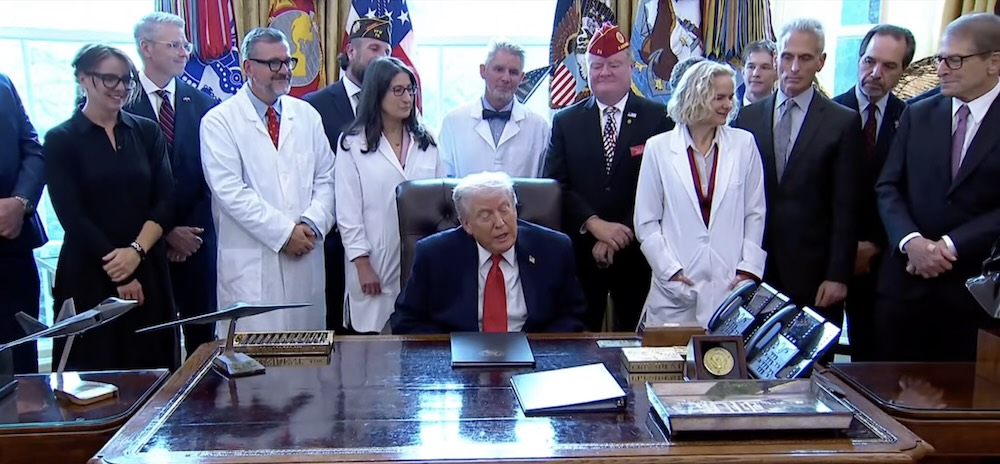
President Donald Trump today signed an executive order expediting the reclassification of cannabis as a less dangerous drug—moving it from Schedule I to Schedule III of the Controlled Substances Act.
The president was joined by several medical leaders during the signing, including Administrator of the Centers for Medicare & Medicaid Services, Dr. Mehmet Oz; Dr. Nora Volkow of the National Institute on Drug Abuse; FDA Commissioner Dr. Martin Makary; and Secretary of Health and Human Services Robert F. Kennedy Jr., among others.
“I have a very distinguished group of people behind me, mostly medical people and brilliant people and they really know what they’re doing,” the president said, prior to announcing he would sign an order to reschedule cannabis.
Trump emphasized the large public support for the reclassification, adding that the move polled at 82% in favor and will help patients “live a far better life.” He also made clear that the rescheduling is not the same as legalization saying, “I want to emphasize the order I’m about to sign doesn’t legalize marijuana in any way, shape or form.”
President Trump signs an executive order in the White House’s Oval Office. Washington, D.C.
Substances classified as Schedule I have a “high abuse potential with no accepted medical use; medications within this schedule may not be prescribed, dispensed or administered,” states the National Library of Medicine. Heroin, LSD, MDMA and cannabis currently fall under this categorization. Last Spring, the United States Drug Enforcement Agency (DEA), proposed that the substance be moved to the list of Schedule III drugs, which have less potential for abuse and are accepted for medical treatments. Other substances classified as Schedule III drugs include ketamine, testosterone and anabolic steroids.
While today’s executive order falls short of full legalization, the reclassification marks one of the most significant reversals in US drug policy in decades. This decision could have wide-ranging effects on the cannabis industry, criminal enforcement and access to research funding.
“Rescheduling cannabis to Schedule III is a meaningful step forward that will finally give legitimate cannabis businesses access to basic banking, tax relief, and the tools needed to operate like any other industry,” says Eugenio Garcia, Cannabis Now’s founder and CEO. “While this progress is welcome, true reform must also include justice—no one should remain incarcerated for cannabis as the nation moves toward acceptance and regulation. This moment is about unlocking economic opportunity while correcting the human cost of prohibition.”
Jamie Pearson, New Holland Group’s president and founder, comments on the progress as well as the work that remains for the cannabis industry: “Today’s executive action is a meaningful and long-overdue step toward aligning federal policy with medical reality. Directing the rescheduling of cannabis to Schedule III acknowledges its accepted medical use and begins to remove structural barriers to research, clinical guidance and responsible access,” she says. This was the message largely put forth by Trump and his supporters during the signing as well.
“That said, rescheduling is not legalization, nor does it resolve all of the regulatory and economic challenges facing the industry,” she says. “The real work now lies in thoughtful implementation, ensuring that research, patient access and public safety advance together, and that policy clarity follows intent. This is progress, and it should be treated with both optimism and discipline.
The prospect of reclassifying cannabis from Schedule I to Schedule III has prompted swift and varied reactions across the political and cannabis landscapes.
“It shows incredible leadership for the president to have the courage to take the lead on cannabis reform,” comments Dave Marrow, CEO of Lume Cannabis MI.
“Today’s executive order to reclassify cannabis is a meaningful step toward aligning federal policy with science and economic reality. Moving cannabis to Schedule III acknowledges its medical value while bringing long-overdue clarity to how cannabis is cultivated, researched, and commercialized. While it’s not the final destination, this shift will accelerate innovation, unlock investment and help professional cultivators and operators continue to raise standards across the industry. At FOHSE Lighting, we see this as real progress for sustainable growth in cannabis cultivation,” says FOHSE Lighting CEO and Co-founder Brett Stevens.
During the signing, those in attendance congratulated Trump for his leadership on the matter. “Thank you for your leadership and vision and finally getting to closure on this issue,” Kennedy, Jr. said. “This is a scientific question that has divided our country for many, many years.”
Trump allowed those alongside him to weigh in, ultimately reinforcing their shared view that increased research into cannabis is essential for advancing medical understanding and improving quality of life. “Research is crucial. Yes, cannabis can be addictive, but we cannot close our eyes to research,” he said. “What we need to do is research and learn how to optimally use it.”
Putting pen to paper, Trump said, “It’s an honor to do this.”
President Donald Trump is weighing an executive order that would push the federal government to reclassify cannabis, a step that could mark the most significant shift in U.S. cannabis policy in decades—even as the White House cautions that no final decision has been made.
The deliberations, first reported late Thursday by The Washington Post, center on moving marijuana from Schedule I—the government’s most restrictive category, reserved for drugs deemed to have no accepted medical use—to Schedule III, a classification that would acknowledge medical value and loosen some federal controls.
“This is an encouraging development and a strong indicator that comprehensive legalization is no longer a distant goal,” says Sorse Tech CEO Howard Lee.
The Post reported Trump discussed the potential policy change in a call that included House Speaker Mike Johnson and cannabis industry executives, alongside senior administration officials. Johnson voiced skepticism, the report said, while industry participants pressed the case that rescheduling would reduce barriers to research and help normalize a legal market that now operates in tension with federal law.
In response to the news, Sasha Nutgent, VP of cannabis retail for Housing Works Cannabis Co. out of New York, tells Cannabis Now that with today’s current cannabis classification, “retailers are not incentivized to operate legally. Reclassification would change that for thousands of businesses, especially those owned by folks from communities most impacted by the War on Drugs.”
Industry and Markets Brace for Potential Policy Change
News of the possible executive order rippled quickly through financial markets early this morning. Cannabis-related stocks and exchange-traded funds jumped in premarket trading after the Post report, according to Reuters, reflecting investor optimism that a federal shift could ease access to capital and reduce tax burdens that have long squeezed state-legal operators.
Rescheduling, however, would not legalize marijuana nationwide. Even supporters describe it as a narrower, technical move with broad downstream effects—especially for research, medical access and business operations—rather than a sweeping rewrite of prohibition-era policy.
Gennaro Luce, founder and CEO at CannaLnx, powered by EM2P2, argues that “Rescheduling is an important and overdue shift for patient-centric healthcare, but the move to Schedule III alone isn’t enough to make medical cannabis more accessible or affordable.”
Luce says insurers still need verification, compliance and eligibility frameworks before they can treat medical cannabis like a real benefit. “That part of the system is still missing from the national conversation — fortunately, it’s the medical-cannabis system piece we’ve already built and tested alongside physicians, patients, dispensaries, POS systems and insurers.”
Legal Nuances Stall Progress
President Trump’s considerations land on well-trodden terrain. The modern push to reconsider cannabis’ federal classification accelerated under President Joe Biden, whose administration initiated a review that produced a recommendation from the Department of Health and Human Services to move cannabis to Schedule III. The Justice Department formally began the rescheduling process in 2024, opening the door to rulemaking that has since faced delays and political crosscurrents.
Policy experts say an executive order can direct agencies and set priorities, but it cannot, by itself, rewrite the Controlled Substances Act. Any durable change to cannabis scheduling ultimately runs through federal administrative procedures led by the Justice Department and the Drug Enforcement Administration, including scientific findings, legal analysis and formal rulemaking steps. That legal nuance has become familiar to cannabis readers—and to anyone who has watched the issue ricochet between campaign promises and bureaucratic reality.
In past coverage of cannabis executive action, Cannabis Now has emphasized that the “stroke of a pen” theory often collides with the limits of federal authority, even when presidents or governors have wide latitude to shape enforcement priorities and regulatory posture. Still, the political stakes are unmistakable. A Trump-backed push to reschedule could scramble the usual partisan map on cannabis, where national Democrats have often positioned themselves as the party of reform while Republicans have been divided between states’-rights advocates and prohibition-aligned lawmakers.
The Post report suggested Trump views rescheduling as a way to “cut restrictions” without endorsing full legalization—a framing that could appeal to voters who support medical access and regulated markets but remain cautious about broader social change.
For the cannabis industry, the practical implications of Schedule III are potentially enormous—but also uneven. Operators have argued that rescheduling could reduce certain federal tax penalties and make it easier for institutions to do business with cannabis companies.
Ryan Hunter, chief revenue officer for Colorado-based Spherex, a leader in cannabis extraction and purification, offers perspective: “Cannabis is still federally illegal—but even as a federally illegal substance, the move to Schedule III dramatically reduces the federal tax burden for operators. Under IRS code 280E, handling Schedule I or Schedule II substances eliminates the ability for operators to deduct standard operating expenses that most other businesses deduct from their federal taxes. As a result of 280E, cannabis operators’ effective tax rate may be as high as 80 pecent. Beyond this significant improvement, the implications are unclear, but we’re hopeful that this move will allow for cannabis operators to garner the same investment opportunities other industries will enjoy.”
Rescheduling’s Promise and Uncertainty
Analysts told Reuters that shifting cannabis to Schedule III could also accelerate pharmaceutical research and distribution models, even as state-legal markets continue to rely on a patchwork of rules that vary widely from one jurisdiction to another. Critics, including some in Congress, argue rescheduling risks moving faster than the science. The Post reported Johnson referenced studies he said cut against reclassification, reflecting a broader debate over how to weigh evidence of therapeutic benefits against risks of misuse and dependency.
What happens next could hinge on timing and follow-through. An executive order, if issued, would likely instruct cabinet agencies to prioritize or expedite the administrative process rather than instantly change marijuana’s legal status. Even then, opponents could challenge the move politically and in court, while regulators would still need to align policy with existing federal statutes and international commitments.
“Whenever the White House moves forward with Schedule III, the federal government is effectively telling us that cannabis is medicine,” comments Calyx Containers President and Co-Founder Alex Gonzalez. “And if it’s medicine, ‘good enough’ cannabis practices won’t cut it anymore. Whether rescheduling happens next month or next year, the direction is clear: Cannabis is moving toward pharma-grade standards. For brands, that means tightening quality systems, investing in the ability to react or scale, and preparing for a regulatory-ready supply chain. We’re seeing the smart operators onshoring infrastructure, and we’re positioning our domestic production and business model on being ready to help operators turn this moment into a competitive advantage.”
In the meantime, the national reality on cannabis continues to diverge from federal law. Most states now allow marijuana for medical use, and a growing number permit adult-use sales—a shift that has normalized cannabis commerce for millions of Americans while leaving businesses and consumers navigating legal gray zones that are invisible at the dispensary counter but very real at banks, research institutions and federal agencies.
“Rescheduling is the single most important drug policy move in decades. The potential opportunities for medical and scientific research will significantly increase, while those living in states without an existing medical program will now have access to the powerful healing properties of the plant,” says Mark Lewis, president of specialty banking at Lüt.
“Make no mistake though, rescheduling is just the beginning for those working in the cannabis industry. Until the SAFE Banking Act or 280E is passed, operators will still have to jump through challenging financial hoops to pay their staff, bills or garner investment. The moment is historic, but until cannabis businesses can operate fiscally with the same ease as any other business, more work needs to be done,” Lewis continued. “Payments still need to work in the reality of today, where the ongoing threat of card network shutdowns exists, not just the promise of future reform. While rescheduling may open doors over time, it does not remove the day-to-day financial friction that cannabis operators face right now.”
Whether Trump ultimately signs an order or backs away, the past 24 hours have underscored a core truth of cannabis politics in Washington: Even incremental change can move markets, reshape messaging and reopen debates that Congress has struggled for years to settle.
EXPERT INTERVIEW — President Trump is welcoming Saudi Crown Prince Mohammed bin Salman to the White House today with an announcement that he plans to approve the sale of F-35 fighter jets to the Kingdom, signaling a policy shift by the U.S. Administration.
The visit to Washington marks one of the most consequential moments in decades for the U.S.–Saudi relationship. Both governments see the meeting as a chance to cement the expansion of the U.S.-Saudi partnership from one focused on energy and security to include advanced technology, AI, critical minerals and defense cooperation.
The trip follows President Donald Trump’s high-profile visit to Saudi Arabia in May, when both countries announced a multibillion-dollar deal that could potentially give Riyadh access to advanced U.S. AI technology. While sources tell The Cipher Brief that many of the details of those deals remain in various stages of negotiation, the Crown Prince’s Washington visit aims to build off of that momentum.
More widely, the visit comes at the end of a year of rapid geopolitical and technological change for the Middle East. Through these shifts, Saudi Arabia and other Gulf leaders like the United Arab Emirates are positioning themselves as centers for AI infrastructure, diversified cheap energy, and global supply chains.
To help unpack the stakes and expectations behind the Crown Prince’s Washington visit, The Cipher Brief spoke with Norm Roule, who spent more than 34 years in the Intelligence Community and has been following regional developments for 43 years - including his time as a business consultant. Roule is in frequent contact with Gulf leaders on energy, security, finance and technology issues and travels frequently to the region. Cipher Brief CEO & Publisher Suzanne Kelly began by asking Roule to summarize the expectations going into this visit. Our conversation has been lightly edited for clarity and length.
THE INTERVIEW
Roule: The visit of Crown Prince Mohammed bin Salman to Washington will likely represent a transformational moment in Saudi-American relations that will stand out among the most important events in the 80-year relationship between the two countries. Each side will likely seek to use this visit to change the traditional relationship from one of oil and security to one that is more of a blend of advanced technology, mining, and energy, which includes nuclear, and defense.
Each side now sees the other as an indispensable partner and views this visit as a way of establishing an architecture that will ensure that periodic political difficulties don't destabilize a critical relationship that needs to last decades. The Saudis seek this more predictable relationship and assets that will allow them to accelerate their evolution toward becoming a global power center.
Washington seeks to revitalize and cement ties with a rising middle power that will certainly have considerably more influence in the Middle East and the Global South and will become an important link in the global energy and supply chain. Regional issues will be discussed during the visit, but I don't think it's likely we're going to see significant shifts outside of the ongoing trends.
Kelly: This visit, of course, does follow the visit by President Trump to Saudi Arabia in May of this year where some signficant deals were announced with regard to technology sharing and investment opportunities.
Roule: That is correct. In essence, what you're looking at is the other side of the coin from those visits. President Trump and a team of unprecedented stature of American cabinet members and highly consequential American business leaders traveled to the Kingdom and concluded a vast array of business deals over the months since that time. American diplomats and business leaders have met to finalize and further expand upon those deals. And now we're looking at a meeting that will, in essence, conclude those agreements or take them to the next stage of developing memorandums of understanding. These are very complicated agreements that in and of themselves will take months, if not years, to play out. But they are indeed transformational for the economies of each of the two partners.
This is exclusive Subscriber+Member content
Saudi Arabia and its neighbor, the United Arab Emirates are drawing on an unprecedented and historic combination of very focused policy decisions, massive domestic and global investment flows that they are developing with themselves and partners, and domestic social engineering that's been something that is unique in the world based upon AI and multiculturalism to redefine themselves from hitherto reliable energy suppliers into world-class members of the global supply chain - architects of the next generation of AI manufacturing and new nodes of political influence in a non-polar Middle East.
Each of these two countries is positioning themselves as models of rule of law, stable governance, and an oasis of multicultural life, open for business, open for boldness. And these two countries have a strategy that relies upon a tight weave of Liquified Natural Gas (LNG), chemicals, energy infrastructure, data centers, and finance. But each country also requires a deep, unprecedented and sustained access to the most advanced US AI technology.
So for this to happen, we're watching the Saudi Crown Prince come to Washington to build this new relationship with the United States. They know that this relationship brings tremendous benefits to the United States as well. It not only helps us build out our infrastructure, our employment at a time when we're having our own challenges, but in a way, it also sends a powerful message. They believe in us. They believe in the American future. They know that we will win, and often in ways that we sometimes don't express in ourselves.
Lastly, they're doing all of this in a way that means that they're not having to cut their commercial ties with China or offend Russia. In return for what they will give, they will receive technology that makes them global AI powers. And with the cheap energy that they are able to attach to that AI, they will be incredibly successful.
Kelly: Clearly, we're going through a dramatic shift in the Middle East right now. How important is this relationship to the United States?
Roule: It's critical. The Middle East remains vital to America's interest. The Middle East, as they say, it's in the middle. You look at any map and the Middle East is in the center of global trade, global transportation, multiple shipping routes move through the region, 80% of the data between Europe and Asia transit the region. You have global energy centered in the region. You have several of the world's major religions in the region. You have crossroads of multiple U.S. national interests.
At the same time, you're now looking at the development of an artificial intelligence infrastructure that is starting to blossom. And our ability to partner with that and to ensure that that technology does not threaten America's interests, and indeed sustains America's interest as that region partners with the Global South. It just protects our interest and expands our influence at a time when China would very much like to replace us.
Kelly: You talked about some of the ambitions of the Kingdom and the UAE, both in investment and AI. We've talked a lot in the past about their efforts and trying to lead when it comes to green energy. What do you think is driving their strategy?
Roule: Their strategy is driven by changes in the world that are just inevitable. If we were to go back one year and I were to tell you that knowledge is power, you would agree completely with me. But today, the adage is now, power is knowledge. The artificial intelligence system is inherently an energy system in and of itself. And artificial intelligence requires access to inexpensive, reliable 24-hour energy. And in the Middle East, Saudi Arabia and the Emirates and the other Gulf Cooperation Council states have access to tremendously inexpensive energy, and the prospect of additional inexpensive energy through their expansion of solar power and nuclear energy, which they're seeking. Those with access to such tremendous cheap energy and artificial intelligence have access to the benefits of artificial intelligence, which will bring them enormous economic advantage in the future.
Now, look at the other end of that stick. In Sub-Saharan Africa, at least 600 million Africans lack access to a reliable source of electricity. Imagine the social and economic disadvantage of those various societies. But let's go forward, just thinking about where the world is moving. By 2040, data center energy needs will rise fourfold. 1.5 billion people are estimated to move to cities. That means 2 billion new air conditioners will come online. And when you're in Saudi Arabia, a large portion of their oil needs, their oil production, is actually used for air conditioners in the summer. And you see their oil production move up in the summer for air conditioners. Global fleets of aircraft are expected to double from 25,000 to 50,000 aircraft by 2040. Jet fuel demand will be up by 30%. Six million kilometers of electrical transmission lines are needed by 2040. Imagine what that means in terms of copper.
So if you're looking at something like this, we're now looking at $4 trillion of investment needed annually for this energy architecture. We can't do this without partners with capital - like Saudi Arabia or the United Arab Emirates - and the many partners they bring together into their ecosystem.
So now let's look at energy. In recent years, you've had this great contest between the people who correctly talk about the need for us to battle climate change, and those who have talked about the need for more energy. Both issues must be dealt with. Well, now we realize oil demand is not going to drop. In fact, oil demand is expected to remain above 100 million barrels a day through 2040. This demand is going to be needed for materials and petrochemicals. LNG demand is expected to grow by 50%. Renewables will double. In essence, the world needs more energy, not replacement for these other energy sources.
Saudi Arabia and the Emirates and Qatar and Kuwait see themselves as becoming islands of cheap energy working with the United States. They see themselves at this moment in history - where, if they can capture a certain amount of extraordinary technology and a strategic relationship with the United States, and this ecosystem of multicultural partnership with the world - they can become a very different society. It's a fascinating dynamic. It's a very exciting time in history.
Kelly: Do you think falling oil prices are going to impact this strategy?
Roule: Well, we're watching that play out. So in essence, what we've seen is very prudent decision making. They have slowed some of the execution of major projects, but they have not stopped the projects themselves. They have extended timelines. They have delayed the rollout of certain large programs. If it has to do with their visions of Vision 2030 or Vision 2040, they have different visions in the Gulf, the projects remain on track. And it's because those projects are critical to where they need to go. If you look, for example, at the city of Neom that is often talked about, well, the port of Oxagon, which is critical to the infrastructure of trade in the Northwest Arabian Peninsula, that’s still functioning, it’s still out there. They're just going to slow the build out of that city because it's reasonable to say to slow the build out to the city. It's just not reasonable to think that you can slow the build out of trade and infrastructure in the Arabian Peninsula. That's going to happen on a different timeline.
Now, we've also seen reports that the Saudis have withdrawn some of their capital from not less productive, but maybe investments in the United States that aren't as relevant to the core vision of equities as in the past. That I think you may see a little more of, but I don't see a massive withdrawal of those investments unless we saw oil prices drop into say the low $50s or $40s. So what we're watching is prudent focus. We're watching attention to timelines. We're watching attention to anti-corruption. I'm impressed. I've not seen anybody waste money or do anything that is injudicious. And I've not seen anybody make allegations that such things have been noted by others.
Kelly: What will make this a successful visit to Washington, both on behalf of the Saudis and on behalf of the U.S.?
Roule: Architecture. And what you're looking for is something that lasts beyond one month, one deal. You're looking for something that binds us together over time. I think what you're going to hear will be announcements of MOUs. You will hear announcements of deals. And as important as it is to focus on the numbers associated with the deals, and there will certainly be focus on that and questions regarding that, it's really more important to focus on the industries, the sectors associated with those deals, and then the depth that each of those MOUs brings to the various societies.
For example, let's say that we see an aviation deal that might bring employment to the United States but will set up a manufacturing node in Saudi Arabia. If something like that were to happen, that would make Saudi Arabia part of a global supply chain. So 20 years from now, we would have a more reliable source of parts or an alternative source of parts. If mining is developed within the kingdom, well, it takes years to develop a mine, but we will have an alternative source of minerals, and Saudi Arabia is a rich source of multiple minerals that are important to the United States. Or if the Saudis invest in minerals in the U.S., it may take years for those to play out. So the architecture associated with those deals will mean employment but it's the depth and the timelines with those deals that will determine the depth of that relationship.
In terms of defense deals, I don't want to downplay that, but America has always stood with Saudi Arabia. People have often asked, 'If there's a single attack did we respond in as well or to the extent that we should have?' That's open to question. But there is no doubt in my mind, nor in the minds of regional leaders, that if there were a serious attack on Saudi Arabia by Iran or another country, we are absolutely going to be there. And do we need a defense deal to say that? I'll leave that to others, but not in my mind. But in any case, we will see some sort of defense architecture develop.
Should the Saudis have nuclear energy? Why not? Every other country does. They're looking for additional technology and there's no reason we can't provide that to them to assist them. But again, it's that architecture and the relationship over years that you seek, vice one delivery, one deal, and the announcements that go with it.
Kelly: Where do you see the region going in 2026? What will be the big headlines and the big drivers next year in the Middle East?
Roule: There's a lot of good news in the Middle East. The U.S. remains the dominant great power. Americans are not and likely will not be the target of a major military confrontation in the region. But the region itself continues to lack a strong cohesive narrative that pulls it together.
The biggest point in the region is that it remains a non-polar region. There's no reason to believe that this administration will cease its vigorous focus on the region. And we must applaud this administration for, in its first 11 months, having multiple emissaries and making visits and sending many cabinet ministers to the region. If you look at the recent conferences that have taken place in Manama, Qatar, Abu Dhabi and Riyadh, we've had cabinet level representation at all of those events to include during a government shutdown, which is no small thing, with representatives from multiple government departments. America is back and Russia and China are not.
Gaza is going to sputter along, and the U.S. commitment remains and CENTCOM is performing marvelously as a key force bringing things together. I think we're going to see that continuing. Neither side, Israel or the Palestinians, have a reason to return to war, but violence will continue. The largest or most significant political shifts in the region likely would come from a change in the Israeli government.
Iran is fragile. Iran nuclear talks are unlikely to begin until the administration sees evidence that the talks will not be a waste of time. Right now, the Iranians seek talks, but that doesn't mean they want to do anything other than have talks, because if they have talks, the rial will be strengthened and the Iranians don't have to bring anything up. The Quds Force will remain active. They will continue to deliver weapons to the Yemenis. But it's unlikely they're interested in looking for a conflict. We can't rule out a sudden collapse of Iran in case of an environmental disaster such as an earthquake, but the regime appears fragile at present.
Syria continues to make progress and I think we're going to see the progress continue in its current trend. Arab infrastructure investment continues to progress. I would watch for telecommunications and port investment work. And the reason that's important is that you're watching the Biden administration IMEC plan in essence or IMEC cooperation be realized as Gulf states put their lines up through Europe and through Syria.
Lebanon will likely remain a greater challenge. I think we're watching a lot of Saudi quiet diplomacy with Yemen and that will continue. GCC infrastructure will continue to develop. I would be surprised if we didn't see more Saudi work with Bahrain and Saudi work between the GCC and the West.
Oil will remain stable likely and soft in coming months. I think you're going to see a lot more natural gas come online. OPEC will continue to do everything it can to prevent oil from falling into the 50s while maintaining a relatively soft position so they can recapture market share from India and other places lost to Russia.
Read more expert-driven national security insights, perspective and analysis inThe Cipher Brief because National Security is Everyone’s Business.

 Login
Login