 Login
LoginEngaging Cisco Talos Incident Response is just the beginning
20 January 2026 at 08:00
Cisco Talos Incident Response Retainer provides expert, proactive, and reactive cybersecurity support to quickly contain threats and strengthen defenses.

Welcome back, aspiring digital forensics investigators!
AnyDesk first appeared around 2014 and very quickly became one of the most popular tools for legitimate remote support and system administration across the world. It is lightweight, fast, easy to deploy. Unfortunately, those same qualities also made it extremely attractive to cybercriminals and advanced persistent threat groups. Over the last several years, AnyDesk has become one of the preferred tools used by attackers to maintain persistent access to compromised systems.
Attackers abuse AnyDesk in a few different ways. Sometimes they install it directly and configure a password for unattended access. Other times, they rely on the fact that many organizations already have AnyDesk installed legitimately. All the attacker needs to do is gain access to the endpoint, change the AnyDesk password or configure a new access profile, and they now have quiet, persistent access. Because remote access tools are so commonly used by administrators, this kind of persistence often goes unnoticed for days, weeks, or even months. During that time the attacker can come and go as they please. Many organizations do not monitor this activity closely, even when they have mature security monitoring in place. We have seen companies with large infrastructures and centralized logging completely ignore AnyDesk connections. This has allowed attackers to maintain footholds across geographically distributed networks until they were ready to launch ransomware operations. When the encryption finally hits critical assets and the cryptography is strong, the damage is often permanent, unless you have the key.
We also see attackers modifying registry settings so that the accessibility button at the Windows login screen opens a command prompt with the highest privileges. This allows them to trigger privileged shells tied in with their AnyDesk session while minimizing local event log traces of normal login activity. We demonstrated similar registry hijacking concepts previously in “PowerShell for Hackers – Basics.” If you want a sense of how widespread this abuse is, look at recent cyberwarfare reporting involving Russia.

Kaspersky has documented numerous incidents where AnyDesk was routinely used by hacktivists and financially motivated groups during post-compromise operations. In the ICS-CERT reporting for Q4 2024, for example, the “Crypt Ghouls” threat actor relied on tools like Mimikatz, PingCastle, Resocks, AnyDesk, and PsExec. In Q3 2024, the “BlackJack” group made heavy use of AnyDesk, Radmin, PuTTY and tunneling with ngrok to maintain persistence across Russian government, telecom, and industrial environments. And that’s just a glimpse of it.
Although AnyDesk is not the only remote access tool available, it stands out because of its polished graphical interface and ease of use. Many system administrators genuinely like it. That means you will regularly encounter it during investigations, whether it was installed for legitimate reasons or abused by an attacker.
With that in mind, let’s look at how to perform digital forensics on a workstation that has been compromised through AnyDesk.
Today we are going to focus on the types of log files that can help you determine whether there has been unauthorized access through AnyDesk. These logs can reveal the attacker’s AnyDesk ID, their chosen display name, the operating system they used, and in some cases even their IP address. Interestingly, inexperienced attackers sometimes do not realize that AnyDesk transmits the local username as the connection name, which means their personal environment name may suddenly appear on the victim system. The logs can also help you understand whether there may have been file transfers or data exfiltration.
For many incident response cases, this level of insight is already extremely valuable. On top of that, collecting these logs and ingesting them into your SIEM can help you generate alerts on suspicious activity patterns such as unexpected night-time access. Hackers prefer to work when users are asleep, so after-hours access from a remote tool should always trigger your curiosity.
Here are the log files and full paths that you will need for this analysis:
C:\Users\%username%\AppData\Roaming\AnyDesk\ad.trace
C:\Users\%username%\AppData\Roaming\AnyDesk\connection_trace.txt
C:\ProgramData\AnyDesk\ad_svc.trace
C:\ProgramData\AnyDesk\connection_trace.txt
AnyDesk can be used in two distinct ways. The first is as a portable executable. In that case, the user runs the program directly without installing it. When used this way, the logs are stored under the user’s AppData directory. The second way is to install AnyDesk as a service. Once installed, it can be configured for unattended access, meaning the attacker can log in at any time using only a password, without the local user needing to confirm the session. When AnyDesk runs as a service, you should also examine the ProgramData directory as it will contain its own trace files. The AppData folder will still hold the ad.trace file, and together these files form the basis for your investigation.
With this background in place, let’s begin our analysis.
The connection_trace.txt logs are relatively readable and give you a straightforward record of successful AnyDesk connections. Here is an example with a randomized AnyDesk ID:
Incoming 2025–07–25, 12:10 User 568936153 568936153
The real AnyDesk ID has been redacted. What matters is that the log clearly shows there was a successful inbound connection on 2025–07–25 at 12:10 UTC from the AnyDesk ID listed at the end. This already confirms that remote access occurred, but we can dig deeper using the other logs.
Now we move into the part of the investigation where we begin to understand who our attacker might be. Although names, IDs, and even operating systems can be changed by the attacker at any time, patterns still emerge. Most attackers do not constantly change their display name unless they are extremely paranoid. Even then, the timestamps do not lie. Remote logins occurring repeatedly in the middle of the night are usually a strong indicator of unauthorized access.
We will work primarily with the ad.trace and ad_svc.trace files. These logs can be noisy, as they include a lot of error messages unrelated to the successful session. A practical way to cut through the noise is to search for specific keywords. In PowerShell, that might look like this:
PS > get-content .\ad.trace | select-string -list 'Remote OS', 'Incoming session', 'app.prepare_task', 'anynet.relay', 'anynet.any_socket', 'files', 'text offers' | tee adtrace.log
PS > get-content .\ad_svc.trace | select-string -list 'Remote OS', 'Incoming session', 'app.prepare_task', 'anynet.relay', 'anynet.any_socket', 'files', 'text offers' | tee adsvc.log
These commands filter out only the most interesting lines and save them into new files called adtrace.log and adsvc.log, while still letting you see the results in the console. The tee command behaves this way both in Windows and Linux. This small step makes the following analysis more efficient.
In many cases, the ad_svc.trace log contains the external IP address from which the attacker connected. You will often see it recorded as “Logged in from,” alongside the AnyDesk ID listed as “Accepting from.” For the sake of privacy, these values were redacted in the screenshot we worked from, but they can be viewed easily inside the adsvc.log file you created earlier.
Once you have the IP address, you can enrich it further inside your SIEM. Geolocation, ASN information, and historical lookups may help you understand whether the attacker used a VPN, a hosting provider, a compromised endpoint, or even their home ISP.
Inside ad.trace you will generally find the attacker’s display name in lines referring to “Incoming session request.” Right next to that field you will see the corresponding AnyDesk ID. You may also see references to the attacker’s operating system.
In the example we examined, the attacker was connecting from a Linux machine and had set their display name to “IT Dep” in an attempt to appear legitimate. As you can imagine, users do not always question a remote session labeled as IT support, especially if the attacker acts confidently.
AnyDesk does not only provide screen control. It also supports file transfer both ways. That means attackers can upload malware or exfiltrate sensitive company data directly through the session. In the ad.trace logs you will sometimes see references such as “Preparing files in …” which indicate file operations are occurring.
This line alone does not always tell you what exact files were transferred, especially if the attacker worked out of temporary directories. However, correlating those timestamps with standard Windows forensic artifacts, such as recent files, shellbags, jump lists, or server access logs, often reveals exactly what the attacker viewed or copied. If they accessed remote file servers during the session, those server logs combined with your AnyDesk timestamps can paint a very clear picture of what happened.
In our case, the attacker posing as the “IT Dep” accessed and exfiltrated files stored in the Documents folder of the manager who used that workstation.
Given how widespread AnyDesk is in both legitimate IT environments and malicious campaigns, you should always consider it a high-priority artifact in your digital forensics and incident response workflows. Make sure the relevant AnyDesk log files are consistently collected and ingested into your SIEM so that suspicious activity does not go unnoticed, especially outside business hours. Understanding how to interpret these logs shows the attacker’s behavior that otherwise feels invisible.
Our team strongly encourages you to remain aware of AnyDesk abuse patterns and to include them explicitly in your investigation playbooks. If you need any support building monitoring, tuning alerts, or analyzing remote access traces during an active case, we are always happy to help you strengthen your security posture.
DLL hijacking is a common technique in which attackers replace a library called by a legitimate process with a malicious one. It is used by both creators of mass-impact malware, like stealers and banking Trojans, and by APT and cybercrime groups behind targeted attacks. In recent years, the number of DLL hijacking attacks has grown significantly.
Trend in the number of DLL hijacking attacks. 2023 data is taken as 100% (download)
We have observed this technique and its variations, like DLL sideloading, in targeted attacks on organizations in Russia, Africa, South Korea, and other countries and regions. Lumma, one of 2025’s most active stealers, uses this method for distribution. Threat actors trying to profit from popular applications, such as DeepSeek, also resort to DLL hijacking.
Detecting a DLL substitution attack is not easy because the library executes within the trusted address space of a legitimate process. So, to a security solution, this activity may look like a trusted process. Directing excessive attention to trusted processes can compromise overall system performance, so you have to strike a delicate balance between a sufficient level of security and sufficient convenience.
Artificial intelligence can help where simple detection algorithms fall short. Kaspersky has been using machine learning for 20 years to identify malicious activity at various stages. The AI expertise center researches the capabilities of different models in threat detection, then trains and implements them. Our colleagues at the threat intelligence center approached us with a question of whether machine learning could be used to detect DLL hijacking, and more importantly, whether it would help improve detection accuracy.
To determine if we could train a model to distinguish between malicious and legitimate library loads, we first needed to define a set of features highly indicative of DLL hijacking. We identified the following key features:
For the training sample, we used dynamic library load data provided by our internal automatic processing systems, which handle millions of files every day, and anonymized telemetry, such as that voluntarily provided by Kaspersky users through Kaspersky Security Network.
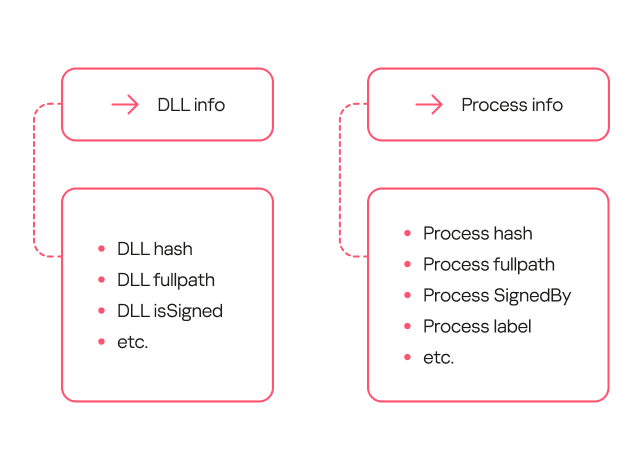
The training sample was labeled in three iterations. Initially, we could not automatically pull event labeling from our analysts that indicated whether an event was a DLL hijacking attack. So, we used data from our databases containing only file reputation, and labeled the rest of the data manually. We labeled as DLL hijacking those library-call events where the process was definitively legitimate but the DLL was definitively malicious. However, this labeling was not enough because some processes, like “svchost”, are designed mainly to load various libraries. As a result, the model we trained on this data had a high rate of false positives and was not practical for real-world use.
In the next iteration, we additionally filtered malicious libraries by family, keeping only those which were known to exhibit DLL-hijacking behavior. The model trained on this refined data showed significantly better accuracy and essentially confirmed our hypothesis that we could use machine learning to detect this type of attacks.
At this stage, our training dataset had tens of millions of objects. This included about 20 million clean files and around 50,000 definitively malicious ones.
| Status | Total | Unique files |
| Unknown | ~ 18M | ~ 6M |
| Malicious | ~ 50K | ~ 1,000 |
| Clean | ~ 20M | ~ 250K |
We then trained subsequent models on the results of their predecessors, which had been verified and further labeled by analysts. This process significantly increased the efficiency of our training.
So, we had a labeled sample with a large number of library loading events from various processes. How can we describe a “clean” library? Using a process name + library name combination does not account for renamed processes. Besides, a legitimate user, not just an attacker, can rename a process. If we used the process hash instead of the name, we would solve the renaming problem, but then every version of the same library would be treated as a separate library. We ultimately settled on using a library name + process signature combination. While this approach considers all identically named libraries from a single vendor as one, it generally produces a more or less realistic picture.
To describe safe library loading events, we used a set of counters that included information about the processes (the frequency of a specific process name for a file with a given hash, the frequency of a specific file path for a file with that hash, and so on), information about the libraries (the frequency of a specific path for that library, the percentage of legitimate launches, and so on), and event properties (that is, whether the library is in the same directory as the file that calls it).
The result was a system with multiple aggregates (sets of counters and keys) that could describe an input event. These aggregates can contain a single key (e.g., a DLL’s hash sum) or multiple keys (e.g., a process’s hash sum + process signature). Based on these aggregates, we can derive a set of features that describe the library loading event. The diagram below provides examples of how these features are derived:
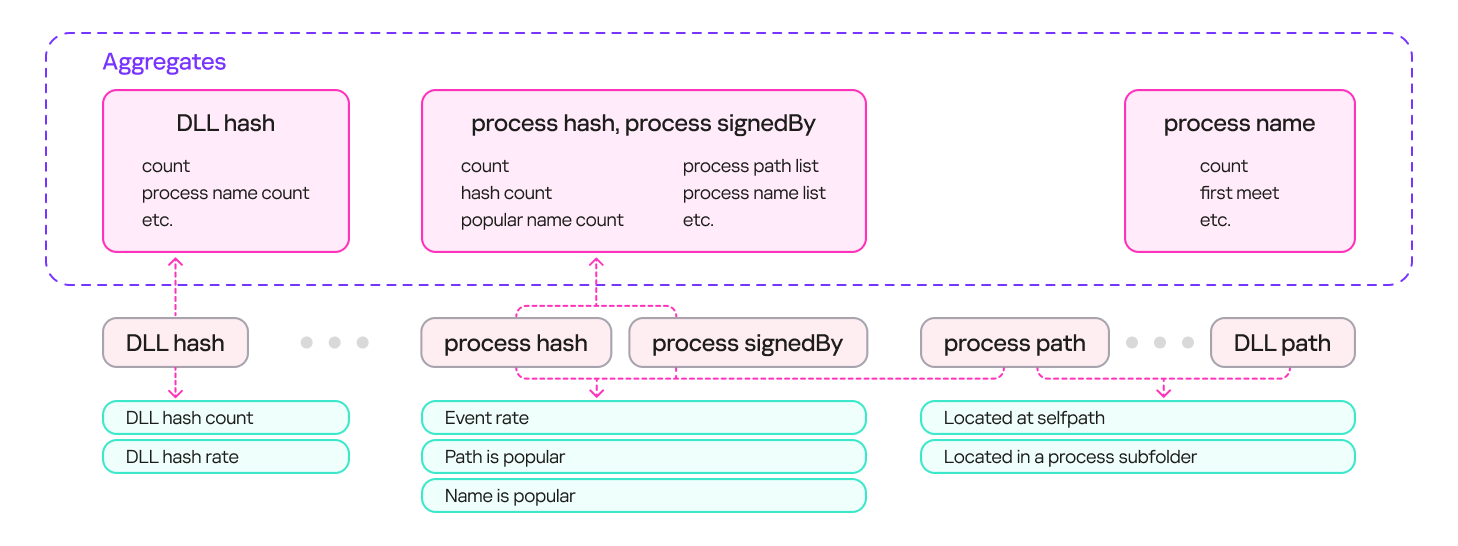
Feature extraction from aggregates
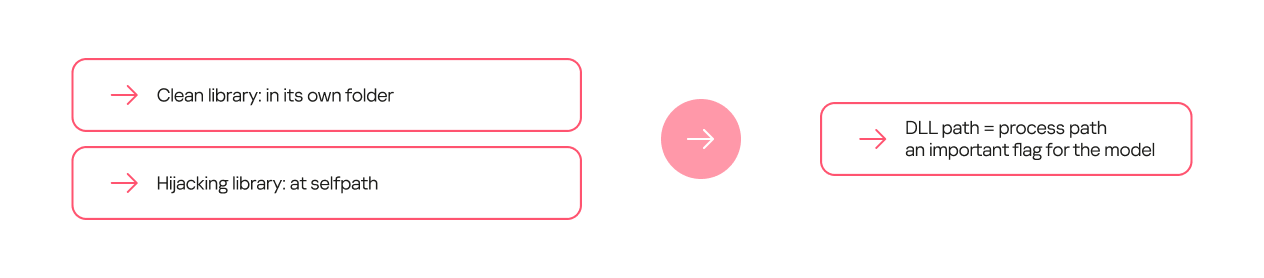
Certain feature combinations (dependencies) strongly indicate DLL hijacking. These can be simple dependencies. For some processes, the clean library they call always resides in a separate folder, while the malicious one is most often placed in the process folder.
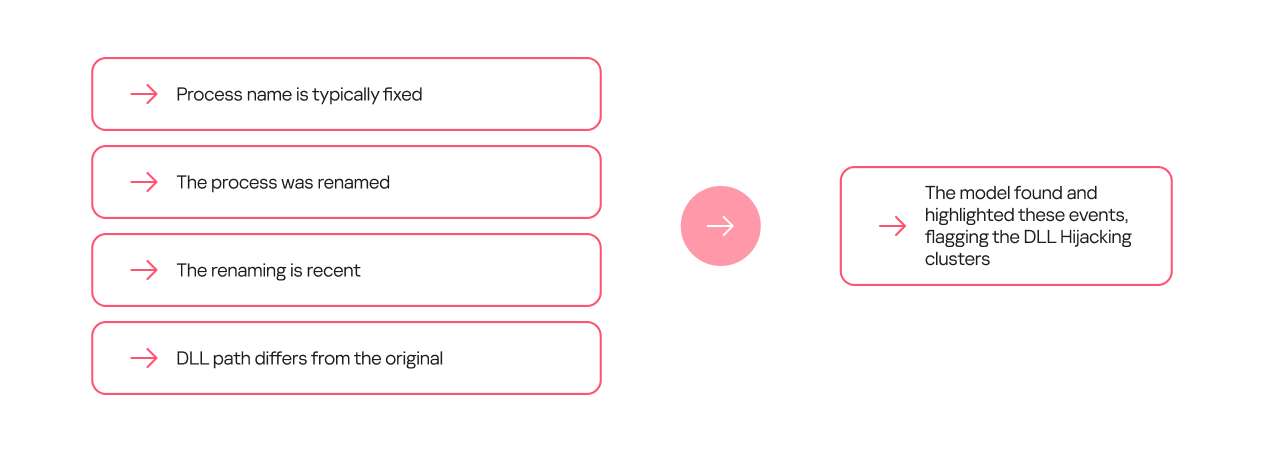
Other dependencies can be more complex and require several conditions to be met. For example, a process renaming itself does not, on its own, indicate DLL hijacking. However, if the new name appears in the data stream for the first time, and the library is located on a non-standard path, it is highly likely to be malicious.
Within this project, we trained several generations of models. The primary goal of the first generation was to show that machine learning could at all be applied to detecting DLL hijacking. When training this model, we used the broadest possible interpretation of the term.
The model’s workflow was as simple as possible:
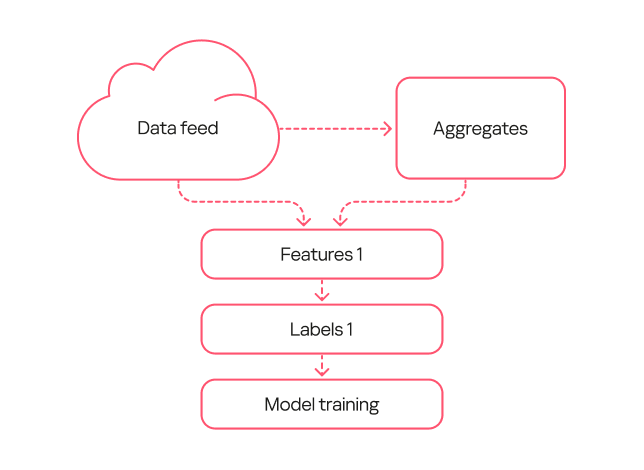
First-generation model diagram
The second-generation model was trained on data that had been processed by the first-generation model and verified by analysts (labeling type 2). Consequently, the labeling was more precise than during the training of the first model. Additionally, we added more features to describe the library structure and slightly complicated the workflow for describing library loads.
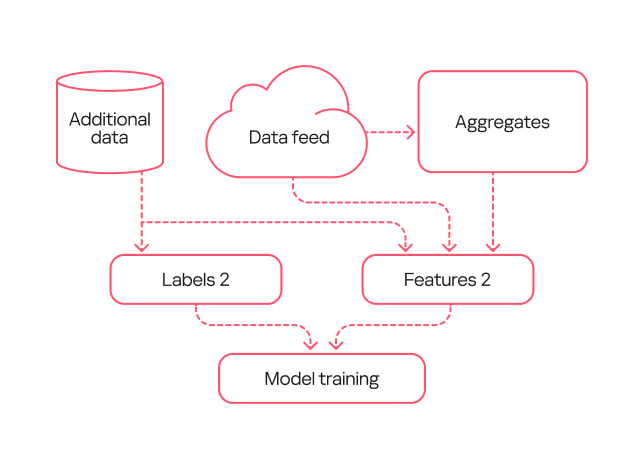
Second-generation model diagram
Based on the results from this second-generation model, we were able to identify several common types of false positives. For example, the training sample included potentially unwanted applications. These can, in certain contexts, exhibit behavior similar to DLL hijacking, but they are not malicious and rarely belong to this attack type.
We fixed these errors in the third-generation model. First, with the help of analysts, we flagged the potentially unwanted applications in the training sample so the model would not detect them. Second, in this new version, we used an expanded labeling that included useful detections from both the first and second generations. Additionally, we expanded the feature description through one-hot encoding — a technique for converting categorical features into a binary format — for certain fields. Also, since the volume of events processed by the model increased over time, this version added normalization of all features based on the data flow size.
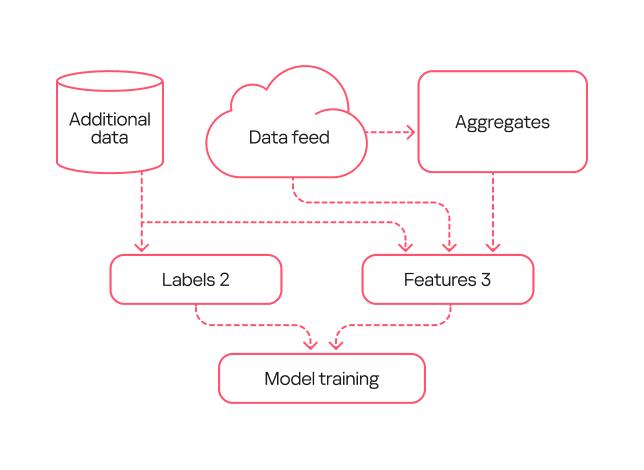
Third-generation model diagram
To evaluate the evolution of our models, we applied them to a test data set none of them had worked with before. The graph below shows the ratio of true positive to false positive verdicts for each model.
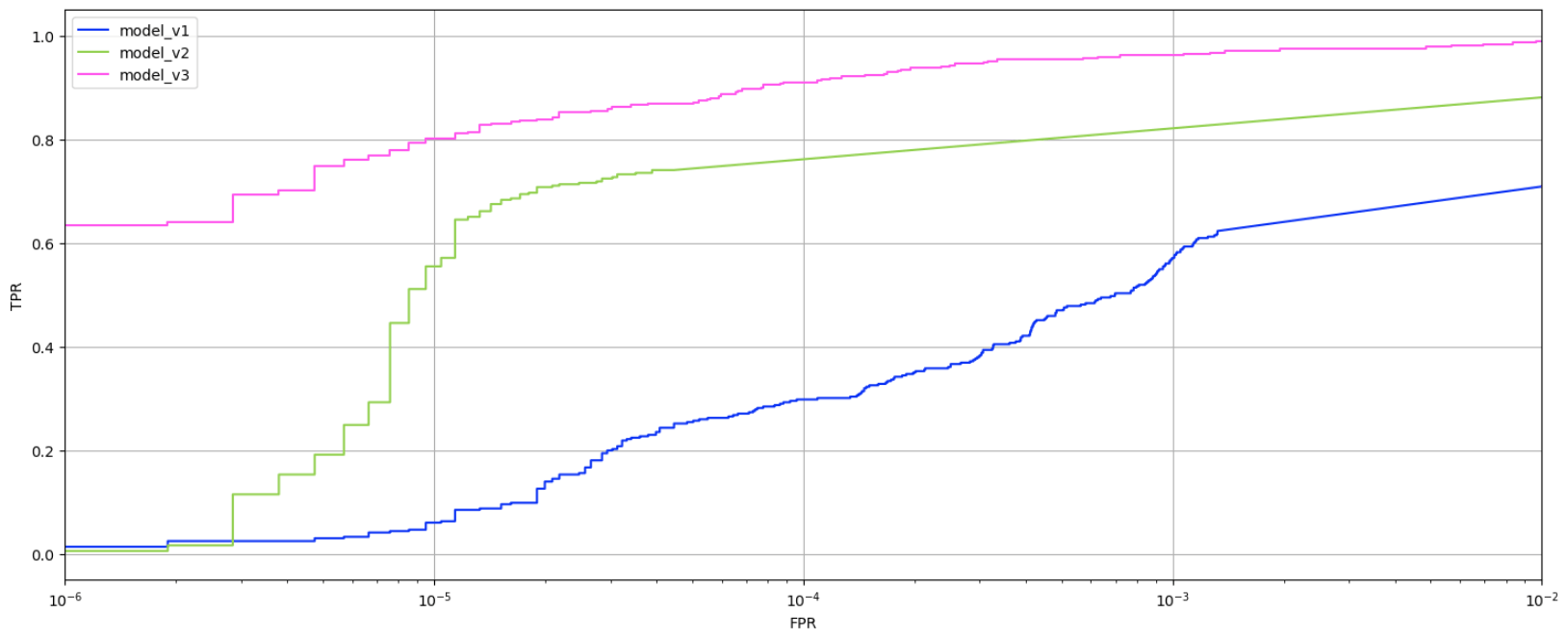
Trends in true positives and false positives from the first-, second-, and third-generation models
As the models evolved, the percentage of true positives grew. While the first-generation model achieved a relatively good result (0.6 or higher) only with a very high false positive rate (10⁻³ or more), the second-generation model reached this at 10⁻⁵. The third-generation model, at the same low false positive rate, produced 0.8 true positives, which is considered a good result.
Evaluating the models on the data stream at a fixed score shows that the absolute number of new events labeled as DLL Hijacking increased from one generation to the next. That said, evaluating the models by their false verdict rate also helps track progress: the first model has a fairly high error rate, while the second and third generations have significantly lower ones.
False positives rate among model outputs, July 2024 – August 2025 (download)
All three model generations are used in our internal systems to detect likely cases of DLL hijacking within telemetry data streams. We receive 6.5 million security events daily, linked to 800,000 unique files. Aggregates are built from this sample at a specified interval, enriched, and then fed into the models. The output data is then ranked by model and by the probability of DLL hijacking assigned to the event, and then sent to our analysts. For instance, if the third-generation model flags an event as DLL hijacking with high confidence, it should be investigated first, whereas a less definitive verdict from the first-generation model can be checked last.
Simultaneously, the models are tested on a separate data stream they have not seen before. This is done to assess their effectiveness over time, as a model’s detection performance can degrade. The graph below shows that the percentage of correct detections varies slightly over time, but on average, the models detect 70–80% of DLL hijacking cases.
DLL hijacking detection trends for all three models, October 2024 – September 2025 (download)
Additionally, we recently deployed a DLL hijacking detection model into the Kaspersky SIEM, but first we tested the model in the Kaspersky MDR service. During the pilot phase, the model helped to detect and prevent a number of DLL hijacking incidents in our clients’ systems. We have written a separate article about how the machine learning model for detecting targeted attacks involving DLL hijacking works in Kaspersky SIEM and the incidents it has identified.
Based on the training and application of the three generations of models, the experiment to detect DLL hijacking using machine learning was a success. We were able to develop a model that distinguishes events resembling DLL hijacking from other events, and refined it to a state suitable for practical use, not only in our internal systems but also in commercial products. Currently, the models operate in the cloud, scanning hundreds of thousands of unique files per month and detecting thousands of files used in DLL hijacking attacks each month. They regularly identify previously unknown variations of these attacks. The results from the models are sent to analysts who verify them and create new detection rules based on their findings.
Our colleagues from the AI expertise center recently developed a machine-learning model that detects DLL-hijacking attacks. We then integrated this model into the Kaspersky Unified Monitoring and Analysis Platform SIEM system. In a separate article, our colleagues shared how the model had been created and what success they had achieved in lab environments. Here, we focus on how it operates within Kaspersky SIEM, the preparation steps taken before its release, and some real-world incidents it has already helped us uncover.
The model’s operation generally boils down to a step-by-step check of all DLL libraries loaded by processes in the system, followed by validation in the Kaspersky Security Network (KSN) cloud. This approach allows local attributes (path, process name, and file hashes) to be combined with a global knowledge base and behavioral indicators, which significantly improves detection quality and reduces the probability of false positives.
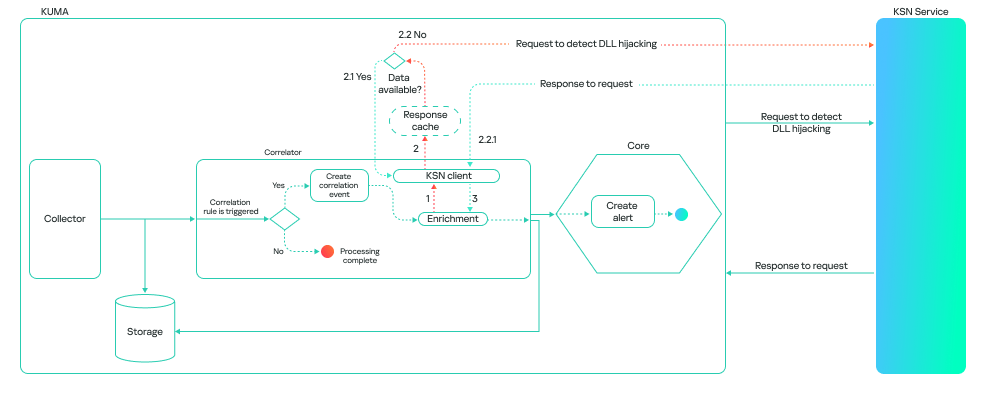
The model can run in one of two modes: on a correlator or on a collector. A correlator is a SIEM component that performs event analysis and correlation based on predefined rules or algorithms. If detection is configured on a correlator, the model checks events that have already triggered a rule. This reduces the volume of KSN queries and the model’s response time.
This is how it looks:
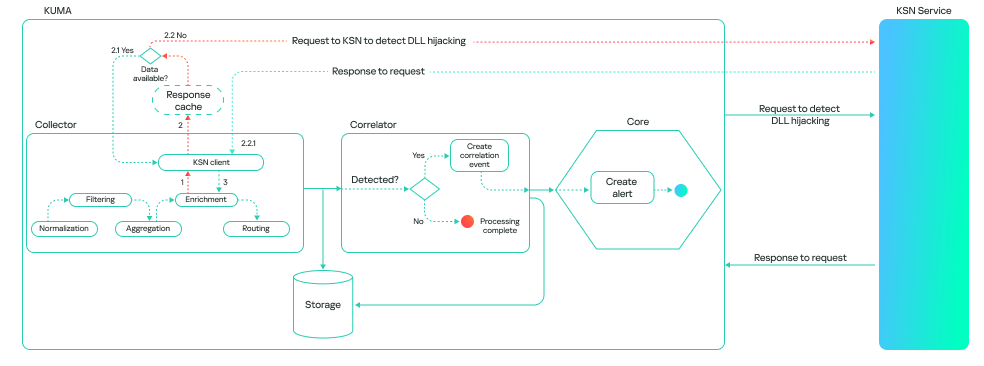
A collector is a software or hardware component of a SIEM platform that collects and normalizes events from various sources, and then delivers these events to the platform’s core. If detection is configured on a collector, the model processes all events associated with various processes loading libraries, provided these events meet the following conditions:
This method consumes more resources, and the model’s response takes longer than it does on a correlator. However, it can be useful for retrospective threat hunting because it allows you to check all events logged by Kaspersky SIEM. The model’s workflow on a collector looks like this:
It is important to note that the model is not limited to a binary “malicious/non-malicious” assessment; it ranks its responses by confidence level. This allows it to be used as a flexible tool in SOC practice. Examples of possible verdicts:
A Kaspersky SIEM rule for detecting DLL hijacking would look like this:
N.KL_AI_DLLHijackingCheckResult > 1
Embedding the model into the Kaspersky SIEM correlator automates the process of finding DLL-hijacking attacks, making it possible to detect them at scale without having to manually analyze hundreds or thousands of loaded libraries. Furthermore, when combined with correlation rules and telemetry sources, the model can be used not just as a standalone module but as part of a comprehensive defense against infrastructure attacks.
Before being released, the model (as part of the Kaspersky SIEM platform) was tested in the MDR service, where it was trained to identify attacks on large datasets supplied by our telemetry. This step was necessary to ensure that detection works not only in lab settings but also in real client infrastructures.
During the pilot testing, we verified the model’s resilience to false positives and its ability to correctly classify behavior even in non-typical DLL-loading scenarios. As a result, several real-world incidents were successfully detected where attackers used one type of DLL hijacking — the DLL Sideloading technique — to gain persistence and execute their code in the system.
Let us take a closer look at the three most interesting of these.
In one incident, the attackers successfully leveraged the vulnerability CVE-2021-27076 to exploit a SharePoint service that used IIS as a web server. They ran the following command:
c:\windows\system32\inetsrv\w3wp.exe -ap "SharePoint - 80" -v "v4.0" -l "webengine4.dll" -a \\.\pipe\iisipmd32ded38-e45b-423f-804d-34471928538b -h "C:\inetpub\temp\apppools\SharePoint - 80\SharePoint - 80.config" -w "" -m 0
After the exploitation, the IIS process created files that were later used to run malicious code via the DLL sideloading technique (T1574.001 Hijack Execution Flow: DLL):
C:\ProgramData\SystemSettings.exe
C:\ProgramData\SystemSettings.dll
SystemSettings.dll is the name of a library associated with the Windows Settings application (SystemSettings.exe). The original library contains code and data that the Settings application uses to manage and configure various system parameters. However, the library created by the attackers has malicious functionality and is only pretending to be a system library.
Later, to establish persistence in the system and launch a DLL sideloading attack, a scheduled task was created, disguised as a Microsoft Edge browser update. It launches a SystemSettings.exe file, which is located in the same directory as the malicious library:
Schtasks /create /ru "SYSTEM" /tn "\Microsoft\Windows\Edge\Edgeupdates" /sc DAILY /tr "C:\ProgramData\SystemSettings.exe" /F
The task is set to run daily.
When the SystemSettings.exe process is launched, it loads the malicious DLL. As this happened, the process and library data were sent to our model for analysis and detection of a potential attack.
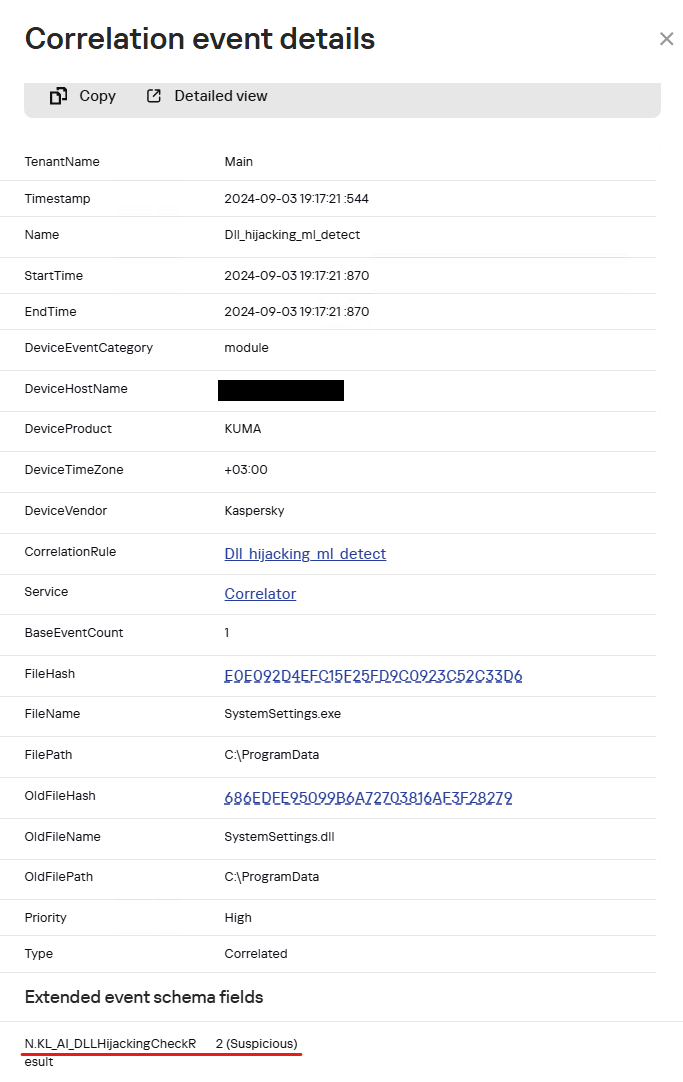
Example of a SystemSettings.dll load event with a DLL Hijacking module verdict in Kaspersky SIEM
The resulting data helped our analysts highlight a suspicious DLL and analyze it in detail. The library was found to be a Cobalt Strike implant. After loading it, the SystemSettings.exe process attempted to connect to the attackers’ command-and-control server.
DNS query: connect-microsoft[.]com
DNS query type: AAAA
DNS response: ::ffff:8.219.1[.]155;
8.219.1[.]155:8443
After establishing a connection, the attackers began host reconnaissance to gather various data to develop their attack.
C:\ProgramData\SystemSettings.exe
whoami /priv
hostname
reg query HKLM\SOFTWARE\Microsoft\Cryptography /v MachineGuid
powershell -c $psversiontable
dotnet --version
systeminfo
reg query "HKEY_LOCAL_MACHINE\SOFTWARE\VMware, Inc.\VMware Drivers"
cmdkey /list
REG query "HKLM\SYSTEM\CurrentControlSet\Control\Terminal Server\WinStations\RDP-Tcp" /v PortNumber
reg query "HKEY_CURRENT_USER\Software\Microsoft\Terminal Server Client\Servers
netsh wlan show profiles
netsh wlan show interfaces
set
net localgroup administrators
net user
net user administrator
ipconfig /all
net config workstation
net view
arp -a
route print
netstat -ano
tasklist
schtasks /query /fo LIST /v
net start
net share
net use
netsh firewall show config
netsh firewall show state
net view /domain
net time /domain
net group "domain admins" /domain
net localgroup administrators /domain
net group "domain controllers" /domain
net accounts /domain
nltest / domain_trusts
reg query HKEY_LOCAL_MACHINE\SOFTWARE\Microsoft\Windows\CurrentVersion\Run
reg query HKEY_CURRENT_USER\Software\Microsoft\Windows\CurrentVersion\RunOnce
reg query HKEY_LOCAL_MACHINE\Software\Microsoft\Windows\CurrentVersion\Policies\Explorer\Run
reg query HKEY_LOCAL_MACHINE\Software\Wow6432Node\Microsoft\Windows\CurrentVersion\Run
reg query HKEY_CURRENT_USER\Software\Wow6432Node\Microsoft\Windows\CurrentVersion\RunOnce
Based on the attackers’ TTPs, such as loading Cobalt Strike as a DLL, using the DLL sideloading technique (1, 2), and exploiting SharePoint, we can say with a high degree of confidence that the ToddyCat APT group was behind the attack. Thanks to the prompt response of our model, we were able to respond in time and block this activity, preventing the attackers from causing damage to the organization.
Another example was discovered by the model after a client was connected to MDR monitoring: a legitimate system file located in an application folder attempted to load a suspicious library that was stored next to it.
C:\Program Files\Chiniks\SettingSyncHost.exe
C:\Program Files\Chiniks\policymanager.dll E83F331BD1EC115524EBFF7043795BBE
The SettingSyncHost.exe file is a system host process for synchronizing settings between one user’s different devices. Its 32-bit and 64-bit versions are usually located in C:\Windows\System32\ and C:\Windows\SysWOW64\, respectively. In this incident, the file location differed from the normal one.
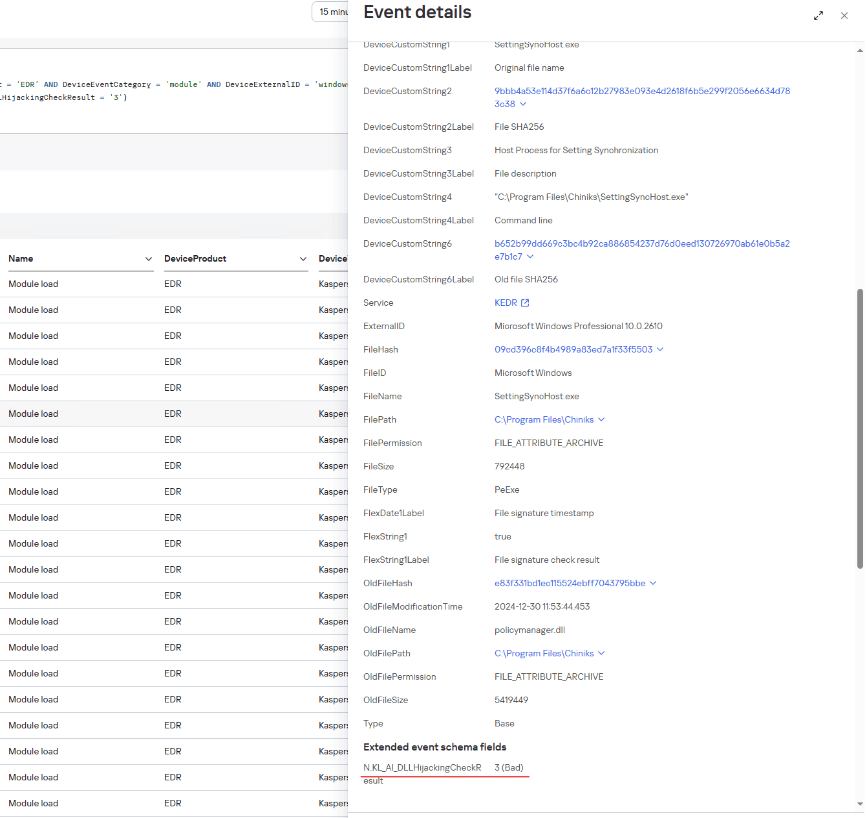
Example of a policymanager.dll load event with a DLL Hijacking module verdict in Kaspersky SIEM
Analysis of the library file loaded by this process showed that it was malware designed to steal information from browsers.
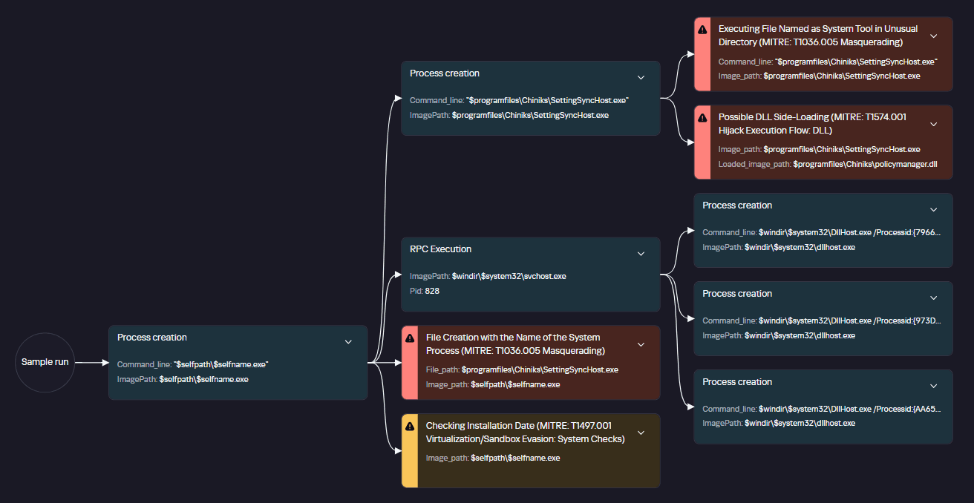
Graph of policymanager.dll activity in a sandbox
The file directly accesses browser files that contain user data.
C:\Users\<user>\AppData\Local\Google\Chrome\User Data\Local State
The library file is on the list of files used for DLL hijacking, as published in the HijackLibs project. The project contains a list of common processes and libraries employed in DLL-hijacking attacks, which can be used to detect these attacks.
Another incident discovered by our model occurred when a user connected a removable USB drive:
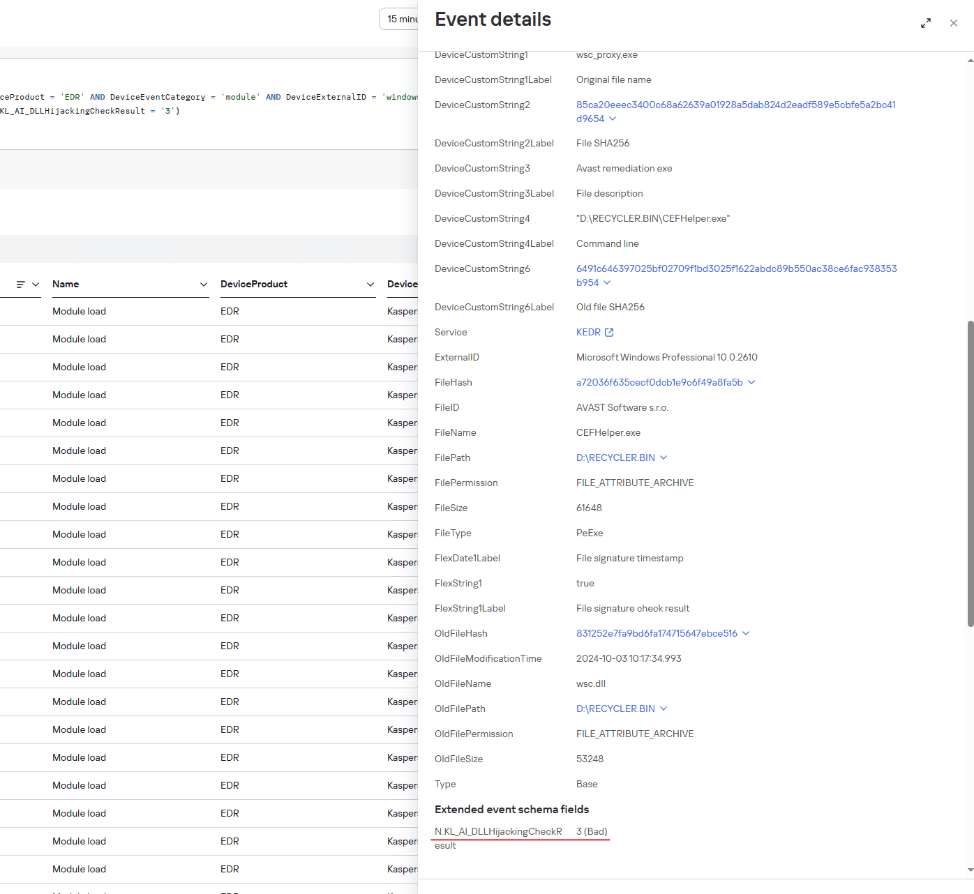
Example of a Kaspersky SIEM event where a wsc.dll library was loaded from a USB drive, with a DLL Hijacking module verdict
The connected drive’s directory contained hidden folders with an identically named shortcut for each of them. The shortcuts had icons typically used for folders. Since file extensions were not shown by default on the drive, the user might have mistaken the shortcut for a folder and launched it. In turn, the shortcut opened the corresponding hidden folder and ran an executable file using the following command:
"%comspec%" /q /c "RECYCLER.BIN\1\CEFHelper.exe [$DIGITS] [$DIGITS]"
CEFHelper.exe is a legitimate Avast Antivirus executable that, through DLL sideloading, loaded the wsc.dll library, which is a malicious loader.
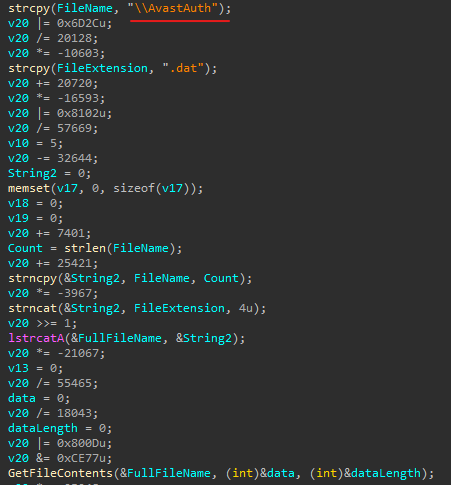
Code snippet from the malicious file
The loader opens a file named AvastAuth.dat, which contains an encrypted backdoor. The library reads the data from the file into memory, decrypts it, and executes it. After this, the backdoor attempts to connect to a remote command-and-control server.
The library file, which contains the malicious loader, is on the list of known libraries used for DLL sideloading, as presented on the HijackLibs project website.
Integrating the model into the product provided the means of early and accurate detection of DLL-hijacking attempts which previously might have gone unnoticed. Even during the pilot testing, the model proved its effectiveness by identifying several incidents using this technique. Going forward, its accuracy will only increase as data accumulates and algorithms are updated in KSN, making this mechanism a reliable element of proactive protection for corporate systems.
Legitimate files used for DLL hijacking
E0E092D4EFC15F25FD9C0923C52C33D6 loads SystemSettings.dll
09CD396C8F4B4989A83ED7A1F33F5503 loads policymanager.dll
A72036F635CECF0DCB1E9C6F49A8FA5B loads wsc.dll
Malicious files
EA2882B05F8C11A285426F90859F23C6 SystemSettings.dll
E83F331BD1EC115524EBFF7043795BBE policymanager.dll
831252E7FA9BD6FA174715647EBCE516 wsc.dll
Paths
C:\ProgramData\SystemSettings.exe
C:\ProgramData\SystemSettings.dll
C:\Program Files\Chiniks\SettingSyncHost.exe
C:\Program Files\Chiniks\policymanager.dll
D:\RECYCLER.BIN\1\CEFHelper.exe
D:\RECYCLER.BIN\1\wsc.dll
When it comes to digital forensics, AmCache plays a vital role in identifying malicious activities in Windows systems. This artifact allows the identification of the execution of both benign and malicious software on a machine. It is managed by the operating system, and at the time of writing this article, there is no known way to modify or remove AmCache data. Thus, in an incident response scenario, it could be the key to identifying lost artifacts (e.g., ransomware that auto-deletes itself), allowing analysts to search for patterns left by the attacker, such as file names and paths. Furthermore, AmCache stores the SHA-1 hashes of executed files, which allows DFIR professionals to search public threat intelligence feeds — such as OpenTIP and VirusTotal — and generate rules for blocking this same file on other systems across the network.
This article presents a comprehensive analysis of the AmCache artifact, allowing readers to better understand its inner workings. In addition, we present a new tool named “AmCache-EvilHunter“, which can be used by any professional to easily parse the Amcache.hve file and extract IOCs. The tool is also able to query the aforementioned intelligence feeds to check for malicious file detections, this level of built-in automation reduces manual effort and speeds up threat detection, which is of significant value for analysts and responders.
Evidence of execution is fundamentally important in digital forensics and incident response, since it helps investigators reconstruct how the system was used during an intrusion. Artifacts such as Prefetch, ShimCache, and UserAssist offer clues about what was executed. AmCache is also a robust artifact for evidencing execution, preserving metadata that indicates a file’s presence and execution, even if the file has been deleted or modified. An advantage of AmCache over other Windows artifacts is that unlike them, it stores the file hash, which is immensely useful for analysts, as it can be used to hunt malicious files across the network, increasing the likelihood of fully identifying, containing, and eradicating the threat.
Application Activity Cache (AmCache) was first introduced in Windows 7 and fully leveraged in Windows 8 and beyond. Its purpose is to replace the older RecentFileCache.bcf in newer systems. Unlike its predecessor, AmCache includes valuable forensic information about program execution, executed binaries and loaded drivers.
This artifact is stored as a registry hive file named Amcache.hve in the directory C:\Windows\AppCompat\Programs. The metadata stored in this file includes file paths, publisher data, compilation timestamps, file sizes, and SHA-1 hashes.
It is important to highlight that the AmCache format does not depend on the operating system version, but rather on the version of the libraries (DLLs) responsible for filling the cache. In this way, even Windows systems with different patch levels could have small differences in the structure of the AmCache files. The known libraries used for filling this cache are stored under %WinDir%\System32 with the following names:
It is worth noting that this artifact has its peculiarities and limitations. The AmCache computes the SHA-1 hash over only the first 31,457,280 bytes (≈31 MB) of each executable, so comparing its stored hash online can fail for files exceeding this size. Furthermore, Amcache.hve is not a true execution log: it records files in directories scanned by the Microsoft Compatibility Appraiser, executables and drivers copied during program execution, and GUI applications that required compatibility shimming. Only the last category reliably indicates actual execution. Items in the first two groups simply confirm file presence on the system, with no data on whether or when they ran.
In the same directory, we can find additional LOG files used to ensure Amcache.hve consistency and recovery operations:
The Amcache.hve file can be collected from a system for forensic analysis using tools like Aralez, Velociraptor, or Kape.
The Amcache.hve file is a Windows Registry hive in REGF format; it contains multiple subkeys that store distinct classes of data. A simple Python parser can be implemented to iterate through Amcache.hve and present its keys:
#!/usr/bin/env python3

import sys
from Registry.Registry import Registry

hive = Registry(str(sys.argv[1]))
root = hive.open("Root")

for rec in root.subkeys():
    print(rec.name())
The result of this parser when executed is:
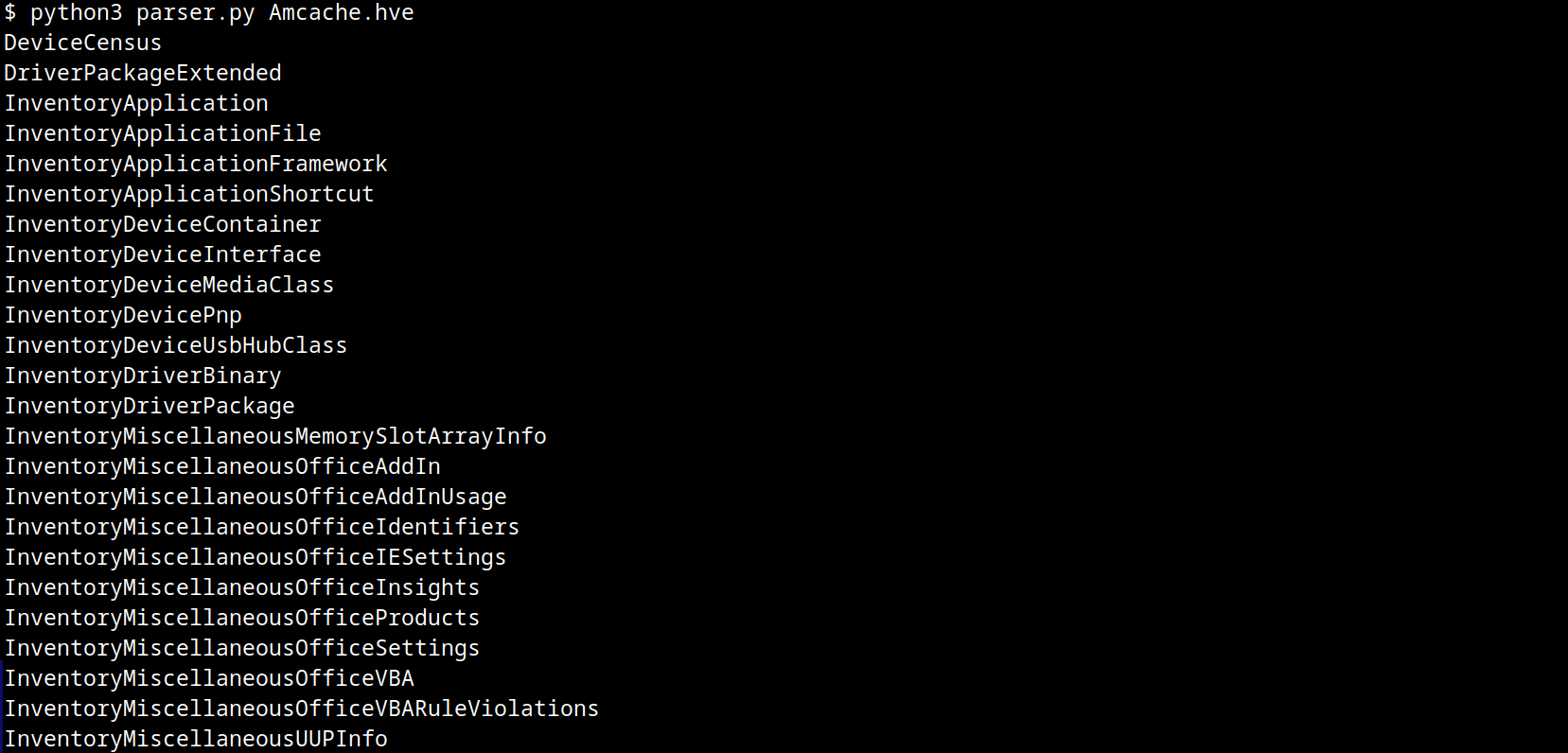
AmCache keys
From a DFIR perspective, the keys that are of the most interest to us are InventoryApplicationFile, InventoryApplication, InventoryDriverBinary, and InventoryApplicationShortcut, which are described in detail in the following subsections.
The InventoryApplicationFile key is essential for tracking every executable discovered on the system. Under this key, each executable is represented by its own uniquely named subkey, which stores the following main metadata:
With some tweaks to our original Python parser, we can read the information stored within this key:
#!/usr/bin/env python3

import sys
from Registry.Registry import Registry

hive = Registry(sys.argv[1])
root = hive.open("Root")

subs = {k.name(): k for k in root.subkeys()}
parent = subs.get("InventoryApplicationFile")

for rec in parent.subkeys():
   vals = {v.name(): v.value() for v in rec.values()}
   print("{}\n{}\n\n-----------\n".format(rec, vals))
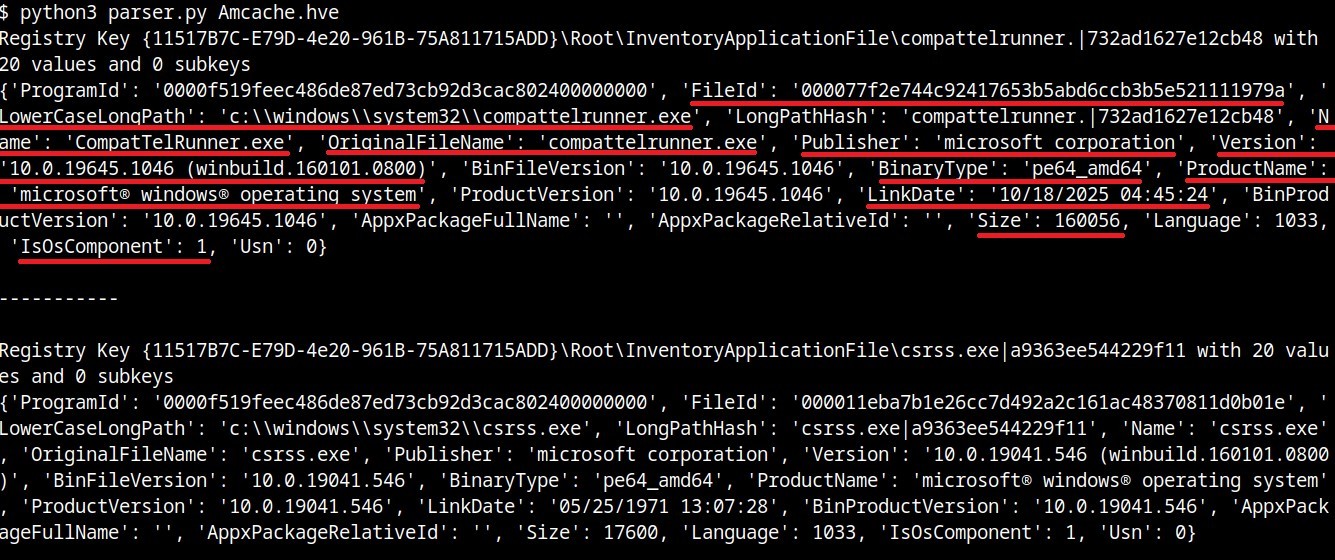
InventoryApplicationFile subkeys
We can also use tools like Registry Explorer to see the same data in a graphical way:
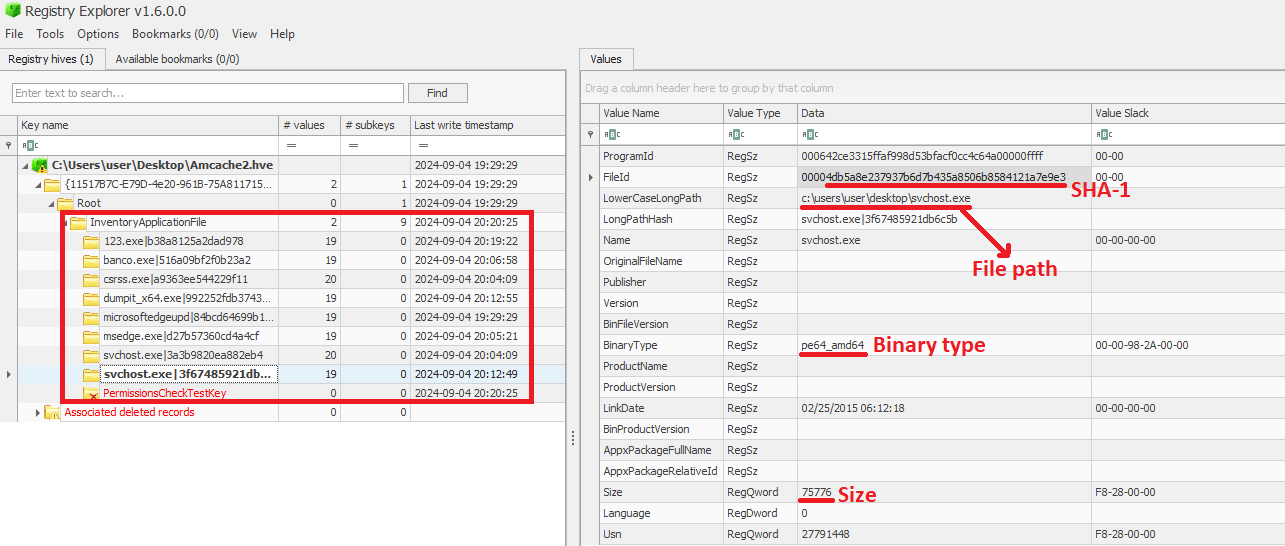
InventoryApplicationFile inspected through Registry Explorer
As mentioned before, AmCache computes the SHA-1 hash over only the first 31,457,280 bytes (≈31 MB). To prove this, we did a small experiment, during which we got a binary smaller than 31 MB (Aralez) and one larger than this value (a custom version of Velociraptor). For the first case, the SHA-1 hash of the entire binary was stored in AmCache.
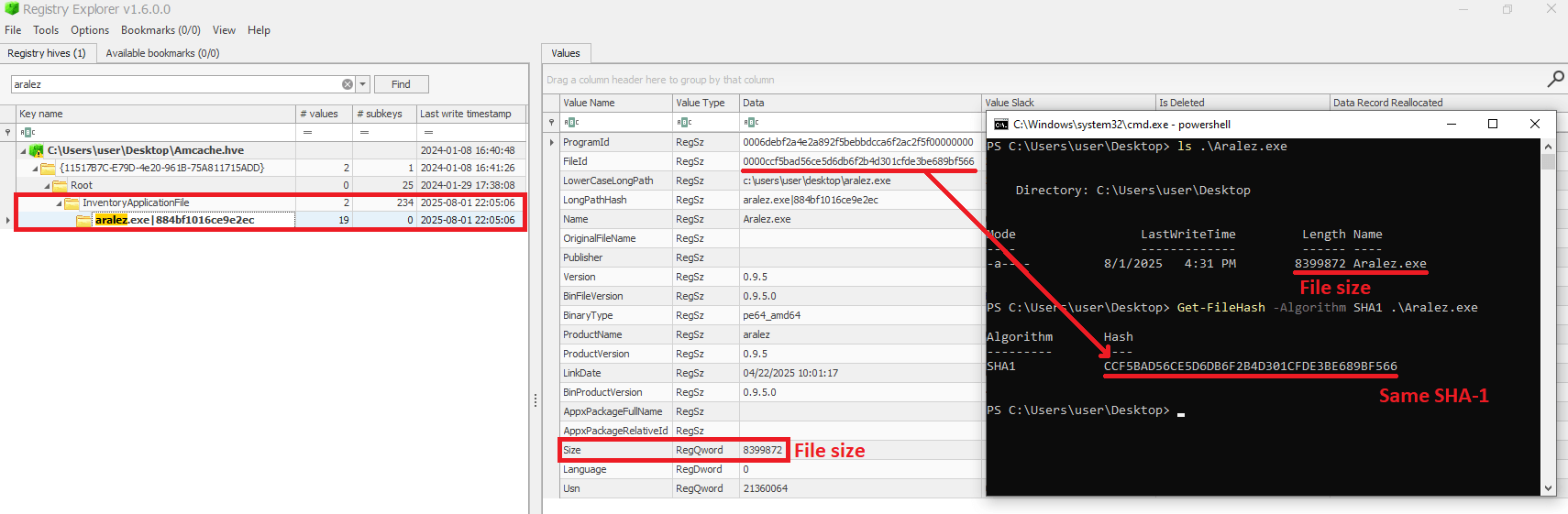
First AmCache SHA-1 storage scenario
For the second scenario, we used the dd utility to extract the first 31 MB of the Velociraptor binary:
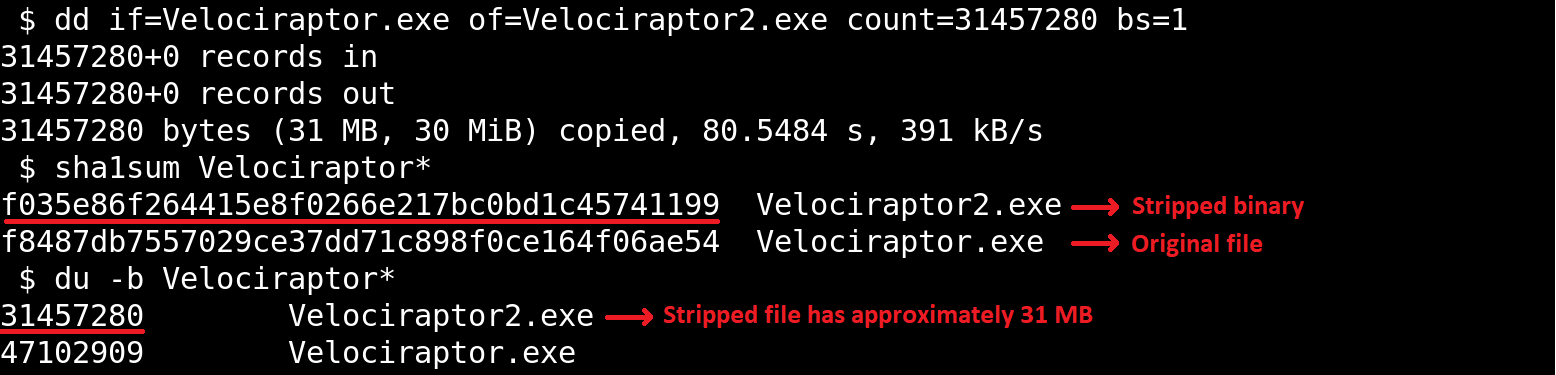
Stripped binary
When checking the Velociraptor entry on AmCache, we found that it indeed stored the SHA-1 hash calculated only for the first 31,457,280 bytes of the binary. Interestingly enough, the Size value represented the actual size of the original file. Thus, relying only on the file hash stored on AmCache for querying threat intelligence portals may be not enough when dealing with large files. So, we need to check if the file size in the record is bigger than 31,457,280 bytes before searching threat intelligence portals.
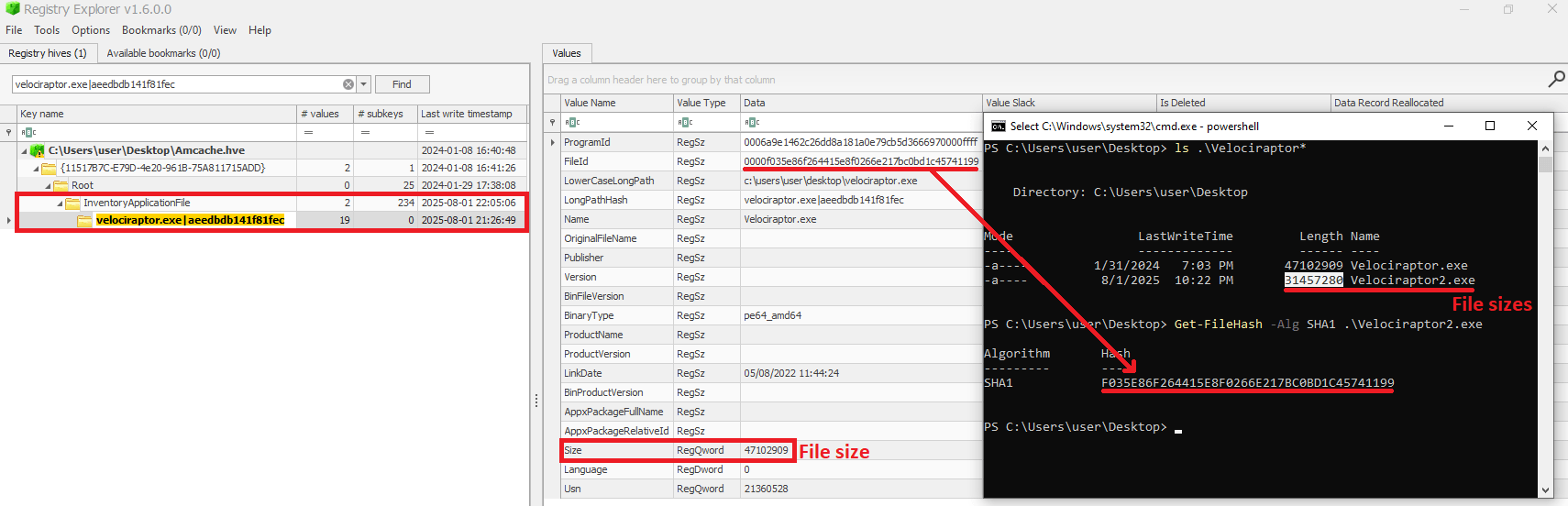
Second AmCache SHA-1 storage scenario
Additionally, attackers may take advantage of this characteristic to purposely generate large malicious binaries. In this way, even if investigators find that a malware was executed/present on a Windows system, the actual SHA-1 hash of the binary will still be unknown, making it difficult to track it across the network and gathering it from public databases like VirusTotal.
Let’s suppose you are searching for a possible insider threat. The user denies having run any suspicious programs, and any suspicious software was securely erased from disk. But in the InventoryApplicationFile, you find a record of winscp.exe being present in the user’s Downloads folder. Even though the file is gone, this tells you the tool was on the machine and it was likely used to transfer files before being deleted. In our incident response practice, we have seen similar cases, where this key proved useful.
The InventoryApplication key records details about applications that were previously installed on the system. Unlike InventoryApplicationFile, which logs every executable encountered, InventoryApplication focuses on those with installation records. Each entry is named by its unique ProgramId, allowing straightforward linkage back to the corresponding InventoryApplicationFile key. Additionally, InventoryApplication has the following subkeys of interest:
With a simple change to our parser, we can check the data contained in this key:
<...>
parent = subs.get("InventoryApplication")
<...>
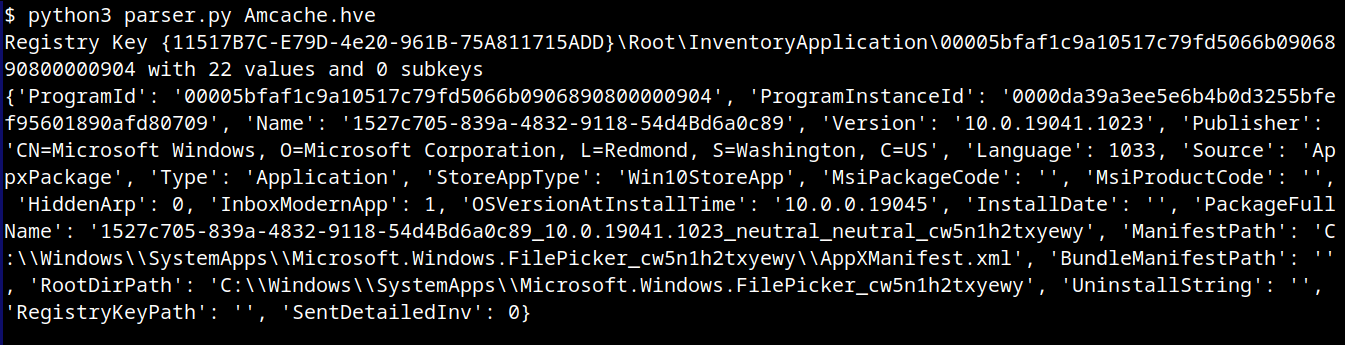
InventoryApplication subkeys
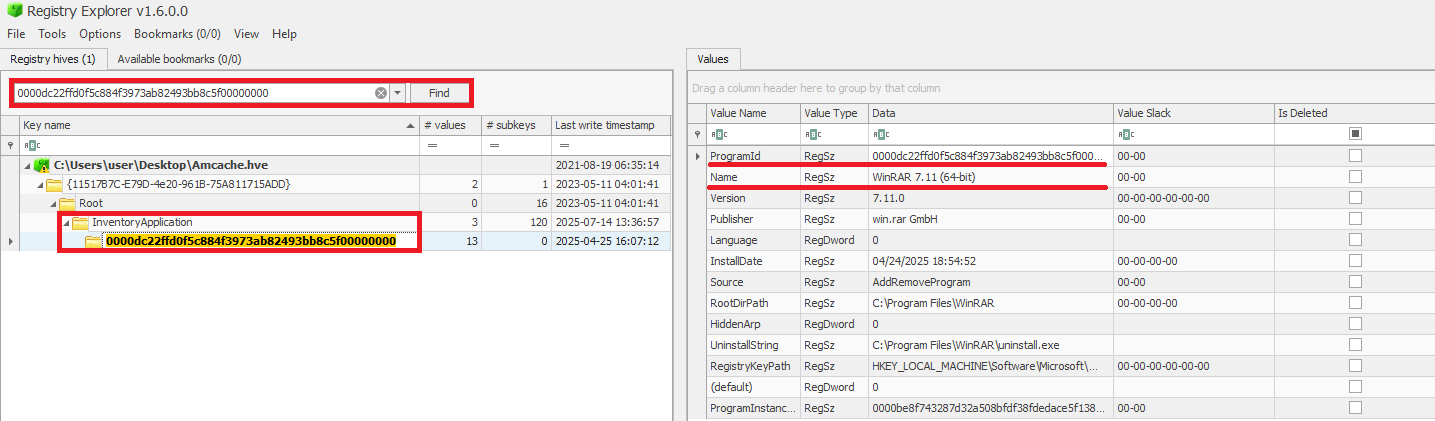
When a ProgramId appears both here and under InventoryApplicationFile, it confirms that the executable is not merely present or executed, but was formally installed. This distinction helps us separate ad-hoc copies or transient executions from installed software. The following figure shows the ProgramId of the WinRAR software under InventoryApplicationFile.
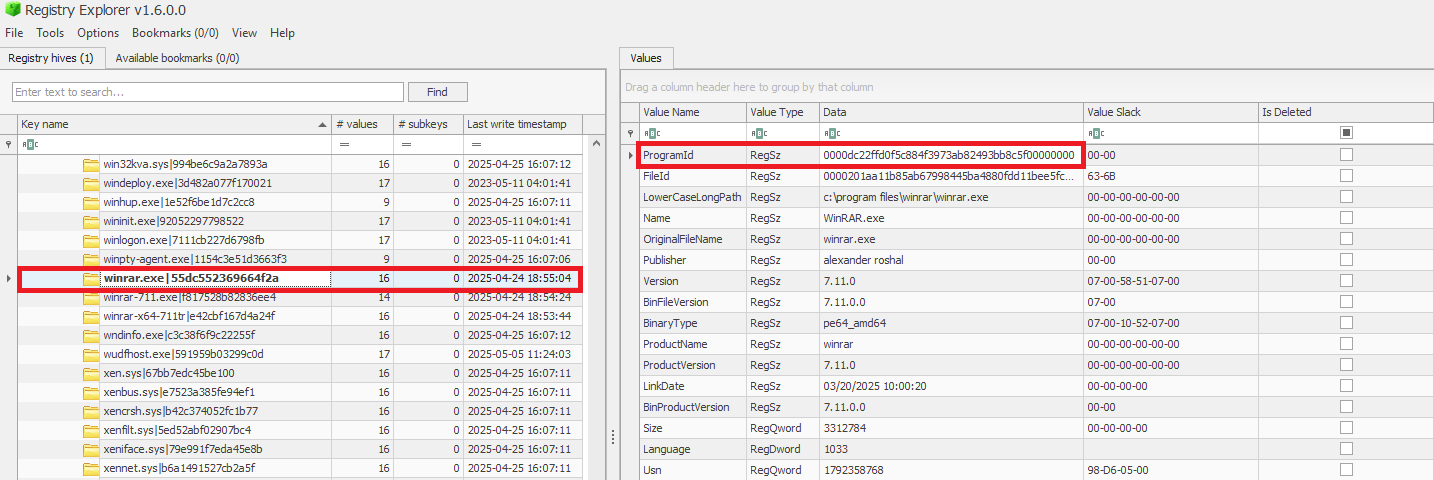
When searching for the ProgramId, we find an exact match under InventoryApplication. This confirms that WinRAR was indeed installed on the system.
Another interesting detail about InventoryApplication is that it contains a subkey named LastScanTime, which is stored separately from ProgramIds and holds a value representing the last time the Microsoft Compatibility Appraiser ran. This is a scheduled task that launches the compattelrunner.exe binary, and the information in this key should only be updated when that task executes. As a result, software installed since the last run of the Appraiser may not appear here. The LastScanTime value is stored in Windows FileTime format.

InventoryApplication LastScanTime information
Suppose that during an incident response engagement, you find an entry for AnyDesk in the InventoryApplication key (although the application is not installed anymore). This means that the attacker likely used it for remote access and then removed it to cover their tracks. Even if wiped from disk, this key proves it was present. We have seen this scenario in real-world cases more than once.
The InventoryDriverBinary key records every kernel-mode driver that the system has loaded, providing the essential metadata needed to spot suspicious or malicious drivers. Under this key, each driver is captured in its own uniquely named subkey and includes:
Because Windows drivers run at the highest privilege level, they are frequently exploited by malware. For example, a previous study conducted by Kaspersky shows that attackers are exploiting vulnerable drivers for killing EDR processes. When dealing with a cybersecurity incident, investigators correlate each driver’s cryptographic hash, file path, signature status, and modification timestamp. That can help in verifying if the binary matches a known, signed version, detecting any tampering by spotting unexpected modification dates, and flagging unsigned or anomalously named drivers for deeper analysis. Projects like LOLDrivers help identify vulnerable drivers in use by attackers in the wild.
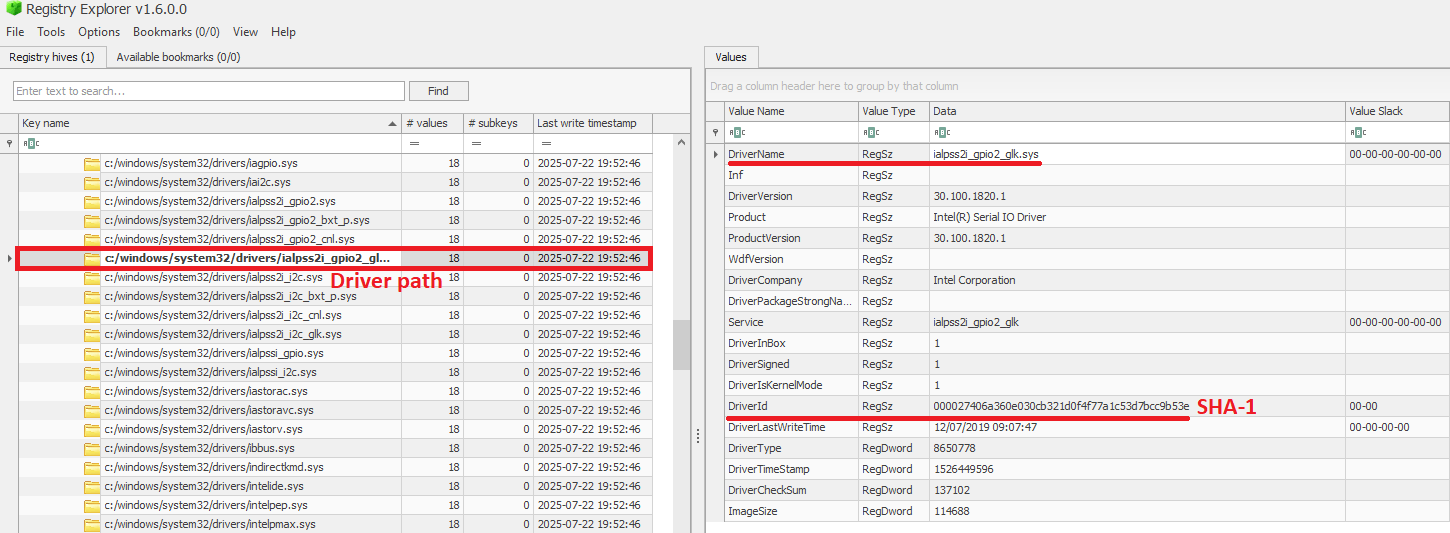
InventoryDriverBinary inspection
In addition to the InventoryDriverBinary, AmCache also provides the InventoryApplicationDriver key, which keeps track of all drivers that have been installed by specific applications. It includes two entries:
InventoryApplication) that were responsible for installing the driver.As shown in the figure below, the ProgramIds key can be used to track the associated program that uses this driver:
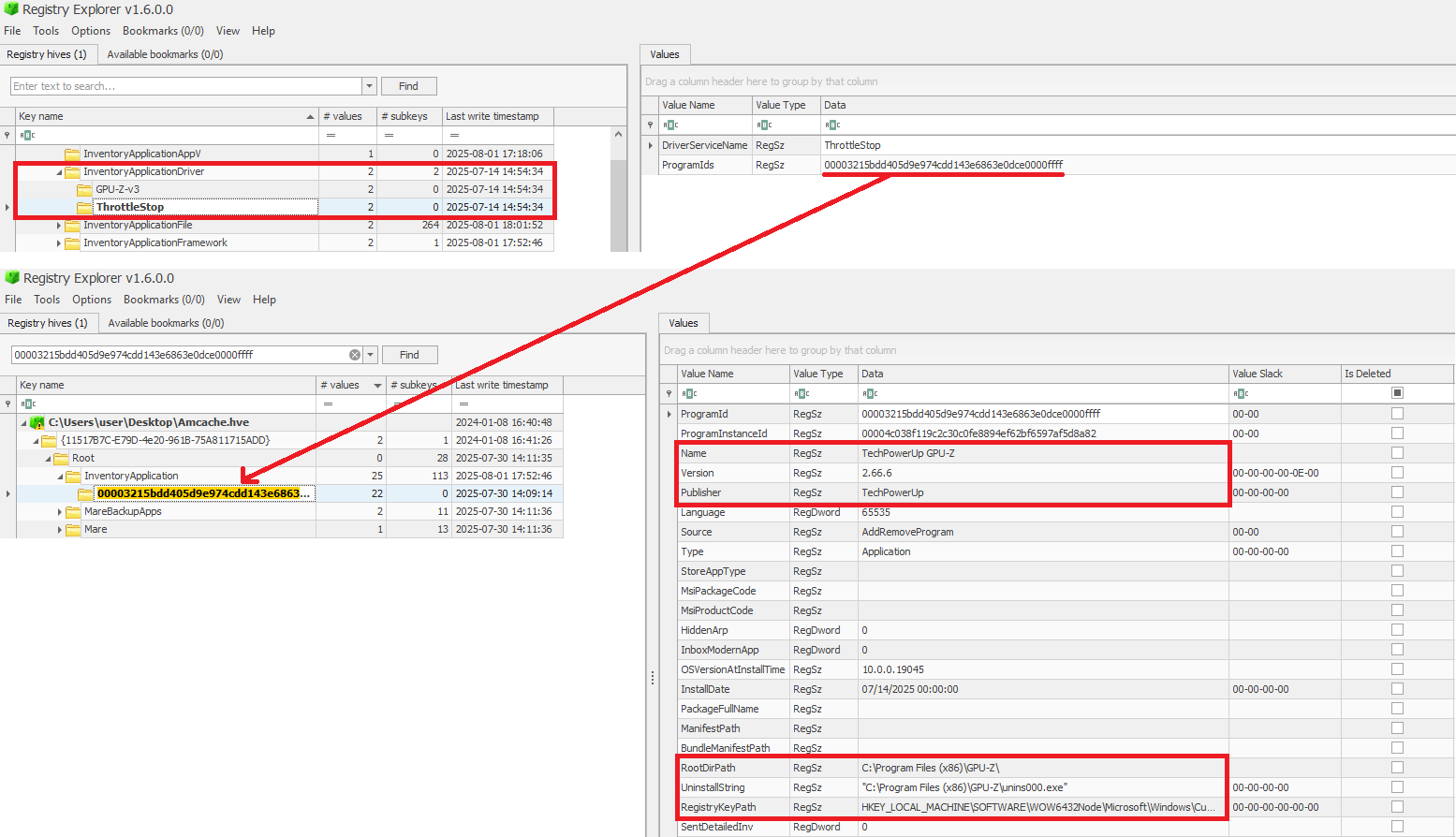
Checking program information by ProgramIds
If the system was compromised through the abuse of a known vulnerable or malicious driver, you can use the InventoryDriverBinary registry key to confirm its presence. Even if the driver has been removed or hidden, remnants in this key can reveal that it was once loaded, which helps identify kernel-level compromises and supporting timeline reconstruction during the investigation. This is exactly how the AV Killer malware was discovered.
This key contains entries for .lnk (shortcut) files that were present in folders like each user’s Start Menu or Desktop. Within each shortcut key, the ShortcutPath provides the absolute path to the LNK file at the moment of discovery. The ShortcutTargetPath shows where the shortcut pointed. We can also search for the ProgramId entry within the InventoryApplication key using the ShortcutProgramId (similar to what we did for drivers).

InventoryApplicationShortcut key
You find that a suspicious program was deleted from the computer, but the user claims they never ran it. The InventoryApplicationShortcut key shows a shortcut to that program was on their desktop and was accessed recently. With supplementary evidence, such as that from Prefetch analysis, you can confirm the execution of the software.
The table below summarizes the information presented in the previous subsections, highlighting the main information about each AmCache key.
| Key | Contains | Indicates execution? |
| InventoryApplicationFile | Metadata for all executables seen on the system. | Possibly (presence = likely executed) |
| InventoryApplication | Metadata about formally installed software. | No (indicates installation, not necessarily execution) |
| InventoryDriverBinary | Metadata about loaded kernel-mode drivers. | Yes (driver was loaded into memory) |
| InventoryApplicationShortcut | Information about .lnk files. | Possibly (combine with other data for confirmation) |
Undoubtedly Amcache.hve is a very important forensic artifact. However, we could not find any tool that effectively parses its contents while providing threat intelligence for the analyst. With this in mind, we developed AmCache-EvilHunter a command-line tool to parse and analyze Windows Amcache.hve registry hives, identify evidence of execution, suspicious executables, and integrate Kaspersky OpenTIP and VirusTotal lookups for enhanced threat intelligence.
AmCache-EvilHunter is capable of processing the Amcache.hve file and filter records by date range (with the options --start and --end). It is also possible to search records using keywords (--search), which is useful for searching for known naming conventions adopted by attackers. The results can be saved in CSV (--csv) or JSON (--json) formats.
The image below shows an example of execution of AmCache-EvilHunter with these basic options, by using the following command:
amcache-evilhunter -i Amcache.hve --start 2025-06-19 --end 2025-06-19 --csv output.csv
The output contains all applications that were present on the machine on June 19, 2025. The last column contains information whether the file is an operating system component, or not.
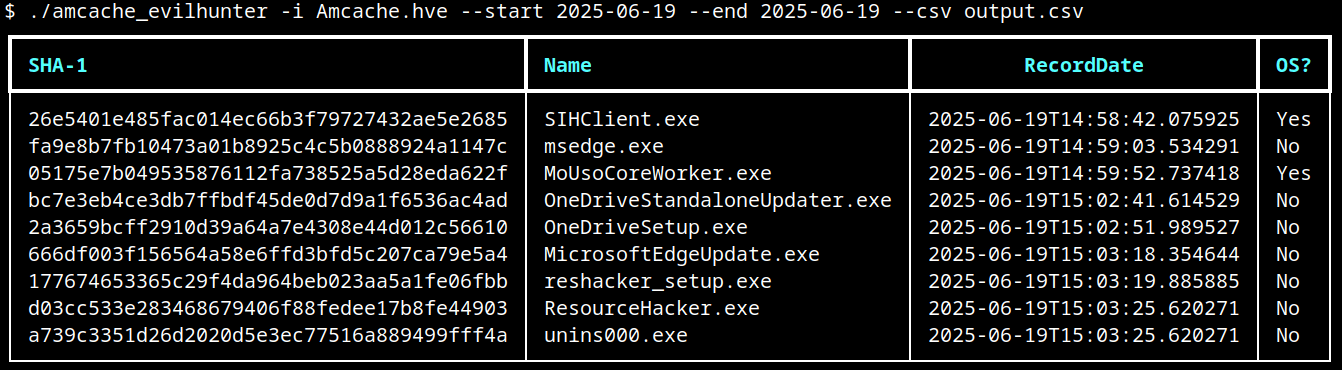
Basic usage of AmCache-EvilHunter
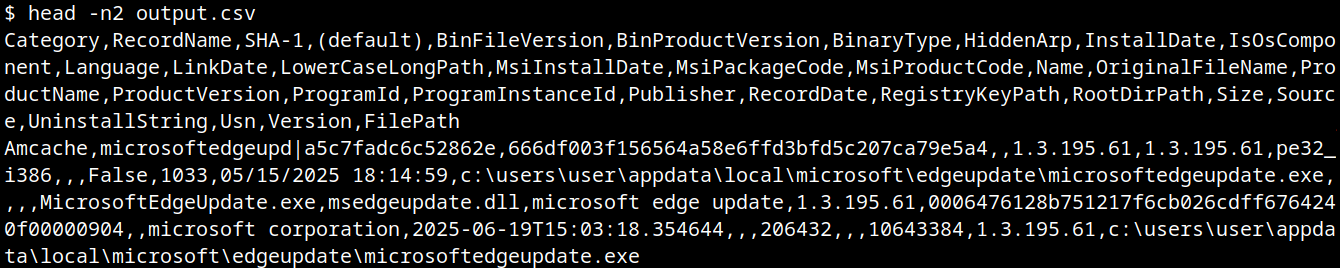
CSV result
Analysts are often faced with a large volume of executables and artifacts. To narrow down the scope and reduce noise, the tool is able to search for known suspicious binaries with the --find-suspicious option. The patterns used by the tool include common malware names, Windows processes containing small typos (e.g., scvhost.exe), legitimate executables usually found in use during incidents, one-letter/one-digit file names (such as 1.exe, a.exe), or random hex strings. The figure below shows the results obtained by using this option; as highlighted, one svchost.exe file is part of the operating system and the other is not, making it a good candidate for collection and analysis if not deleted.

Suspicious files identification
Malicious files usually do not include any publisher information and are definitely not part of the default operating system. For this reason, AmCache-EvilHunter also ships with the --missing-publisher and --exclude-os options. These parameters allow for easy filtering of suspicious binaries and also allow fast threat intelligence gathering, which is crucial during an incident.
Another important feature that distinguishes our tool from other proposed approaches is that AmCache-EvilHunter can query Kaspersky OpenTIP (--opentip ) and VirusTotal (--vt) for hashes it identifies. In this way, analysts can rapidly gain insights into samples to decide whether they are going to proceed with a full analysis of the artifact or not.

Threat intel lookup
Binaries of the tool are available on our GitHub page for both Linux and Windows systems.
Amcache.hve is a cornerstone of Windows forensics, capturing rich metadata, such as full paths, SHA-1 hashes, compilation timestamps, publisher and version details, for every executable that appears on a system. While it does not serve as a definitive execution log, its strength lies in documenting file presence and paths, making it invaluable for spotting anomalous binaries, verifying trustworthiness via hash lookups against threat‐intelligence feeds, and correlating LinkDate values with known attack campaigns.
To extract its full investigative potential, analysts should merge AmCache data with other artifacts (e.g., Prefetch, ShimCache, and Windows event logs) to confirm actual execution and build accurate timelines. Comparing InventoryApplicationFile entries against InventoryApplication reveals whether a file was merely dropped or formally installed, and identifying unexpected driver records can expose stealthy rootkits and persistence mechanisms. Leveraging parsers like AmCache-EvilHunter and cross-referencing against VirusTotal or proprietary threat databases allows IOC generation and robust incident response, making AmCache analysis a fundamental DFIR skill.
The Sentinels League is the official, week-by-week standings for the Threat Hunting World Championship – the first-of-its-kind tournament where the world’s top defenders go head-to-head across four surfaces: AI, Cloud, SIEM, and Endpoint. Thousands of blue teamers from more than 100 countries are tackling real-world attack scenarios to earn points, climb the tables, and secure their path to Las Vegas.
Bookmark this blog post to check your position, track the movement each week, and jump into the next qualifier if you’re not on the board yet.
Qualifiers run throughout the month of September across the four league tracks with players who finish in the top 50 in each league advancing to the Regional Finals on October 22 for the Americas, Europe, and Asia Pacific & Japan. From there, regional champions progress to the Grand Final at OneCon in Las Vegas from November 4 to 6, where the World Champion is crowned.
This is more than a game. It’s a global showdown that blends entertainment, education, and elite competition. Defenders everywhere will up-level their skills and battle for:
Only one player will take home the title, but everyone gains the experience of battling in real-world scenarios that sharpen the skills cyber defenders use daily.
These games are grounded in real incidents and operational trade-offs. Players earn points for flags captured and accuracy under time limits. This means pace and precision both matter. The tables below display each player’s alias, alongside points, and the prize they would receive should they finish in that same position.
Compete online from anywhere, or in-person at select events this month. Earn Threat Hunting Hero badges, prizes, and points that advance you up the league tables. Throughout September, players may enter once per qualifier and compete across all four tracks.
The top 200 players from each region (Americas, Europe, Asia Pacific & Japan) will face off live in an action-packed online event. Only three regional champions will advance.
Three finalists will earn an all-expenses-paid trip to OneCon 2025 in Las Vegas to compete live on stage for the World Championship title, the trophy, and the $100K prize pool.
Live table for the AI League Qualifiers are as follows. Top 50 on October 2 qualify for the Regional Finals.
| Rank | Alias | Score | Prize |
|---|---|---|---|
| 1 | Sean | 4800 | $2,000 + Entry |
| 2 | Gon | 4800 | $1,200 + Entry |
| 3 | Hyena | 4800 | $800 + Entry |
| 4 | 0xDariusNG | 4800 | $500 + Entry |
| 5 | PHEAKRO | 4780 | Entry |
| 6 | 0xKowloon | 4780 | Entry |
| 7 | Mingi | 4780 | $500 + Entry |
| 8 | injun | 4760 | $500 + Entry |
| 9 | cameronpaddyTL | 4740 | $500 + Entry |
| 10 | donghyeok | 4740 | $500 + Entry |
| 11 | Gowda | 4730 | Entry |
| 12 | kerostic | 4700 | Entry |
| 13 | Absol | 4700 | Entry |
| 14 | NotFound | 4700 | Entry |
| 15 | Jay | 4700 | Entry |
| 16 | Anonghost | 4700 | Entry |
| 17 | Siwoo | 4680 | Entry |
| 18 | qutypie | 4680 | Entry |
| 19 | AAA | 4680 | Entry |
| 20 | avynilite | 4680 | Entry |
| 21 | Shawn_Kwak | 4660 | Entry |
| 22 | ouoaaa | 4660 | Entry |
| 23 | N-dawg | 4660 | Entry |
| 24 | Johncena | 4660 | Entry |
| 25 | haon | 4660 | Entry |
| 26 | matrix | 4660 | Entry |
| 27 | meowfoobar | 4640 | Entry |
| 28 | bheda | 4640 | Entry |
| 29 | host | 4600 | Entry |
| 30 | weeknd | 4550 | Entry |
| 31 | davkjp | 4500 | Entry |
| 32 | ThreatAnalystX | 4500 | Entry |
| 33 | clerkofcourse | 4500 | Entry |
| 34 | Sujin | 4500 | Entry |
| 35 | heogi | 4400 | Entry |
| 36 | gwthm01 | 4400 | Entry |
| 37 | elesh27 | 4240 | Entry |
| 38 | 1-1063 | 4160 | Entry |
| 39 | mohan | 4150 | Entry |
| 40 | haysia-aml | 3980 | Entry |
| 41 | SmolAME | 3960 | Entry |
| 42 | riz_wan | 3920 | Entry |
| 43 | Ninja | 3860 | Entry |
| 44 | Paul-NZ | 3760 | Entry |
| 45 | dinnershow | 3700 | Entry |
| 46 | aaditya_khandke | 3680 | Entry |
| 47 | sanalk | 3660 | Entry |
| 48 | Gibbo | 3600 | Entry |
| 49 | Nisanak | 3520 | Entry |
| 50 | weeknd | 3460 | Entry |
| Rank | Alias | Score | Prize |
|---|---|---|---|
| 1 | ELL | 4800 | $2,000 + Entry |
| 2 | Andy | 4800 | $1,200 + Entry |
| 3 | Krzysztof | 4800 | Entry |
| 4 | christopher | 4800 | $500 + Entry |
| 5 | HermessNRJ | 4800 | $500 + Entry |
| 6 | jodie | 4800 | $500 + Entry |
| 7 | Arnau | 4800 | $500 + Entry |
| 8 | Fenio2 | 4800 | $500 + Entry |
| 9 | imouse | 4800 | Entry |
| 10 | TristanA | 4800 | $500 + Entry |
| 11 | SSman | 4800 | Entry |
| 12 | nicpooon | 4800 | Entry |
| 13 | goksara01 | 4800 | Entry |
| 14 | TomEdwards | 4800 | Entry |
| 15 | msnaydenov | 4800 | Entry |
| 16 | mrdiSec | 4800 | Entry |
| 17 | Kurty | 4800 | Entry |
| 18 | HackNSeek | 4780 | Entry |
| 19 | SEnev | 4780 | Entry |
| 20 | Plissken | 4780 | Entry |
| 21 | mka | 4780 | Entry |
| 22 | Ptikek | 4780 | Entry |
| 23 | Chris | 4780 | Entry |
| 24 | stahl | 4780 | Entry |
| 25 | D1vy | 4780 | Entry |
| 26 | alexcohen | 4780 | Entry |
| 27 | Krxsx | 4780 | Entry |
| 28 | hemalsoni22 | 4780 | Entry |
| 29 | bytesize | 4780 | Entry |
| 30 | manthan1501 | 4780 | Entry |
| 31 | buttercup6789 | 4780 | Entry |
| 32 | CBVirus | 4780 | Entry |
| 33 | Kamil7cd | 4760 | Entry |
| 34 | Pikachu | 4760 | Entry |
| 35 | krysix | 4760 | Entry |
| 36 | gandalf | 4760 | Entry |
| 37 | Parshwa | 4760 | Entry |
| 38 | P1ckl3 | 4760 | Entry |
| 39 | DenRubai | 4740 | Entry |
| 40 | A380 | 4740 | Entry |
| 41 | alwayshungry | 4740 | Entry |
| 42 | xdoubtful | 4720 | Entry |
| 43 | Sunny59 | 4720 | Entry |
| 44 | AJ56 | 4700 | Entry |
| 45 | nobody27 | 4680 | Entry |
| 46 | bluephish | 4680 | Entry |
| 47 | Kalilee | 4660 | Entry |
| 50 | ft44k | 4380 | Entry |
| Rank | Alias | Score | Prize |
|---|---|---|---|
| 1 | eforsha | 4800 | $2,000 + Entry |
| 2 | Thomas | 4800 | $1,200 + Entry |
| 3 | 1-2-3-4 | 4800 | $800 + Entry |
| 4 | AU1 | 4800 | $500 + Entry |
| 5 | Survivor4Ever | 4800 | $500 + Entry |
| 6 | NightHammer | 4800 | $500 + Entry |
| 7 | ZachsAlt | 4800 | $500 + Entry |
| 8 | Romulus | 4800 | $500 + Entry |
| 9 | pmchale | 4800 | $500 + Entry |
| 10 | ByKroo | 4800 | Entry |
| 11 | kquirosf102 | 4800 | Entry |
| 12 | JConatus | 4800 | Entry |
| 13 | bwillhelm | 4800 | Entry |
| 14 | jasonmull | 4800 | Entry |
| 15 | ThreatSlayer | 4800 | Entry |
| 16 | james | 4800 | Entry |
| 17 | JayHole | 4800 | Entry |
| 18 | capnjack | 4800 | Entry |
| 19 | mainasara | 4800 | Entry |
| 20 | Sil3nt_gh0st | 4800 | Entry |
| 21 | RakeshN | 4800 | Entry |
| 22 | ninjacat | 4800 | Entry |
| 23 | jswiegele | 4800 | Entry |
| 24 | Max | 4780 | Entry |
| 25 | nkoester | 4780 | Entry |
| 26 | benthehen100 | 4780 | Entry |
| 27 | nok0 | 4780 | Entry |
| 28 | max | 4780 | Entry |
| 29 | Dani | 4780 | Entry |
| 30 | testuser | 4780 | Entry |
| 31 | mprof | 4780 | Entry |
| 32 | caputdraconis | 4780 | Entry |
| 33 | colsaBoys | 4780 | Entry |
| 34 | Endlaze | 4780 | Entry |
| 35 | littymac | 4780 | Entry |
| 36 | jlytle | 4780 | Entry |
| 37 | ana7z | 4780 | Entry |
| 38 | mkilp | 4780 | Entry |
| 39 | ComradePanda | 4780 | Entry |
| 40 | SHWON | 4760 | Entry |
| 41 | s-swift | 4760 | Entry |
| 42 | sickstick | 4760 | Entry |
| 43 | David_S | 4760 | Entry |
| 44 | EchoNight | 4760 | Entry |
| 45 | gg88gg99 | 4760 | Entry |
| 46 | rtovell | 4760 | Entry |
| 47 | saberwolf617 | 4745 | Entry |
| 48 | alevine | 4740 | Entry |
| 49 | enleak | 4740 | Entry |
| 50 | ahmad | 4740 | Entry |
Back to the Menu Quick Jump
Live table for the Cloud League Qualifiers are as follows. Top 50 on October 2 qualify for the Regional Finals.
| Rank | Alias | Score | Prize |
|---|---|---|---|
| 1 | NotFound | 3900 | $2,000 + Entry |
| 2 | Sean | 3900 | $1,200 + Entry |
| 3 | Shawn_Kwak | 3900 | $800 + Entry |
| 4 | Absol | 3900 | $500 + Entry |
| 5 | Salmon-Mia | 3900 | $500 + Entry |
| 6 | injun | 3900 | $500 + Entry |
| 7 | Gon | 3900 | $500 + Entry |
| 8 | Hyena | 3900 | $500 + Entry |
| 9 | donghyeok | 3900 | $500 + Entry |
| 10 | Minyoung | 3900 | $500 + Entry |
| 11 | 1stTimer | 3900 | Entry |
| 12 | HoumanD | 3900 | Entry |
| 13 | mastoto | 3900 | Entry |
| 14 | Jim | 3900 | Entry |
| 15 | gwthm01 | 3900 | Entry |
| 16 | cyrusmehra | 3900 | Entry |
| 17 | kerostic | 3880 | Entry |
| 18 | 0xDariusNG | 3880 | Entry |
| 19 | Jay | 3880 | Entry |
| 20 | ouoaaa | 3880 | Entry |
| 21 | pgpt | 3880 | Entry |
| 22 | HNVN | 3880 | Entry |
| 23 | TI-MG | 3880 | Entry |
| 24 | weeknd | 3880 | Entry |
| 25 | Bolito687 | 3880 | Entry |
| 26 | Sujin | 3880 | Entry |
| 27 | Siwoo | 3860 | Entry |
| 28 | Johncena | 3860 | Entry |
| 29 | Nisanak | 3860 | Entry |
| 30 | 1-1063 | 3860 | Entry |
| 31 | Ketsui | 3860 | Entry |
| 32 | clerkofcourse | 3850 | Entry |
| 33 | wliu | 3840 | Entry |
| 34 | heogi | 3820 | Entry |
| 35 | usrbin | 3820 | Entry |
| 36 | SmolAME | 3810 | Entry |
| 37 | qutypie | 3800 | Entry |
| 38 | quifl | 3800 | Entry |
| 39 | avynilite | 3770 | Entry |
| 40 | sanketsalve | 3760 | Entry |
| 41 | r00t | 3750 | Entry |
| 42 | ctrlmurray | 3740 | Entry |
| 43 | Dia | 3680 | Entry |
| 44 | Gowda | 3460 | Entry |
| 45 | skkcyb3r | 3390 | Entry |
| 46 | ezhunt | 3080 | Entry |
| 47 | jeba | 2740 | Entry |
| 48 | josep | 2720 | Entry |
| 49 | pincode | 2700 | Entry |
| 50 | Shiva | 2660 | Entry |
| Rank | Alias | Score | Prize |
|---|---|---|---|
| 1 | ELL | 3900 | $2,000 + Entry |
| 2 | french_taco | 3900 | $1,200 + Entry |
| 3 | jodie | 3900 | $800 + Entry |
| 4 | Revil | 3900 | $500 + Entry |
| 5 | EthicalPetal | 3900 | $500 + Entry |
| 6 | hemalsoni22 | 3900 | $500 + Entry |
| 7 | Krish | 3900 | $500 + Entry |
| 8 | Parshwa | 3900 | $500 + Entry |
| 9 | D1vy | 3900 | $500 + Entry |
| 10 | HermessNRJ | 3900 | $500 + Entry |
| 11 | mka | 3900 | Entry |
| 12 | ah01 | 3900 | Entry |
| 13 | tomkerswill | 3900 | Entry |
| 14 | demisto | 3900 | Entry |
| 15 | P3ngu1nB3er | 3900 | Entry |
| 16 | Arnau | 3880 | Entry |
| 17 | A380 | 3880 | Entry |
| 18 | Lennard | 3880 | Entry |
| 19 | Fenio | 3880 | Entry |
| 20 | manthan1501 | 3880 | Entry |
| 21 | imouse | 3880 | Entry |
| 22 | rado-van | 3880 | Entry |
| 23 | MrHokage | 3880 | Entry |
| 24 | guin | 3880 | Entry |
| 25 | Duall | 3880 | Entry |
| 26 | jamesthor | 3880 | Entry |
| 27 | Dhara23 | 3870 | Entry |
| 28 | christopher | 3860 | Entry |
| 29 | moon77 | 3860 | Entry |
| 30 | eniz | 3860 | Entry |
| 31 | Oscar_G | 3860 | Entry |
| 32 | dcpl | 3860 | Entry |
| 33 | htue | 3860 | Entry |
| 34 | sug4r-wr41th | 3840 | Entry |
| 35 | modeus | 3840 | Entry |
| 36 | blackhat | 3840 | Entry |
| 37 | xdoubtful | 3840 | Entry |
| 38 | CBVirus | 3840 | Entry |
| 39 | Plissken | 3840 | Entry |
| 40 | Igor | 3840 | Entry |
| 41 | StijnG | 3820 | Entry |
| 42 | RDx | 3820 | Entry |
| 43 | JohnMatrix | 3820 | Entry |
| 44 | Ptikek | 3820 | Entry |
| 45 | Kalilee | 3800 | Entry |
| 46 | canigetabeepbeep | 3780 | Entry |
| 47 | SilentPursuit | 3780 | Entry |
| 48 | nobody27 | 3780 | Entry |
| 49 | Drako | 3770 | Entry |
| 50 | desidosa | 3760 | Entry |
| Rank | Alias | Score | Prize |
|---|---|---|---|
| 1 | Stephen | 3900 | $2,000 + Entry |
| 2 | Honu | 3900 | Entry |
| 3 | AU1 | 3900 | $800 + Entry |
| 4 | Red-Beard | 3900 | $500 + Entry |
| 5 | Thomas | 3900 | $500 + Entry |
| 6 | 1-2-3-4 | 3900 | $500 + Entry |
| 7 | nmkoester | 3900 | $500 + Entry |
| 8 | bwillhelm | 3900 | $500 + Entry |
| 9 | WilliamMailhot | 3900 | $500 + Entry |
| 10 | alevine | 3900 | $500 + Entry |
| 11 | eforsha | 3900 | Entry |
| 12 | GenericAll | 3900 | Entry |
| 13 | threathunting123 | 3900 | Entry |
| 14 | benthehen100 | 3900 | Entry |
| 15 | Cwallis | 3900 | Entry |
| 16 | Joshua_Knight | 3900 | Entry |
| 17 | JacobL | 3900 | Entry |
| 18 | josh_24v_15 | 3900 | Entry |
| 19 | james | 3900 | Entry |
| 20 | maverick | 3900 | Entry |
| 21 | Hunter53 | 3900 | Entry |
| 22 | tessah_k | 3900 | Entry |
| 23 | Wisdom1k | 3900 | Entry |
| 24 | riskybusiness | 3900 | Entry |
| 25 | rpatrick | 3900 | Entry |
| 26 | wizard113 | 3900 | Entry |
| 27 | Dr_Ew | 3900 | Entry |
| 28 | Survivor4Ever | 3900 | Entry |
| 29 | BGrad | 3900 | Entry |
| 30 | 0x626d | 3900 | Entry |
| 31 | _operator | 3900 | Entry |
| 32 | oj_cup | 3900 | Entry |
| 33 | ThreatSlayer | 3900 | Entry |
| 34 | Seasalt | 3900 | Entry |
| 35 | daswon | 3880 | Entry |
| 36 | dwest | 3880 | Entry |
| 37 | mprof | 3880 | Entry |
| 38 | Dani | 3880 | Entry |
| 39 | hue | 3880 | Entry |
| 40 | ZachsAlt | 3880 | Entry |
| 41 | flipyaforreal | 3880 | Entry |
| 42 | jswisher | 3880 | Entry |
| 43 | gary | 3880 | Entry |
| 44 | ana7z | 3880 | Entry |
| 45 | DefenderA | 3880 | Entry |
| 46 | Avlyssna | 3880 | Entry |
| 47 | JayHole | 3880 | Entry |
| 48 | Max | 3880 | Entry |
| 49 | TheExemplar | 3880 | Entry |
| 50 | eDak | 3880 | Entry |
Back to the Menu Quick Jump
Live table for the SIEM League Qualifiers are as follows. Top 50 on October 2 qualify for the Regional Finals.
| Rank | Alias | Score | Prize |
|---|---|---|---|
| 1 | Jay | 4100 | $2,000 + Entry |
| 2 | Sean | 4100 | $1,200 + Entry |
| 3 | ouoaaa | 4100 | $800 + Entry |
| 4 | injun | 4100 | $500 + Entry |
| 5 | Hyena | 4100 | $500 + Entry |
| 6 | 0xKowloon | 4100 | Entry |
| 7 | Gon | 4080 | $500 + Entry |
| 8 | NotFound | 4080 | $500 + Entry |
| 9 | drake | 3980 | $500 + Entry |
| 10 | Johncena | 3820 | $500 + Entry |
| 11 | Absol | 3800 | Entry |
| 12 | Shawn_Kwak | 3800 | Entry |
| 13 | Bolito687 | 3800 | Entry |
| 14 | heogi | 3780 | Entry |
| 15 | kerostic | 3760 | Entry |
| 16 | Mingi | 3720 | Entry |
| 17 | 1stTimer | 3680 | Entry |
| 18 | ctrlmurray | 3680 | Entry |
| 19 | avynilite | 3660 | Entry |
| 20 | Tape_Dispenser | 3600 | Entry |
| 21 | AgentMrX | 3600 | Entry |
| 22 | Duckduck | 3580 | Entry |
| 23 | SteveM | 3540 | Entry |
| 24 | Minyoung | 3500 | Entry |
| 25 | GCTDLover | 3500 | Entry |
| 26 | Salmon-Mia | 3480 | Entry |
| 27 | HYEOK | 3480 | Entry |
| 28 | Siwoo | 3440 | Entry |
| 29 | gwthm01 | 3440 | Entry |
| 30 | Sujin | 3440 | Entry |
| 31 | SmolAME | 3400 | Entry |
| 32 | 1-1063 | 3320 | Entry |
| 33 | host | 3200 | Entry |
| 34 | Ketsui | 3200 | Entry |
| 35 | 0xDariusNG | 3200 | Entry |
| 36 | tianred | 3180 | Entry |
| 37 | 1stTimer | 3180 | Entry |
| 38 | Anusthika | 3020 | Entry |
| 39 | null_faruq | 2780 | Entry |
| 40 | ace | 2760 | Entry |
| 41 | usrbin | 2680 | Entry |
| 42 | haysia-aml | 2660 | Entry |
| 43 | MooH | 2660 | Entry |
| 44 | CTF_threathunt9 | 2660 | Entry |
| 45 | clerkofcourse | 2640 | Entry |
| 46 | quifl | 2640 | Entry |
| 47 | shreyas | 2620 | Entry |
| 48 | hardikjain | 2580 | Entry |
| 49 | Genie | 2580 | Entry |
| 50 | Dastr0 | 2560 | Entry |
| Rank | Alias | Score | Prize |
|---|---|---|---|
| 1 | Red-Beard | 4100 | $2,000 + Entry |
| 2 | Romulus | 4100 | $1,200 + Entry |
| 3 | Survivor4Ever | 4100 | $800 + Entry |
| 4 | nok0 | 4000 | $500 + Entry |
| 5 | staas | 4000 | $500 + Entry |
| 6 | Sneha | 3960 | $500 + Entry |
| 7 | ninjascout_ii | 3900 | $500 + Entry |
| 8 | CmdnControl | 3900 | $500 + Entry |
| 9 | 1-2-3-4 | 3880 | $500 + Entry |
| 10 | post | 3880 | $500 + Entry |
| 11 | ZachsAlt | 3880 | Entry |
| 12 | jqueso | 3860 | Entry |
| 13 | rzv | 3840 | Entry |
| 14 | zero_cool | 3780 | Entry |
| 15 | SHWON | 3740 | Entry |
| 16 | m4lwhere | 3700 | Entry |
| 17 | rutvij2811 | 3700 | Entry |
| 18 | spelosi | 3680 | Entry |
| 19 | mp-549228 | 3640 | Entry |
| 20 | TheExemplar | 3620 | Entry |
| 21 | Max | 3600 | Entry |
| 22 | AU1 | 3580 | Entry |
| 23 | Sil3nt_gh0st | 3580 | Entry |
| 24 | Kizzmit | 3580 | Entry |
| 25 | mprof | 3500 | Entry |
| 26 | jasonmull | 3500 | Entry |
| 27 | riskybusiness | 3480 | Entry |
| 28 | Tester123 | 3480 | Entry |
| 29 | oj_cup | 3480 | Entry |
| 30 | noobpro | 3460 | Entry |
| 31 | eforsha | 3440 | Entry |
| 32 | french_taco | 3400 | Entry |
| 33 | Hacker | 3400 | Entry |
| 34 | Linus | 3400 | Entry |
| 35 | heringfish | 3400 | Entry |
| 36 | malik | 3400 | Entry |
| 37 | cyberpanda | 3400 | Entry |
| 38 | Dani | 3380 | Entry |
| 39 | LindzerBeamz | 3340 | Entry |
| 40 | Diasum | 3300 | Entry |
| 41 | NotTotallyHere | 3300 | Entry |
| 42 | dwest | 3300 | Entry |
| 43 | alevine | 3300 | Entry |
| 44 | james | 3300 | Entry |
| 45 | pgruntkowski | 3300 | Entry |
| 46 | ninjacat | 3280 | Entry |
| 47 | 4thelulz1 | 3280 | Entry |
| 48 | eDak | 3280 | Entry |
| 49 | OptimalNaptime | 3200 | Entry |
| 50 | Tony_Willey27 | 3200 | Entry |
| Rank | Alias | Score | Prize |
|---|---|---|---|
| 1 | Arnau | 3980 | $2,000 + Entry |
| 2 | acassano | 3900 | $1,200 + Entry |
| 3 | tocj | 3900 | $800 + Entry |
| 4 | JoeS | 3900 | $500 + Entry |
| 5 | carlosgomez | 3880 | $500 + Entry |
| 6 | demisto | 3880 | $500 + Entry |
| 7 | RDx | 3880 | Entry |
| 8 | jodie | 3860 | $500 + Entry |
| 9 | Pinax | 3860 | $500 + Entry |
| 10 | Chris | 3860 | $500 + Entry |
| 11 | Fenio | 3860 | Entry |
| 12 | desidosa | 3840 | Entry |
| 13 | mka | 3800 | Entry |
| 14 | Nirmit | 3800 | Entry |
| 15 | SSman | 3780 | Entry |
| 16 | karasek | 3780 | Entry |
| 17 | blackhat | 3760 | Entry |
| 18 | Kamil7cd | 3740 | Entry |
| 19 | rado-van | 3700 | Entry |
| 20 | Pst | 3700 | Entry |
| 21 | tomkerswill | 3700 | Entry |
| 22 | Mzk00 | 3680 | Entry |
| 23 | ALDX | 3620 | Entry |
| 24 | mtekbicak | 3580 | Entry |
| 25 | modeus | 3560 | Entry |
| 26 | andresitoo | 3540 | Entry |
| 27 | eniz | 3540 | Entry |
| 28 | DenRubai | 3540 | Entry |
| 29 | StijnG | 3500 | Entry |
| 30 | HackNSeek | 3500 | Entry |
| 31 | Plissken | 3480 | Entry |
| 32 | m3m3kritis | 3460 | Entry |
| 33 | trashclutch | 3460 | Entry |
| 34 | Dante | 3440 | Entry |
| 35 | DFJ | 3420 | Entry |
| 36 | __zCK | 3340 | Entry |
| 37 | alwayshungry | 3320 | Entry |
| 38 | seclingua | 3260 | Entry |
| 39 | ronald_mcdonald | 3260 | Entry |
| 40 | mara-deva | 3180 | Entry |
| 41 | ABogdan | 3160 | Entry |
| 42 | icheptrosu | 3160 | Entry |
| 43 | MrMurkl | 3160 | Entry |
| 44 | TristanA | 3040 | Entry |
| 45 | h4ckm4estro | 2920 | Entry |
| 46 | gen_kai | 2880 | Entry |
| 47 | Dani | 2860 | Entry |
| 48 | Graf | 2800 | Entry |
| 49 | hipparcos | 2760 | Entry |
| 50 | Bilal | 2740 | Entry |
Back to the Menu Quick Jump
Live table for the Endpoint League Qualifiers are as follows. Top 50 on October 2 qualify for the Regional Finals.
| Rank | Alias | Score | Prize |
|---|---|---|---|
| 1 | Salmon-Mia | 6100 | $2,000 + Entry |
| 2 | Jay | 6100 | $1,200 + Entry |
| 3 | ouoaaa | 6100 | $800 + Entry |
| 4 | Sean | 6100 | $500 + Entry |
| 5 | INTfinityBeyond | 6100 | $500 + Entry |
| 6 | tanjiro | 6100 | $500 + Entry |
| 7 | Tape_Dispenser | 6100 | $500 + Entry |
| 8 | Duckduck | 6100 | $500 + Entry |
| 9 | GCTDLover | 6100 | $500 + Entry |
| 10 | PrincessLeia | 6100 | $500 + Entry |
| 11 | injigi | 6100 | Entry |
| 12 | Hyena | 6100 | Entry |
| 13 | heogi | 6100 | Entry |
| 14 | HYEOK | 6100 | Entry |
| 15 | NotFound | 6100 | Entry |
| 16 | ctrlmurray | 6100 | Entry |
| 17 | 0xDariusNG | 6100 | Entry |
| 18 | Minyoung | 6100 | Entry |
| 19 | v_chips | 6100 | Entry |
| 20 | Muhammed | 6100 | Entry |
| 21 | avynilite | 6080 | Entry |
| 22 | ana | 6080 | Entry |
| 23 | nilnocnil | 6080 | Entry |
| 24 | jstanINTern | 6060 | Entry |
| 25 | Johncena | 6060 | Entry |
| 26 | matrix | 6060 | Entry |
| 27 | Siwoo | 6060 | Entry |
| 28 | DemetrianTitus | 6050 | Entry |
| 29 | kerostic | 6050 | Entry |
| 30 | BobCrusader | 6040 | Entry |
| 31 | pgpt | 6000 | Entry |
| 32 | SmolAME | 6000 | Entry |
| 33 | haszayan | 5990 | Entry |
| 34 | jsil | 5990 | Entry |
| 35 | JasonPhang98 | 5930 | Entry |
| 36 | MPrin | 5920 | Entry |
| 37 | null_faruq | 5900 | Entry |
| 38 | MooH | 5870 | Entry |
| 39 | clerkofcourse | 5850 | Entry |
| 40 | Anusthika | 5810 | Entry |
| 41 | JimmyJames007 | 5780 | Entry |
| 42 | drake | 5780 | Entry |
| 43 | l3Iadk | 5670 | Entry |
| 44 | tigerkali | 5650 | Entry |
| 45 | gwthm01 | 5580 | Entry |
| 46 | Anonghost | 5560 | Entry |
| 47 | ZKAD00SH | 5550 | Entry |
| 48 | Sujin | 5540 | Entry |
| 49 | Gowda | 5510 | Entry |
| 50 | qutypie | 5360 | Entry |
| Rank | Alias | Score | Prize |
|---|---|---|---|
| 1 | AU1 | 6100 | $2,000 + Entry |
| 2 | eforsha | 6100 | $1,200 + Entry |
| 3 | Red-Beard | 6100 | $800 + Entry |
| 4 | Thomas | 6100 | $500 + Entry |
| 5 | Survivor4Ever | 6100 | $500 + Entry |
| 6 | Stephen | 6100 | $500 + Entry |
| 7 | wgadzinski | 6100 | $500 + Entry |
| 8 | jdennen | 6100 | $500 + Entry |
| 9 | french_taco | 6100 | $500 + Entry |
| 10 | Romulus | 6100 | $500 + Entry |
| 11 | 1-2-3-4 | 6100 | Entry |
| 12 | packetnerd | 6100 | Entry |
| 13 | josh_24v_15 | 6100 | Entry |
| 14 | jswisher | 6100 | Entry |
| 15 | nok0 | 6100 | Entry |
| 16 | bwillhelm | 6100 | Entry |
| 17 | bcs3c | 6100 | Entry |
| 18 | ThreatSlayer | 6100 | Entry |
| 19 | testuser | 6100 | Entry |
| 20 | benthehen100 | 6100 | Entry |
| 21 | mar | 6100 | Entry |
| 22 | alphacentauri | 6080 | Entry |
| 23 | jqueso | 6080 | Entry |
| 24 | IamMalayali | 6080 | Entry |
| 25 | tresscross | 6080 | Entry |
| 26 | OptimalNaptime | 6080 | Entry |
| 27 | ZachsAlt | 6080 | Entry |
| 28 | riskybusiness | 6080 | Entry |
| 29 | Cwallis | 6080 | Entry |
| 30 | Tester123 | 6080 | Entry |
| 31 | Dani | 6080 | Entry |
| 32 | mp-549228 | 6070 | Entry |
| 33 | dwest | 6060 | Entry |
| 34 | bat | 6060 | Entry |
| 35 | cgrussell | 6060 | Entry |
| 36 | David_S | 6060 | Entry |
| 37 | ninjascout_ii | 6060 | Entry |
| 38 | staas | 6050 | Entry |
| 39 | bsimm | 6050 | Entry |
| 40 | garfield | 6050 | Entry |
| 41 | Diasum | 6040 | Entry |
| 42 | SHWON | 6040 | Entry |
| 43 | CyberSaiyan84 | 6040 | Entry |
| 44 | Kratos | 6030 | Entry |
| 45 | LowImpulsControl | 6030 | Entry |
| 46 | relogonm | 6030 | Entry |
| 47 | WilliamMailhot | 6020 | Entry |
| 48 | purpleai | 6020 | Entry |
| 49 | silly_monkey | 6020 | Entry |
| 50 | Gagneet | 6020 | Entry |
| Rank | Alias | Score | Prize |
|---|---|---|---|
| 1 | Tarak | 6100 | $2,000 + Entry |
| 2 | eceh | 6100 | Entry |
| 3 | Andy | 6100 | $800 + Entry |
| 4 | Naruto | 6100 | Entry |
| 5 | ELL | 6100 | $500 + Entry |
| 6 | jodie | 6100 | $500 + Entry |
| 7 | kochl0 | 6100 | Entry |
| 8 | mka | 6100 | Entry |
| 9 | RDx | 6090 | Entry |
| 10 | jasmineadams | 6080 | $500 + Entry |
| 11 | Sid_XDR | 6070 | Entry |
| 12 | carlosgomez | 6070 | Entry |
| 13 | gen_kai | 6060 | Entry |
| 14 | SSman | 6060 | Entry |
| 15 | Arnau | 6050 | Entry |
| 16 | Chris | 6050 | Entry |
| 17 | IamKD | 6040 | Entry |
| 18 | tdlwv | 6040 | Entry |
| 19 | acassano | 6020 | Entry |
| 20 | Linus | 6000 | Entry |
| 21 | Vaishnavi | 6000 | Entry |
| 22 | Meghana | 6000 | Entry |
| 23 | StijnG | 6000 | Entry |
| 24 | Revil | 6000 | Entry |
| 25 | D1vy | 6000 | Entry |
| 26 | Pinax | 6000 | Entry |
| 27 | Shreya | 6000 | Entry |
| 28 | moon77 | 5980 | Entry |
| 29 | Obfuscated_LOL | 5980 | Entry |
| 30 | Nico | 5980 | Entry |
| 31 | Devarsh | 5980 | Entry |
| 32 | hemalsoni22 | 5980 | Entry |
| 33 | manthan1501 | 5980 | Entry |
| 34 | jenilsadrani | 5980 | Entry |
| 35 | Krish | 5980 | Entry |
| 36 | jaygohel | 5960 | Entry |
| 37 | monster77 | 5960 | Entry |
| 38 | EthicalPetal | 5960 | Entry |
| 39 | Parshwa | 5950 | Entry |
| 40 | Skandora | 5940 | Entry |
| 41 | rado-van | 5940 | Entry |
| 42 | surennp | 5930 | Entry |
| 43 | palgari9718 | 5910 | Entry |
| 44 | karasek | 5890 | Entry |
| 45 | VRO | 5860 | Entry |
| 46 | sstoyanov | 5800 | Entry |
| 47 | Mzk00 | 5800 | Entry |
| 48 | Xavier | 5780 | Entry |
| 49 | eniz | 5680 | Entry |
| 50 | MelonPan | 5660 | Entry |
Back to the Menu Quick Jump
This championship is proud to unite thousands of cybersecurity defenders in a showcase of skill, innovation, and strategy. We invite you to share this blog for live updates, engage with us on social media, help grow the buzz across our community, and watch as the stage for threat hunting glory gets bigger. Also, it’s not too late to make a run at Regionals. Enter the next qualifier and save your spot in the Sentinels League today!
Participation is open worldwide. Prize eligibility is subject to Terms & Conditions and some countries are not eligible to receive monetary rewards. See the full rules for details.
Do you ever wonder if your cryptocurrency platform cashes in ransomware payments? Maybe not, but it might be worth investigating. Bitcoin-associated ransomware continues to plague companies, government agencies and individuals with no signs of letting up. And if your platform gets sanctioned, you may instantly lose access to all your funds.
What exchanges or platforms do criminals use to cash out or launder ransomware payments? And what implications does this have for people who use exchanges legitimately?
Between 2014 and 2017, the BTC-e crypto exchange allegedly cashed out nearly 95% of all ransomware payments worldwide. Feds asserted that BTC-e ringleader Alexander Vinnik also played a role in the theft of about 800,000 bitcoin (about $400 million at the time) from the Japanese Mt. Gox exchange. Eventually, the U.S. government indicted Vinnik, who was sentenced to five years in jail. BTC-e eventually shut down, along with all its accounts. Meanwhile, many legitimate BTC-e customer account holders remained stuck in limbo.
Then came SUEX, the OTC cryptocurrency broker reportedly receiving $160 million from ransomware and other scammers. In 2021, the U.S. Treasury’s Office of Foreign Assets Control (OFAC) placed the Russia-based broker on the Specially Designated Nationals and Blocked Persons (SDN) List. Americans are prohibited from doing business with any company on the SDN list.
More recently, the virtual currency mixer Tornado Cash was sanctioned. According to the U.S. Treasury, the mixer “has been used to launder more than $7 billion worth of virtual currency since its creation in 2019.” A State Department spokesman said the mixer had provided “material support” to the Lazarus Group — an organization believed to work on behalf of the North Korean government. As of August 2022, the platform was also on the SDN List.
Given these incidents, how can you tell if a crypto platform is being used for nefarious purposes? What signs indicate that criminals could use your exchange, too?
The reality is that malicious actors can use any financial entity for fraudulent purposes. In 2021, the illicit share of all cryptocurrency transaction volume reached an all-time low of 0.15%. Meanwhile, the UN estimates the amount of fiat money laundered globally in one year is 2 to 5% of the global GDP, or $800 billion to $2 trillion.
It’s not unheard of for criminals to use multinational banks to launder money. But if you invest in crypto and your platform gets sanctioned overnight, you might not be able to recover your coins the next day.
Three key policies can help crypto businesses to deter money laundering and ransomware payouts. When evaluating the platform you use, ask if they implement:
Some red flags crypto businesses look out for that might indicate money laundering include:
Given the ongoing cryptocurrency scams, many are calling for regulatory action. A recent DIFC Fintech conference outlined the current cryptocurrency regulatory scenario. Some of the highlights include:
In a recent executive order and strategy documents, President Biden pledged to support the development of cryptocurrencies and to restrict their illegal uses. But regulation often hinders innovation speed. Meanwhile, the United States continues to develop cryptocurrency policies with a global impact. These policies include sanctioning cryptocurrency exchanges, recovering ransomware payments and improving collaborative security efforts with other countries.
KYC and AML policies have been applied to U.S. cryptocurrency exchanges for years. Still, this can’t prevent actors from pivoting to exchanges in other less regulated countries that enable illicit transactions. For now, the only way to combat this is to continually monitor for platforms involved in illegal activity.
In November 2021, less than two months after the SUEX sanctions, the Treasury Department followed up with sanctions on Chatex, another Russian platform, as well as three of Chatex’s suppliers. Then, in April 2022, the Treasury Department added a third exchange operating in Russia, Garantex, to the SDN List.
So far, the efforts to fight cryptocurrency crime are all a step in the right direction. Still, no in-depth analysis has measured the overall impact of these actions on levels of crypto crime.
Sanctions and policing efforts have also been accompanied by a call to develop a U.S. central bank digital currency (CBDC). However, a CBDC collides with privacy and sovereignty issues that largely gave rise to cryptocurrencies in the first place.
Undoubtedly, no simple solutions exist for cryptocurrency-related crimes. But easy answers never existed with paper money either.
The post How to Spot a Nefarious Cryptocurrency Platform appeared first on Security Intelligence.
Neil Wyler started his job amid an ongoing cyberattack. As a threat hunter, he helped his client discover that millions of records had been stolen over four months. Even though his client used sophisticated tools, its threat-hunting technology did not detect the attack because the transactions looked normal. But with Wyler’s expertise, he was able to realize that data was leaving the environment as well as entering the system. His efforts saved the company from suffering even more damage and disruption.
Wyler shows that threat hunters can help prevent a cybersecurity catastrophe. But what is a threat hunter, and how can they improve an organization’s security posture?
While enterprise security systems are a key part of cybersecurity, threat hunters provide organizations extra protection. A threat hunter reviews all the security data and systems to look for abnormalities and potential malware issues. Threat hunting complements automated security tools and is best used in conjunction with that technology. By combining the strengths of both human expertise and artificial intelligence (AI) tools, companies can find cyber threats faster and reduce damage.
Threat hunters search, log, monitor and neutralize threats to find issues before they become serious problems. In some companies, threat hunters design the threat-hunting program, which starts by building the hypothesis the program is looking to answer, such as searching for malware with specific criteria. Threat hunting typically involves looking for malware threats incorporated into commercial technology but not yet known.
Threat hunters use three approaches: structured, unstructured and situational.
During structured tests, the threat hunter leverages indicators of attack (IoAs) and the tactics, techniques and procedures (TTPs) of an attacker. Unstructured hunts occur when a trigger indicates a compromise, and the hunter looks at patterns before and after the detection. Situational hunts commence when a risk assessment is warranted, such as knowing attacks are happening at similar companies.
What makes threat hunting different from other cybersecurity tasks is that they don’t just use security information and event management (SIEM), endpoint detection and response (EDR) and other typical processes. Instead, threat hunters search through security data to look for patterns that indicate malware or attackers. Once they discover a cyber criminal’s potential entry method, they work to patch the issue to prevent future incidents.
Threat hunting is often one of the responsibilities of a cybersecurity analyst. However, some managed service professionals (MSPs) hire threat hunters whose primary responsibility is threat hunting for clients. Cybersecurity firms also hire threat hunters to provide the service to their clients. Additionally, threat hunters can work freelance for companies that need threat-hunting expertise but don’t want to hire an MSP.
Companies often look for certifications or bachelor’s degrees when hiring for analyst and threat-hunting positions. Candidates can also go into threat hunting with digital badges or certifications. However, cybersecurity analysts can learn threat-hunting skills on the job and then move into a threat-hunting role.
Threat hunters need strong technical skills and expertise with cybersecurity tools. However, the most important skills are problem-solving and analysis because the role requires manually reviewing data. Threat hunters must also have a strong interest in cybersecurity and a willingness to continually stay updated on cyber criminals’ latest TTPs. Additionally, threat hunters need good written skills to communicate findings to IT leaders. Because threat hunters often work on a team with other cybersecurity professionals, they also need the ability to collaborate and verbally communicate with others.
As cybersecurity risks and threats continue to increase, threat hunting is apt to become an even more crucial facet of cybersecurity. Organizations need the human touch to catch sophisticated threats, even using sophisticated tools. Cybersecurity professionals specializing in threat hunting or adding it to their skill set will likely have solid employment opportunities.
The post How Do Threat Hunters Keep Organizations Safe? appeared first on Security Intelligence.

IBM X-Force researchers have discovered a new campaign targeting organizations with fake business emails that deliver NetWire remote-access Trojan (RAT) variants.
The RAT is hidden inside an IMG file, which is a file extension used by disk imaging software. Since many attachments can be automatically blocked by email security controls, spammers often carefully choose the type of file extensions they use in malspam messages, and shuffle the types of files they conceal malware in. X-Force’s analysis shows that emails delivered by the NetWire RAT in this campaign are being sent from a small number of unique senders supposedly located in Germany.
The NetWire RAT is a malicious tool that emerged in the wild in 2012. This multi-platform malware has since undergone various upgrade cycles and was detected in different types of attacks that range from cybercrime endeavors by Nigerian scammers to advanced persistent threat (APT) attacks. The NetWire RAT is a commercial offering that can be easily purchased on Dark Web markets, which means that it can be used by just about any threat actor.
This isn’t the first time NetWire is being delivered in fake business communications. In a previous campaign launched in September 2019, its operators sent booby-trapped fake PDF files to potential victims, indicating it was a commercial invoice. The actual file was an executable that installed the NetWire RAT as soon as the file was clicked.
In one of the samples we looked into, an IMG file named “Sales_Quotation_SQUO00001760.img.” was a way for the attackers to archive the malware until the file was clicked open. Once opened, it extracted an executable: the NetWire RAT.
Immediately after this initial execution, the malware established persistence via a scheduled task, a common tactic to many malware developers. Scheduled tasks enable the malware to keep checking that it’s active or relaunch itself in a recurring fashion.
Additionally, registry keys are created to store the command-and-control (C&C) server’s IP address and save data used by the malware to operate on the infected device. Communication with the C&C server is performed over TCP port 3012.
Since this malware can be used by any group with any motivation, attribution is rather futile. What we did want to figure out was what the NetWire RAT campaign we detected was after this time.
Looking at some unencrypted strings found in memory, we identified a series of strings written in a foreign language, which appears to be Indonesian. Below is a screenshot from Google Translate showing a rough translation of the various identified strings. Many of these terms either relate to a login prompt, payment options, donations or the term “afterlife savings”:
Figure 1: Translated malware strings from recent NetWire RAT campaign
This term may relate to permanent life insurance for retirement purposes offered in some parts of the world.
From the overall look of it, this campaign is financially motivated and most likely being carried out by local fraudsters looking to rob account owners in various ways. Although we have not seen the complete post-infection flow, it may be followed up by a 419-type scam, or might also include social engineering or phishing pages to lure the victim to enter their banking credentials and enable the attackers to take over their accounts.
Recent campaigns in the wild show that the NetWire RAT is not the only malware being delivered via disk imaging file extensions. This was somewhat of a trend in late 2019, likely because the same spamming operators were distributing RATs for different threat actors.
Oftentimes, as security professionals, we hear about the larger and more impactful data breaches, ransomware attacks, and destructive campaigns, which are often carried out by sophisticated cybercrime gangs. But while most financially motivated cybercrime is the work of larger, organized crime groups, smaller factions are still very much in business, and they too target businesses to compromise bank accounts and steal money by using commercially available malware year-round.
Indicators of compromise (IoCs) and other information on how to protect networks from the NetWire RAT can be found on IBM X-Force Exchange.
The post New NetWire RAT Campaigns Use IMG Attachments to Deliver Malware Targeting Enterprise Users appeared first on Security Intelligence.
