
Normal view

There are new articles available, click to refresh the page.
Yesterday — 24 January 2026Main stream

Spot vs Perpetual Trading on Hyperliquid: What Every Trader Must Understand

By: MintonFin
24 January 2026 at 06:50
Spot vs Perpetual Trading on Hyperliquid

One wrong choice between spot and perpetual trading can silently drain your capital — especially on a high-performance platform like Hyperliquid.

Hyperliquid has rapidly emerged as one of the most talked-about decentralized trading platforms in crypto. With lightning-fast execution, deep liquidity, and a fully on-chain order book, it attracts everyone from casual traders to highly leveraged professionals.

But here’s the uncomfortable truth most guides don’t tell you:

  • Spot and perpetual trading on Hyperliquid are not interchangeable.
  • They reward completely different mindsets, risk tolerances, and time horizons.
  • Choosing the wrong one can turn a profitable strategy into a liquidation event.

In this guide, you’ll learn exactly how spot trading and perpetual trading work on Hyperliquid, how they differ, and most importantly, which one aligns with your goals, capital structure, and psychology as a trader.

Whether you’re a long-term crypto holder, an active DeFi participant, or an advanced derivatives trader, this article will help you make smarter, safer, and more profitable decisions on Hyperliquid.

What Is Hyperliquid?

Hyperliquid is a decentralized exchange (DEX) optimized for high-performance spot and perpetual futures trading, built with a custom Layer-1 blockchain designed specifically for trading.

Unlike many DeFi platforms that rely on AMMs (automated market makers), Hyperliquid uses a fully on-chain central limit order book (CLOB) — similar to Binance or OKX, but decentralized.

Key Features of Hyperliquid

  • Fully on-chain order book
  • Ultra-low latency execution
  • Deep liquidity for major trading pairs
  • Spot trading and perpetual futures in one interface
  • No KYC required
  • Non-custodial (you control your funds)

This hybrid design makes Hyperliquid uniquely powerful — but also more complex than typical DeFi platforms.

Understanding spot vs perpetual trading is critical before using it seriously.

Are you servicing a high-interest debt or want better savings?

Private credit is becoming the new income solution. Get $300 on first deposit with Insidefinacent.

Spot Trading Explained (Hyperliquid Spot Markets)

What Is Spot Trading?

Spot trading means buying or selling an asset for immediate settlement at the current market price.

When you buy ETH on the spot market:

  • You own the ETH
  • It appears directly in your wallet
  • There is no leverage
  • No liquidation risk

How Spot Trading Works on Hyperliquid

On Hyperliquid’s spot market:

  • You trade crypto pairs (e.g., ETH/USDC)
  • Trades settle instantly on-chain
  • Assets are fully owned by you
  • Profits and losses are unrealized until you sell

Spot Trading Example

If you:

  • Buy ETH at $2,500
  • Hold it for three months
  • Sell at $3,000

Your profit is simply:

($3,000 — $2,500) × ETH amount

No funding rates. No margin calls. No forced liquidation.

Advantages of Spot Trading on Hyperliquid

Spot trading is often underestimated — especially in a derivatives-driven market.

1. Zero Liquidation Risk

Your position cannot be forcibly closed due to volatility.

This makes spot trading ideal for:

  • Long-term investors
  • Conservative traders
  • Portfolio builders

2. Full Asset Ownership

You actually own the underlying crypto, which means:

  • You can withdraw anytime
  • You can move assets to cold storage
  • You can use them in DeFi elsewhere

3. Simple Risk Management

Your maximum loss is limited to your initial investment.

No leverage = no surprise margin calls.

4. Ideal for Market Cycles

Spot trading excels during:

  • Bull markets
  • Accumulation phases
  • Long-term trend formation

Disadvantages of Spot Trading

Despite its safety, spot trading has limitations.

1. Capital Inefficiency

Without leverage:

  • Returns are slower
  • Large capital is needed for meaningful gains

2. No Short Selling (in pure spot)

You cannot profit from falling prices unless:

  • You sell an asset you already own
  • Or rotate into stablecoins

3. Opportunity Cost

Capital tied in spot positions can’t be redeployed quickly for short-term trades.

Perpetual Trading Explained (Hyperliquid Perps)

What Are Perpetual Futures?

Perpetual contracts (perps) are derivative instruments that track the price of an asset without expiration.

You do NOT own the underlying asset.

Instead, you:

  • Open long or short positions
  • Use margin
  • Trade price movement only

How Perpetual Trading Works on Hyperliquid

Hyperliquid’s perpetual markets allow:

  • High leverage
  • Long and short positions
  • Cross-margin and isolated margin
  • Continuous funding payments

Key Components

  • Margin: Collateral posted to open a position
  • Leverage: Borrowed exposure (e.g., 10x, 20x)
  • Funding Rate: Periodic payments between longs and shorts
  • Liquidation Price: Price at which your position is forcibly closed

Perpetual Trading Example

You:

  • Deposit $1,000
  • Open a 10x long on ETH
  • Control $10,000 worth of ETH exposure

If ETH rises 5%:

  • Your profit ≈ 50%

If ETH drops ~10%:

  • Your position is liquidated
  • Your capital is gone

Advantages of Perpetual Trading on Hyperliquid

1. Leverage Amplifies Returns

Perps allow:

  • Faster capital growth
  • Efficient use of capital
  • Aggressive strategies

2. Ability to Short the Market

You can profit from:

  • Bear markets
  • Downtrends
  • Market corrections

This is critical for professional traders.

3. High Liquidity and Tight Spreads

Hyperliquid’s order book provides:

  • Minimal slippage
  • Institutional-grade execution

4. Advanced Trading Strategies

Perpetuals support:

  • Hedging spot positions
  • Delta-neutral strategies
  • Arbitrage opportunities

Risks of Perpetual Trading

Perpetual trading is not forgiving.

1. Liquidation Risk

Small price movements can wipe out positions.

Most retail traders lose money due to:

  • Over-leverage
  • Poor stop placement
  • Emotional trading

2. Funding Rate Costs

Holding perps long-term can:

  • Erode profits
  • Turn winning trades negative

3. Psychological Pressure

Perps amplify:

  • Stress
  • Overtrading
  • Revenge trading

This is why many traders underperform despite good analysis.

Spot vs Perpetual Trading on Hyperliquid (Comparison Table)

Spot vs Perpetual Trading on Hyperliquid

Which Should You Choose on Hyperliquid?

Choose Spot Trading If:

  • You’re building long-term positions
  • You want low stress
  • You prioritize capital preservation
  • You’re new to Hyperliquid

Choose Perpetual Trading If:

  • You understand leverage deeply
  • You actively manage risk
  • You trade intraday or swing short-term
  • You have strict stop-loss discipline

Advanced Strategy: Combining Spot + Perpetuals

Professional traders often use both.

Example Hedging Strategy

  • Hold ETH spot long-term
  • Short ETH perps during market weakness
  • Reduce volatility without selling spot

This approach:

  • Protects capital
  • Preserves upside
  • Requires discipline

This is how professionals trade. Combining spot and perpetuals isn’t advanced — it’s essential.

If this strategy changed how you think about trading, clap to help it reach more serious traders.

Common Mistakes Traders Make on Hyperliquid

  1. Over-leveraging perps
  2. Using perps for long-term holding
  3. Ignoring funding rates
  4. Trading emotionally after losses
  5. Treating perps like spot

Avoiding these mistakes alone can dramatically improve performance.

Is Hyperliquid Safe for Spot and Perpetual Trading?

Hyperliquid’s non-custodial design reduces:

  • Exchange counterparty risk
  • Custody failures

However:

  • Smart contract risk exists
  • Trader behavior is the biggest risk factor

The platform isn’t dangerous — poor risk management is.

Final Thoughts: Spot vs Perpetual Trading on Hyperliquid

Hyperliquid is one of the most powerful decentralized trading platforms available today. But power cuts both ways.

  • Spot trading rewards patience and conviction
  • Perpetual trading rewards precision and discipline

Understanding the difference is not optional — it’s essential.

The traders who thrive on Hyperliquid aren’t the most aggressive. They’re the ones who choose the right tool for the right market condition.

Trade Smarter on Hyperliquid

The difference between surviving and thriving isn’t luck — it’s structure.

  • Save this guide
  • Clap if it added value
  • Follow for more no-nonsense crypto trading breakdowns

Your capital deserves better decisions.


Spot vs Perpetual Trading on Hyperliquid: What Every Trader Must Understand was originally published in Coinmonks on Medium, where people are continuing the conversation by highlighting and responding to this story.
Before yesterdayMain stream

Trader Strategies That Work (and Fail) on Hyperliquid

By: MintonFin
21 January 2026 at 06:10
Trader Strategies That Work (and Fail) on Hyperliquid

Hyperliquid doesn’t punish bad traders — it exposes them. And in 2026’s ultra-competitive on-chain trading landscape, exposure happens faster than ever.

As one of the fastest-growing decentralized perpetual exchanges, Hyperliquid has become a magnet for professional traders, whales, and high-frequency participants looking for deep liquidity without centralized risk. But while the platform itself is powerful, most traders still lose money on it — not because Hyperliquid is flawed, but because their strategies are.

This article breaks down which trading strategies actually work on Hyperliquid, which ones consistently fail, and why.

If you trade perpetuals, plan to, or are migrating from Binance, Bybit, or dYdX, this guide will help you avoid the most expensive mistakes traders keep repeating.

What Is Hyperliquid Trading?

Hyperliquid trading refers to spot and perpetual futures trading on Hyperliquid, a decentralized exchange with a fully on-chain order book, low latency execution, and transparent liquidation mechanics.

Traders use Hyperliquid to trade crypto perpetuals with leverage while retaining self-custody and avoiding centralized exchange risk.

Strategies That Work vs Strategies That Fail on Hyperliquid

Strategies that work on Hyperliquid:

  • Low leverage (1x–5x)
  • Defined invalidation levels
  • Funding-aware positioning
  • Trading high-liquidity pairs

Strategies that fail on Hyperliquid:

  • 20x–50x leverage
  • Revenge trading
  • Blind copy-trading
  • Scalping illiquid pairs

What Makes Hyperliquid Different From Other Perpetual Exchanges?

Before discussing strategies, it’s critical to understand why strategies behave differently on Hyperliquid compared to centralized exchanges.

Key Features That Change Strategy Performance

Hyperliquid is not just “another perp DEX.” Its architecture directly impacts trading outcomes:

  • Fully on-chain order book
  • No KYC
  • Low latency execution
  • Deep liquidity for major pairs
  • Transparent liquidation mechanics
  • No hidden exchange risk

This combination attracts professional traders, which means edge disappears faster and poor strategies are punished more efficiently.

Why Do Most Traders Lose Money on Hyperliquid?

Most traders lose money on Hyperliquid because they overuse leverage, ignore funding rates, overtrade low-liquidity pairs, and abandon risk management after losses.

Hyperliquid’s transparency exposes poor discipline faster than centralized exchanges.

If you’ve ever been liquidated and thought “I’ll make it back on the next trade”… you’re not alone, and that mindset is exactly why Hyperliquid wipes accounts fast.

Comment “DISCIPLINE” if this hit close to home, and clap so other traders see this before learning the hard way.

Which Trading Strategies Work Best on Hyperliquid?

The trading strategies that work best on Hyperliquid include:

  1. Low-leverage trend following
  2. Funding-aware position trading
  3. Range trading on high-liquidity pairs
  4. Risk-first position sizing
  5. Session-based trading discipline

Strategy #1 That Works: Low-Leverage Trend Following

Why Trend Following Thrives on Hyperliquid

Trend following remains one of the most consistently profitable strategies on Hyperliquid — when executed properly.

Because Hyperliquid’s order book reflects real, on-chain demand, strong directional moves tend to be cleaner and less manipulated than on smaller DEXs.

What works:

  • 2x–5x leverage
  • Clear higher-timeframe bias (4H / Daily)
  • Entries on pullbacks, not breakouts
  • Strict invalidation levels

Why it works:

  • Funding rates stay reasonable longer
  • Liquidity absorbs entries smoothly
  • Fewer artificial wicks than low-liquidity venues

Strategy #2 That Fails: High-Leverage Scalping

The Illusion of Easy Money

Many traders arrive on Hyperliquid thinking it’s a scalper’s paradise. Tight spreads, fast execution, no KYC — what could go wrong? Everything.

High-leverage scalping (20x–50x) consistently underperforms on Hyperliquid for most retail traders.

Why it fails:

  • On-chain execution still has latency
  • Professional traders dominate short-term order flow
  • Fees + slippage compound faster than expected
  • One liquidation erases dozens of small wins

Hyperliquid is efficient, not forgiving.

Strategy #3 That Works: Funding-Aware Position Trading

Trading Funding Instead of Price

One of the most overlooked advantages on Hyperliquid is funding transparency.

Unlike centralized exchanges where funding can feel opaque or manipulated, Hyperliquid’s funding dynamics reflect real positioning imbalance.

Profitable approach:

  • Identify extreme positive or negative funding
  • Enter in the direction opposite crowded positioning
  • Use spot-like leverage (1x–3x)
  • Hold through mean reversion

Example:

When longs are paying excessive funding:

  • Reduce long exposure
  • Look for short entries near resistance
  • Target funding normalization rather than full trend reversal

This strategy rewards patience and capital efficiency, not reflexive trading.

Strategy #4 That Fails: Copying Whale Wallets Blindly

Transparency Cuts Both Ways

Yes, Hyperliquid is on-chain.
Yes, you can see whale activity.
No, that does not mean copying them will make you profitable.

Why copy-trading fails:

  • You don’t know their hedge structure
  • Their entry timing differs from yours
  • Their liquidation tolerance is larger
  • They may be market-making, not directional

By the time retail traders react, the edge is already gone.

Better alternative:
Use whale activity as context, not signals.

Strategy #5 That Works: Range Trading High-Liquidity Pairs

When Markets Go Sideways

Not every market trends — and Hyperliquid’s liquidity makes range trading viable when volatility compresses.

Best conditions:

  • BTC, ETH, SOL pairs
  • Clearly defined support/resistance
  • Flat funding rates
  • Low news volatility

Execution rules:

  • Enter near range extremes
  • Tight invalidation
  • Partial profits at midpoint
  • Never range-trade during macro events

Range trading rewards precision, not prediction.

Strategy #6 That Fails: Overtrading Low-Liquidity Pairs

Just Because It’s Listed Doesn’t Mean It’s Tradable

Hyperliquid supports a wide variety of assets — but liquidity quality varies dramatically.

Common failure patterns:

  • Slippage exceeds risk model
  • Stop losses trigger prematurely
  • Spreads widen during volatility
  • Liquidity disappears during stress

Professional traders stick to high-volume pairs for a reason.

Strategy #7 That Works: Risk-First Position Sizing

The Strategy Behind Every Winning Strategy

No strategy survives poor risk management.

The traders who last on Hyperliquid:

  • Risk 0.5%–1% per trade
  • Size positions after defining invalidation
  • Accept small losses quickly
  • Avoid revenge trading

Successful Hyperliquid traders prioritize position sizing and liquidation avoidance over leverage maximization.

Strategy #8 That Fails: Emotional Trading After Liquidations

The Fastest Way to Zero

Hyperliquid’s liquidation engine is transparent — but brutal.

The worst traders:

  • Increase leverage after losses
  • Trade immediately after liquidation
  • Abandon system rules
  • Chase “one trade to make it back”

This is not a strategy. It’s self-destruction with a chart.

Know someone trading Hyperliquid like it’s a casino?

Share this article with them before leverage teaches the lesson instead. One share can save a blown account.

Strategy #9 That Works: Session-Based Trading Discipline

Trade When Liquidity Is Real

Liquidity on Hyperliquid peaks during:

  • US market hours
  • Major macro overlaps
  • High-volume crypto sessions

Avoid trading during:

  • Thin overnight hours
  • Weekends with low volume
  • Illiquid holiday periods

Time selection alone can dramatically improve results.

Strategy #10 That Fails: Treating Hyperliquid Like a Casino

Hyperliquid is not:

  • A meme pump venue
  • A leverage toy
  • A replacement for risk discipline

It is a professional-grade trading venue that rewards preparation and punishes ego.

Difference Between Winning Traders and Losing Traders on Hyperliquid

The final difference isn’t strategy — it’s mindset.

Losing traders focus on:

  • Leverage
  • Win rate
  • PnL screenshots

Winning traders focus on:

  • Process
  • Drawdown control
  • Longevity

Hyperliquid magnifies both skill and weakness.

Conclusion: Hyperliquid Is a Mirror

Hyperliquid doesn’t create bad traders — it reveals them.

If your strategy relies on:

  • Overleverage
  • Speed without edge
  • Emotion over rules

It will fail.

If your strategy emphasizes:

  • Risk management
  • Patience
  • Structural understanding

It will scale.

The difference isn’t the platform. It’s the trader.

If this guide helped you:

  • Clap to support high-signal crypto education
  • Share it with traders migrating from CEXs
  • Follow for deeper breakdowns of on-chain trading, DeFi risk, and professional-grade crypto strategies

Trader Strategies That Work (and Fail) on Hyperliquid was originally published in Coinmonks on Medium, where people are continuing the conversation by highlighting and responding to this story.

Where Does Hyperliquid (HYPE) Stand Now? A Deep Dive Into Key Metrics Post-2025

20 January 2026 at 23:00

After a tumultuous conclusion to 2025, characterized by heightened volatility and the impactful October 10 crypto crash, Hyperliquid (HYPE), one of the market’s largest decentralized exchanges (DEXs), faced significant challenges as it entered 2026. 

With less than two weeks remaining in January, market research firm GLC released an interesting report assessing Hyperliquid’s current standing and evaluating its recovery metrics.

Post-October 10 Downturn

The report highlights that Hyperliquid’s trading volume and open interest suffered a considerable decline following the liquidation event on October 10, marking the onset of a downtrend for the platform. 

Since that date, trading volume has decreased by 44.3%, dropping from $10.17 billion to $5.66 billion. Open interest has also experienced a decline of 35.7%, falling from $14.75 billion to $9.48 billion. 

However, there are signs of recovery. Notably, since December 1, 2025, trading volume on the platform has seen a slight decrease of 3.2%, while open interest has surged by 45.6%.

Year-to-date metrics reveal a more optimistic picture: trading volume has increased by 59.2%, rising from $3.56 billion to $5.66 billion, and open interest has grown by 24.7%, going from $7.60 billion to $9.48 billion. 

While open interest has started to recover since the October event, trading volume has not rebounded at the same rate. This disparity has caused the volume-to-open interest (OI) ratio to decline from 0.90 on December 1 to 0.60 as of mid-January, likely due to decreased market volatility, which has dampened trading activity.

Despite these challenges, there is a positive trend indicating that traders are beginning to open larger positions on Hyperliquid, and the recovery in volume on a year-to-date basis is promising. 

The report suggests that open interest is a more reliable indicator of trader confidence and long-term positioning, while trading volume tends to be influenced by broader market conditions. Although current metrics remain below pre-October 10 levels, the trend indicates that recovery is underway.

Will 2026 Mark A Surprising Resurgence For Hyperliquid?

The recent volume and open interest data are said to be bullish, with the 7-day average volume increasing by over 130% year-to-date, primarily driven by one active deployer, XYZ, which accounts for roughly 80% of that volume. The 7-day average open interest has also risen by more than 60%.

Moreover, Hyperliquid is regaining market share from centralized exchanges (CEXs) as seen in the chart below, with its open interest currently representing about 14.6% of Binance’s, gaining momentum against platforms like Bybit and OKX.

Hyperliquid

Another key factor that could further contribute to the platform’s recovery this year is the rollout of portfolio margin. Currently live on testnet, this feature will enable traders to borrow and lend against their collateral, unlocking numerous new use cases. 

Historical evidence from other exchanges, such as Bybit, suggests that introducing portfolio margin can be a significant growth catalyst, potentially translating to a substantial increase in trading volume for Hyperliquid.

Overall, core metrics are gradually improving, and several catalysts lie ahead, such as the growing adoption of equity perpetuals and the introduction of portfolio margin. GLC’s report asserts: 

…If improving market conditions are combined with the catalysts outlined above, and potentially another S3 season bringing in new traders, Hyperliquid will surprise the market once again.

Hyperliquid

At the time of writing, the platform’s HYPE token is trading at around $21.84. This represents a significant 9% retracement within the last 24 hours alone, placing the altcoin 63% below its all-time high of $59.30.

Featured image from OpenArt, chart from TradingView.com 

Trove Shocks Investors: $9.4M ICO Funds Retained, Token Crashes 95% After Solana Pivot

20 January 2026 at 04:57

Trove Markets has come under intense scrutiny after confirming it will retain roughly $9.4 million from a token sale that was originally marketed around a planned integration with Hyperliquid, despite pivoting its perps DEX to Solana just days before its token launch.

This led its newly launched TROVE token to collapse by more than 95% minutes after trading began.

TROVE launched with an expected market capitalization of about $20 million, but within ten minutes of going live, the token plunged to around $0.0008, cutting its valuation to under $2 million, as shown by DEXScreener data.

Source: DEXScreener

At the time of writing, TROVE is trading near $0.000703, with a market cap of roughly $703,000.

The sudden drop followed growing frustration from contributors who said the project had changed direction too late in the fundraising process.

Liquidity Exit Triggers Trove’s Shift From Hyperliquid to Solana

Trove had raised more than $11.5 million through a public token sale tied to building a perpetual decentralized exchange using Hyperliquid’s infrastructure.

Just days before the token generation event, however, the team announced it would pivot to Solana instead.

That shift immediately raised questions about whether funds collected for the Hyperliquid build should be returned.

Instead, Trove said it would retain $9,397,403 to continue development on Solana, describing the move as the only viable way to keep the product alive.

One of Trove’s builders, known as Unwise, attributed the abrupt pivot to the withdrawal of a key liquidity partner, who had previously supported the Hyperliquid path with a position of roughly 500,000 HYPE tokens.

We’re pivoting Trove to Solana.

After recent sentiment around Trove, the liquidity partner that had been supporting our Hyperliquid path chose to unwind their 500k $HYPE position. That was their decision and we fully respect it.

This changes our constraints: we’re no longer…

— unwise (@unwisecap) January 18, 2026

With that support gone, the team said it no longer made sense to continue building on Hyperliquid rails and opted to rebuild the perps exchange on Solana from scratch.

Trove said the decision fundamentally changed its constraints and forced a reset rather than pushing forward with what it described as an uncertain setup.

Trove acknowledged on X that its handling of the ICO and subsequent decisions caused confusion, frustration, and a breakdown of trust.

https://t.co/sc8b59sjYE

— TROVE (@TroveMarkets) January 19, 2026

Trove said it had already refunded about $2.44 million as part of cleaning up participation and protecting distribution integrity, with an additional $100,000 slated to be refunded automatically to ICO participants.

The remaining funds, it said, have been spent or earmarked for developer salaries, frontend and backend infrastructure, a chief technology officer, advisory services, marketing, and operating costs.

Trove Under Pressure as Community Questions Fundraising Conduct

Despite those explanations, critics have continued to question the handling of the raise.

On X, some users accused the project of breaking fundraising expectations, arguing that money raised to build on Hyperliquid should not be repurposed after a last-minute pivot.

refund the people now!!!

you raised to money to build on hyperliquid!

Give back the money and raise on solana if you think that's what your community really wants

— HYPEconomist (@HYPEconomist) January 18, 2026

Others went further, calling for refunds, threatening legal action, or alleging the situation could result in lawsuits.

Additional on-chain analysis added to the controversy with data shared by Bubblemap showed that a single entity appeared to control about 12% of the TROVE supply, spread across dozens of fresh wallets funded through the same exchange and clustered in tight time windows.

2/ $TROVE launched earlier today and quickly dropped -90%

• The presale was at $20M FDV
• It now trades around $2M FDV https://t.co/HHABuaSnz7 pic.twitter.com/2FhDwew2IX

— Bubblemaps (@bubblemaps) January 19, 2026

Bubblemap said it had found no evidence directly linking those wallets to the Trove team but noted that the pattern raised open questions about presale behavior.

The turmoil follows an already chaotic ICO process earlier in January.

Trove initially announced the sale had crossed $11.5 million, far above its $2.5 million target, and promised pro-rata refunds. It then briefly announced a five-day extension, only to reverse that decision hours later, citing a mistake.

The post Trove Shocks Investors: $9.4M ICO Funds Retained, Token Crashes 95% After Solana Pivot appeared first on Cryptonews.

ASTER Slumps 75% to New Lows as Hyperliquid Pulls Ahead — Is the Perp DEX Race Already Over?

19 January 2026 at 09:44

A sharp sell-off in Aster’s token is drawing fresh attention to the decentralized perpetuals trading sector, even as overall derivatives activity remains historically high.

ASTER fell roughly 75% from its peak to trade near new lows this week, showing the growing gap between platforms that are capturing durable trading interest and those struggling to hold on once incentives fade.

The decline has unfolded as Hyperliquid extends its lead over rivals, raising questions about whether the race among perp-focused decentralized exchanges is already tilting decisively in one direction.

Hyperliquid Pulls Ahead as ASTER Selloff Deepens

At the time of writing, ASTER was trading around $0.62, down more than 13% over the past 24 hours. The decline follows weeks of sustained weakness, with the token down over 11% in the last seven days and nearly 74% below its all-time high of $2.41.

Source: Coingecko

Trading activity surged during the selloff, with 24-hour volume jumping more than 300% to over $300 million, pointing to heightened short-term positioning rather than a recovery in confidence.

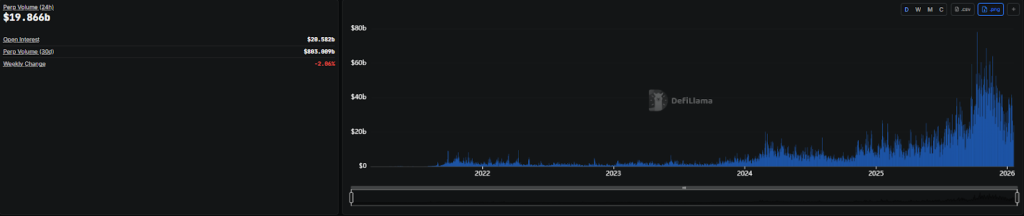
Data from DefiLlama shows that the overall activity in the sector continues to explode, with cumulative perp volume exceeding $803 billion over 30 days.

Total perp trading volume over the past 24 hours stood near $19.9 billion, while open interest reached about $20.6 billion.

Source: DefiLlama

Market data shows Hyperliquid pulling further ahead in both trading volume and open interest, two metrics that traders tend to treat differently.

Over the past seven days, Hyperliquid processed about $40.7 billion in perpetual futures volume, according to figures compiled from CryptoRank and DefiLlama.

That compared with roughly $31.7 billion on Aster and $25.3 billion on Lighter over the same period.

Hyperliquid reclaims the perps throne

As Lighter’s airdrop is distributed, the platform’s volumes have started to fade – weekly volume has decreased nearly 3x from its peak.@HyperliquidX has captured the lead and is now ranked 1st by volume and open interest.@variational_iopic.twitter.com/LChbSdaU8a

— CryptoRank.io (@CryptoRank_io) January 18, 2026

The divergence becomes more pronounced when looking at open interest, which reflects where traders are willing to keep leveraged positions open rather than simply rotate trades.

Hyperliquid recorded about $9.57 billion in open interest over the past 24 hours, exceeding the combined $7.34 billion held across rival platforms, including Aster, Lighter, Variational, edgeX, and Paradex.

The widening gap suggests traders are increasingly using Hyperliquid as a primary venue to hold leveraged positions, rather than simply rotating capital in search of short-term incentives.

The shift has become more apparent as reward-driven activity cools across the sector.

Buybacks Roll Out as Unlocks Cloud Perp DEX Outlook

Lighter, which saw a surge in trading ahead of its airdrop late last year, has experienced a sharp slowdown since the distribution, with weekly volumes falling significantly from their December highs.

Also, the LIT token has dropped to new lows, losing more than a third of its value over the past month as a significant share of airdropped tokens moved into the market.

In an effort to support its token, Aster recently activated what it calls a Strategic Buyback Reserve.

We're now actively deploying our Strategic Buyback Reserve for $ASTER token repurchases automatically.

Building on our Stage 5 Buyback Program announced last month, this activation allocates 20-40% of daily platform fees into targeted buybacks, responding dynamically to market… https://t.co/cIbles9eHM

— Aster (@Aster_DEX) January 19, 2026

The program builds on a broader buyback framework announced in December, under which up to 80% of daily fees can be directed to automatic and discretionary buybacks, all executed on-chain.

However, the scale of upcoming token unlocks remains a central concern for the market.

Aster has significant token unlocks scheduled through 2026, including quarterly releases of roughly 183 million ASTER in January and April, followed by additional large releases mid-year and ongoing monthly emissions.

Although the team previously delayed unlocks to build utility and reduce near-term pressure, the scale of upcoming supply has become a focal point for traders assessing downside risk.

While incentive-driven activity has cooled across the sector, Hyperliquid has continued to attract capital even as its token, HYPE, has weakened alongside the broader market.

The post ASTER Slumps 75% to New Lows as Hyperliquid Pulls Ahead — Is the Perp DEX Race Already Over? appeared first on Cryptonews.

Lighter launches LIT token: check out all the details here

30 December 2025 at 05:51
  • Half of the token supply is allocated to the ecosystem, with an immediate airdrop converting 2025 points into LIT.
  • LIT is used for staking, access to trading services, and payment for data verification on the platform.
  • Lighter ranks third by recent perpetuals volume, behind Hyperliquid and Aster.

A new token launch is putting fresh focus on how decentralised trading platforms are designing their economic models.

Perpetuals-focused Layer 2 exchange Lighter has rolled out its native cryptocurrency, LIT, positioning it as a core part of its infrastructure rather than a simple governance add-on.

Built on Ethereum, the platform is targeting active derivatives traders while also appealing to builders and long-term backers interested in transparent, onchain systems that mirror aspects of traditional markets.

The launch comes at a time when onchain perpetuals trading is consolidating around a small group of high-volume venues.

Lighter is attempting to differentiate itself by tying token utility directly to trading performance, data verification, and revenue visibility, while operating through a US-registered corporate structure.

Token distribution and airdrop design

The total LIT supply is split evenly between the ecosystem and insiders.

Half of all tokens are allocated to users, partners, and future incentives, while the remaining half goes to the team and investors.

Early participants are being rewarded through an immediate airdrop that converts 12.5 million points earned during 2025 into LIT tokens.

That initial distribution accounts for 25% of the project’s fully diluted value, which represents the maximum supply if all tokens are issued.

The remaining ecosystem allocation is reserved for future rewards, partnerships, and expansion initiatives.

Team and investor tokens are subject to a one-year lockup, followed by linear vesting over three years, according to details shared by the project on X.

Utility beyond governance

Lighter is framing LIT as an operational token embedded in how its exchange functions.

Rather than focusing solely on voting rights or passive rewards, the token underpins access to different levels of trading execution and data verification services on the platform.

Users who want higher-tier services are required to stake increasing amounts of LIT.

These requirements are designed to scale as the network decentralises further, shifting control from a single operator to a broader set of participants.

Fees for market data and price verification are also paid in LIT, with staking acting as a mechanism to ensure data accuracy and reduce risk across the trading system.

Onchain revenue and buyback flexibility

Another feature highlighted by the project is full onchain visibility of revenue generated by its trading platform and future products.

All income is intended to be publicly trackable on the blockchain, allowing users to independently verify performance.

Management has indicated that this revenue could be used either to support ecosystem growth or to buy back LIT tokens from the market.

Any buyback activity would reduce circulating supply, but there is no fixed schedule.

Decisions are expected to depend on market conditions and longer-term strategic considerations, rather than automated rules.

Market position in perpetuals trading

Lighter’s activity places it among the more active decentralised perpetuals venues.

Over the past seven days, Lighter-based perpetuals have averaged $2.7 billion in trading volume, ranking third behind Hyperliquid and Aster, based on data from a Dune-powered tracker.

Hyperliquid’s HYPE token currently carries a market valuation of $6.26 billion, making it one of the largest digital assets globally.

Against that backdrop, Lighter is betting that tightly coupling token utility with execution quality, data integrity, and transparent revenues can help it carve out a durable role in the evolving onchain derivatives landscape.

The post Lighter launches LIT token: check out all the details here appeared first on CoinJournal.

Hyperliquid price reclaims $25 as whales look to buy more HYPE

22 December 2025 at 09:14
  • Hyperliquid price gained to above $25 as buyers piled into the HYPE token.
  • Lookonchain shared details of two whales adding to their Hyperliquid positions.
  • Lookonchain noted that the large investors had deposited $5 million in USDC into Hyperliquid to purchase more HYPE tokens.

Bitcoin’s rally toward $90,000 on Monday drew widespread market attention, but Hyperliquid also stood out among assets posting notable gains.

The decentralised perpetuals trading platform’s native token, HYPE, rose nearly 5% as it moved back above the $25 level.

The advance followed a large whale transaction earlier in the session, alongside on-chain data indicating continued accumulation by large holders.

Sentiment was further supported after Hyperliquid shared an update related to HYPE trading activity and transparency on the platform.

HYPE featured among a group of tokens showing strong 24-hour performance, alongside Midnight, Sky, Kaspa and Sei, as broader interest extended beyond Bitcoin’s move.

Hyperliquid whales buy more HYPE, price gains

Recent on-chain data, highlighted by Lookonchain on X, reveals a strategic accumulation by two prominent whale wallets.

On December 22, 2025, Lookonchain noted that the large investors had deposited $5 million in USDC into Hyperliquid to purchase more HYPE tokens.

One of the wallets held 214,497 HYPE, worth over $5.44 million at the time and still boasted $5.52 million, likely ready to pounce.

The other whale held 102,460 HYPE worth $2.61 million and dry powder of $2.45 million meant for future purchases.

Both whales held the money in the USDC stablecoin.

Over the past hour, two more whales deposited $5M USDC into #Hyperliquid to buy $HYPE.

0xDAeF currently holds 214,497 $HYPE($5.44M) and still has 5.52M $USDC ready to buy more.

0x3300 currently holds 102,460 $HYPE($2.61M) and still has 2.45M $USDC allocated for further… pic.twitter.com/qwWh2GB1vN

— Lookonchain (@lookonchain) December 22, 2025

As noted, the price of HYPE, which had experienced a decline of over 14% over the past seven days as it dropped to $22, swiftly reclaimed the $25 threshold.

The rebound could accelerate amid an altcoin bounce, allowing for a retest of the $30 resistance zone.

Whales might offer a formidable bid wall. A surge in buying pressure shows in the 15% spike in daily trading volume.

Hyperliquid Labs comments on HYPE insider trading

The HYPE price fell sharply in recent weeks, with allegations of insider trading surfacing.

Now, Hyperliquid has officially commented on the concerns.

In its update, the team categorically denies any misconduct from its members.

Per a statement shared on X, Hyperliquid Labs has clarified that a wallet accused of shorting HYPE belonged to a former employee who was terminated in the first quarter of 2024.

Hyperliquid Labs emphasised its stringent ethical standards. It includes a comprehensive trading policy that prohibits derivatives trading involving HYPE by team members and maintains a zero-tolerance stance on insider trading.

Co-founder of Hyperliquid Illiensic posted a similar update on Discord.

While the platform has dismissed the allegations of insider trading as solely the work of an unaffiliated former employee, the co-founder noted two key facts: Employees and the team cannot trade derivatives on the HYPE token or use insider information to trade. The same cannot be passed to third parties.

The post Hyperliquid price reclaims $25 as whales look to buy more HYPE appeared first on CoinJournal.

❌
❌