Normal view

There are new articles available, click to refresh the page.
Today — 19 December 2025Main stream

Terraform Liquidators Allege Jump Trading Helped Fuel Crypto’s Biggest Crash: Report

18 December 2025 at 23:53

The administrators winding down what is left of Do Kwon’s Terraform Labs have turned on one of crypto’s biggest trading shops, alleging Jump Trading profited from Terra’s surge and helped lay the groundwork for its collapse.

Todd Snyder, the court-appointed plan administrator for the Terraform bankruptcy, filed a lawsuit in federal court in Illinois seeking $4B in damages from Jump Trading, co-founder William DiSomma, and former Jump Crypto president Kanav Kariya, the Wall Street Journal reported Thursday.

“Jump Trading actively exploited the Terraform Labs ecosystem through manipulation, concealment, and self-dealing that enriched Jump while financially devastating thousands of unsuspecting investors,” Snyder said in a statement.

“This action is a necessary step to hold Jump Trading accountable for illegal conduct that directly caused the largest crypto collapse in history.”

The Office of the Terraform Labs Plan Administrator has filed a $4B lawsuit against Jump Trading over its direct role in the collapse of Terraform Labs, seeking to hold Jump to account for enriching itself through illicit market manipulation, self-dealing, and misuse of assets.…

— Terra 🌍 Powered by LUNA 🌕 (@terra_money) December 19, 2025

Terra’s Death Spiral And The Contagion That Followed

Terraform’s collapse still hangs over the market. TerraUSD, known as UST, was billed as a stablecoin that would hold $1 through an algorithm tied to its sister token, Luna, known as LUNA. When UST broke its peg in May 2022, the mechanism unraveled and both tokens spiraled toward near zero in days.

The wipeout erased about $40B in value and rippled across the industry, squeezing lenders, funds, and exchanges that had treated UST yields and Luna liquidity as deep and durable.

Three Arrows Capital was among the first major casualties, with later failures piling up as confidence and collateral evaporated.

Terraform filed for bankruptcy in Jan. 2024, and public filings show the estate has recovered about $300M so far for creditors as it unwinds what remains.

Claims Of Peg Support And Profits From Terra’s Fall

Snyder’s complaint says Jump entered a secret arrangement to support TerraUSD’s peg before the final break and later walked away from the wreckage with outsized gains.

Regulators have previously pointed to Jump’s trading in Luna, with the SEC saying in court filings that Jump made about $1B in profit by selling the token.

The suit lands after a bruising year for Terraform’s former leadership. The company and Kwon agreed to a roughly $4.5B settlement with the SEC in 2024 following a jury verdict on securities fraud claims.
Kwon, once a celebrity founder who mocked critics as UST scaled, pleaded guilty in August 2025 and a New York federal judge sentenced him to 15 years in prison last week.

The post Terraform Liquidators Allege Jump Trading Helped Fuel Crypto’s Biggest Crash: Report appeared first on Cryptonews.
Yesterday — 18 December 2025Main stream

Asia Market Open: Bitcoin Slides As Asian Markets Take Cues From Tech Recovery

18 December 2025 at 21:56

Bitcoin slipped to around $85,200 on Friday as Asian stocks steadied after a tech-led bounce on Wall Street, and traders turned their attention to Japan, where a Bank of Japan rate move later in the day could jolt currencies and bonds.

The mood improved after a shock slowdown in US consumer price inflation to 2.7%, although analysts cautioned the reading looked clearly distorted lower by the government shutdown and should not be taken at face value.

Market snapshot

  • Bitcoin: $85,811, down 1%
  • Ether: $2,836, down 0.1%
  • XRP: $1.79, down 3.8%
  • Total crypto market cap: $2.97 trillion, down 1.4%

Bitcoin Pullback Reframes Debate Around Dormant Capital And DeFi Use

Crypto traders focused on positioning and flows rather than the headline macro print. Bitfinex analysts said current data shows institutional buyers absorbing around 13% more Bitcoin than the about 450 newly mined coins produced daily on a rolling basis.

“This marks the first meaningful supply flip since early November, despite recent concerns around ETF outflows.”

“From a technical perspective, there is strong buying support in the $82,000–$85,000 range,” they said. “A sustained hold in this zone would reinforce bullish momentum by strengthening buyer confidence. This, in turn, could attract fresh liquidity through higher ETF inflows and reduced selling pressure, supporting further accumulation to the upside.”

📊 U.S. asset manager Bitwise forecasts a surge in crypto-linked ETFs, predicting 100+ new products could launch in the U.S. by 2026.#ETFs #Bitwise https://t.co/R4eJ2LV8Yb

— Cryptonews.com (@cryptonews) December 18, 2025

Some market watchers used the pullback to push a longer-term use case story. Dom Harz, co-founder of BOB, said Bitcoin’s fluctuations this week do not diminish its long-term potential.

“Despite holding almost $2 trillion in market capitalization, the vast majority of BTC remains dormant, with about 0.3% actively deployed in native Bitcoin DeFi,” he said. “This untapped liquidity represents a transformative opportunity to put the asset to work for lending, borrowing, and yield generation, while BTC collateral remains natively secured on Bitcoin.”

Inflation Keeps Pressure On BOJ As Yen Stability Hangs In Balance

In rates, Fed pricing moved only marginally after the inflation data, with a January cut implied at 27%, while March nudged up to 58% from 54% before the release.

Japan took centre stage in Asia. Markets implied around a 90% chance the BOJ would lift its policy rate by a quarter point to 0.75% later Friday, and traders watched closely for guidance on how far policymakers may want to go next.

Investors currently wager on just one additional move to 1.0% in 2026. Any hint of a steeper path could steady the embattled yen, while adding pressure to government bonds.

Data released on Friday showed Japan’s core CPI rose 3.0% in November, unchanged from the previous month, keeping inflation in focus heading into the BOJ decision.

Equities tracked the improving tone. Japan’s Nikkei rose 0.6%, South Korea climbed 1.2% after strong results from chipmaker Micron Technology, and MSCI’s broadest index of Asia-Pacific shares outside Japan added 0.2%.

Central Bank Signals Complicate Global Bond And FX Trades

In the US, S&P 500 futures and Nasdaq futures held flat after the overnight rebound, and bond markets reacted cautiously to the CPI report. Ten-year Treasury yields sat around 4.126%, below a recent 3-1/2-month high of 4.2%.

Central bank divergence added another thread for global markets. British bonds fell after the Bank of England cut rates as expected, but only after a tight 5-4 vote, while policymakers signalled caution on the pace of future easing and markets pushed the next fully priced cut out to June.

The European Central Bank took an even tougher line, holding rates at 2.0% and signalling a likely end to its easing cycle, with markets implying only a small chance of any cut through 2026. Sweden and Norway also kept policy steady, although Norway left the door open to one or more cuts.

The post Asia Market Open: Bitcoin Slides As Asian Markets Take Cues From Tech Recovery appeared first on Cryptonews.

North Korea-Linked Crypto Thefts Top $2B In 2025, All-Time Haul Reaches $6.75B

18 December 2025 at 08:20

North Korea-linked hackers just posted their biggest crypto theft year on record, turning 2025 into a warning that a handful of state-backed strikes can still overwhelm even well-funded defences.

Chainalysis said in its Crypto Crime Report published Thursday that the industry lost more than $3.4B to theft from January through early Dec. 2025, with a single March compromise of Bybit accounting for $1.5b.

Within that total, the Democratic People’s Republic of Korea (DPRK) remained the dominant threat actor by value. Chainalysis put DPRK-linked theft at at least $2.02B in 2025, up 51% year-on-year, and said those attacks accounted for a record 76% of all service compromises.

The lower-bound cumulative estimate for DPRK crypto theft now stands at $6.75B.

Image Source: Chainalysis

This jump came even as investigators assessed fewer confirmed incidents, a sign that a small number of hits now do more damage than a long list of smaller breaches.

Embedded IT Workers Enable High-Impact Breaches

Chainalysis said the top three hacks in 2025 made up 69% of all service losses, and the largest incident crossed 1,000 times the median theft for the first time.

One driver is access. Chainalysis said DPRK-linked actors increasingly embed IT workers inside crypto services to gain privileged access, then use that foothold to enable high-impact compromises across exchanges, custodians and Web3 firms.

The report also framed private key compromises as a recurring fault line for centralized platforms, where rare failures still dominate the loss tally when they happen.

1/ In the first preview chapter of our 2026 Crypto Crime Report, we look at how North Korean hackers stole $2.02B in crypto during 2025, a 51% increase from 2024, pushing their all-time total to $6.75B: https://t.co/B9l4x1g9VM

— Chainalysis (@chainalysis) December 18, 2025

Chainalysis said private key compromises drove 88% of losses in the first quarter of 2025, even at firms with institutional resources and professional security teams.

At the same time, the personal-wallet problem grew wider, even as the average hit got smaller.

South Korean Probe Links Solana Wallet Breach To DPRK Actors

South Korean officials and several cybersecurity firms believe the Nov. 2025 breach of Upbit’s Solana hot wallet was carried out by Lazarus, North Korea’s state-backed hacking group, in an attack that siphoned roughly 44.5 billion won, or about $30 to $36 million, in Solana-based tokens.

Chainalysis estimated theft incidents surged to 158,000 in 2025 with at least 80,000 victims, and said the total stolen from individuals fell to $713 million, suggesting attackers targeted more users for less per victim.

When DPRK-linked funds move, they often move with discipline. Chainalysis described a structured, multi-wave laundering pathway that typically unfolds over roughly 45 days after major hacks, starting with rapid layering, then integration through selected venues, and finishing with conversion-focused touchpoints.

It also flagged distinctive operational choices, including heavy use of Chinese-language money movement and guarantee services, plus strong reliance on bridges and mixing services, while showing less interest in lending protocols and P2P venues than other stolen-fund actors.

Even the on-chain “shape” looks different. Chainalysis said DPRK laundering concentrates slightly over 60% of volume below $500,000 per transfer, while other actors more often send funds in $1M to $10M plus tranches, a pattern it framed as a sign of sophisticated structuring.

The post North Korea-Linked Crypto Thefts Top $2B In 2025, All-Time Haul Reaches $6.75B appeared first on Cryptonews.

💾

Whale Multisig Breached After Private Key Compromise Drains $27M

18 December 2025 at 00:45

A crypto whale has watched a supposedly hardened multisig wallet turn into a single point of failure, after a private key compromise let an attacker siphon about $27.3M and start washing funds on-chain.

PeckShield flagged the incident in an X alert, observing on Thursday that “a whale’s Multisig was drained of ~$27.3M due to a private key compromise.”

On-chain traces shared by the security firm show the drainer routing a large chunk of the haul through Tornado Cash, a privacy mixer often used to break transaction links.

PeckShield said the attacker had already laundered about $12.6M, roughly 4,100 ETH, and still held around $2M in liquid assets.

#PeckShieldAlert A whale's Multisig was drained of ~$27.3M due to a private key compromise.

The drainer has laundered $12.6M (4,100 $ETH) via #TornadoCash and retains ~$2M in liquid assets.

The drainer also controls the victim's multisig, which maintains a leveraged long… pic.twitter.com/1Ulk4X7bkl

— PeckShieldAlert (@PeckShieldAlert) December 18, 2025

Multisig Control Turns Active Aave Position Into Live Risk

The breach also came with a live tail risk. PeckShield said the attacker now controls the victim’s multisig, which still holds a leveraged long on Aave, with about $25M in ETH supplied against roughly $12.3M in DAI borrowed.

That detail matters because multisig setups do not automatically protect funds if an attacker can meet the signing threshold, or if the wallet’s governance is effectively captured through compromised keys and approvals.

Once the attacker can sign, they can move fast, pull liquidity, and make recovery attempts far harder.

Live Positions Turn Key Theft Into Cascading Risk

Data shows repeated outflows to Tornado Cash in round lots, the sort of pattern traders associate with systematic laundering rather than a one-off panic exit.

They also point to the attacker interacting with contracts tied to ownership and control, suggesting the compromise extended beyond a single transfer.

Teams can distribute signing keys and still lose them to phishing, malware, SIM swaps, unsafe backups, or rushed approvals on malicious transaction prompts.

It also points to a second-order risk specific to DeFi power users. The wallet is not just a vault but a control plane for live positions. Once an attacker gains access to collateral, borrow lines or health factors, the damage can cascade well beyond the initial drain.

The post Whale Multisig Breached After Private Key Compromise Drains $27M appeared first on Cryptonews.

💾

Before yesterdayMain stream

Asia Market Open: Bitcoin Edges Lower As Asia Follows Wall Street’s Tech Rout

17 December 2025 at 22:18

Bitcoin dipped toward $86,000 on Thursday as Asian markets opened softer, extending a risk-off swing that hit both crypto and equities after a sharp tech-led slide on Wall Street.

The pressure built overnight as investors cut exposure to high-multiple technology names and the broader AI trade, a shift that usually spills into crypto when momentum fades.

In early Asia, shares in Japan and Australia fell and Hong Kong shares pointed lower.

Market snapshot

  • Bitcoin: $86,575, down 1.1%
  • Ether: $2,832, down 4.2%
  • XRP: $1.86, down 3.7%
  • Total crypto market cap: $3 trillion, down 1.5%

Tech Rout Deepens As AI Valuation Fears Grip Wall Street

In the US, the tech-heavy Nasdaq 100 dropped 1.9% on Wednesday. Nvidia slid 3.8% to its lowest since September, and the S&P 500 fell 1.2% to a three-week low, slipping under its 50-day moving average.

🚨Final S&P 500 $SPX Wednesday Heat Map

Not quite the Santa Rally I expected.. pic.twitter.com/8Snp9mhHq4

— Jesse Cohen (@JesseCohenInv) December 17, 2025

The selling gathered pace as investors questioned whether the companies at the center of the AI boom can continue to justify their lofty valuations and heavy spending. Concerns around the cost and viability of data centre expansion added to the unease, with traders watching how big-ticket financing plans ripple through the sector.

Oracle fell 5.4% after a report said its largest data centre partner, Blue Owl Capital, will not back a $10B deal for its next facility.

Amazon slipped 0.6% after a report said it is in talks to invest about $10B in ChatGPT maker OpenAI, and Alphabet dropped 3.2% after a Reuters report said Google is working on an effort, alongside Meta, to erode Nvidia’s software advantage.

The chip complex took a broader hit. Broadcom fell 4.5% and the Philadelphia Semiconductor Index dropped 3.9%, reinforcing a market mood that has turned more sensitive to any sign that the AI buildout may deliver profits slower than hoped.

Crypto Awaits CPI As Bitcoin Hovers Without Clear Support

For Bitcoin, that backdrop kept the move heavy and the bounce restrained. Mike Marshall, head of research at Amberdata, said the key is that the “support bid” has not shown up in size.

“We are seeing weak market structure beneath price and relatively light ETF inflows, which reduces the market’s ability to stabilize quickly when momentum flips. Broader macro worries around rates, growth uncertainty, and cautious risk sentiment are compounding it.”

“In this environment, the market tends to probe until it finds a level where buyers have conviction. Based on our ETF cost-basis analysis, the first meaningful floor is near $80K, and if we see sustained outflows or tighter financial conditions, $60K becomes the next major reference,” he said.

Rate markets reflected the same caution. Comments from Federal Reserve Governor Christopher Waller, often viewed as dovish, supported demand for two- and five-year Treasuries, and longer-dated bonds lagged, nudging the 10-year yield about one basis point higher to roughly 4.15%.

Traders now turn to Thursday’s consumer inflation data, which could reset rate expectations into year-end and decide whether crypto stabilizes near current levels or keeps probing for a clearer floor.

The post Asia Market Open: Bitcoin Edges Lower As Asia Follows Wall Street’s Tech Rout appeared first on Cryptonews.

💾

HashKey’s Hong Kong Market Debut Lacks Spark As Volatility Keeps Buyers On Edge

17 December 2025 at 00:23

HashKey Holdings started trading in Hong Kong on Wednesday with an early pop that quickly cooled, as investors weighed the exchange’s long term pitch against a jittery crypto backdrop.

The company’s shares rose about 6% in the opening stretch, then gave back most of the move and dipped slightly below the IPO price of HK$6.68 later in the morning.

The listing followed an offering that raised about $206M, making HashKey the first crypto company to go public in Hong Kong.

Founded in 2018, the firm runs the city’s largest licensed crypto exchange and also offers brokerage, tokenization and asset management services.

Filings showed strong demand across the book. The institutional tranche drew subscriptions about 5.5 times the stock available, while the retail portion was nearly 394 times oversubscribed.

HashKey Secures Top-Tier Investors As Bitcoin Pulls Back

Investors also stepped into the deal through cornerstone allocations, including Fidelity, UBS, CDH Investments and Cithara Fund. JPMorgan and Guotai Haitong acted among the joint bookrunners.

🎉 HashKey Holdings Limited is officially listed on the Main Board of HKEX!

As Asia’s first publicly listed digital asset company via an IPO in Hong Kong, this milestone marks the company's entry into a new stage of development and establishes a stronger foundation for its… pic.twitter.com/fV0IfsRCCu

— HashKey Group (@HashKeyGroup) December 17, 2025

The debut arrived as crypto prices swung sharply in recent months after earlier record highs. Bitcoin fell as much as 36% in about a month after reaching an all time peak above $126,000 in early October.

Xiao Feng, HashKey’s chairman and chief executive, said he remained upbeat on where digital assets are headed even as prices whipsaw. “My confidence is only growing stronger and I am more optimistic than 10 years ago because there’s more regulation and compliance guidelines for us to follow which will allow the industry to grow further,” he said.

Beijing Curb Meets Hong Kong Embrace Of Digital Assets

Hong Kong has leaned into digital assets even as mainland China keeps a tighter grip after Beijing banned cryptocurrency trading in 2021 and renewed warnings about virtual assets.

Xiao said mainland measures targeted pyramid schemes and fraud using stablecoins, and he framed Hong Kong’s approach as distinct.

“Hong Kong continues to promote policies regarding digital assets and we have benefited from that,” he said. “We should firmly adhere to ‘one country’, but wisely take advantage of ‘two systems.’”

IPO Funds Earmarked For Infrastructure And Expansion

HashKey currently remains loss-making and Xiao said the firm will focus on cash flow in the near term while continuing to invest as the sector develops. The prospectus said it plans to use IPO proceeds on technology infrastructure, market expansion and partnerships, and operational and risk management.

HashKey secured one of the earliest licences under Hong Kong’s 2022 digital asset regime, and research cited in its filing said it accounts for more than 75% of the city’s onshore digital asset trading volume.

Beyond spot trading, it runs on-chain services such as staking, tokenization and custody, and manages billions in client assets through funds and structured products aimed at institutional and high net worth investors.

The post HashKey’s Hong Kong Market Debut Lacks Spark As Volatility Keeps Buyers On Edge appeared first on Cryptonews.

Canada’s Central Bank Pushes For Strong Reserve Backing For Stablecoins

16 December 2025 at 23:27

Canada is moving closer to putting rules around stablecoins, and the Bank of Canada wants the guardrails tight.

Governor Tiff Macklem said Tuesday that any future Canadian stablecoins should look and behave like reliable money, not a speculative token with a promise attached.

Macklem’s message was simple. If stablecoins are going to circulate as a payment tool, they must hold their value at par, and they must remain redeemable when it matters most. “We want stablecoins to be good money, like bank notes or money on deposit at banks,” he said.

To get there, he set out two core conditions. “A stablecoin must be pegged at a one-to-one ratio to a central bank currency and be backed by high-quality liquid assets so that it can always be converted to cash at par,” he told the Montreal Chamber of Commerce said.

In practice, that means reserve assets that can be sold quickly without taking big losses, typically government-backed instruments such as treasury bills and government bonds.

Bank Of Canada Calls For Clear, Fee-Free Stablecoin Exit Paths

Macklem also pushed for clarity on the user experience, not just the balance sheet. He said issuers should fully disclose the conditions for redeeming stablecoins, including the timing and any fees, so consumers and businesses know exactly what they are buying into before they rely on the token for payments.

The remarks land after the Liberal government said in November that it would introduce stablecoin regulations next year.

Ottawa wants to modernize Canada’s financial system, and it has pointed to stablecoins as one piece of a broader push to keep pace with other economies, including the United States, that are already building rules for fiat-pegged digital tokens.

📢 Canada will introduce its first federal framework for fiat-backed stablecoins under the 2025 budget, following the US model.#Canada #Stablecoinhttps://t.co/PjX4xPix3x

— Cryptonews.com (@cryptonews) November 5, 2025

Canada’s urgency also reflects a wider shift. Stablecoins have pushed further into mainstream finance after the GENIUS Act in the United States created a clearer framework for dollar-backed stablecoins, a move that supporters say could accelerate adoption.

Stablecoins Get Rules, Not Endorsements, From Canada’s Central Bank

As more dollar stablecoins circulate globally, policymakers in other countries have started to worry about monetary sovereignty and what happens if local users default to foreign digital dollars for everyday transactions.

That is why Macklem framed his stance as pragmatic rather than promotional. “It’s not really up to the Bank of Canada to encourage stablecoins or discourage stablecoins. What is up to the Bank of Canada is to ensure that if Canadians, Canadian businesses want to use stablecoins, they are, in fact, stable,” he said in a news conference after his speech.

Stablecoin Oversight Tied To Canada’s Payments Modernization Push

The finance ministry has argued that a proper framework would build trust so fiat-backed stablecoins are safe and secure for consumers and businesses to use, and it has said the central bank will act as the regulator.

Macklem tied the stablecoin conversation to a larger upgrade cycle in Canadian payments. He said 2026 should bring more innovation as the country modernises infrastructure, including the Real-Time Rail system designed to enable instant settlement for consumers and businesses, including cross-border use cases.

He also pointed to open banking as another pillar, saying the Bank of Canada intends to work on implementation that would make it easier for customers to compare services and switch banks.

The post Canada’s Central Bank Pushes For Strong Reserve Backing For Stablecoins appeared first on Cryptonews.

Asia Market Open: Bitcoin Holds $87k As Shares Nudge Up On Mixed US Jobs Report

16 December 2025 at 22:46

Bitcoin rose about 2% in Asian hours on Wednesday as regional shares edged higher, and traders kept one eye on Thursday’s US inflation print for clues on how much room the Federal Reserve has to cut rates in 2026.

Equity markets remained measured across the region after a mixed US jobs report and soft purchasing managers’ data left investors debating whether growth is cooling fast enough to justify easier policy.

Akshat Siddhant, lead quant analyst at Mudrex, said “Despite this uncertainty, Bitcoin exchange reserves sitting at record lows have supported the upside, giving bulls an edge. Attention now turns to the upcoming CPI data, which will shape expectations around a potential Fed rate cut.”

“If momentum holds, BTC could advance toward $90,000, with support gradually moving higher to the $86,000 zone,” he added.

Market snapshot

  • Bitcoin: $87,274, up 1.9%
  • Ether: $2,948, up 0.5%
  • XRP: $1.93, up 3.4%
  • Total crypto market cap: $3.05 trillion, up 1.3%

Tech Rebound Lifts Asian Mood As CPI Looms

S&P 500 futures slipped 0.1% as the CPI release moved to the top of the macro calendar.

Technology shares helped lift sentiment after a bruising stretch. South Korea’s KOSPI gained 0.6% and Hong Kong’s Hang Seng added 0.3%, as buyers returned to large-cap tech names and the broader AI complex.

Some of that lift spilled into the robotaxi theme in Hong Kong. Pony AI and WeRide climbed more than 3% each, tracking strength in Tesla after chief executive Elon Musk said the carmaker was testing robotaxis with no human safety drivers.

On Wall Street, the Nasdaq finished Tuesday higher and the S&P 500 and Dow ended lower, with healthcare and energy weighing. Investors parsed delayed economic releases after a recent government shutdown slowed data collection, and the market treated the numbers as directionally useful rather than definitive.

Payroll Surprise Fails To Ease Growth Concerns

A Labor Department report showed nonfarm payrolls rose by 64,000 jobs in November after an October drop linked to government spending cuts, and the unemployment rate climbed to 4.6%. Separate figures showed retail sales were flat in October, slightly below economists’ expectations.

Nic Puckrin, an investment analyst and co-founder of Coin Bureau, said year-end tax-loss selling is adding pressure, with Bitcoin among the assets where many investors are sitting on losses.

He said that dynamic could weigh on prices into the end of 2025 and leaves room for a slide below $80,000 if the sell-off deepens. In the near-term, he pointed to the ETF cost basis around $83,800 as a key level, with further support near $81,200, which he described as the market’s true mean.

Japan Gains On Trade Data As Rate Hike Bets Build

In Greater China, the Shanghai Shenzhen CSI 300 rose 0.5% and the Shanghai Composite stayed flat, as investors waited for clearer signs of fiscal support from Beijing after a run of soft November data.

Elsewhere, Australia’s ASX 200 dipped 0.2% and Singapore’s Straits Times index fell 0.3%, and data showed Singapore’s non-oil exports rose in November.

Japan’s Nikkei 225 added 0.3% and the broader Topix gained 0.1% after trade data showed exports beat expectations, a signal that overseas demand is supporting growth into year-end. Traders also watched the Bank of Japan ahead of Friday’s policy decision, with markets leaning toward a rate increase as the yen stays weak and inflation remains sticky.

US rate expectations also sat under a leadership storyline, after the Wall Street Journal reported President Donald Trump is set to interview Fed Governor Christopher Waller on Wednesday for the chair role, adding another variable to a week already driven by CPI risk.

The post Asia Market Open: Bitcoin Holds $87k As Shares Nudge Up On Mixed US Jobs Report appeared first on Cryptonews.

Whale Unwinds AI Agent Positions at 92% Loss After Market Slump

16 December 2025 at 01:57

An AI Agent whale has just turned one of this year’s loudest narratives into an expensive lesson, unloading a basket of agent tokens bought for $31.12M and getting back only $2.57M, according to on-chain data posted from Ember.

The wallet built its positions at the start of the year during the peak of the AI Agent narrative, when capital chased anything linked to autonomous trading bots and AI-powered execution.

With liquidity now thin and sentiment cooler, the same bets have been closed at a loss of about $28.54 million, or roughly 92%.

Token by token, the damage is stark. The whale lost about 91%, or $15.89M, on AIXBT and 92%, or $9.87M, on FAI.

太惨烈了~
一个巨鲸在年初的 AI Agent 热潮中用 $3112 万资金购买了多个 AI Agent 代币,如今随着浪潮退下,他在今天上午清仓割掉了这些 AI Agent 代币。他 $3112 万资金只卖回成 $257 万,亏损高达 $2854 万 (-92%)。$AIXBT :亏损了 91% ($1589 万);$FAI :亏损了 92% ($987 万);$NFTXBTpic.twitter.com/P0KTfUdqXn

— 余烬 (@EmberCN) December 16, 2025

Aggressive Sell-Off Hammers AI Agent Tokens With Losses Across the Board

Positions in NFTXBT and POLY, both from the Virtuals ecosystem, were nearly wiped out with losses of 99%, equal to around $690,000 and $780,000 respectively.

The book did not fare much better elsewhere. BOTTO, an AI-driven art and curation project, produced an 84% hit of about $930,000. MAICRO, another Virtuals-linked agent token, cost the wallet roughly $380,000, a 90% drawdown versus its entry.

Because order books in these names are now shallow, the forced exit hit prices in real time.

Ember’s breakdown shows AIXBT falling about 10% during the selling, FAI dropping 8% and NFTXBT sliding 29%. BOTTO sank 32%, MAICRO tumbled 48% and POLY declined 26% as the whale worked its way through positions.

Arkham Reveals Large-Scale Sell-Off as AI Agent Hype Fades

Screenshots from Arkham’s explorer point to a sequence of transfers between the whale address and liquidity pools, with tens of millions of tokens in each project moving in quick succession. The flows suggest a deliberate decision to capitulate rather than a slow rebalance, locking in losses instead of waiting for a fresh burst of AI Agent speculation.

For market participants who rode the same theme, the episode is a reminder of how narrative-driven sectors can behave once attention shifts elsewhere. Many AI Agent tokens launched into the tail end of the broader AI mania and never built the depth or organic usage that support large tickets on the way out.

The liquidation also shows the limits of whale size in illiquid corners of crypto. Size that helps drive performance during the initial run-up can turn into a liability when liquidity dries up, since every attempt to exit pushes prices lower and erodes recovery value.

For traders still navigating the agents meta, the whale’s exit cuts both ways. It is a sharp reminder that late-stage narratives can punish even deep wallets, yet some may view the flush as clearing stale supply from thin markets.

The post Whale Unwinds AI Agent Positions at 92% Loss After Market Slump appeared first on Cryptonews.

Grayscale Predicts Bitcoin Will Hit a New All-Time High by Early 2026

15 December 2025 at 22:52

Grayscale says Bitcoin is not done with this cycle. In its 2026 outlook, the asset manager projects that BTC will set a fresh all-time high in the first half of next year, arguing that the market is shifting into a more mature, institution-led phase.

The firm expects 2026 to accelerate what it calls structural shifts in digital asset investing. On one side is macro demand for alternative stores of value as public debt and fiat risks build.

On the other is clearer regulation, which it says is finally pulling crypto into mainstream financial infrastructure instead of pushing it to the edges.

Together, those forces should bring in new capital, broaden adoption among wealth managers and institutions, and pull public blockchains deeper into traditional markets, Grayscale argues.

The firm believes this backdrop will lift valuations across crypto and mark the end of the so-called four-year cycle, the popular idea that Bitcoin’s fate is locked to a halving-driven boom and bust every four years.

Image Source: Grayscale

Rising Debt And Inflation Fears Drive Demand For Scarce Crypto Assets

Crypto has already grown from a niche experiment to what Grayscale calls a mid-sized alternative asset class, with millions of tokens and roughly $3T in combined market value.

Bitcoin and Ether sit at the core of that universe as scarce digital commodities and alternative monetary assets. Grayscale says rising debt and inflation worries will keep portfolio demand for such assets growing as investors look for ballast against fiat currency debasement.

Supply dynamics are part of the story. Bitcoin’s issuance rate has dropped below 1% and the 20 millionth coin is expected to be mined in March 2026. In Grayscale’s view, that kind of transparent, capped supply looks increasingly attractive as fiscal imbalances mount, and it expects investors to treat BTC and ETH more like strategic holdings than short-term trades.

2026 may be the year digital assets enter their institutional era.

Grayscale believes macro tailwinds and regulatory clarity will drive demand for scarce assets like $BTC & $ETH. 🧵👇https://t.co/ReaqqGksni

— Grayscale (@Grayscale) December 15, 2025

Regulation is the other pillar. The firm notes that in recent years US authorities pursued investigations or lawsuits against many major crypto companies, but says that posture has started to shift.

Bipartisan Legislation Expected To Cement A Clear US Crypto Rulebook

Court wins opened the door to spot exchange traded products, Bitcoin and Ether ETPs launched in 2024, and the GENIUS Act on stablecoins passed in 2025. Grayscale now expects bipartisan crypto market structure legislation to become law in 2026, giving the industry a clearer rulebook and deeper access to capital markets.

Spot ETPs are already pulling money in. Since US Bitcoin products debuted in Jan. 2024, global crypto ETPs have seen about $87B in net inflows, according to the report.

Even so, Grayscale estimates that less than 0.5% of US-advised wealth is allocated to crypto, leaving plenty of room for slow-moving institutional capital to come in as platforms complete their due diligence and add tokens to model portfolios. Early adopters include names such as Harvard Management Company and Abu Dhabi’s Mubadala.

That institutional tilt has also changed how Bitcoin trades. Previous bull runs saw 1,000% plus gains over a single year. This cycle’s maximum year-over-year increase, around 240% into March 2024, is far tamer.

Grayscale reads that as a sign of steadier buying from large pools of capital instead of a one off retail melt up, and it sees a relatively low chance of a deep, prolonged drawdown in 2026.

Grayscale Maps 10 Themes Shaping Digital Assets In The Year Ahead

Macro policy could add fuel. The last two major cycle peaks arrived while the Federal Reserve was raising rates. This time, the Fed cut three times in 2025 and is expected to continue easing next year.

Kevin Hassett, seen as a contender to replace Jerome Powell as chair, recently said President Trump will choose someone who helps Americans get cheaper car loans and easier access to mortgages at lower rates. Grayscale argues that a growing economy and broadly supportive Fed stance would align with stronger appetite for risk assets, including crypto.

Around that core view, the firm maps ten big themes it thinks will drive digital assets in 2026, from dollar debasement and regulatory clarity to the expansion of stablecoins under the GENIUS Act, asset tokenization, privacy tooling, the intersection of AI and blockchains, faster DeFi lending, next generation infrastructure and default staking in proof of stake networks.

It expects investors to favour tokens with clear use cases, measurable revenue and access to regulated venues.

Two hot talking points do not make Grayscale’s main list. The report argues that quantum computing risk is real but still too distant to move prices next year, and that digital asset treasuries, despite owning chunks of BTC, ETH and SOL, are unlikely to drive major waves of forced selling or new demand in 2026.

Taken together, the outlook paints 2026 as the dawn of what Grayscale calls crypto’s institutional era, one where the story is less about halving folklore and more about regulation, macro hedging and steady flows from traditional portfolios.

In that world, it says, new highs for Bitcoin look more like a base case than a stretch target.

The post Grayscale Predicts Bitcoin Will Hit a New All-Time High by Early 2026 appeared first on Cryptonews.

Asia Market Open: Bitcoin Tumbles to $85k as Asian Shares Decline in Pre-Jobs Data Trade

15 December 2025 at 22:16

Bitcoin dropped nearly 4% to about $85,940 on Tuesday as Asian equities slipped at the open, with investors cutting risk before a run of US economic data that could shape the next leg for interest rates.

Indexes in Japan dipped, while Australian shares edged higher, after the S&P 500 fell for a second straight session overnight.

Futures linked to the S&P 500 and Nasdaq 100 were weaker in early Asian trading, signalling more pressure on Wall Street as traders wait for clues on growth, inflation and the Federal Reserve’s path.

Market snapshot

  • Bitcoin: $85,719, down 4.1%
  • Ether: $2,930, down 6.1%
  • XRP: $1.87, down 6.2%
  • Total crypto market cap: $3.02 trillion, down 3.7%

Analysts See Bitcoin Laying Foundations For A 2026 Return To Record Highs

Despite the pullback, some crypto analysts remain upbeat on the medium term. Bitfinex’s research team expects the coming year to be defined by improving global liquidity conditions that will make Bitcoin “more solid than ever.”

They argue that the groundwork is being laid for BTC to regain its all-time high near $126,110 in 2026, supported by looser monetary policy, rising liquidity and steady crypto adoption.

Bitfinex also points to a changing market structure. With annual Bitcoin issuance now below 1%, they say the halving’s marginal impact has faded and recent drawdowns have been materially shallower, as flows from exchange traded funds, corporates and sovereign linked entities absorb multiples of yearly mined supply. In their view, that shift has created a market dominated by patient, long-term capital.

Not everyone is in a rush to add risk. Lin Tran, senior market analyst at XS.com, said Bitcoin’s failure to hold above the psychological $90,000 level after being rejected near $100,000 shows a cautious tone is still in charge. According to Tran, investors are trimming exposure into year end and prioritising capital preservation after a powerful rally earlier in the cycle.

Risk Appetite Pauses As Investors Look For Clarity From Upcoming Indicators

In traditional markets, the yen strengthened against the dollar to around 154.85, as traders position for the Bank of Japan to lift its key rate to the highest level in three decades on Friday.

A measure of the dollar slipped for a second day, trading near levels last seen in early October, as investors leaned into expectations of further easing from the Fed over the medium term.

The broader backdrop is one of nervous consolidation into a heavy data week. Following the Fed’s latest rate cut, the November jobs report due Tuesday is expected to show a soft labour market and will include an updated estimate for October payrolls, which were delayed by the federal shutdown.

The US consumer price index is scheduled for Thursday, alongside figures on retail sales, business activity and inflation that could challenge or reinforce the current narrative.

Officials Split On Whether Current Fed Stance Is Appropriate For 2026

Fed officials have sent mixed signals. Fed Governor Stephen Miran argued that the current stance is unnecessarily restrictive, while New York Fed President John Williams said policy is “well positioned” for next year after last week’s move.

Boston Fed President Susan Collins described the latest decision as a “close call,” noting she remains concerned about elevated inflation.

In Japan, investors are watching the tug of war between the government’s need for cheap financing and the pressure from a weak yen that is pushing up import costs.

Benchmark 10-year Japanese government bond yields touched 1.97% earlier this month, the highest in 18 years, prompting Bank of Japan Governor Kazuo Ueda to warn that yields are rising “somewhat fast.”

Back in the US, some strategists caution that data quality may be patchy after the Bureau of Labor Statistics played catch up following the shutdown.

Ian Lyngen at BMO Capital Markets says that backdrop could encourage a cautious reaction to this week’s prints, but if market expectations prove broadly correct it may set up another strong stretch for Treasuries, which are already on track for their best year since 2020.

Wall Street closed lower on Monday as traders digested the Fed chatter and braced for the incoming numbers.

The S&P 500 and Nasdaq logged their steepest daily declines in more than three weeks on Friday amid concern over inflation and debt fuelled AI investments, leaving both equity and crypto markets sensitive to any surprise in the data.

The post Asia Market Open: Bitcoin Tumbles to $85k as Asian Shares Decline in Pre-Jobs Data Trade appeared first on Cryptonews.

HashKey Said To Target Upper-End Pricing For Its Hong Kong IPO

15 December 2025 at 00:00

HashKey, operator of Hong Kong’s largest licensed crypto exchange, is set to price its initial public offering near the top of the range, raising about HK$1.6B ($206M) in a key test of demand for regulated digital asset platforms in the city.

The company sold 240.6M shares at HK$6.68 each, Bloomberg reported Monday, after marketing the offer in a range of HK$5.95 to HK$6.95. HashKey did not exercise an option to increase the size of the deal.

Investor interest was strong. The top 20 entities in the institutional book took roughly 80% of the shares available in that tranche, excluding stock earmarked for cornerstone buyers, the outlet said. Overall demand ran at several times the number of shares on offer.

HashKey’s Share Sale Could Make It Hong Kong’s First Public Crypto Exchange

HashKey is bidding to become Hong Kong’s first listed crypto exchange, in a transaction that will gauge how much public market appetite remains for compliant digital asset venues after the latest leg of the cycle. The listing also lands in an active year for Hong Kong IPOs, with total proceeds on track for a four year high.

HashKey Holdings, the operator of Hong Kong’s largest licensed cryptocurrency exchange, raised HK$1.6 billion ($206 million) after pricing its initial public offering toward the high end of the marketed range, according to people familiar with the matter https://t.co/vwGm6HAFST

— Bloomberg (@business) December 15, 2025

The company had earlier flagged plans to sell about 240.6M shares globally, with around 24.1M reserved for Hong Kong investors and the rest allocated internationally. At the top of the marketed range, the deal would have raised up to HK$1.67B and valued HashKey at about HK$19B, according to its prospectus.

HashKey’s shares are scheduled to start trading on Wednesday in Hong Kong. JPMorgan Chase and Guotai Junan are joint sponsors of the offering.

IPO Will Test Whether Investors Back Hong Kong’s Leading Regulated Crypto Exchange

HashKey was among the first exchanges to secure a licence under Hong Kong’s dedicated digital asset regime, introduced in 2022 as the city sought to pull trading onshore from offshore venues.

Research cited in its filing said HashKey holds more than 75% of Hong Kong’s onshore digital asset trading volume, giving it a dominant share in the regulated segment of the market.

Beyond spot trading, HashKey runs one of Asia’s larger on chain services platforms, offering staking, tokenisation and custodial technology for multiple protocols. It also manages billions in client assets through funds and structured products aimed at institutional and high net worth investors.

Proceeds from the IPO will go toward scaling its technology stack and infrastructure, hiring more staff and strengthening risk management, the company has said. Those investments are meant to position HashKey as a core beneficiary if Hong Kong’s push to become a regional digital asset hub gains further traction.

The timing of the debut is not without challenges. Bitcoin has fallen about 30% from its record high in October, and global risk appetite has softened as traders reassess how much they want to pay for growth and AI related stories.

For crypto-focused investors, HashKey’s first day performance will offer an early read on whether public equity buyers are ready to back regulated exchanges at premium valuations.

The post HashKey Said To Target Upper-End Pricing For Its Hong Kong IPO appeared first on Cryptonews.

Asia Market Open: Bitcoin Edges Lower As Stocks Retreat On Clouded Tech Outlook

14 December 2025 at 23:04

Bitcoin slipped below $90,000 on Friday as Asian markets started the final full trading week of 2025 on a weaker footing, with growing doubts over technology earnings weighing on risk appetite across equities and crypto alike.

Equity futures pointed to losses for Australian, Hong Kong and Japanese benchmarks in early trading after US stocks slumped on Friday.

A downbeat sales outlook from Broadcom rattled confidence in the artificial intelligence trade and pushed the S&P 500 lower by about 1%, reinforcing concerns that heavy AI spending may not translate into profits as quickly as investors once expected.

Market snapshot

  • Bitcoin: $89,293, down 1.1%
  • Ether: $3,111, down 0.3%
  • XRP: $2.00, down 1.4%
  • Total crypto market cap: $3.13 trillion, down 0.9%

Tech Valuation Fears Weigh On Global Sentiment As Asia Faces Added Pressure

Global risk sentiment has been fading as traders question whether tech stocks, which have climbed roughly 300% since the current bull market began three years ago and driven global indices to record highs, can continue to justify rich valuations and aggressive AI budgets.

Asian markets, which have outperformed global peers this year, look especially exposed given the region’s dependence on manufacturing the chips and hardware that power the technology boom.

MSCI’s broad gauge of Asia Pacific equities outside Japan fell about 1%, with South Korea, often seen as a bellwether for AI exuberance, dropping more than 2% in Monday trade.

Equity index futures for major US benchmarks shifted between small gains and losses in Asian hours, after Wall Street ended Friday with technology shares leading the retreat. The choppy tone in futures trading reflected uncertainty over how much more earnings downgrades could pressure high-multiple growth names into year-end.

Softer Dollar And Rate Cut Bets Offer Support, But Crypto Eyes Tech Led Risk Swings

President Donald Trump added another layer to the macro discussion, saying the new Federal Reserve chair will want interest rates to fall. The dollar recorded its longest run of weekly losses since August last week as markets firmed up bets on two Fed rate cuts in 2026, one more than the central bank itself is currently signalling.

For crypto traders, that mix of softer dollar momentum and growing expectations of future rate cuts would usually be a tailwind, but the immediate focus has shifted back to equity volatility and the durability of the AI trade.

With tech now central to both stock indices and digital asset narratives, any wobble in earnings can spill quickly across risk markets.

The post Asia Market Open: Bitcoin Edges Lower As Stocks Retreat On Clouded Tech Outlook appeared first on Cryptonews.

YouTube Now Lets US Creators Get Paid in Stablecoins via PayPal

11 December 2025 at 23:24

YouTube creators in the US can now choose to receive their payouts in PayPal’s dollar-backed stablecoin PYUSD, in a move that quietly pulls one of the world’s biggest creator platforms deeper into crypto rails.

PayPal crypto head, May Zabaneh, confirmed to Fortune that the feature is live and currently limited to US-based users.

A Google spokesperson confirmed to the outlet that creator payouts in PayPal’s stablecoin are now supported, while declining to provide further detail.

YouTube already uses PayPal’s mass payout infrastructure to pay creators, gig workers and contractors.

Big Tech’s Push Into Tokenized Money Grows As YouTube Adopts PYUSD

Earlier in the third quarter, PayPal added an option that lets payment recipients take their money in PYUSD instead of cash balances. YouTube then decided to extend that choice to creators who receive a share of revenue from the ads and subscriptions their videos generate.

Zabaneh said the structure means PayPal handles the crypto piece end-to-end. In practice, YouTube continues to interact with PayPal in fiat terms, while PayPal converts payouts into PYUSD for creators who opt in, reducing the technical and regulatory lift for the video platform.

The change lands as Big Tech leans further into stablecoins and tokenized money. Google and its peers have shown growing interest in crypto infrastructure during a fresh wave of digital asset hype in Silicon Valley. For YouTube, letting creators earn in stablecoins adds another toggle to its monetization toolkit without redesigning the core product.

Trump Era Stablecoin Rules And Mega Deals Propel Tokens Into Broader Finance

Stablecoins such as PYUSD track assets like the dollar and have long been a core building block of crypto trading. Over the past year, they have pushed further into mainstream finance, helped by President Donald Trump signing new federal legislation on stablecoin oversight and by a run of high-profile corporate deals.

Payments giant Stripe, for example, closed a $1.1B acquisition of stablecoin firm Bridge in February.

PayPal has been one of the earlier movers among large tech and payments companies. It enabled buying and selling of Bitcoin, Ethereum and a handful of other tokens in 2020, then launched PYUSD in 2023. The token now has a market value of nearly $4B, according to CoinGecko, and sits at the centre of the company’s on-chain strategy.

PYUSD Gains Reach As PayPal Pushes Its Stablecoin Into Everyday Payments

Since launch, PayPal has threaded PYUSD through its ecosystem. Users can hold the token in PayPal’s main wallet and in Venmo, spend it at supported merchants and, from this year, use it as a settlement asset for small and medium-sized businesses paying vendors.

The YouTube integration effectively extends that reach to millions of potential creators who may prefer to hold a dollar stablecoin rather than receive traditional bank payouts.

This is not the first time Google has interacted directly with PYUSD. An executive at Google Cloud previously told Fortune that the cloud division had accepted payments from two customers in the PayPal stablecoin, signalling that the company is willing to experiment with on chain settlement where it fits into existing contracts.

The post YouTube Now Lets US Creators Get Paid in Stablecoins via PayPal appeared first on Cryptonews.

Coinbase Plans Major Product Rollout Featuring Prediction Markets, Tokenized Stocks

11 December 2025 at 22:14

Coinbase plans to roll out prediction markets and tokenized equities, moving into two of the fastest-growing corners of digital finance as it prepares a product showcase next week.

Bloomberg reported Friday that the the US-based exchange will announce the new offerings at an event on Dec. 17, a source told the outlet, adding that Coinbase intends to issue tokenized stocks in-house rather than through external partners.

Executives at Coinbase have previously signalled interest in both businesses, but until now the company had not formally laid out a launch timeline.

Traders Anticipate New Tools After Images Reveal Coinbase’s Expanding Roadmap

In recent weeks, screenshots that appear to show prediction market and tokenized equity features inside Coinbase apps have circulated on X, fuelling speculation among traders.

According to Bloomberg, Coinbase is expected to announce the launch of new features—including proprietary tokenized U.S. equities—at its December 17 event. Screenshots of the upcoming application have been circulating on X for weeks, though the company has not formally disclosed…

— Wu Blockchain (@WuBlockchain) December 12, 2025

A Coinbase spokesperson said the company would reveal its upcoming products during a livestream on Dec. 17 and encouraged viewers to watch the event for full details.

The push fits with Coinbase’s ambition to become an “everything app” for digital assets, where customers can trade crypto, tokenized versions of traditional securities and, increasingly, event-based markets. It also helps the company keep pace with rivals that are adding similar tools as competition intensifies.

Trading In Digital Stock Representations Surges As Adoption Spreads

Robinhood Markets this year began offering prediction products from Kalshi Inc, giving its users a way to bet on economic and political outcomes. Robinhood and crypto exchange Kraken already list tokenized US stocks and exchange-traded funds in some jurisdictions, although these products remain unavailable in the US itself.

Trading in tokenized equities, which are digital representations of stocks recorded on a blockchain, has been gaining traction. Monthly transfer volumes have risen about 32% in the past 30 days to roughly $1.45B, according to data provider rwa.xyz, as more platforms experiment with bringing traditional assets on chain.

Demand For Event Contracts Climbs As Exchanges Embrace Prediction Tools

Prediction markets, which allow users to wager on the outcomes of events such as elections, sports and macro data releases, have also grown quickly over the past year. They have attracted interest from both traditional exchanges and crypto native firms that see them as a new way to monetize information and order flow.

Gemini, the exchange founded by Tyler and Cameron Winklevoss, recently secured a key approval from the US Commodity Futures Trading Commission to launch its prediction platform, Gemini Titan, for American customers. The licence will allow it to offer event contracts structured as simple yes or no questions.

Crypto.com has struck deals with partners including Trump Media & Technology Group to help them build prediction markets, while Robinhood and trading firm Susquehanna have agreed to buy 90% of regulated venue LedgerX, a move that deepens their exposure to event driven crypto derivatives.

The post Coinbase Plans Major Product Rollout Featuring Prediction Markets, Tokenized Stocks appeared first on Cryptonews.

Asia Market Open: Bitcoin Ticks Up As Asian Markets Gain After S&P 500 Record

11 December 2025 at 21:21

Bitcoin edged higher above $92,000 on Friday as Asian stocks advanced in early trade, with investors taking their cue from a fresh record on the S&P 500 even as renewed weakness in Oracle stirred nerves around big tech and the artificial intelligence trade.

Lack of firm dip buying kept Bitcoin’s gains limited. Samer Hasn, senior market analyst at XS.com, said the market still lacks committed buyers, which leaves prices vulnerable. He noted that more than $220M in long liquidations today show leveraged traders pulling back rather than positioning for a rebound.

Those liquidations added to the sense that speculative leverage is being flushed out rather than rebuilt, a pattern that often leaves spot moves choppy even when broader risk sentiment improves.

Market snapshot

  • Bitcoin: $92,331, up 2.4%
  • Ether: $3,248, up 0.7%
  • XRP: $2.04, up 1.6%
  • Total crypto market cap: $3.23 trillion, up 1.9%

Asia Traders Watch Positioning Shifts As ETF Inflows Offer Brief Support

For traders in Asia, that backdrop keeps the focus on positioning data and funding rates as much as on the headline price.

One support pillar came from US spot Bitcoin exchange-traded funds. Data provider SoSo Value reported more than $223M of net inflows on Thursday, the strongest reading in twenty days.

In the current environment, however, these flows may reflect short-term positioning rather than sticky institutional demand, and could reverse quickly if equity markets wobble again.

Bitfinex analysts said the next moves will hinge on Fed signals, Treasury market reactions, ETF flows and the behaviour of ETH relative to BTC.

They noted that the steady rise in ETH/BTC, even with low network fees, suggests capital is rotating back into Ethereum’s longer-term story, making the pair a useful gauge of risk appetite in crypto.

Global Benchmarks Hit New Highs As Traders Position For Gentler Fed Settings

Global markets have been recalibrating since the Federal Reserve delivered a third consecutive interest rate cut this week while sounding less hawkish than many feared. The move helped lift the MSCI All Country World Index to a new closing high and pushed the dollar index down to a two-month low near 98.30, as traders leaned into the idea that policy is slowly shifting toward easier settings.

BREAKING: The S&P 500 officially posts its highest close in history, now up +42% since the April 2025 bottom. pic.twitter.com/HsxiJIHqnm

— The Kobeissi Letter (@KobeissiLetter) December 11, 2025

Fed funds futures now imply about a 75.6% chance that the central bank will hold rates at its next meeting on Jan. 28, up from roughly 73.9% a day earlier. Traders are still betting on two cuts in 2026 even though the Fed’s latest projections point to only one.

In equity markets, MSCI’s broad index of Asia Pacific shares outside Japan rose about 0.7%, tracking Thursday’s mostly higher close in the US, where the Dow and Russell 2000 both notched new highs while the Nasdaq dipped.

The move extended a global rally that has favoured cyclicals and small caps, a backdrop that often helps sentiment in higher beta assets such as crypto.

Japan Outperforms As Softbank Jumps, While Wall Street Futures Turn Cautious

Tokyo’s Nikkei 225 outperformed in morning trade, climbing around 1%. Shares in SoftBank Group jumped about 6% after a Bloomberg News report said the conglomerate is considering an acquisition of the US data centre company Switch Inc, a deal that investors see as another way to capitalise on rising demand for AI infrastructure.

Futures pointed to a more cautious open for Wall Street. S&P 500 e-mini contracts were little changed in Asian hours, while Nasdaq futures slipped about 0.2% after Oracle shares plunged 13% overnight. The company’s heavy spending plans and weak forecasts fanned doubts over how quickly large AI investments will translate into profit, triggering a fresh round of tech selling.

Tech sentiment was mixed even within the AI complex. Broadcom projected first-quarter revenue above Wall Street estimates, offering some reassurance, but its shares fell about 5% in late trading after it warned that margins would narrow because a higher share of sales is coming from AI.

The post Asia Market Open: Bitcoin Ticks Up As Asian Markets Gain After S&P 500 Record appeared first on Cryptonews.

Norway Rules Out Immediate Need For A CBDC — Here’s Why

11 December 2025 at 01:44

Norway’s central bank has decided it does not need a central bank digital currency (CBDC) for now, capping several years of research and signalling that the country’s existing payment system still does the job for consumers, banks and merchants.

Norges Bank said Wednesday that introducing a digital krone is “currently not warranted” after assessing whether a CBDC is needed to keep payments in Norwegian currency secure, efficient and attractive.

Cash use in Norway has fallen to among the lowest levels globally, which had added urgency to the debate over a potential digital alternative.

“The Norwegian payment system is efficient and secure,” the bank said, citing stable operations, fast settlement, low economic cost and “sound” contingency arrangements. It added that work is already under way to further strengthen these back up systems.

Norway Leaves Room For A CBDC While Citing No Immediate Requirement

Governor Ida Wolden Bache stressed that the decision is about timing, not closing the door.

“Norges Bank has concluded that introducing a central bank digital currency is currently not warranted. The need for such a currency may, however, change in the future. We will be ready to introduce a central bank digital currency if it becomes necessary to maintain an efficient and secure payment system,” she said.

The bank distinguishes between two main types of CBDC, retail and wholesale. A retail CBDC would serve as a universally accessible means of payment similar to cash and deposits, while a wholesale CBDC would be limited to banks and other financial institutions. In the wholesale model, deposits at the central bank are represented as digital units, or tokens, in a ledger based on blockchain technology and can be used for interbank settlement.

Bank Expands Tokenization Research While Deferring A Digital Krone Decision

Norges Bank is not stepping away from tokenization. It says token-based systems can deliver innovation, efficiency gains and lower settlement risk, even as it warns that other risks and open questions remain and the eventual scale of use is uncertain.

The bank plans to keep running experiments, often with other payment system participants, to test tokenised solutions in practice.

The central bank will publish a report on its CBDC research and lay out more detailed plans for further work in the first quarter of next year. It will also continue to monitor international developments, including the Eurosystem’s work on a potential digital euro and emerging standards that could one day support shared CBDC infrastructure.

The post Norway Rules Out Immediate Need For A CBDC — Here’s Why appeared first on Cryptonews.

Half Of Asia Pacific’s High Net Worth Individuals Now Allocate Over 10% To Crypto

10 December 2025 at 23:08

Asia’s wealthy investors are putting meaningful chunks of their money into digital assets, with almost half now allocating more than 10% of their portfolios to crypto and a clear majority planning to add more over the next few years.

Swiss Singaporean digital asset bank Sygnum found in its APAC HNWI Report 2025 that 87% of more than 270 respondents already hold digital assets.

The survey covered high net worth and professional investors across 10 markets, including Singapore, Hong Kong, Indonesia, South Korea and Thailand, and defined high net worth individuals as those with over $1M in investable assets and ultra high-net-worth investors as those with more than $25M.

High Net Worth Investors Embrace Crypto As A New Alternative Asset Class

For this group, crypto has become a core allocation, not a side bet. Median holdings sit in the 10% to 20% range, with a weighted average near 17%, putting tokens in the same conversation as equities and private markets inside portfolios.

Image Source: Sygnum

Motivation has shifted away from pure speculation. Sygnum reports that 90% of high-net-worth investors see digital assets as important for long-term wealth preservation and legacy planning.

Portfolio diversification drives a majority of decisions, with 56% citing it as a key reason to invest, and many framing crypto as a new alternative asset class rather than a short-term punt.

APAC Investors Expect A New Crypto Cycle Within Two To Five Years

Looking ahead, 60% of respondents say they plan to increase allocations. A bullish or very bullish long-term outlook comes from 57% of high net worth investors and 61% of ultra high net worth investors, with many expecting the next strong cycle to unfold over a two to five year horizon rather than in the next few weeks.

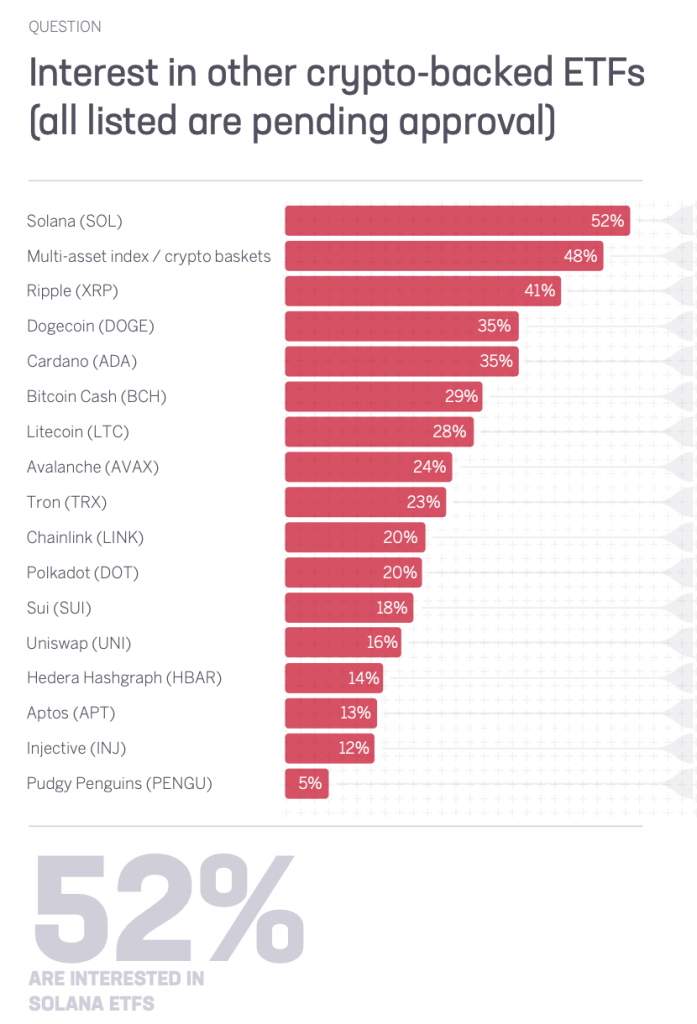
Product preferences tell a similar story of maturation. Beyond Bitcoin and Ethereum, 80% of investors want more crypto exchange-traded funds, with Solana drawing the strongest single asset demand at 52%.

Image Source: Sygnum

Multi-asset index products and XRP also attract interest, and 70% of respondents say they would allocate or allocate more if staking yield were bundled into ETF structures, a clear nod to yield-focused, regulated wrappers that sit comfortably in traditional wealth plans.

APAC Emerges As A Leading Gateway As Digital Assets Embed Into Wealth Portfolios

Security and rules still shape how fast this money moves. Around two thirds of investors say they need their private bank or wealth manager to demonstrate strong custody and security standards before they scale up exposure, while regulatory uncertainty and volatility remain key brakes.

At the same time, most respondents say regulatory clarity has improved and recent policy moves in major markets strengthen the long term case for digital assets.

“Digital assets are now firmly embedded within APAC’s private wealth ecosystem,” said Gerald Goh, Sygnum co founder and APAC chief executive.

He noted that frameworks in Singapore and Hong Kong have built the infrastructure for traditional wealth managers to offer crypto services and described Asia Pacific as one of the fastest growing gateways for digital assets, with momentum likely to build into 2026.

The post Half Of Asia Pacific’s High Net Worth Individuals Now Allocate Over 10% To Crypto appeared first on Cryptonews.

❌
❌