
❌

Normal view

There are new articles available, click to refresh the page.
Yesterday β€” 18 December 2025Main stream

NASA’s DiskSat Technology Demo Launches to Low Earth Orbit

18 December 2025 at 11:00
Seven people wearing blue lab coats stand near a lab table that supports two disk-shaped spacecraft
A team of engineers at The Aerospace Corporation’s facility in El Segundo, California, gather around two completed DiskSats as they conduct final checks before shipment. From left: Albert Lin, DiskSat system engineer, Elijah Balcita, intern, Darren Rowen, DiskSat chief engineer, Catherine Venturini, DiskSat principal investigator, and Eric Breckheimer, NASA program office program manager at The Aerospace Corporation; Roger Hunter, Small Spacecraft & Distributed Systems program manager at NASA; and Ziba Shahriary, DiskSat program manager at The Aerospace Corporation.
The Aerospace Corporation

NASA’s DiskSat technology demonstration mission will test the performance of a new small spacecraft platform designed to expand the capabilities of current small spacecraft. By demonstrating the advantages of a flat, disk-shaped architecture over the conventional CubeSat design, DiskSat aims to enable lower-cost space missions, broaden scientific opportunities, and increase overall access to space.

At 12:03 a.m. EST on Thursday, Dec. 18, DiskSat launched aboard a Rocket Lab Electron rocket from the company’s Launch Complex 2 on Wallops Island, Virginia.

The demonstration will evaluate the performance of the DiskSat spacecraft themselves and a specialized dispenser mechanism. The dispenser is engineered to securely contain four DiskSat spacecraft during launch, then sequentially deploy them into low Earth orbit where they will perform maneuvers. Each DiskSat is a circular, flat spacecraft 40 inches (one meter) in diameter and one inch (two-and-a-half centimeters) thick – similar to a small coffee table. Each has an electric propulsion system to allow for orbit changes and maintenance. The DiskSat design is also conducive to operations in very low Earth orbit, which can offer sharper Earth imaging and sensing capabilities as well as lower latency communications solutions.

DiskSat boosts U.S. innovation and commercial space opportunities while providing mission designers new flexibility, enabling them to pursue and achieve NASA’s goalsΒ fasterΒ andΒ more affordably. DiskSats offer an alternative platform that could significantly expand the scope of future small spacecraft missions for NASA, the commercial space industry, other government agencies, and academia. The DiskSat demonstration also supports NASA’s long-term plans for sustained exploration at the Moon and Mars as well as advancing our ability to study and better understand our home planet.
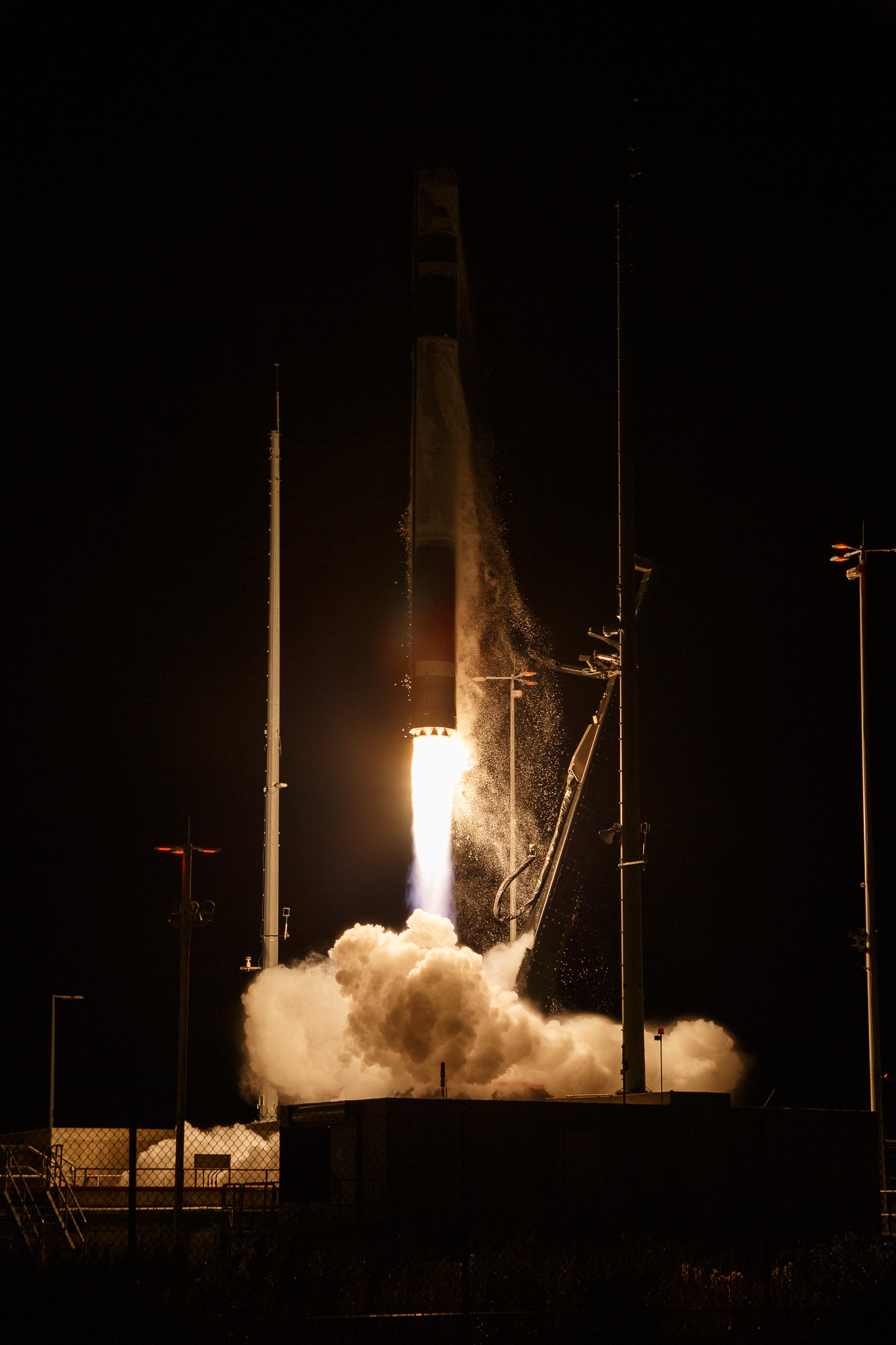
An Electron rocket lifting off from the pad at night time. A bright white fire leave the bottom with smoke spreading out around the pad.
An Electron Rocket launches from Wallops Island, Virginia, Dec. 18; 2025, at 12:03 a.m. EST from Rocket Lab’s Launch Complex 2. The rocket carried NASA’s DiskSat technology demonstration mission, which will test the performance of a new small spacecraft platform designed to expand the capabilities of current small spacecraft.
NASA/Garon Clark

The Aerospace Corporation, headquartered in Chantilly, Virginia, is leading the design and development of the DiskSat concept as well as the DiskSat spacecraft. NASA’s Small Spacecraft & Distributed Systems program within the agency’s Space Technology Mission Directorate funded the development of the DiskSat technology and demonstration mission. The program is based at NASA’s Ames Research Center in California’s Silicon Valley. The DiskSat launch and in-orbit operations are funded by the U.S. Space Force’s Rocket Systems Launch Program (RSLP) and Department of War Space Test Program (STP), respectively. Rocket Lab USA, Inc., of Long Beach, California is providing launch services. NASA’s Wallops Flight Facility, the agency’s only owned and operated launch range, enabled the mission providing services such as tracking, telemetry, and range safety to ensure a safe and successful mission.

Members of the news media interested in covering this topic should reach out to theΒ NASA Ames newsroom.Β 

Before yesterdayMain stream

NASA’s Two-in-One Satellite Propulsion Demo Begins In-Space Test

17 December 2025 at 12:25

2 min read

Preparations for Next Moonwalk Simulations Underway (and Underwater)

Dual Propulsion Experiment (DUPLEX) deploys from the International Space Station December 2, 2025.
NASA

NASA is working with commercial partners to create high-performing, reliable propulsion systems that will help small spacecraft safely maneuver in orbit, reach intended destinations across the solar system, and accomplish mission operations.β€―β€―Β 

Two new micropropulsion technologies are being tested in space onboard a CubeSat called DUPLEX (Dual Propulsion Experiment) that deployed into low Earth orbit from the International Space Station on Dec. 2. The CubeSat is fitted with two thruster systems that use spools of polymer fibers to provide performance levels of propulsion comparable to existing systems but with greater safety during assembly and more affordability.Β Β 

One of the propulsion technologies is a fiber-fed pulsed plasma thruster system which employs an electric pulse to vaporize Teflon material and uses the resulting ions to deliver strong, efficient thrust while using very little fuel. The other propulsion technology is a monofilament vaporization propulsion system – inspired by 3D printers – which heats and vaporizes a common polymer material known as Delrin to create continuous thrust.Β 

On orbit, DUPLEX will test its advanced propulsion systems by raising and lowering its orbit over two years, demonstrating the systems’ capabilities to maintain a vehicle’s orbit over time. Micropropulsion solutions enable a variety of cost-efficient capabilities necessary for operators in a bustling low Earth orbit economy, including maintaining and adjusting orbits to avoid debris or nearby spacecraft, and coordinating maneuvers between spacecraft to perform maintenance, inspections, and other critical activities. The systems tested on DUPLEX can also make spacecraft capable of lower cost extended missions in areas that are farther from Earth, such as the Moon and Mars.Β 

Technologies like those demonstrated onboard DUPLEX open the door for U.S. industry to provide efficient, affordable spacecraft systems for various space-based applications, building a stronger orbital economy to meet the needs of NASA and the nation.Β 

The DUPLEX spacecraft was developed by Champaign-Urbana Aerospace in Illinois. NASA’s Small Spacecraft and Distributed Systems program at the agency’s Ames Research Center in California’s Silicon Valley supported the development, with funding from the Small Business Innovation Research program and a 2019 Tipping Point industry partnership award through the agency’s Space Technology Mission Directorate.β€―Β 

Keep Exploring

Discover More Topics From NASA

❌
❌