Normal view

There are new articles available, click to refresh the page.
Before yesterdayMain stream

Ethereum Fusaka Is Live: Buterin Explains Why It Is ‘Significant’

4 December 2025 at 09:00

Ethereum’s Fusaka upgrade is now live on mainnet, marking a major structural change in how the network handles data and scaling. The upgrade was activated at epoch 411392 at 21:49:11 UTC, with the official Ethereum account first signalling “upgrade in progress . . . activating Fusaka @ epoch 411392 // 21:49:11 UTC” and then confirming that “Fusaka is live on Ethereum mainnet!”

In its announcement, the account highlighted three core elements of Fusaka. PeerDAS “now unlocks 8x data throughput for rollups,” substantially expanding the amount of data that rollup-based layer 2 networks can publish to the network. The upgrade also introduces “UX improvements via the R1 curve & pre-confirmations,” and is described as explicit “prep for scaling the L1 with gas limit increase & more.” The project added that community members and core developers will “continue to monitor for issues over the next 24 hrs.”

Why Fusaka Is ‘Significant’ For Ethereum

Vitalik Buterin framed the core of the upgrade in unusually direct terms. “PeerDAS in Fusaka is significant because it literally is sharding,” he wrote. “Ethereum is coming to consensus on blocks without requiring any single node to see more than a tiny fraction of the data. And this is robust to 51% attacks – it’s client-side probabilistic verification, not validator voting.” In other words, the network can now agree on blocks even though no node has to download all of the associated data, relying instead on probabilistic verification on the client side.

Buterin tied this to a long-running research line, noting that “sharding has been a dream for Ethereum since 2015, and data availability sampling since 2017,” and linking back to early research work on data availability and erasure coding. With Fusaka, that architecture is no longer just a roadmap concept but a live mechanism securing Ethereum’s data layer.

At the same time, Buterin was clear that Fusaka does not complete the sharding roadmap. He stressed that “there are three ways that the sharding in Fusaka is incomplete.” First, he argued that “we can process O(c^2) transactions (where c is the per-node compute) on L2s, but not on the ethereum L1,” adding that “if we want to scaling to benefit the ethereum L1 as well, beyond what we can get by constant-factor upgrades like BAL and ePBS, we need mature ZK-EVMs.”

Second, he pointed to the “proposer/builder bottleneck,” where “the builder needs to have the whole data and build the whole block,” and said “it would be amazing to have distributed block building.” Third, he noted bluntly: “We don’t have a sharded mempool. We still need that.”

Despite those caveats, Buterin called Fusaka “a fundamental step forward in blockchain design.” He argued that “the next two years will give us time to refine the PeerDAS mechanism, carefully increase its scale while we continue to ensure its stability, use it to scale L2s, and then when ZK-EVMs are mature, turn it inwards to scale ethereum L1 gas as well.”

He closed by sending “big congrats to the Ethereum researchers and core devs who worked hard for years to make this happen,” underscoring that for the Ethereum community, Fusaka is not a routine protocol update but the arrival of a long-promised sharding era on mainnet.

At press time, ETH traded at $3,194.

Ethereum price

Ethereum Price Prediction: Vitalik Reveals Emergency Plan as ETH Faces Possible Collapse from Quantum Tech

2 December 2025 at 09:28

Vitalik Buterin, Ethereum’s cofounder, is once again warning about the growing threat of quantum computers, but this time he has actually outlined a plan to fight it.

He has talked about this risk many times before, and it is becoming a bigger concern for the entire crypto market. How exactly? Your crypto wallet’s private key is protected by a math problem called elliptic curve multiplication.

Right now, no normal computer on Earth can break that key. It would take billions of years. Quantum computers are different. They use something called Shor’s algorithm, which is designed to break this specific kind of math.

If someone builds a large enough quantum computer with stable qubits, it could calculate your private key from your public address in hours, maybe even minutes.

🚨 A quantum computer just solved a problem in 2 minutes that would take Earth’s fastest supercomputer over 7 million years.

The crazy thing about this is that it runs at room temperature!

Welcome to the age of photonic quantum computing.
Here’s why this changes everything 🧵👇 pic.twitter.com/8F5tZatr6y

— Skywatch Signal (@UAPWatchers) June 10, 2025

Vitalik Buterin’s Emergency Plan To Resist Quantum Computers

Citing forecasting platform Metaculus, Buterin said there is “about a 20% chance” that quantum computers capable of breaking today’s cryptography could arrive before 2030, with the median estimate closer to 2040.

Metaculus's median date for when quantum computers will break modern cryptography is 2040:https://t.co/Li8ni8A9Ox

Seemingly about a 20% chance it will be before end of 2030.

— vitalik.eth (@VitalikButerin) August 27, 2025

Quantum progress is speeding up fast as companies and governments pour billions into the field. Buterin’s quantum emergency plan includes rolling back blocks, freezing EOAs, and migrating funds into quantum-resistant smart contract wallets.

That last part is what most experts focus on. These upgradeable smart contract wallets, often called account abstraction wallets, can switch to quantum-proof signatures the moment those signatures become available. Anyone can already move to one of these wallets today.

But what if a quantum breakthrough arrives suddenly? Long before these recent public warnings, Buterin outlined a 2024 Ethereum Research post called “How to hard-fork to save most users’ funds in a quantum emergency.”

In that scenario, Ethereum would trigger an emergency hard fork. The network would detect theft through on-chain monitoring, roll the blockchain back to the last safe block (rewinding hours or even days of transactions), and freeze vulnerable EOAs to prevent attackers from draining more funds.

Source: irnb / ethresear

So, Is Ethereum Safe?

Yes, Ethereum is still extremely safe today. But quantum computers could eventually break some of the deeper math that Ethereum relies on for fast Layer 2s and zero-knowledge proofs. That is why the real fix is not just upgrading wallet keys, it is replacing those underlying cryptographic components too.

VITALIK BUTERIN: "What's coming for Ethereum will surprise a lot of people!" 💥 pic.twitter.com/9EHxEz3PPp

— Coinvo (@Coinvo) November 25, 2025

The scariest “what if” scenario is a sudden quantum breakthrough that starts draining billions overnight. Vitalik’s backup plan for that is an emergency hard fork to pause the damage and move everyone’s money to new safe wallets, but everyone knows that would be messy and controversial.

This is exactly why he does not want to wait for a crisis. The goal is to let people slowly move to upgradeable smart-contract wallets long before quantum computers become a real threat, so almost no one is still using the vulnerable legacy format when the time comes.

For you right now, staying safe is simple: use a modern smart-contract wallet, don’t reuse the same address forever, and keep an eye on official Ethereum updates. Do that, and quantum computers will remain a nerdy future problem, not your problem.

Ethereum Price Prediction: December For ETH

November has been one of the worst months for ETH. Spot Ethereum ETFs faced an outflow exceeding $1.42B, setting a new historical record for these funds.

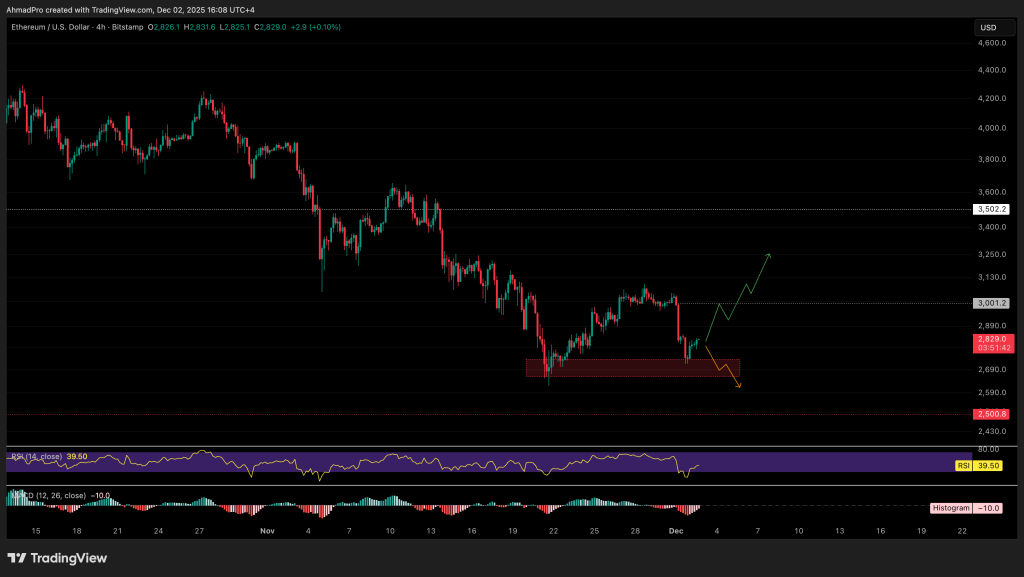
Source: ETHUSD / TradingView

Right now, Ethereum is sitting around 2,829 dollars, just a bit above the same support zone it bounced from last time. The first rebound got rejected at 3,000, and ETH might be gearing up to retest that level again if it can keep holding above support.

A clean break above 3,000 would open the door to a move toward the next resistance around 3,500. The RSI sitting near 40 plus rising volume shows momentum is trying to rebuild, but holding this support zone is the whole game. If ETH slips below it, things can get a lot uglier for both Ethereum and the rest of the altcoins.

Bitcoin Hyper Closing On $29M: Is This The Next Big Layer 2?

Bitcoin Hyper is pulling in serious momentum at a time when Ethereum is dealing with everything from quantum security worries to record ETF outflows. And while ETH tries to hold its support zone, Bitcoin Hyper is moving in the opposite direction with a presale that keeps accelerating.

The project has already raised more than 28.8 million dollars, which is not something you normally see during a shaky market month. Early buyers are locking in a steady 40% APY through staking, and that predictable yield is becoming a magnet for investors who want upside without drowning in volatility.

With Bitcoin Hyper building a lightning-fast Bitcoin Layer 2 using SVM, plus the combination of real yield and massive early demand, the presale is shaping up to be one of the strongest narratives heading into 2025.

Visit the Official Website Here

The post Ethereum Price Prediction: Vitalik Reveals Emergency Plan as ETH Faces Possible Collapse from Quantum Tech appeared first on Cryptonews.

Ethereum Founder Buterin Donates 256 ETH To Two Privacy Messaging Projects

27 November 2025 at 23:00

Ethereum founder Vitalik Buterin has quietly redirected part of his growing on-chain privacy activity toward the encrypted-messaging space, donating a total of 256 ETH to SimpleX Chat and Session via the Railgun privacy protocol.

Onchain analytics firm Arkham first flagged the move, noting “VITALIK JUST SENT $2.9M $ETH TO RAILGUN. Vitalik holds over $700 MILLION of ETH, and just sent $2.9M into Railgun. What is he cooking?”

VITALIK JUST SENT $2.9M $ETH TO RAILGUN

Vitalik holds over $700 MILLION of ETH, and just sent $2.9M into Railgun.

What is he cooking? pic.twitter.com/2HvDFRDqi2

— Arkham (@arkham) November 26, 2025

Buterin Backs SimpleX And Session

Shortly after, Buterin confirmed the donations from his vitalik.eth account and framed them explicitly as a bet on the next frontier of privacy: permissionless and metadata-hardened messaging. “Encrypted messaging, like @signalapp, is critical for preserving our digital privacy,” he wrote. “Two important next steps for the space are (i) permissionless account creation and (ii) metadata privacy.” He then named Session and SimpleX as “two messaging apps pushing these directions forward.”

Buterin specified that he had “donated 128 ETH to each” project, providing their official websites for anyone wishing to “follow on,” and then pivoted from philanthropy to adoption: “But also, actually download and use them!”

The transactions to SimpleX and Session were executed via Railgun, a zero-knowledge privacy system on Ethereum that obscures the sender, recipient, token type and amount when interacting with smart contracts and DeFi protocols.

While Buterin has used Railgun and other privacy-preserving systems repeatedly over the past two years, he has often explained that such transfers typically represent “some donation to a charitable, non-profit, or other project,” rather than personal cash-outs.The latest pattern fits that narrative: funds routed into Railgun and then out to privacy-focused infrastructure and applications, this time in the messaging domain.

In his post, Buterin positions encrypted messengers as a crucial layer in the broader privacy stack alongside financial anonymity. He explicitly ties the importance of Signal-style end-to-end encryption to new requirements that go beyond content secrecy: “permissionless account creation” and “metadata privacy.” The first is about removing reliance on centralized, real-world identifiers such as phone numbers or email addresses in order to create an account. The second targets the far less visible but equally revealing exhaust of digital communication: who talks to whom, when, and from where.

Why The  Ethereum Founder Supports Both Projects

Both SimpleX and Session are trying to address those problems in ways that diverge sharply from the mainstream model of phone-number-based, cloud-synced messengers. SimpleX’s own documentation emphasizes “complete privacy of your identity, profile, contacts and metadata,” stressing that the platform “has no identifiers assigned to the users – not even random numbers.”

Instead, users establish connections via QR codes or links, and communication routing is designed so that the service itself cannot reconstruct the social graph. Session, originally forked from Signal but rebuilt around onion routing and decentralized service nodes, is pushing a similar line: no phone numbers, Tor-like network-level obfuscation, and attention to metadata minimization.

Buterin is clear that his endorsement is not a claim that these apps are already finished products. “Neither of the two are perfect pieces of software, they have a way to go to get to truly optimal user experience and security,” he cautioned. He then sketched the core engineering problems that still need to be solved if “strong metadata privacy” is to coexist with the kind of convenience users now expect from mainstream messengers.

“Strong metadata privacy requires decentralization, decentralization is hard, users expecting multi-device support makes everything harder,” he wrote. He also flagged Sybil and denial-of-service resistance as a still-open design space: developers must harden “both in the message routing network and on the user side (without forcing phone number dependence).”

The latest donations also underline how Buterin increasingly uses his personal holdings to nudge the ecosystem toward specific priorities: privacy-preserving DeFi, open-source infrastructure, and now, metadata-resistant communication tools. In this case, he explicitly calls for more developer attention: “These problems need more eyes on them. I wish all teams working on these important problems best of luck.”

At press time, Ethereum (ETH) traded at $3,007.

Ethereum price

❌
❌