Normal view

There are new articles available, click to refresh the page.
Before yesterdayMain stream

Student Art Murals at Johnson Celebrate 25 Years of Humanity in Space 

3 December 2025 at 11:58

Select walls at NASA’s Johnson Space Center have been transformed into works of art. Each piece reflects creativity, collaboration, and the spirit of discovery. Painted by Texas students, the murals honor the legacy of the International Space Station and 25 years of continuous human presence in space. 

The International Space Station Program Mural Project began in 2022 as part of a broader effort to bring color and inspiration into the workplace while connecting classrooms to NASA’s mission. 
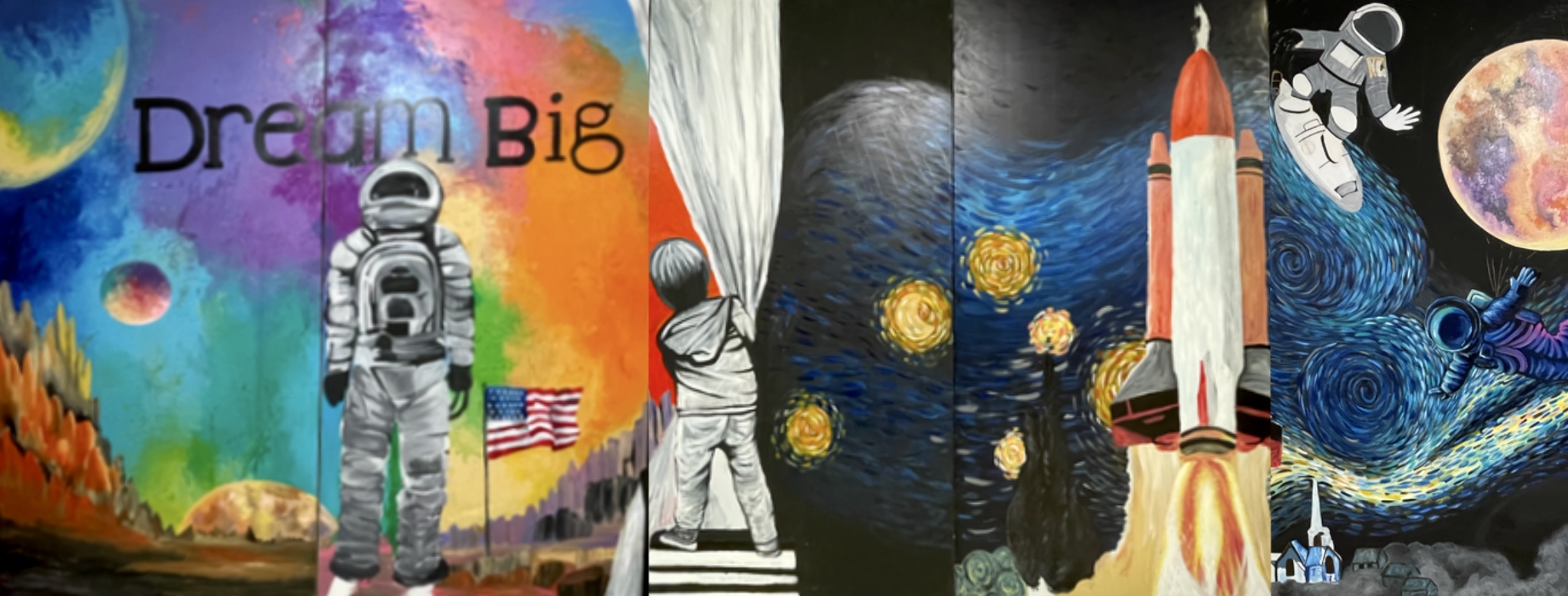
A colorful art mural representing space exploration. The words "Dream Big" appear in the upper left corner.
“Dream Big,” created by Texas City High School students with the International Space Station Program Mission and Program Integration team in 2025, symbolizes imagination becoming exploration.

“The mural collection is a reminder that today’s dreams can be tomorrow’s realities,” said Space Operations Mission Directorate Deputy Associate Administrator Joel Montalbano. “The future of space exploration depends on the imagination of our students.” 

As NASA prepares for the next giant leap through Artemis, the art on the walls serves as a reminder that every mission begins with creativity and courage. This initiative continues to inspire the next generation to Dare | Unite | Explore. While art allows for interpretation, each mural required careful planning, communication, and problem-solving, just like the work behind human spaceflight.  

The most recent mural, “Dream Big,” was installed in the hallway leading to the International Space Station Program suite on the fifth floor of building 1. Created by Texas City High School students with the International Space Station Program Mission Integration and Operations team, the artwork shows a grayscale child pulling back a curtain to reveal rockets, astronauts, and bright planetary landscapes.  

The mural’s design draws from both classic and modern art influences. The students were inspired by Van Gogh’s impressionistic style and Banksy’s Behind the Curtain, combining movement and curiosity to reflect how imagination can open the door to exploration. 

“The National Art Honor Society was honored to take on this inspiring project,” said Texas City High School art teacher Jennifer Massie. “They chose ‘Where Creativity Meets Reality’ to show how a child’s creative mind keeps moving and evolving—and that with big dreams and hard work, kids can follow in their heroes’ footsteps.” 

What started as an idea between Gary Johnson, technical manager in the International Space Station Mission Integration and Operations Office, and Raul Tijerina, then the program’s building graphics lead, has grown into a gallery-sized initiative that bridges science and creativity. 

“We want students to have the unique opportunity to contribute to NASA’s legacy through their artwork,” Johnson said. “These murals show that every mission begins with imagination and that the next generation of explorers is already helping paint humanity’s future among the stars.”  
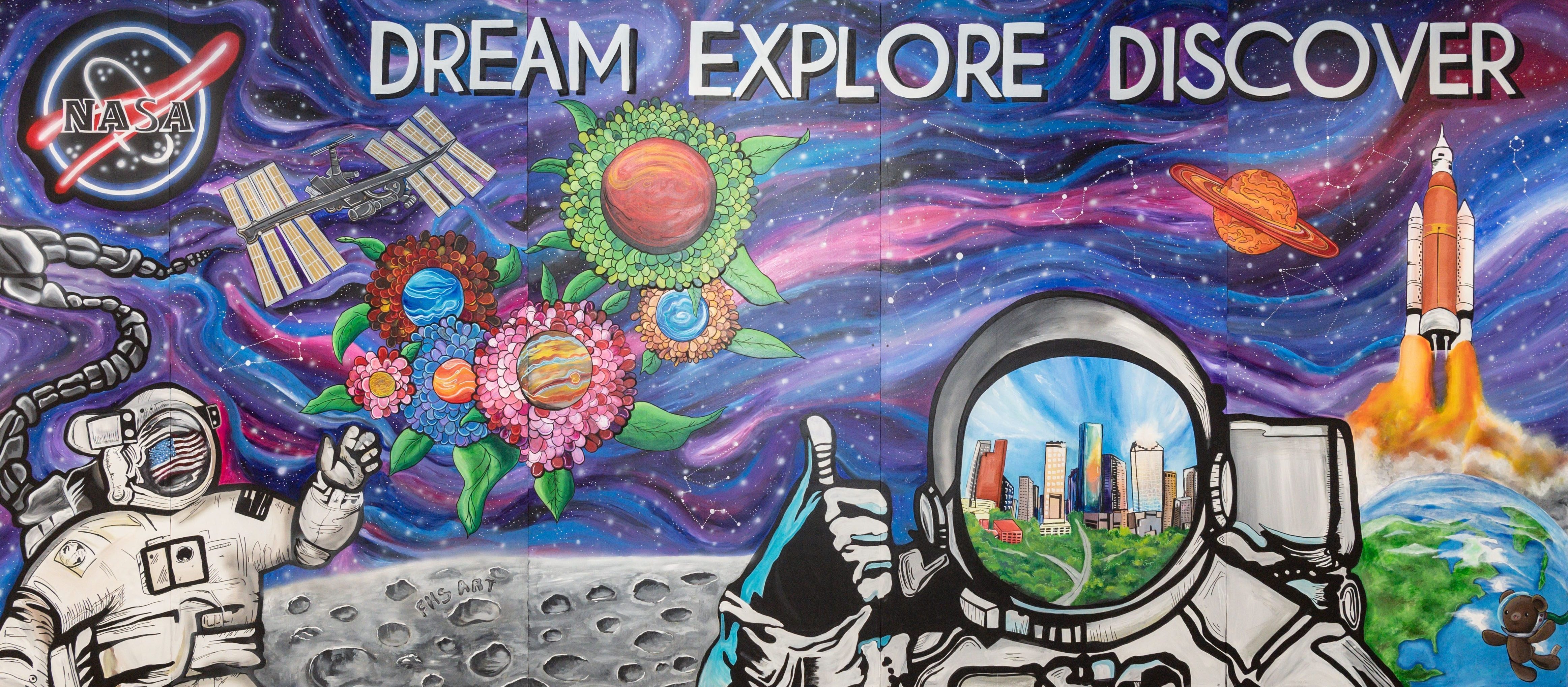
A colorful art mural featuring two astronauts on a lunar landscape with the Earth and a rocket in the background. The NASA meatball insignia is in the top left corner.
“Dream Explore Discover” was the first art mural created by Friendswood High School students in 2022.
NASA/Bill Stafford

Two murals are now housed in the hallway of the Neutral Buoyancy Laboratory’s International Space Development Integration Laboratory, known as the SDIL. The first, “Dream Explore Discover,” created by Friendswood High School students, was originally displayed in building 4 south. Under the guidance of art teacher Mandy Harris, more than 30 students designed and painted the 8-by-18-foot mural, starting with sketches and brainstorming sessions that considered how art could reflect human space exploration. The students combined their ideas into a single design celebrating the beauty and excitement of discovery. 

Elements of the mural include an astronaut’s visor reflecting the Houston skyline, zinnias symbolizing life and science connecting beyond Earth, and a small floating teddy bear representing both the dreams of children who look up to the stars and the generations of explorers who carried small tokens of home into space. It serves as a reminder of the human heart behind every mission.  

The mural also features the launch of NASA’s SLS (Space Launch System) rocket with NASA’s Orion spacecraft riding on top, heading for the next giant leap in exploration. Beside the capsule, the Orion constellation appears in the sky, symbolizing how the stars continue to guide humanity’s journey to the Moon, Mars, and beyond.  
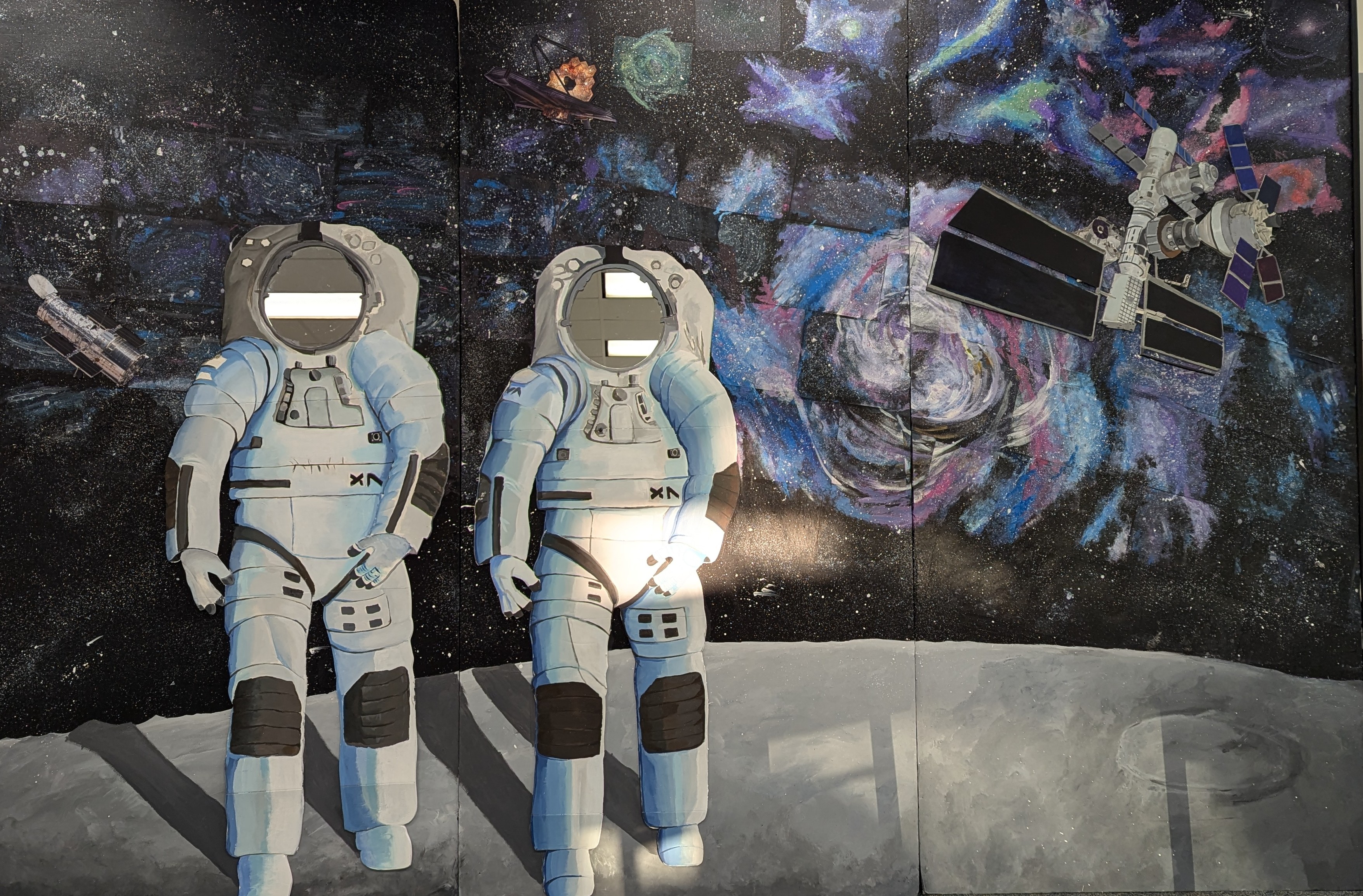
A mural showcases two spacesuit cutouts on a lunar surface, allowing visitors to pose as astronauts. The backdrop features a depiction of space, with colorful galaxies, the Hubble Space Telescope, and a satellite orbiting a distant planet.
“The Moon Now,” created by La Marque High School students, depicts two astronauts on the lunar surface in Axiom spacesuits with mirrored visors.

“The Moon Now,” created by students from La Marque High School, Blocker Middle School, and Giles Middle School, is also housed at the SDIL. The artwork depicts two astronauts on the lunar surface wearing Axiom spacesuits with mirrored visors that reflect the faces of the next generation who will carry humanity back to the Moon. Individual student artworks of the Milky Way and celestial objects were collaged into the final piece, creating a tapestry of imagination and exploration. 
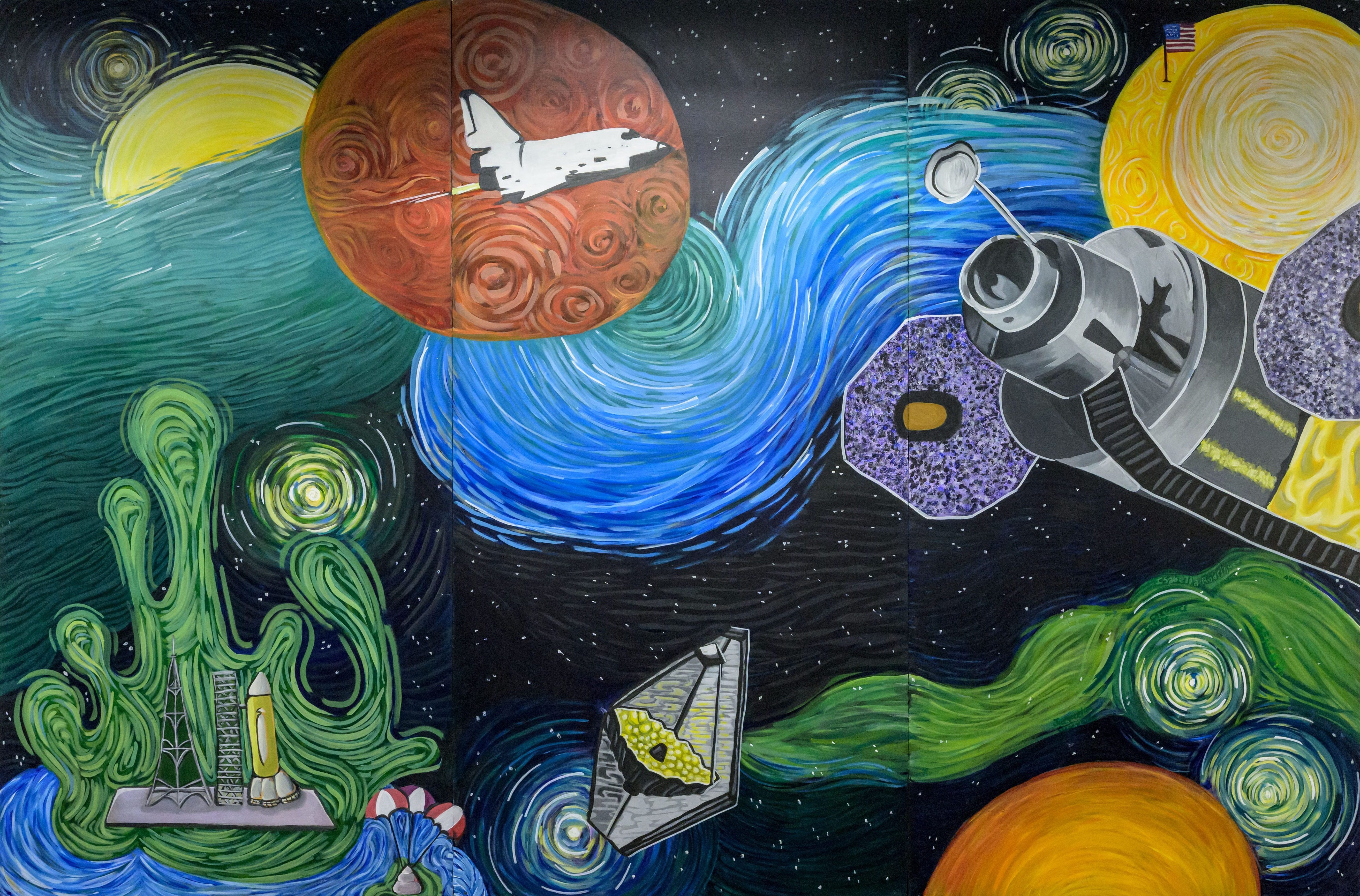
A colorful art mural with a Van Gogh style depicting space exploration.
Dickinson High School’s “A Starry Night” reimagines classic artistry through the lens of modern spaceflight.
NASA/Josh Valcarcel

The remaining murals are installed in building 4 south at Johnson. In 2023, the program expanded to include Dickinson High School, whose students created “A Starry Night,” a blend of Renaissance-style painting and modern space imagery. “Everyone wanted to be involved,” said art teacher Jennifer Sumrall. “The kids loved it and did their own research on how each of NASA’s missions impacts the world.” 
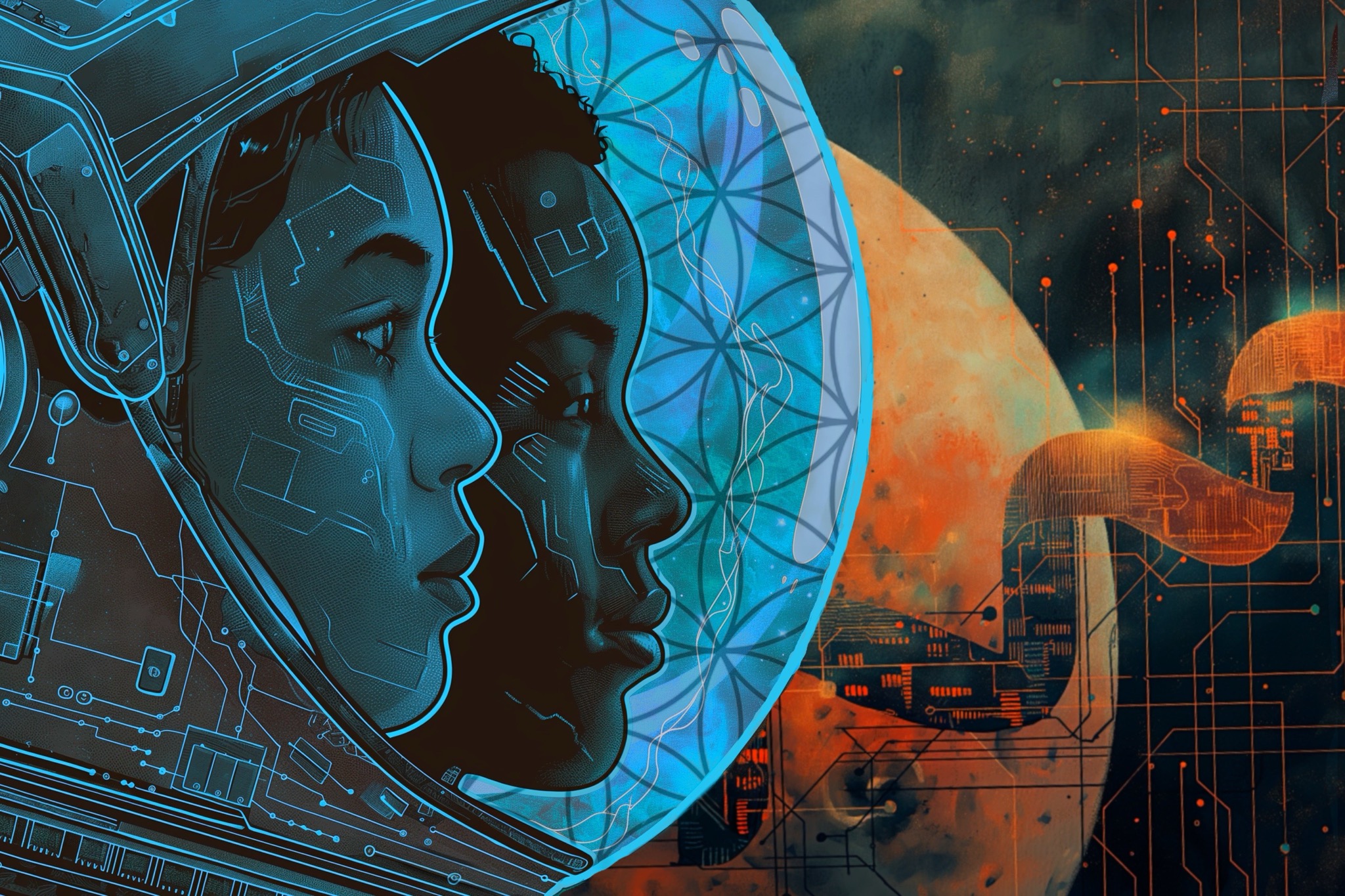
A stylized digital artwork featuring two individuals in profile within an astronaut helmet. The helmet’s design incorporates circuitry patterns. In the background, Mars looms with orange and red hues, surrounded by abstract geometric lines and digital elements.
“Absolute Equality: Breaking Boundaries” by Reginald C. Adams, symbolizes unity and humanity’s collective future in space exploration.

“Absolute Equality: Breaking Boundaries” by Houston artist Reginald C. Adams symbolizes unity and humanity’s shared future in space exploration. Two figures share a single helmet. Patterns inspired by circuitry surround the faces and suggest the role of technology in connecting people around the world and beyond it. 
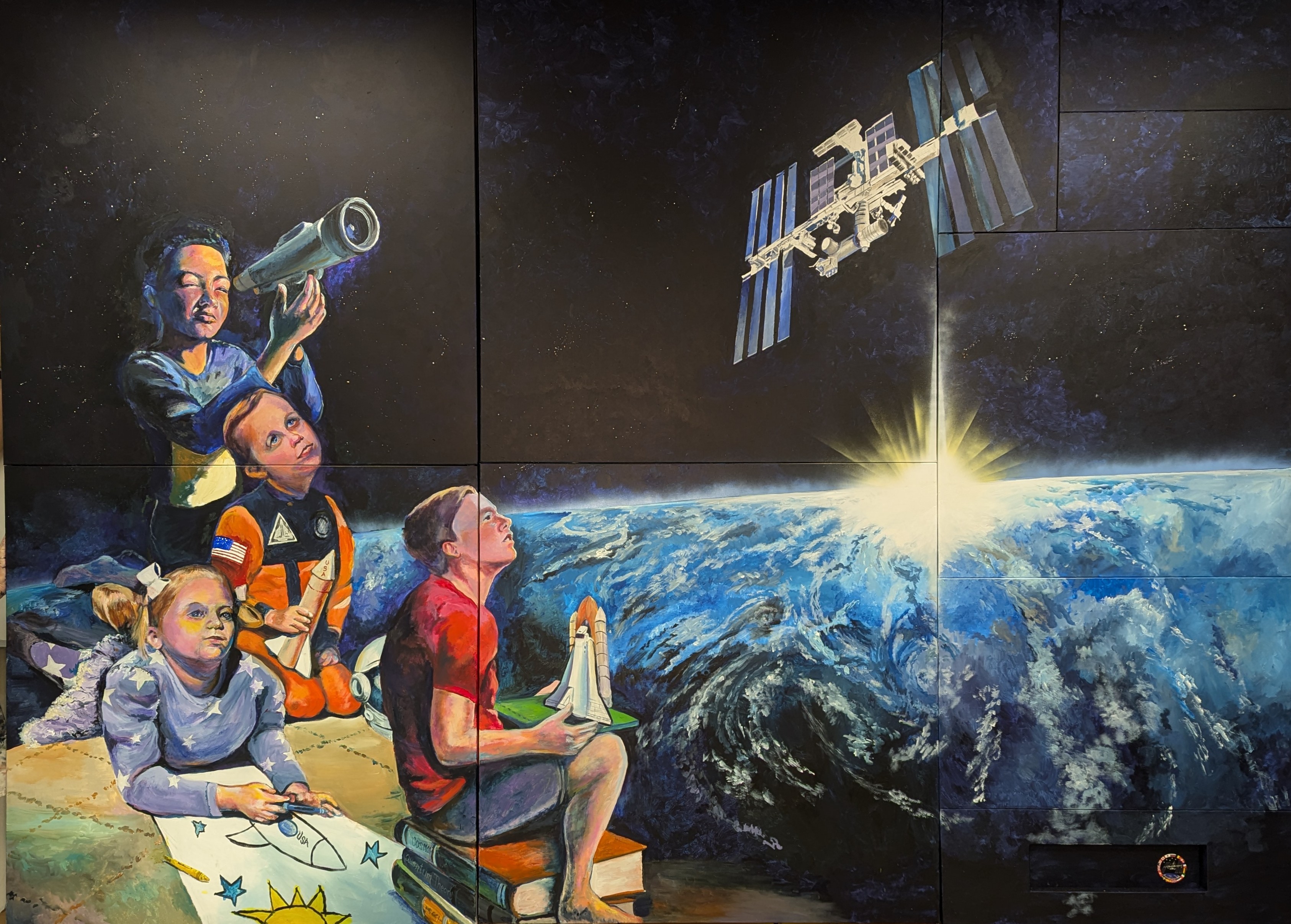
A mural depicts children gazing at the night sky. One child looks through a telescope, while others hold models of rockets and spacecraft. The International Space Station orbits above Earth.
La Marque High School students, art teacher Joan Finn, and artist Cheryl Evans painted “Collaboration” to illustrate the interconnected roles in space exploration.

“Collaboration” was painted by La Marque High School students with art teacher Joan Finn and artist Cheryl Evans to depict the interconnected roles of visionaries, engineers, artists, and astronauts in exploration. Built from 10 stretched canvases bolted together — a nod to the station’s assembly across more than 40 missions — the mural includes the space station patch at the bottom to represent the collaboration of the 15 countries involved.

NASA Johnson thanks Joel Montalbano, who championed student engagement that connects classrooms to mission work during his tenure as International Space Station Program manager. The center also acknowledges Gary Johnson for conceiving the mural project and guiding its partnerships, Raul Tijerina for early design leadership that set the standard, Gordon Andrews for opening doors through behind-the-scenes tours, and art educators for mentoring the students who brought each mural to life.  

Mark Elder: Building the Future of Spacewalking for Artemis and Beyond 

1 December 2025 at 06:00

For more than 25 years, Mark Elder has helped make human spaceflight safe and possible. As the International Space Station EVA hardware manager in the Extravehicular Activity (EVA) Office within the EVA and Human Surface Mobility Program, he leads the team responsible for the spacesuits, tools, and logistics that keep astronauts protected during spacewalks—and ensures NASA is ready for the next era of Artemis exploration. 

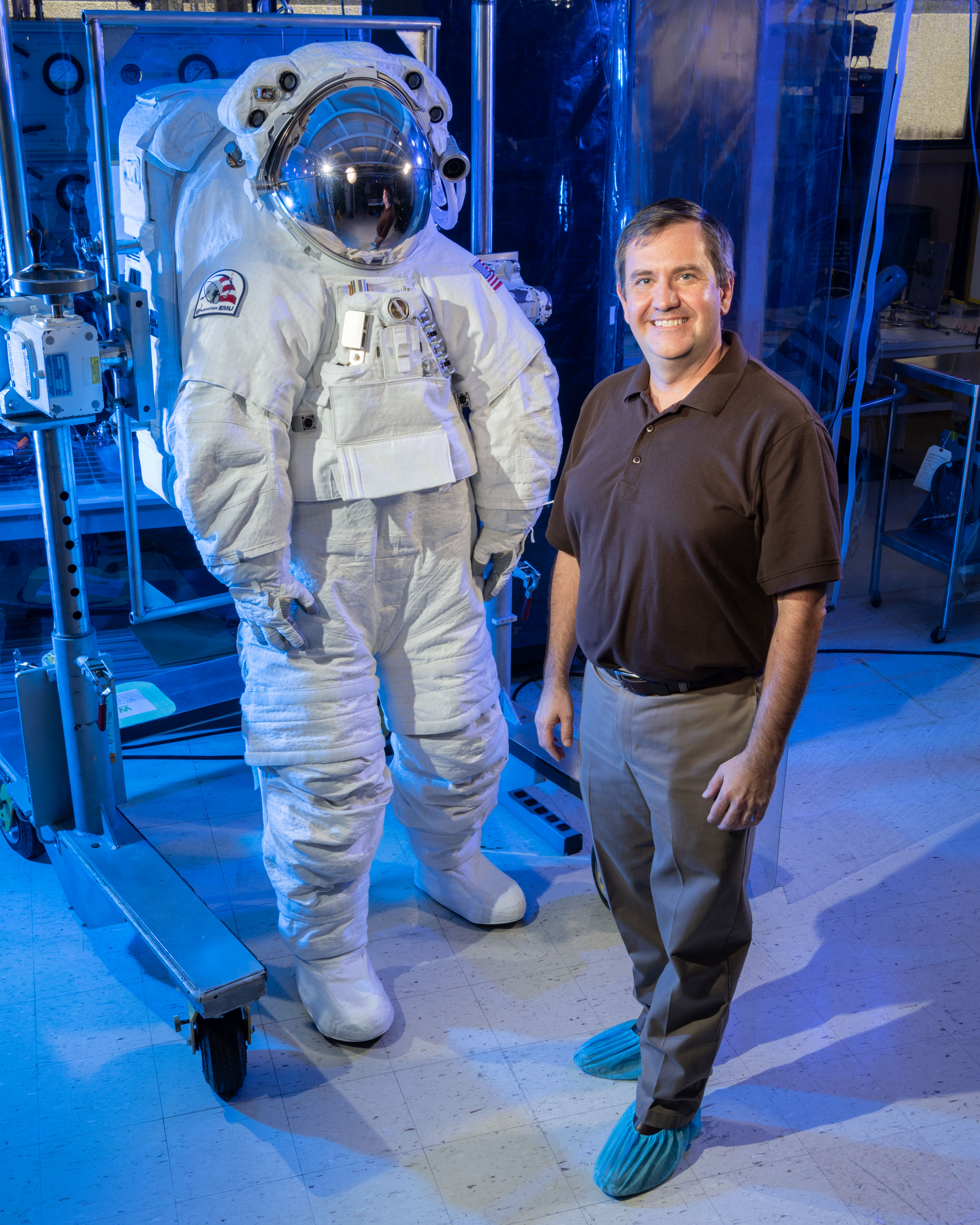
Mark Elder with NASA’s Exploration Extravehicular Mobility Unit (xEMU) spacesuit at Johnson Space Center in Houston.
NASA/Bill Stafford

His team is programmatically responsible for the Extravehicular Mobility Unit, or EMU, spacesuit. That means every bolt, bearing, and battery astronauts rely on outside the International Space Station ultimately falls under their watch. He also oversees the EVA Space Operations Contract, which provides engineering and technical support to keep spacesuit systems flight ready. 

Elder’s work directly supports every EVA, or spacewalk, conducted at the station. His team coordinates with astronauts, engineers, and the Mission Control Center in Houston to make sure the suits and tools operate reliably in the most unforgiving environment imaginable. Their work helps ensure every EVA is conducted safely and successfully. 

Elder’s passion for NASA began at an early age. 

“When I was little, my parents gave me a book called ‘The Astronauts,’” he said. “It had drawings of a reusable spacecraft—the space shuttle—and I fell in love with it. From then on, I told everyone I was going to work at NASA.” 

That dream took off at age 16, when he attended Space Academy in Huntsville, Alabama. “That cemented my dream of someday working at NASA, and it taught me a little bit more about the different roles within the agency,” he said. 

While attending Case Western Reserve University as a mechanical engineering student, he learned about a new NASA program that allowed college students to design and build an experiment and then come to Johnson Space Center for a week to fly with their experiment on the Boeing KC-135 Stratotanker. “I jumped on the chance to be part of the team,” he said. “The experience further cemented my dream of working at NASA one day—Johnson in particular.” 

After graduation, Elder worked with Pratt & Whitney on jet engines. While the experience was invaluable, he knew his heart belonged in human spaceflight. “I learned that one of Pratt’s fellow companies under the United Technologies umbrella was Hamilton Sundstrand, which was the prime contractor for the spacesuit,” he said. “I jumped at the chance to transfer, and my career at NASA finally began.” 

Elder spent his first three years at Johnson performing tool-to-tool fit checks on spacewalking equipment, giving him hands-on experience with nearly every tool that he would eventually become responsible for as a hardware manager. 

Mark Elder stands in front of the Space Shuttle Atlantis before the STS-117 launch on June 8, 2007.

His early years coincided with the shuttle return-to-flight era, when he worked on reinforced carbon-carbon panel repairs and thermal protection systems. Those experiences built his technical foundation and prepared him for the leadership roles to come. 

Over time, Elder took on increasingly complex assignments, eventually leading the team that developed the EVA Long Life Battery—the first human-rated lithium battery used in space. His team created a rigorous test plan to certify the battery for human spaceflight at a time when lithium batteries were under scrutiny for safety concerns. 

“Finally signing the certification paperwork was satisfying, but watching an EVA powered by the batteries provided a great sense of pride,” he said. 

This innovation set the stage for future generations of even safer, higher-capacity batteries that power today’s spacewalking operations and will eventually support lunar surface activities. 

Looking back, Elder said some of his greatest lessons came from learning how to lead with purpose. “The great thing about NASA is the highly motivated and dedicated workforce,” he said. “When I first became a team lead, I thought success meant making quick decisions and moving fast. I learned that leadership is really about listening. Strong teams are built on trust and open communication.” 

Another defining lesson, he said, has been learning to assume positive intent. “In a place like NASA, everyone is deeply passionate about what they do,” he said. “It’s easy to misinterpret a disagreement as opposition, but when you remember that everyone is working toward the same goal, the conversation changes. You focus on solving problems, not winning arguments.” 

That mindset has guided Elder through some of NASA’s most complex programs and helped him build lasting partnerships across the agency. 

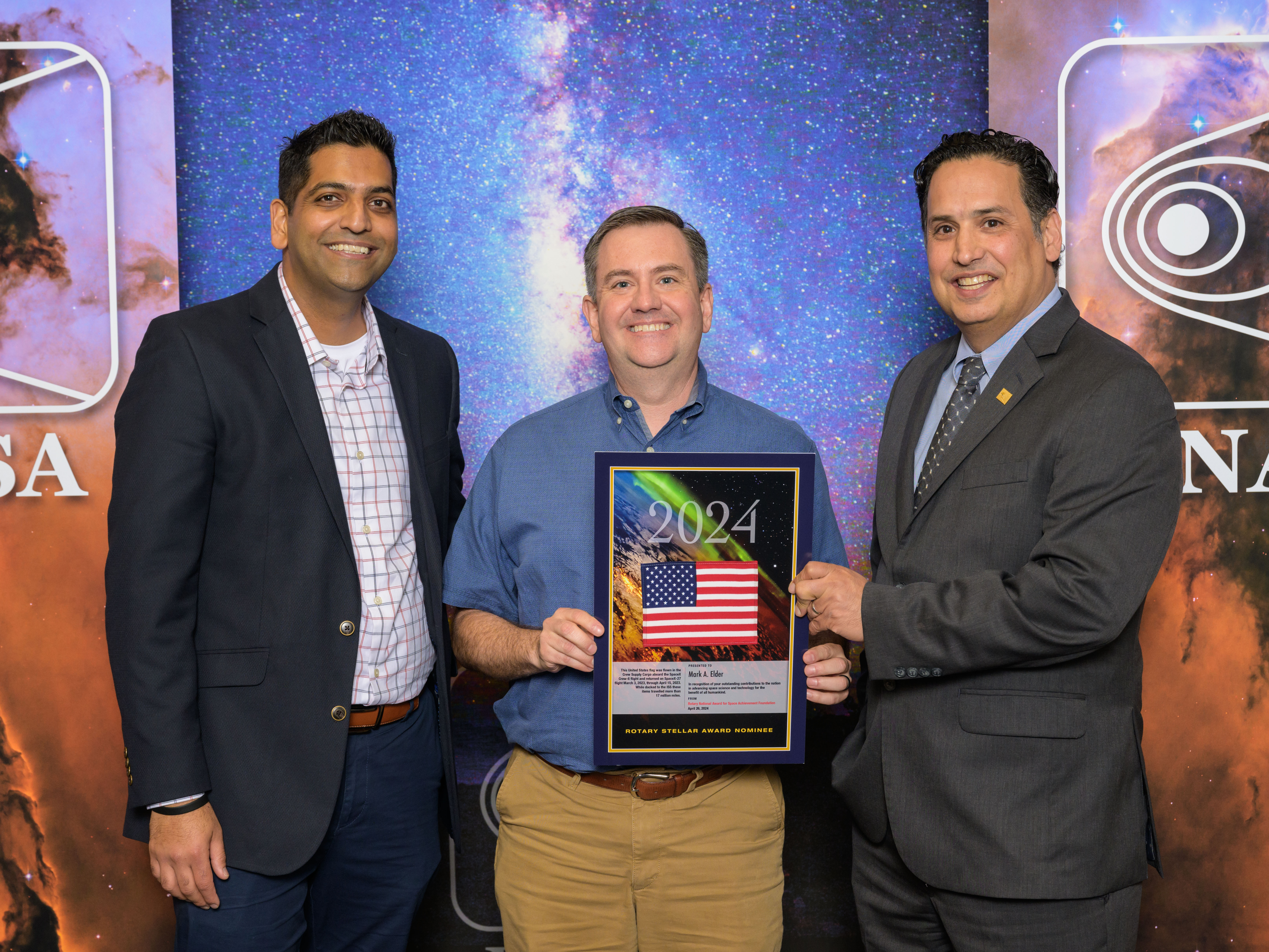
Mark Elder receives an award at the 2024 Rotary National Award for Space Achievement Stellar Awards ceremony at the Hyatt Regency in downtown Houston.
NASA/Josh Valcarcel

Today, Elder’s work extends beyond the orbiting laboratory. As NASA prepares for Artemis missions to the Moon, his team’s experience maintaining and improving the EMU informs the design of next-generation exploration suits. 

“The foundation we’ve built on the space station is critical for the future,” he said. “Every tool we’ve refined, every system we’ve upgraded—it all feeds into how we’ll operate on the lunar surface and eventually on Mars.” 

Elder believes that the key to future success lies in perseverance. He advises the next generation to never stop dreaming. “My path wasn’t direct, and it would have been easy for me to give up,” he said. “But dreams have a way of guiding you if you don’t let go of them.” 

When he’s not supporting those missions, Elder’s creativity takes shape in his workshop. “In my spare time, I love woodworking,” he said. “Building something useful from a pile of rough-sawn boards helps calm me and gives me a great sense of accomplishment. I love being able to build furniture for my family,” he added, after recently finishing a desk for his youngest son. 

The same patience and precision he brings to woodworking defines his approach to exploration—steady progress, careful craftmanship, and attention to detail. “As NASA goes to the Moon and Mars, there will be challenges,” Elder said. “As long as we keep dreaming, we will see the next generation walking on the Moon and heading to Mars.” 

NASA’s 2025 Astronaut Candidates: Shaping Artemis Exploration 

24 November 2025 at 15:00
5 Min Read

NASA’s 2025 Astronaut Candidates: Shaping Artemis Exploration 

NASA’s Johnson Space Center Director Vanessa Wyche introduces the agency’s 24th astronaut class on Sept. 22, 2025.
Credits: NASA/James Blair

When NASA’s 2025 astronaut candidates arrived at the agency’s Johnson Space Center in Houston this fall, they stepped into history, sharing a common mission to master the skills and teamwork that define NASA’s next era of exploration. 

Selected from a pool of more than 8,000 applicants, the new class represents a range of backgrounds — military test pilots, engineers, a physician, and a scientist — but all were inspired by moments in their lives that set them on a path to space.  

They will spend nearly two years in training before becoming eligible for missions to low Earth orbit, the Moon, and eventually, Mars. When they graduate, they will join NASA’s active astronaut corps, advancing science aboard the International Space Station and supporting Artemis missions that will carry human exploration farther than ever before. 

During the class announcement at Johnson on Sept. 22, 2025, Center Director Vanessa Wyche celebrated the moment as a milestone for exploration. 

“Today is an exciting day for our nation and for all of humanity as we introduce NASA’s 2025 astronaut candidates — the next generation who will help us explore the Moon, Mars, and beyond,” Wyche said. “Each one of these candidates brings unique experiences and perspectives that reflect the diversity of America and the spirit of exploration that defines NASA.” 

Behind their new blue flight suits are years of preparation and stories as multifaceted as the missions they will one day support. 

Different Roads to the Same Horizon 

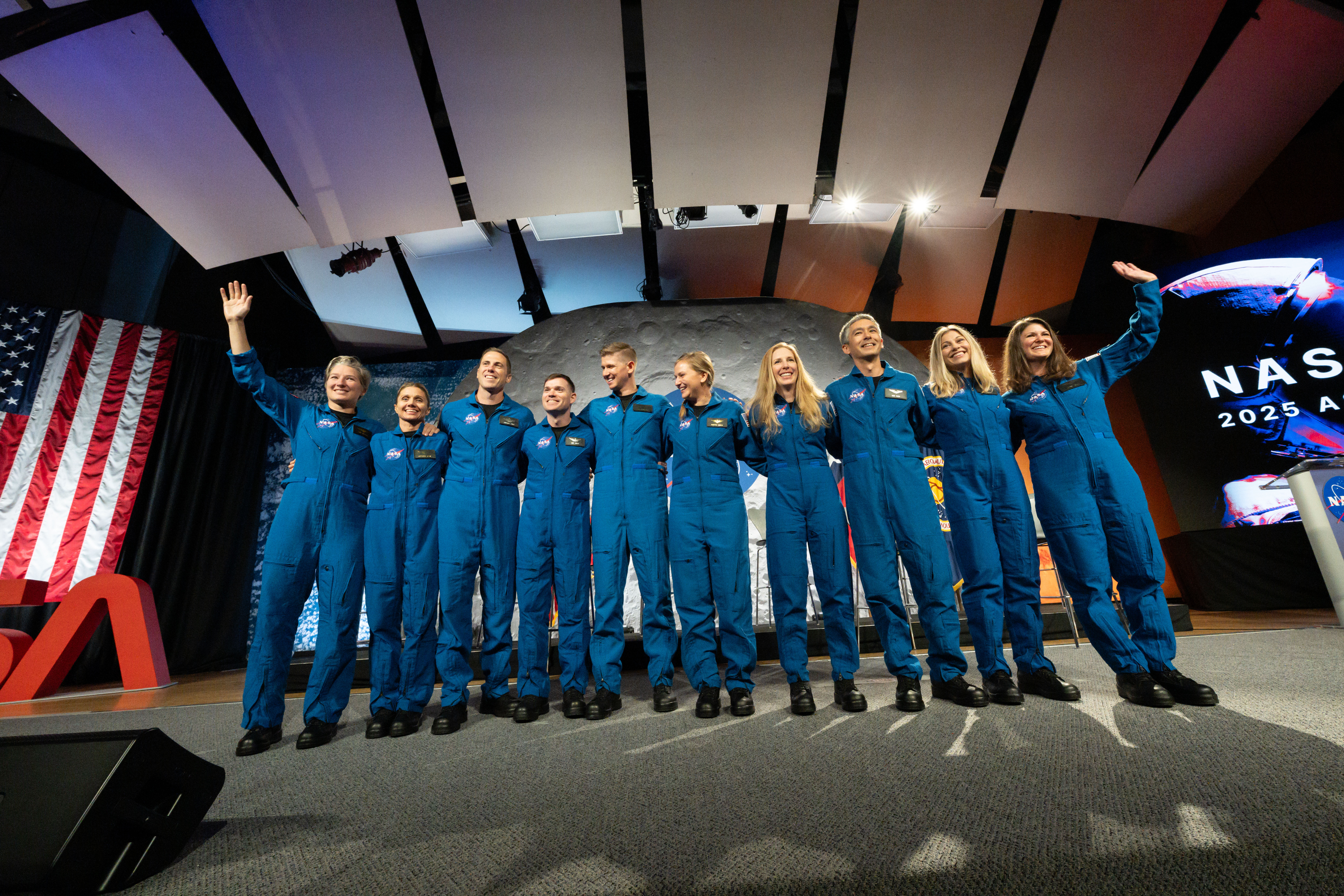
Ten people in blue flight suits wave to an audience in an auditorium.
NASA’s new astronaut candidates greet the crowd for the first time at Johnson Space Center in Houston.
NASA/James Blair

Some of the candidates built their careers in the air, where precision, communication, and teamwork were part of every mission. Former U.S. Navy pilot and test pilot Rebecca Lawler says that is exactly what drew her to NASA. 

“All of these people are coming from different disciplines and levels of expertise, and you’re all working together to get science to fly,” she said. “That’s what excites me most — bringing those experiences together as a team.” 

Imelda Muller, an anesthesiologist and former U.S. Navy undersea medical officer, said her experience supporting experimental diving teams taught her how people from different backgrounds can come together under one mission, something she sees echoed at NASA. 

Muller remembers looking up at the night sky as a kid, able to see almost every star on a clear night. Her grandfather worked on the Apollo program and used to share stories with her, and she says the mix of stargazing and imagining those missions inspired her dream of becoming an astronaut. 

Anna Menon, a biomedical engineer and former flight controller, has seen the human side of spaceflight from the ground and from space. She supported astronaut health aboard the space station from the Mission Control Center in Houston and served as a mission specialist and medical officer aboard SpaceX’s Polaris Dawn mission.

As more people venture into space, we have this incredible opportunity to learn how the human body changes in microgravity. That knowledge will help keep crews healthy as we go farther than ever before.

Anna Menon

Anna Menon

NASA Astronaut Candidate

A Houston native, she discovered her passion for exploration in the fourth grade during a field trip to Johnson. “That experience lit a fire in me to want to be part of the space industry,” she said. 

The Language of Human Spaceflight 

A woman speaks during a ceremony. Three people are beside her. The U.S. flag (left) and NASA meatball insignia are behind them.
NASA astronaut candidate Erin Overcash speaks during the class announcement ceremony at Johnson Space Center.
NASA/James Blair

For the test pilots — including Adam Fuhrmann, Cameron Jones, Ben Bailey, and Erin Overcash — flight testing taught adaptability, composure, and the discipline to make quick decisions when it matters most. As Fuhrmann put it, it is about knowing when to lead and when to listen. 

In flight test, nothing happens alone. We work with incredible engineers and professionals to plan and execute complex missions. That teamwork translates perfectly to human spaceflight.

Adam Fuhrmann

Adam Fuhrmann

NASA Astronaut Candidate

Every astronaut candidate will spend nearly two years learning spacecraft systems, practicing spacewalks in the Neutral Buoyancy Laboratory, flying T-38 jets, and studying geology, robotics, and survival training. 

As U.S. Army Chief Warrant Officer and helicopter test pilot Ben Bailey said, it is not one skill that matters most — it is the combination. 

“Each one is exciting on its own — flying, language training, spacewalks — but getting to do them all together, as a crew, that’s the best part,” Bailey said. 

During the event, current astronauts welcomed the new class and shared advice drawn from their own journeys in human spaceflight. “Thankfully, you will have some of the most talented, passionate instructors and an incredibly dedicated team here at NASA,” said NASA astronaut Chris Williams. “Some of the most special moments will come as you find how much you get to learn from each other.” 

From the International Space Station, NASA astronaut Zena Cardman encouraged the candidates to “learn everything you can, get to know each other, and enjoy the ride.” 

NASA astronaut Jonny Kim followed with a reminder every explorer carries forward: “The people sitting beside you now will become lifelong friends.” 

Explorers of the Golden Age 

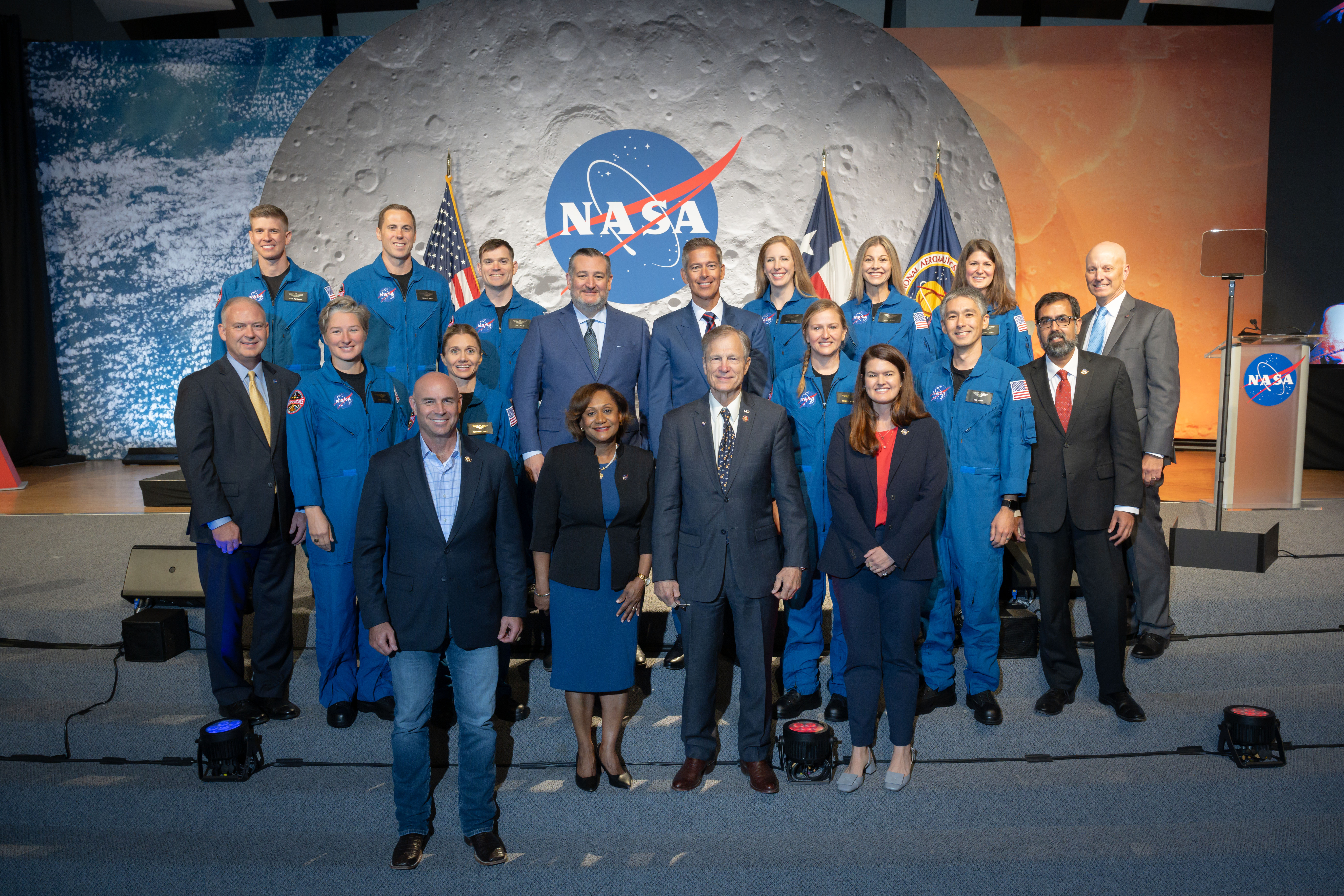
The 2025 astronaut candidates with NASA leadership during their class announcement.
NASA/James Blair

From geologist Lauren Edgar, who worked on the Curiosity Mars Rover and the Artemis III science team, to engineers like Yuri Kubo, who completed seven NASA internships, and Katherine Spies, who designed and tested flight systems that make exploration possible, each brings a layer of expertise to the agency’s future on the Moon and beyond. 

I’ve always loved figuring out how things work and finding ways to make them better. That’s what drew me to engineering, and it’s what keeps me excited about exploration.

Yuri Kubo

Yuri Kubo

NASA Astronaut Candidate

A New Era Begins 

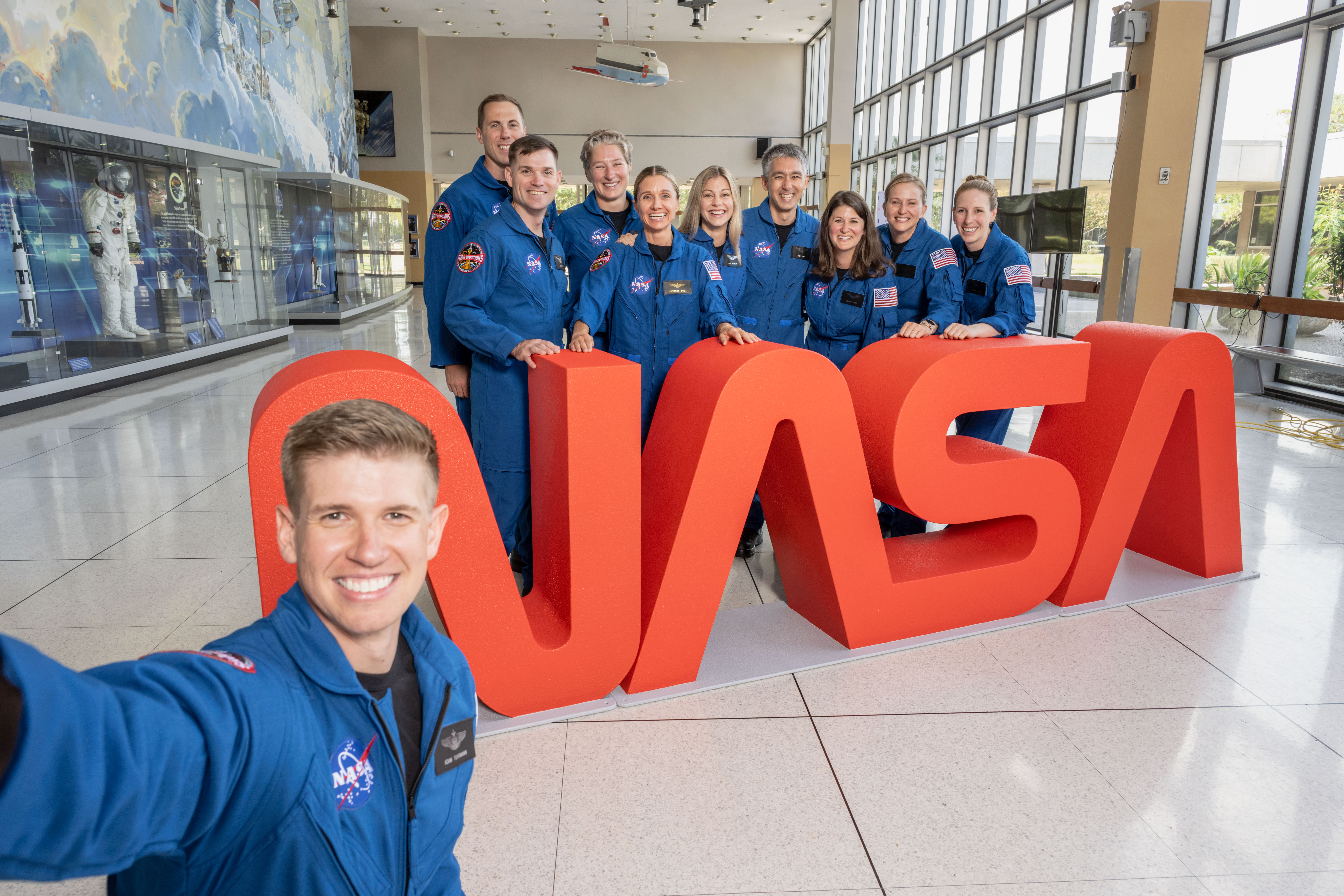
A man in a blue flight suit takes a selfie with a group and the NASA worm insignia in the background.
NASA’s astronaut candidate class pose for a selfie during their first week at Johnson Space Center.
NASA

At the announcement ceremony, NASA Flight Operations Director Norm Knight said, “Every lesson learned aboard station has paved the way for where we’re headed next – to the Moon, this time to stay, and on to Mars. We have a group of individuals who are not only exceptional, but who will be inspirational for the United States of America and for our planet.”  

Together, the astronaut candidates reflect the spirit of Artemis — curiosity, courage, and continuous learning as humanity prepares for its next giant leap. 

About the Author

Sumer Loggins

Sumer Loggins

Share

Details

Last Updated
Nov 25, 2025
Keep Exploring

Discover More Topics From NASA

Celebrating 25 Years of Humanity in Space 

19 November 2025 at 17:52
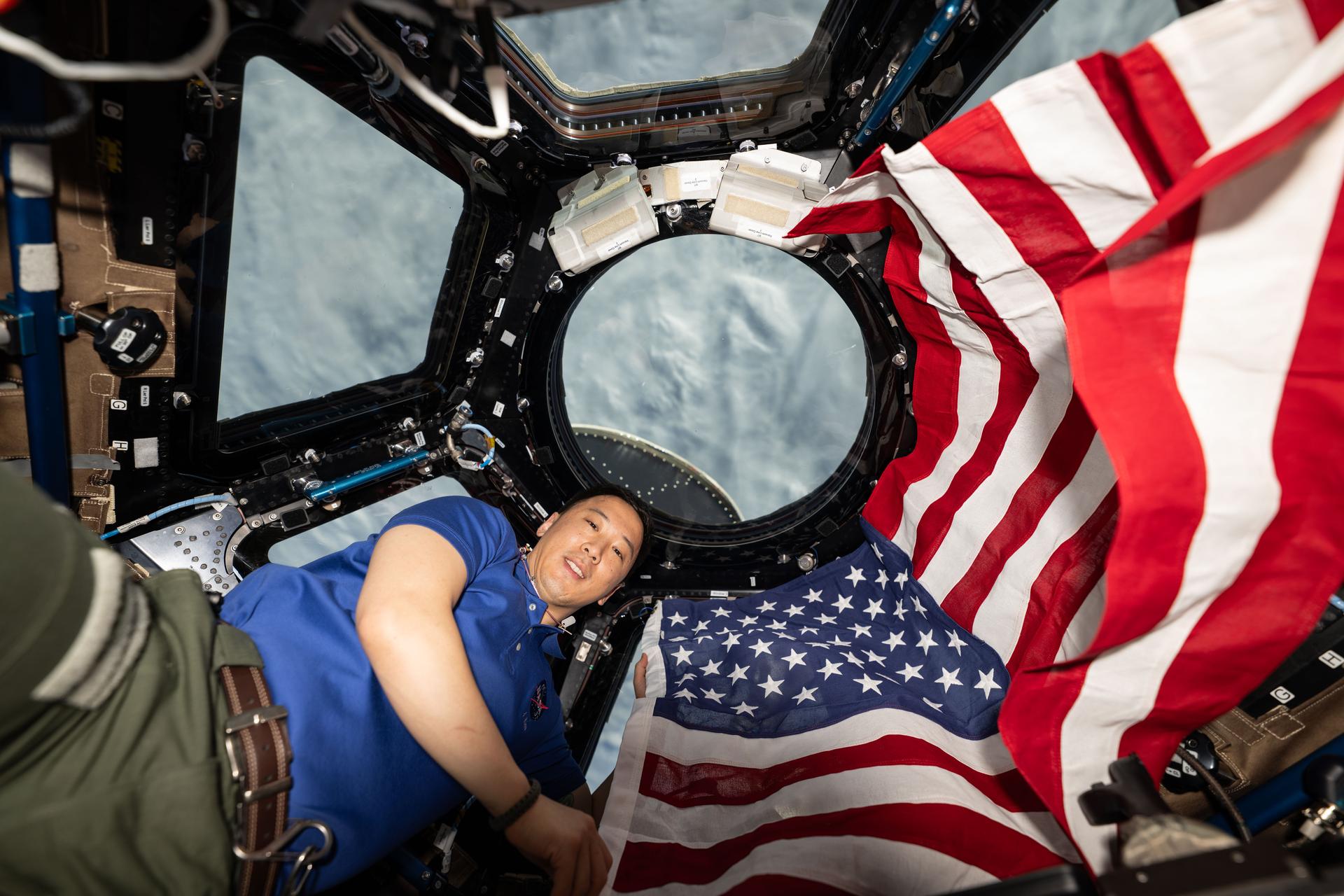
NASA astronaut and Expedition 73 Flight Engineer Jonnny Kim poses for a portrait with the American flag on the Fourth of July, or Independence Day, inside the International Space Station's "window to the world," the cupola. The orbital outpost was soaring 268 miles above a cloudy Atlantic Ocean at the time of this photograph.
NASA astronaut Jonny Kim poses for a portrait with the American flag inside the International Space Station’s “window to the world,” the cupola.
NASA

In 2025, NASA and its international partners celebrate 25 years of continuous human presence aboard the International Space Station. Since November 2, 2000, more than 290 people from 26 countries have lived and worked aboard the orbiting laboratory, conducting thousands of experiments that have advanced science and technology on Earth and paved the way for Artemis missions to the Moon and future journeys to Mars. 

Beyond its role as a science platform, the station has been a bridge—connecting cultures, sparking creativity, and inspiring generations. The memories of Johnson Space Center employees reflect how the orbiting laboratory is not only an engineering marvel but also a deeply human endeavor.  

Christopher Brown – Advancing Life Support Systems for Future Exploration 

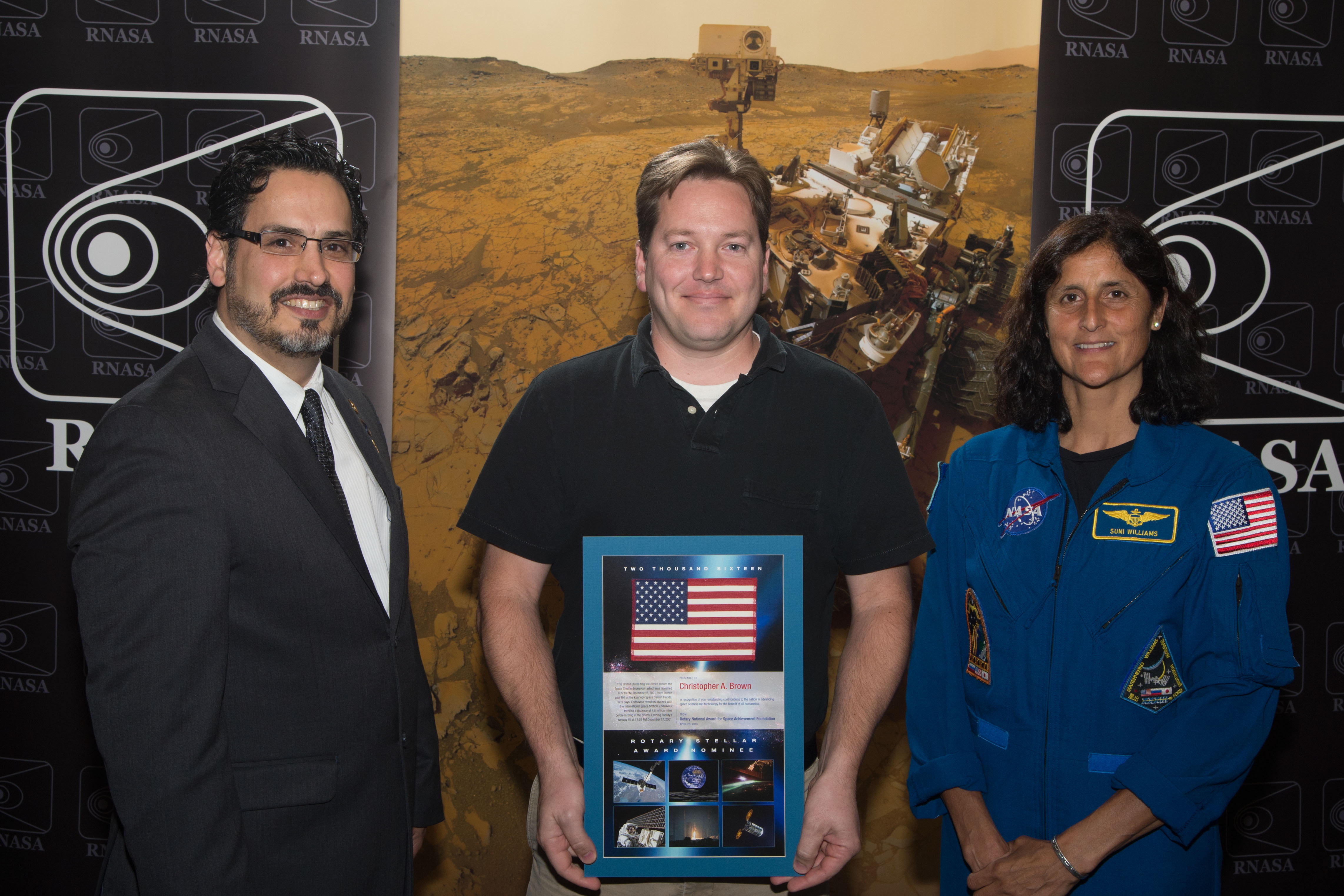
Christopher Brown (center) receives the Rotary National Award for Space Achievement alongside NASA astronaut Sunita Williams.
NASA/James Blair

As a space station Environmental Control and Life Support System (ECLSS) integrator, Christopher Brown’s role has been ensuring astronauts have clean air and water. ECLSS removes carbon dioxide from the air, supplies oxygen for breathing, and recycles wastewater—turning yesterday’s coffee into tomorrow’s coffee. Today, these systems can recover nearly 98% of the water brought to the station.  

His proudest memory was commissioning regenerative life support systems and raising a symbolic toast with the crew while on console in mission control. He also helped activate the Water Storage System, saving crew time and improving operations on station. For Brown, these milestones were vital steps toward future long-duration missions beyond Earth. 

Stephanie Sipila – The Heart of Microgravity Research  

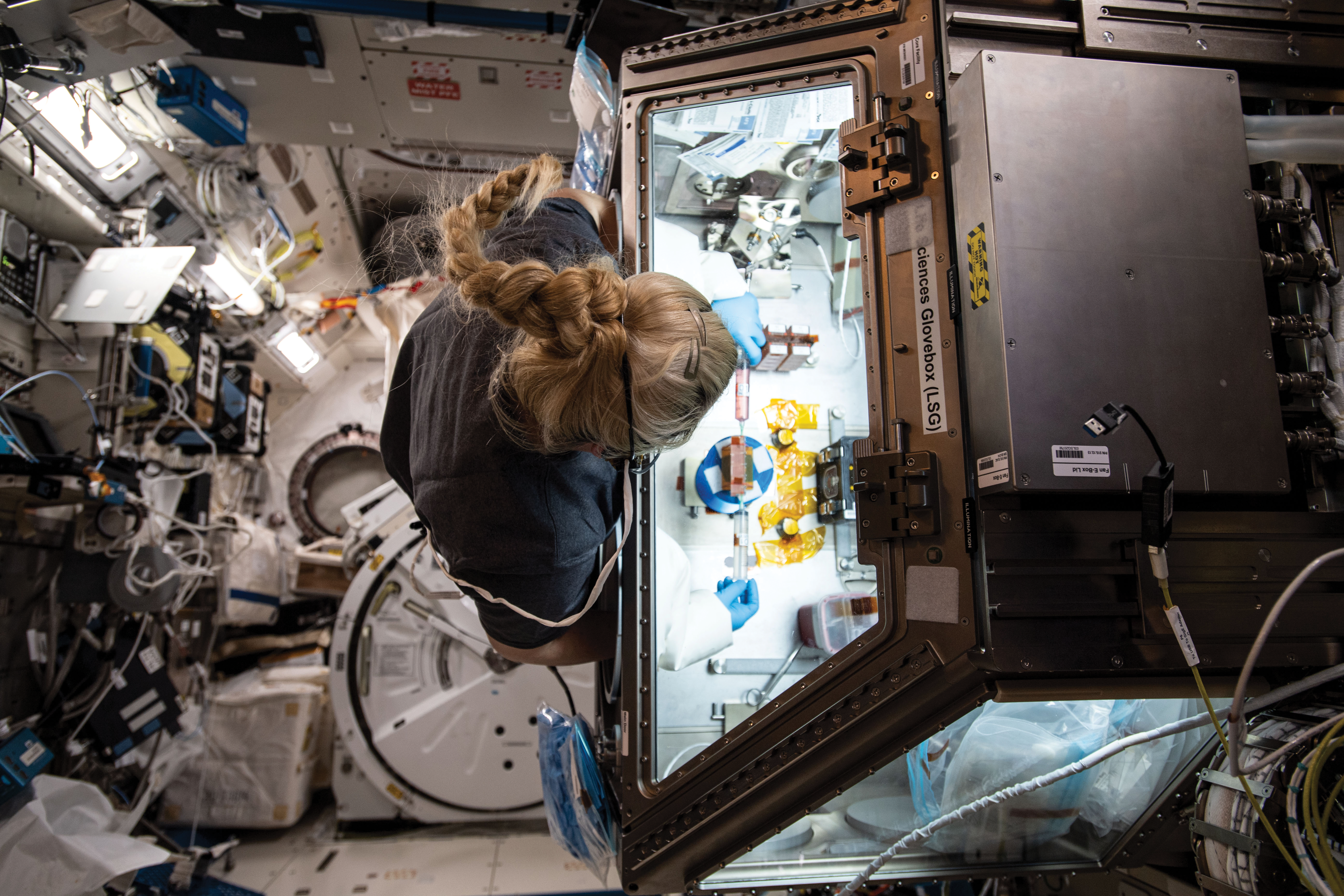
image of an astronaut working with an experiment at a glovebox
NASA astronaut Kate Rubins works on the Cardinal Heart study, which seeks to help scientists understand the aging and weakening of heart muscles in the search for new treatments for astronauts and people on Earth.
NASA/Mike Hopkins

Stephanie Sipila, now integration manager for NASA’s Extravehicular Activity and Human Surface Mobility Program, began her career as a mechanical and robotic systems instructor for the orbital outpost. Her favorite experiment, Engineered Heart Tissues, studies microgravity’s effect on the human heart to help develop new treatments for cardiovascular disease. She recalls NASA astronaut Sunita Williams running the Boston Marathon on a treadmill aboard station, becoming the first person to complete the race in space and showing how astronauts stay connected to Earth while living on orbit.  

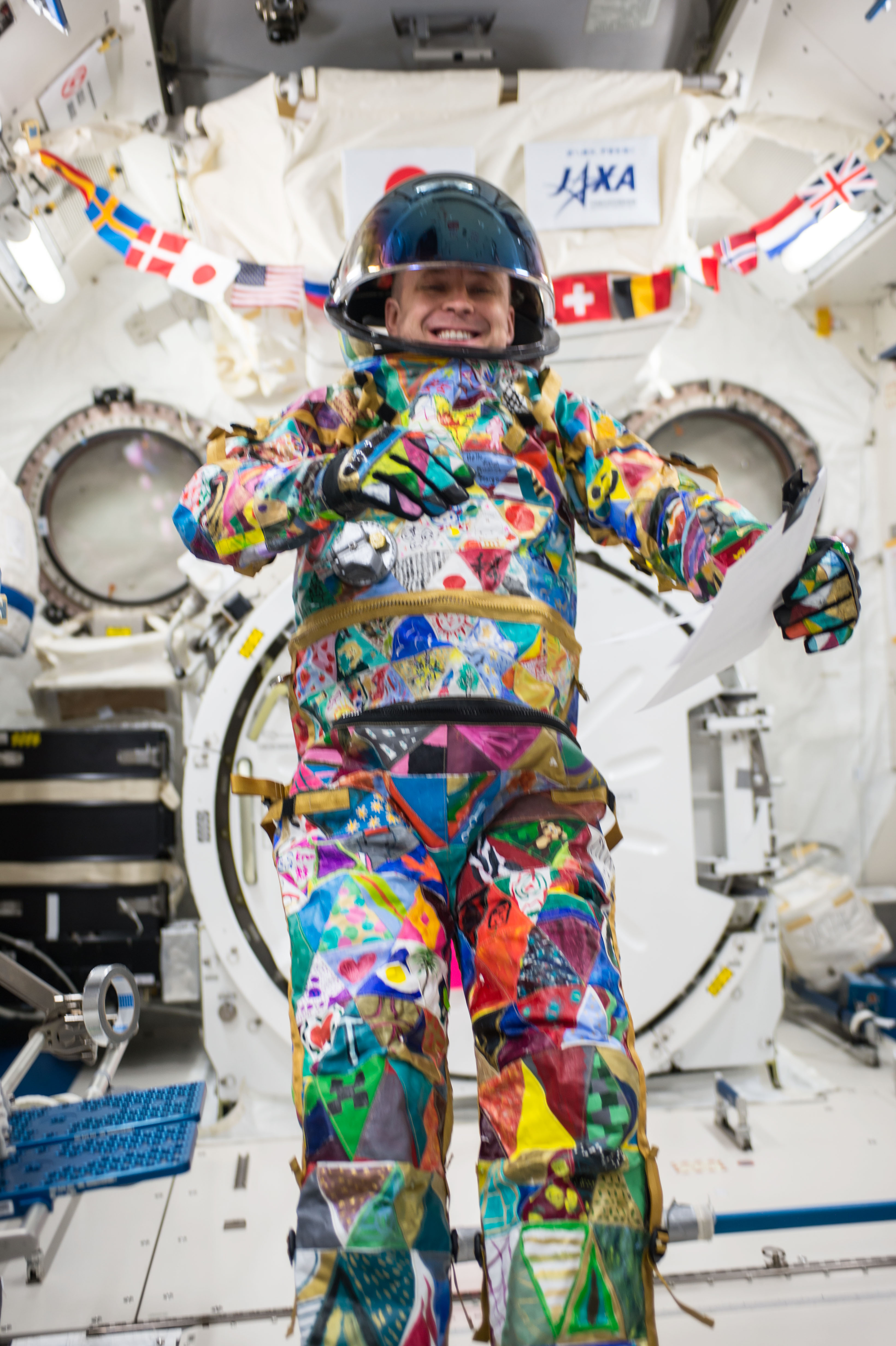
Sipila also highlights the Spacesuit Art Project, an initiative that turned artwork from children with cancer into spacesuits flown to and worn aboard the orbital outpost during live downlinks, connecting science, art, and hope — and raising awareness of cancer research conducted aboard the orbital outpost.  

Liz Warren – Where Exploration Meets Humanity 

An image of an astronaut aboard the space station wearing a colorful spacesuit.
NASA astronaut Jack Fischer wearing the Unity spacesuit painted by patients at MD Anderson Cancer Center in Houston.
NASA/Randy Bresnik

Space station Associate Chief Scientist Liz Warren has seen firsthand how the Spacesuit Art Project uplifted children on Earth. During Expedition 52, she watched astronaut Jack Fischer wear a suit covered in artwork created by young cancer patients, including his own daughter, a survivor. “It was incredibly touching to note the power of art and inspiration. Human spaceflight requires fortitude, resilience, and teamwork—so does fighting childhood cancer,” Warren said. 

Her memories also extend to her time as an operations lead for NASA’s Human Research Program, which uses research to develop methods to protect the health and performance of astronauts in space to prepare for long-duration missions. While out for a weekend run, Warren received a call from the Payload Operations and Integration Center in Huntsville, Alabama. An astronaut on station, following a prescribed diet for a research study, wanted to swap out a food item. Warren coordinated with her support team and relayed the decision back to orbit—all while continuing her run. The moment, she recalls, underscored the constant, real-time connection between astronauts in space and teams on the ground. 

Adam Baker – Checkmate: Space Debris Cleanup 

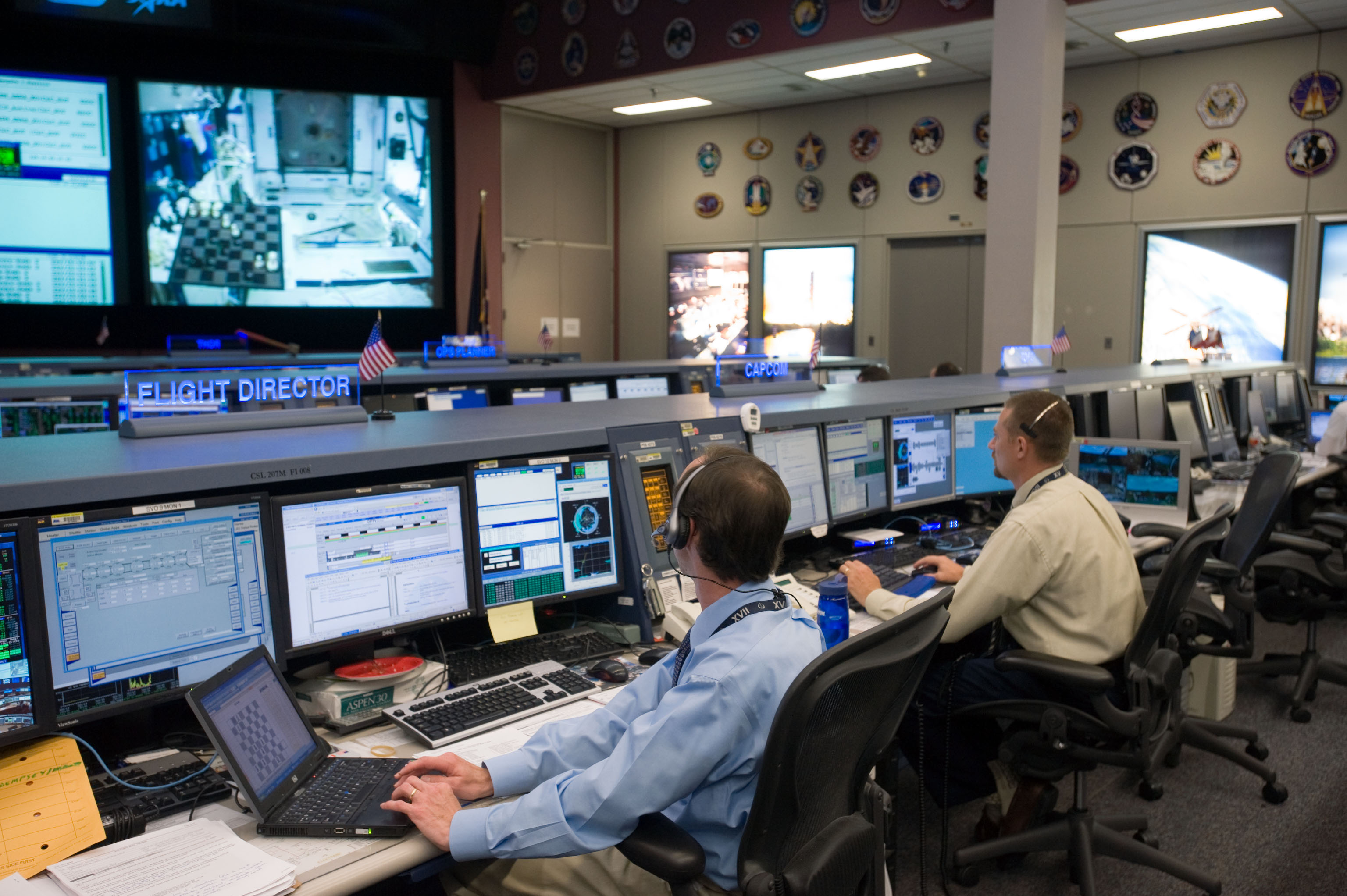
A man sitting at a desk on console with several monitors in front of him.
Flight Director Chris Edelen, left, and capsule communicator Jay Marschke discuss their next chess move during a match with NASA astronaut Greg Chamitoff, Expedition 17 flight engineer aboard the space station.
NASA/Robert Markowitz

As an aerospace engineer, Adam Baker helped track experiments and spacecraft operations from mission control. Baker remembers when mission control played a live chess match with astronaut Greg Chamitoff during Expedition 17, a moment that showed the unique ways the station connects crews in orbit with people on Earth. His favorite technical project, though, was the RemoveDebris small satellite, deployed from the station in 2018 to test technologies for cleaning up space junk. “Knowing these experiments could one day help keep the orbital environment safe made it even more meaningful,” he said.   

Michael McFarlane – Training for Success 

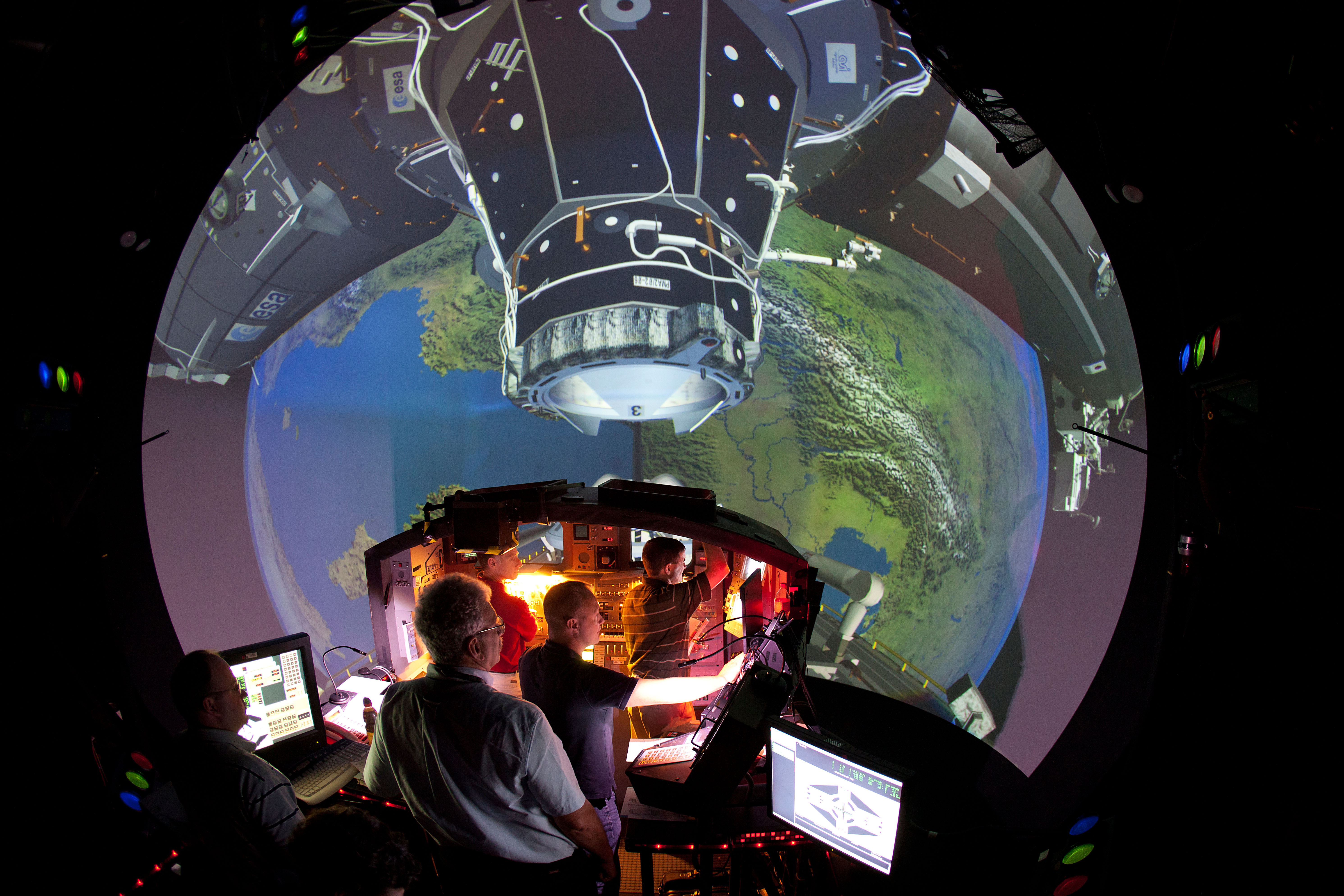
An image of people walking through an Earth dome simulation with a spacec.
Engineers run simulations inside Johnson’s Systems Engineering Simulator during a shuttle-to-station docking simulation.
Smiley Pool/Houston Chronicle

As chief of the Simulation and Graphics Branch, Michael McFarlane prepared astronauts for space station assembly missions using high-fidelity simulators. “My greatest memory is seeing the station grow as we successfully executed assembly missions that looked very much like what we analyzed and trained for in our ground-based simulations,” he said. 

A Legacy of Ingenuity and Community 

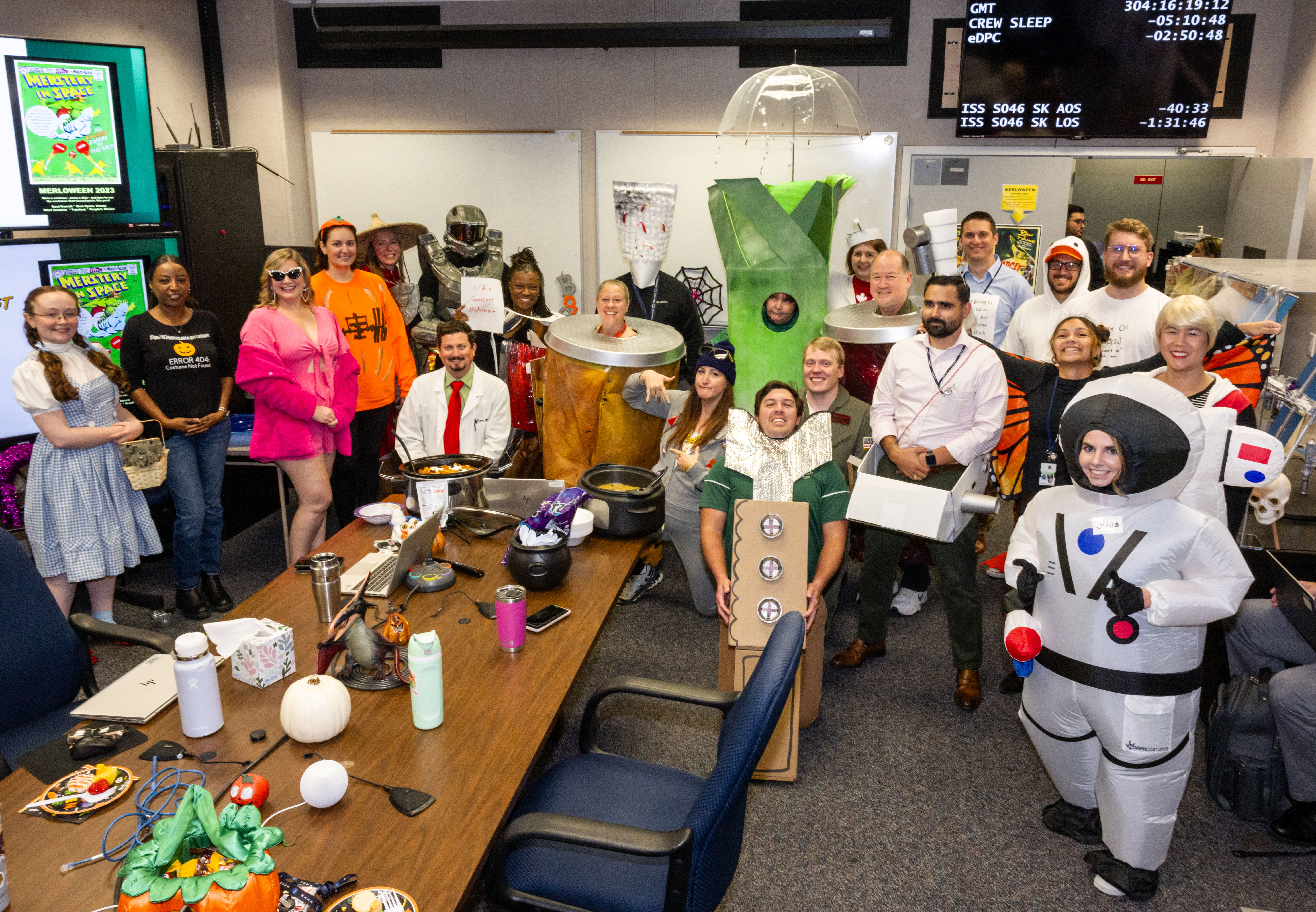
A group of people dressed in Halloween costumes pose inside of a room.
The space station Mission Evaluation Room (MER) team in costume for “MERloween,” a long-running tradition at NASA’s Johnson Space Center.
NASA/James Blair

In the Mission Evaluation Room, engineers not only troubleshoot in real time but also celebrate milestones with traditions like “MERloween,” where controllers dress in space-themed costumes to honor the year’s lessons learned. 

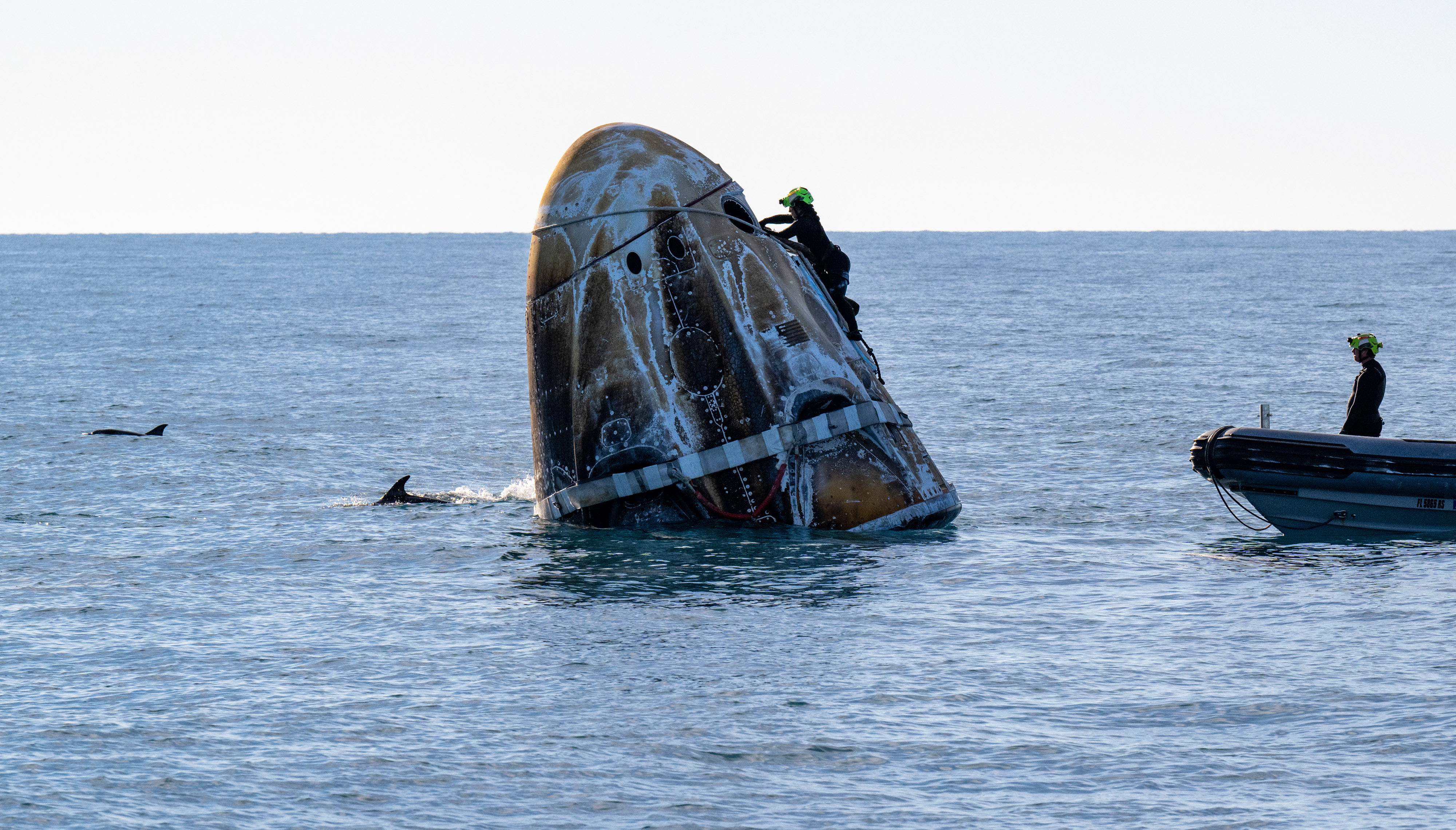
A spacecraft in the ocean surrounded by dolphins. A boat is approaching from the right.
NASA’s SpaceX Dragon Freedom spacecraft splashed down in the Gulf of America, off the coast of Tallahassee, Florida, returning Crew-9 to Earth on March 18, 2025.
NASA/Keegan Barber

For social media consultant Mark Garcia, sharing the station story with the public has been the highlight of his career. His favorite moment was watching NASA’s SpaceX Crew-9 splash down in 2025, greeted by dolphins in the Gulf of America. “I love writing about the science aboard the station that benefits people on Earth,” he said. 

For 25 years, the International Space Station has shown what humanity can accomplish together. The lessons learned aboard will guide Artemis missions to the Moon and future journeys to Mars—ensuring the next 25 years are built on innovation, resilience, and the human spirit. 

Building a Lunar Network: Johnson Tests Wireless Technologies for the Moon 

18 September 2025 at 12:37
2 Min Read

Building a Lunar Network: Johnson Tests Wireless Technologies for the Moon 

A group of people stand together at a test site in the desert, with wide open terrain and craters in the background.
From left, Johnson Exploration Wireless Laboratory (JEWL) Software Lead William Dell; Lunar 3GPP Principal Investigator Raymond Wagner; JEWL intern Harlan Phillips; and JEWL Lab Manager Chatwin Lansdowne.
Credits: Nevada Space Proving Grounds (NSPG)

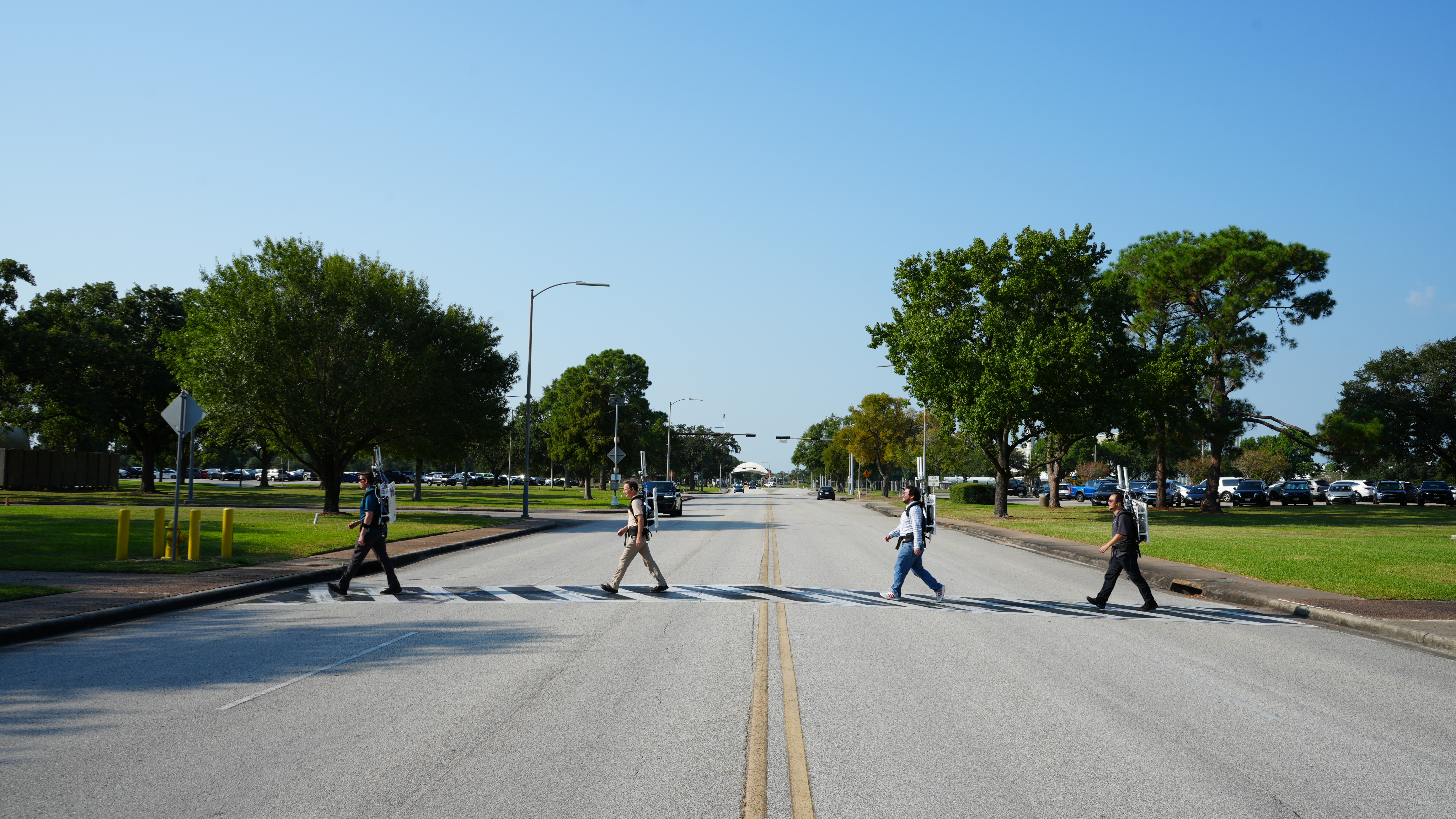
NASA engineers are strapping on backpacks loaded with radios, cameras, and antennas to test technology that might someday keep explorers connected on the lunar surface. Their mission: test how astronauts on the Moon will stay connected during Artemis spacewalks using 3GPP (LTE/4G and 5G) and Wi-Fi technologies. 

It’s exciting to bring lunar spacewalks into the 21st century with the immersive, high-definition experience that will make people feel like they’re right there with the astronauts.

Raymond Wagner

Raymond Wagner

NASA’s Lunar 3GPP Project Principal Investigator

A person walks with a prototype backpack in the Nevada desert.
A NASA engineer tests a backpack-mounted wireless communications system in the Nevada desert, simulating how astronauts will stay connected during Artemis lunar spacewalks.
NSPG

With Artemis, NASA will establish a long-term presence at the Moon, opening more of the lunar surface to exploration than ever before. This growth of lunar activity will require astronauts to communicate seamlessly with each other and with science teams back on Earth.  

“We’re working out what the software that uses these networks needs to look like,” said Raymond Wagner, principal investigator in NASA’s Lunar 3GPP project and member of Johnson Space Center’s Exploration Wireless Laboratory (JEWL) in Houston. “We’re prototyping it with commercial off-the-shelf hardware and open-source software to show what pieces are needed and how they interact.” 

A person walks with a prototype backpack in the Nevada desert.
Carrying a prototype wireless network pack, a NASA engineer helps test wireless 4G and 5G technologies that could one day keep Artemis astronauts connected on the Moon.
NSPG

The next big step comes with Artemis III, which will land a crew on the Moon and carry a 4G/LTE demonstration to stream video and audio from the astronauts on the lunar surface. 

 The vision goes further. “Right now the lander or rover will host the network,” Wagner said. “But if we go to the Moon to stay, we may eventually want actual cell towers. The spacesuit itself is already becoming the astronaut’s cell phone, and rovers could act as mobile hotspots. Altogether, these will be the building blocks of communication on the Moon.” 

Four people wearing prototype backpack communication systems cross a street at Johnson Space Center in Houston.
Team members from NASA’s Avionics Systems Laboratory at Johnson Space Center in Houston.
NASA/Sumer Loggins

Back at Johnson, teams are simulating lunar spacewalks, streaming video, audio, and telemetry over a private 5G network to a mock mission control. The work helps engineers refine how future systems will perform in challenging environments. Craters, lunar regolith, and other terrain features all affect how radio signals travel — lessons that will also carry over to Mars. 

For Wagner, the project is about shaping how humanity experiences the next era of exploration. “We’re aiming for true HD on the Moon,” he said. “It’s going to be pretty mind-blowing.” 

About the Author

Sumer Loggins

Sumer Loggins

Share

Details

Last Updated
Sep 18, 2025
Keep Exploring

Discover More Topics From NASA

❌
❌