
❌

Normal view

There are new articles available, click to refresh the page.
Before yesterdayMain stream

Shelf Life Extended: Hacking E-Waste Tags into Conference Badges

3 December 2025 at 07:00
PN26 badge

Ever wonder what happens to those digital price tags you see in stores once they run out of juice? In what is a prime example of e-waste, many of those digital price tags are made with non-replaceable batteries, so once their life is over they are discarded. Seeing an opportunity to breathe new life into these displays, [Tylercrumpton] went about converting them to be the official badge of the Phreaknic 26 conference.

Looking for a solution for a cheap display for the upcoming conference badge, [Tylercrumpton] recalled seeing the work [Aaron Christophel] did with reusing electronic shelf labels. Looking on eBay, he picked up a lot of 100 ZBD 55c-RB labels for just $0.70 a piece. When they arrived, he got to work liberating the displays from their plastic cases. The long-dead batteries in the devices ended up being easily removed, leaving behind just the display and the PCB that drives it.

db9 programmerAnother hacker assisting with the badge project, [Mog], noticed that the spacing of the programming pads on the PCB was very close to the spacing of a DB9/DE9 cable. This gave way to a very clever hack for programming the badges: putting pogo pins into a female connector. The other end of the cable was connected to a TI CC Debugger which was used to program the firmware on the displays. But along the way, even this part of the project got an upgrade with moving to an ESP32 for flashing firmware, allowing for firmware updates without a host computer.

The next challenge was how to handle customizing 200 unique badges for the conference. For this, each badge had a unique QR code embedded in the back of the 3D printed case that pointed to an online customization tool. The tool allowed the user to change which of the images was used for the background, as well as input the name they wanted to be displayed on the badge. Once finished, the server would provide a patched firmware image suitable for flashing the badge. The original intent was to have stations where attendees could plug in their badge and it would update itself; however, due to some 11th hour hiccups, that didn’t pan out for this conference. Instead, [Tylercrumpton] ran the update script on his machine, and it gave him a great opportunity to interact with conference attendees as they stopped by to update their badges.

For the Phreaknic 27 badge, the plan is to once again use electronic shelf labels, but this time to utilize some of the advanced features of the tags such as the EEPROM and wireless communications. We’re eager to see what the team comes up with.
Elli Furedy Brings Cyberpunk Games to Life

26 November 2025 at 13:30

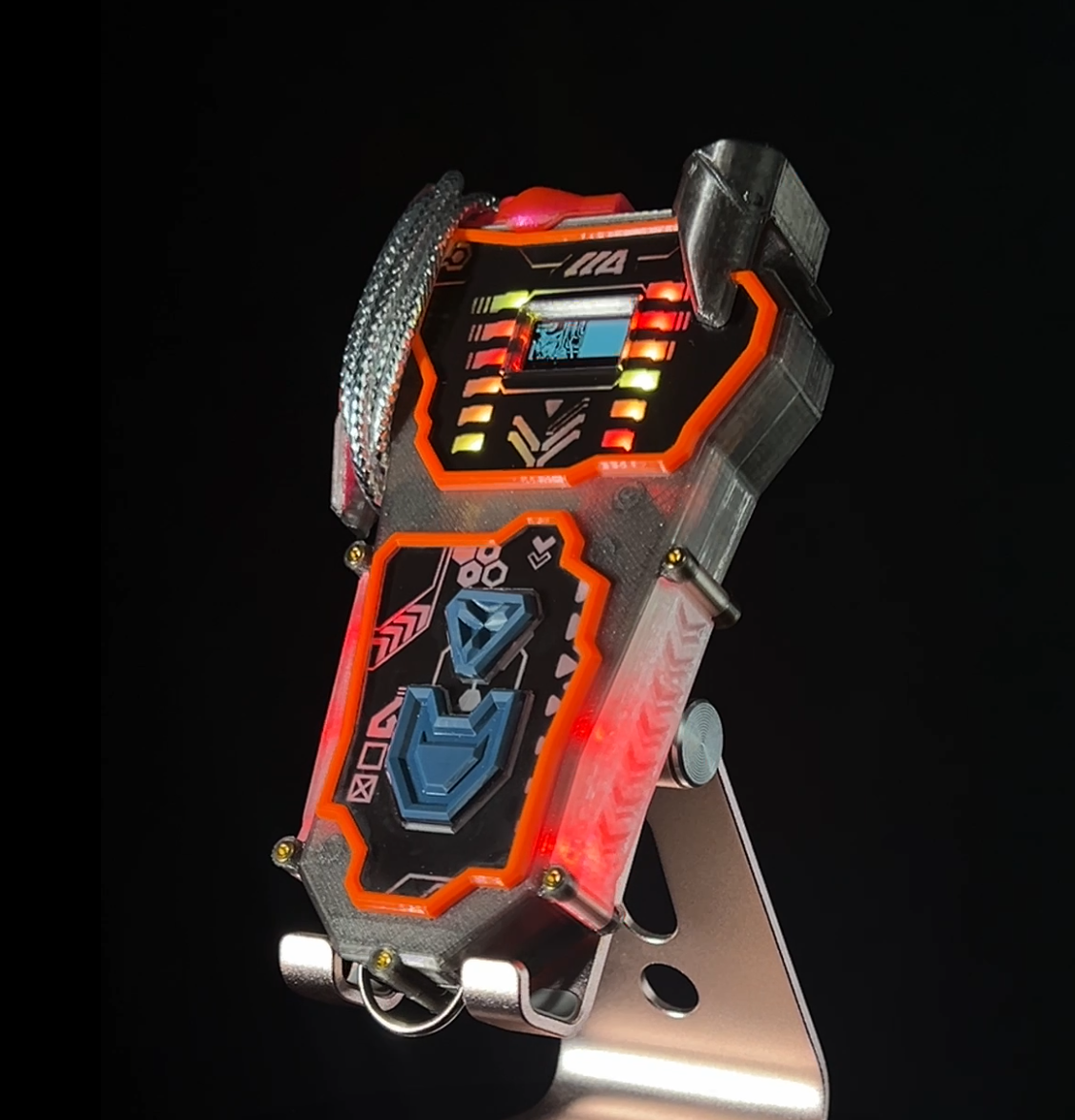
When you’re designing a bounty hunter game for a five-day cyberpunk live-action-role-play out in the middle of the Mojave desert, you’ve got to bring something extra cool. But [Elli]’s Hackaday Supercon talk isn’t just about the hardware; it’s as much about the design philosophy behind the game – how you bring something immersive and exciting to hundreds of players.

Sandbox Systems

The game itself is fairly simple: bounty hunters try to find the bounty, and when they do, they have a quick-draw to see who wins. Everyone is issued a color-coded Portable Data Node device, and when a hunter jacks into a bounty’s Node, a countdown begins, and the first to press the button after the display say β€œGo” wins.

But the simplicity of the game is by design, and [Elli] talks about the philosophy that she and her team followed to make it a success. If you’re designing a conference badge or an immersive game for a large group of people, take note.

The first principle is to focus on the people first before the tech. Here, that essentially means making the experience as simple as possible in order to leave room for the players to put their own spin on it – it’s a role-play event after all.

Next is providing opportunities over demands. In this game, for instance, if you’re playing the bounty hunter role, you have to deliver a β€œDeclaration of Intent to Seize” when you encounter a bounty player, but what deciding on your personal catchphrase for this is left up to you.

Embedding the rules of the game in the hardware is perhaps the most involved of the principles. The Data Nodes decide the winner and the loser, report it automatically over WiFi to a central scoreboard, and has anti-button-mashing provisions. These and many more examples of embedding the rules help make the game both fair and simple – nobody has to break the flow to look things up in a rule book or remember who gives what token to whom.

Selling the story of the game with the tech is also important. For instance, there is a part of the Node that [Elli] calls β€œthe doodad” which is just pure LED and greebles. It doesn’t do anything, but it looks cool.

Finally, [Elli] mentions that her team puts an effort into making the game as accessible for everyone as possible. The onboarding video has cyberpunk-styled closed captioning, for instance. While originally designed for folks who don’t hear well, it ended up providing an aesthetic that everyone can enjoy – an example of the curb-cut effect at work.

The end result? 374 players played 3,838 matches over five days, but that’s just the stats. As [Elli] points out, the real point of the game is as an ice-breaker, to allow people room to explore whatever character they’re playing, and to connect people in real-space. It sounds like it was a complete success on all fronts.

The Sandbox

This is a talk on design principles, but it’s also a talk at Supercon, and [Elli] gets pulled into the hardware side of things many times throughout the talk. The Nodes have OLEDs and haptic motors for feedback, they use and ESP32 with WiFi for the score reporting, and there’s even discussion of the serial protocol that they speak to each other when they get connected up via an audio jack.

[Elli] gets some great questions about ways to expand the game, and you’re just going to have to watch the video to appreciate them all. Or join in: after all, it’s an open-source project and it’s intended to be a sandbox!

There seems to be a lot of room to play along, and [Elli]’s talk is definitely food for thought if you’re designing hardware with the end goal of creating and encouraging human interaction through building up an engaging story.

In 1982, a physics joke gone wrong sparked the invention of the emoticon

20 November 2025 at 07:00

On September 19, 1982, Carnegie Mellon University computer science research assistant professor Scott Fahlman posted a message to the university’s bulletin board software that would later come to shape how people communicate online. His proposal: use :-) and :-( as markers to distinguish jokes from serious comments. While Fahlman describes himself as β€œthe inventor… or at least one of the inventors” of what would later be called the smiley face emoticon, the full story reveals something more interesting than a lone genius moment.

The whole episode started three days earlier when computer scientist Neil Swartz posed a physics problem to colleagues on Carnegie Mellon’s β€œbboard,” which was an early online message board. The discussion thread had been exploring what happens to objects in a free-falling elevator, and Swartz presented a specific scenario involving a lit candle and a drop of mercury.

That evening, computer scientist Howard Gayle responded with a facetious message titled β€œWARNING!” He claimed that an elevator had been β€œcontaminated with mercury” and suffered β€œsome slight fire damage” due to a physics experiment. Despite clarifying posts noting the warning was a joke, some people took it seriously.

Read full article

Comments

Β© Benj Edwards / DEC

❌
❌