Student teams competed in the 2025 Invention Challenge at NASA’s Jet Propulsion Laboratory on Dec. 5. The event pits middle and high school teams against each other as they try to get handmade devices to accomplish a task.
NASA/JPL-Caltech
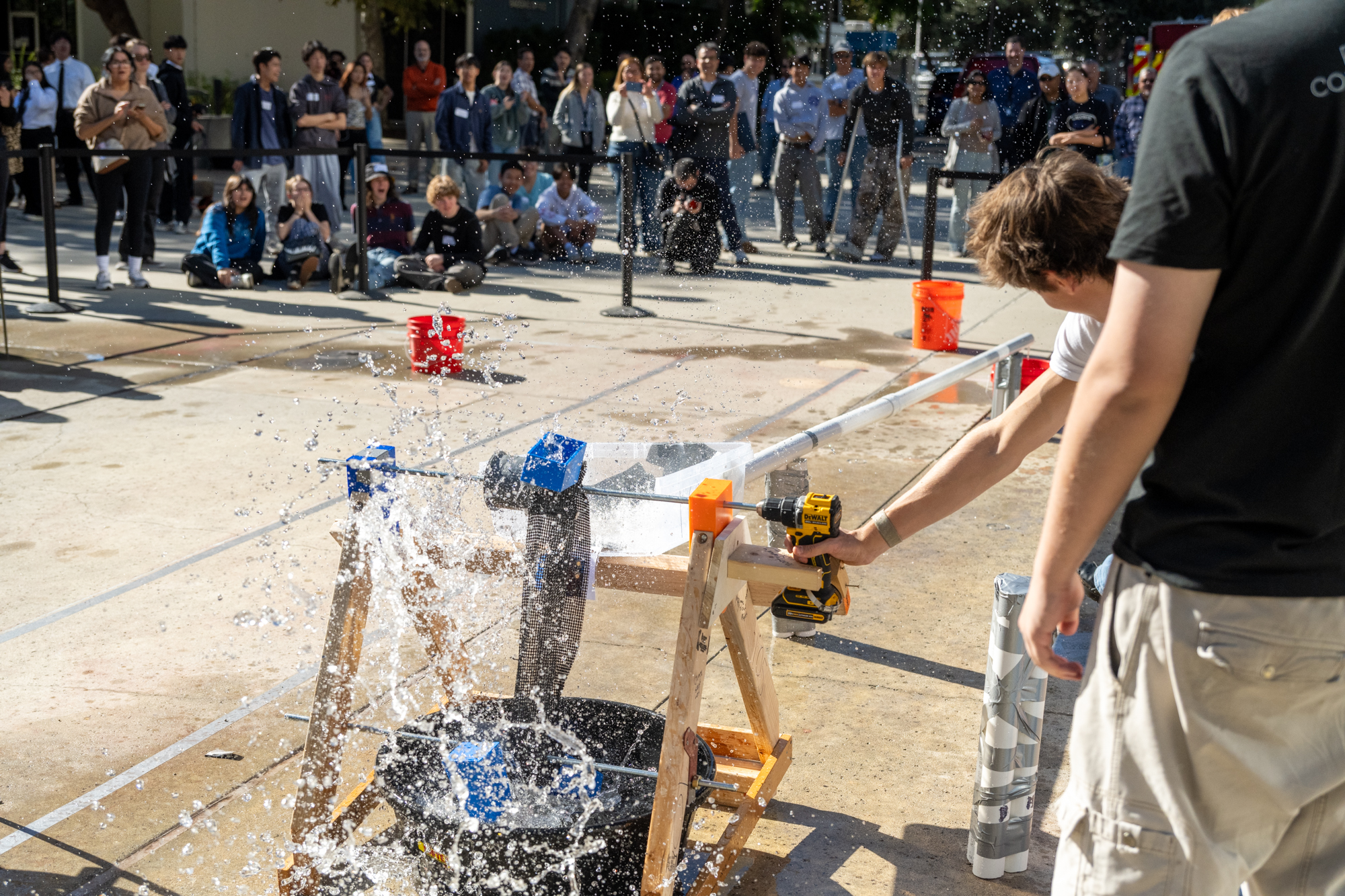
The 2025 Invention Challenge at JPL called on teams to build devices capable of moving about 2 gallons (8 liters) of water from a holding reservoir into a bucket about 16 feet (5 meters) away within 60 seconds.
Teams at JPL’s 2025 Invention Challenge built their devices with plywood, PVC pipe, duct tape, and even soda cans.
NASA/JPL-Caltech
Now in its 26th year, the event brings teams of middle and high school students to the lab to compete with home-built contraptions.
Teenagers wielding power tools and plywood demonstrated their engineering prowess at the annual Invention Challenge at NASA’s Jet Propulsion Laboratory in Southern California on Friday. Also in evidence: lots of small motors, 3D-printed gears, PVC pipe, and duct tape.
First held at JPL in 1998, the event pits middle and high school teams against each other as they try to get handmade devices to accomplish a task that changes annually. For this year’s challenge, dubbed the “Bucket Brigade Contest,” teams needed to create devices capable of moving about 2 gallons (8 liters) of water from a holding reservoir into a bucket about 16 feet (5 meters) away in 60 seconds while satisfying a long list of rules.
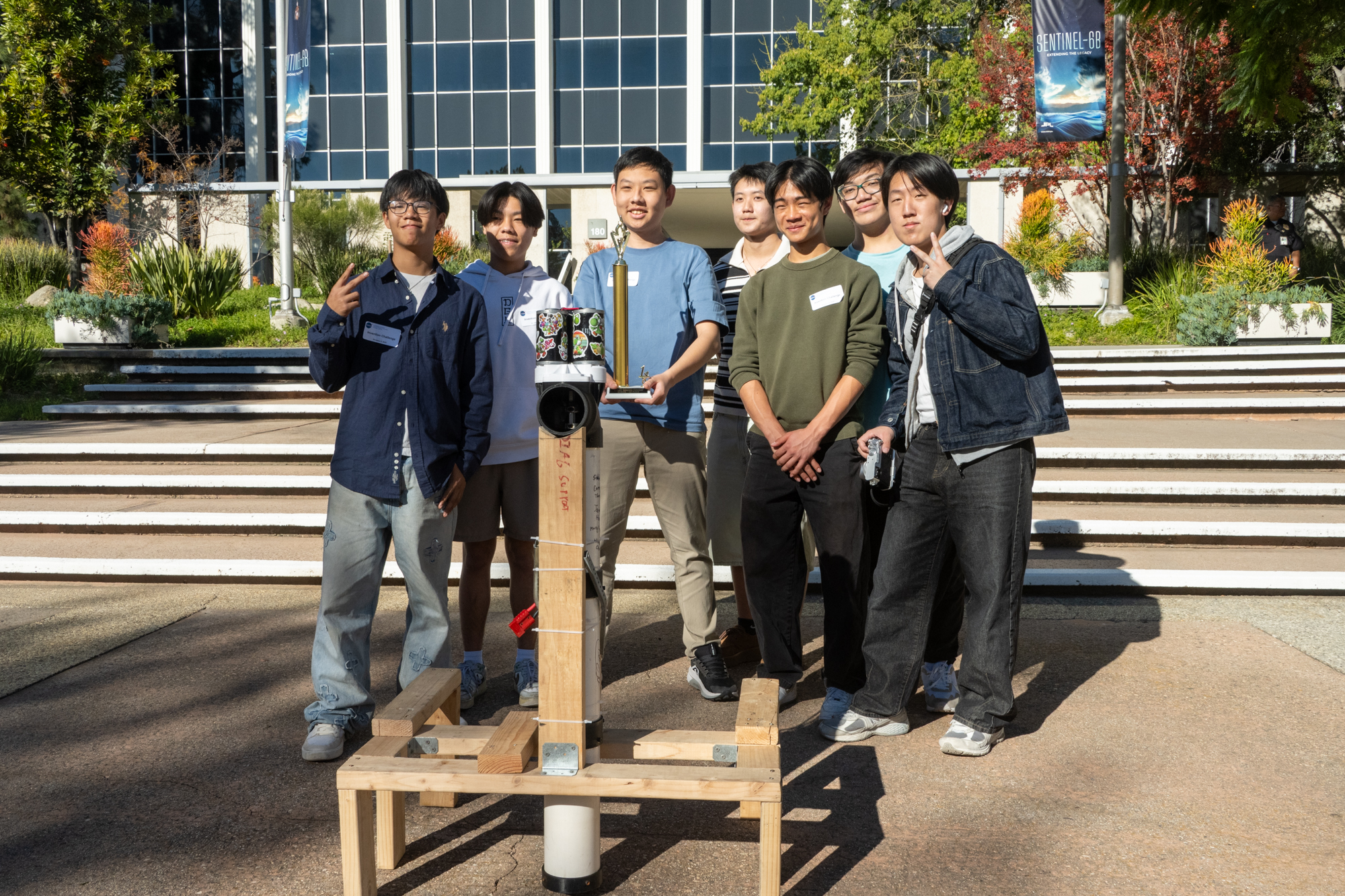
Arcadia High School’s Team Still Water won first place among student teams in the 2025 Invention Challenge at JPL.
NASA/JPL-Caltech
In all, 18 teams of students from middle and high schools across Los Angeles and Orange counties competed. First place went to Arcadia High School’s Team Still Water, which completed the task in just 6.45 seconds. Mission Viejo High’s Team Senior Citizens was close behind, finishing in 6.71 seconds. The Samo Seals of Santa Monica High came in third, at 9.18 seconds.
Five teams from outside the area — four from schools in Colorado and Massachusetts and one involving professional engineers — were invited to compete as well. Of those, the team led by retired JPL engineer Alan DeVault’s Team “Trial and Error Engineering” came in first (a repeat from last year). And “Team 6” from Pioneer Charter School of Science in the Boston area took second place (also a repeat performance from 2024). No team qualified for third place.
Some of the devices in the 2025 Invention Challenge at NASA JPL made a big splash.
NASA/JPL-Caltech
Judges named Team Clankers from Mission Viejo High most artistic, Team 6 from Pioneer Charter School of Science most unusual, and Team Winning Engineering Team (WET) from Temple City High most creative.
The event was supported by dozens of volunteers from JPL staff. JPL Fire Chief Dave Dollarhide, familiar with a bucket brigade, was a guest judge.
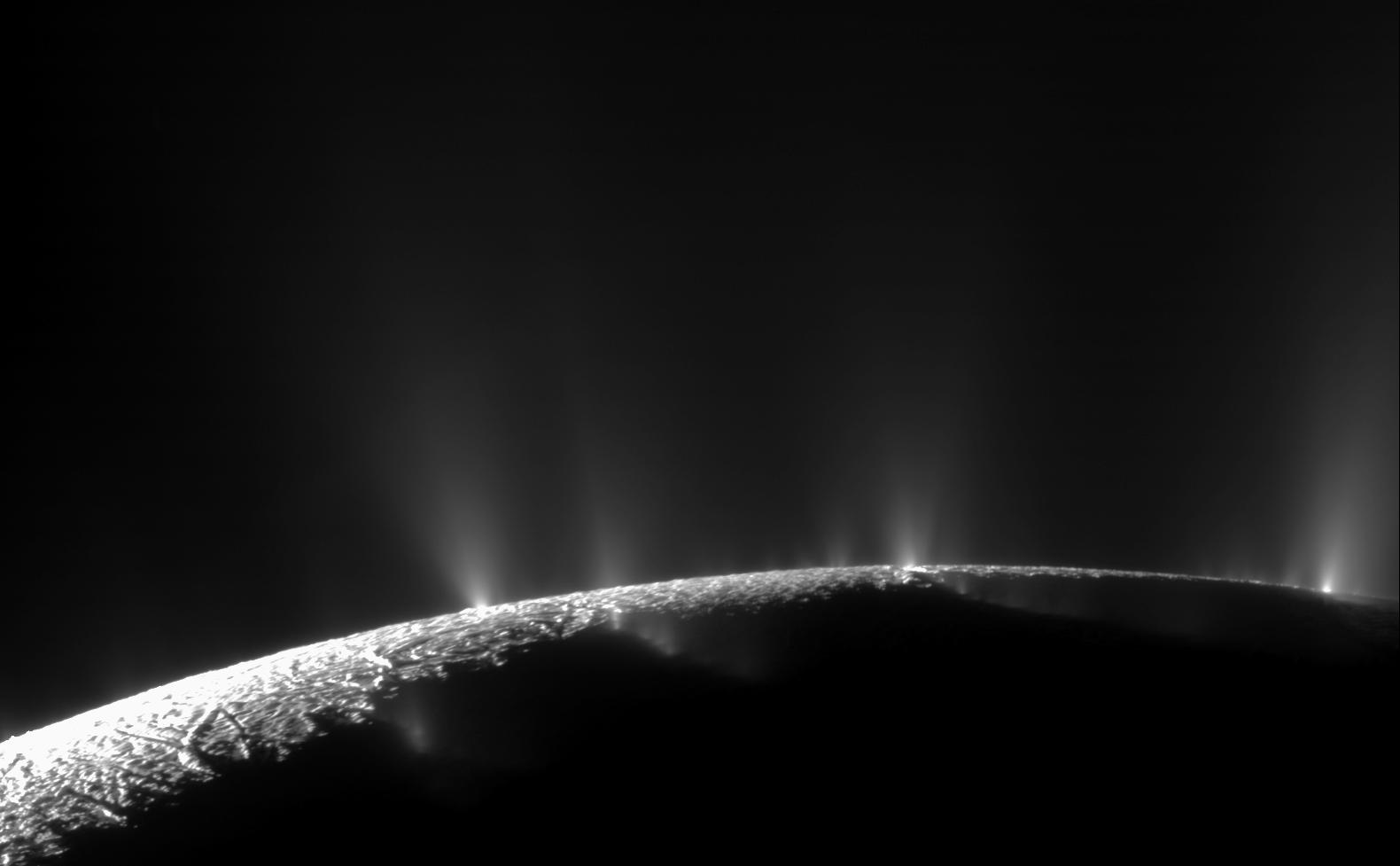
In this image captured by NASA’s Cassini spacecraft in 2009, dramatic plumes of water ice and vapor are seen erupting from the south pole of Saturn’s moon Enceladus.
NASA/JPL/Space Science Institute
Researchers dove deep into information gathered from the ice grains that were collected during a close and super-fast flyby through a plume of Saturn’s icy moon.
A new analysis of data from NASA’s Cassini mission found evidence of previously undetected organic compounds in a plume of ice particles ejected from the ocean that lies under the frozen shell of Saturn’s moon Enceladus. Researchers spotted not only molecules they’ve found before but also new ones that lay a potential path to chemical or biochemical activity.
The ice grains studied were collected just 13 miles (21 kilometers) from the moon’s surface and mark the first time scientists have observed this diversity of organics in fresh particles ejected from the subsurface water of Enceladus. Published Wednesday in Nature Astronomy, the findings signal an important step toward confirming active organic chemistry below the moon’s surface. This is the kind of chemical activity that could support compounds that are important to biological processes and are an essential component of life on Earth.
Besides increasing the diversity of detected organics, the recent work added a new layer to earlier findings by analyzing particles that the Cassini spacecraft collected when it flew directly through a plume — the next-best thing to diving directly into the moon’s ocean.
“Previously, we detected organics in ice grains that were years old and potentially altered by the intense radiation environment surrounding them,” said Nozair Khawaja of the Freie Universität Berlin, lead author of the study. “These new organic compounds were just minutes old, found in ice that was fresh from the ocean below Enceladus’ surface.”
Scientists knew from previous Cassini data-mining that nitrogen- and oxygen-bearing organic compounds were present in particles from Saturn’s E ring, a faint, wide outer band around the planet fed by the icy material that fans out from Enceladus’ plumes. But the new research analyzed ice grains from a moon plume itself — in other words, grains found closest to their subsurface origin.
“These molecules we found in the freshly ejected material prove that the complex organic molecules Cassini detected in Saturn’s E ring are not just a product of long exposure to space, but are readily available in Enceladus’ ocean,” said coauthor Frank Postberg, also of Freie Universität Berlin.
Fast and fruitful
The data was collected and sent to Earth in 2008, when ice particles impacted Cassini’s Cosmic Dust Analyzer instrument. Besides being directly sourced from a plume, the ice grains had another thing going for them: They’d been smashed to smithereens as they struck the instrument during the spacecraft’s fast fly-through at 11 miles per second (about 18 kilometers per second relative to the moon).
The energy of the impact vaporized the ice grains and ionized a substantial fraction of them. Those ions were then analyzed by the instrument’s mass spectrometer, which examined their chemical makeup.
The study’s authors were able to analyze the tiniest of fragments — smaller than a thousandth of a millimeter, smaller even than a flu virus — and identify organic compounds they hadn’t seen before in plume particles.
The newly detected compounds included those from the aliphatic and cyclic ester and ether families, some with double bonds in their molecular structures. Together with the confirmed aromatic, nitrogen- and oxygen-bearing compounds, these compounds can form the building blocks to support chemical reactions and processes that could have led to more complex organic chemistry — the kind that is of interest to astrobiology and narrows the focus of where we search for life in the solar system.
After flying through the plume, the spacecraft, managed by NASA’s Jet Propulsion Laboratory in Southern California, explored the complex Saturn system for nearly another decade.
More about Cassini
The Cassini-Huygens mission was a cooperative project of NASA, ESA (European Space Agency), and the Italian Space Agency. A division of Caltech in Pasadena, JPL managed the mission for NASA’s Space Mission Directorate in Washington and designed, developed, and assembled the Cassini orbiter.

 Login
Login