THAMBULI - A delicious , nutritious and cooling food from Karnataka .
Years ago when I visited the Portland Farmers Market I happened to taste Gazpacho, a chilled food served in sealed cups similar to popular Summer favourites like Fruit Yogurt and Ice cream . The first spoon of Vegetable Gazpacho gave a jolt to my taste buds which were all set to relish a sweet dish ! But in no time they were enjoying the novel taste and were craving for more ! The taste and flavour reminded me of a Summer Coolant called Thambuli ( Thampu meaning cool + Huli is gravy or soup in Kannada language ) prepared back home to beat the heat of Summer .
Thambuli is a no cooking dish and is prepared by blending vegetables , herbs, coconut and spice with thick Curds . Started this Summer with this nutritious Cucumber Thambuli with added vegetables .
INGREDIENTS
Cucumber ( Medium size ) - 1
Coconut gratings - 1/2 Cup
Green chillies - 2
Coriander leaves ( Chopped) - 1/2 bunch
Fresh ginger grated ( Optional ) - 1 tsp
Pink Himalayan Salt - 1/4 tsp
Thick Curds - 1 1/2 Cups
Chopped and Steamed Vegetables of your choice - 1/2 Cup
( I used Carrots , Snake gourd and Pumpkin )
Coconut oil - 1 tsp
Cumin seeds - 1/2 tsp
Curry leaves - a few
METHOD
1. Steam cook the chopped vegetables with a dash of salt and set them aside to cool down .
2. Wash and cut Cucumber into cubes .
3. Blend the Cucumber cubes , chopped Coriander , Coconut , Green chillies , Ginger and salt together in a mixer . Add the thick Curds and blend together quickly for only a few seconds .
4. Pour the Cucumber Thambuli in a bowl and stir in the steamed vegetables .
5. Splutter the cumin seeds and curry leaves in warm coconut oil and pour the seasoning on the Thambuli.
Relish with steaming hot rice , or refrigerate and have it as a cold snack similar to Gazpocho and stay cool this Summer .
We enjoyed the best of both worlds when an intercultural wedding was celebrated in the family a month ago . Fun and frolic , music and dance , flowers and lights , food and beverages dotted with various religious ceremonies kept both guests and hosts on toes .
It was a two day wedding commencing with Ganseh pooja . After Haldi , Mehndi and a grand Welcome Lunch, Ring Ceremony and Sangeet Ceremony followed . Finally the DJ party took over and rocked through the night . The next morning the groom's family chose a time slot before the Mayra Ceremony to conduct the traditional Maalai Maatral (Exchange of garlands) and Knnoonjal ( Swing ) ceremonies. Many a time these two traditional customs are rushed through with great tension as the Muhurtam time would be closing in soon .
But in this wedding the Muhurtam was scheduled at 9.30 P.M. Hence we had lot of time for conducting the rituals at an enjoyable and leisurely pace. The bride and the groom seated on the shoulders of their respective uncles had a fun time exchanging garlands . The uncles helped the couple dodge each other amidst loud cheering of excited onlookers .
After the exchange of garlands the couple were made to sit on a decorated swing . Elderly ladies queued up to to feed the couple with banana slices mixed with milk . Red and yellow coloured rice balls were waved around the bride and groom and thrown on all the four directions to protect them from the negative effects of evil eyes .
The high pitched Oonjal songs specially composed for the occasion echoed all around . The groom's father surprised the crowd by singing a Carnatic Classical while the aunt presented an 'abhinayam' (expressing the essence of the lyrics in Bharatanatyam dance Style ) for the same.
Ladies aged from 8 to 80 danced around the bride and the groom for a 'Kummi' Song played by the Naadaswaram artist . The participants went round in circles dancing and clapping to the rhythm of the instrument . As the momentum caught up more and more ladies joined the fun .
A Kathakali artist in his traditional make up and attire lead the kids carrying trays of Vilayaadal Saman in a procession . The kids presented the Vilayaadal Saman to the bride in style. A nine year old sweet girl wearing Pattu Pavadai Chokka ( Traditional long skirt and blouse ) read out the meaning of the ritual to the bride and her relatives. A lovely tween wearing Pavadai Davani (Traditional long skirt and half saree ) read out notes describing each and every Vilayaadal Item presented) .
The Baraat in the evening transported us to a totally new dream world ! The procession was lead by music and dance , lights and gaiety. The Groom dressed in glittering Sherwani , turban and pearls with a sword tucked in his belt , looked like a Prince from far away historic times ! The bride was no less than an angel , adorned with a gorgeous Lehenga , exotic jewellery and above all a priceless smile !
Finally with Fire God as witness and the full moon smiling from above , Saath Phere / Saptapadi - the most important ritual in a Hindu wedding which seals the wedding bond between the bride and the groom , was conducted !
The memories of the royal wedding celebrated in a dream land still lingers in my mind 💖!
The following text about Vilayaadal and Vilayaadal Saamaan is from the notes read out to the bride by the little girls in the family.
INTRODUCTION
Vilayaadal is a Tamil word literally meaning 'playing'. It is a fun filled social event which originated in olden times when children were married off at a very young age , the bride often younger than ten . Vilayaadal ritual was meant to serve as an ice breaker for the young couple as well as for their respective siblings. The child brides were presented with dolls , play things , grooming kits , clothes and accessories by the groom's sisters . The newly married couple were also made to play variety of competitive games with relatives on both sides joining as cheer leaders . The participants were also encouraged to display their singing and dancing talents.
In modern times marrying couples are no longer little kids . But the Vilayaadal ritual is retained in traditional weddings for the sheer fun and joy it brings to the wedding festivities. Many modern brides find it amusing to receive Barbie Dolls and toys as Vilayaadal gifts !
Here is a brief account of the Vilayaadal Saamaan presented to welcome the lovely Mumbai bride to our Bengaluru family. The assortment of artifacts representing the customary Vilayaadal items are hand picked from the four Southern States on behalf of all the little girls of our family .
MARAPPACHI DOLLS
These dolls are hand carved , out of Red Sanders , a valuable wood found in Andhra Pradesh .The paste of the wood has healing properties and is valued in indigenous medical systems.
The Marappachi pair represents Lakshmi and Vishnu or Raja Rani and occupy pride of place in the Navaratri Dolls Display ( Golu in Tamil , Gombe Habba in Kannada , Bommala Koluvu in Telugu ) organized in South Indian homes.
ROSEWOOD INLAY JEWEL BOX
An intricate handicraft of Karnataka , a state rich in forest wealth . Inlay work using various materials on rosewood base is a traditional craft perfected by the Gudigars ( artisans who carve wood ) of Karnataka . The craft was patronized by the Wodeyar Kings of Mysore Kingdom.
The elephant motif is very popular in the State and is seen in all possible arts and crafts . Karnataka is home to the largest population of Elephants in India.
SANDALWOOD JEWELLARY
Southern Karnataka is called Gandhada Gudi - The temple of Sandal Wood - as the forests are thick with Sandal Wood trees . Creating beautiful and fragrant artefacts out of the valuable wood is a traditional craft promoted by the former Kings and now by the Government of Karnataka.
Sandal wood bead malas and bracelets are choice pieces from our artisans.
CHANNAPATNA TOYS
The wooden toys and other articles made in Channapatna - THE TOY TOWN OF KARNATAKA - are G I Tagged. The products are hand turned , hand painted and finished with lacquer coating. They are light weight , and have a non toxic colouring. The craft was introduced in Channapatna 300 years ago and perfected with Japanese Techniques 100 years ago. The wood used is Ivory Wood , Cedar , Sycamore and Rubber Wood.
CHOPPU JAAMAAN ( SAAMAAN)
Toy Kitchen set made of wood are known as Choppu . Kitchen play sets are traditional toys gifted to little girls from times immemorial in all societies of the world.
These Choppu Jaamaan from Kanyakumari District of Tamil Nadu are both play things and collectibles. Colourful wooden Choppus are widely sold in Fairs , Pilgrimage centers and retro shops. All sets big or small are packed in hand woven palm leaf baskets called Olai Koodai.
COCONUT SHELL CRAFT OF KERALA
Kerala the land of coconut palms has a long tradition of using all parts of this palm - called Kalpavriksham - without wasting even a twig. The hard shells of the nut make very good cups and utensils , found in all traditional homes along the South West Coast . In present times too eco friendly essentials are being made with more refined finishing.
The Soup Bowls with spoons are from the rural artisans near Palakkad in Kerala .
METAL LAMPS
In India a lamp is regarded as a metaphor for Knowledge . No ritual is complete without lighting an oil lamp. Brass and Bronze lamps of high quality are produced in centuries old foundries of Swamimalai near Kumbakonam in Tamil Nadu . Kerala too has its own long tradition in casting Bronze lamps. In Karnataka , Nagamangala and Karkala have been traditional centers for metal casting by a process called Lost Wax Process.
Kuttuvilakku , Agal Vilakku , Paavai Vilakku , Koondu Vilakku , Kamakshi Vilakku are some of the traditional lamps cast in brass and bronze.
MYSORE SILK STOLE
The name Mysore Silk has justly become a byword for high quality soft silk . The innovative yarn twisting procedure introduced in the Mysore Kingdom during the 20th century beat back the Silk that was being imported from China. Local weavers who had already adopted Silk Worm breeding and Silk Yarn spinning during the middle of 18th century were trained to create the iconic MYSORE SILK. Ramanagaram continues to be the bulk producer of Silk since then.
KOBRI SAKKRE
This is a commonly prepared give away Prasadam in and around Mysore region. It is given to visitors on all happy occasions as a symbol of sharing joy. Dry coconut ( Kobri) , Sugar ( Sakkre ) , Roasted gram and Cardamom are ground together into a coarse powder and given to the guests in small packets along with the customary Tamboolam ( Betel leaves , betel nuts and coconut ).
For weddings beautiful motifs are carved on whole Kobris or made into decorative Kobri dolls to represent the bride and the groom .
Sugar dolls ( Sakkre Achchu ) have a special place in this ensemble . The Nandi Idol moulded with Roasted gram and jaggery complete the use of all the auspicious ingredients for the happy occasion.
In olden days all traditional homes had skilled hands which were adept in making decorative Kobris and Sugar Dolls ( Sakkre Achchu). In modern times these beautiful edible artifacts are out sourced along with other wedding Sweets.
PARUPPU TENGAI
Paruppu Tengai is a cone shaped traditional sweet which has a prominent place in South Indian Weddings . Boondi , Manoharam , Coconut Burfi , Sugar or jaggery coated Cashew nuts , Peanuts , Roasted gram are some of the sweets used in the making of Paruppu Tengais . Sometimes colourful Cadbury candies are also used in preparing the cones. Any prepared Sweet at the finishing stage is poured into greased conical moulds and are allowed to cool down . The pair of Sweet Cones are said to represent Shiva and Shakti .
The colourfully decorated Paruppu Tengais occupy the central position among other Seer Bakshanams presented to the groom's party during the wedding rituals .
I conclude this post with lots of blessings to the newly weds , who gave us an opportunity for the inter cultural bonding of two families , which will last for ever . Thank you family for encouraging me to write this memoir ! Special thanks to my sister who always stands by me in all my endeavours .
DONNE BIRIYANI - A Signature Dish Of Namma Bengaluru !
I have come across many eateries big and small with attractive boards boasting about their special Donne Biriyanis while going in and around Bangalore. I had not given much thought to the dish as I believed it to be a Military Hotel specialty.
Historians have concluded that Donne Biriyani was invented by Military Hotels to cater to the hungry soldiers when Bengaluru was under the Maratha rule during the 17th century . The healthy and wholesome food with rice , spice and meat was served in donnes - leaf cups - and hence the name Donne Biriyani.
I was totally swept off my feet when I happened to taste a literally green coloured Donne Biriyani at 'Go Native ' which serves healthy vegan food ! Here is how I tried making Donne Biriyani at CAK , but served it on a plate !
INGREDIENTS and METHOD FOR MAKING THE MASALA PASTE
Cinnamon - 1 inch stick
Cardamoms - 2
Cloves - 4
Cumin seeds - 1 tsp
Coriander seeds - 1 tsp
Black peppers - 1 tsp
Grind all the above ingredients finely using a mixer.
NEXT STEP
Onion - 1 big ( Peeled and chopped )
Coriander leaves - 1 bunch ( cleaned and chopped)
Mint leaves - 1 bunch ( cleaned and chopped )
Garlic cloves - 2 tbsps ( peeled )
Ginger - 2 tbsps ( grated )
Green chillies - 2
Turmeric powder - 1/2 tsp
Chilly powder - 1 tsp
Add all the above ingredients to the mixer and grind into a smooth paste along with the already ground spice powder.
INGREDIENTS TO MAKE BIRIYANI
Sona Masuri Rice ( Soaked for 20 minutes) - 1 lota ( 2 Cups )
Cinnamon - 1 inch piece
Cardamom - 2
Cloves - 4
Star Anise - 1
Cooking oil - 4 to 5 tbsps
Chopped potato cubes - 1/2 Cup
Frozen green peas - 1/4 Cup
Salt - 2 tsps
Juice of one big lime
Curd - 1/2 Cup (Optional)
MAKING BIRIYANI
1. Heat oil in a heavy bottomed pan and add the spices.
2. When the spices emanate a pleasant aroma add the potato cubes and saute for about four minutes.
3. Add the ground green masala paste and curd ( Vegans omit curd ) and cook till the oil comes out .
4. Stir in the peas and pre soaked and drained rice .
5. Add salt and four and a half cups of water and stir well till the water starts to boil.
6. Cover and cook on low flame for fifteen minutes.
7. Mix in the lime juice , cover and cook for another five to ten minutes until the rice is done. Cover tightly to keep the aroma intact till serving time.
Enjoy the flavoursome Donne Biriyani with side dishes of your choice .
My family loves Ragi cooked in any form or name ! Ragi Maddae , Ragi Dosae , Ragi Idly, Ragi Rotti , Ragi Uppittu , Ragi Otthu Shyaavige , Ragi Halbai , Ragi Soup are often included in our menu !
I was thrilled when I learnt that the recipe of Ragi Modak won the National Millet Recipe Competition organized by The Union Ministry Of Agriculture at the Millet Culinary Carnival ! Why hadn't I thought of this recipe before ! This thought set me in an experimental mode !
So here is my version of Ragi Kozhukattai / Ragi Modakam which turned out really yummy ! I am sure Ragi lovers will fall for these melt in the mouth Kozhukattais !
INGREDIENTS FOR THE SWEET FILLING
Fresh coconut gratings - 1 cup
Round Jaggery ( Grated) - 3/4 cup
Cardamom powder - 1 pinch
TO MAKE THE FILLING
1. Combine coconut gratings and jaggery in a heavy bottomed pan and cook on low flame till they combine well.
2. Cook till the filling (Poornam / Hoorana) comes together , mix in the cardamom powder and keep aside.
INGREDIENTS TO MAKE THE DOUGH FOR OUTER COVER
Ragi flour - 3/4 cup
Salt - 1 pinch
Sesame oil - 2 tbsps + 1 tbsp
Water - 1 cup
TO MAKE THE DOUGH
1. Boil water adding salt and 2 tbsps of sesame oil.
2. When it comes to a rolling boil stir in Ragi flour .
3. Cook on low flame stirring continuously till the cooked flour comes together into a soft dough.
4. Leave it covered till it is cool enough to handle.
5. Apply the remaining sesame oil to the dough and knead well.
TO MAKE THE KOZHUKATTAIS / MODAKAMS
1. Take a lemon size ball of the ragi dough , dust it with little flour and roll it into a small disk using a rolling pin.
2. Place a spoon of the sweet filling and gather the edges together over the filling.
3. Press the gathered edges together and give it a slight twist to form a peak.
4. Make Kozhukattais / Modakams similarly using all the dough and the filling .
5. Steam the Ragi Kozhukattais / Ragi Modakams in a steamer or a pressure cooker for ten minutes .
Allow it to cool down and remove the luscious and warm Ragi Kozhukattais / Ragi Modakams on to a plate . Offer the Modakams to Lord Ganesha and enjoy the prasadam.
Jack Fruit Seeds have been in use in Indian kitchens since time immemorial , much before researchers found out about their nutritive value and health benefits . My brother's home grown Jack Fruit does not need the customary honey dip since the fruit itself tastes as sweet as honey ! Like always we enjoyed the luscious fruit and collected and saved up all the seeds for future use during this season as well.
A spicy Sambar with Jack Fruit Seeds and Yellow Cucumber (Golden Cucumber also known as Kani Vellari in Malayalam) with steaming hot rice is the perfect food to enjoy on a cold and rainy day !
The outer shells of the Jack Fruit seeds crack open when they are sun dried . They can be easily peeled and cooked along with dal . Or they can be cooked with the shell , peeled and then added to the sambar.
INGREDIENTS
Jack Fruit Seeds - 10 to12
Yellow Cucumber - 1 small (Peeled and cubed)
Tamarind - 1 lemon size ball
Salt - 1 1/2 tsps
Tur Dal - 1/2 cup
Turmeric powder - 1/ 4 tsp
Curry leaves - a few
INGREDIENTS FOR ROASTING AND GRINDING
Coriander seeds - 1 tbsp
Bengal gram dal - 1 tbsp
Red Chillies - 8 ( broken)
Fenugreek seeds - 1/4 tsp
Asafoetida - 1 pinch
Grated coconut - 2 tbsps
Sesame oil - 1 tsp
MAKING THE SPICE POWDER
1. Heat half tea spoon of oil in a kadai and roast coriander seeds, Bengal gram dal, fenugreek seeds, and red chillies together till it emanates a pleasant aroma. Add asafoetida and roast for another minute.
2. Switch off flame and add the fresh coconut gratings and roast in the still hot kadai .
3. Allow to cool and grind the roasted ingredients into a smooth powder .
TO MAKE THE SAMBAR
1. Pressure cook the dal adding 1 1/2 cups of water and turmeric powder.
2. Place a plate with Jack Fruit seeds on top of the dal container so that they get cooked simultaneously.
3. Mash the cooked dal and keep aside . Peel the shells of the Jack Fruit seeds and keep aside.
4. Soak tamarind in warm water and extract the juice adding two glasses of water.
5. Add salt and cook the cucumber cubes in tamarind juice.
6. When the cucumber cubes are soft add the mashed dal and the cooked and peeled Jack Fruit seeds.
7. Mix the ground spice powder with little water and stir into the boiling sambar.
8. Stir and cook till the spice blends well with dal emanating a pleasant aroma.
9. Heat the remaining oil in a seasoning ladle and splutter the curry leaves, and pour it on the sambar .
Enjoy the Palakottai and Kani Vellari Sambar with steaming hot rice topped with a spoon of fresh ghee!
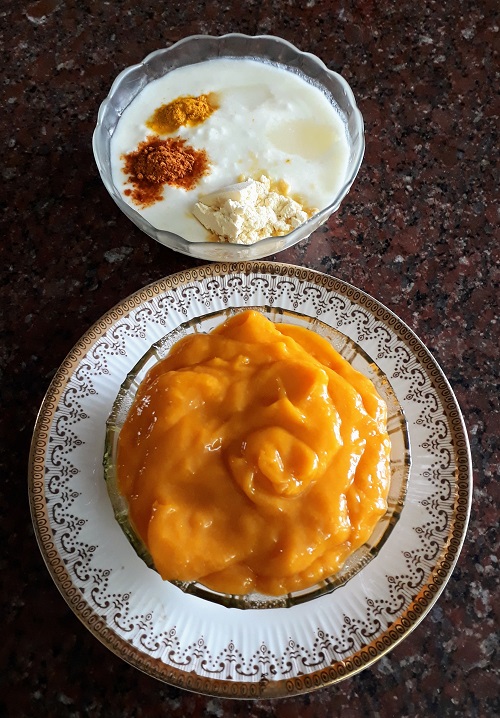
Mango Kadhi is a festive dish which can not be resisted especially during Mango season when sweet and juicy mangoes are available in abundance. Mango Kadhi is almost similar to Mambazha Morkuzhzmbu except that few ingredients are slightly different . It is exotic ! It is delicious ! It is a five minute wonder ! So why delay ? Go ahead and cook the mango magic in a jiffy as you go through this easy recipe!
INGREDIENTS
Smooth pulp of one sweet ripe mango
Thick curd - 1 Cup
Besan - 1heaped tbsp
Turmeric powder - 1 pinch
Chilly powder - 1/4 tsp
Salt - 1/4 tsp
Sugar - 1/4 tsp
Asafoetida - 1 pinch
# Blend all the ingredients until smooth using a spoon and keep aside .
SEASONING INGREDIENTS
Sesame oil - 1 tbsp
Mustard seeds - 1/4 tsp
Cumin seeds - 1/4 tsp
Broken red chillies - 2
Curry leaves - a few
# Heat oil in a kadai and add the seasoning ingredients one by one as listed above.
PREPARING THE KADHI
# Stir in the prepared mango - curd mixture to the seasoning and cook for two minutes till the Mango Kadhi acquires a rich colour .
Enjoy the creamy delicious MANGO KADHI with Poories or Parathas ! Or relish a bowl of mango magic as it is !
CAK was intended for documenting recipes cooked at home for the reference of children who stayed far away from home base . As our family circle started expanding to other states through marital connections an array of recipes belonging to different regions are also being documented in CAK . Learnt the recipe of a simple and tasty dish from a sweet angel who will be part of our family soon . As the name suggests powdered lentil and spice are used in the preparation of Besan Capsicum Curry . It reminds me of Paruppu Usili which is also prepared using lentil - but soaked and ground - along with any selected vegetable. Here is the recipe of a yummy Rajasthani dish slightly altered to my convenience !
INGREDIENTS
Capsicum ( Chopped finely ) - 2 cups
Sweet corn ( Steamed ) - 1/4 cup ( Optional)
Besan ( dry roast ) - 1/2 cup
Chilly Powder - 1 tbsp ( Instead I love to use my Sambar Powder ! )
Dania powder - 1 tsp
Cumin powder - 1 tsp
Turmeric powder - 1 / 2 tsp
Asafoetida - 1/4 tsp
Salt - 1/2 tbsp
Sesame oil - 2 tbsps
Mustard seeds - 1/4 tsp
Curry leaves - a few
METHOD
1. Blend all the dry powders in a bowl .
2. Add chopped Capsicum and steamed sweet corn and mix well .
3. Heat oil in a kadai and splutter mustard seeds and then add the curry leaves.
4. Add the vegetable and spice mixture , and stir well .
5. Stir and cook on medium flame till the capsicum softens .
6. Keep stirring till the oil comes out and the Besan mixture turns reddish in colour.
Enjoy the hot and spicy Besan Capsicum Curry with rotis or rice.
Baingan Bharta , Eggplant chutney and Sutta Kattarikkai Pachadi are oft prepared Eggplant dishes at home. But the spicy roasted Eggplant Slices served along with Kichdi at my daughter's place was an entirely new gastronomic experience for me . As always I tried out the dish at home and now it has become an oft prepared dish too ! Baingan Baja is an easy to make side dish which can turn a simple and healing Paruppu Sadam / Dal Chawal / Bele Tovvae and Anna into a special meal !
INGREDIENTS
Eggplant - 1 ( Choose a fresh and well formed vegetable without blemishes or holes )
Besan - 1/2 cup
Sambar Powder - 1 1/2 tbsps
Turmeric powder - 1 tsp
Salt - 3/4 tbsp
Asafoetida Or any other Masala powder of your choice - 1/4 tsp
Sesame oil - For roasting
METHOD
1. Wash and cut the Eggplant uniformly into 1/4 inch thick slices and immediately immerse them in water.
2. Mix all the dry ingredient together in a shallow plate.
3. Drain the Eggplant slices and dust them thoroughly on both sides with the spice powder mixture.
4. Let the powder coated slices stand for ten to fifteen minutes till the moisture in the slices absorb the spice.
5. Heat a greased tava and pour one tablespoon of oil on it.
6. Arrange four spice coated eggplant slices on the tava and cover with a lid.
7. After two minutes remove the lid and cook for another minute till you see reddish brown spots on the roasted side.
8. Flip the slices , dribble oil around and roast the other side.
9. When they are done remove the crisp Tava Roasted Spicy Eggplant on to a plate.
10. Cook all the slices similarly batch by batch .
Tastes yummy as they are and goes very well with non spicy rice preparations.
Delighted to write this post after a long pause inspired by the new look of CAK ! Thanks to the efforts of my dear sons , the blog has come out with an attractive makeover .
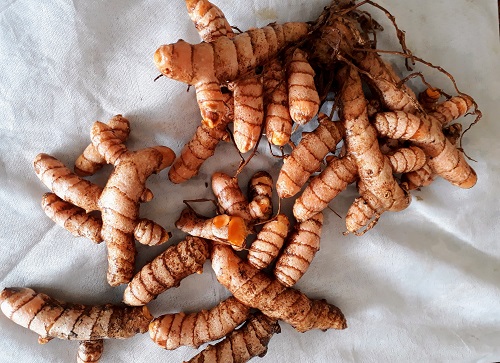
Turmeric is considered auspicious and is used in all festive rituals in India . No Indian kitchen is complete without Turmeric in the spice box . CAK is making a fresh start on this happy Ugadi festival with a Fresh Turmeric recipe.
I was dumb struck when I received a bagful of freshly harvested Turmeric / Pasum Manjal grown in my brother's home garden . What would I do with the enormous quantity of the auspicious rhizomes ? More of them were left on hand even after making Fresh Turmeric Chutney , Fresh Turmeric Gojju. and many more dishes posted earlier in this blog .
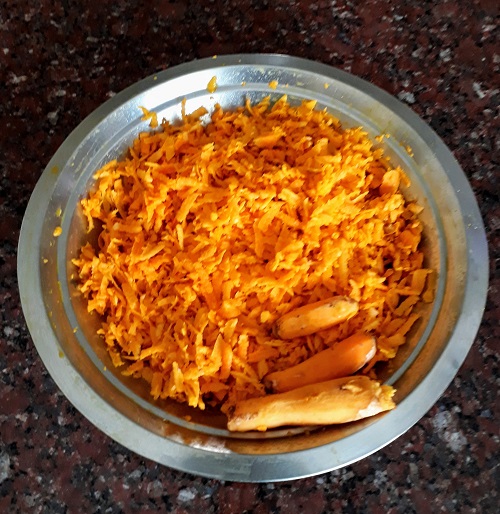
I came across a Rajastani Turmeric Curry recipe while browsing and decided to experiment using my own spice powders . Fresh Turmeric And Curd Curry did turn out delicious!
Gojju also known as Menskai is a sweet sour traditional dish popular in Karnataka . It is one of the mandatory dishes included in a festive spread . Gojjus can be prepared using vegetables as well as fruits. Tamarind is used in the preparation of Gojjus with vegetables like capsicum, okra or bitter gourd. But the same can be omitted while preparing Gojjus using sweet sour fruits like Pineapple, Mango or Gooseberries . Here is a recipe to prepare a sweet sour finger licking Nellikkai Gojju / Gooseberry relish .
INGREDIENTS
Gooseberries - 10
Turmeric powder - 1/4 tsp
Jaggery - a plum size ball
Salt - 1 tsp
INGREDIENTS FOR THE GOJJU MASALA
Split Black gram dal - 2 tbsps
White Sesame seeds - 2 tbsps
Cumin seeds - 1 tsp
Fenugreek seeds - 1/4 tsp
Red chillies - 3 ( Broken)
Grated coconut - 2 tbsps
Oil - 1/4 tsp
TO MAKE THE GOJJU PASTE
1. Dry roast sesame seeds and keep aside.
2. Roast Black gram dal, Fenugreek seeds , Cumin seeds and Red chillies in hot oil till they emanate a very pleasant aroma and allow them to cool .
3. Grind all the roasted ingredients with coconut gratings into a smooth paste adding little water .
TO MAKE THE GOJJU
1. Cover the gooseberries with water and cook adding turmeric powder, salt and jaggery.
2. When the berries are cooked blend in the ground Gojju masala .
3. Stir well and cook till the Gojju thickens and switch off flame.
Add a seasoning with mustard seeds and curry leaves if you wish to.
Enjoy the flavoursome Nellikkai Gojju with steaming hot rice as a main course or relish it as a side dish with your meal.
Rice is the staple food thorough out our country. Especially so in the South since it is widely cultivated in this region. Eating cooked plain rice along with dal and vegetables has been a daily routine since ancient times. Traditionally prepared Variety Rice also known Chitra Anna or Kalanda Sadam is usually limited to only traditional festive menus. Not anymore ! Variety Rice has found its own special niche as a one pot meal in our daily meal plan .
People who have hectic work schedules prefer one pot meals / lunch box meals for the ease of cooking , cleaning and time saving . Variety Rice comes in handy during these situations. Other than Pulavs , Biriyanis and the traditional Chitra Annas , more and more innovative rice recipes with South Indian flavour are coming up on culinary platforms .
Here is a very simple Variety Rice prepared with Potatoes with a pleasant aroma of the nutritious Fenugreek leaves .
INGREDIENTS
Cooked rice - 2 cups
Potatoes ( Pealed and cubed ) - 2 cups
Fenugreek leaves ( Washed and chopped ) - 2cups
Sesame oil - 2 tbsps
Mustard seeds - 1/4 tsp
Cumin seeds - 1/4 tsp
Asafoetida - 1 pinch
Curry leaves - a few
Turmeric powder - 1 pinch
Salt - 3/4 tsp
Sambar powder - 1 tsp
Chopped tomatoes - 1/2 cup
METHOD
1. Heat oil in a kadai and splutter mustard seeds and cumin seeds.
2. Add asafoetida , turmeric powder and curry leaves.
3. Stir in the fenugreek leaves and cook till it wilts.
4. Add the potato cubes , stir , cover and cook on medium flame till almost done.
5. Add salt and Sambar Powder and blend well with potatoes.
6. Cook till the potatoes are roasted and then add the tomatoes.
7. Keep stirring till the tomatoes are just cooked.
8. Switch off flame and add cooked rice.
9. Blend the rice well with the curry gently without mashing the rice or potatoes . A teaspoon of sesame oil can be added at this stage if you feel the rice is too dry.
Enjoy the flavoursome Potato Rice with any raita of your choice or with thick plain curds,
Cooking food wrapped in leaves is an age old practice followed around the world. Cabbage leaves , Grape leaves and Colocasia leaves used for wrapping and steaming are consumed along with the dish . Turmeric leaves, jackfruit leaves and screw pine are also used in steaming different kinds of kadubus which are peeled and discarded before relishing the food. Elai Adai , Idlies and Kadubus acquire a pleasant aroma and retain moisture when banana leaves are either used as wraps or cups for steaming. Here is a steamed dish wrapped in corn husk which I relished during a visit to a farmer's market . I tried out a vegan version of Mexican Tamales using freshly ground Sweet Corn paste and stir fried vegetables . Since fresh corn becomes slightly watery when ground , I have used wheat flour to adjust the consistency of the batter. Besan , Rice flour , Maize flour or any other flour of your choice can also be used .
INGREDIENTS
Fresh Corn Cobs - 2
Wheat flour - 2 tbsps or as required
Salt - 1/4 tsp
Sambar Powder - 1/4 tsp
TO PREPARE THE OUTER COVERING
1. Separate the husks , wash and keep them immersed in hot water till required.
2. Remove the corn from the cob and grind to a smooth paste adding Sambar Powder and salt.
3. Blend in the wheat flour to make a thick spreadable batter.
INGREDIENTS FOR THE FILLING
Finely chopped carrots - 1/2 cup
Finely chopped cabbage - 1/2 cup
Finely chopped capsicum - 1/2 cup
Grated ginger - 1/2 tsp
Grated garlic - 1/2 tsp
Crushed pepper - 1/2 tsp
Salt - 1/4 tsp
Sesame oil - 2 tbsps
TO PREPARE THE FILLING
1. Heat oil and add crushed pepper followed by grated ginger and garlic.
2. When it emanates a pleasant aroma add all the finely chopped vegetables.
3. Stir fry till half done .
4. Stir in salt and switch off flame.
MAKING THE TAMALES
1. Drain and pat dry the soaked corn husks.
2. Spread out a husk and grease it on the inner side.
3.Place a lump of batter and flatten it along the greased husk.
4. Spread about three table spoons of the stir fried vegetables on the batter .
5. Fold the husk bringing the tip and and base of the husk together.
6. Tuck in the folded edges underneath the Tamale and place it in a steamer with the folded edges facing downwards.
7. Line the rest of the husks with batter, fill with vegetables and fold all the Tamales similarly and steam them for fifteen minutes.
8. Relish the warm Vegan Tamales with Tomato Sauce or Green Chutney after discarding the husk.
Gooseberry season has arrived !Time to make lip smacking chutney , pachadi , tokku and pickles using these wonder berries containing an inexhaustible source of nutrients necessary for good health ! Here is a quick and easy to make recipe for Nellikkai Oorugai / Gooseberry pickle. Since it is an instant pickle it can be prepared in small batches as and when required . Stays good up to a week under refrigeration.
INGREDIENTS
Gooseberries / Nellikkai - 250 gms
Sesame oil - 4 tbsps
Chilly powder - 1 tbsp
Salt - 1 tbsp
Turmeric powder - 1/4 tsp
Asafoetida - 1/4 tsp
Powdered Fenugreek seeds - 1/4 tsp
Mustard seeds - 1 pinch
METHOD
1. Wash the Gooseberries/ Nellikkai thoroughly and steam them for 15 minutes and cool them.
2. The segments of the steamed berries will fall apart easily .
3. Remove the seeds from the segments.
4. Heat oil in a kadai and splutter mustard seeds .
5. Add asafoetida , powdered fenugreek seeds and turmeric powder one after another.
6. Stir in the gooseberry segments .
7. Add chilly powder and salt and blend well on low flame for a minute.
8. Switch off flame and cool the pickle before storing in a clean dry jar.
Enjoy your lip smacking Dideer Nellikkai Oorugai / Instant Gooseberry Pickle with your meal .
Gojju also known as Menaskai is a Karnataka delicacy. A wedding feast is never complete without this sweet-sour relish. Gojjus can be prepared using any sweet sour fruit. But Pineapple Gojju / Menaskai is the most popular relish. Here is a unique Gojju / Menskai prepared with Star Fruit known as Kamarakshi in Kannada.
INGREDIENTS
Ripe Star Fruit slices - 2 cups
Tamarind - 1 plum size ball ( Extract juice )
Jaggery - 1 plum size piece
Turmeric powder - 1 pinch
Salt - 1 tsp
INGREDIENTS TO MAKE THE GOJJU PASTE
Sesame seeds - 2 tbsps
Asafoetida - 1 pinch
Split Black gram dal - 2 tbsp
Red chillies ( Broken) - 3
Fenugreek seeds - 1 pinch
Cumin seeds - 1 tsp
Fresh coconut ( Grated) - 2 tbsps
Sesame oil - 1/2 tsp
Mustard seeds and curry leaves for seasoning
TO MAKE THE GOJJU PASTE
1. Dry roast Sesame seeds and keep aside .
2. Roast split Black gram dal, Fenugreek seeds , Cumin seeds, Red chillies and Asafoetida in 1/4 tsp of oil till they emanate a pleasant aroma.
3. Cool the roasted ingredients and grind with roasted sesame seeds and fresh coconut into a smooth paste adding water.
TO MAKE THE GOJJU
1. Lightly scrape the rinds and cut the Star fruits into star shaped slices.
2 . Cook the Star fruit slices in tamarind juice adding salt, turmeric powder and jaggery.
3. Blend in the prepared gojju paste and cook for few more minutes till the gojju thickens and switch off flame.
4. Splutter a pinch of mustard seeds and curry leaves in 1/4 tsp of oil and season the gojju.
Relish the flavoursome Star Fruit Gojju / Menaskai with steaming hot rice.
Spreading joy and good will is the main aim of sharing goodies during festivals. This is the time of the year when the winter months come to a close and Makara Sankranti heralds the arrival of the bright and sunny Spring season . Makara Sankranti is a harvest festival celebrated by all the states in India . Each state celebrates the festival with its own traditional food prepared with the seasonal produce. Sesame seeds which lend warmth and nourishment to the body find an important place in the festive sweets of all states. In Karnataka Yellu Bella - a mixture of Sesame seeds, Jaggery, Peanuts, Roasted Gram and Copra - is distributed among friends and relatives during Sankranti . 'Yellu Bella tindu olle maatanaadu' is a saying which means ' eat sesame and jaggery and speak good words. ' Sesame Laddus and Sesame Chikkis are popular in other states.
Five Seeds Laddu is a Makara Sankranti / Pongal special prepared with a blend of four other healthy seeds along with Sesame seeds.
INGREDIENTS
Sesame seeds - 1/4 cup
Flax seeds - 1/4 cup
Pumpkin seeds - 1/4 cup
Sunflower seeds - 1/4 cup
Chia seeds - 1/4 cup
Raisins - 1 cup
Cardamom - 2
METHOD
1. Dry roast the seeds one by one till they start cracking, emanating a pleasant nutty flavour.
2. Allow the roasted seeds to cool down .
3. Grind the roasted seeds together into a coarse powder .
4. Add raisins and cardamom and grind again .
5. The powder will come together when the seeds start releasing oil .
6. Scoop the powder into a bowl and knead well .
7. Take small portions of the seeds and raisin mixture and firmly shape them into Laddus .
The oil from the seeds and the stickiness in the raisins will help to hold the Laddus together .
Enjoy the healthy Five Seeds Laddus and share them with your near and dear ones during the festival .
CARROT AND OATS PIDI KOZHUKATTAI
Rice being the staple food of the whole of South India , most of the Palagarams in this region like Idlies , Dosas , Aapams and Uthappams are also prepared using rice and lentils. Pidi Kozhukattai is another traditional steamed dish prepared using broken rice and lentils. Many people nowadays try to cut down on their rice intake due to their sedentary life styles and opt for healthier substitutes. Here is a healthy version of Pidi Kozhukattai known as Kadubu in Kannada prepared using Oats , Lentils and Carrots .
Recipe and Pictures Courtesy: Vidya Murali
INGREDIENTS
Oats - 2 Cups
Split Pigeon Peas / Tur Dal - 2 tbsps ( Soaked, drained and coarsely broken)
Carrot - 1 ( Grated )
Fresh coconut gratings - 2 tbsps
Sesame oil - 1 tbsp
Mustard seeds - 1/4 tsp
Split black gram dal - 1 tsp
Green chillies - 2 ( Chopped )
Fresh ginger ( grated ) - 2 tsps
Curry leaves - a few
Asafoetida - 1 pinch
Salt - 3/4 tsp
Curds - 2 tbsps (Optional) METHOD
1. Dry roast Oats till it turns brown emanating a pleasant nutty aroma and keep it aside .
2. Heat oil in a kadai and splutter mustard seeds followed by split black gram dal.
3. When the dal turns golden in colour add asafoetida, green chillies, ginger and curry leaves.
4. Stir in carrot gratings and add two cups of water.
5. Add salt, coconut gratings and curds ( Omit curd if you are vegan ) and bring it to a boil.
6. Stir in roasted Oats and broken dal, cover and cook on medium flame till it absorbs all the water.
7.Take a scoop of the cooked Oats and shape it into a Kozhukattai using your wet palms without pressing too much.
8. Make all the Kozhukattais similarly using the cooked Oats, place them on greased Idly plates and steam them for 6 minutes.
9. Let the Carrot and Oats Kozhukattais rest for ten minutes before you take them out .
Enjoy the healthy Carrot and Oats Kozhukattais with any chutney and gojju / vattal kozhambu of your choice .
BEETROOT CHITRANNA
The first dish which comes to mind when you say Chitranna is the simple Lemon Rice. It is a quick to make tasty dish which lends a festive look to any simple meal . By combining different spices and different fruits or vegetables a simple Chitranna can be turned into a showstopper on special occasions. Kittale Chitraanna, Naartam Pazha Sadam, Anaasa Annam, Manga Sadam, Vangi Bath , Tomato Ogare, Nellikkai Chitranna are few of the many Chitranna / Variety Rice recipes posted in CAK.
Today's recipe is for Beetroot Chitranna .
INGREDIENTS
Cooked Rice - 2 cups
Beetroot - 1 big INGREDIENTS TO BE ROASTED AND POWDERED
Coriander seeds - 1 tbsp
Bengal gram dal - 1/2 tsp
Black gram dal - 1/2 tsp
Cumin seeds - 1/2 tsp
Red chillies - 2 or 3( Broken)
Cinnamon - 1 small piece
Asafoetida - 1 pinch
Sesame oil - 1 drop FOR SEASONING
Sesame oil - 2 tbsps
Mustard seeds - 1/4 tsp
Split Black gram dal - 1 tsp
Peanuts - 2 tbsps
Curry leaves - a few
Salt - 1 tsp
Juice of half lime METHOD
1. Wash and pressure cook beetroot along with the peel.
2. Allow to cool, peel and grate the beetroot and keep it aside.
3. Heat a drop of oil in a pan and fry the cinnamon.
4. Add coriander seeds, Bengal gram dal , black gram dal , cumin seeds , red chillies and asafoetida , and roast till you get a pleasant aroma .
5. Cool the roasted ingredients and grind them into a powder and keep aside .
6. Heat the remaining oil and splutter mustard seeds.
7. Add split black gram dal followed by peanuts and curry leaves.
8. When the nuts crack add grated Beetroot, salt and the spice powder and mix well .
9. Switch off flame and mix in the lime juice.
10. Fluff up the cooked rice and add it to the seasoned beetroot.
11. Add 1/2 tsp of extra oil to prevent the rice from clumping together, and gently blend till each grain of rice is coated with the beetroot palya / curry .
Enjoy the vibrant coloured nutritious Beetroot Chitranna with any raita of your choice.
VEGAN SHEPHERD'S PIE
I had the opportunity to watch my daughter-in-law bake Vegetable Shepherd's Pie about seven years ago. Last week I tried making a Vegan version using the available ingredients in my kitchen for my dear grand daughter. It turned out well and the family enjoyed the one dish meal which was quite filling and tasty too !
INGREDIENTS
Potatoes ( Cooked and mashed smoothly ) - 2 to 3 cups
Cabbage ( Minced ) - 2 cups
Carrots ( Finely chopped ) - 2 cups
Capsicum ( Minced ) - 2 cups
Beans ( Finely chopped ) - 2 cups
(All vegetables of your choice either grated or minced can be included )
Onion - ( Finely chopped ) - 1 cup
Tomatoes ( Finely chopped ) - 1 cup
Cumin seeds - 1/2 tsp
Fresh ginger ( grated ) - 1 tbsp Sambar Powder - 1 tsp ( I love to add this to all my recipes for its flavour and colour!)
Salt - 1 1/2 tsp
Sesame oil - 2 tbsps
Quinoa - 1/2 cup
Cashew nuts - 12
Pepper powder - 1 tsp TO MAKE CASHEW CHEESE
Soak Cashew nuts in warm water for half an hour and drain them. Add a pinch of salt and a pinch of pepper powder and grind the soaked nuts into a spreadable paste adding little water . Now your Vegan cheese is ready. (Addition of a spoon of nutritional yeast would give it a cheesy flavour ) TO COOK QUINOA
Wash and soak Quinoa for about fifteen minutes and drain. Add one cup of water and cook on medium flame till the water evaporates. TO PREPARE THE PIE
1. Heat oil in a kadai and splutter cumin seeds.
2. Add chopped onion and grated ginger and saute till it turns glassy.
3. Add tomatoes followed by Sambar Powder and salt , stir and cook till it becomes mushy.
4. Add all the chopped vegetables one by one and stir fry till done.
5. Add cooked quinoa, about two table spoons of mashed potatoes and a dash of pepper powder and blend well with the sauteed vegetables.
Taste the vegetable filling and adjust salt if necessary.
6. Grease a baking dish . Fill it up with the vegetable filling and pat and pack it neatly into the dish.
7. Add a dash of pepper powder and salt to the remaining mashed potatoes and whip well to make it smooth .
8. Spread the whipped potato evenly on top of the vegetables .
9. Spread the Vegan Cashew Cheese evenly on top of the potato layer.
Vegan Shepherd's Pie is ready to be baked.
Bake the pie in a pre heated oven at 350 degree F for twenty minutes until the top turns into a golden brown clolur .
I used the Convection Cooking option in my microwave to bake the Pie. Cooked the Pie for 20 minutes at 200 degrees C in the pre heated oven.
Once the top turns golden in colour allow the Vegan Shepherd's Pie to slightly cool down and then remove it carefully from the oven .
Scoop out a portion of the Vegan Shepherd's Pie into the serving plate and enjoy with tomato sauce.
KARUVEPPILAI KUZHAMBU
This month is full of Poojas and festivals traditionally followed by huge spreads of festive food . This is the time when people who follow different types of health diets tend to enjoy their cheat meals to their heart's content . The sudden change in eating routine may cause certain gastrointestinal issues later. Karuveppilai Kuzhambu - a spicy and tangy curry leaf gravy - is a remedial dish to avoid such issues and also to set right the system.
INGREDIENTS
Curry leaves - 2 cups tightly packed ( washed and patted dry )
Coriander seeds - 1 tbsp
Bengal gram dal - 1 tbsp
Split black gram dal - 1 tsp
Red chillies - 3 ( broken )
Cumin seeds - 1 tsp
Asafoetida - 1 pinch
Tamarind - a marble size ball ( Soaked in warm water )
Salt - 1 tsp
Sesame oil - 1 tsp
Ghee or oil ( for seasoning ) -1/2 tsp
Mustard seeds - 1 pinch METHOD
1. Heat oil in a pan and add the dals , coriander seeds , broken red chillies , cumin seeds and asafoetida and roast till the ingredients emanate a pleasant aroma.
2. Add curry leaves and saute till the leaves wilt.
3. Allow the ingredients to cool down and grind them together in a mixer .
4. Add the soaked tamarind and one glass of water to the ground mixture and once again blend together in the mixer.
5. Pour back the curry leaf and spice liquid into the pan .
6. Add salt and cook till it thickens into a Kuzhambu / gravy. ( The gravy should not be too thick like chutney nor too runny like soup.)
7. Splutter mustard seeds in 1/2 tsp of ghee or oil and pour it over the Kuzhambu / gravy.
Enjoy the flavoursome Karuveppilai Kuzhambu / Curry Leaves Gravy with a morsel of steaming hot rice at the beginning of a meal.
MOLAKE MENTHYA TOVVAE / MULAI KATTIYA VENDAYA PARUPPU
Fenugreek seeds / Menthya / Vendayam have their own health benefits. Including these seeds in the diet helps in good digestion . Chewing 1/4 tsp of these seeds followed by drinking a warm cup of water alleviates flatulence. They are said to have lactogenic properties hence used in the preparation of postpartum diets. Soak a spoon of Fenugreek Seeds in a cup of warm milk and stir in a teaspoon of curd . Allow it to set overnight . Having the fresh 'Fenugreek Curd' along with the soaked seeds on an empty stomach in the morning cools down the body system . Sprouted Fenugreek Seeds are known as Molake Menthya in Kannada and Mulai Kattiya Vendayam in Tamil. These sprouts are as nutritious as all other sprouts and are especially rich in protein. Fenugreek Sprouts can be included in salads . They can be made into Kuzhambus or added to the batter while steaming Idlies or making Dosas. Here is a recipe where Fenugreek Sprouts are used in making a delicious Dal / Tovvae / Parupu.
INGREDIENTS
Fenugreek Sprouts - 1 cup
Split pigeon peas/ Tur Dal - 1cup
Turmeric powder - 1/4 tsp
Onion ( Finely chopped ) - 1/2 cup
Tomatoes ( Chopped ) - 1/2 cup
Fresh ginger ( Finely chopped) - 1 tsp
Curry leaves - a few
Mustard seeds - 1 pinch
Cumin seeds - 1/4 tsp Sambar Powder - 3/4 tsp
Salt - 3/4 tsp
Sesame oil - 2 tbsps TO SPROUT THE FENUGREEK SEEDS
Wash and soak 1 cup of Fenugreek Seeds in clean water for 12 hours.
Drain the seeds and store them in an air tight container.
Leave the container in a warm place overnight.
Next morning you will see the sprouts.
Sprinkle little water if they look very dry , close the lid , shake well and leave it for another day to obtain longer sprouts.
Store in refrigerator for future use . TO MAKE THE DAL
1. Pressure cook dal adding turmeric powder and 2 cups of water .
2. Heat oil in a kadai and splutter mustard seeds followed by cumin seeds .
3. Add ginger, curry leaves and chopped onion and saute till the onion turns golden in colour.
4. Stir in chopped tomatoes, followed by Sambar powder and salt .
5. Cook till the tomatoes become mushy.
6. Add the Fenugreek Sprouts and stir for two minutes.
7. Mash the cooked dal and add it to the kadai .
8. Add 1/2 cup of water, stir and bring it to a boil. ( Optional : Half a tsp of garam masala powder may be added at this stage )
9. Switch off flame when all the ingredients combine well.
Enjoy the Molake Menthya Tovvae / Mulai Kattiya Vendaya Paruppu / Sprouted Fenugreek Dal
with rice or chapaties .

 Login
Login


%20resized.jpg)


%20resized.jpg)


%20resized.jpg)
.jpg)


%20resized.jpg)
%20resized.jpg)