Reading view

There are new articles available, click to refresh the page.

Bitcoin Bulls Eye Dollar Weakness As Yen Intervention Rumors Build

Bitcoin traders are once again anchoring to FX, after intervention rumors around USD/JPY revived a familiar tug-of-war: short-term shock risk from a strengthening yen versus the longer-horizon bid that typically follows a softer dollar and easier global liquidity.

The spark over the weekend was a viral X thread (2.9 million views) from Bull Theory (@BullTheoryio), which framed reported “rate checks” by the Federal Reserve Bank of New York as a prelude to coordinated action. “The New York Fed has already done rate checks, which is the exact step taken before real currency intervention,” the account wrote. “That means the US is preparing to sell dollars and buy yen. This is rare. And historically, when this happens, global markets surge.”

Bitcoin In The Crosshairs

Bull Theory pointed to the macro backdrop in Japan, years of yen weakness, Japanese bond yields at multi-decade highs, and a still-hawkish Bank of Japan, as the pressure cooker forcing officials toward more aggressive signaling. In the thread’s telling, the key variable is coordination: Japan acting alone “does not work,” while joint US-Japan action “does,” citing 1998 and the Plaza Accord era as historical reference points.

A Bloomberg report cited by the account described the yen’s sharp jump on speculation that Japanese authorities could be preparing intervention to arrest the currency’s slide, after traders reported the New York Fed had conducted rate checks with major banks. The story said the yen rallied as much as roughly 1.6% to around 155.90 per dollar, marking its strongest level since December in that session.

🇺🇸 THE FED IS PREPARING TO SELL U.S. DOLLARS AND BUY JAPANESE YEN FOR THE FIRST TIME THIS CENTURY.

The New York Fed has already done rate checks, which is the exact step taken before real currency intervention. That means the U.S. is preparing to sell dollars and buy yen.

This… pic.twitter.com/7xFReOFoDo

— Bull Theory (@BullTheoryio) January 25, 2026

The fight in the replies was less about whether markets moved and more about what a “rate check” actually signals.

Daniel Kostecki (@Dan_Kostecki) dismissed the viral framing outright, arguing the mechanism is often misread. “The Japanese asked the NY Fed to act as their agent in the American market,” Kostecki wrote. “NY Fed employees then started calling banks in New York to perform the ‘rate check’—strictly at the Japanese’s request. If officials from Tokyo had called New York banks, traders might have ignored it as a ‘local Japanese problem.’ But when the Fed calls, banks treat it as a signal that a joint intervention (USA + Japan) might be coming.”

That distinction matters for crypto because the thread’s “bull case” leans heavily on the idea that selling dollars to buy yen mechanically weakens the dollar and expands liquidity, conditions many macro-focused crypto traders associate with risk-asset upside.

Ted (@TedPillows) echoed the liquidity-first interpretation while flagging the path dependency. “The Fed is preparing for a possible yen intervention,” he wrote, before laying out the causal chain: dollars sold, yen bought, dollar weaker, liquidity higher, risk assets helped, then warning that “a strengthening yen could first cause a similar crash like in August 2024.” After that, he added, markets could stabilize and rally.

Michael A. Gayed (@leadlagreport), Portfolio Manager of The Free Markets ETF, offered a different rationale for why Washington would care, suggesting the Fed is acting to prevent a scenario where Japan would need to sell US Treasuries to raise dollars to intervene—“It’s not that Japan will panic. It’s the Fed that will panic,” he wrote.

Bull Theory’s most concrete crypto claim was that the setup contains both a near-term trap and a medium-term tailwind. The account argued there are “hundreds of billions of dollars tied into the yen carry trade,” meaning abrupt yen strength can force deleveraging in the very assets, stocks and crypto, funded with cheap yen borrowing.

As an example, the account pointed to August 2024, claiming a small BoJ rate hike pushed the yen higher and “Bitcoin crashed from $64K to $49K in six days,” with crypto losing “$600B in value.” Bull Theory framed that episode as the template for the “catch” in 2026: yen strength can be toxic in the first act, even if sustained dollar weakness ultimately improves the liquidity backdrop for Bitcoin.

LondonCryptoClub (@LDNCryptoClub) leaned into that lagged-liquidity framing, arguing that a weaker dollar tends to filter into risk assets with a delay, while also introducing an additional US liquidity variable. “Continued and accelerated breakdown of the dollar will be good for Bitcoin and broad risk over the next few months,” the account wrote, adding that the dollar “tends to act with a 3 months lag” outside of “knee jerk reactions.” It also warned that a potential US government shutdown and subsequent Treasury General Account rebuild could offset some of the positive liquidity impulse.

At press time, Bitcoin traded at $87,926.
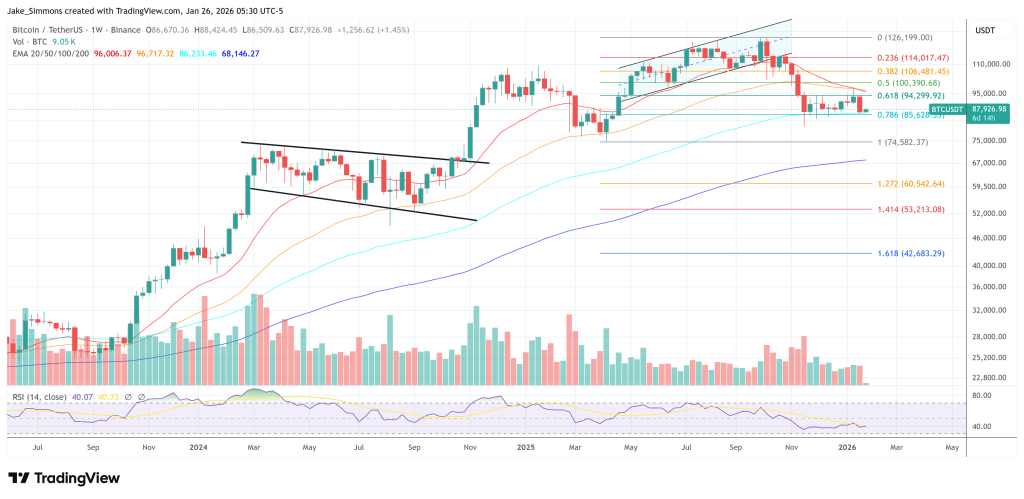
Bitcoin price chart

Joe Nguyen named Seattle Chamber president and CEO after leaving Washington state Commerce role

Seattle Metropolitan Chamber of Commerce President and CEO Joe Nguyen. (Legislative Support Services Photo)

Joe Nguyen is the new president and chief executive officer of the Seattle Metropolitan Chamber of Commerce, the organization announced Monday.

Less than a week after revealing that he was stepping down from his role as director of Washington state’s Department of Commerce, Nguyen was confirmed as the head of Seattle’s business advocacy organization.

A tech veteran who previously worked at Microsoft and Expedia, Nguyen previously served in the Washington State Senate representing Seattle’s 34th Legislative District. He said his focus as Chamber CEO will be on ensuring the region is an attractive place to do business, grow companies, and create jobs.

“The Chamber plays a critical role in advocating for policy outcomes that support businesses and our region’s economic stability,” Nguyen said in a news release. “My priority is to work closely with our members and policymakers to strengthen the business climate, ensure smart use of public resources, and advance solutions that support job creation, affordability, and a safe, thriving regional economy.”

The Chamber job has been open since Rachel Smith left as the organization’s president and CEO to become president of the Washington Roundtable. Nguyen succeeds interim Chamber President and CEO Gabriella Buono.

“He brings an incisive, results-oriented approach and the ability to work across sectors to advance a strong, competitive economy for the Seattle region,” Chamber Board Chair Teresa Hutson, a Microsoft executive, said in a statement.

Nguyen told Commerce employees last Tuesday that he was leaving after one year on the job, but he didn’t say where he was headed. Rumors began circulating online and among business lobbyists in recent days, according to the Washington State Standard, which noted that Nguyen is the first member of Gov. Bob Ferguson’s executive cabinet to quit, though others have retired.

At Commerce, Nguyen managed a budget of $7.9 billion and administered more than 100 programs in the areas of housing, energy, community and economic development, local government and business services.

The Seattle Chamber is an independent business organization with 2,600 members.

Nguyen, who will officially assume the Chamber role at the end of January, is a lifelong Washington resident and graduate of Seattle University, where he earned degrees in finance and humanities.

Previously:

Washington state Commerce chief Joe Nguyen is leaving, reportedly to lead Seattle Metro Chamber

Commerce Director Joe Nguyen speaks at the Tech Alliance State of Technology Luncheon in Seattle. (GeekWire File Photo / Todd Bishop)

This story first appeared in the Washington State Standard.

Joe Nguyen is stepping down as director of Washington state’s Department of Commerce and is expected to be named the next leader of the Seattle Metropolitan Chamber.

Nguyen told Commerce employees on Tuesday that he is leaving but didn’t disclose his new job. He said he didn’t anticipate taking off “until sometime in January.”

“Although I can’t tell you where I’m going just yet, I will be working in Seattle, closer to home,” he wrote in an agencywide email. “Sometimes opportunity knocks, even when you haven’t invited anyone to your door. Recently I was offered an opportunity outside of Commerce that I have accepted because it was the right thing to do for my family.”

The chamber, an independent business organization with 2,600 members, plans an announcement Monday concerning its chief executive officer position. A spokesperson declined further comment.

Rumors of Nguyen’s selection had begun circulating online and among business lobbyists in recent days. Nguyen did not return multiple phone calls for comment.

The job has been open since Rachel Smith left as the organization’s president and CEO to become president of the Washington Roundtable.

Nguyen, a White Center Democrat, was in his second term in the state Senate representing the 34th Legislative District when Gov. Bob Ferguson named him to the high-ranking post. He is the first member of Ferguson’s executive cabinet to quit, though others have retired. 

Nguyen led an agency with a $7.9 billion budget and that administers more than 100 programs in the areas of housing, energy, community and economic development, local government and business services. One of its largest portfolios is promoting development of affordable housing, a top priority of Ferguson’s.

In his email to employees, Nguyen wrote he was “honored” that Ferguson “put his faith in me nearly a year ago and I thank him for that trust.” He said he did not know if Ferguson would install an interim leader or hire a new director right away.

In a statement, Ferguson praised the outgoing director and didn’t say how he plans to replace him.

“I spoke with Joe, and it’s clear he received an offer he couldn’t refuse,” Ferguson said. “I deeply appreciate Joe’s work this past year. Joe always has an open invitation to join my administration in the future.”

Republished from Washington State Standard under Creative Commons license CC BY-NC-ND 4.0.

❌