Gold shone brightly today, racing to a new high while crypto took the back seat, and the gap between the two assets opened wide.
On Monday, the precious metal moved past the $5,000 mark, registering a price point market sentinels had not witnessed before. Bitcoin, by contrast, failed to keep pace and traded well below its recent highs.
Gold Hits Record Levels
Safe-haven demand pushed gold sharply higher. Prices were up above $5k an ounce and inked roughly $5,110 at the peak. Silver, for its part, did not go unnoticed, jumping to fresh peaks near $107/ounce.
Traders pointed to simmering geopolitical friction and talk of tougher trade moves led by US President Donald Trump as fuel for the rally.
A weaker greenback made metals more attractive to customers overseas, and central bank buying provided steady backing. Liquidity in some corners were thin as investors rushed to shift cash into things that feel stable when risk elevates.
Bitcoin Falls Behind
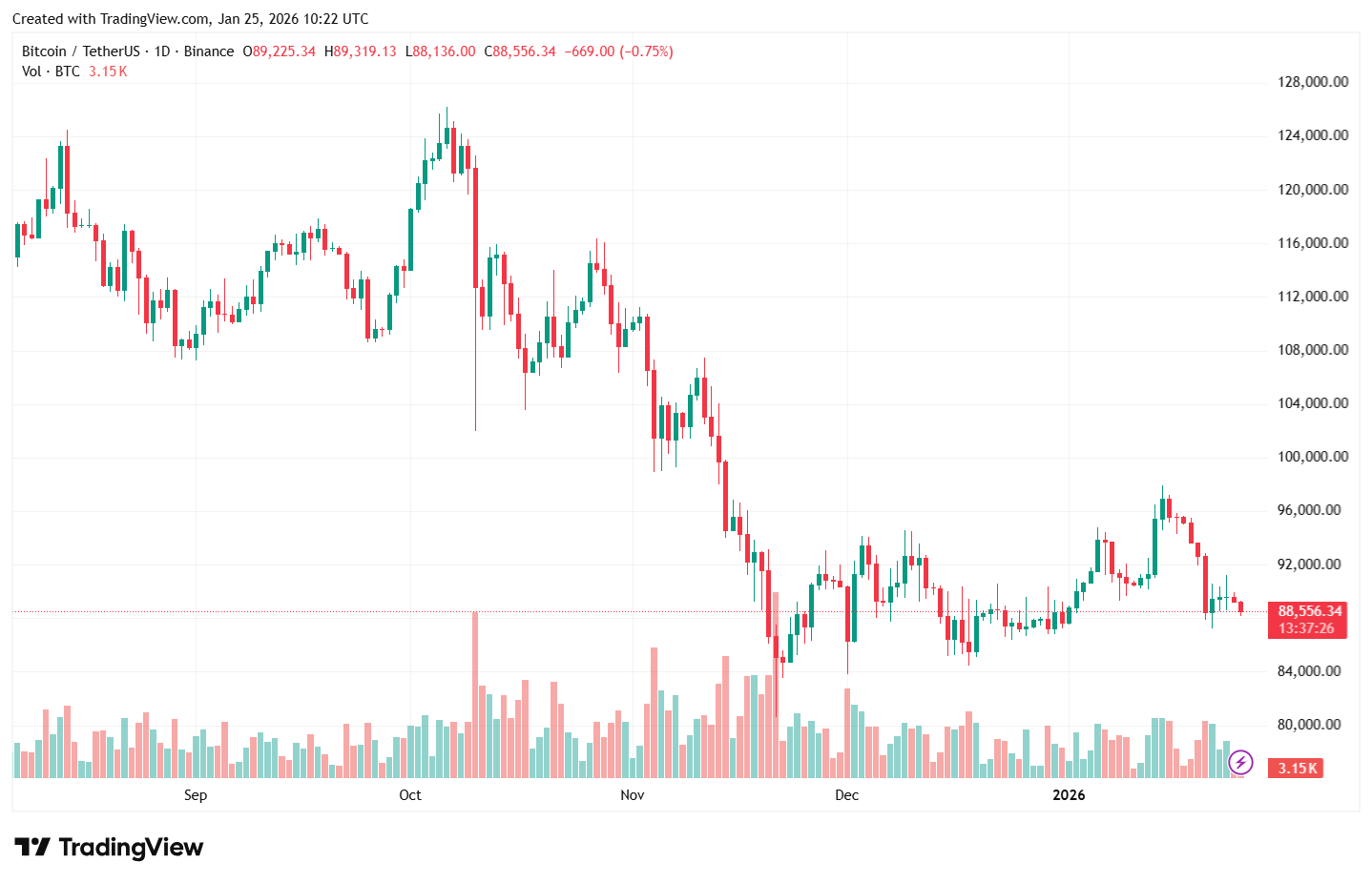
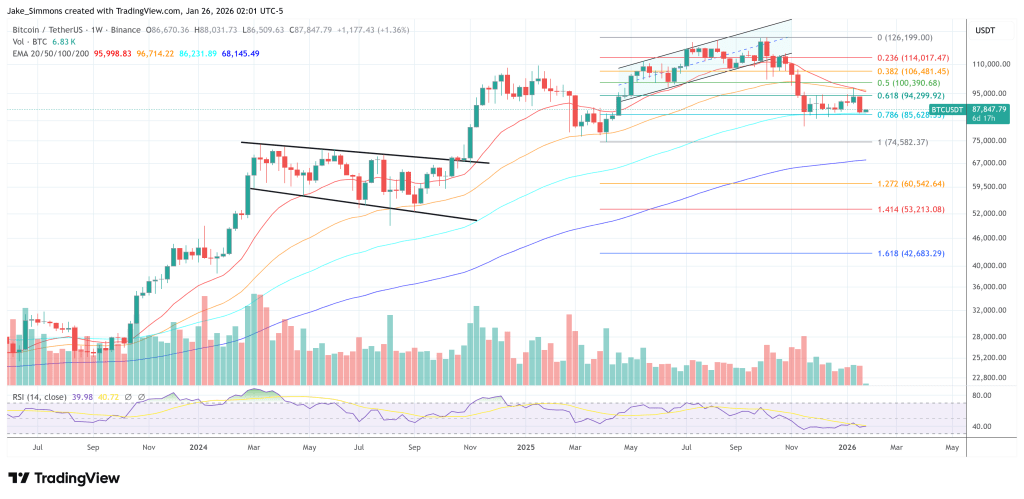
Market numbers show Bitcoin hovering in the mid-$80,000s range, retreating from peaks seen late last year. Reports note the alpha crypto is roughly 30% below the highest level it hit reached in October 2025, leaving some holders quite jittery.
Volatility was another factor. Where bullion is being sought for safety, Bitcoin is viewed more as a growth or speculative play, and that difference in investor application becomes clear when markets tighten. Some funds slashed their crypto exposure, signaling a short reroute away from high-risk gambits.
Why Investors Are Shifting
Analysts and traders described a simple choice: shelter or swing for gains. When headlines push worry, money flows into assets that are widely trusted across markets and governments.
Metals fit that ticket. Based on market chatter, fears of a US government funding clash and fresh tariff announcements stacked pressure on stocks and added a sense of urgency to safe-haven acquisition.
Options and futures trading hinted at a more cautious perpective, with volatility indexes rising and bond yields behaving in ways that made the yellow metal look more appealing by comparison.
What Traders Are Watching
Market watchers said eyes will be glued on a few key metrics: The dollar’s path, moves by major central banks, and any sign that US politics escalates could keep metals elevated.
For Bitcoin, network activity, large wallet flows, and regulatory headlines will likely set the tone. Some traders expect swings both ways. Others caution that when risk appetite is back, crypto may bounce hard, but that outcome is not a sure thing and will be dependent on a string of policy and macro moves.
Featured image from Unsplash, chart from TradingView
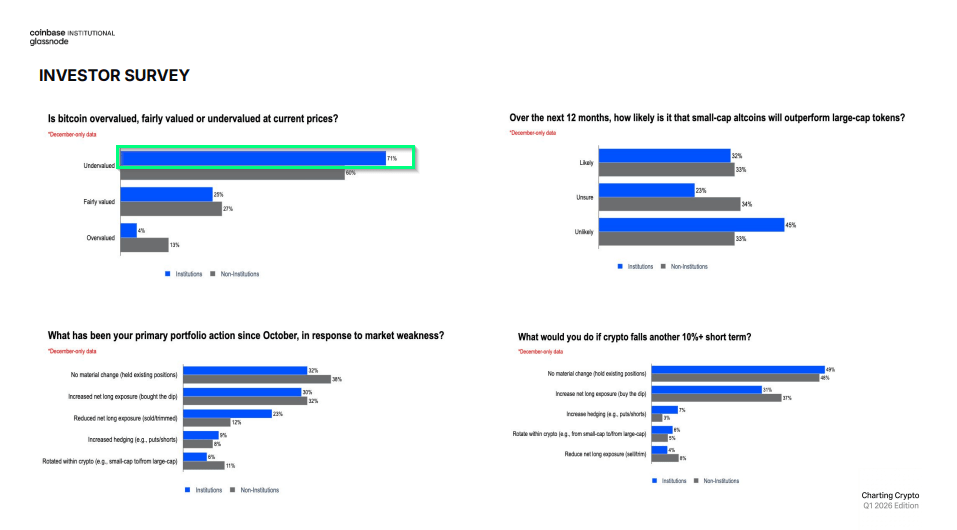
Investors are showing a steady faith in Bitcoin even as money moves elsewhere. According to Coinbase’s Charting Crypto Q1 2026 report, many big players think the current price is a bargain. The mood is cautious, but the view among large institutions leans toward holding for the long run.
Institutional Confidence And Behavior
Reports say about 71% of institutional investors view Bitcoin as undervalued when it sits between $85,000 and $95,000. Independent investors are not far behind, with 60% sharing that view.
A quarter of institutions felt the price was fair, and only a small share thought it was too high. These numbers show a strong tilt toward belief in future gains.
Gold And Silver Are Doing Very Well
Gold has climbed sharply, and silver has more than doubled since last October. That flow into metals has come as investors seek shelter while worries over global tensions rise.
Stocks have not surged as much; the S&P 500 has posted modest gains. The contrast is clear: some money went into traditional hedges instead of crypto.
Geopolitical Friction And Trade Signals
Reports note renewed tariff threats from US President Donald Trump and rising strain between the US and parts of the Middle East.
Such moves have been linked to market nervousness. If energy supply or trade routes are hit, risk assets often wobble. That makes Bitcoin more sensitive than usual to headlines.
Bitcoin Price Action In Context
Bitcoin has been trading in the high $80,000s. It briefly tried to hold above $90K but slipped back, touching nearer $86,000 at times.
Volatility has returned, and liquidations were seen after the big October move. Still, many technical analysts keep longer-term targets on their charts, arguing that the broader trend is not necessarily broken.
Institutional Game Plan
Reports say 80% of those large investors would either keep their stakes or add more if prices fell another 10%. More than 60% have already held or raised their positions since October’s peak.
Over half think the market is in an accumulation phase or still in a bear cycle, which explains why many prefer to buy on weakness rather than sell.
Macro Outlook And Possible Tailwinds
Coinbase expects the Federal Reserve to cut rates twice in 2026, an outlook that could help risk assets if it comes to pass. Consumer inflation has been steady and GDP growth looked strong in the last quarter. These conditions could nudge sentiment back toward risk-taking, though timing is far from sure.
The story is not simply bullish or bearish. On one hand, large investors show clear conviction and are willing to act on dips.
On the other, safe-haven flows and geopolitical shocks keep a lid on rapid re-rating. The near-term path is likely choppy, while the longer view depends on whether macro calm returns and whether demand for crypto picks up again.
Featured image from Unsplash, chart from TradingView
How to hack Bitcoin? How does the blockchain calculate time? How does mining difficulty change? What happens if two miners mine a block simultaneously? Where are transactions stored before confirmation, how are fees calculated, and is it possible to send a transaction with zero fee? What types of nodes exist in the blockchain, and how do they differ? When can you use mining rewards?
This is roughly how I studied all the information around these topics.
Here I provide deeper answers to these questions because popular materials about Bitcoin either don’t explain these things at all or do so very superficially. To understand this article, you need a minimal understanding of how blockchain works, which you can get here: https://vas3k.com/blog/blockchain/
TL;DR
How to hack Bitcoin? A quantum computer will only be able to derive a private key from a public key after a transaction has been sent. If no transaction has occurred, the wallet is protected. A 51% attack only provides the ability to cancel your own or others’ transactions to double-spend your own coins; gaining control over others’ coins is impossible.
How does mining difficulty change? Difficulty is recalculated every ~2 weeks based on the mining time of the previous two weeks.
What happens if two miners mine a block at the same time? The chain temporarily splits until one branch becomes longer. The longer branch becomes the main one.
When can mining rewards be used? After 100 blocks.
How does the blockchain calculate time? Based on the median time of the past 11 blocks and the system time of the nodes.
Where are transactions stored before confirmation, how is the fee calculated, and can you send without one? They’re stored on nodes for no more than two weeks. A zero-fee transaction is theoretically possible but practically almost impossible to get confirmed.
What nodes are in the blockchain and how do they differ? Full nodes — hold the blockchain data and enforce the rules. Miners — query full nodes for data and build new blocks. Light nodes — often used in wallets on weak devices; they query full nodes for what they need.
What’s the point of Bitcoin (besides speculation), in plain English
At the end of researching.
Bitcoin is an alternative financial system that does not require user trust. When using traditional banks, we must trust them not to steal or lose our money, and if that happens, we must trust the state to be able to return it. We also have to hope that money won’t be blocked at the whim of authorities or bank employees.
The point of Bitcoin is the opposite: everything is tied to strict mathematics that removes the probability of all these potential problems (or drastically reduces), provided you store Bitcoin in a personal non-custodial wallet.
Non-custodial wallet: A wallet controlled only by whoever has the private key; essentially just a small file/program that stores keys and signs transactions.
Custodial wallet: An account on an exchange that controls your assets and stores your funds in its own non-custodial wallets. This allows the exchange to block or seize your funds if you violate its rules or national laws, though the exchange offers more convenient and expanded functionality in return.
Interesting fact: A Bitcoin wallet is not an object inside the blockchain, but a program that stores keys and signs transactions.
The blockchain stores UTXOs (Unspent Transaction Outputs). Each UTXO is “locked” by a condition (program), usually tied to an address (practically, a hash of a public key).
To spend a UTXO, the wallet creates a transaction referencing that UTXO as an input and adds a signature. Network nodes verify the signature and the script’s execution. As a result, the old UTXO becomes spent, and the transaction creates new outputs — new UTXOs for the recipients.
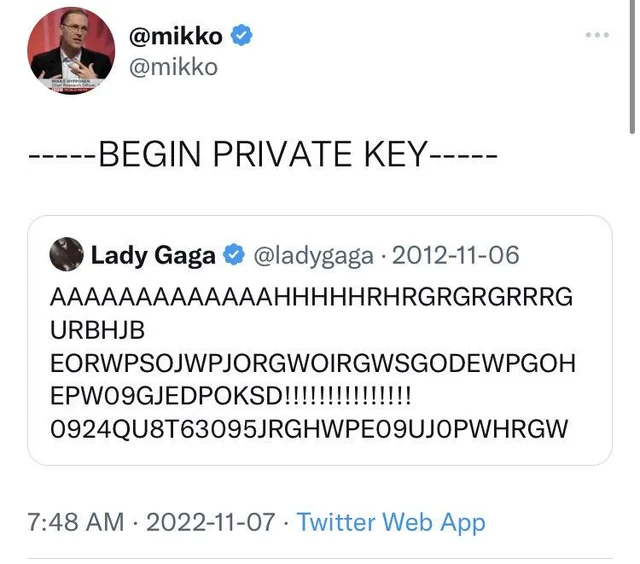
A private key is a number. A public key can be calculated if you have the private key, but the reverse is practically impossible (how that’s attacked is discussed later in the “attacks” section). Using a private key, you can sign data, but this signature cannot be forged with a public key. Meanwhile, the public key can verify that the signature was produced by the corresponding private key.
— — — — —END-PRIVATE-KEY — — — — —
In early versions, the wallet address was the public key. But later, addresses derived as a hash/encoding of the key or script began to be used. This is a crucial point for the section on quantum computer attacks.
Once a transaction is signed, it must be embedded in a block. First, it goes into a general pool of unconfirmed transactions (mempool), where any miner can take it to create a block.
But a transaction can exist only once in the blockchain, so the network can’t allow every miner to create their own block with the same set of transactions and have them all accepted.
Block Header
Each block has a header containing version data, the previous block’s hash, the merkle root (hash of all transactions in the current block), time, bits (mining difficulty), and a nonce.
All of these fields are combined and then hashed via SHA-256.
SHA-256 is a hashing technology: take some data and turn it into a different set of numbers that you can’t convert back into the original data if you only know the hash. But you _can_ verify it, because for a fixed input X the result is always the same output Y. So knowing X gives you Y; knowing Y does not practically give you X back — even with a quantum computer.
You can try hashing any data here. SHA-256 is also one of the core tools in the HTTPS connections we use every day, and it plays a key role in hundreds of internet protocols.
The nonce is needed to find out whose block to record. Miners change the nonce so the header’s hash is less than the target. In our example, the hash has 19 zeros.
Finding such a hash is hard. It takes roughly ~10 minutes of the entire Bitcoin network’s mining power. Blocks should appear roughly every 10 minutes — that’s how Satoshi Nakamoto designed it.
Why exactly this many zeros, and how does mining difficulty change?
Proof of Work in real life
It’s not actually about the zeros, but about the **target**. The target determines mining difficulty: the smaller the target, the higher the difficulty. A valid block header hash must be ≤ the target. Because small target numbers in hexadecimal start with zeros, hashes often appear with many leading zeros (e.g., ~19 or more). The smaller the target, the rarer it is for a random hash to land below it, so mining becomes harder.
Difficulty Calculation Hack: If the difficulty increases by 16 times, the required threshold becomes 16 times lower— often resulting in one additional leading hex-zero.
Difficulty adjustments (retarget) occur every 2016 blocks (roughly 2 weeks, 1 block ~10 minutes). The blockchain uses a simple formula:
Target_new= target_old*T_act/T_exp, 4Texp
Target_new = new target (new difficulty) Target_old = old target T_act = actual time it took to mine the last 2016 blocks T_exp = expected time for 2016 blocks: 2016*600 seconds (10 min = 600 sec) 4T_exp= The change is limited: difficulty can’t shift more than 4× either way.
If, since the last difficulty retarget, the network’s total hash rate (the combined power of all miners) has increased over the past 2,016 blocks, then with near-certainty the average time to mine a block will decrease. That means the actual time to produce those 2,016 blocks T_act will be less than the expected time T_exp, so T_act/T_exp < 1. As a result, the new target Target_new will go down: and the lower the target, the higher the difficulty and the harder it is to mine.
But what to do if two different miners mine a block at the same time?
That happens,and there’s a safety mechanism for it.
In theory, they can make practically identical blocks if the same transactions in the same order fall into each block. But blocks still won’t be identical because the first transaction in every block is the coinbase (the miner reward), and it pays to the miner’s address — so two miners can’t have the exact same block because their addresses differ.
But it is possible that two miners almost simultaneously mine different blocks. If the delay between the creation of a block and its distribution among nodes is 2 seconds, then this means that after the creation of the first block, there is a two-second gap in which a second block can be created. The longer this time, the higher the probability, but with each year this time is reduced. The probability of creating three blocks is almost negligible, but the protection system is the same.
If two blocks are created, they are saved in nodes, and these two chains are passed further. Miners then choose which block to build on — usually the one they saw first. And when they find the next block for one of the chains, it is distributed further and the nodes agree with it, and the shorter version is forgotten. This is the rule of the longer chain. Even if 2, 3, or more blocks in a row are formed in two chains, sooner or later one branch outpaces the other.
Transactions have 3 probable paths:
1. Fall into the chain that wins, then they remain in the blockchain. 2. Fall into both chains, then only the version in the winning chain remains relevant. 3. Fall into the chain that loses, then they go again into the pools of unconfirmed transactions (more on this below).
A few numbers:
Approx. probability of a fork given ~1s delay: 0.17%
A second block on the same competing branch: 0.00028%
Third: 4.6*10^⁻⁹
Fourth: 7.7*10^⁻¹²
That’s why exchanges don’t credit your deposit after 1 confirmation. Typically they wait for 6 confirmations — ~1 hour on average (6 blocks × 10 minutes).
There is no limit to the length of the second/third chain because they disappear quickly. Not counting these two cases:
Reorganization through 53 blocks due to a bug in the software (source).
Another incident with reorganization through 24 blocks (source).
And there is also the possibility of an attack through a second chain, but about this at the very end.
From this follows the next question:
Since the miner receives a reward for mining a block, what happens when two blocks are mined?
Simple: a miner can spend the reward only after 100 blocks.
If you are a miner and mined block № 1000, you will be able to use the reward for this block only starting from block №1100. This looks like a time-lock transaction, but technically it is not one. I will write about the time-lock technology next time, this is already turning into too much text.
Miners add transactions to the blockchain, receiving a fee for this. And from this follow a few more questions:
Where and for how long are unconfirmed transactions stored, and can a transaction with a zero fee pass in theory?
The fee in Bitcoin depends not on the number of tokens sent in the transaction, but on the size of the transaction and the occupancy of the network at the given moment. After sending your transaction from a non-custodial wallet, it goes to the nearest node(s), these nodes decide based on several characteristics whether to accept your transaction or not:
1. Does it comply with the rules and did you not assign yourself non-existent tokens or something else? 2. Is the specified transaction fee sufficient?
If the answer to one of these questions is no, the node will not take the transaction and it will not fall into the blockchain, and your balance will not change. It turns out that a zero fee, in most cases, will not pass into the blockchain, although theoretically a miner can include such a transaction in a block, it is extremely unlikely.
How does a node assign a fee?
The node has a certain amount of memory where it stores such unconfirmed transactions after receiving them, but until the moment they are recorded in the blockchain.
By default, it is limited to 300 MiB of RAM memory and 336 hours of storage. However, if the blocksonly setting is enabled in Bitcoin-Core 25.0, the RAM memory will be reduced to 5 MiB; this is often done for validating the blockchain.
All these data can be changed when setting up the node, but this is often not done, as for most it would be a simple waste of extra resources.
And what will happen if you send a transaction with the minimum allowable fee?
If the node does not throw it out after adoption due to overflow, and if miners will not take this transaction due of small fee, it will be deleted after 336 hours = 2 weeks.
After the transaction is accepted, nodes distribute it to other nodes, and miners insert transactions with the highest fees into the block.
Considering the limits on transaction size of 400,000 weight units ≈ 100KB (but it could be more with SegWit, but those are already too small details). A maximum of 10 such large transactions can fit into 1 block, and ≈ 10,000 of the smallest. But on average it comes out to 2500 transactions per 1 block.
The fee itself is calculated by the formula: fee (sat) = vsize (vB) * feerate (sat/vB)
fee = commission.
vsize = transaction size.
sat = satoshi, in one Bitcoin there are 100,000,000 satoshis.
vB = Virtual Byte.
Your wallet can find out the minimum feerate from the nodes, but this is the lower boundary of whether the transaction will be distributed, not a guarantee of its confirmation. To estimate how much you need to pay now, wallets use mempool statistics and confirmation history.
An average transaction weighs 150vB; if at the given moment the average sat/vB = 2, then the transaction will cost 300 sat. And it will cost $0.27.
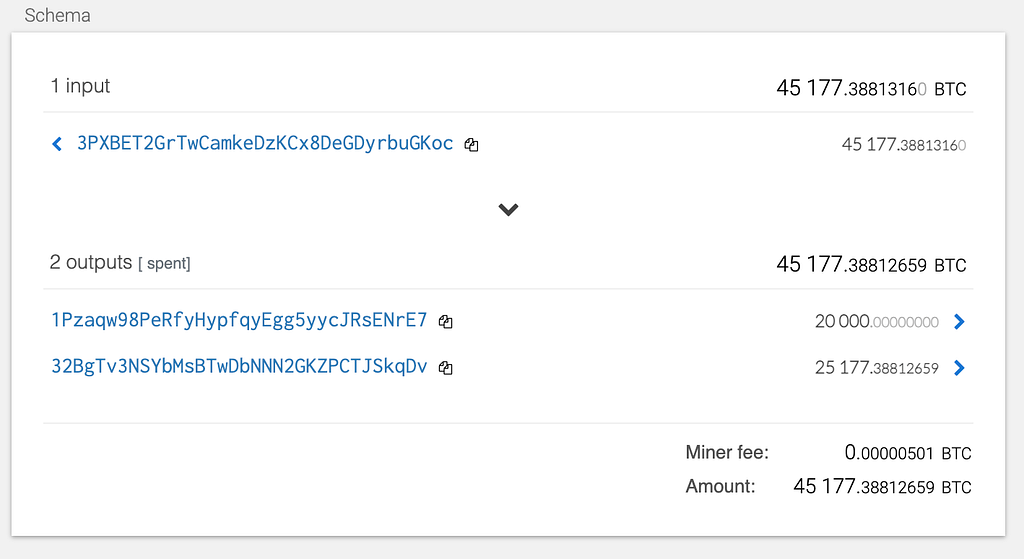
For example, for this transaction of 45,177 BTC (several billion $), the fee was less than $1.
The highest sat/vB was in April 2024 during the halving and was from 1795 to 2751 sat/vB (source). On that day, an average transaction would have already cost from $160 to $245, depending on how quickly it needed to be processed.
The busier the network, the higher sat/vB. If you want your transaction to get confirmed faster, you set sat/vB above the current average.
Nodes define the fee as: fee = sum(inputs) — sum(outputs), then they look at the transaction size to check if it fits their internal policies.
Don’t forget about UTXO: if over time you received 10 separate incoming transactions, and now you want to send the entire balance in one transaction, the blockchain sees that as 10 inputs — meaning the transaction is larger and therefore more expensive.
To save on fees in the future, it is useful to sometimes do “consolidation” — sending yourself all small remnants in one transaction when the network is calm and sat/vB is minimal.
Returning to the first topic and the block header, the following question may arise:
How does the blockchain know that ~10 minutes passed, and that miners aren’t lying?
The blockchain receives information about the time from miners and nodes (nodes that store information but do not mine) in UTC format.
Miners write the time in the block header. Nodes have their own clocks and verify the median time received from other nodes.
Bitcoin is a closed system, so the blockchain cannot connect to ntp.org to check if the miners are writing the truth in the block header and the nodes or not.
How can the blockchain check if the nodes and especially the miners aren’t lying?
For this, there is MTP — Median Time Past.
Median Time Past is easier to understand than Past Simple.
Not the average, but precisely the median.
It is calculated from the last 11 blocks arranged in order. For example:
18, 2, 12000 (liar), 14, 6, 20, 10, 4, 16, 12, 8
If we take the average value, then we need to sum all these numbers and divide by 11, we get 1100. Because of the liar who put 12000, everything has changed a lot.
But if we take the median, then first we arrange them in order:
2, 4, 6, 8, 10, 12, 14, 16, 18, 20, 12000 (liar)
And we take the value from the middle, that is, 12. This is how MTP is calculated.
The time of a new block is always greater than the MTP; otherwise, the block will not be accepted by other miners/nodes and will not be inserted into the blockchain.
But if someone wants to go to the future, at what time gap should blocks be rejected?
What will affect my future more, 10 push-ups or this article?
In the past Bitcoin used NAT — Network Adjusted Time (time adjusted by the network), which compared median time from peers. Later NAT was removed as a consensus component.
Now nodes use their own system UTC time to check how far “into the future” a new block is. If a block’s timestamp is more than 2 hours ahead of a node’s local time, that node rejects it.
If some node’s time differs significantly from other nodes, then NAT warns about it — that’s basically the only remaining use.
Miners and other nodes, how do they differ and why are they needed?
There are 3 main types of nodes in Bitcoin: a full node with two variations (archival and pruned), a light node, and a miner.
The other nodes are superstructures on top of these three pillars of the blockchain.
Full archival node: a server that has all the information about the blockchain for all time. Validates or rejects blocks in accordance with the rules of the blockchain.
Full pruned node: also checks blocks but does not store all data, only the UTXO and part of the last blocks.
Relay node: a superstructure on top of a full node, which is connected to other nodes with a large number of peers for fast distribution of information. Like torrent seeders.
Light node: stores only block headers to check their hashes. For transactions, it ask information from full node. Great for phone wallets or weak devices where storing dozens/hundreds of GB is inconvenient.
Miner: takes information from a full node or is one; based on this information, searches for a nonce to produce a valid block, then broadcasts it to the network.
If you need a non-custodial wallet on a PC, then perhaps a full pruned node for this would be the best option. You can choose the one you need here: bitcoin.org/en/choose-your-wallet?step=1
How to hack Bitcoin?
There are many possible attack vectors. If I described all of them, the article would be longer than it already is. But someday I will write. For now, let’s briefly look at two hack variants that are often talked about.
Quantum Computer VS Bitcoin
A quantum computer could derive a private key from a public key — but there’s already partial protection. If you’ve never spent from your address, your wallet is protected because outsiders see only the hash of your public key, not the public key itself.
Even with a quantum computer, it is practically impossible to brute-force the hash of a public key. But after the first outgoing transaction, the public key becomes visible to everyone. Therefore, to protect against quantum attacks, you should use addresses once.
However, there’s still a possible “interception” scenario: if a quantum computer could, after you broadcast a transaction but before it’s confirmed, derive your private key from your revealed public key — it would have very little time, but that’s the idea.
But there are wallets (outputs) of old formats, where the public key is visible immediately, and such wallets can be hacked even if there was not a single transaction from them.
And there are also many “lost” wallets; transactions were made from some, but that was many years ago. And with the help of quantum computers, coins from these wallets will probably fall back into circulation and possibly crash the Bitcoin price. But let’s leave these speculations to analysts who were perfectly described by one satirical channel:
”Last week’s target for Bitcoin at 34 thousand dollars has been revised and now stands at 240 thousand.”
So, a quantum computer will not destroy Bitcoin in this way.
But they are already thinking about creating a reusable quantum-protected wallet. This will require a soft-fork (change of rules), which has been done more than once.
If 1 person has more than 51% of the mining power, it will be easy for him to create a second chain of blocks as he wants. In this case, he will be able to cancel transactions and rewrite the history of his spending.
But even in this case, he will not be able in any way to steal someone else’s coins that were never on his wallet. The older the transactions that need to be rewritten, the longer and harder it will be, and there is no 100% guarantee that it will work and he will be able to make his chain longer and faster than the other 49%.
Such an attack is possible even with 30% and 40%, but the probability is much lower.
How much money will be needed for such an attack? If we attack from scratch, then we essentially have to have a power 0.5% more than the entire power of Bitcoin miners. The hashrate today is approximately 1 ZH/s = 1,000,000,000,000,000,000,000 SHA-256 hash findings per second.
Modern ASICs (mining devices) have a power of approximately 200 TH/s, meaning 5,000,000 of them will be needed. Their efficiency is ≈ 17–20 J/TH. Multiply by 10⁹ and you get 17–20 GW. A bit less than the power of the largest hydroelectric dam in the world.
To this, we add the prices for the ASICs themselves, which comes out to ≈ $7.5 billion. Not counting extra infrastructure which will also be very expensive.
Even all these costs will lead at most to double spending of own coins in the blockchain and censorship of transactions. And even then, it will be visible to everyone and the price will probably crash and the game will not be worth the candle.
The UK’s Financial Conduct Authority (FCA) has moved into the final stage of consultations on a sweeping set of proposed crypto regulations, as it advances the government’s broader plan to bring digital assets firmly within the country’s regulatory perimeter.
Key Takeaways:
The FCA has entered the final consultation phase on 10 proposed rules to regulate the UK crypto market.
The regulator aims to boost trust and transparency while acknowledging that crypto investment risks will remain.
A new licensing regime for crypto firms is planned, with applications expected to open in September 2026.
In a recent statement, the FCA said it is seeking feedback on 10 proposed rules, describing the move as the “final step” in its consultation process.
The proposals are designed to shape how crypto firms operate in the UK, while aligning the sector more closely with standards applied across traditional financial markets.
FCA Says New Crypto Rules Aim to Build Trust Without Eliminating Risk
“These proposals continue our progress towards an open, sustainable and competitive crypto market that people can trust,” the regulator said.
At the same time, the FCA stressed that crypto investing will always carry risk, and regulation is intended to improve transparency and consumer understanding rather than eliminate volatility altogether.
The consultation package spans a wide range of market activity.
It includes proposed rules on business conduct standards, restrictions on using credit to purchase crypto, regulatory reporting requirements, asset safeguarding, and how retail collateral is treated when borrowing digital assets.
Stakeholders have until March 12 to submit feedback.
BREAKING: The UK Just Moved to Fully Integrate Crypto Firms Into the FCA Rulebook pic.twitter.com/mGBJ61hLLB
The proposals were first outlined in December, when the FCA signaled its intention to regulate crypto in a manner broadly consistent with conventional financial services.
Since then, the regulator says it has made “significant progress” in refining the framework as part of the government’s crypto roadmap.
Earlier this month, the FCA also published an indicative timeline for a new licensing regime covering crypto asset service providers.
Under the current plan, the application window for firms seeking authorization is expected to open in September 2026, though the regulator noted that details will be confirmed at a later date.
Once in force, the licensing regime would impose tighter oversight on crypto businesses operating in the UK, requiring FCA approval and ongoing compliance with regulatory standards.
UK Weighs Ban on Crypto Donations
As reported, the UK government is considering a ban on cryptocurrency donations to political parties, a move that could directly affect Reform UK, which recently became the first party in the country to accept digital assets.
The proposal is under review as part of the upcoming Elections Bill, according to people familiar with internal discussions, though officials have yet to formally confirm the plan.
The debate follows Reform UK’s push to present itself as Britain’s most crypto-friendly party under the leadership of Nigel Farage.
Furthermore, the UK government has moved a step closer to overhauling how decentralized finance activity is taxed, backing a new framework that would spare users from triggering capital gains each time they deposit tokens into lending protocols or liquidity pools.
On-chain investigator ZachXBT says a $40 million-plus theft from US government crypto seizure wallets may trace back to John Daghita, an alleged threat actor who goes by “Lick,” and a contractor relationship tied to Daghita’s family.
The $40 Million+ Govt Crypto Wallet Robbery
In a Jan. 25 post, ZachXBT pointed to Command Services & Support (CMDSS), describing it as a firm with “an active IT government contract in Virginia,” and alleging it was “awarded a contract to assist the USMS in managing/disposing of seized/forfeited crypto assets.” ZachXBT added: “It still remains unclear at this point how John obtained access from his dad.”
In case you are curious how John Daghita (Lick) was able to steal $40M+ from US government seizure addresses.
John’s dad owns CMDSS, which currently has an active IT government contract in Virginia.
The allegation lands against a backdrop of earlier tracing work published Jan. 23, where ZachXBT linked wallet activity and recorded chats to the same persona. “Meet the threat actor John (Lick), who was caught flexing $23M in a wallet address directly tied to $90M+ in suspected thefts from the US Government in 2024 and multiple other unidentified victims from Nov 2025 to Dec 2025,” ZachXBT wrote.
ZachXBT’s thread centers on a dispute in a Telegram group chat between “John” and another threat actor, Dritan Kapplani Jr., in what the community calls “band for band (b4b)”, an on-the-spot contest to prove who controls more funds. ZachXBT said the interaction was “fully recorded,” and claims the footage includes screen-shared wallet balances and contemporaneous transfers that help establish control.
According to the thread, the recording shows John screen-sharing an Exodus wallet displaying a Tron address holding $2.3 million. In a second segment, ZachXBT said “another $6.7M worth of ETH” moved into an Ethereum address while the argument continued.
3/ In part 1 of the recording Dritan mocks John however John screenshares Exodus Wallet which shows the Tron address below with $2.3M:
TMrWCLMS3ibDbKLcnNYhLggohRuLUSoHJg pic.twitter.com/jvcjIVEpaE
ZachXBT framed the key evidentiary point as ownership continuity across addresses: “The recording captures that John clearly controls both addresses. Additional addresses can likely be found in the recordings. I then began tracing backwards to verify the source of funds.”
That tracing, ZachXBT said, connects the cluster to a March 2024 transfer of $24.9 million from a US government address tied to the Bitfinex crypto hack seizure. He also claimed $18.5 million “currently sits” at a cited address.
Beyond that 2024 linkage, ZachXBT asserted the primary address he tracked was tied to “$63M+ inflows from suspected victims and government seizure addresses in Q4 2025,” listing multiple transactions and chains, and separately flagged an additional 4.17K ETH ($12.4 million) flow from MEXC into the same cluster.
The Jan. 25 post attempts to explain a potential access path: if CMDSS was involved in US Marshals Service crypto asset management, the question becomes whether contractor-side systems, credentials, or processes provided an opening, intentionally or otherwise. ZachXBT stressed that the exact mechanism remains unknown.
Shortly after the post, ZachXBT said CMDSS’s X account, website, and LinkedIn “were all just deactivated,” and claimed Daghita “began trolling again on Telegram.”
On X, the claims drew sharp reactions from prominent Bitcoin commentators. Nakamoto Inc. CEO David Bailey wrote: “The son of the CEO of the company hired by the US Marshalls to safeguard the nation’s Bitcoin, stole $40m from it and now appears to be running. Treasury must secure the private keys from the Justice Department ASAP before more is stolen.”
Prominent Bitcoin advocate and co-founder of the Satoshi Nakamoto Institute Pierre Rochard framed the situation in national-security terms, posting, “This is a national security crisis,” and urging Congress to pass the BITCOIN Act.
Crypto traders often assume that meaningful gains need long timelines to take place, and they often give up during the wait and silence. However, crypto has a habit of shattering that belief without warning. History shows that when conditions line up, altcoins do not grind higher over years. They release and erase multiple years of drawdowns in a matter of weeks.
That memory was highlighted by a crypto commentator known as Waterman on the social media platform X, who noted a familiar seasonal window between February and late April to early May for an altcoin explosion.
Speed Matters More Than Time
The most notable example of an altcoin rally season was in 2021, when the entire altcoin market went on a rally to new all-time highs, many of which are still unbroken for some cryptocurrencies.
The 2021 cycle delivered some of the clearest reminders of just how fast capital can rotate once momentum takes hold. Solana moved from roughly $20 to $200 in about 50 days, a clean tenfold run. Although Solana has since broken above this peak to register a new all-time high of $293 in January 2025, this was still Solana’s most explosive rally to date.
Dogecoin followed an even sharper trajectory, climbing from $0.07 to a peak of $0.73 in under a month due to speculative interest that flowed into other memecoins like Shiba Inu. Unlike Solana, Dogecoin is yet to reclaim or surpass this peak price.
Avalanche went further, rallying from around $3 to $60 in less than 40 days, a twentyfold expansion that unfolded faster than most long-term projections ever anticipate. None of these moves required years of development or prolonged accumulation.
A Timeframe To Watch Closely
Notably, February through late April or early May has more often than not been the period where altcoin performance increases the most. If that pattern repeats, the coming weeks may matter far more than the years that came before them.
At the time of writing, the notion of an altcoin season is still impeded by strong Bitcoin dominance. Much of that comes down to how the entire crypto industry ecosystem has changed massively since 2021, especially after the launch of crypto-based ETFs. That steady demand has kept capital inflows concentrated around Bitcoin and slowed the usual rotation into altcoins.
At the same time, investors have become more selective, favoring cryptocurrencies tied to clearer utility. As a result, many crypto communities have been working to create utility for their meme coins.
Nonetheless, as noted by Waterman, you only need about four to six weeks for an altcoin to wipe out three to four years of suffering. You don’t need one to two years for altcoins to make massive gains.
Featured image from YouHodler, chart from TradingView
AFP Protección, Colombia’s second-largest private pension manager, is preparing a new product that will give some savers a way to gain exposure to Bitcoin. Reports say the move will be limited, targeted and tied to advisory checks rather than open to every account holder.
Bitcoin As An Option For Qualified Savers
Reports note the fund will be offered only to investors who meet a risk profile and pass a tailored advisory process. That means access won’t be automatic; it will be conditional on an assessment meant to match a person’s tolerance with a small, optional slice of crypto.
The product is designed for long-term allocation and not for quick trading or speculation, according to market coverage. AFP Protección’s executives emphasized that core pension portfolios will remain focused on traditional assets such as bonds and equities, and that any Bitcoin exposure would be a narrow, complementary allocation.
En primicia, Valora Analitik conoció que Protección se prepara para lanzar desde Colombia un fondo con exposición a Bitcoin. El producto no estará enfocado en la especulación de corto plazo, sino en ampliar las opciones de diversificación con una gestión integral de riesgos y… pic.twitter.com/nAO8mbsTLi
The language used by the firm frames the initiative as diversification rather than a wholesale shift of retirement capital. Juan David Correa, who serves as president of Protección SA, confirmed the plan in an interview with local media outlet Valora Analitik.
Size And Reach Of The Manager
AFP Protección manages assets for millions of clients and has a sizable balance sheet. Reports put its assets under management at roughly 220 trillion Colombian pesos — roughly US$55 billion — and note that the firm serves a broad base of workers through mandatory pensions, voluntary saving plans and severance accounts. The sheer scale of the manager helps explain why even a small, optional product gets wide attention.
Regulation And Reporting
Reports also point to a tightening regulatory backdrop in Colombia. Tax and customs authorities have rolled out new crypto reporting rules that align with international reporting standards.
Those rules are likely to affect how crypto products are structured and how returns or transfers are reported for tax purposes. The change in rules is one reason AFP Protección has framed its product as measured and compliant.
How This Fits A Regional Trend
Across Latin America, some institutional players have been experimenting with limited crypto exposure for years. Colombia’s move follows earlier steps by one or two other local managers and fits a regional pattern where established firms test small, controlled offerings before widening access. The step will be watched closely by investors and regulators overseas.
Reports say potential participants should expect thorough suitability checks, clear disclosures and limits on how much of a retirement portfolio can sit in the new vehicle.
Featured image from Pexels, chart from TradingView
The calls of a potential Bitcoin supercycle in 2026 intensified over the past week after former Binance CEO Changpeng ‘CZ’ Zhao — yet another prominent voice in crypto — laid out his predictions for the new year. However, a popular analyst on the social media platform X has released an opposing view, predicting a deep bottom for the BTC price this year.
BTC Price At Risk Of Further 65% Decline
In a January 25th post on the X platform, prominent crypto trader Ali Martinez said, in a sarcastic tone, that “the super cycle is super cycling.” In what seemed like a response to the buzz around CZ’s Bitcoin supercycle projection, the market pundit tempered the expectations with a $31,000 price bottom call for the premier cryptocurrency in 2026.
This bearish prediction is based on the appearance of price fractals on the BTC chart. For context, fractals are repeating patterns in price charts that can help map and project potential price movements for a particular cryptocurrency (Bitcoin, in this scenario).
As observed in the chart above, the price of BTC is currently following a similar movement pattern as in 2022. The premier cryptocurrency, after initially setting a then all-time high around $67,000 in early 2021, witnessed a nearly 55% correction to just above the $30,000 level by mid-July.
While the price of Bitcoin recovered and went back to set a record high of above $69,000 by the end of 2021, the market leader spent the majority of the following year in a downward trend. Exacerbated by the various bearish events of 2022, BTC ended the year at a low of around $15,500.
Martinez believes that the Bitcoin price is undergoing a similar movement pattern, having experienced an over 32% decline before climbing to the current all-time high of $126,080. The market pundit postulates that the premier cryptocurrency is currently witnessing the extended decline that saw its price reach $15,500 in 2022.
However, it is worth mentioning that the target this time around lies at $31,800, nearly 65% drop from the current price point. Hence, if the historical patterns highlighted by Martinez are to go by, there seems to be a higher likelihood of the Bitcoin price embarking on an extended downward trend rather than a supercycle.
Bitcoin Price At A Glance
As of this writing, the price of BTC stands at around $88,528, reflecting an over 1% decline in the past 24 hours.
Small shops and some bigger chains in Las Vegas are now taking Bitcoin for everyday buys. People scan a QR code, pay from a phone, and the merchant gets paid. According to local reports, owners are trying this out to cut the cost of credit card processing and to attract customers who prefer crypto.
Merchants Cut Costs With Bitcoin
Reports say the move is largely about fees. Credit card processing often takes away 2.5–3.5% of a sale. For many small operators, that is painful. Payment tools that accept Bitcoin — often routed over the Lightning Network or through services that can convert crypto to cash — have lowered that burden for merchants.
According to FOX5, more businesses across Las Vegas are now accepting Bitcoin payments, from chains like Steak ’n Shake to small shops and medical practices. Merchants said Bitcoin helps attract new customers and cut costs, while Square has enabled about 4 million U.S. merchants…
Square’s program, which lets millions of US merchants enable Bitcoin checkout with no processing fee through 2026, helped speed up adoption in the area.
Stores Report Real Transactions
Business owners are reporting real use, not just experiments. Juice stands and cafes have processed payments. Some larger outlets are listed on public payment maps so customers can find them.
This has meant more foot traffic from people who travel with crypto or who prefer to keep their cards for other uses. Reports note both new customers and savings on fees as clear benefits.
Lightning Network Speeds Up Payments
The Lightning Network is being used to make payments faster and cheaper at the cash register. It moves small Bitcoin payments quickly without the long wait a base-layer transfer can cause.
Merchants scan a code or show one on a screen. The payment is then sent from the buyer’s wallet and settled almost instantly. This technical fix has made in-person Bitcoin payments workable for the first time at many spots.
How Owners See It
Owners are balancing savings against new risks. Some keep crypto for a short time, then sell it for cash. Others leave part of their receipts in Bitcoin. Chargebacks, a problem with cards, are reduced when crypto is used.
A few places say small boosts in sales followed their switch to crypto, yet long-term patterns are still being watched. Reports have disclosed these mixed outcomes as part of a slow but clear shift.
Customers Find New Ways To Pay
Shoppers are adapting. Tourists who carry crypto find these spots useful. Locals who are curious try the method at least once. Payment apps and merchant directories make the process easier for everyone.
For those who like simple steps, scanning a QR code and approving a payment on a phone works fine. For others it is a novelty that might stick.
Featured image from Unsplash, chart from TradingView
Las Vegas Valley businesses are accepting Bitcoin as payment as the cryptocurrency continues to grow in popularity.For more Local News from KVVU: https://www...
“Bitcoin is the digital gold” is one of the most popular narratives in the cryptocurrency industry, reiterating BTC’s growing status as a formidable store of value. However, while the premier cryptocurrency has floundered over the past months, gold and the metals market have largely witnessed explosive growth.
These contrasting performances have led to conversations about capital rotation between Bitcoin and gold, as the crowd expects one to always outperform the other at any given time. Recent data, however, suggests that the relationship between the BTC and gold price action is overrated.
Capital Flow Link Between BTC And Gold Overestimated
In a January 24 post on the X platform, on-chain analyst with the pseudonym Darkfost weighed in on the discourse surrounding capital rotation between gold and Bitcoin. According to the market pundit, the idea that investor funds flow from gold to Bitcoin is somewhat overblown.
To highlight this overestimation, Darkfost shared a chart showing periods where BTC outperforms or underperforms depending on gold’s trend. This chart typically provides two signals: positive (BTC above the 180-day moving average [MA] and gold below the 180-day MA) and negative (BTC below the 180-day moving average and gold below the 180-day MA).
As observed in the chart above and stated by Darkfost, the relationship between Bitcoin and gold does not appear to be fully substantiated. The on-chain analyst revealed that there have been as many positive periods as the negative ones, suggesting that the flagship cryptocurrency moves independently of gold.
Darkfost wrote:
This suggests that BTC continues to evolve independently, without clear evidence of a sustained capital rotation from gold.
Furthermore, Darkfost noted that a positive signal does not necessarily mean that capital is flowing out of gold into Bitcoin. According to the on-chain analyst, it is simply not possible to determine whether there is a capital flow relationship between the world’s largest cryptocurrency and gold.
Bitcoin & Gold Price Overview
While Bitcoin started the new year on a pretty strong note, the bullish momentum has pretty much waned over the past two weeks. Meanwhile, the gold price has continued to flourish this year, recently reaching a new all-time high above $4,900 per ounce.
As of this writing, the price of BTC stands at around $89,230, reflecting no significant movement in the past 24 hours. According to data from CoinGecko, the flagship cryptocurrency is nearly 30% adrift its all-time high above the $126,000 level.
Reports say the Ethereum Foundation has started a new team to prepare the network for possible quantum computer attacks. These machines could one day break the math behind wallets and signatures. The team’s work is moving from research into practical tests and experiments, which has drawn attention across the crypto community.
Ethereum Launches Post-Quantum Team
Based on reports, Thomas Coratger will lead the effort. The team includes cryptographers and engineers already testing new systems on devnets. Some work ties into a project called leanVM and a researcher named Emile, who focuses on building simple quantum-safe tools. The goal is to test new algorithms in real software while keeping current transactions running smoothly.
Today marks an inflection in the Ethereum Foundation’s long-term quantum strategy.
We’ve formed a new Post Quantum (PQ) team, led by the brilliant Thomas Coratger (@tcoratger). Joining him is Emile, one of the world-class talents behind leanVM. leanVM is the cryptographic…
A $1 million prize has been set for improvements to the Poseidon hash function. Another $1 million prize supports broader post-quantum research. In total, roughly $2 million are being offered to labs and independent developers to design and test quantum-resistant solutions. Reports say this funding is meant to speed up work and show what can realistically replace current signatures.
Early Tests And Community Involvement
Multi-client devnets are already active. Developers are experimenting with new signature types to see what works and what fails. Biweekly sessions led by researchers like Antonio Sanso let teams share results and update code. A Post-Quantum Day is scheduled for March 2026 before ETHCC, with a larger event planned in October 2026 to show progress and plan next steps.
Quantum computers could, in theory, break the ECDSA and secp256k1 schemes used today. That risk is not immediate but serious enough that Ethereum is acting now. Reports note users should watch for official guidance, follow wallet updates, and avoid reusing addresses once upgrades roll out.
Community reaction has been mixed. Some online discussions praised the careful planning, while traders noticed a small dip in ETH price. Others questioned how upgrades would reach millions of wallets and what happens to old keys. The Foundation’s approach is to test solutions early so users and services are better protected when changes happen.
This step is part of Ethereum’s long-term plan for safety. Tests will continue, standards will be debated, and progress will be shared publicly. By acting now, Ethereum aims to reduce risk and make future transitions smoother for everyday users and the network as a whole.
Featured image from Unsplash, chart from TradingView
While Binance co-founder and former CEO Changpeng “CZ” Zhao made the headlines following his interview at the just-concluded World Economic Forum, where he called a Bitcoin supercycle in 2026, his crypto counterpart and Coinbase CEO, Brian Armstrong, has come forward with feedback from the global event held in Davos, Switzerland.
Coinbase CEO Praises Trump-Led White House As Most Crypto-Forward Government
In a January 24 post on the social media platform X, Armstrong shared a few key “themes and takeaways” from the latest edition of WEF. After admitting that the conference offered a productive time of meeting people one-on-one, the Coinbase CEO revealed that the major focus was on pushing crypto adoption globally.
Starting his list of takeaways, Armstrong highlighted that everyone was talking about tokenization, which is beginning to expand to every asset class in the world. The crypto leader said to expect some major progress in the tokenization sector in 2026, especially as the Fortune 500 business leaders continuously lean in.
Secondly, the Coinbase CEO shared that crypto legislation and the CLARITY Act were another area of focus, as the government of the day looks to make the United States the crypto capital of the world. According to Armstrong, most of the bank CEOs he met at the WEF in the past week are actually pro-crypto.
Armstrong wrote on X:
One CEO of a top 10 global bank told me crypto is their number one priority, and they view it as existential.
Furthermore, the Coinbase CEO lauded the Trump administration as the most crypto-forward government in the world at the moment. Armstrong acknowledged their progress with the crypto market structure, stating that these clear rules are crucial for global competitiveness and will put money back in people’s pockets.
In what seemed like a cheeky tone, Armstrong mentioned that ESG (Environmental, Social, and Governance) and DEI (Diversity, Equity, and Inclusion) topics didn’t come up throughout the forum. According to the crypto founder, the week felt productive, as it centered around real, global progress — all thanks to BlackRock CEO and new WEF co-chair Larry Fink.
The Coinbase leader touted crypto and AI (artificial intelligence) as the most talked-about technologies in today’s world. Highlighting their compatibility, Armstrong stated that AI agents will eventually default to using stablecoins for payments, as they cannot be KYC’d like human beings.
Finally, Armstrong revealed that the Coinbase, Circle, and Bermuda partnership to build a fully on-chain economy was announced at WEF Davos 2026. “Excited to make progress on this and create a compelling case study for other nations to follow,” the crypto CEO concluded.
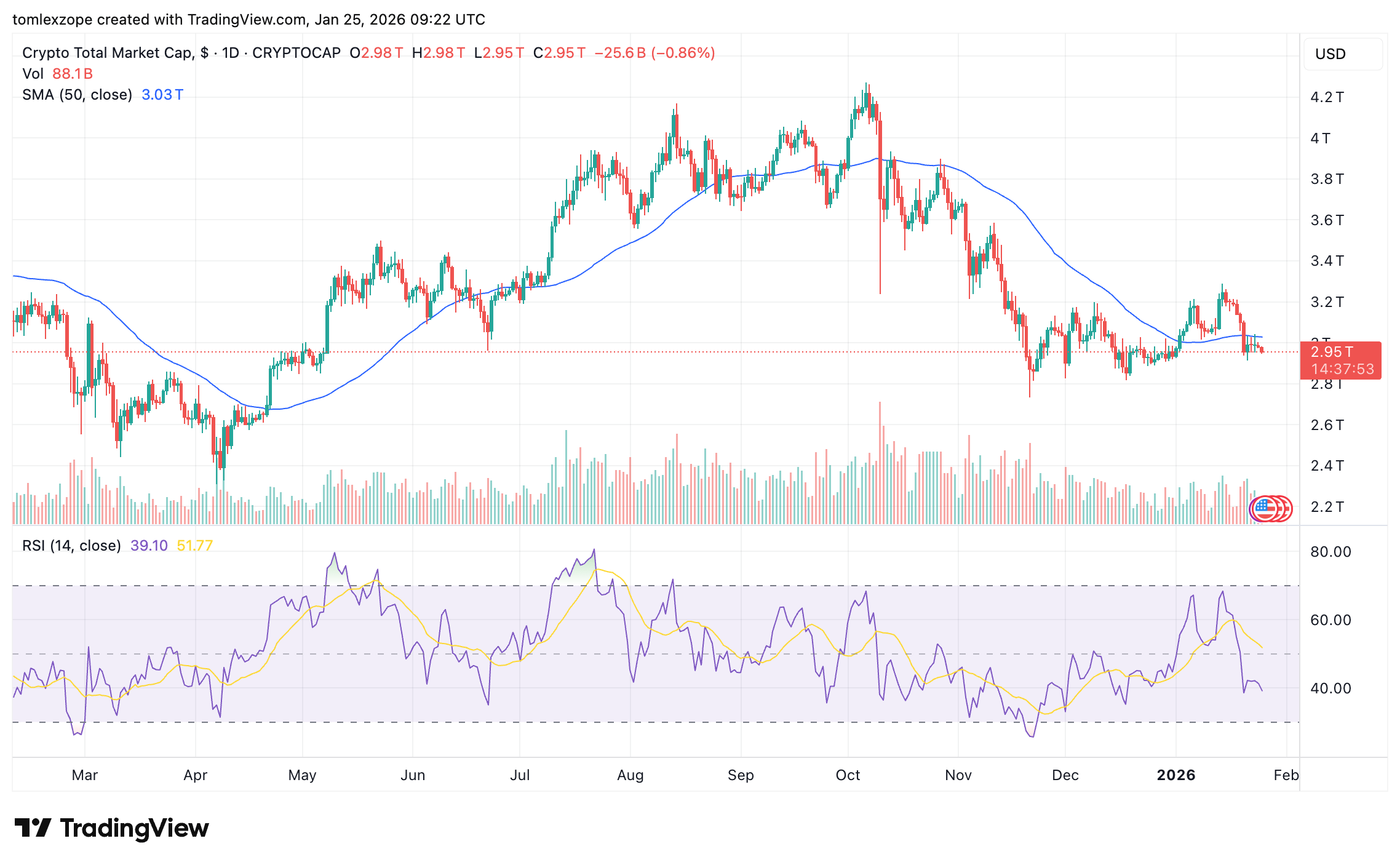
Total Crypto Market Cap At $3.09 Trillion
As of this writing, the global cryptocurrency market has a total capitalization of $3.086 trillion, with Bitcoin retaining its spot as the world’s largest cryptocurrency.
Nifty Gateway, the marketplace that once helped bring NFT drops to a wider audience, will stop running its marketplace on February 23, 2026. The company put the site into a withdrawal-only mode the same day it made the announcement, and users were told they must move any remaining funds and NFTs off the platform before that date.
Withdrawal Window Opens
According to the company, withdrawal tools are available now. Reports note users can pull USD or ETH balances through a linked Gemini Exchange account or send funds to their bank via Stripe.
Emails with step-by-step instructions will be sent to account holders, and a shutdown notice already appears on the Nifty Gateway homepage. The aim, as described by the owner, is to let people retrieve what they own before the platform goes dark.
Today, we are announcing that the Nifty Gateway platform will be closing on February 23, 2026. Starting today, Nifty Gateway is in withdrawal-only mode.
Nifty Gateway was launched in 2020 with the vision of revolutionizing digital art. Since launching, Nifty supported dozens of…
Based on reports from Gemini, the closure is meant to let the parent firm concentrate on building one bigger app for customers. The move highlights how interest and trading activity in many NFT markets have cooled from the highs seen in earlier years.
Some collectors and artists are left scrambling to rehome items they once sold or stored on Nifty Gateway.
End Of An Early Player
Nifty Gateway helped make buying NFTs easier for people who preferred credit cards and familiar checkout flows. It launched as a high-profile marketplace and hosted major drops from well-known creators.
The platform supported hundreds of millions in sales at its peak and played a clear part in bringing NFT art into mainstream headlines. Its exit marks the end of an important chapter for that wave of marketplaces.
What Owners Must Do Now
Owners should check their inboxes for the official instructions, confirm where their tokens are stored, and move assets before the deadline. If NFTs are stored in custodial wallets on the site, they will need to be transferred out.
USD and ETH balances should be withdrawn or moved into a connected Gemini account if that option suits the owner. Waiting past the closure date will reduce options.
A Quiet Turning Point
For many collectors, this will feel like another sign that the early boom years have passed. For creators, the change raises questions about where drops and secondary sales will happen next.
Gemini says it will keep supporting NFTs through its other products, including the Gemini Wallet, but the specific ways that creators and buyers reconnect with those audiences will depend on new tools and services that arrive in the next months.
Featured image from Unsplash, chart from TradingView
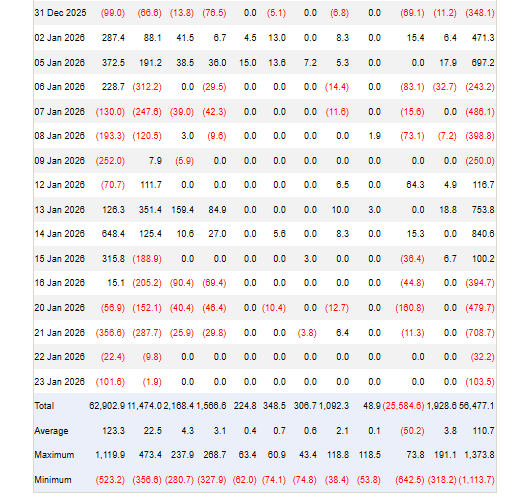
US-based spot Bitcoin exchange-traded funds pulled funds for a fifth straight trading day, and the totals added up quickly. According to Farside data, about $103.5 million left on Friday, bringing the five-day sum to roughly $1.72 billion.
Bitcoin was trading near $89,160 at the time of these reports — still well below the $100,000 mark it last reached on November 13. This movement has sent a clear signal: many investors are stepping back right now.
ETF Flows And Who Is Selling
Reports note that ETF flows are often on the radar as a quick read on investor mood, but the picture is not always simple. Large outflows can reflect institutional rebalancing or tactical moves by funds, not only mass retail selling.
The US market had a four-day trading week because of Martin Luther King Jr. Day on Monday, which may have concentrated trades into fewer sessions and amplified the numbers. Still, losing more than a billion dollars in a few days will get attention.
Market Mood And Metals
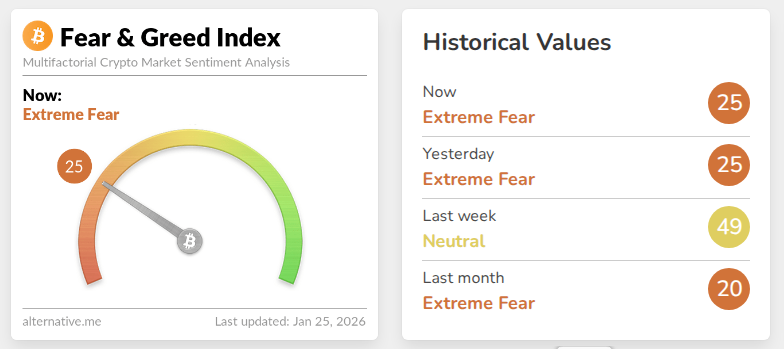
The wider mood has soured. The Crypto Fear & Greed Index registered an Extreme Fear score of 25, and sentiment trackers have been flashing caution. Reports say Santiment believes retail traders are pulling back while attention drifts toward more traditional assets.
Meanwhile, metals have been strong. Reports disclose that with gold trading near $5,000 and silver approaching $100, some market players feel Bitcoin has been left out of a rally that lifted metals, which has weighed on confidence in the crypto market.
Bitcoin Price Action
Bitcoin has struggled to find a steady rhythm over the past week. Prices slipped below the $89,000 to $90,000 range as traders reacted to fresh geopolitical tension and renewed trade worries, before stabilizing as nerves eased.
This was driven higher after some soft political indicators around tariff threats, only to substantiate the idea that markets rarely react to conflict but rather to changes in tone and expectations.
Signals That Could Matter
These movements illustrate how Bitcoin behaves more like a risk asset rather than an asset shelter, falling in tandem with equities when unexpected financial shocks hit the globe, before rebounding when the fever subsides to gather fresh buyers.
Current price patterns indicate caution, where traders are weighing short-term political risks against medium- and long-term macro patterns, as well as institutional interests.
There are some quieter indications that the rout could be losing steam. To this effect, there are assertions suggesting that supply distribution on-chain and social chatter can be circumstantial evidence showing there is less selling pressure.
Featured image from Money; Shutterstock, chart from TradingView
A growing number of analysts believe Ethereum’s current price action is being misunderstood. Although frustration is growing due to Ethereum’s inability to hold above $3,000, some technical analysts are quick to point out that the structure forming beneath the surface tells a very different story. According to one analyst, the real risk right now is not being bullish on Ethereum and trying to short in anticipation of a downside breakout.
Higher Lows And A Structure That Keeps Tightening
The analyst’s technical view on Ethereum is focused less on short-term momentum and more on the structure developing on the chart, which he argues is even clearer than what is currently visible on Bitcoin’s chart.
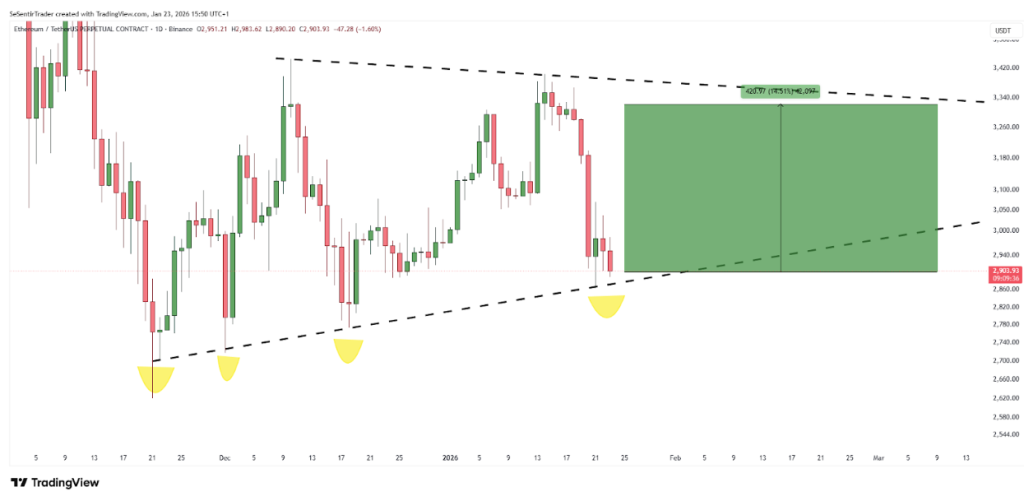
Notably, Ethereum’s price action is carving out a series of higher lows on the daily candlestick timeframe chart to form a tightening triangular pattern since December 2025. This kind of behavior shows that each pullback is being absorbed at progressively higher levels, which is how strong trends reset before continuation.
Ethereum needs to avoid a breakdown below key support zones in order for this trend continuation setup to still be valid. According to the analyst, a dip under $2,860 would begin to weaken the pattern, while a close below $2,780 would invalidate the higher-low structure.
At the time of writing, Ethereum is trading around $2,950, which is dangerously close to the lower boundary of this setup. Therefore, some traders will be tempted to short Ethereum at this level, but the analyst called it the dumbest thing to do here.
As long as those levels ($2,860 and $2,780) hold, the analyst sees no technical justification for betting against ETH, especially near the lower boundary of the channel where buyers have repeatedly stepped in.
If support holds, the next move would be a gradual return to the upper trendline of the channel, which is just below $3,340. A move into that region would bring price back into direct contact with overhead resistance and set the stage for a breakout if buying pressure continues to increase.
Ethereum is entering 2026 without clear bullish momentum, a reality that has dampened sentiment across the spot and derivatives markets. Spot ETF inflows into Ethereum and Bitcoin have slowed down, and issuers have been highlighted with consistent days of outflows.
Speaking of staking, BitMine Technologies recently amped up its ETH staking to over $5.71 billion worth of Ethereum. On-chain data from Arkham Intelligence shows that the firm has staked an additional 171,264, worth $503.2 million, pushing its total stake to over 1.94 million ETH.
Featured image from Unsplash, chart from TradingView
Africa is seeing a quiet shift in how people send and hold value. Mobile phones are central. According to Vera Songwe, a former UN under-secretary-general, millions who lack bank accounts can use stablecoins to protect savings and move money faster. That access matters in places where inflation has been high and bank fees are steep.
Use By Businesses And Everyday People
Reports have disclosed that stablecoins now make up around 43% of all crypto transaction volume in sub-Saharan Africa. Nigeria alone processed nearly $22 billion in dollar-linked stablecoin activity over a recent 12-month span.
That money is used for remittances, payroll and business settlements. Firms and market traders are among the biggest users, but many everyday people are joining in too.
In countries such as Egypt, Nigeria, Ethiopia and South Africa, demand is driven by volatile local currencies and rules that limit access to dollars. Mobile money networks help push adoption along.
Stablecoins Speed Up Cross-Border Payments
Traditional remittances can be costly. At a World Economic Forum panel in Davos, Switzerland on Thursday, Songwe noted that sending $100 through traditional money transfer services in Africa often costs around $6, making cross-border payments both slow and costly.
Stablecoins cut those costs and shorten wait times from days to minutes for many transfers. Small payments and wages can be settled quickly, and that speed changes how businesses plan cash flow.
Local Rules Are Changing Fast
Governments are reacting in different ways. Ghana passed a Virtual Asset Service Providers law to bring trading into a formal framework. On January 13, Nigeria required crypto platforms to link transactions to tax ID numbers, a move meant to bring activity into official records.
South Africa’s central bank has warned that stablecoins and other tokens could pose risks to financial stability as use grows. Policy is being written while users and tech firms keep pushing ahead.
Risks And The Road Ahead
High inflation remains a core reason people are turning to stablecoins. Reports say inflation has exceeded 20% in 12 to 15 countries since the pandemic, and that reality pushes people to look for alternatives to local notes.
Everyday Use, Measured Change
What started as a tech niche has grown into a practical tool for many across the continent. For small and medium businesses, the benefit is clear: faster settlements and lower costs.
For people without bank accounts, a smartphone can now open a route to store value in currencies less tied to local inflation. Adoption will likely keep rising, but how quickly it becomes part of mainstream finance will depend on stronger rules, better safeguards, and the continued spread of simple mobile services that people trust.
Featured image from Unsplash, chart from TradingView
With more stablecoin transfers in 2024 than Visa and Mastercard combined, the asset-pegged token is shifting from niche crypto instrument to a foundational e...
XRP has spent most of the past few months trading with lower highs since July 2025, frustrating traders and compressing price action into an increasingly tight range.
However, a technical breakdown shared by crypto analyst ChartNerd argued that what looks like stagnation may actually be the final preparation phase before a historic move. The price structure suggests something far bigger that sends XRP on its most aggressive rally in eight years, but the implications only become clear when the full setup is examined.
A 400-Day Rectangular Reaccumulation Still Holding Structure
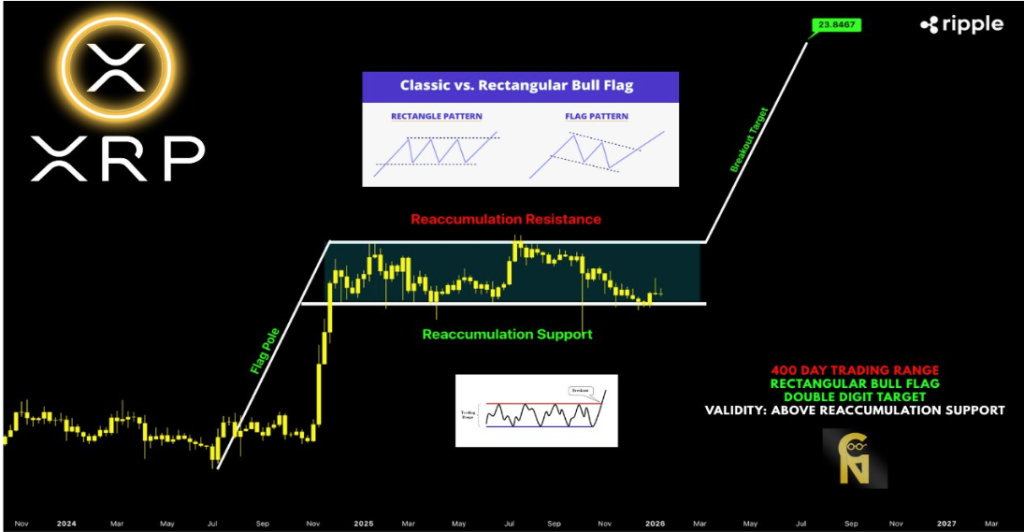
According to technical analysis done by ChartNerd, XRP’s price action has been locked inside a rectangular reaccumulation zone for about 400 days, and this has led to the formation of what looks like a rectangular bull flag on a macro timeframe. The technical chart shows a strong impulsive move from July 2024 to December 2024 acting as the flagpole, right when XRP peaked at the $3.4 price zone back then.
This impulsive flagpole has been followed by a long period of sideways trading where XRP’s price has repeatedly respected a clearly defined support around $1.8 and resistance boundaries around $3.6. This type of structure is associated with reaccumulation within the support and resistance zones, especially when it is playing out after a sharp expansion move and holding for this length of time.
Each dip into reaccumulation support has been absorbed, preventing any sustained breakdown and keeping the broader pattern intact. ChartNerd noted that the rectangular flag will be valid as long as this support level is defended, and this will activate the expansion journey.
Macro Breakout Projection Puts XRP Price Target At $23
According to ChartNerd, bearish participants are increasingly pressured by the fact that this fractal is still holding despite repeated attempts to invalidate it. The longer XRP’s price action is trapped inside the rectangle without breaking down, the more likely it becomes that the eventual resolution favors the dominant trend that preceded the consolidation. In this case, that trend was bullish, which strengthens the case for an upside breakout once resistance is cleared.
If the rectangular bull flag resolves to the upside as projected, the chart outlines a breakout trajectory that would carry XRP into double-digit territory, with a long-term target region near $23. This price target projection is derived from the height of the flagpole extended from the top of the reaccumulation range.
ChartNerd labelled this possible move as one of the most aggressive rallies XRP could see in seven to eight years. At the time of writing, XRP is trading around $1.92, meaning a move toward the $23 region would represent a gain of over 1,000% from current levels, which is a type of percentage expansion XRP has played out well in the past.
Featured image from Unsplash, chart from TradingView
The Securities and Exchange Commission has dropped its lawsuit against Gemini, the crypto exchange founded by Trump backers Cameron and Tyler Winklevoss.
GameStop moved its entire Bitcoin stash into Coinbase Prime this month, according to blockchain trackers that monitor large transfers.
The wallet associated with the company sent a large deposit to the institutional arm of Coinbase, a platform used by big traders and companies.
Analysts watching on-chain flows immediately flagged the move as a likely setup for a sale, though no confirmed sell orders have been announced.
Big Move To Coinbase Prime
According to on-chain reports, GameStop holds 4,710 BTC that it bought last year, and that full balance was shifted into Coinbase Prime.
The company first bought the coins in May 2025 at prices that averaged near $107,900 per BTC, a buy that cost roughly $504 million at the time.
Moving a corporate treasury from cold storage to an active institutional account is often read as a step toward execution — to sell, hedge, or rebalance — but it is not the same as a sale itself.
GameStop throws in the towel?
Their on-chain wallets just moved all BTC holdings to Coinbase Prime, likely to sell.
Between May 14–23, 2025, they bought 4,710 BTC at an avg. price of $107.9K, investing ~$504M.
Reports say the math is simple and stark: selling now, with Bitcoin trading closer to the $90,000 area, would lock in a sizable loss versus the initial purchase price.
Several analytics firms put that figure near $76 million if the whole lot were sold at recent market levels. Some market watchers suggest the company could be doing tax-loss harvesting or trimming volatile assets on its books.
Others view it as a pragmatic adjustment to reduce treasury exposure to crypto swings. Still, defenders of the move point out that GameStop’s Bitcoin stake was never a core retail play; it was a treasury experiment meant to diversify.
How Much Has Already Moved
Not all outlets agree on timing or size of day-by-day transfers. Reports note that some transfers earlier this month added up to about half of the original position — roughly 2,396 BTC moved in smaller tranches before the full deposit was flagged.
On-chain sleuths track each shift, and those staggered movements can mean many things: a staged sale, an internal reorganization, or simply routing through a trusted custodian before any trades.
Market And Shareholder Reaction
Share action around GameStop has not mirrored the crypto chatter. While Bitcoin watchers focused on the wallet move, investors were also reacting to company news on other fronts, including fresh share purchases by CEO Ryan Cohen.
Featured image from PeterPhoto, chart from TradingView

 Login
Login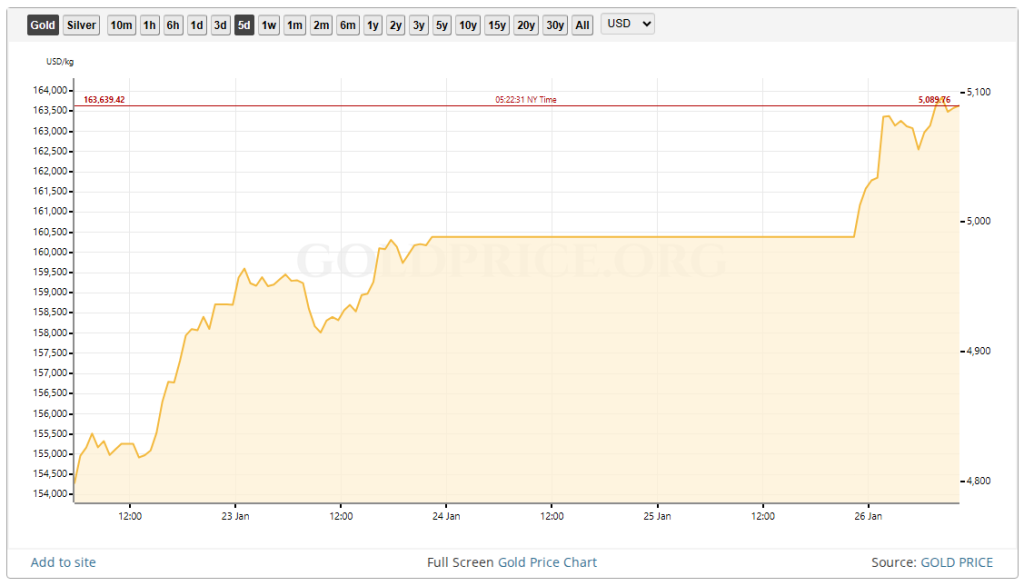









 BREAKING: The UK Just Moved to Fully Integrate Crypto Firms Into the FCA Rulebook


 En primicia, Valora Analitik conoció que Protección se prepara para lanzar desde Colombia un fondo con exposición a Bitcoin. El producto no estará enfocado en la especulación de corto plazo, sino en ampliar las opciones de diversificación con una gestión integral de riesgos y…