Reading view

There are new articles available, click to refresh the page.

U.S. Bitcoin Custody Concerns Rise After Alleged Insider Stole $40 Million In Digital Assets

Bitcoin Magazine
U.S. Bitcoin Custody Concerns Rise After Alleged Insider Stole $40 Million In Digital Assets

All of the bitcoin held by the U.S. government has come under scrutiny after allegations surfaced that tens of millions of dollars in seized crypto were stolen through insider access at a federal custody contractor.

Blockchain investigator ZachXBT alleged over the weekend that more than $40 million in digital assets was siphoned from wallets linked to the U.S. Marshals Service (USMS), reportedly by the son of an executive at a firm contracted to manage seized crypto. 

The alleged theft centers on Command Services & Support (CMDSS), a Virginia-based technology firm awarded a USMS contract in October 2024 to manage and dispose of certain categories of seized digital assets. 

Those assets include crypto not supported by major exchanges and tied to high-profile criminal cases, including funds seized from the 2016 Bitfinex hack.

According to ZachXBT, an individual identified online as “Lick,” whom he claims is John Daghita, gained access to government-controlled wallets through insider channels. ZachXBT has further alleged that Daghita is the son of Dean Daghita, CMDSS’s president and chief executive.

The investigation began after a recorded dispute in a private Telegram chat surfaced online. During the exchange, the individual screen-shared a wallet showing millions of dollars in crypto and appeared to move funds in real time. 

On-chain analysis later linked those wallets to addresses known to hold government-seized assets.

A conflict of interest involving U.S. bitcoin 

One transaction trail cited by ZachXBT points to a government address that received roughly $24.9 million in bitcoin tied to Bitfinex-related seizures earlier in 2024. 

Additional blockchain data suggests that around $20 million was removed from USMS-linked wallets in October 2024. Most of those funds were returned within a day, though about $700,000 routed through instant exchanges was not recovered.

ZachXBT estimates that total suspected thefts could exceed $90 million when accounting for other wallet activity observed in late 2025. Some of the funds remain in compromised wallets, raising concerns that further losses could occur.

Neither the U.S. Marshals Service nor CMDSS has issued a public statement addressing the allegations.

Rightfully so, the investigation has renewed criticism on how the U.S. government manages its growing stockpile of seized crypto — especially its bitcoin. 

David Bailey, CEO of bitcoin-focused firm Nakamoto, posted on X after the report, “The son of the CEO of the company hired by the US Marshalls to safeguard the nation’s Bitcoin, stole $40m from it and now appears to be running. Treasury must secure the private keys from the Justice Department ASAP before more is stolen.”

The U.S. government holds a massive amount of Bitcoin seized through law enforcement actions, with some blockchain analytics estimating roughly 198,000 BTC under federal control with others projecting more than 300,000 BTC, worth tens of billions of dollars. 

If insiders can allegedly move millions from custodial wallets with minimal detection, it suggests current custody practices may leave portions of the government’s Bitcoin reserves exposed. 

Previous reports have found that the Marshals Service relied on manual tracking systems and struggled to provide precise estimates of its crypto holdings. CMDSS’s contract award also faced a protest in 2024 from a competing firm, which raised concerns about licensing and potential conflicts of interest. 

JUST IN: David Bailey says, “The son of the CEO of the company hired by the US Marshalls to safeguard the nation’s Bitcoin, stole $40m from it”

“Treasury must secure the private keys from the Justice Department ASAP” 👀 pic.twitter.com/6UroPNzqJY

— Bitcoin Magazine (@BitcoinMagazine) January 26, 2026

Did the United States sell bitcoin destined for the Strategic Bitcoin Reserve? 

Earlier this year, journalist Frank Corva published an investigation exploring the fact that prosecutors in the Southern District of New York and the U.S. Marshals Service may have sold bitcoin forfeited in the Samourai Wallet case, potentially in violation of President Trump’s Executive Order 14233, which dictates seized bitcoin be held in the U.S. Strategic Bitcoin Reserve rather than liquidated. 

There was on-chain evidence showing 57.55 BTC tied to the Samourai plea agreement moving through a Coinbase Prime address and later showing a zero balance, raising questions about whether the assets were improperly disposed of.

Shortly afterward, U.S. officials denied that any sale took place, affirming that the Samourai Wallet bitcoin will remain on the government’s balance sheet as part of the Strategic Bitcoin Reserve under the executive order.

U.S. officials failed to show blockchain evidence but the reports and overall sentiment relay controversy over how the U.S. handles seized bitcoin. The allegations from ZachXBT further push this sentiment. 

This post U.S. Bitcoin Custody Concerns Rise After Alleged Insider Stole $40 Million In Digital Assets first appeared on Bitcoin Magazine and is written by Micah Zimmerman.
Strategy ($MSTR) Sells $257 Million in Stock to Buy 2,932 Bitcoin

Bitcoin Magazine

Strategy ($MSTR) Sells $257 Million in Stock to Buy 2,932 Bitcoin

Bitcoin proxy Strategy announced Monday that it acquired an additional 2,932 bitcoin for approximately $264 million between Jan. 20 and Jan. 25, according to a filing with the U.S. Securities and Exchange Commission. 

The purchases were executed at an average price of $90,061 per coin, lifting the company’s total bitcoin holdings to 712,647 BTC.

At current market prices, Strategy’s bitcoin treasury is valued at roughly $62.5 billion, reinforcing its position as the world’s largest publicly traded corporate holder of the asset. 

The company’s aggregate purchase price for its holdings stands at approximately $54.2 billion, including fees and expenses, translating to an average acquisition price of $76,037 per bitcoin.

The latest purchases were funded through proceeds generated under Strategy’s at-the-market (ATM) offering program. According to the filing, the firm sold 1,569,770 shares of its Class A common stock, MSTR, for approximately $257 million in net proceeds during the five-day period. 

It also sold 70,201 shares of its perpetual preferred stock, STRC, raising an additional $7 million, bringing total ATM proceeds to roughly $264 million.

As of Jan. 25, Strategy said it still has substantial capacity remaining across its ATM programs, including approximately $8.17 billion available for future issuance under its common stock offering. The company also maintains multiple preferred stock programs, including STRK, STRF, STRC and STRD, which collectively represent tens of billions of dollars in potential future capital raises.

With more than 712,000 BTC now on its balance sheet, Strategy controls roughly 3.4% of bitcoin’s fixed 21 million supply. 

At current prices, the company is sitting on an estimated $8.3 billion in unrealized gains.

Strategy’s MSCI inclusion 

Earlier this month, Strategy was relieved of some selling pressure when MSCI concluded its review of digital asset treasury companies and decided not to exclude them from its major global equity indexes.

The index provider said bitcoin-heavy firms will remain eligible under existing rules while it conducts further research on how to distinguish operating companies from investment-like entities.

The decision eased months of market anxiety after MSCI had proposed reclassifying companies with more than 50% of assets in digital assets as fund-like and therefore ineligible for inclusion.

Companies like Strategy, along with industry groups, pushed back strongly, warning that exclusions could trigger billions of dollars in forced passive selling.

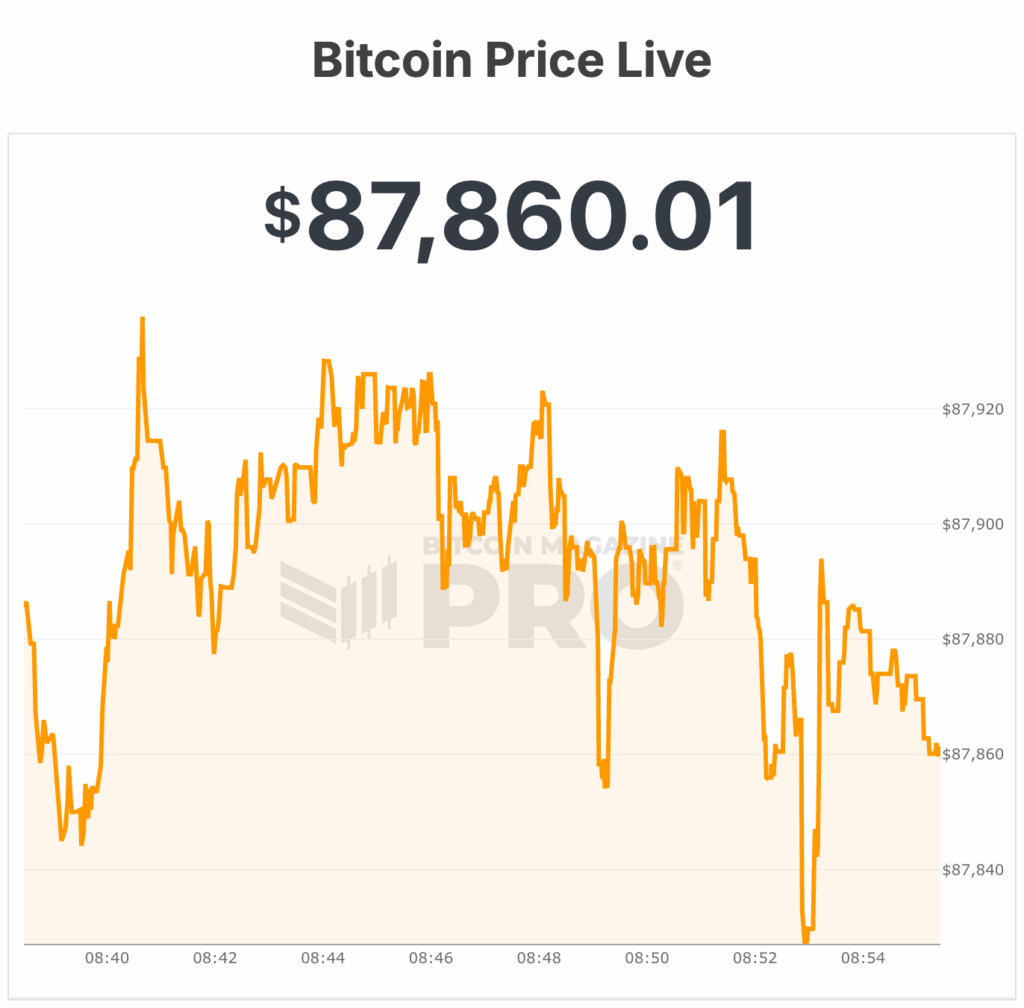
At the time of writing, Bitcoin is trading near $89,000. 

strategy

This post Strategy ($MSTR) Sells $257 Million in Stock to Buy 2,932 Bitcoin first appeared on Bitcoin Magazine and is written by Micah Zimmerman.

Oklahoma Introduces Bill Allowing State Employees and Vendors to Be Paid in Bitcoin

Bitcoin Magazine

Oklahoma Introduces Bill Allowing State Employees and Vendors to Be Paid in Bitcoin

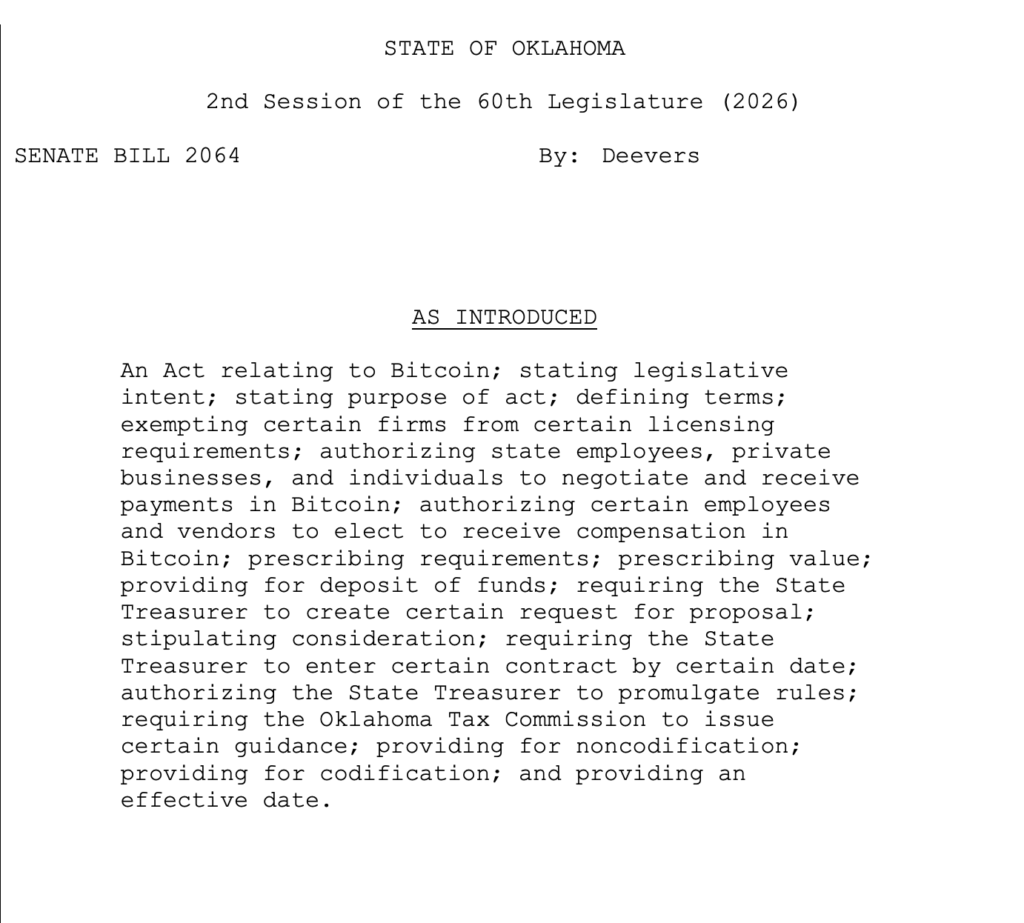
Oklahoma lawmakers introduced legislation this week that would allow state employees, vendors, private businesses, and residents to negotiate and receive payments in bitcoin.

Senate Bill 2064, introduced by Senator Dusty Deevers during the 2026 legislative session, establishes a legal framework for the use of bitcoin as a medium of exchange and compensation without designating it as legal tender.

The bill explicitly states that it does not conflict with the U.S. Constitution’s prohibition on states coining money or declaring legal tender other than gold and silver, instead recognizing bitcoin as a financial instrument operating within existing legal frameworks.

If enacted, the bill would permit Oklahoma state employees to elect to receive salaries or wages in bitcoin, either based on the asset’s market value at the start of a pay period or at the time of payment. 

Employees would be allowed to revise their payment preference at the beginning of each pay period and could choose to receive compensation in bitcoin, U.S. dollars, or a combination of both. 

Payments would be deposited either into a self-hosted wallet controlled by the employee or into a third-party custodial account designated by the employee.

The legislation would also allow vendors contracting with the state to opt into receiving payment in bitcoin on a per-transaction basis. The bitcoin value of those payments would be determined by the market price at the time of the transaction unless otherwise agreed upon in writing.

Beyond state payroll and procurement, the bill broadly authorizes private businesses and individuals in Oklahoma to negotiate and receive payments in bitcoin, reinforcing its use as a voluntary medium of exchange across the state economy.

JUST IN: Oklahoma introduces bill to allow state employees, businesses, and individuals to accept Bitcoin payments 🇺🇸 pic.twitter.com/2HjQr4PVLM

— Bitcoin Magazine (@BitcoinMagazine) January 23, 2026

SB 2064 includes provisions aimed at reducing regulatory friction for bitcoin-native businesses. Firms that deal exclusively in digital assets and do not exchange them for U.S. dollars would be exempt from Oklahoma’s money transmitter licensing requirements, according to legislation text. 

The bill directs the Oklahoma State Treasurer to issue a request for proposals for a digital asset firm to process bitcoin payments for state employees and vendors.

In selecting a provider, the Treasurer must consider factors including fees, transaction speed, cybersecurity practices, custody options, and any relevant state licenses. The Treasurer would be required to finalize a contract with a provider by January 1, 2027, and is authorized to promulgate rules to implement the program.

Back in January 2025, Oklahoma State Senator Dusty Deevers introduced a similar initiative called the Bitcoin Freedom Act (SB 325). It was a bill designed to let employees, vendors, and businesses voluntarily receive and make payments in Bitcoin while creating a legal framework for its use in the state’s economy.

Oklahoma’s bitcoin adoption echoes other U.S. states

This move follows other states like New Hampshire and Texas in exploring ways to integrate Bitcoin into public finance. 

New Hampshire passed the nation’s first Strategic Bitcoin Reserve law, allowing the state to hold up to 5% of its funds in high-market-cap digital assets and even approve a bitcoin-backed municipal bond.

Texas, meanwhile, has paired legislation with action, creating a Strategic Bitcoin Reserve and making the first U.S. state Bitcoin ETF purchase of around $5 million, framing it as both a hedge against economic volatility and a step toward modernizing state finances. 

If passed, SB 2064 would take effect on November 1, 2026, positioning Oklahoma among a small but growing number of U.S. states exploring direct integration of bitcoin into government payment systems.

The Oklahoma Tax Commission would also be required to issue guidance on the tax treatment of digital assets received as payment by January 1, 2027, addressing an area that has often created uncertainty for employees and employers alike.

oklahoma

This post Oklahoma Introduces Bill Allowing State Employees and Vendors to Be Paid in Bitcoin first appeared on Bitcoin Magazine and is written by Micah Zimmerman.

UBS Plans Bitcoin Trading for Select Wealth Clients

Bitcoin Magazine

UBS Plans Bitcoin Trading for Select Wealth Clients

UBS Group AG is preparing to offer bitcoin trading to a select group of private banking clients in Switzerland.

According to a Bloomberg report citing people familiar with the matter, the Swiss banking giant has been in discussions for several months about launching a cryptocurrency trading offering and is currently in the process of selecting external partners. 

The service would initially be limited to a small subset of Swiss private banking clients, with a broader rollout possible at a later stage.

UBS has not made a final decision on implementation, the people said, and the plans remain subject to regulatory, operational, and risk considerations.

Rather than building a full digital asset stack in-house, the banks is reportedly evaluating partnerships with third-party providers that could handle trading execution, custody, and compliance. 

A partner-led model would allow the bank to offer crypto exposure while limiting balance sheet risk and operational complexity.

Such an approach mirrors strategies adopted by other major financial institutions entering the digital asset space, particularly those seeking to comply with stringent capital requirements under the Basel III framework.

Under the proposed structure, the company would initially allow eligible clients to buy and sell bitcoin (BTC) and ethereum (ETH), the two largest digital assets by market capitalization. 

Additional assets have not been discussed.

Possible UBS expansion beyond Switzerland

While the initial rollout would focus on Switzerland, Bloomberg reported that UBS is considering expanding the service to other regions, including Asia-Pacific and the United States, depending on regulatory clarity and client demand.

UBS currently manages approximately $4.7 trillion in wealth assets as of September 30, making it the largest wealth manager globally, according to Bloomberg. Even a limited crypto offering could represent a meaningful step toward broader institutional adoption of bitcoin within traditional private banking.

The bank has historically maintained a cautious stance on cryptocurrencies. 

In November 2023, UBS allowed wealthy clients in Hong Kong to trade cryptocurrency-linked exchange-traded funds, joining competitors such as HSBC, but stopped short of offering direct spot crypto trading.

A UBS spokesperson declined to comment on the specifics of the Bloomberg report but confirmed that the bank continues to explore digital asset initiatives.

“As part of UBS’s digital asset strategy, we actively monitor developments and explore initiatives that reflect client needs, regulatory developments, market trends and robust risk controls,” the spokesperson said. “We recognize the importance of distributed ledger technology like blockchain, which underpins digital assets.”

This post UBS Plans Bitcoin Trading for Select Wealth Clients first appeared on Bitcoin Magazine and is written by Micah Zimmerman.
Nasdaq Moves to Remove Position Limits on Bitcoin ETF Options

Bitcoin Magazine

Nasdaq Moves to Remove Position Limits on Bitcoin ETF Options

Nasdaq has filed a rule change with the U.S. Securities and Exchange Commission seeking to remove position and exercise limits on options tied to spot Bitcoin exchange-traded funds, a move that would further integrate crypto-linked products into traditional derivatives markets.

The proposal, originally filed on Jan. 7 and made effective this week on the 21st, eliminates the current 25,000-contract cap on options linked to Bitcoin and Ethereum ETFs listed on Nasdaq. 

Affected products include funds from BlackRock, Fidelity, Grayscale, Bitwise, ARK/21Shares and VanEck, according to the filing.

The SEC waived its standard 30-day waiting period, allowing the rule change to take effect immediately, while retaining the authority to suspend it within 60 days if further review is deemed necessary. 

A public comment period is now open, with a final SEC determination expected by late February unless the rule is paused.

Nasdaq argued that lifting the limits would allow crypto ETF options to be treated “in the same manner as all other options that qualify for listing,” eliminating what it described as unequal treatment without undermining investor protections. 

The exchange said the change would support market efficiency while maintaining safeguards against manipulation and excessive risk.

Options are derivative contracts that give traders the right, but not the obligation, to buy or sell an asset at a predetermined price before a set expiration date. Position and exercise limits are typically imposed to prevent concentrated positions that could amplify volatility or destabilize markets.

The filing builds on Nasdaq’s approval in late 2025 to list options on single-asset crypto ETFs as commodity-based trusts. While that decision allowed Bitcoin and Ethereum ETF options to trade on the exchange, existing position limits remained in place.

Nasdaq has steadily expanded its involvement in crypto markets in recent years. 

Nasdaq’s bitcoin and digital asset push

In November, the exchange filed a separate proposal to raise position limits on options tied to BlackRock’s iShares Bitcoin Trust (IBIT) to as much as one million contracts, citing growing institutional demand and increased use of options for hedging strategies.

The exchange has also pushed into crypto indexing and tokenization. In January, Nasdaq and CME Group announced plans to unify their crypto benchmarks under the Nasdaq-CME Crypto Index, which tracks major digital assets including Bitcoin, Ether, XRP, Solana, Cardano and Avalanche.

If approved permanently, the latest rule change would mark another step toward normalizing Bitcoin derivatives within U.S. regulated markets, further blurring the line between traditional financial instruments and crypto-native assets.

This post Nasdaq Moves to Remove Position Limits on Bitcoin ETF Options first appeared on Bitcoin Magazine and is written by Micah Zimmerman.

Kansas Introduce Bill to Establish Strategic Bitcoin Reserve

Bitcoin Magazine

Kansas Introduce Bill to Establish Strategic Bitcoin Reserve

Kansas has become the latest U.S. state to explore a formal role for Bitcoin and digital assets in public finance, with lawmakers introducing legislation that would create a state-managed Bitcoin and Digital Assets Reserve Fund.

The bill, introduced by State Senator Craig Bowser, proposes amending Kansas’ unclaimed property laws to explicitly recognize digital assets, including cryptocurrencies and virtual currencies, and to establish a framework for their custody, management, and potential sale.

If passed, the legislation would place oversight of the reserve with the Kansas State Treasurer.

Under the proposal, unclaimed digital assets, like Bitcoin, would be transferred to the state after three years of inactivity following undeliverable written or electronic communication to the owner. 

There is some ambiguity around what an ‘unclaimed digital asset’ is but the bill appears to apply only to custodial digital assets held by a legally defined “holder,” such as exchanges, banks, trust companies, or other licensed custodians, not to self-custodied wallets. 

Per the bill, the three-year abandonment clock begins only after written or electronic communication to the owner is returned as undeliverable, and it stops immediately if the owner shows any sign of activity, including logging in or accessing another account with the same custodian.

Unlike many traditional forms of unclaimed property, the bill allows these assets to be delivered and held in their native digital form, rather than being immediately liquidated.

The legislation also permits the state’s designated qualified custodian to stake digital assets and receive airdrops, subject to direction from the treasurer. 

Any staking rewards or airdropped assets generated after three years would be transferred into the BTC and Digital Assets Reserve Fund, creating a mechanism for the state to accumulate digital assets over time.

In a notable provision, the bill prohibits BTC from being deposited into the state’s general fund.

Instead, Kansas would retain Bitcoin as part of its reserve, while directing 10% of deposits of non-bitcoin digital assets into the general fund, contingent on legislative appropriations. Supporters argue this structure treats BTC as a long-term reserve asset rather than a short-term revenue source.

BREAKING: Kansas Senator Craig Bowser introduces bill to create a Strategic Bitcoin Reserve 🇺🇸 pic.twitter.com/WeQjtrc3Vi

— Bitcoin Magazine (@BitcoinMagazine) January 22, 2026

States are actively pushing for bitcoin reserves 

The bill also lays out how the state would handle the sale of digital assets. Cryptocurrencies that trade on established exchanges would have to be sold at market prices, while assets without active exchange listings could be sold using other commercially reasonable methods. 

The goal of all this is to minimize market disruption while adding clearer guardrails around how state-held digital assets are managed.

If passed, the legislation would put Kansas alongside a growing number of U.S. states exploring how Bitcoin and other digital assets might fit into long-term financial and custodial strategies. 

In recent years, state lawmakers across the country have debated whether Bitcoin could serve as a hedge against inflation, a diversification tool, or a way to modernize public finance infrastructure.

This post Kansas Introduce Bill to Establish Strategic Bitcoin Reserve first appeared on Bitcoin Magazine and is written by Micah Zimmerman.

Coinbase Forms Quantum Computing Advisory Board as Bitcoin Security Concerns Grow

Bitcoin Magazine

Coinbase Forms Quantum Computing Advisory Board as Bitcoin Security Concerns Grow

Earlier this week, Coinbase announced the creation of an Independent Advisory Board on Quantum Computing and Blockchain, aiming to safeguard the crypto ecosystem against emerging quantum threats

The board will bring together leading experts in quantum computing, cryptography, and blockchain to assess risks and provide guidance to the broader industry.

Quantum computers, if scaled successfully, could compromise the cryptography that underpins major blockchains like Bitcoin and Ethereum. Coinbase, in their announcement, stressed that preparing for these future challenges is crucial to maintaining the security of digital assets.

The advisory board includes notable figures such as quantum computing pioneer Scott Aaronson, Stanford cryptography expert Dan Boneh, Ethereum researcher Justin Drake, and Coinbase’s own Head of Cryptography, Yehuda Lindell. 

The group says they will publish position papers, recommend best practices for long-term security, and respond to significant advances in quantum computing.

This initiative is part of Coinbase’s larger post-quantum security strategy, which also includes updating Bitcoin address handling, enhancing internal key management, and advancing research on post-quantum signature schemes. The board’s first position paper is expected early next year, laying out a roadmap for quantum resilience in blockchain systems.

Coinbase said the move underscores the importance of proactive planning, ensuring the crypto industry remains prepared, not reactive, as quantum technology evolves.

Is bitcoin at risk from Quantum Computing? 

Over the last several months, concerns over quantum computing’s potential impact on Bitcoin have begun to ripple through traditional finance, prompting some investors to radically rethink their exposure to the cryptocurrency. 

Jefferies strategist Christopher Wood recently removed Bitcoin from his Greed & Fear model portfolio, citing the existential risk that large-scale quantum computers could undermine the cryptographic foundations securing digital assets. 

While the threat is not imminent, Wood and other institutional voices — including BlackRock and UBS CEO Sergio Ermotti — warn that quantum advances could eventually allow attackers to derive private keys from public ones, putting millions of BTC at risk. 

As a result, Wood replaced Bitcoin with gold and gold-mining equities, emphasizing that long-term store-of-value claims for digital assets may be less reliable in the face of accelerating technological change.

The debate over quantum computing in the Bitcoin ecosystem is intensifying. Coinbase research indicates that roughly 20% to 50% of Bitcoin’s supply, particularly coins in older wallet formats, could be vulnerable to so-called long-range quantum attacks. 

Crypto developers and researchers are divided over the urgency of implementing quantum-resistant solutions, with some advocating proactive upgrades and others arguing the risk remains distant. 

Strategy Chairman Michael Saylor believes that quantum computing will actually strengthen Bitcoin rather than threaten it. Network upgrades and coin migrations will boost security, while lost coins remain frozen, Saylor posted.

This post Coinbase Forms Quantum Computing Advisory Board as Bitcoin Security Concerns Grow first appeared on Bitcoin Magazine and is written by Micah Zimmerman.

Bitcoin Payments Startup ZBD Raises $40M to Build Gaming Payments Rails

Bitcoin Magazine

Bitcoin Payments Startup ZBD Raises $40M to Build Gaming Payments Rails

Bitcoin payments startup ZBD has raised $40 million in a Series C funding round as it looks to expand blockchain-based payment infrastructure for the video game industry, Fortune reported.

The New Jersey–based company, which provides payments software for game developers, was led in the round by Blockstream Capital. The crypto investment firm contributed $36 million, according to cofounder and CEO Simon Cowell, who spoke with Fortune

Cowell declined to disclose the company’s valuation or name the other investors involved.

The platform allows video game developers to integrate payments directly into games, enabling transactions such as peer-to-peer transfers, loyalty rewards, and Bitcoin payouts without relying on third-party fintech providers.

 “We’re talking about a payment solution for the entire industry that actually really enables them to have a direct financial relationship to the player,” Cowell said.

The fundraise comes at a time when enthusiasm for crypto gaming has cooled. 

Once touted as a major use case for blockchain technology, crypto-based gaming — particularly NFT-driven models — has struggled to gain mainstream traction since the 2021–2022 bull market. 

ZBD has deliberately avoided NFTs and crypto-native gameplay, instead focusing on payments, an area that has seen more concrete adoption, especially as stablecoins gain attention from firms like Stripe and banks including JPMorgan Chase, according to Fortune.

Founded by Cowell alongside André Neves and Christian Moss, ZBD centers its technology on Bitcoin rather than stablecoins. 

However, the company positions itself as a broader payments provider, allowing developers to keep users within their ecosystems rather than routing transactions through external services.

While the startup is not yet profitable and declined to share revenue figures, Cowell said the company worked with 55 games in 2025 and currently employs about 70 people. 

The newly raised capital will be used to expand ZBD’s payments product suite over the coming year, Fortune reported.

ZBD’s bitcoin rewards

ZBD integrated Bitcoin rewards into TapNation’s mobile game Idle Bank last year, marking the first mainstream mobile game to deliver Lightning Network payouts, which boosted 30-day player retention by 355% and revenue per player by 124%. 

The company, originally testing Bitcoin rewards with a modded Counter-Strike server, developed an SDK and API that allow game developers to seamlessly add Bitcoin rewards while addressing cybersecurity and fraud concerns. 

ZBD’s model turns ad revenue into Bitcoin payouts for players, increasing engagement and monetization, and has already driven significant growth for games like Bitcoin Miner.

This post Bitcoin Payments Startup ZBD Raises $40M to Build Gaming Payments Rails first appeared on Bitcoin Magazine and is written by Micah Zimmerman.

Thailand Finalizes Rules for Bitcoin ETFs and Crypto Futures in Early-2026 Push

Bitcoin Magazine

Thailand Finalizes Rules for Bitcoin ETFs and Crypto Futures in Early-2026 Push

Thailand is moving decisively to cement its position as one of Asia’s most crypto-friendly financial centers, with regulators finalizing new rules for bitcoin and crypto exchange-traded funds (ETFs), futures trading, and tokenized investment products in early 2026.

The country’s Securities and Exchange Commission (SEC) confirmed this week that it is preparing comprehensive regulatory guidelines that would allow crypto ETFs to be formally established, crypto futures to trade on the Thailand Futures Exchange (TFEX), and digital assets to be recognized as an official asset class under existing derivatives law.

SEC Deputy Secretary-General Jomkwan Kongsakul said the new framework is designed to expand access to digital assets while addressing security and custody risks that have historically deterred institutional investors.

“A key advantage of crypto ETFs is ease of access,” Kongsakul said, according to local reports. “They eliminate concerns over hacking and wallet security, which has been a major barrier for many investors.”

Bitcoin and crypto ETFs are moving closer to market

Thailand’s SEC board has already approved crypto ETFs in principle, with regulators now finalizing operational rules covering custody, liquidity, and cooperation between asset managers and licensed digital asset exchanges.

Thailand approved its first spot Bitcoin ETF in June 2024, initially restricting participation to institutional investors. By October 2025, the regulator signaled plans to expand offerings beyond bitcoin to include other cryptocurrencies, such as ether, potentially in the form of diversified crypto “basket” products.

Under the proposed framework, investors would be allowed to allocate up to 4–5% of diversified portfolios to digital assets—an approach aimed at balancing innovation with risk management.

Once approved, domestically listed crypto ETFs could trade on the Stock Exchange of Thailand, offering local exposure without requiring investors to directly hold or manage cryptocurrencies.

Alongside ETFs, the SEC is advancing plans to launch crypto futures trading on TFEX under the Futures Trading Act. Regulators also intend to formally recognize digital assets as an underlying asset class under the Derivatives Act, providing a clearer legal foundation for crypto-linked derivatives.

To support liquidity and price stability, the SEC plans to introduce market-making mechanisms in 2026. Potential market makers could include financial institutions, licensed digital asset exchanges, corporations, and entities holding cryptocurrencies on their balance sheets.

The futures market is expected to provide investors with hedging tools and more advanced risk management options, while expanding institutional participation in Thailand’s digital asset markets.

Thailand’s recent crypto incentives

Thailand’s regulatory push extends beyond ETFs and derivatives. The SEC is also developing rules for tokenized real-world assets (RWAs), including tokenized bonds and other securities that could be issued and traded on blockchain infrastructure.

These efforts align with broader global trends in asset tokenization and could eventually include baht-backed stablecoins. In 2025, Thailand approved U.S. dollar stablecoins for local trading, marking another step toward regulated digital finance.

On the tax front, Thailand eliminated capital gains tax on crypto trading from January 1, 2025, through December 31, 2029. 

This post Thailand Finalizes Rules for Bitcoin ETFs and Crypto Futures in Early-2026 Push first appeared on Bitcoin Magazine and is written by Micah Zimmerman.

Crypto Bill Delayed Several Months as Senate Pivots to Trump’s Housing Initiatives

Bitcoin Magazine

Crypto Bill Delayed Several Months as Senate Pivots to Trump’s Housing Initiatives

The sweeping U.S. Senate effort to establish a comprehensive legal framework for cryptocurrency trading and oversight is likely to be pushed back for weeks or even months, after key legislative momentum stalled this week in the wake of major industry backlash.

The Senate Banking Committee indefinitely postponed work on its long-anticipated market structure bill — widely seen as the centerpiece of U.S. crypto regulation — after Coinbase, one of the industry’s largest exchanges, publicly withdrew its support for the measure.

The withdrawal came at a crucial moment before a scheduled markup hearing, where lawmakers would have debated amendments and potentially advanced the bill toward a floor vote. With Coinbase no longer backing the legislation “as written,” the committee has shifted its immediate focus to other priorities, including housing affordability initiatives tied to President Donald Trump’s agenda.

Industry insiders say the delay could stretch into late February or March, according to Bloomberg reporting. Lawmakers wrestled with unresolved policy disputes and are trying to rebuild bipartisan consensus in a sharply divided Senate.

Several factors are contributing to the slowdown. Coinbase’s withdrawal of support, following CEO Brian Armstrong’s decision, shows there are some deep divisions between crypto firms and portions of the bill’s drafters, mainly around stablecoin rewards.

Industry leaders argue that provisions in the current text could weaken the Commodity Futures Trading Commission’s authority, restrict decentralized finance (DeFi), and curtail stablecoin rewards — measures widely viewed as essential to continued crypto innovation. 

Political dynamics are slowing the crypto bill’s progress

At the same time, the traditional banking sector has pushed lawmakers to impose tighter restrictions on yield-bearing crypto products, warning that such features could draw deposits away from banks and destabilize lending markets; that lobbying effort appears to have shaped the bill’s language and intensified industry opposition. 

Also, shifting legislative priorities ahead of the midterm elections have further slowed momentum, as senators face pressure to focus on voter-facing issues such as housing affordability.

While some lawmakers insist the delay is temporary and that robust crypto rules remain achievable, the interruption highlights the fragile nature of legislative consensus on digital assets. 

Senate Agriculture Committee members have released a separate market structure draft, but industry observers caution it may lack the bipartisan backing necessary to prevail.

Patrick Witt, executive director of the White House council on digital assets, has publicly urged continued negotiation, describing regulatory clarity as “a question of when, not if.” However, he warned that without industry cooperation, future iterations could be less favorable to crypto firms.

This post Crypto Bill Delayed Several Months as Senate Pivots to Trump’s Housing Initiatives first appeared on Bitcoin Magazine and is written by Micah Zimmerman.

Strive ($ASST) Plans $150 Million Follow-On Offering to Buy More Bitcoin, Retire Convertible Notes

Bitcoin Magazine

Strive ($ASST) Plans $150 Million Follow-On Offering to Buy More Bitcoin, Retire Convertible Notes

Strive announced today that it intends to raise up to $150 million through a follow-on offering of its Variable Rate Series A Perpetual Preferred Stock, known as SATA Stock, subject to market conditions. 

The offering is registered under the Securities Act of 1933 and marks Strive’s latest move to expand its bitcoin holdings while addressing outstanding debt.

Strive plans to use the proceeds from the offering, along with cash on hand and potentially funds from terminating certain derivative contracts tied to convertible debt, to repurchase or redeem all or a portion of the 4.25% Convertible Senior Notes due 2030 issued by its subsidiary Semler Scientific, Inc. 

These Semler Convertible Notes, guaranteed by Strive, were originally issued under an indenture with U.S. Bank Trust Company, National Association acting as trustee. 

Strive wants to buy more bitcoin

The company may also use funds to pay down Semler Scientific’s borrowings under its loan agreements with Coinbase Credit Inc., acquire additional bitcoin and related products, and support general corporate needs.

In addition, Strive is negotiating with some holders of the Semler Convertible Notes to potentially exchange their notes for shares of SATA Stock. 

SATA Stock is structured as a variable-rate, cumulative dividend security with a stated value of $100 per share. Dividends are currently set at an annualized rate of 12.25%, payable monthly, though Strive reserves the right to adjust the rate within certain limits. 

If a dividend is missed, it accrues additional compounded interest, which can rise up to 20% per year. The company intends to manage the dividend rate to help the stock trade within a target range of $95 to $105 per share.

Strive also retains the right to redeem SATA Stock at $110 per share (or higher at its discretion), plus accrued dividends. Redemption can occur at any time, but the company generally cannot redeem less than $50 million of SATA Stock unless a clean-up or tax-related redemption applies.

The liquidation preference for SATA Stock is $100 per share, adjusted daily to the greater of the stated value, the previous trading day’s closing price, or the 10-day average price. 

Strive said that Barclays and Cantor are joint book-running managers for the offering, with Clear Street acting as co-manager.

After SATA briefly hit $100 today, the company’s approach to set a follow-on offering price based on current market conditions is seen as a cleaner alternative to an “at-the-market” (ATM) offering, avoiding dilution and allowing Strive to capitalize on favorable pricing. 

The raised funds will help the company retire legacy convertible debt and expand its Bitcoin holdings, signaling continued commitment to its crypto-focused growth strategy.

This post Strive ($ASST) Plans $150 Million Follow-On Offering to Buy More Bitcoin, Retire Convertible Notes first appeared on Bitcoin Magazine and is written by Micah Zimmerman.
Bitcoin Price Surges to $90,000 After Trump Delays Tariffs

Bitcoin Magazine

Bitcoin Price Surges to $90,000 After Trump Delays Tariffs

The bitcoin price experienced several intraday spikes on Wednesday, swinging by several thousand dollars as traders reacted to shifting geopolitical headlines and fresh comments from U.S. President Donald Trump.

The world’s largest cryptocurrency started the day near $88,000 before surging above $90,000 in early trading. The rally proved short-lived, however, with bitcoin sliding back into the upper $87,000 range after markets opened and dipped. Prices then roared higher once again, rebounding toward $90,000 after Trump announced a delay to planned trade tariffs.

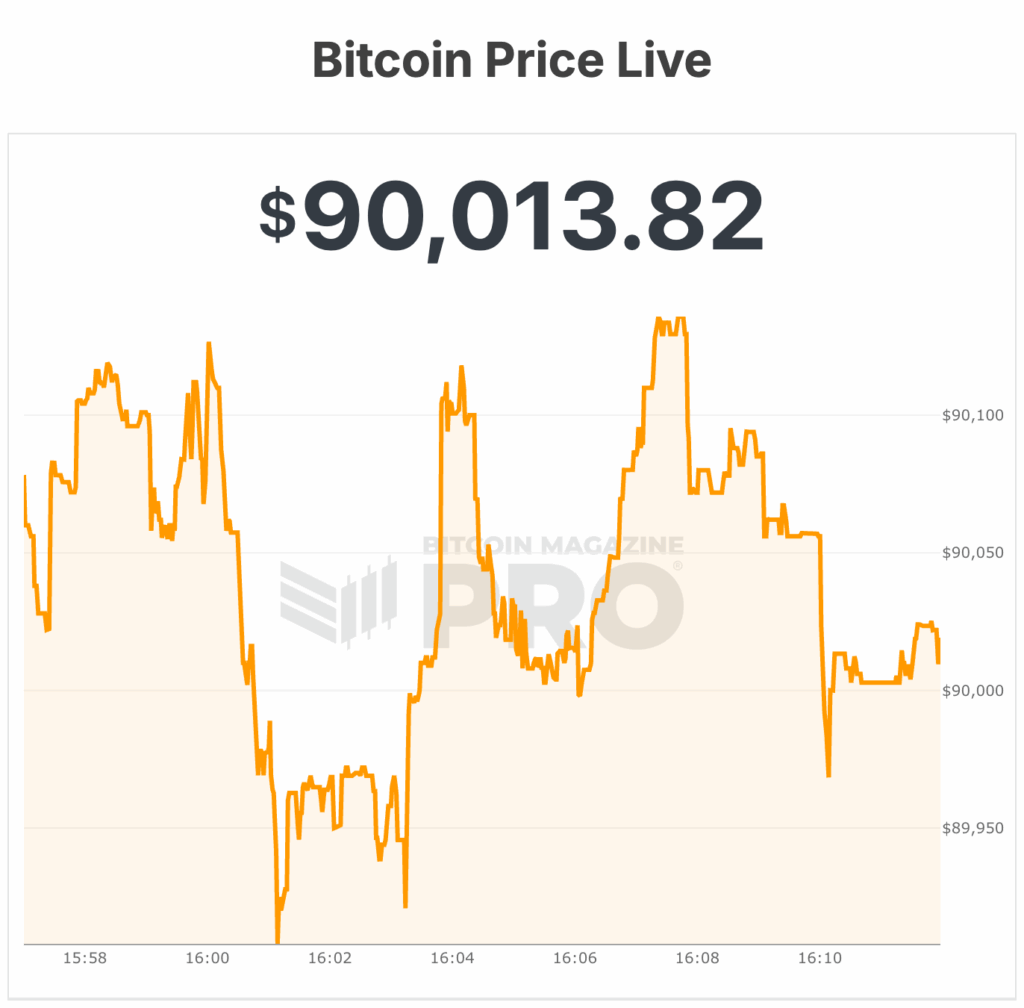
Bitcoin price was last trading around $90,000 at the time of writing, having briefly reclaimed the level for the second time in the same session.

Trump comments spark bitcoin price rally

The latest move followed comments from Trump at the World Economic Forum in Davos, Switzerland, and a subsequent post on his Truth Social platform. 

Trump said he would delay tariffs that were scheduled to take effect on February 1 after what he described as a “very productive meeting” with NATO Secretary General Mark Rutte.

In the post, Trump outlined a preliminary framework for a broader agreement involving Greenland and the Arctic region, calling the potential deal “a great one for the United States of America, and all NATO nations.” He added that, based on the discussions, the planned tariffs would not move forward.

Markets responded positively to the news. U.S. equities bounced sharply, with the S&P 500, Nasdaq and Dow Jones Industrial Average all rising roughly 1.5% on the day. 

Risk assets across the board followed suit, lifting the bitcoin price and other major cryptocurrencies back toward recent highs.

During his Davos remarks, Trump also reiterated his support for digital assets, saying he hopes to sign comprehensive crypto market structure legislation “very soon.”

“Now, Congress is working very hard on crypto market structure legislation — Bitcoin, all of them — which I hope to sign very soon, unlocking new pathways for Americans to reach financial freedom,” Trump said.

Bitcoin price analysis as macro risks linger

Despite the relief rally, macroeconomic concerns remain in the background. Analysts have pointed to renewed stress in Japan’s bond market as a potential headwind for global risk assets.

Japan’s 10-year government bond yield has climbed to around 2.29%, a level not seen since 1999. QCP Capital highlighted in a note that Japan’s government debt exceeds 240% of GDP, with debt servicing costs projected to consume roughly a quarter of fiscal spending by 2026.

According to Bitcoin Magazine analysis, the bitcoin price held its bullish structure above $90,000 last week, rallying to $98,000 and closing around $93,600, keeping a mildly bullish bias.

Bulls will want the bitcoin price to reclaim $94,000 and retest $98,000 this week, with a sustained break potentially reaching $103,500 and the $106,000–$109,000 resistance zone.

Key support is at $91,400, with a loss possibly leading to a deeper pullback toward $87,000 or $84,000. 

While momentum has improved, the $103,500–$109,000 area is expected to be strong resistance, where rejection could decide whether the rally continues or drops toward sub-$80,000 levels.

Wednesday’s dramatic price action proved costly for leveraged crypto traders. According to CoinGlass data, more than $1 billion in crypto positions were liquidated over the past 24 hours as prices whipsawed higher and lower and then higher.

Long positions bore the brunt of the damage, accounting for approximately $672 million in liquidations, while short positions made up about $335 million. 

Bitcoin led the losses with roughly $426 million in liquidations, followed by Ethereum at around $366 million.

Currently, the bitcoin price is trading at $90,019 with a 24-hour volume of $67 B, holding steady over the past day. Its market cap stands at $1.798 T, just below its 7-day high of $90,296 and above the 7-day low of $87,304.


bitcoin price

This post Bitcoin Price Surges to $90,000 After Trump Delays Tariffs first appeared on Bitcoin Magazine and is written by Micah Zimmerman.

FTX-Fraudster Caroline Ellison Set for Release From Federal Custody After Serving Reduced Sentence

Bitcoin Magazine

FTX-Fraudster Caroline Ellison Set for Release From Federal Custody After Serving Reduced Sentence

Caroline Ellison, the former co-CEO of Alameda Research and a central figure in the collapse of cryptocurrency exchange FTX, is expected to be released from federal custody on Wednesday after serving roughly 440 days of a two-year prison sentence, according to data from the U.S. Federal Bureau of Prisons. 

Ellison, 31, is expected to exit from a residential reentry management facility — commonly known as a halfway house — in New York, where she has been held in community confinement since late 2025. 

Her early release came approximately ten months ahead of her original projected term and reflects credit for cooperation with prosecutors and good conduct while incarcerated.

Ellison was sentenced in September 2024 to two years in prison after pleading guilty in December 2022 to multiple fraud and conspiracy charges tied to the misuse of customer funds at FTX and the trading firm Alameda Research. 

She began serving her sentence in November 2024 at a federal facility in Connecticut before being transferred to community confinement.

Ellison’s role in FTX

As part of her plea agreement, Ellison cooperated extensively with federal authorities and testified against former FTX CEO Sam Bankman-Fried during his criminal trial in 2023.

Her testimony detailed how Alameda and FTX commingled customer assets, concealed financial losses, and relied on an effectively unlimited line of credit that allowed Alameda to draw directly from FTX customer deposits.

That evidence played a key role in Bankman-Fried’s conviction on multiple fraud charges. He was sentenced in March 2025 to nearly 25 years in prison and ordered to forfeit up to $11 billion in assets to compensate investors and lenders.

Federal regulators have barred Ellison from serving as an officer or director of a public company or cryptocurrency exchange for ten years. 

The Securities and Exchange Commission has also sought similar prohibitions against other former FTX executives who cooperated with authorities, including former CTO Gary Wang and ex-engineering head Nishad Singh, both of whom avoided prison time.

FTX collapsed in November 2022 after a liquidity crisis exposed a multibillion-dollar hole in its balance sheet, triggering one of the largest bankruptcies in the history of the crypto industry.

Bankman-Fried and Caroline Ellison reportedly had an on-again, off-again romantic and professional relationship, living together with other FTX executives in a Bahamian penthouse while working closely at Alameda Research. 

This post FTX-Fraudster Caroline Ellison Set for Release From Federal Custody After Serving Reduced Sentence first appeared on Bitcoin Magazine and is written by Micah Zimmerman.

Cathie Wood Says Bitcoin Price Is Nearing End of Down Cycle, Predicts ‘Shallowest Four-Year Decline’

Bitcoin Magazine

Cathie Wood Says Bitcoin Price Is Nearing End of Down Cycle, Predicts ‘Shallowest Four-Year Decline’

ARK Invest CEO Cathie Wood said she believes bitcoin is nearing the end of its current down cycle, arguing that the asset’s latest four-year drawdown will likely be the shallowest in its history.

“We’re pretty well through the down cycle here,” Wood said in a CNBC interview, pushing back against fears that bitcoin still faces a prolonged correction. She noted that the most recent bull market was muted by historical standards, which she believes has limited the severity of the current pullback.

“I know there’s a lot of fear about the four-year cycle,” Wood said. “We didn’t have much of an upcycle by bitcoin standards, so we think we’re pretty well through the down cycle here.”

Wood acknowledged that bitcoin could continue to test key psychological levels in the near term, potentially trading within an $80,000 to $90,000 range. However, she said ARK expects those levels to hold.

“We may test in this $80,000 to $90,000 range on bitcoin, but we do think that the test will be successful,” she said.

According to Wood, the current market environment reflects a maturing asset rather than structural weakness. She described the present drawdown as “the shallowest four-year cycle decline in bitcoin’s short history,” adding that ARK expects renewed upside once the correction fully plays out.

“And then we’re off again,” she said.

Wood framed bitcoin’s long-term thesis as extending far beyond short-term price cycles, describing it as “three revolutions in one”: a new global, rules-based monetary system competing with fiat currencies, a breakthrough technology, and the leading asset in a new asset class.

“It is a technology revolution,” Wood said, “and it is the leader of a new asset class.”

Recent Bitcoin price action

Bitcoin saw a lot of intraday volatility today, swinging thousands of dollars as markets reacted to fresh geopolitical headlines from U.S. President Donald Trump. 

The price surged from the $88,000 range in early morning hours to $90,500, slid back into the upper $87,000s, and then rebounded toward $90,000 following Trump’s announcement that he would delay planned tariffs.

In a post on Truth Social, Trump said the decision followed what he described as a “very productive meeting” with NATO Secretary General Mark Rutte, outlining a preliminary framework for a broader deal involving Greenland and the Arctic region. 

Citing the talks, Trump said tariffs scheduled to take effect on February 1 would not be imposed, easing near-term trade concerns and helping lift risk assets, including bitcoin, back toward key psychological levels.

This post Cathie Wood Says Bitcoin Price Is Nearing End of Down Cycle, Predicts ‘Shallowest Four-Year Decline’ first appeared on Bitcoin Magazine and is written by Micah Zimmerman.
Delaware Life Launches First Fixed Index Annuity That Offers Bitcoin Exposure

Bitcoin Magazine

Delaware Life Launches First Fixed Index Annuity That Offers Bitcoin Exposure

Delaware Life Insurance Company has become the first U.S. insurance carrier to offer a fixed index annuity (FIA) linked to a cryptocurrency-focused index, the BlackRock U.S. Equity Bitcoin Balanced Risk 12% Index. 

The move allows retirement investors to gain indirect exposure to Bitcoin while retaining principal protection, a hallmark of traditional annuity products.

The newly launched index blends 74% exposure to the iShares Core S&P 500 ETF with 25% exposure to the iShares Bitcoin Trust ETF (IBIT) and a 1% cash allocation. It is designed with a 12% target volatility, using dynamic cash adjustments to moderate BTC’s price swings.

“This launch builds around the tremendous success and client demand we have seen for IBIT, enabling insurance clients to now add Bitcoin exposure as part of a broader indexed annuity strategy,” said Robert Mitchnick, Global Head of Digital Assets at BlackRock.

“The BlackRock U.S. Equity Bitcoin Balanced Risk 12% Index offers a measured approach, allowing policyholders to participate in digital assets while maintaining the downside protection they expect from annuity products.”

Delaware Life’s CEO of Marketing, Colin Lake, touched on the company’s focus on innovation. 

“We’re proud to partner with BlackRock as the first insurance carrier to offer cryptocurrency exposure through a fixed index annuity,” Lake said. “As the retirement-planning landscape evolves, we’re continuously and thoughtfully innovating to meet the needs of financial professionals and their clients. Our fixed index annuities deliver what today’s investors want and need: opportunity for growth with protection.”

Bitcoin’s high returns balanced with equity growth

The index’s mixed allocation is designed to balance traditional equity growth with BTC’s high return potential, all while managing volatility.

As of December 31, 2024, the index delivered a six-month return of 1.88%, though BTC’s recent three-month decline contributed to a 3.16% drop over that period.

The BlackRock U.S. Equity Bitcoin Balanced Risk 12% Index is available on three Delaware Life FIA products: Momentum Growth™, Momentum Growth Plus™, and DualTrack Income™, giving clients multiple avenues to integrate BTC exposure into retirement portfolios.

The inclusion of IBIT, the largest and most liquid Bitcoin exchange-traded product, provides professional management without requiring direct cryptocurrency ownership.

This is the first time a life insurance company has allowed policy holders to select a product which includes Bitcoin.

The price of BTC today is $87,774, down 2% in the last 24 hours, with a 24-hour trading volume of $64 billion.

This post Delaware Life Launches First Fixed Index Annuity That Offers Bitcoin Exposure first appeared on Bitcoin Magazine and is written by Micah Zimmerman.

Fast-Food Chain Steak ‘n Shake to Pay Hourly Workers a Bitcoin Bonus

Bitcoin Magazine

Fast-Food Chain Steak ‘n Shake to Pay Hourly Workers a Bitcoin Bonus

Fast-food chain Steak ‘n Shake is rolling out a bitcoin bonus program for hourly workers, deepening its embrace of bitcoin just days after disclosing a $10 million bitcoin purchase for its corporate treasury.

Starting March 1, hourly employees at company-operated Steak ’n Shake locations will earn a bitcoin bonus worth $0.21 for every hour worked. The rewards will vest after two years, meaning workers must remain employed for that period before they can access the accumulated bitcoin.

The bonus is roughly equivalent to about 1% of the U.S. federal minimum wage and will be administered in partnership with Fold, a bitcoin rewards application.

Employees will continue to receive their regular wages in dollars, with the bitcoin component treated as an additional incentive rather than a replacement for cash pay.

The move builds on Steak ‘n Shake’s broader crypto strategy, which began in 2025 when the burger chain started accepting bitcoin payments via the Lightning Network at all U.S. locations. 

At the time, company executives said the integration reduced card processing fees by roughly half and helped attract younger customers. Same-store sales rose more than 10% in the second quarter of 2025, according to company comments.

Steak ‘n Shake loves bitcoin 

Last week, Steak ‘n Shake disclosed that it had added $10 million worth of bitcoin to its balance sheet, marking one of the more significant treasury allocations to the asset by a consumer-facing restaurant brand. 

The company has also leaned into bitcoin-themed marketing, including the launch of a limited-time “Bitcoin Meal” in October that includes a small donation to open-source bitcoin development.

The hourly bonus rate references bitcoin’s fixed supply cap of 21 million coins, a symbolic nod frequently used in crypto culture. 

At current prices, a worker putting in 30 hours a week would earn roughly $327 worth of bitcoin per year under the program, assuming a stable bitcoin price.

Last year, a company executive said that Bitcoin transactions were already outperforming expectations.

“The day we launched Bitcoin, 1 out of every 500 bitcoin transactions in the world happened at Steak ‘n Shake,” Executive Dan Edwards said at the Bitcoin Conference. 

“Bitcoin is faster than credit cards, and when customers choose to pay in Bitcoin, we’re saving 50% in processing fees,” said Edwards. “That makes Bitcoin a win for the customer, a win for us, and a win for the Bitcoin community.” 

This post Fast-Food Chain Steak ‘n Shake to Pay Hourly Workers a Bitcoin Bonus first appeared on Bitcoin Magazine and is written by Micah Zimmerman.

Trump Vows to Sign Major Bitcoin Bill ‘Very Soon,’ Says U.S. Must Remain Crypto Capital

Bitcoin Magazine

Trump Vows to Sign Major Bitcoin Bill ‘Very Soon,’ Says U.S. Must Remain Crypto Capital

U.S. President Donald Trump said Wednesday that he wants to sign sweeping cryptocurrency market structure legislation “very soon,” arguing that digital assets are both a political priority and a strategic battleground in the United States’ economic competition with China.

Speaking during a wide-ranging address to world leaders and financial executives at the World Economic Forum in Davos, Switzerland, Trump framed his administration’s embrace of crypto as central to preserving U.S. leadership in financial innovation. 

His comments came as bitcoin surged above $90,000, extending gains amid optimism that clearer U.S. regulation could further legitimize the asset class.

“To unleash innovation and savings and financing, I’m also working to ensure America remains the crypto capital of the world,” Trump said.

He pointed to legislation he said he signed last year — the GENIUS Act, focused on stablecoins — as a foundational step toward that goal, while signaling that broader crypto market structure rules are now close to becoming law.

“Congress is working very hard on crypto market structure legislation — bitcoin, all of them — which I hope to sign very soon,” Trump said, adding that the effort would unlock new pathways for Americans to achieve what he described as “financial freedom.”

BREAKING: 🇺🇸 President Trump says he hopes to sign crypto bill soon. pic.twitter.com/kT4nwlPjDq

— Bitcoin Magazine (@BitcoinMagazine) January 21, 2026

Trump openly acknowledged the political calculus behind his support for crypto, saying it delivered “tremendous political support,” but stressed that geopolitical competition was the more important driver. 

“China wanted that market too,” he said. “It’s just like they want the AI. And we’ve got that market, I think, pretty well locked up.”

He also took aim at former President Joe Biden, claiming Democrats only softened their stance on crypto late in the 2024 election cycle after realizing how many voters cared about digital assets. 

“All of a sudden they loved it very much, but it was too late,” Trump said. “They blew it.”

Trump’s support for crypto legislation in the United States

Trump’s remarks come as U.S. lawmakers continue to negotiate a long-awaited framework to define how cryptocurrencies are regulated, including whether tokens fall under securities or commodities law and which agencies will oversee the sector. 

The Senate is currently advancing market structure legislation through multiple committees, though final language has yet to be released and markups keep getting delayed.

Political action committees backed by crypto firms spent hundreds of millions of dollars during the 2024 election cycle and are already mobilizing ahead of the 2026 midterms.

As Trump speaks, Bitcoin is trading at $89,942, down 1% over the past 24 hours on $60 billion in volume, leaving it about 1% below its seven-day high of $90,778 and 2% above its seven-day low of $87,902. 

This post Trump Vows to Sign Major Bitcoin Bill ‘Very Soon,’ Says U.S. Must Remain Crypto Capital first appeared on Bitcoin Magazine and is written by Micah Zimmerman.

‘Bitcoin Has No Issuer’: Coinbase CEO Clashes With French Central Banker at Davos

Bitcoin Magazine

‘Bitcoin Has No Issuer’: Coinbase CEO Clashes With French Central Banker at Davos

Coinbase CEO Brian Armstrong challenged skepticism earlier today toward Bitcoin from the head of France’s central bank during a World Economic Forum panel in Davos.

Armstrong took a public stand on stage arguing that the asset’s lack of centralized control makes it more independent than traditional monetary authorities.

The exchange unfolded after Banque de France Governor François Villeroy de Galhau questioned Bitcoin’s credibility, saying he places more trust in independent central banks with democratic mandates than in what he described as “private issuers” of Bitcoin. 

François Villeroy de Galhau said “I trust more independent central banks with a democratic mandate than private issuers of Bitcoin”.

Armstrong leaned in and hit back, saying, “bitcoin is a decentralized protocol. There’s actually no issuer of it. So in the sense that central banks have independence, Bitcoin is even more independent. There’s no country or company or individual who controls it in the world.”

“Bitcoin doesn’t have a money printer,” Armstrong said. “It’s more independent”

The discussion took place during a panel focused on tokenization at the WEF Annual Meeting, an event where conversations more commonly center on blockchain infrastructure and central bank digital currencies rather than BTC itself.

Framing Bitcoin as a monetary counterweight, Armstrong argued that competition between state-issued currencies and decentralized alternatives is healthy. 

He said BTC’s fixed supply and lack of a “money printer” provide a check on government overspending, likening its role during periods of uncertainty to gold’s historical function.

Villeroy de Galhau maintained that trust ultimately comes from central bank independence paired with accountability to citizens.

JUST IN: Coinbase CEO calls out Franch Central Bank governer:

“Bitcoin doesn't have a money printer. It's more independent” pic.twitter.com/2eW02mEaCy

— Bitcoin Magazine (@BitcoinMagazine) January 21, 2026

Coinbase CEO: Bitcoin to $1,000,000

At events centered around the conference, Armstrong also reiterated his long-held prediction that BTC could reach $1 million by 2030, arguing that its fixed 21 million supply and rising global demand matter more than short-term volatility, even as prices hovered near $89,000 and the broader crypto market lost $160 billion in a day. 

Speaking at Bloomberg House during the World Economic Forum in Davos, Armstrong urged investors to focus on long-term trends and said he remains optimistic about U.S. crypto legislation. 

Armstrong also said Coinbase can no longer support the current Senate Banking Committee crypto market structure bill, calling it worse than the status quo and harmful to innovation and competition.

For context, the U.S. Senate committee postponed debate last week on the landmark crypto “Clarity Act” after Armstrong said the company could not support the bill, dealing a major blow to its prospects. 

In essence, the legislation would establish a regulatory framework for cryptocurrencies by defining when tokens are securities or commodities and clarifying the SEC’s authority, marking the culmination of years of industry lobbying for clearer rules. 

This post ‘Bitcoin Has No Issuer’: Coinbase CEO Clashes With French Central Banker at Davos first appeared on Bitcoin Magazine and is written by Micah Zimmerman.

Trump-Appointed CFTC Chair Launches ‘Future-Proof’ Initiative, Signaling a Pro-Crypto Shift

Bitcoin Magazine

Trump-Appointed CFTC Chair Launches ‘Future-Proof’ Initiative, Signaling a Pro-Crypto Shift

U.S. Commodity Futures Trading Commission (CFTC) Chairman Mike Selig posted an op-ed on Tuesday outlining an aggressive push to modernize U.S. financial regulation, pledging to move away from what he called years of “regulation by enforcement” and toward clear, tailored rules for digital assets, prediction markets and other emerging technologies.

In a policy statement and accompanying opinion piece, Selig framed the effort as a pivotal moment for American financial markets, arguing that advances in blockchain and artificial intelligence are enabling entirely new products, platforms and business models that legacy regulations were never designed to oversee.

“Advances in technology are transforming the financial services landscape as we know it,” Selig said, adding that Congress is now “on the cusp” of passing the Digital Asset Market Clarity Act, which would establish a formal market structure for crypto in the United States.

If enacted, the legislation would expand the CFTC’s authority over digital asset markets, positioning the agency as a primary regulator for large segments of the crypto economy. 

Selig said the CFTC is prepared to take on that role and ensure innovation remains onshore rather than being driven overseas by regulatory uncertainty.

CFTC’s ‘Future-Proof’ Initiative 

The chairman announced the launch of a new “Future-Proof” initiative, under which agency staff will conduct a comprehensive review of existing CFTC rules — many of which were originally written for agricultural futures markets — to determine which should be updated or replaced to better accommodate new asset classes and trading venues.

“Decades-old rules designed for pork bellies and wheat futures do not contemplate blockchain-native markets that trade 24/7,” Selig said. “The CFTC must meet innovators where they are.”

Selig drew a sharp contrast with the Biden administration’s approach, criticizing prior regulators for applying legacy rules to novel products such as digital assets and perpetual futures through enforcement actions rather than formal rulemaking. 

That strategy, he argued, pushed startups offshore and limited access for U.S. market participants.

Under the new approach, Selig said the agency will focus on “the minimum effective dose of regulation” — rules that protect against fraud, manipulation and abuse without stifling experimentation. Future policy, he added, should be established through notice-and-comment rulemaking to provide durability across administrations.

The chairman also highlighted rapid growth in areas such as prediction markets and digital assets, noting that crypto has expanded from a niche experiment into a market exceeding $3 trillion in value. These developments, he said, require regulatory frameworks that are purpose-built rather than retrofitted.

“Anyone with a smartphone and an internet connection can now access peer-to-peer markets that operate around the clock,” Selig said, pointing to both blockchain-based platforms and the increasing use of artificial intelligence in risk management and trading strategies.

Selig credited President Donald Trump’s broader regulatory agenda for creating the conditions for what he described as a potential “golden age” of American financial markets. He said coordination among financial regulators will be critical as new legislation reshapes oversight of digital assets.

“If Congress passes market structure legislation and hands us the torch, we will ensure these markets flourish at home,” Selig said. “The great innovations of today and tomorrow should be made in America.”

This post Trump-Appointed CFTC Chair Launches ‘Future-Proof’ Initiative, Signaling a Pro-Crypto Shift first appeared on Bitcoin Magazine and is written by Micah Zimmerman.

U.S. Treasury Confirms That All Seized Bitcoin Will Join the Strategic Bitcoin Reserve

Bitcoin Magazine

U.S. Treasury Confirms That All Seized Bitcoin Will Join the Strategic Bitcoin Reserve

When asked about the U.S. government’s approach to Bitcoin and recent BTC seizures, U.S. Treasury Secretary Scott Bessent re-affirmed that the administration will halt all sales of seized BTC and instead add it to the Strategic Bitcoin Reserve (SBR). 

At the World Economic Forum in Davos, Bessent told journalist Christine Lee that the initiative is part of a larger effort to bring digital-asset innovation onto U.S. soil while keeping federal oversight of seized cryptocurrency

This sentiment comes from questions about the government’s handling of BTC seized from developers linked to Tornado Cash in the Southern District of New York as well as the handling of bitcoin from Samourai Wallet developers.

While Bessent declined to comment on ongoing litigation, he emphasized that any seized BTC would be retained by the federal government after legal damages are resolved, rather than being sold at auction as in prior years.

“This administration’s policy is to add seized Bitcoin to our digital asset reserve,” Bessent said, highlighting the first step in implementing the SBR: stopping all sales.

JUST IN: 🇺🇸 Treasury Sec. Scott Bessent says, “The policy of this government is to add seized #Bitcoin to our digital asset reserve.”
pic.twitter.com/e6X2D4peSv

— Bitcoin Magazine (@BitcoinMagazine) January 20, 2026

The reserve, established under a March 2025 executive order, treats Bitcoin as a long-term strategic asset, akin to gold or petroleum stockpiles.

Bessent also seemed to frame the broader strategy of this current innovation as a pro-innovation, pro-onshore. 

The Treasury wants to make the U.S. the “best regulatory regime for digital assets,” citing bipartisan legislation such as the Genius Act, which codifies stablecoin rules at the federal level. 

The U.S. government says they didn’t sell any Samourai Wallet bitcoin

Last week, U.S. officials denied reports that BTC forfeited by Samourai Wallet developers had been sold, confirming the assets will remain part of the Strategic Bitcoin Reserve (SBR) under Executive Order 14233. 

Patrick Witt of the President’s Council of Advisors for Digital Assets stated that the Department of Justice confirmed the 57.55 BTC, worth roughly $6.3 million, has not and will not be liquidated. 

The clarification came after earlier reports suggested the U.S. Marshals Service may have transferred the BTC to Coinbase Prime, fueling speculation of a sale that would have violated the executive order. 

Journalist Frank Corva reported that the U.S. Marshals Service appears to have sent the 57.55 BTC forfeited by Samourai Wallet developers directly to a Coinbase Prime address, which showed a zero balance, suggesting the BTC may have already been sold.

If true, this selling would contradict Executive Order 14233, which requires forfeited bitcoin to be held in the U.S. Strategic Bitcoin Reserve rather than liquidated.

This post U.S. Treasury Confirms That All Seized Bitcoin Will Join the Strategic Bitcoin Reserve first appeared on Bitcoin Magazine and is written by Micah Zimmerman.

❌