The disruption began Saturday (5am Pacific time, Jan .24) affecting approximately 1.8 billion Gmail users worldwide with widespread email misclassification.
The disruption began Saturday (5am Pacific time, Jan .24) affecting approximately 1.8 billion Gmail users worldwide with widespread email misclassification.
The integration between Trend Vision One and Security Hub CSPM is exactly that, two powerful platforms enhancing each other to keep your AWS infrastructure protected.
More and more enterprises are opting for cloud-native application protection platforms (CNAPPs) instead of complex and hard-to-manage cloud security point solutions. Find out where your organization is on its CNAPP maturity journey.
The global e‑commerce market is accelerating faster than ever before, driven by expanding online retail, and rising consumer adoption worldwide. According to McKinsey Global Institute, global e‑commerce is projected to grow by 7–9% annually through 2040.
At Kaspersky, we track how this surge in online shopping activity is mirrored by cyber threats. In 2025, we observed attacks which targeted not only e‑commerce platform users but online shoppers in general, including those using digital marketplaces, payment services and apps for everyday purchases. This year, we additionally analyzed how cybercriminals exploited gaming platforms during Black Friday, as the gaming industry has become an integral part of the global sales calendar. Threat actors have been ramping up their efforts during peak sales events like Black Friday, exploiting high demand and reduced user vigilance to steal personal data, funds, or spread malware.
This report continues our annual series of analyses published on Securelist in 2021, 2022, 2023, and 2024, which examine the evolving landscape of shopping‑related cyber threats.
Methodology
To track how the shopping threat landscape continues to evolve, we conduct an annual assessment of the most common malicious techniques, which span financial malware, phishing pages that mimic major retailers, banks, and payment services, as well as spam campaigns that funnel users toward fraudulent sites. In 2025, we also placed a dedicated focus on gaming-related threats, analyzing how cybercriminals leverage players’ interest. The threat data we rely on is sourced from the Kaspersky Security Network (KSN), which processes anonymized cybersecurity data shared consensually by Kaspersky users. This report draws on data collected from January through October 2025.
Key findings
In the first ten months of 2025, Kaspersky identified nearly 6.4 million phishing attacks which targeted users of online stores, payment systems, and banks.
As many as 48.2% of these attacks were directed at online shoppers.
We blocked more than 146,000 Black Friday-themed spam messages in the first two weeks of November.
Kaspersky detected more than 2 million phishing attacks related to online gaming.
Around 1.09 million banking-trojan attacks were recorded during the 2025 Black Friday season.
The number of attempted attacks on gaming platforms surged in 2025, reaching more than 20 million, a significant increase compared to previous years.
More than 18 million attempted malicious attacks were disguised as Discord in 2025, a more than 14-time increase year-over-year, while Steam remained within its usual five-year fluctuation range.
Shopping fraud and phishing
Phishing and scams remain among the most common threats for online shoppers, particularly during high-traffic retail periods when users are more likely to act quickly and rely on familiar brand cues. Cybercriminals frequently recreate the appearance of legitimate stores, payment pages, and banking services, making their fraudulent sites and emails difficult to distinguish from real ones. With customers navigating multiple offers and payment options, they may overlook URL or sender details, increasing the likelihood of credential theft and financial losses.
From January through to October 2025, Kaspersky products successfully blocked 6,394,854 attempts to access phishing links which targeted users of online stores, payment systems, and banks. Breaking down these attempts, 48.21% had targeted online shoppers (for comparison, this segment accounted for 37.5% in 2024), 26.10% targeted banking users (compared to 44.41% in 2024), and 25.69% mimicked payment systems (18.09% last year). Compared to previous years, there has been a noticeable shift in focus, with attacks against online store users now representing a larger share, reflecting cybercriminals’ continued emphasis on exploiting high-demand retail periods, while attacks on banking users have decreased in relative proportion. This may be related to online banking protection hardening worldwide.
Financial phishing attacks by category, January–October 2025 (download)
In 2025, Kaspersky products detected and blocked 606,369 phishing attempts involving the misuse of Amazon’s brand. Cybercriminals continued to rely on Amazon-themed pages to deceive users and obtain personal or financial information.
Other major e-commerce brands were also impersonated. Attempts to visit phishing pages mimicking Alibaba brands, such as AliExpress, were detected 54,500 times, while eBay-themed pages appeared in 38,383 alerts. The Latin American marketplace Mercado Libre was used as a lure in 8,039 cases, and Walmart-related phishing pages were detected 8,156 times.
Popular online stores mimicked by scammers, January–October 2025 (download)
In 2025, phishing campaigns also extensively mimicked other online platforms. Netflix-themed pages were detected 801,148 times, while Spotify-related attempts reached 576,873. This pattern likely reflects attackers’ continued focus on high-traffic digital entertainment services with in-service payments enabled, which can be monetized via stolen accounts.
How scammers exploited shopping hype in 2025
In 2025, Black Friday-related scams continued to circulate across multiple channels, with fraudulent email campaigns remaining one of the key distribution methods. As retailers increase their seasonal outreach, cybercriminals take advantage of the high volume of promotional communications by sending look-alike messages that direct users to scam and phishing pages. In the first two weeks of November, 146,535 spam messages connected to seasonal sales were detected by Kaspersky, including 2,572 messages referencing Singles day sales.
Scammers frequently attempt to mimic well-known platforms to increase the credibility of their messages. In one of the recurring campaigns, a pattern seen year after year, cybercriminals replicated Amazon’s branding and visual style, promoting supposedly exclusive early-access discounts of up to 70%. In this particular case, the attackers made almost no changes to the text used in their 2024 campaign, again prompting users to follow a link leading to a fraudulent page. Such pages are usually designed to steal their personal or payment information or to trick the user into buying non-existent goods.
Beyond the general excitement around seasonal discounts, scammers also try to exploit consumers’ interest in newly released Apple devices. To attract attention, they use the same images of the latest gadgets across various mailing campaigns, just changing the names of legitimate retailers that allegedly sell the brand.
Scammers use an identical image across different campaigns, only changing the retailer’s branding
As subscription-based streaming platforms also take part in global sales periods, cybercriminals attempt to take advantage of this interest as well. For example, we observed a phishing website where scammers promoted an offer for a “12-month subscription bundle” covering several popular services at once, asking users to enter their bank card details. To enhance credibility, the scammers also include fabricated indicators of numerous successful purchases from other “users,” making the offer appear legitimate.
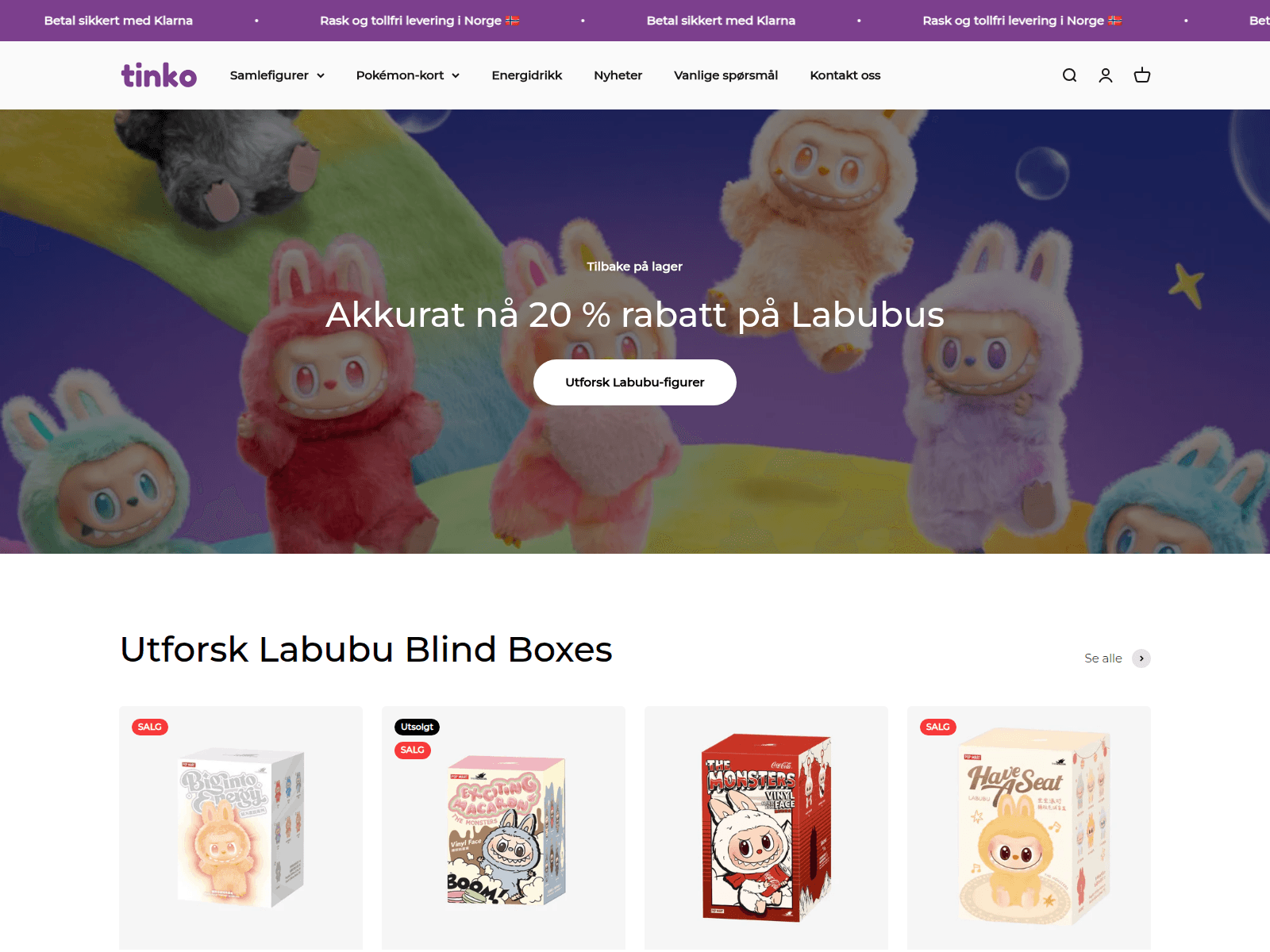
In addition to imitating globally recognized platforms, scammers also set up fake pages that pretend to be local services in specific countries. This tactic enables more targeted campaigns that blend into the local online landscape, increasing the chances that users will perceive the fraudulent pages as legitimate and engage with them.
Non-existent Norwegian online store and popular Labubu toys sale
Banking Trojans
Banking Trojans, or “bankers,” are another tool for cybercriminals exploiting busy shopping seasons like Black Friday in 2025. They are designed to steal sensitive data from online banking and payment systems. In this section, we’ll focus on PC bankers. Once on a victim’s device, they monitor the browser and, when the user visits a targeted site, can use techniques like web injection or form-grabbing to capture login credentials, credit card information, and other personal data. Some trojans also watch the clipboard for crypto wallet addresses and replace them with those controlled by the malicious actors.
As online shopping peaks during major sales events, attackers increasingly target e-commerce platforms alongside banks. Trojans may inject fake forms into legitimate websites, tricking users into revealing sensitive data during checkout and increasing the risk of identity theft and financial fraud. In 2025, Kaspersky detected over 1,088,293* banking Trojan attacks. Among notable banker-related cases analysed by Kaspersky throughout the year, campaigns involving the new Maverick banking Trojan distributed via WhatsApp, as well as the Efimer Trojan which spread through malicious emails and compromised WordPress sites can be mentioned, both illustrating how diverse and adaptive banking Trojan delivery methods are.
*These statistics include globally active banking malware, and malware for ATMs and point-of-sale (PoS) systems. We excluded data on Trojan-banker families that no longer use banking Trojan functionality in their attacks, such as Emotet.
A holiday sales season on the dark web
Apparently, even the criminal underground follows its own version of a holiday sales season. Once data is stolen, it often ends up on dark-web forums, where cybercriminals actively search for buyers. This pattern is far from new, and the range of offers has remained largely unchanged over the past two years.
Threat actors consistently seize the opportunity to attract “new customers,” advertising deep discounts tied to high-profile global sales events. It is worth noting that year after year we see the same established services announce their upcoming promotions in the lead-up to Black Friday, almost as if operating on a retail calendar of their own.
We also noted that dark web forum participants themselves eagerly await these seasonal markdowns, hoping to obtain databases at the most favorable rates and expressing their wishes in forum posts. In the months before Black Friday, posts began appearing on carding-themed forums advertising stolen payment-card data at promotional prices.
Threats targeting gaming
The gaming industry faces a high concentration of scams and other cyberthreats due to its vast global audience and constant demand for digital goods, updates, and in-game advantages. Players often engage quickly with new offers, making them more susceptible to deceptive links or malicious files. At the same time, the fact that gamers often download games, mods, skins etc. from third-party marketplaces, community platforms, and unofficial sources creates additional entry points for attackers.
The number of attempted attacks on platforms beloved by gamers increased dramatically in 2025, reaching 20,188,897 cases, a sharp rise compared to previous years.
Attempts to attack users through malicious or unwanted files disguised as popular gaming platforms (download)
The nearly sevenfold increase in 2025 is most likely linked to the Discord block by some countries introduced at the end of 2024. Eventually users rely on alternative tools, proxies and modified clients. This change significantly expanded the attack surface, making users more vulnerable to fake installers, and malicious updates disguised as workarounds for the restriction.
It can also be seen in the top five most targeted gaming platforms of 2025:
Platform
The number of attempted attacks
Discord
18,556,566
Steam
1,547,110
Xbox
43,560
Uplay
28,366
Battle.net
5,538
In previous years, Steam consistently ranked as the platform with the highest number of attempted attacks. Its extensive game library, active modding ecosystem, and long-standing role in the gaming community made it a prime target for cybercriminals distributing malicious files disguised as mods, cheats, or cracked versions. In 2025, however, the landscape changed significantly. The gap between Steam and Discord expanded to an unprecedented degree as Steam-related figures remained within their typical fluctuation range of the past five years, while the number of attempted Discord-disguised attacks surged more than 14 times compared to 2024, reshaping the hierarchy of targeted gaming platforms.
Attempts to attack users through malicious or unwanted files disguised as Steam and Discord throughout the reported period (download)
From January to October, 2025, cybercriminals used a variety of cyberthreats disguised as popular related to gamers platforms, modifications or circumvention options. RiskTool dominated the threat landscape with 17,845,099 detections, far more than any other category. Although not inherently malicious, these tools can hide files, mask processes, or disable programs, making them useful for stealthy, persistent abuse, including covert crypto-mining. Downloaders ranked second with 1,318,743 detections. These appear harmless but may fetch additional malware among other downloaded files. Downloaders are typically installed when users download unofficial patches, cracked clients, or mods. Trojans followed with 384,680 detections, often disguised as cheats or mod installers. Once executed, they can steal credentials, intercept tokens, or enable remote access, leading to account takeovers and the loss of in-game assets.
Threat
Gaming-related detections
RiskTool
17,845,099
Downloader
1,318,743
Trojan
384,680
Adware
184,257
Exploit
152,354
Phishing and scam threats targeting gamers
In addition to tracking malicious and unwanted files disguised as gamers’ platforms, Kaspersky experts also analysed phishing pages which impersonated these services. Between January and October 2025, Kaspersky products detected 2,054,336 phishing attempts targeting users through fake login pages, giveaway offers, “discounted” subscriptions and other scams which impersonated popular platforms like Steam, PlayStation, Xbox and gaming stores.
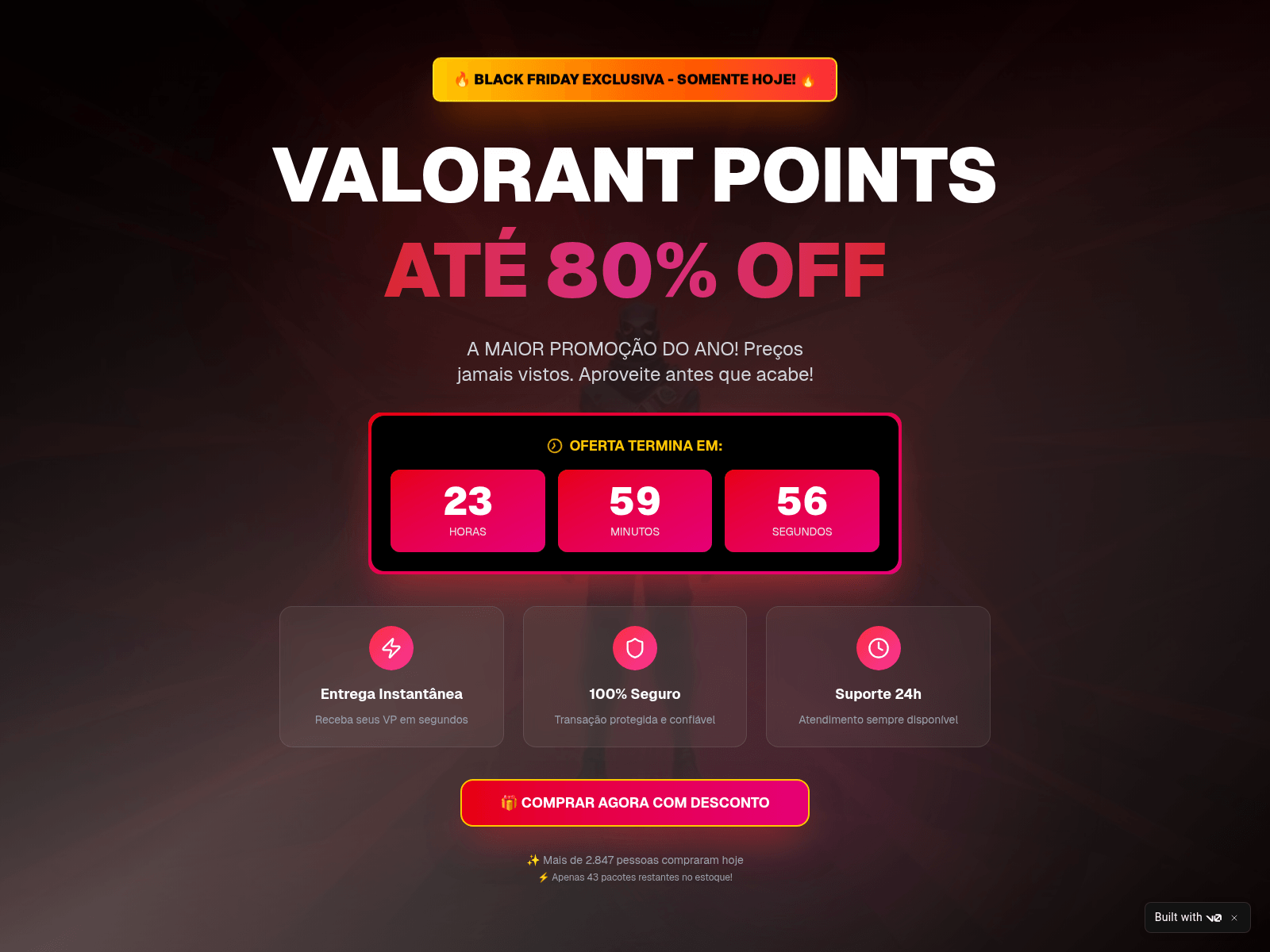
Example of Black Friday scam using a popular shooter as a lure
The page shown in the screenshot is a typical Black Friday-themed scam that targets gamers, designed to imitate an official Valorant promotion. The “Valorant Points up to 80% off” banner, polished layout, and fake countdown timer create urgency and make the offer appear credible at first glance. Users who proceed are redirected to a fake login form requesting Riot account credentials or bank card details. Once submitted, this information enables attackers to take over accounts, steal in-game assets, or carry out fraudulent transactions.
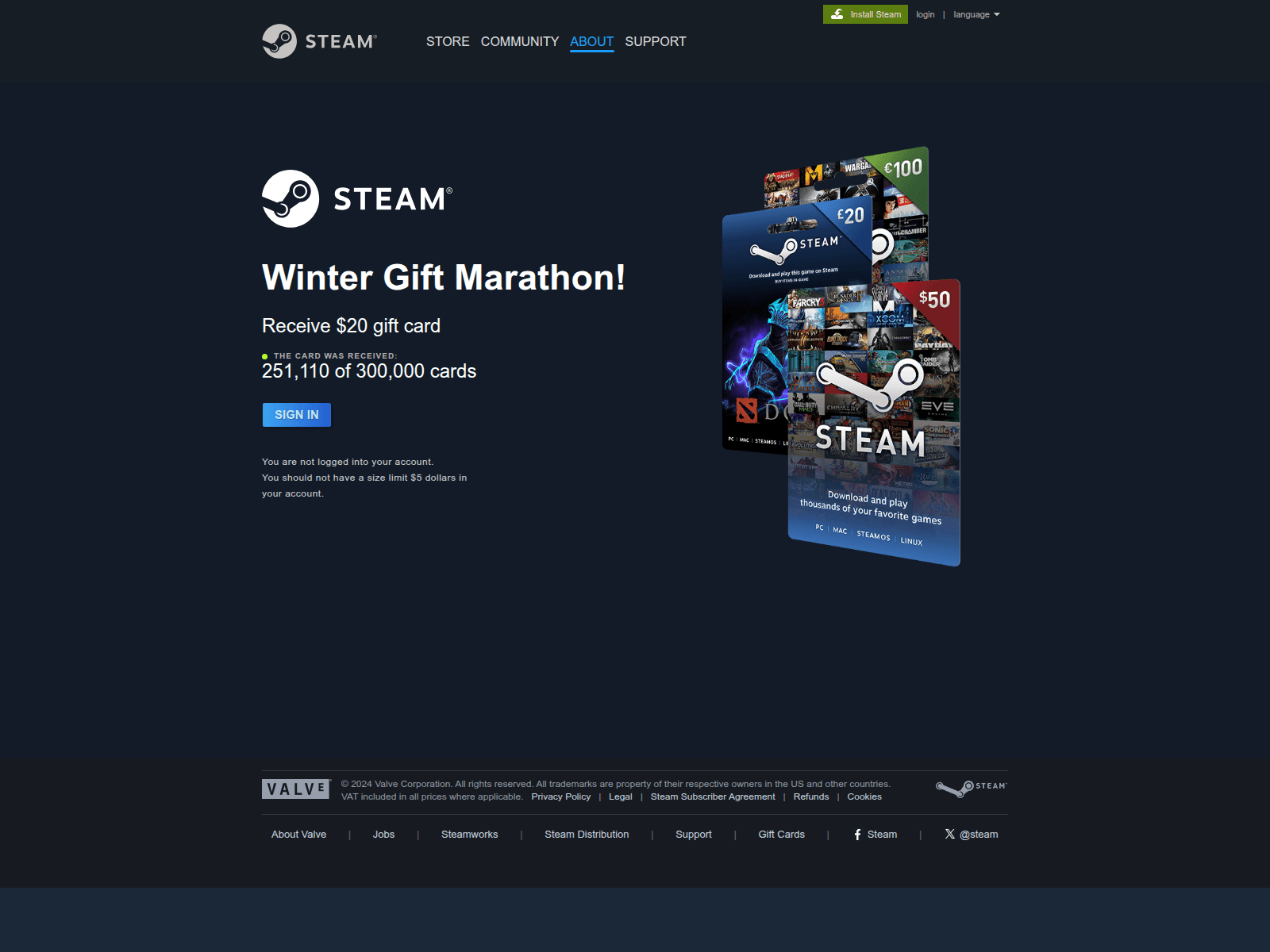
Minor text errors reveal the page’s fraudulent nature. The phrase “You should not have a size limit of 5$ dollars in your account” is grammatically incorrect and clearly suspicious.
Another phishing page relies on a fabricated “Winter Gift Marathon” that claims to offer a free $20 Steam gift card. The seasonal framing, combined with a misleading counter (“251,110 of 300,000 cards received”), creates an artificial sense of legitimacy and urgency intended to prompt quick user interaction.
The central component of the scheme is the “Sign in” button, which redirects users to a spoofed Steam login form designed to collect their credentials. Once obtained, attackers can gain full access to the account, including payment methods, inventory items, and marketplace assets, and may be able to compromise additional services if the same password is used elsewhere.
Examples of scams on Playstation 5 Pro and Xbox series X
Scams themed around the PlayStation 5 Pro and Xbox Series X appear to be generated from a phishing kit, a reusable template that scammers adapt for different brands. Despite referencing two consoles, both pages follow the same structure which features a bold claim offering a chance to “win” a high-value device, a large product image on the left, and a minimalistic form on the right requesting the user’s email address.
A yellow banner promotes an “exclusive offer” with “limited availability,” pressuring users to respond quickly. After submitting an email, victims are typically redirected to additional personal and payment data-collection forms. They also may later be targeted with follow-up phishing emails, spam, or malicious links.
Conclusions
In 2025, the ongoing expansion of global e-commerce continued to be reflected in the cyberthreat landscape, with phishing, scam activity, and financial malware targeting online shoppers worldwide. Peak sales periods once again created favorable conditions for fraud, resulting in sustained activity involving spoofed retailer pages, fraudulent email campaigns, and seasonal spam.
Threat actors also targeted users of digital entertainment and subscription services. The gaming sector experienced a marked increase in malicious activity, driven by shifts in platform accessibility and the widespread use of third-party tools. The significant rise in malicious detections associated with Discord underscored how rapidly attackers adjust to changes in user behavior.
Overall, 2025 demonstrated that cybercriminals continue to leverage predictable user behavior patterns and major sales events to maximize the impact of their operations. Consumers should remain especially vigilant during peak shopping periods and use stronger security practices, such as two-factor authentication, secure payment methods, and cautious browsing. A comprehensive security solution that blocks malware, detects phishing pages, and protects financial data can further reduce the risk of falling victim to online threats.
In the race to secure cloud infrastructure, intrusion prevention systems (IPS) remain one of the most critical yet complex at the cloud network layer of defense. For many organizations, deploying IPS in the cloud is a balancing act between agility and control.
Security is a central challenge in modern application development and maintenance, requiring not just traditional practices but also a deep understanding of application architecture and data flow. While organizations now have access to rich data like logs and telemetry, the real challenge lies in translating this information into actionable insights. This article explores how leveraging those insights can help detect genuine security incidents and prevent their recurrence.
Almost every day, my spouse and I have a conversation about spam. Not the canned meat, but the number of unwelcomed emails and text messages we receive. He gets several nefarious text messages a day, while I maybe get one a week. Phishing emails come in waves — right now, I’m getting daily warnings that my AV software license is about to expire. Blocking or filtering has limited success and, as often as not, flags wanted rather than unwanted messages.
Our ritual of comparing phishing attempts acts as informal security crowdsourcing. While most of these messages are clearly a poor attempt at social engineering, something realistic seeps in every so often.
So we talk about it. We review basic security practices. Just one wrong click could have a devastating impact on his work network.
We all know that phishing and malicious messages have been effective attack vectors since the earliest days of the internet, and yet users continue to fall victim. Spammers and threat actors know that recipients of these messages will continue to fall for their schemes.
What helps threat actors and hurts the rest of us is the inability to do anything to stop phishing attacks. It’s not just a matter of filtering something to go into the junk folder.
What will make a difference is the ability to take the information about malicious messaging and report it back to communication providers, network administrators and security teams so everyone can work together to eliminate threats.
Crowdsourcing Security is Common
Using crowdsourcing as a way to prevent phishing attacks builds on other popular crowdsourced security methods. Large tech companies have used bug bounties for years, with monetary rewards offered to users who find vulnerabilities in their systems.
The more people who look for something, the greater their chance of finding it. This is the theory that crowdsourcing is based on. Some organizations see crowdsourcing as ongoing penetration testing, and if the rewards are high enough, users will continue to be watchful for potential bugs in the system.
But as we’ve seen repeatedly, what works for security works for the bad guys as well. Threat actors also use crowdsourcing for cyber crime.
“Cyber crime is just crowdsourced security but without any of the ethical elements. The reward structure mimics the way that cyber crime operates more closely than traditional security testing methods,” explained a blog post from Detectify.
Crowdsourcing Phishing Shows Promise
A study conducted by ETH Zurich found that the exercises used to train users to recognize phishing attempts have the opposite effect — rather than becoming resilient, users become more susceptible to falling for nefarious messaging. What does work, the research found, was crowdsourcing through collective phishing detection.
“Such crowdsourcing allows fast detection of new phishing campaigns, the operational load for the organization is acceptable and the employees remain active over long periods of time,” the report stated.
When a “Report Phishing” button was added to an email platform, the study found that users would report suspicious emails within five to 30 minutes of receipt. Users were fairly accurate in detecting a potentially dangerous email: they were right 68% of the time for a phishing attack and 79% when spam was included.
Even better, there appears to be no reporting fatigue for users and little burden to organizations adopting a crowdsourcing system. The quick response from the users means that security teams can address the threat quickly.
The Bigger Picture of Crowdsourcing Security
Crowdsourcing goes beyond internal security. The ultimate goal is to leverage information from individual users to detect and prevent phishing attacks on millions of users within a network.
For example, with the release of iOS 16, users have the ability to report spam sent through iMessage directly to Apple. This won’t prevent the sender from sending messages, but the user’s device will block further messages once reported. It’s an option that has been available on Android devices for a while.
MSSPs and security vendors are using tools and applications that share phishing information across their network of clients. When one user or company reports a suspected phishing message through the tool, this information can benefit investigations of similar attacks against other organizations and stop potential threats.
The federal government also encourages crowdsourcing phishing information. On the Federal Trade Commission’s phishing information page, users can take a quiz to test their knowledge of phishing attacks and are urged to forward phishing emails to the Anti-Phishing Working Group (APWG) at reportphishing@apwg.org. APWG analyzes this data to build phishing activity trend reports. Organizations can see the type of impacts phishing attacks have — what industries are seeing the most attacks, how the attacks are happening and the type of malware (mostly ransomware) affecting networks — and then use the information to offer the best security plan for their needs.
Crowdsourcing Security Helps Keep Your Organization Safe
Sharing data surrounding phishing attacks and other types of malicious messaging allows organizations to develop more effective cybersecurity defense systems and increases overall security awareness. As the ETH Zurich study showed, traditional methods of phishing awareness training have been found wanting. Actively engaging employees to not only know how to spot phishing attacks but also to properly report them will increase their own sense of ownership in the organization’s security posture. Once more invested, they are more likely to use better security practices more consistently. In the long run, this helps organizations reduce costs related to cyber risks.
When done right, crowdsourcing security is an effective cybersecurity tool, especially for phishing and malicious messaging attacks.
As reported in the IBM X-Force Threat Intelligence Index 2020, X-Force research teams operate a network of globally distributed spam honeypots, collecting and analyzing billions of unsolicited email items every year. Analysis of data from our spam traps reveals trending tactics that attackers are utilizing in malicious emails, specifically, that threat actors are continuing to target organizations through the exploitation of older Microsoft Word vulnerabilities (CVE-2017-0199 and CVE-2017-11882).
CVE-2017-0199 was first disclosed and patched in April 2017. It allows an attacker to download and execute a Visual Basic Script containing PowerShell commands after the victim opens a malicious document containing an embedded exploit. Unlike many other Microsoft Word and WordPad exploits, the victim does not need to enable macros or accept any prompts — the document just loads and executes a malicious file of the attacker’s choosing.
CVE-2017-11882 was first disclosed and patched in November 2017. This vulnerability involves a stack buffer overflow in the Microsoft Equation Editor component of Microsoft Office that allows for remote code execution. Interestingly, the vulnerable component was 17 years old (compiled in 2000) at the time of exploitation and unchanged since its removal in 2018.
These vulnerabilities, which were reported and subsequently issued patches in 2017, are the most frequently used of the top eight vulnerabilities observed in 2019. They were used in nearly 90 percent of malspam messages despite being well-publicized and dated. These findings highlight how delays in patching allow cybercriminals to continue to use old vulnerabilities and still see some success in their attacks.
2 Years and Still Going Strong
In addition to these vulnerabilities’ popularity in malspam, the volume of 2019 network attacks that targeted X-Force-monitored customers while attempting to exploit them was 25 times higher than the combined number of network attacks attempting to exploit similar vulnerabilities that leverage Object Linking and Embedding (OLE).
Our analysts did not observe a commonality regarding the malicious payloads used post-exploitation, which means that using these vulnerabilities is the choice of a wide array of threat actors and not specific to a small number of campaigns or adversarial groups.
Figure 1: Observed usage of top CVEs in 2019 spam emails (Source: IBM X-Force)
Another noteworthy insight from the figure above is that most vulnerabilities commonly used by cybercriminals are older ones. None of the vulnerabilities leveraged in 2019 were disclosed last year and only one was disclosed in 2018. The rest go back as far as 2003, further driving home the point that when it comes to malicious cyber activity, what’s old is new and what’s new is old.
The Allure of Older Vulnerabilities
Why would a wide array of threat actors use the same two old and well-known exploits in so many of their attacks? There are a few possible explanations, but the essence of it is they are cheaper, better documented, battle-tested and more likely to lead to legacy systems that are no longer being patched.
First, the exploits are very convenient for an attacker to use in that they don’t require user interaction. Unlike more recent Word vulnerabilities, which require the attacker to convince the user to enable macros, the exploits for these particular vulnerabilities automatically execute when the document is opened. This can help reduce the chance of arousing user suspicions and, accordingly, increase the rate of success.
Second, since so many different actors use these vulnerabilities, it can complicate attribution, as their widespread usage makes associating them with any particular individual or group difficult.
For example, IBM researchers recently observed threat actors leveraging these CVEs and using a variant of the X-Agent malware, which was historically associated with a threat actor known to IBM as ITG05 (also known as APT28). That threat group has been attributed to Russia’s Main Intelligence Directorate. But while they were being used by highly sophisticated threat actors, these vulnerabilities were also leveraged by low-end spammers dropping commodity malware through massive email campaigns.
The reuse of common exploits is a convenient way to muddy threat actor attribution, especially for groups that wish to remain anonymous in their operations. It can allow threat actors to hide among a large volume of activity, obfuscating their actions.
The third and perhaps most likely reason for the continued use of these vulnerabilities is the simple ease and convenience of generating documents that can exploit them. Because these types of documents are essential to the day-to-day operations of many target organizations, they are often not blocked by enterprise email filters. As a final bonus to threat actors, they are also some of the cheapest exploits cybercriminals can buy.
X-Force’s dark web research of underground forums highlights multiple offerings of free document builders that leverage each of these vulnerabilities. Our team also identified free YouTube videos focused on each vulnerability, illustrating how an attacker can generate a document to exploit these issues.
Figure 2: YouTube videos detailing how to generate documents exploiting CVEs 2017-0199, 2017-11882 (Source: IBM X-Force)
One should keep in mind that successful exploitation of older vulnerabilities is more likely to happen on older, unpatched operating systems (OSs) and legacy systems where OS end-of-life means that no new patches are even available. These kinds of systems are most likely used by organizations that can’t patch due to other issues or priorities. While there are many reasons that can contribute to the decision to defer patching, that decision is never a good one in the long run.
What Can Companies Do With This Sort of Information?
Older vulnerabilities are clearly not going away any time soon, so organizations need to be prepared to defend against their attempted exploitation. IBM X-Force Incident Response and Intelligence Services (IRIS) has the following tips for organizations to better protect themselves:
Asset management is an ongoing process that should be top of mind for risk management. Part of this process is continually assessing risk to critical systems and considering the consequences of not patching them. Reassess the risks and consider patching and updating operating systems as soon as possible. Reality check: Windows 7’s end-of-life took place on January 14, 2020. Is your organization ready to move to an updated OS?
Monitor the organization’s environment for PowerShell callouts that may be attempting to download and execute malicious payloads.
Continue user education on the risks of opening attachments from unknown sources, as vulnerabilities like these do not require any user interaction beyond opening to cause harm.
Scope and engage in a vulnerability management program to determine if older vulnerabilities are exposing your environment to exploitation by an attacker.

 Login
Login