Reading view

There are new articles available, click to refresh the page.

Michigan man learns the hard way that “catch a cheater” spyware apps aren’t legal

In 2002, Bryan Fleming helped to create pcTattletale, software for monitoring phone and computer usage. Fleming's tool would record everything done on the target device, and the videos would be uploaded to a server where they could be viewed by the pcTattletale subscriber.

This might sound creepy, but it can also be legal when used by a parent monitoring their child or an employer monitoring their workers. These are exactly the use cases that were once outlined on pcTattletale's website, where the software was said to have "helped tens of thousands of parents stop their daughters from meeting up with pedophiles." Businesses could "track productivity, theft, lost hours, and more." Even "police departments use it for investigating."

But this week, nearly 25 years after launching pcTattletale, Fleming pled guilty in federal court to having knowingly built and marketed software to spy on other adults without their consent. In other words, pcTattletale was often used to spy on romantic partners without their knowledge—and Fleming helped people do it.

Read full article

Comments

© Getty Images

Did DOJ Prosecutors Violate Trump’s Executive Order by Selling the Forfeited Samourai Wallet Bitcoin?

Bitcoin Magazine

Did DOJ Prosecutors Violate Trump’s Executive Order by Selling the Forfeited Samourai Wallet Bitcoin?

It seems that the U.S. Marshall Service (USMS) has sold the $6.3 million worth of bitcoin that Samourai Wallet developers Keonne Rodriguez and William Lonergan Hill paid the U.S. Department of Justice (DOJ) as a fee that was part of their guilty plea.

In doing so, it has potentially violated Executive Order (EO) 14233, which mandates that bitcoin acquired via criminal or civil asset forfeiture proceedings should be held as part of the United States’ Strategy Bitcoin Reserve (SBR).

If the Southern District of New York (SDNY), the federal judicial district in which the Samourai case was to be tried, did, in fact, violate EO 14233, it would not be the first time employees of the SDNY have acted in defiance of direction from the federal government.

What Happened to the Bitcoin?

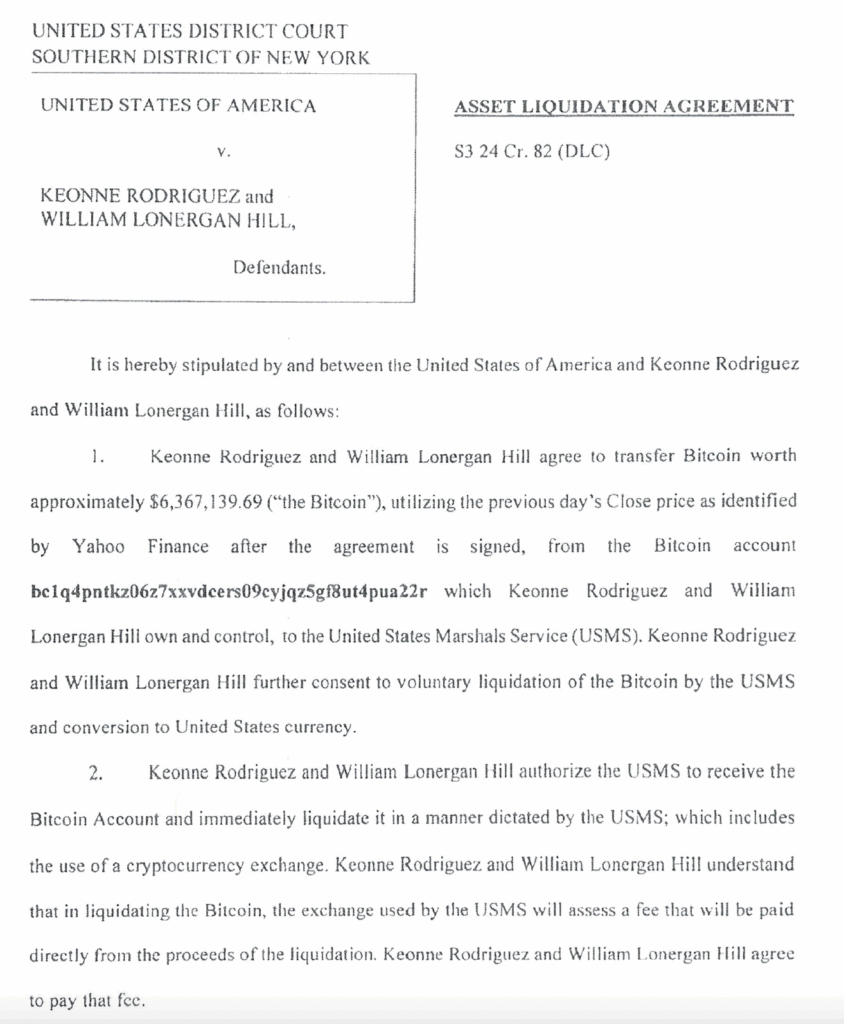
According to a document titled “Asset Liquidation Agreement”, which has been obtained exclusively by Bitcoin Magazine and has not until now been made public, the bitcoin that Rodriguez and Hill forfeited is to be sold — or already has been.

As per the document, the defendants agreed to transfer $6,367,139.69 worth of bitcoin — 57.55353033 bitcoin at the time the final party signed the agreement, which was Assistant United States Attorney Cecilia Vogelon November 3, 2025 — to the USMS.

The bitcoin, which was sent from address bc1q4pntkz06z7xxvdcers09cyjqz5gf8ut4pua22r on November 3, 2025, seems to have bypassed any direct custody by the USMS. Instead, it seems to have been sent directly to Coinbase Prime address 3Lz5ULL7nG7vv6nwc8kNnbjDmSnawKS3n8 (Arkham Intel attributes this address to the brokerage), presumably to be sold.

This Coinbase Prime address currently has a zero balance, indicating that the bitcoin may have already been sold.

Violating Executive Order 14233

If the USMS has sold the forfeited bitcoin, it likely contravened EO 14233, which orders that bitcoin acquired by the U.S. government via criminal forfeiture, termed “Government BTC” in the EO, “shall not be sold” and should be contributed into the U.S. SBR.

If the USMS sold the bitcoin, they did so at their own discretion and not as a legal mandate, which indicates that certain members of the DOJ may still view bitcoin as a taboo asset to be offloaded as opposed to a strategic asset that President Trump has directed government agencies to retain.

Given that the Samourai prosecution originated under the previous administration, which was notoriously hostile toward noncustodial crypto tools and their developers, the decision to ignore EO 14233 and sell the bitcoin despite a mandate from the executive branch fits a pattern of treating bitcoin as something that should be removed from government balance sheets as soon as possible.

Legal Details Regarding the Forfeiture and Liquidation

According to a legal source close to this matter, the Samourai developers’ forfeited their bitcoin under 18 U.S. Code § 982(a)(1), which stipulates that any offense that violates 18 U.S. Code § 1960, the statute that prohibits the operation of unlicensed money transmitting businesses, orders that person to forfeit to the United States any property involved in the offense.

Judging by § 982 and its incorporation of 21 U.S.C. § 853(c), a criminal forfeiture statute that stipulates that “property that is subsequently transferred to a person other than the defendant may be the subject of a special verdict of forfeiture and thereafter shall be ordered forfeited to the United States,” the bitcoin that Rodriguez and Hill forfeited fits the EO’s definition of “Government BTC”.

Neither § 982 nor the incorporated § 853 requires that property that is forfeited as part of a criminal offense be liquidated. Furthermore, the fund forfeiture statutes cited in section three of the EO — 31 U.S.C. § 9705 and 28 U.S.C. § 524(c) — regulate where forfeiture proceeds are deposited and how they may be used; they do not require that forfeited bitcoin be converted to cash rather than held in kind.

The EO also stipulates that “Government BTC” falls under the umbrella of “Government Digital Assets” and states that “the head of each agency shall not sell or otherwise dispose of any Government Digital Assets” except in certain scenarios, none of which apply in the Rodriguez or Hill cases and, in all of which, the U.S. attorney general would play a role in determining what should be done with the forfeited digital assets.

The Sovereign District of New York

When taking EO 14233 and the statutes cited in this article into account, the SDNY seems to have acted in a manner that defies the EO 14233’s mandate to transfer bitcoin obtained via criminal forfeiture to the U.S. SBR.

This would not mark the first time that the SDNY has acted in such a manner. 

The judicial jurisdiction, sometimes colloquially referred to as “Sovereign District of New York,” has earned a reputation for operating independently and unilaterally, despite being part of a federal system.

The fact that the SDNY proceeded with the cases against Rodriguez and Hill as well as the case against Tornado Cash developer Roman Storm, is further evidence of this.

On April 7, 2025, Deputy Attorney General Todd Blanche issued a memo entitled “Ending Regulation By Prosecution” in which he stated “the Department [of Justice] will no longer target virtual currency exchanges, mixing and tumbling services, and offline wallets for the acts of their end users…”

The SDNY seemed to disregard the language in this memo, though, as it proceeded with the Samourai Wallet or Tornado Cash cases.

And when the defense team for Hill and Rodrguez learned as per a Brady request that two high-ranking members of the U.S. Department of the Treasury’s Financial Crimes Enforcement Network (FinCEN) “strongly suggested” that Samourai Wallet wasn’t serving as a money transmitter due to the noncustodial nature of the service, the prosecution proceeded anyway.

When it comes to criminal cases tried within the federal court system, over 90% of defendants are convicted and sentenced, with as little as 0.4% being acquitted some years. And the prosecution for SDNY cases has a reputation for having an even higher win rate.

Rodriguez was aware of these statistics, as well as the fact that Judge Denise Cote, the judge who presided over his and Hill’s cases, has a reputation for harsh sentencing.

He told me as much the morning before he pleaded guilty to the conspiracy to operate an unlicensed money transmitter business charge.

Is the War on Crypto Really Over?

Many Bitcoin and crypto proponents who voted for President Trump in 2024 as well as the crypto industry, which supported the president in his reelection, are now beginning to question whether or not President Trump really does want to see an end to the war on crypto.

For this to happen, the DOJ under President Trump must honor what is mandated in EO 14233 and follow Deputy Attorney General Blanche’s guidance to stop prosecuting developers of noncustodial crypto technology.

To the latter point, President Trump recently stated that he is considering a pardon for Rodriguez.

His pardoning Rodriguez as well having the DOJ look into why it sold the bitcoin that the Samourai developers forfeited would send a signal that the president is quite serious about his pro-Bitcoin and pro-crypto stance.

This post Did DOJ Prosecutors Violate Trump’s Executive Order by Selling the Forfeited Samourai Wallet Bitcoin? first appeared on Bitcoin Magazine and is written by Frank Corva.

Trump Weighs Executive Order to Advance Cannabis Rescheduling

President Donald Trump is weighing an executive order that would push the federal government to reclassify cannabis, a step that could mark the most significant shift in U.S. cannabis policy in decades—even as the White House cautions that no final decision has been made.

The deliberations, first reported late Thursday by The Washington Post, center on moving marijuana from Schedule I—the government’s most restrictive category, reserved for drugs deemed to have no accepted medical use—to Schedule III, a classification that would acknowledge medical value and loosen some federal controls. 

“This is an encouraging development and a strong indicator that comprehensive legalization is no longer a distant goal,” says Sorse Tech CEO Howard Lee.

The Post reported Trump discussed the potential policy change in a call that included House Speaker Mike Johnson and cannabis industry executives, alongside senior administration officials. Johnson voiced skepticism, the report said, while industry participants pressed the case that rescheduling would reduce barriers to research and help normalize a legal market that now operates in tension with federal law. 

In response to the news, Sasha Nutgent, VP of cannabis retail for Housing Works Cannabis Co. out of New York, tells Cannabis Now that with today’s current cannabis classification, “retailers are not incentivized to operate legally. Reclassification would change that for thousands of businesses, especially those owned by folks from communities most impacted by the War on Drugs.”

Industry and Markets Brace for Potential Policy Change

News of the possible executive order rippled quickly through financial markets early this morning. Cannabis-related stocks and exchange-traded funds jumped in premarket trading after the Post report, according to Reuters, reflecting investor optimism that a federal shift could ease access to capital and reduce tax burdens that have long squeezed state-legal operators. 

Rescheduling, however, would not legalize marijuana nationwide. Even supporters describe it as a narrower, technical move with broad downstream effects—especially for research, medical access and business operations—rather than a sweeping rewrite of prohibition-era policy. 

Gennaro Luce, founder and CEO at CannaLnx, powered by EM2P2, argues that “Rescheduling is an important and overdue shift for patient-centric healthcare, but the move to Schedule III alone isn’t enough to make medical cannabis more accessible or affordable.”

Luce says insurers still need verification, compliance and eligibility frameworks before they can treat medical cannabis like a real benefit. “That part of the system is still missing from the national conversation — fortunately, it’s the medical-cannabis system piece we’ve already built and tested alongside physicians, patients, dispensaries, POS systems and insurers.”

Legal Nuances Stall Progress

President Trump’s considerations land on well-trodden terrain. The modern push to reconsider cannabis’ federal classification accelerated under President Joe Biden, whose administration initiated a review that produced a recommendation from the Department of Health and Human Services to move cannabis to Schedule III. The Justice Department formally began the rescheduling process in 2024, opening the door to rulemaking that has since faced delays and political crosscurrents. 

Policy experts say an executive order can direct agencies and set priorities, but it cannot, by itself, rewrite the Controlled Substances Act. Any durable change to cannabis scheduling ultimately runs through federal administrative procedures led by the Justice Department and the Drug Enforcement Administration, including scientific findings, legal analysis and formal rulemaking steps. That legal nuance has become familiar to cannabis readers—and to anyone who has watched the issue ricochet between campaign promises and bureaucratic reality.

In past coverage of cannabis executive action, Cannabis Now has emphasized that the “stroke of a pen” theory often collides with the limits of federal authority, even when presidents or governors have wide latitude to shape enforcement priorities and regulatory posture. Still, the political stakes are unmistakable. A Trump-backed push to reschedule could scramble the usual partisan map on cannabis, where national Democrats have often positioned themselves as the party of reform while Republicans have been divided between states’-rights advocates and prohibition-aligned lawmakers.

The Post report suggested Trump views rescheduling as a way to “cut restrictions” without endorsing full legalization—a framing that could appeal to voters who support medical access and regulated markets but remain cautious about broader social change. 

For the cannabis industry, the practical implications of Schedule III are potentially enormous—but also uneven. Operators have argued that rescheduling could reduce certain federal tax penalties and make it easier for institutions to do business with cannabis companies.

Ryan Hunter, chief revenue officer for Colorado-based Spherex, a leader in cannabis extraction and purification, offers perspective: “Cannabis is still federally illegal—but even as a federally illegal substance, the move to Schedule III dramatically reduces the federal tax burden for operators. Under IRS code 280E, handling Schedule I or Schedule II substances eliminates the ability for operators to deduct standard operating expenses that most other businesses deduct from their federal taxes. As a result of 280E, cannabis operators’ effective tax rate may be as high as 80 pecent. Beyond this significant improvement, the implications are unclear, but we’re hopeful that this move will allow for cannabis operators to garner the same investment opportunities other industries will enjoy.”

Rescheduling’s Promise and Uncertainty

Analysts told Reuters that shifting cannabis to Schedule III could also accelerate pharmaceutical research and distribution models, even as state-legal markets continue to rely on a patchwork of rules that vary widely from one jurisdiction to another. Critics, including some in Congress, argue rescheduling risks moving faster than the science. The Post reported Johnson referenced studies he said cut against reclassification, reflecting a broader debate over how to weigh evidence of therapeutic benefits against risks of misuse and dependency. 

What happens next could hinge on timing and follow-through. An executive order, if issued, would likely instruct cabinet agencies to prioritize or expedite the administrative process rather than instantly change marijuana’s legal status. Even then, opponents could challenge the move politically and in court, while regulators would still need to align policy with existing federal statutes and international commitments.

“Whenever the White House moves forward with Schedule III, the federal government is effectively telling us that cannabis is medicine,” comments Calyx Containers President and Co-Founder Alex Gonzalez. “And if it’s medicine, ‘good enough’ cannabis practices won’t cut it anymore. Whether rescheduling happens next month or next year, the direction is clear: Cannabis is moving toward pharma-grade standards. For brands, that means tightening quality systems, investing in the ability to react or scale, and preparing for a regulatory-ready supply chain. We’re seeing the smart operators onshoring infrastructure, and we’re positioning our domestic production and business model on being ready to help operators turn this moment into a competitive advantage.”

In the meantime, the national reality on cannabis continues to diverge from federal law. Most states now allow marijuana for medical use, and a growing number permit adult-use sales—a shift that has normalized cannabis commerce for millions of Americans while leaving businesses and consumers navigating legal gray zones that are invisible at the dispensary counter but very real at banks, research institutions and federal agencies.

“Rescheduling is the single most important drug policy move in decades. The potential opportunities for medical and scientific research will significantly increase, while those living in states without an existing medical program will now have access to the powerful healing properties of the plant,” says Mark Lewis, president of specialty banking at Lüt.

“Make no mistake though, rescheduling is just the beginning for those working in the cannabis industry. Until the SAFE Banking Act or 280E is passed, operators will still have to jump through challenging financial hoops to pay their staff, bills or garner investment. The moment is historic, but until cannabis businesses can operate fiscally with the same ease as any other business, more work needs to be done,” Lewis continued. “Payments still need to work in the reality of today, where the ongoing threat of card network shutdowns exists, not just the promise of future reform. While rescheduling may open doors over time, it does not remove the day-to-day financial friction that cannabis operators face right now.”

Whether Trump ultimately signs an order or backs away, the past 24 hours have underscored a core truth of cannabis politics in Washington: Even incremental change can move markets, reshape messaging and reopen debates that Congress has struggled for years to settle.

The post Trump Weighs Executive Order to Advance Cannabis Rescheduling appeared first on Cannabis Now.

Pardoning the Samourai Developers Would Restore Legal Clarity and Protect Non-Custodial Code

Bitcoin Magazine

Pardoning the Samourai Developers Would Restore Legal Clarity and Protect Non-Custodial Code

The Samourai Wallet matter raises a fundamental question about how the United States treats non-custodial software and the developers who create it. Keonne Rodriguez and William Lonergan Hill did not operate a financial service or handle customer assets. They wrote and maintained software that allowed users to construct collaborative Bitcoin transactions in a privacy-preserving way. Throughout the tool’s entire lifecycle, users controlled their own keys, initiated their own transactions, and never relied on Samourai or its developers to transmit or safeguard value. The distinction between a custodial service and a non-custodial tool is not a technicality; it is the core boundary that the Bank Secrecy Act, FinCEN guidance, and decades of regulatory practice use to distinguish software authors from regulated financial intermediaries.

This point was reinforced by FinCEN itself. In an internal analysis, the agency concluded that Samourai’s architecture did not constitute money transmission because no third party took possession or control of user funds. That conclusion was never disclosed to the defense while the prosecution advanced a theory that required the opposite: that building software which users employ for privacy is functionally equivalent to operating a financial institution. When that analysis finally surfaced, it confirmed what has long been understood across the industry and within the regulatory community—that non-custodial tools fall outside the BSA’s money-transmitter framework because there is no transfer of value by a third party. The case ultimately treated the developers as if they were responsible for the independent actions of users, even though they had no role in executing, intermediating, or approving any transaction. Some individuals did misuse the tool, as happens with any privacy or security technology, but the law has never equated misuse with liability for the creators. We do not treat the authors of encryption libraries, VPN protocols, or email clients as participants in unlawful activity simply because bad actors rely on those tools. Collapsing the distinction between developing a tool and operating a service would introduce an untenable level of risk for anyone building privacy-enhancing or security-critical software.

There is also an important speech component. Courts have consistently recognized that code is expressive, and publishing open-source software is an act of communication. When publication is treated as evidence of “operation,” the legal boundary between authorship and conduct becomes blurred in a way that threatens a wide range of legitimate technologies. Any precedent suggesting that developers are responsible for unforeseeable downstream use would have immediate consequences for cryptography, cybersecurity research, and open-source work more broadly.

Rodriguez and Hill ultimately accepted plea agreements in the face of substantial sentencing exposure, even though government records undermined the central regulatory theory of the case. Their convictions now rest on a framework that is at odds with established guidance and with the direction in which federal policy has since moved. A pardon would bring the legal outcome back into alignment with the underlying facts: this was software development, not money transmission, and the individuals involved should not bear criminal liability for writing code that users executed independently.

This case has already had a measurable chilling effect on developers working on privacy and security tools in the United States. Leaving the convictions in place would discourage responsible innovation and push critical work to jurisdictions that do not share our commitment to open research and transparent development. A pardon would correct a clear misapplication of federal law, protect the integrity of long-standing distinctions in financial regulation, and reaffirm that publishing non-custodial software is not—and should not become—a criminal act.

Disclaimer – This is a guest contribution by Zack Shapiro, originally published by the Bitcoin Policy Institute (BPI). The views and opinions expressed are solely those of the author and do not necessarily reflect the views of BTC Inc or Bitcoin Magazine.

This post Pardoning the Samourai Developers Would Restore Legal Clarity and Protect Non-Custodial Code first appeared on Bitcoin Magazine and is written by Zack Shapiro.

Longtime legal leader Pallavi Wahi on leading Arnold & Porter’s new office and navigating the AI moment

Pallavi Mehta Wahi. (Arnold & Porter Photo)

Pallavi Wahi‘s latest career move is both a professional leap and a personal bookend.

Wahi, a veteran lawyer and business community leader, came to Seattle 25 years ago as an immigrant with no local network. She built a career and civic presence, and is now helping bring a nationally prominent firm deeper into the city’s legal and innovation ecosystem.

Wahi recently joined Arnold & Porter to launch its Seattle office and lead strategic growth on the West Coast, following a long tenure at K&L Gates, where she was a managing partner.

Arnold & Porter signed a lease in downtown’s U.S. Bank Center and wants to add at least 60 lawyers in Seattle within two years. Planting a flag in the Pacific Northwest is squarely aimed at the region’s innovation economy — and the rising regulatory complexity around it.

“Arnold and Porter has a very deep regulatory bench, and that is really what makes them so much of a differentiator in the market,” Wahi said. The firm’s specialties span healthcare, technology, manufacturing, cross-border trade, FDA and antitrust work — areas where she said corporate clients increasingly need strategic and practical guidance as rules evolve.

The view on AI

Arnold & Porter says it’s using generative AI for document review, legal research, collaboration, litigation prep, transactional diligence, and regulatory review. The firm uses tools such as Microsoft Copilot, Anthropic Claude Enterprise, and ChatGPT Enterprise alongside in-house models.

Wahi described the firm as “very open to accepting and moving forward with new technology,” including pilots that use AI tools to support client work.

But she also draws a clear boundary for the legal profession: while AI can help lawyers, it can’t replace them.

“We have to be careful that it doesn’t substitute for actual legal work,” Wahi said. “You should not be filing briefs or doing anything which is generated by AI. You are the author — and the minute you forget that … is when trouble comes.”

Bullish on Seattle

The city, Wahi said, has become more welcoming, entrepreneurial and dynamic over the past quarter-century, and remains “an incredible incubator of change.”

“There’s an energy here,” Wahi said. “There’s a fabric of electricity.”

She added: “This city makes you bigger than you are. I truly believe that the reason for the success of many in this city is because of Seattle.”

Wahi has spent much of her legal career arguing cases and advising companies. Her other job has been to push Seattle’s business community to look beyond its own walls. She has done so by example, plugging into the boards of the Seattle Chamber, the Federal Reserve Bank, the Woodland Park Zoo, Seattle Rep, the King County Bar Foundation and more. She even participated in a dance competition to raise money for Plymouth Housing.

Her message to other leaders in Seattle is straightforward: participation matters.

“As a lawyer, I do believe I have a role to be a community leader, to really try and show up in ways that can help,” she said. “We need to show up for more than doing our jobs. We need to show up for each other in ways that make sense to ourselves.”

Continued Activism Is Vital for the Future of Global Cannabis

Several jurisdictions around the world now permit some level of legal cannabis activity by consumers, patients and, in some cases, entrepreneurs. In places where cannabis is legal for medical or adult use, there has never been a better time to be a cannabis patient or consumer since the dawn of cannabis prohibition. Those freedoms did not come about randomly. They were only achieved thanks to the tireless efforts of local cannabis activists, and it is important that, as the global cannabis industry continues to spread, activism efforts continue.

While it is hard to pinpoint the first official cannabis activism effort, it is a safe bet that many such efforts began immediately and simultaneously after jurisdictions around the world enacted prohibition. Cannabis prohibition has been a harmful public policy since the very beginning, and sensible people with compassion and empathy have pushed back against it in various ways.

The First Major Cannabis Reform Victory

The first major cannabis reform victory occurred in 1973 in the State of Oregon when lawmakers approved a cannabis decriminalization measure. For the first time in nearly four decades in the United States, consumers no longer faced jail time for possessing a personal amount of cannabis (one ounce) in Oregon. Instead, they were fined and faced no criminal charges.

Another major cannabis reform victory occurred in 1996 in California when the state’s voters approved Proposition 215, making California the first state in the U.S. to legalize medical cannabis. Suffering patients in California were finally able to gain safe access to their medicine without fear of any penalty. The Proposition 215 victory ushered in a new era for state-level medical cannabis legalization in the U.S., and by extension, inspired countries around the world to enact medical cannabis policy modernizations of their own.

The next frontier for cannabis policy modernization came in 2012, when Colorado and Washington State both adopted adult-use cannabis legalization measures on Election Day. The following year, Uruguay made history by becoming the first country to adopt a national adult-use cannabis legalization measure.

Cannabis Wins of Today

Zoom forward to today, and several countries have adopted national recreational cannabis legalization measures. Canada, Malta, Luxembourg, Germany, South Africa, and the Czech Republic have all joined Uruguay in adopting such measures, with Czechia’s law scheduled to take effect on January 1, 2026. All of the victories that have piled up came about as a result of the work of passionate cannabis advocates.

The collective cannabis community mustn’t get complacent and make the mistake of taking newly afforded freedoms for granted. Just because medical and adult-use policy modernization victories have been achieved does not mean that there is no chance of policy regressions. One needs to look no further than Thailand to find a real-world example of this phenomenon occurring.

Lawmakers in Thailand approved a historic cannabis measure in 2022 that yielded exponential growth for the nation’s emerging cannabis industry. Thailand’s Narcotics Law was amended in 2022, resulting in cannabis being removed from the nation’s list of controlled drugs. That led to the country becoming one of the top cannabis tourism destinations on the planet.

Some Cannabis Laws Regressing

Unfortunately, the Pheu Thai party eventually won control of the nation’s government and tightened regulations earlier this year. The policy change banned retailers from selling cannabis to customers without a prescription and reclassified cannabis as a controlled substance. Ongoing efforts are underway to take cannabis laws and regulations backwards in other jurisdictions as well.

One of the most noteworthy examples is in Germany, where the Federal Cabinet recently approved a measure that would amend the Medical Cannabis Act (MedCanG). The measure was drafted by the Federal Ministry of Health (BMG), and if approved, would require personal contact between the patient and doctor before a cannabis prescription can be approved. Restrictions on mail-order medical cannabis are also part of the proposal. Both changes would negatively impact suffering patients, particularly patients who live in rural areas or have mobility limitations. The proposal is sure to be a top focus at the upcoming International Cannabis Business Conference in Berlin on April on April 13-15, 2026.

Even in the United States, where two dozen states have adopted adult-use cannabis legalization measures, efforts are in full swing to reverse state-level legalization provisions. For example, in Ohio, the House of Representatives recently approved a measure that, while not a full legalization reversal, would revise the state’s legalization law to remove certain protections of adult-use cannabis activity. Cannabis opponents are waging a citizen initiative in Massachusetts that seeks to drastically roll back that state’s legalization model as well.

The Battle Presses On

These are just a few examples of efforts by cannabis opponents to reverse the progress that cannabis advocates have made in recent years. All such efforts serve as reminders that the battle is never over when it comes to cannabis reform, and cannabis patients, consumers, and advocates need to refrain from getting too comfortable. Always keep fighting for sensible cannabis policies. The future of cannabis depends on it.

The post Continued Activism Is Vital for the Future of Global Cannabis appeared first on Cannabis Now.

❌